Chapter: Chapter 38
Learning Objectives
LO 38.1.0 Solve problems related to the photon, the quantum of light.
LO 38.1.1 Explain the absorption and emission of light in terms of quantized energy and
photons.
LO 38.1.2 For photon absorption and emission, apply the relationships between energy, power,
intensity, rate of photons, the Planck constant, the associated frequency, and the associated
wavelength.
LO 38.2.0 Solve problems related to the photoelectric effect.
LO 38.2.1 Make a simple and basic sketch of a photoelectric experiment, showing the incident
light, the metal plate, the emitted electrons (photoelectrons), and the collector cup.
LO 38.2.2 Explain the problems physicists had with the photoelectric effect prior to Einstein and
the historical importance of Einstein’s explanation of the effect.
LO 38.2.3 Identify a stopping potential Vstop and relate it to the maximum kinetic energy Kmax of
escaping photoelectrons.
LO 38.2.4 For a photoelectric setup, apply the relationships between the frequency and
wavelength of the incident light, the maximum kinetic energy Kmax of the photoelectrons, the
work function Φ, and the stopping potential Vstop.
LO 38.2.5 For a photoelectric setup, sketch a graph of the stopping potential Vstop versus the
frequency of the light, identifying the cutoff frequency f0 and relating the slope to the Planck
constant h and the elementary charge e.
LO 38.3.0 Solve problems related to photons, momentum, Compton scattering, light
interference.
LO 38.3.1 For a photon, apply the relationships between momentum, energy, frequency, and
wavelength.
LO 38.3.2 With sketches, describe the basics of a Compton scattering experiment.
LO 38.3.3 Identify the historic importance of Compton scattering.
LO 38.3.4 For an increase in the Compton-scattering angle Φ, identify whether these quantities
of the scattered x ray increase or decrease: kinetic energy, momentum, wavelength.
LO 38.3.5 For Compton scattering, describe how the conservations of momentum and kinetic
energy lead to the equation giving the wavelength shift Δλ.
LO 38.3.6 For Compton scattering, apply the relationships between the wavelengths of the
incident and scattered x rays, the wavelength shift Δλ, the angle Φ of photon scattering, and the
electron’s final energy and momentum (both magnitude and angle).
LO 38.3.7 In terms of photons, explain the double-slit experiment in the standard version, the
single photon version, and the single-photon, wide-angle version.
LO 38.4.0 Solve problems related to the birth of quantum physics.
LO 38.4.1 Identify an ideal blackbody radiator and its spectral radiancy S(λ).
LO 38.4.2 Identify the problem that physicists had with blackbody radiation prior to Planck’s
work, and explain how Planck and Einstein solved the problem
LO 38.4.3 Apply Planck’s radiation law for a given wavelength and temperature.
LO 38.4.4 For a narrow wavelength range and for a given wavelength and temperature, find
the intensity in blackbody radiation.
LO 38.4.5 Apply the relationship between intensity, power, and area.
LO 38.4.6 Apply Wien’s law to relate the surface temperature of an ideal black body radiator
to the wavelength at which the spectral radiancy is maximum.
LO 38.5.0 Solve problems related to electrons and matter waves.
LO 38.5.1 Identify that electrons (and protons and all other elementary particles) are matter
waves.
LO 38.5.2 For both relativistic and nonrelativistic particles, apply the relationships between the
deBroglie wavelength, momentum, speed, and kinetic energy.
LO 38.5.3 Describe the double-slit interference pattern obtained with particles such as electrons.
LO 38.5.4 Apply the two-slit equations (Module 35-2) and diffraction equations (Module 36-1)
to matter waves.
LO 38.6.0 Solve problems related to Schrӧdinger’s equation
LO 38.6.1 Identify that matter waves are described by Schrӧdinger’s equation.
LO 38.6.2 For a nonrelativistic particle moving along an x axis, write the Schrӧdinger equation
and its general solution for the spatial part of the wave function.
LO 38.6.3 For a nonrelativistic particle, apply the relationships between angular wave number,
energy, potential energy, kinetic energy, momentum, and de Broglie wavelength.
LO 38.6.4 Given the spatial solution to the Schrӧdinger equation, write the full solution by
including the time dependence.
LO 38.6.5 Given a complex number, find the complex conjugate.
LO 38.6.6 Given a wave function, calculate the probability density.
LO 38.7.0 Solve problems related to Heisenberg’s uncertainty principle
LO 38.7.1 Apply the Heisenberg uncertainty principle for, say, an electron moving along the x
axis and explain its meaning.
LO 38.8.0 Solve problems related to reflection from a potential step.
LO 38.8.1 Write the general wave function for Schrӧdinger’s equation for an electron in a region
of constant (including zero) potential energy.
LO 38.8.2 With a sketch, identify a potential step for an electron, indicating the barrier height
Ub.
LO 38.8.3 For electron wave functions in two adjacent regions, determine the coefficients
(probability amplitudes) by matching values and slopes at the boundary.
LO 38.8.4 Determine the reflection and transmission coefficients for electrons incident on a
potential step (or potential energy step), where the incident electrons each have zero potential
energy U = 0 and a mechanical energy E greater than the step height Ub.
LO 38.8.5 Identify that because electrons are matter waves, they might reflect from a potential
step even when they have more than enough energy to pass through the step.
LO 38.8.6 Interpret the reflection and transmission coefficients in terms of the probability of an
electron reflecting or passing through the boundary and also in terms of the average number of
electrons out of the total number shot at the barrier.

LO 38.9.0 Solve problems related to tunneling through a potential barrier.
LO 38.9.1 With a sketch, identify a potential barrier for an electron, indicating the barrier height
Ub and thickness L.
LO 38.9.2 Identify the energy argument about what is classically required of a particle’s energy
if the particle is to pass through a potential barrier.
LO 38.9.3 Identify the transmission coefficient for tunneling.
LO 38.9.4 For tunneling, calculate the transmission coefficient T in terms of the particle’s energy
E and mass m and the barrier’s height Ub and thickness L.
LO 38.9.5 Interpret a transmission coefficient in terms of the probability of any one particle
tunneling through a barrier and also in terms of the average fraction of many particles tunneling
through the barrier.
LO 38.9.6 In a tunneling setup, describe the probability density in front of the barrier, within the
barrier, and then beyond the barrier.
LO 38.9.7 Describe how a scanning tunneling microscope works.
Multiple Choice
1. The units of the Planck constant h are those of:
A) energy
B) power
C) momentum
D) angular momentum
E) frequency
2. The quantization of energy, E = nhf, is not important for an ordinary pendulum because:
A) the formula applies only to mass-spring oscillators
B) the allowed energy levels are too closely spaced
C) the allowed energy levels are too widely spaced
D) the formula applies only to atoms
E) the value of h for a pendulum is too large
3. The frequency of light beam A is twice that of light beam B. The ratio EA/EB of photon
energies is:
A) 1/2
B) 1/4
C) 1

D) 2
E) 4
4. The wavelength of light beam B is twice the wavelength of light beam B. The energy of a
photon in beam A is:
A) one-fourth the energy of a photon in beam B
B) half the energy of photon in beam B
C) equal to the energy of a photon in beam B
D) twice energy of a photon in beam B
E) four times the energy of a photon in beam B
5. Which of the following electromagnetic radiations has photons with the greatest energy?
A) blue light
B) yellow light
C) x rays
D) radio waves
E) microwaves
6. The intensity of a light beam with a wavelength of 500 nm is 2000 W/m2. The photon flux is
about:
A) 5 1017 /m2s
B) 5 1019 /m2s
C) 5 1021 /m2s
D) 5 1023 /m2s
E) 5 1025 /m2s
7. The concentration of photons in a uniform light beam with a wavelength of 500 nm is 1.7
1013 m−3. The intensity of the beam is:
A) 6.8 10−6 W/m2
B) 3.2 102 W/m2
C) 1.0 103 W/m2
D) 2.0 103 W/m2
E) 4.0 103 W/m2
8. Light beams A and B have the same intensity but the wavelength associated with beam A is
longer than that associated with beam B. The photon flux (number crossing a unit area per unit
time) is:
A) greater for A than for B
B) greater for B than for A
C) the same for A and B
D) greater for A than for B only if both have short wavelengths
E) greater for B than for A only if both have short wavelengths
9. Rank following electromagnetic radiations according to the energies of their photons, from
least to greatest.
1. blue light
2. yellow light
3. x rays
4. radio waves
A) 1, 2, 3, 4
B) 4, 2, 1, 3
C) 4, 1, 2, 3
D) 3, 2, 1, 4
E) 3, 1, 2, 4
10. In a photoelectric effect experiment at a frequency above cut off, the number of electrons
ejected is proportional to:
A) their kinetic energy
B) their potential energy
C) the work function
D) the frequency of the incident light
E) the number of photons that hit the sample
11. The main problem physicists had with understanding the photoelectric effect before Einstein
explained it in terms of photons was:
A) the intensity of emitted electrons did not depend on the intensity of the source.
B) the maximum energy of the emitted electrons did not depend on the frequency of the source.
C) the maximum energy of the emitted electrons did not depend on the intensity of the source.
D) the cutoff frequency depended on the material used as a target.
E) the cutoff frequency did not depend on the material used as a target.
12. In a photoelectric effect experiment the stopping potential is:
A) the energy required to remove an electron from the sample
B) the kinetic energy of the most energetic electron ejected
C) the potential energy of the most energetic electron ejected
D) the photon energy
E) the electric potential that causes the electron current to vanish
13. In a photoelectric effect experiment at a frequency above cut off, the stopping potential is
proportional to:
A) the energy of the least energetic electron before it is ejected
B) the energy of the least energetic electron after it is ejected
C) the energy of the most energetic electron before it is ejected
D) the energy of the most energetic electron after it is ejected
E) the electron potential energy at the surface of the sample

14. In a photoelectric effect experiment no electrons are ejected if the frequency of the incident
light is less than A/h, where h is the Planck constant and A is:
A) the maximum energy needed to eject the least energetic electron
B) the minimum energy needed to eject the least energetic electron
C) the maximum energy needed to eject the most energetic electron
D) the minimum energy needed to eject the most energetic electron
E) the intensity of the incident light
15. The work function for a certain sample is 2.3 eV. The stopping potential for electrons
ejected from the sample by 7.0 1014-Hz electromagnetic radiation is:
A) 0 V
B) 0.60 V
C) 2.3 V
D) 2.9 V
E) 5.2 V
16. The stopping potential for electrons ejected by 6.8 1014-Hz electromagnetic radiation
incident on a certain sample is 1.8 V. The kinetic energy of the most energetic electrons ejected
and the work function of the sample, respectively, are:
A) 1.8 eV, 2.8 eV
B) 1.8 eV, 1.0 eV
C) 1.8 eV, 4.6 eV
D) 2.8 eV, 1.0 eV
E) 1.0 eV, 4.6 eV
17. The diagram shows the graphs of the stopping potential as a function of the frequency of
the incident light for photoelectric experiments performed on three different materials. Rank
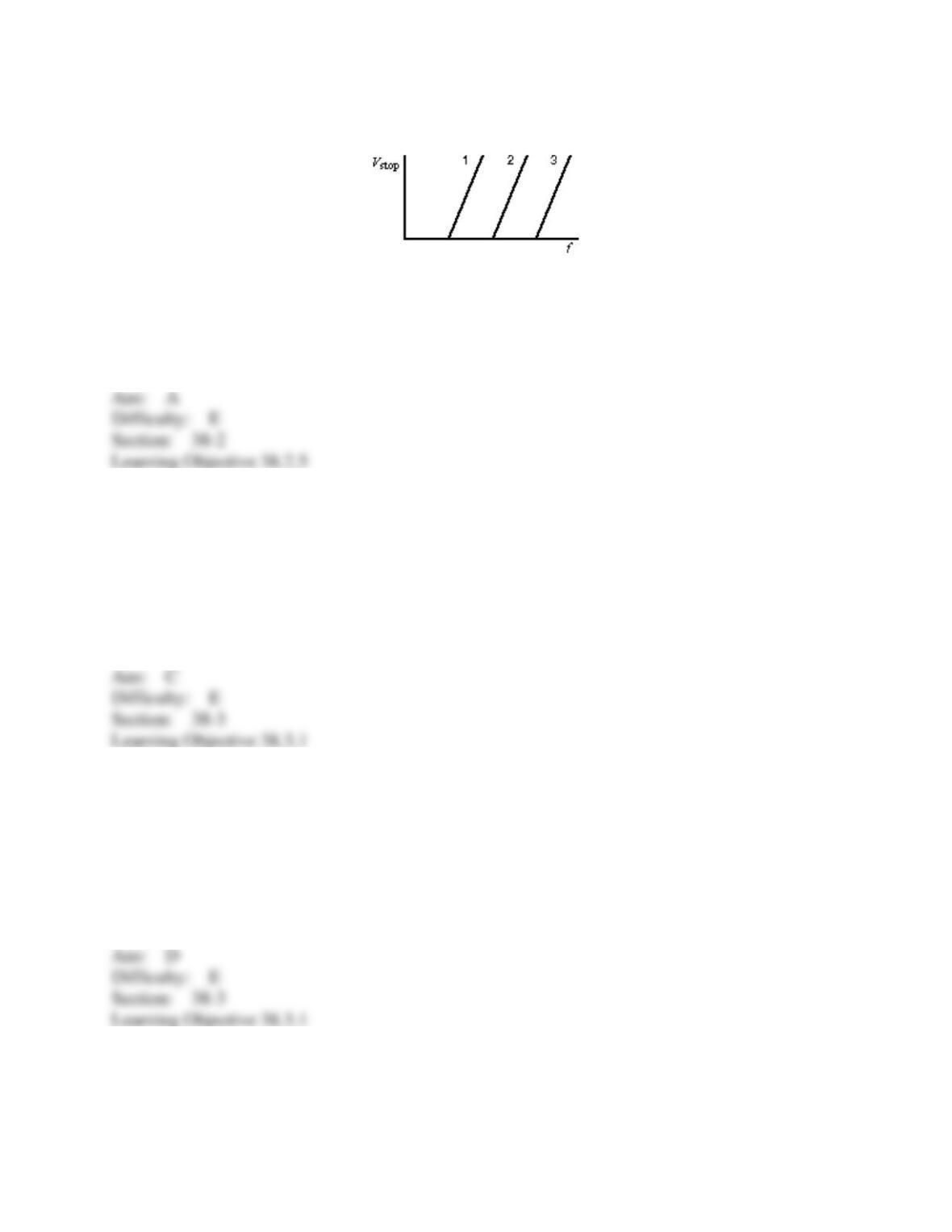
the materials according to the values of their work functions, from least to greatest.
A) 1, 2, 3
B) 3, 2, 1
C) 2, 3, 1
D) 2, 1, 3
E) 1, 3, 2
18. Which of the following electromagnetic radiations has photons with the greatest
momentum?
A) blue light
B) yellow light
C) x rays
D) radio waves
E) microwaves
19. A photon in light beam A has twice the energy of a photon in light beam B. The ratio
pA/pB of their momenta is:
A) 1/2
B) 1/4
C) 1
D) 2
E) 4
20. In Compton scattering from stationary electrons the largest change in wavelength occurs
when the photon is scattered through:
A) 0
B) 22.5
C) 45
D) 90
E) 180
21. Separate Compton effect experiments are carried out using visible light and x rays. The
scattered radiation is observed at the same scattering angle. For these experiments:
A) the x rays have the greater shift in wavelength and the greater change in photon energy
B) the two radiations have the same shift in wavelength and the x rays have the greater change
in photon energy
C) the two radiations have the same shift in wavelength and the visible light has the greater
change in photon energy
D) the two radiations have the same shift in wavelength and the same change in photon energy
E) the visible light has the greater shift in wavelength and the greater shift in photon energy
22. In Compton scattering from stationary particles the maximum change in wavelength can be
made smaller by using:
A) higher frequency radiation
B) lower frequency radiation
C) more massive particles
D) less massive particles
E) particles with greater charge
23. Of the following, Compton scattering from electrons is most easily observed for:
A) microwaves
B) infrared light
C) visible light
D) ultraviolet light
E) x rays
24. In Compton scattering from stationary electrons the frequency of the emitted light is
independent of:
A) the frequency of the incident light
B) the recoil speed of the electron
C) the scattering angle
D) the electron recoil energy
E) none of the above
25. In Compton scattering from stationary electrons the largest change in wavelength that can
occur is:
A) 2.43 10–15 m
B) 2.43 10–12 m
C) 2.43 10–9 m
D) dependent on the frequency of the incident light
E) dependent on the work function
26. Electromagnetic radiation with a wavelength of 5.7 10–12 m is incident on stationary
electrons. Radiation that has a wavelength of 6.6 10–12 m is detected at a scattering angle of:
A) 10
B) 40
C) 50
D) 69
E) 111
27. Electromagnetic radiation with a wavelength of 3.5 10–12 m is scattered from stationary
electrons and photons that have been scattered through 50 are detected. An electron from which
one of these photons was scattered receives an energy of:

A) 0 J
B) 1.1 10–14 J
C) 1.9 10–14 J
D) 2.3 10–14 J
E) 1.3 10–13 J
28. Electromagnetic radiation with a wavelength of 3.5 10–12 m is scattered from stationary
electrons, and photons that have been scattered through 50 are detected. After a scattering event
the magnitude of the photon’s momentum is:
A) 0 kgm/s
B) 8.7 10–23 kgm/s
C) 1.5 10–22 kgm/s
D) 2.0 10–22 kgm/s
E) 2.2 10–22 kgm/s
29. Consider the following:
I. A photoelectric process in which all emitted electrons have energy less than hf, where f
is the frequency of the incident light.
II. A photoelectric process in which some emitted electrons have kinetic energy greater
than hf.
III. Compton scattering from stationary electrons for which the emitted light has a
frequency that is greater than that of the incident light.
IV. Compton scattering from stationary electrons for which the emitted light has a
frequency that is less than that of the incident light.
The only possible processes are:
A) I
B) III
C) I and III
D) I and IV
E) II and IV

30. The main problem that physicists had in understanding blackbody radiation before Planck’s
work was:
A) Blackbody radiation came from objects that were not actually black.
B) The classically predicted frequency spectrum showed an infinitely large peak at low
frequencies.
C) The classically predicted frequency spectrum showed an infinitely large peak at high
frequencies.
D) The classically predicted frequency spectrum had a minimum intensity rather than a
maximum as observed.
E) The classically predicted frequency spectrum had a maximum intensity that decreased with
temperature, rather than increasing as observed.
31. The surface of the Sun is at a temperature of approximately 5800 K, and radiates a peak
wavelength of 500 nm. According to the Planck radiation law, what is its emitted intensity per
unit wavelength at the peak?
A) 8.4 W/cm2∙nm
B) 42 W/cm2∙nm
C) 84 W/cm2∙nm
D) 8.4 x 10³ W/cm2∙nm
E) 4.2 x 10⁷ W/cm2∙nm
32. What is the temperature of a burner on an electric stove when its glow is barely visible, at a
wavelength of 700 nm? Assume the burner radiates as an ideal blackbody and that 700 nm
represents the peak of its emission spectrum.
A) 41 K
B) 240 K
C) 410 K
D) 2400 K
E) 4100 K
33. Monoenergetic electrons are incident on a single slit barrier. If the energy of each incident
electron is increased the central maximum of the diffraction pattern:
A) widens
B) narrows
C) stays the same width
D) widens for slow electrons and narrows for fast electrons
E) narrows for slow electrons and widens for fast electrons
34. Evidence for the wave nature of matter is:
A) electron diffraction experiments of Davisson and Germer
B) Thompson’s measurement of e/m
C) Young’s double slit experiment
D) the Compton effect
E) Lenz’s law
35. Which of the following is NOT evidence for the wave nature of matter?
A) The photoelectric effect
B) The diffraction pattern obtained when electrons pass through a slit
C) Electron tunneling
D) The validity of the Heisenberg uncertainty principle
E) The interference pattern obtained when electrons pass through a two-slit system
36. Of the following which is the best evidence for the wave nature of matter?
A) The photoelectric effect
B) The Compton effect
C) The spectral radiancy of cavity radiation
D) The relationship between momentum and energy for an electron
E) The reflection of electrons by crystals

37. Consider the following three particles:
1. a free electron with speed v0
2. a free proton with speed v0
3. a free proton with speed 2v0
Rank them according to the wavelengths of their matter waves, least to greatest.
A) 1, 2, 3
B) 3, 2, 1
C) 2, 3, 1
D) 1, 3, 2
E) 1, then 2 and 3 tied
38. Consider the following three particles:
1. a free electron with kinetic energy K0
2. a free proton with kinetic energy K0
3. a free proton with kinetic energy 2K0
Rank them according to the wavelengths of their waves, least to greatest.
A) 1, 2, 3
B) 3, 2, 1
C) 2, 3, 1
D) 1, 3, 2
E) 1, then 2 and 3 tied
39. A free electron has a momentum of 5.0 10–24 kg m/s. Its wavelength, as given by its
wave function, is:
A) 1.3 10–8 m
B) 1.3 10–10 m
C) 2.3 10–11 m
D) 2.3 10–13 m
E) none of these

40. The frequency and wavelength of the matter wave associated with a 10-eV free electron
are:
A) 1.5 1034 Hz, 3.9 10–10 m
B) 1.5 1034 Hz, 1.3 10–34 m
C) 2.4 1015 Hz, 1.2 10–9 m
D) 2.4 1015 Hz, 3.9 10–10 m
E) 4.8 1015 Hz, 1.9 10–10 m
41. If the kinetic energy of a non-relativistic free electron doubles, the frequency of its wave
function changes by the factor:
A) 1/√2
B) 1/2
C) 1/4
D) √2
E) 2
42. A non-relativistic free electron has kinetic energy K. If its wavelength doubles, its kinetic
energy is:
A) 4 K
B) 2 K
C) K
D) K/2
E) K/4
43. A free electron and a free proton have the same kinetic energy. This means that,
compared to the matter wave associated with the proton, the matter wave associated with the
electron has:
A) a shorter wavelength and a greater frequency
B) a longer wavelength and a greater frequency

C) a shorter wavelength and the same frequency
D) a longer wavelength and the same frequency
E) a shorter wavelength and a smaller frequency
44. A free electron and a free proton have the same momentum. This means that, compared
to the matter wave associated with the proton, the matter wave associated with the electron has:
A) a shorter wavelength and a greater frequency
B) a longer wavelength and a greater frequency
C) the same wavelength and the same frequency
D) the same wavelength and a greater frequency
E) the same wavelength and a smaller frequency
45. A free electron and a free proton have the same speed. This means that, compared to the
matter wave associated with the proton, the matter wave associated with the electron has:
A) a shorter wavelength and a greater frequency
B) a longer wavelength and a greater frequency
C) a shorter wavelength and a smaller frequency
D) the same wavelength and a greater frequency
E) a longer wavelength and a smaller frequency
46. The probability that a particle is in a given small region of space is proportional to:
A) its energy
B) its momentum
C) the magnitude of its wave function
D) the wavelength of its wave function
E) the square of the magnitude of its wave function

47.
(x) is the wave function for a particle moving along the x axis. The probability that the
particle is in the interval from x = a to x = b is given by:
A)
(b) –
(a)
B)
(b)/
(a)
C)
(b)2/
(a)2
D) ∫𝜓(𝑥)𝑑𝑥
𝑏
𝑎
E) ∫|𝜓(𝑥)|2
𝑏
𝑎𝑑𝑥
48. The significance of
2 is:
A) probability
B) energy
C) probability density
D) energy density
E) wavelength
49. Maxwell’s equations are to electric and magnetic fields as __________ equation is to the
wave function of the particle.
A) Einstein’s
B) Fermi’s
C) Newton’s
D) Schrödinger’s
E) Bohr’s
50. A free electron in motion along the x axis has a localized wave function. If it enters a region
of space where its potential energy increases,
A) its total energy will decrease.
B) its momentum will increase.
C) its wave number will increase.
D) its wavelength will increase.

E) its kinetic energy will increase.
51. A free electron in motion along the x axis has a localized wave function. The uncertainty in
its momentum is decreased if:
A) the wave function is made more narrow
B) the wave function is made less narrow
C) the wave function remains the same but the energy of the electron is increased
D) the wave function remains the same but the energy of the electron is decreased
E) none of the above
52. The uncertainty in position of an electron in a certain state is 5 10–10 m. The uncertainty
in its momentum could be
A) 5.0 10–24 kgm/s
B) 4.0 10–24 kgm/s
C) 3.0 10–24 kgm/s
D) any of the above
E) none of the above
53. The reflection coefficient R for a certain barrier tunneling problem is 0.80. The
corresponding transmission coefficient T is:
A) 0.80
B) 0.60
C) 0.50
D) 0.20
E) 0

54. An electron with energy E is incident upon a potential energy barrier of height Epot > E and
thickness L. The transmission coefficient T:
A) is zero
B) decreases exponentially with L
C) is proportional to 1/L
D) is proportional to 1/L2
E) is non-zero and independent of L
55. An electron with energy E is incident upon a potential energy barrier of height Epot < E and
thickness L. The reflection coefficient R:
A) is always equal to zero
B) is always equal to 1
C) does not depend on E – Epot
D) is, in general, not equal to zero
E) is equal to T + 1 where T is the transmission coefficient
56. An electron with energy E is incident upon a potential energy barrier of height Epot < E and
thickness L. If the reflection coefficient R = 0.05,
A) the electron has a 0.05% chance of being reflected
B) the electron has a 5% chance of being reflected
C) the electron has a 95% chance of being reflected
D) the electron will be partially reflected and partially transmitted
E) the electron has no chance of being reflected
57. In order to tunnel through a potential barrier a particle must:
A) have energy greater than the barrier height
B) have spin
C) be massive
D) have a wavelength longer than the barrier width
E) none of the above

58. An electron with energy E is incident on a potential energy barrier of height Epot and
thickness L. The probability of tunneling increases if:
A) E decreases without any other changes
B) Epot increases without any other changes
C) L decreases without any other changes
D) E and Epot increase by the same amount
E) E and Epot decrease by the same amount
59. Identical particles, each with energy E, are incident on the following four potential energy
barriers:
1. barrier height = 5E, barrier width = 2L
2. barrier height = 10E, barrier width = L
3. barrier height = 17E, barrier width = L/2
4. barrier height = 26E, barrier width = L/3
Rank the barriers in terms of the probability that the particles tunnel through them, from least
probability to greatest probability.
A) 1, 2, 3, 4
B) 4, 3, 2, 1
C) 1 and 2 tied, then 3, then4
D) 1, then 2 and 3 tied, then 4
E) 3, 2, 1, 4