41. Two objects, one having three times the mass of the other, are dropped from the same
height in a vacuum. At the end of their fall, their velocities are equal because:
A) anything falling in vacuum has constant velocity
B) all objects reach the same terminal velocity
C) the acceleration of the larger object is three times greater than that of the smaller object
D) the force of gravity is the same for both objects
E) none of the above
42. A feather and a lead ball are dropped from rest in vacuum on the Moon. The acceleration of
the feather is:
A) more than that of the lead ball
B) the same as that of the lead ball
C) less than that of the lead ball
D) 9.8 m/s2
E) zero since it floats in a vacuum
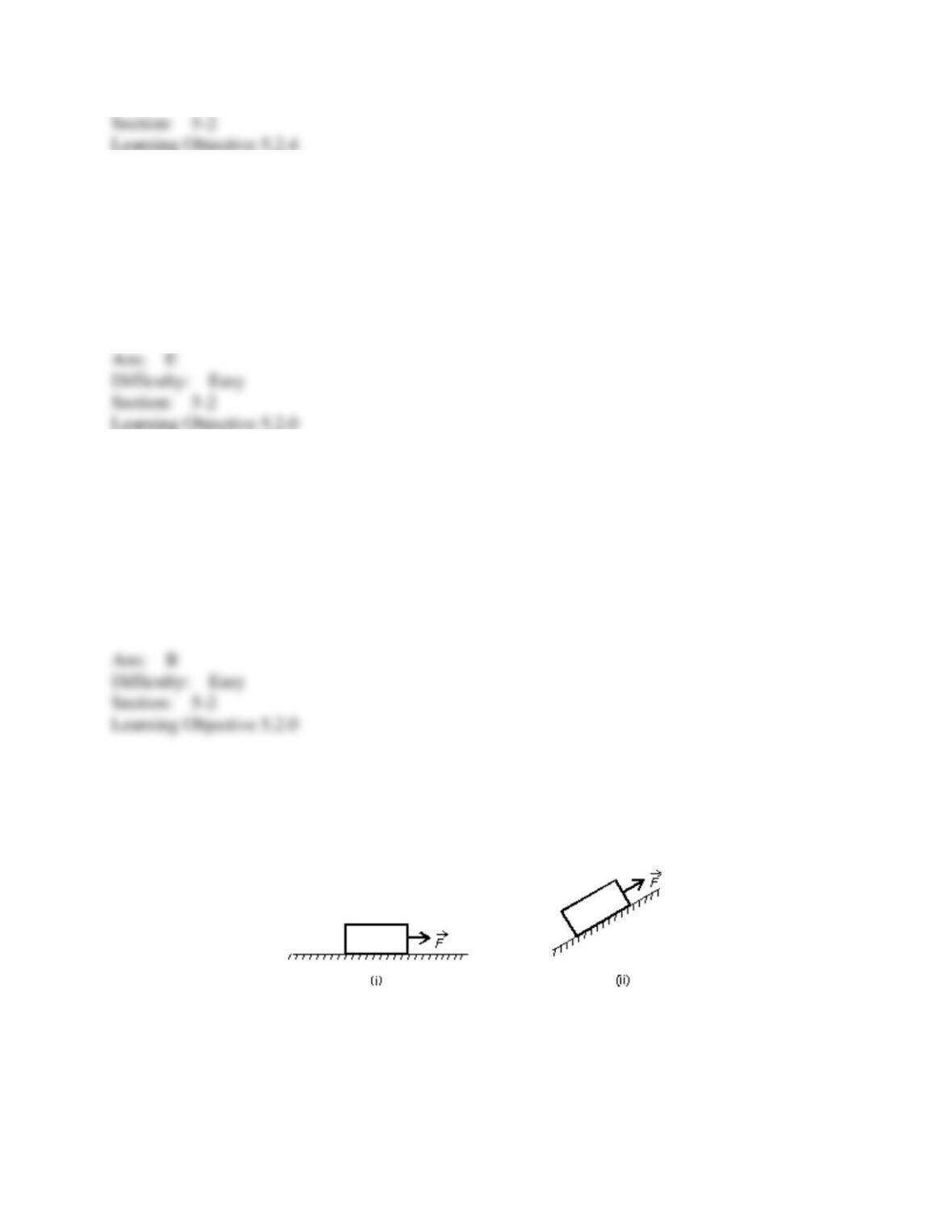
43. A heavy wooden block is dragged by a force 𝐹
⃗ along a rough steel plate, as shown below
for two cases. The magnitude of the applied force 𝐹
⃗ is the same for both cases. The normal
force in (ii), as compared with the normal force in (i) is:
A) the same
B) greater
C) less
D) less for some angles of the incline and greater for others
E) less or greater, depending on the magnitude of the applied force 𝐹
⃗
44. In general, any surface exerts two forces on objects that are in contact with it. One force is
parallel to the surface and the other is perpendicular to the surface. What are these forces called?
A) The parallel force is surface tension and the perpendicular force is friction.
B) The parallel force is the normal force and the perpendicular force is friction.
C) The parallel force is friction and the perpendicular force is surface tension.
D) The parallel force is friction and the perpendicular force is the normal force.
E) The parallel force is static friction and the perpendicular force is kinetic friction.
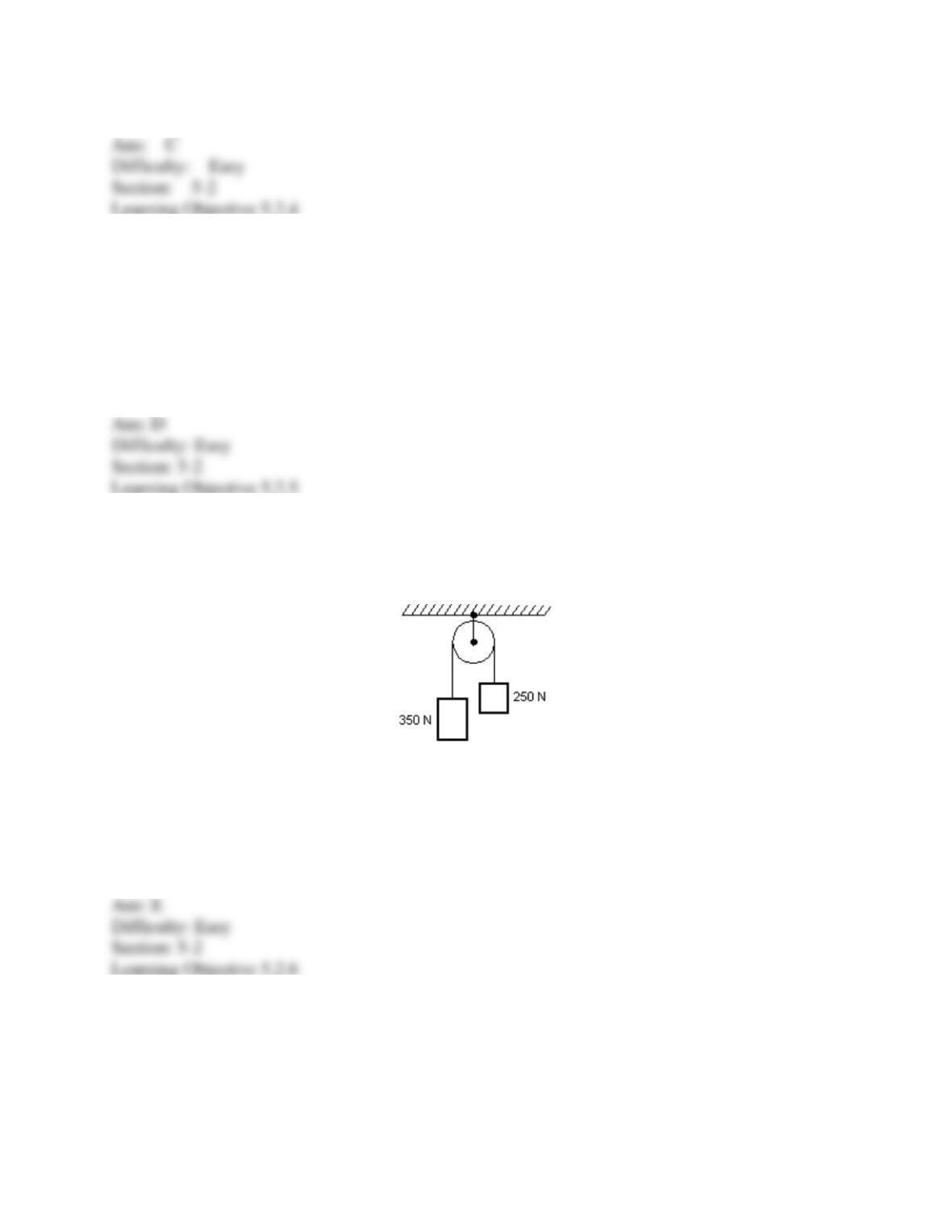
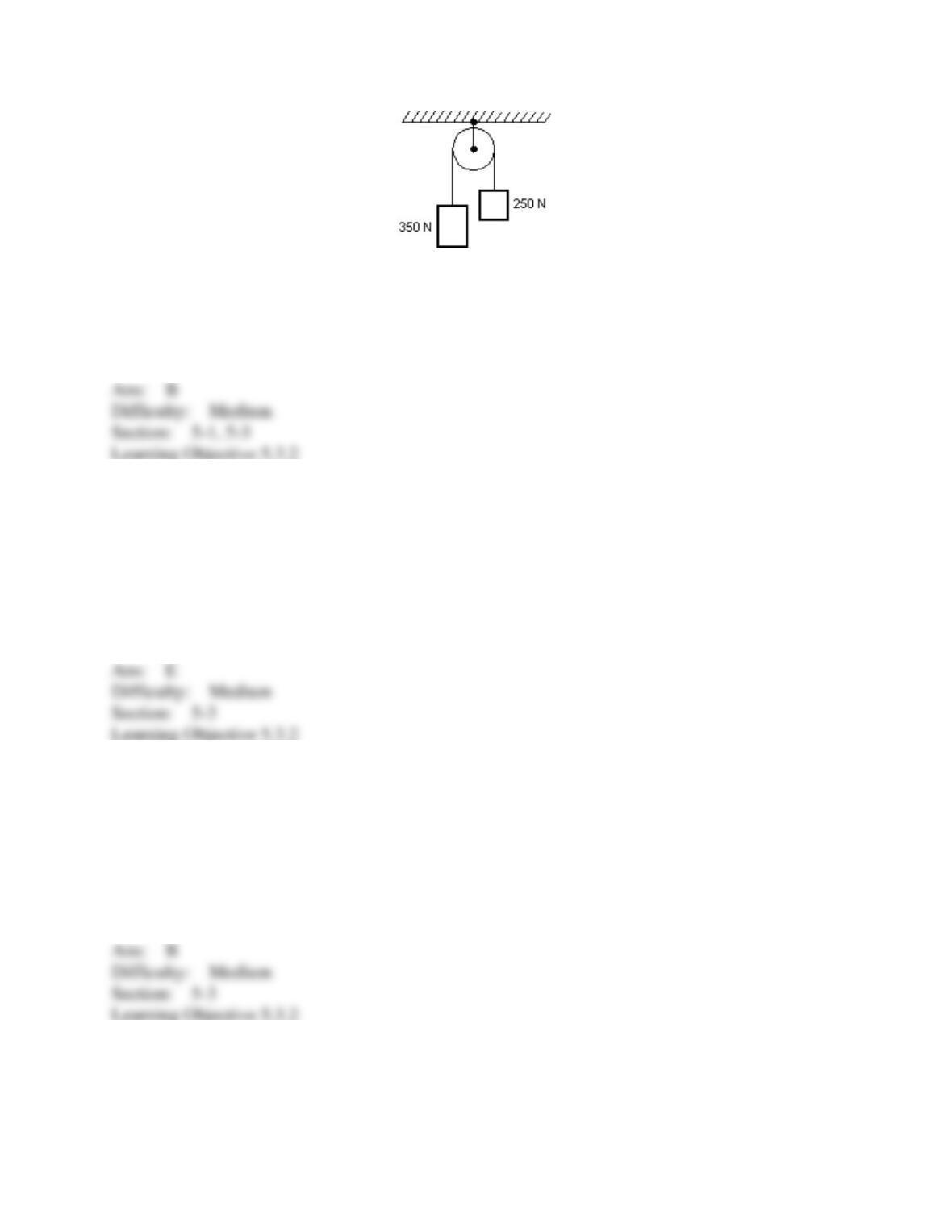
45. Two blocks are connected by a massless string that passes over a massless pulley, as shown.
In the absence of friction, how does the tension force exerted by the string on the 250 N block
compare with the tension force exerted by the string on the 350 N block?
A) The force on the 250 N block is smaller by a factor of 0.71.
B) The force on the 250 N block is larger by a factor of 1.4.
C) The force on the 250 N block is always equal to its weight.
D) The force on the 250 N block is equal to the weight of the 350 N block.
E) The two forces are equal.
46. The “reaction” force does not cancel the “action” force because:
A) the action force is greater than the reaction force
B) they act on different bodies
C) they are in the same direction
D) the reaction force exists only after the action force is removed
E) the reaction force is greater than the action force
47. A book rests on a table, exerting a downward force on the table. The reaction to this force
is:
A) the force of the Earth on the book
B) the force of the table on the book
C) the force of the Earth on the table
D) the force of the book on the Earth
E) the inertia of the book
48. A lead block is suspended from your hand by a string. The reaction to the force of gravity
on the block is the force exerted by the:
A) string on the block
B) block on the string
C) string on the hand
D) hand on the string
E) block on the Earth
49. A 5-kg concrete block is lowered with a downward acceleration of 2.8 m/s2 by means of a
rope. The force of the block on the Earth is:
A) 14 N, up
B) 14 N, down
C) 35 N, up
D) 35 N, down
E) 49 N, up
50. A 5-kg concrete block is lowered with a downward acceleration of 2.8 m/s2 by means of a
rope. The force of the block on the rope is:
A) 14 N, up
B) 14 N, down
C) 35 N, up
D) 35 N, down
E) 49 N, up
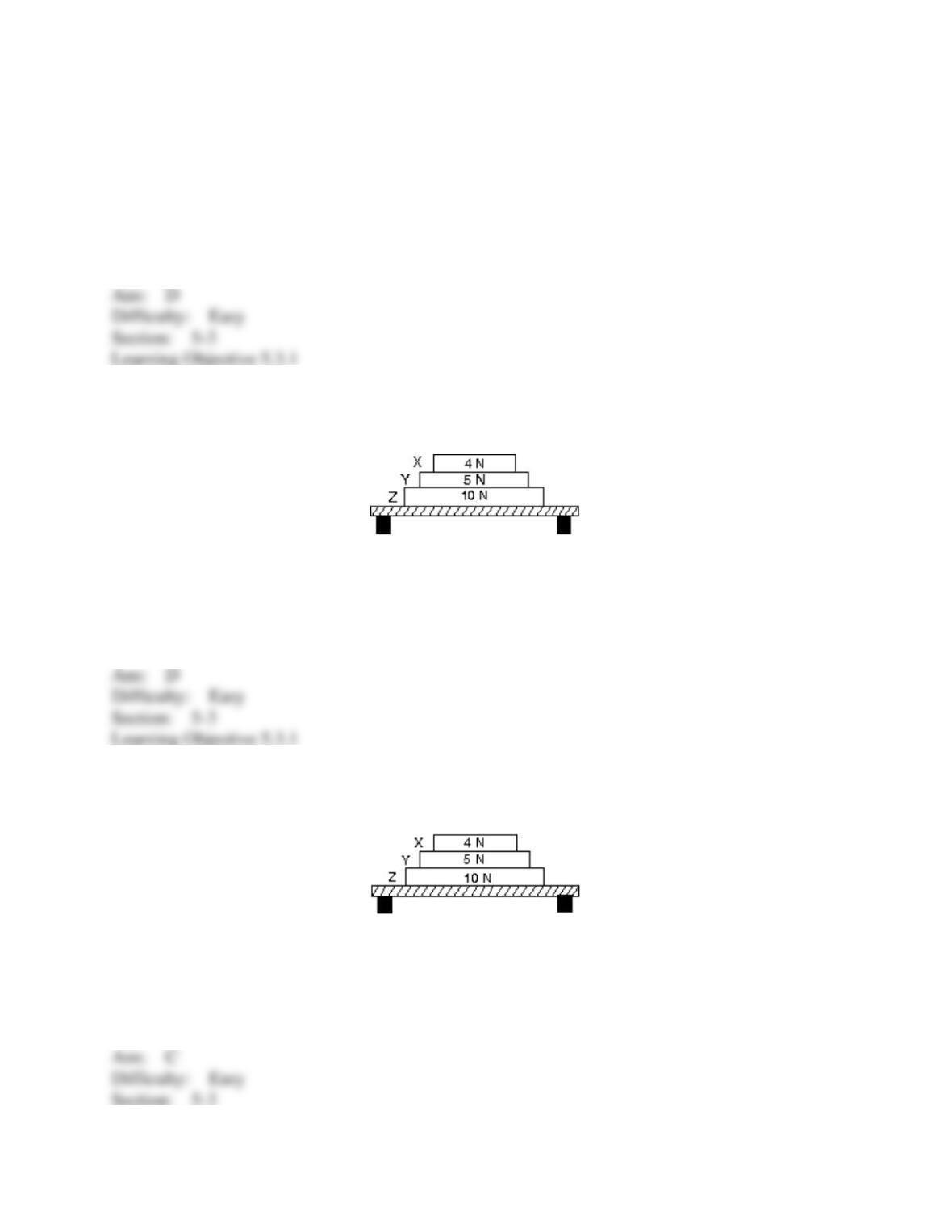
51. Three books (X, Y, and Z) rest on a table. The weight of each book is indicated. The net
force acting on book Y is:
A) 4 N down
B) 5 N up
C) 9 N down
D) 0 N
E) none of these
52. Three books (X, Y, and Z) rest on a table. The weight of each book is indicated. The force
of book Z on book Y is:
A) 0 N
B) 5 N
C) 9 N
D) 14 N
E) 19 N
53. A 25-kg crate is pushed across a frictionless horizontal floor with a force of 20 N, directed
20 below the horizontal. The acceleration of the crate is:
A) 0.27 m/s2
B) 0.75 m/s2
C) 0.80 m/s2
D) 170 m/s2
E) 470 m/s2
54. Two forces are applied to a 5.0-kg crate; one is 6.0 N to the north and the other is 8.0 N to
the west. The magnitude of the acceleration of the crate is:
A) 0.50 m/s2
B) 2.0 m/s2
C) 2.8 m/s2
D) 10 m/s2
E) 50 m/s2
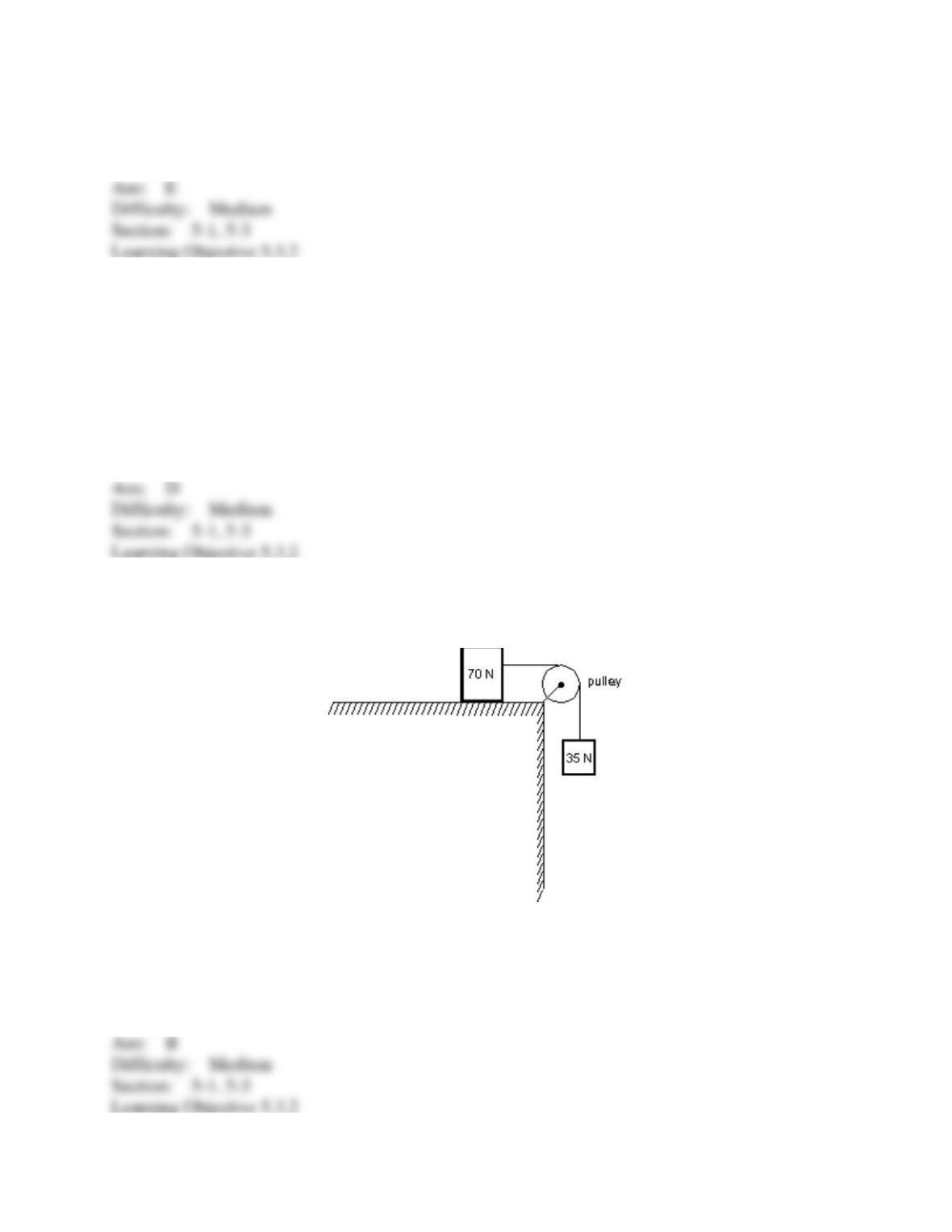
55. Two blocks are connected by a string and pulley as shown. Assuming that the string and
pulley are massless, the magnitude of the acceleration of each block is:
A) 0.049 m/s2
B) 0.020 m/s2
C) 0.0098 m/s2
D) 0.54 m/s2
E) 0.98 m/s2
56. A 13-N weight and a 12-N weight are connected by a massless string over a massless,
frictionless pulley. The 13-N weight has a downward acceleration with magnitude equal to that
of a freely falling body times:
A) 1
B) 1/12
C) 1/13
D) 1/25
E) 13/25
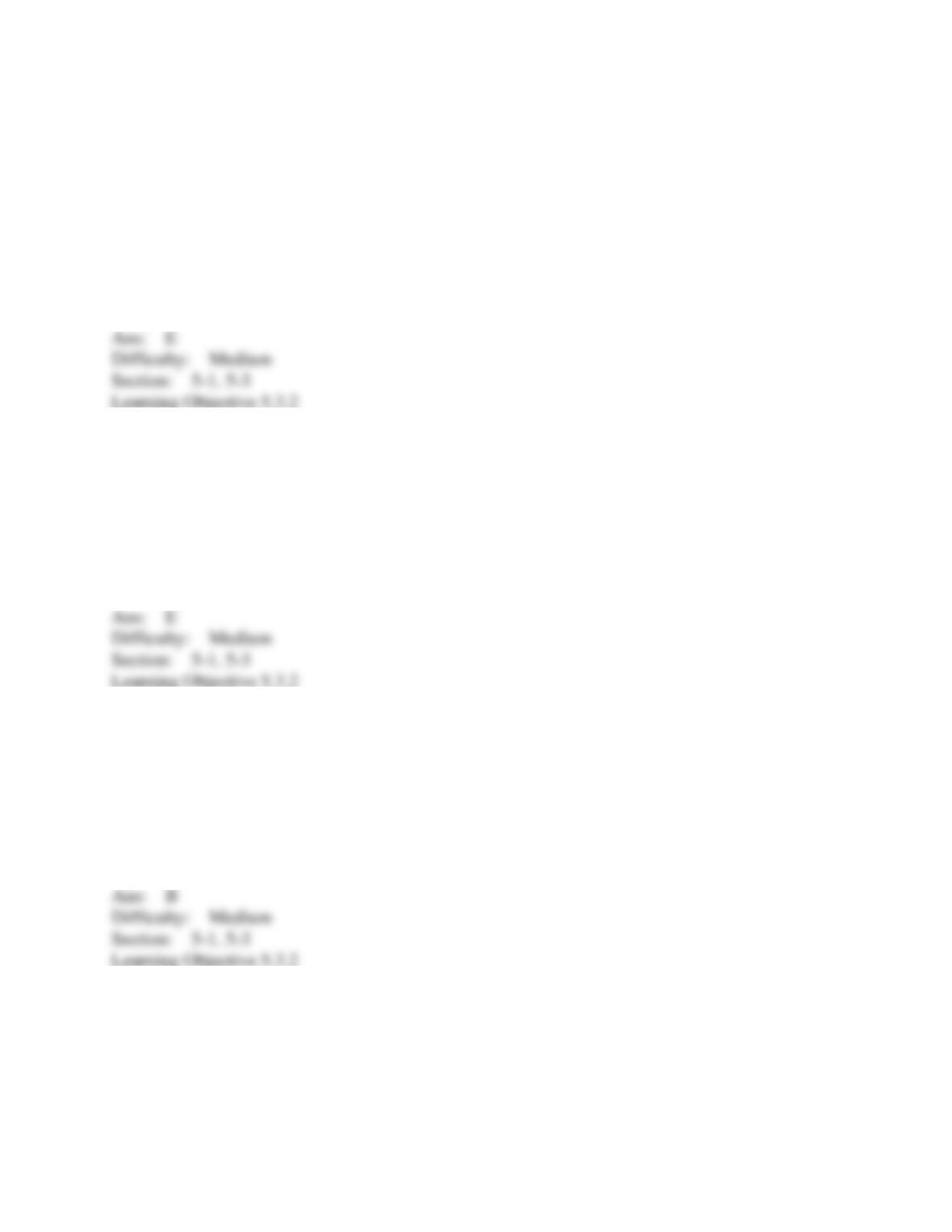
57. A 70-N block and a 35-N block are connected by a string as shown. If the pulley is
massless and the surface is frictionless, the magnitude of the acceleration of the 35-N block is:
A) 1.6 m/s2
B) 3.3 m/s2
C) 4.9 m/s2
D) 6.5 m/s2
E) 9.8 m/s2
58. A massless rope passes over a massless pulley suspended from the ceiling. A 4-kg block is
attached to one end and a 5-kg block is attached to the other end. The acceleration of the 5-kg
block is:
A) g/4
B) 5g/9
C) 4g/9
D) g/5
E) g/9
59. A 1100-kg elevator is rising and its speed is increasing at 3.0 m/s2. The tension in the
elevator cable is:
A) 7500 N
B) 1100 N
C) 3300 N
D) 11000 N
E) 14000 N
60. A 5-kg block is suspended by a rope from the ceiling of an elevator that accelerates
downward at 3.0 m/s2. The tension force of the rope on the block is:
A) 15 N, up
B) 34 N, up
C) 34 N, down
D) 64 N, up
E) 64 N, down
61. A crane operator lowers a 16,000 N steel ball with a downward acceleration of 3 m/s2. The
tension in the cable is:
A) 4900 N
B) 11,000 N
C) 16,000 N
D) 21,000 N
E) 48,000 N
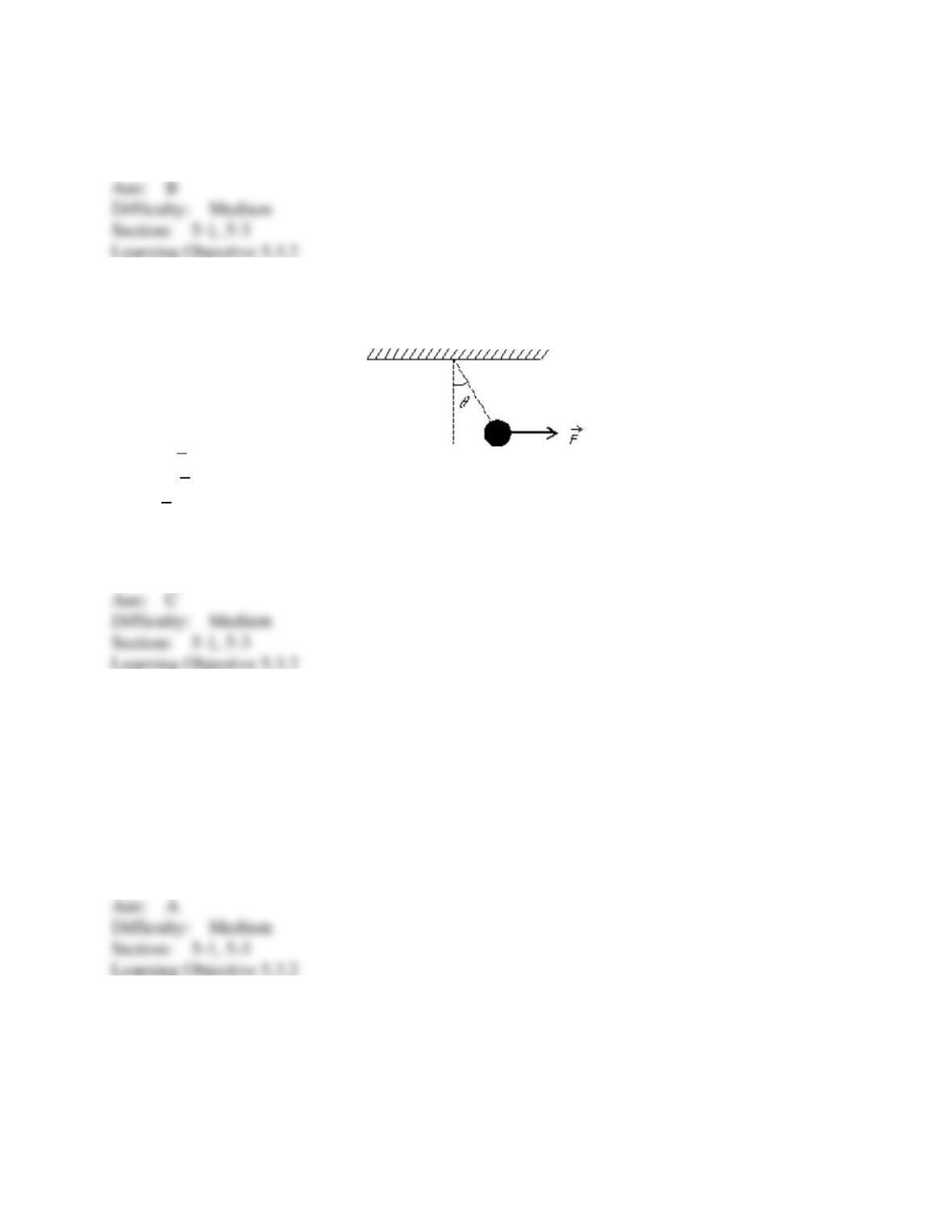
62. A 1-N pendulum bob is held at an angle
from the vertical by a 2-N horizontal force F as
shown. The tension in the string supporting the pendulum bob is:
A) 2/√5
B) 2 √5 N
C) √5 N
D) 1 N
E) none of these
63. A car drives in a straight line on a level road with a constant acceleration of 3 m/s2. A ball
is suspended by a string from the ceiling of the car; the ball does not swing, being at rest with
respect to the car. What angle does the string make with the vertical?
A) 17
B) 35
C) 52
D) 73
E) Cannot be found without knowing the length of the string
64. Two blocks weighing 250 N and 350 N respectively, are connected by a string that passes
over a massless pulley as shown. The tension in the string is:
A) 210 N
B) 290 N
C) 410 N
D) 500 N
E) 4900 N
65. A block slides down a frictionless plane that makes an angle of 30 with the horizontal.
The acceleration of the block is:
A) 9.80 m/s2
B) 5.66 m/s2
C) 8.49 m/s2
D) 0 m/s2
E) 4.90 m/s2
66. A 25-N crate slides down a frictionless incline that is 25 above the horizontal. The
magnitude of the normal force of the incline on the crate is:
A) 11 N
B) 23 N
C) 25 N
D) 100 N
E) 220 N
67. A 25-N crate is held at rest on a frictionless incline by a force that is parallel to the incline.
If the incline is 25 above the horizontal the magnitude of the applied force is:
A) 4.1 N
B) 4.6 N
C) 8.9 N
D) 11 N
E) 23 N
68. A 25-N crate is held at rest on a frictionless incline by a force that is parallel to the incline.
If the incline is 25 above the horizontal the magnitude of the normal force of the incline on the
crate is:
A) 4.1 N
B) 4.6 N
C) 8.9 N
D) 11 N
E) 23 N
69. A 32-N force, parallel to the incline, is required to push a certain crate at constant velocity
up a frictionless incline that is 30 above the horizontal. The mass of the crate is:
A) 3.3 kg
B) 3.8 kg
C) 5.7 kg
D) 6.5 kg
E) 160 kg
70. A sled is on an icy (frictionless) slope that is 30 above the horizontal. When a 40-N force,
parallel to the incline and directed up the incline, is applied to the sled, the acceleration of the
sled is 2.0 m/s2, down the incline. The mass of the sled is:
A) 4.1 kg
B) 6.2 kg
C) 8.1 kg
D) 10 kg
E) 14 kg
71. When a 40-N force, parallel to the incline and directed up the incline, is applied to a crate
on a frictionless incline that is 30 above the horizontal, the acceleration of the crate is 2.0 m/s2,
up the incline. The mass of the crate is:
A) 3.8 kg
B) 4.1 kg
C) 5.8 kg
D) 6.2 kg
E) 10 kg
72. A short 10-g string is used to pull a 50-g toy across a frictionless horizontal surface. If a
3.0 10–2 N force is applied horizontally to the free end of the string, the force of the string on
the toy, at the other end, is:
A) 0.15 N
B) 6.0 10–3 N
C) 2.5 10–2 N
D) 3.0 10–2 N
E) 3.5 10–2 N
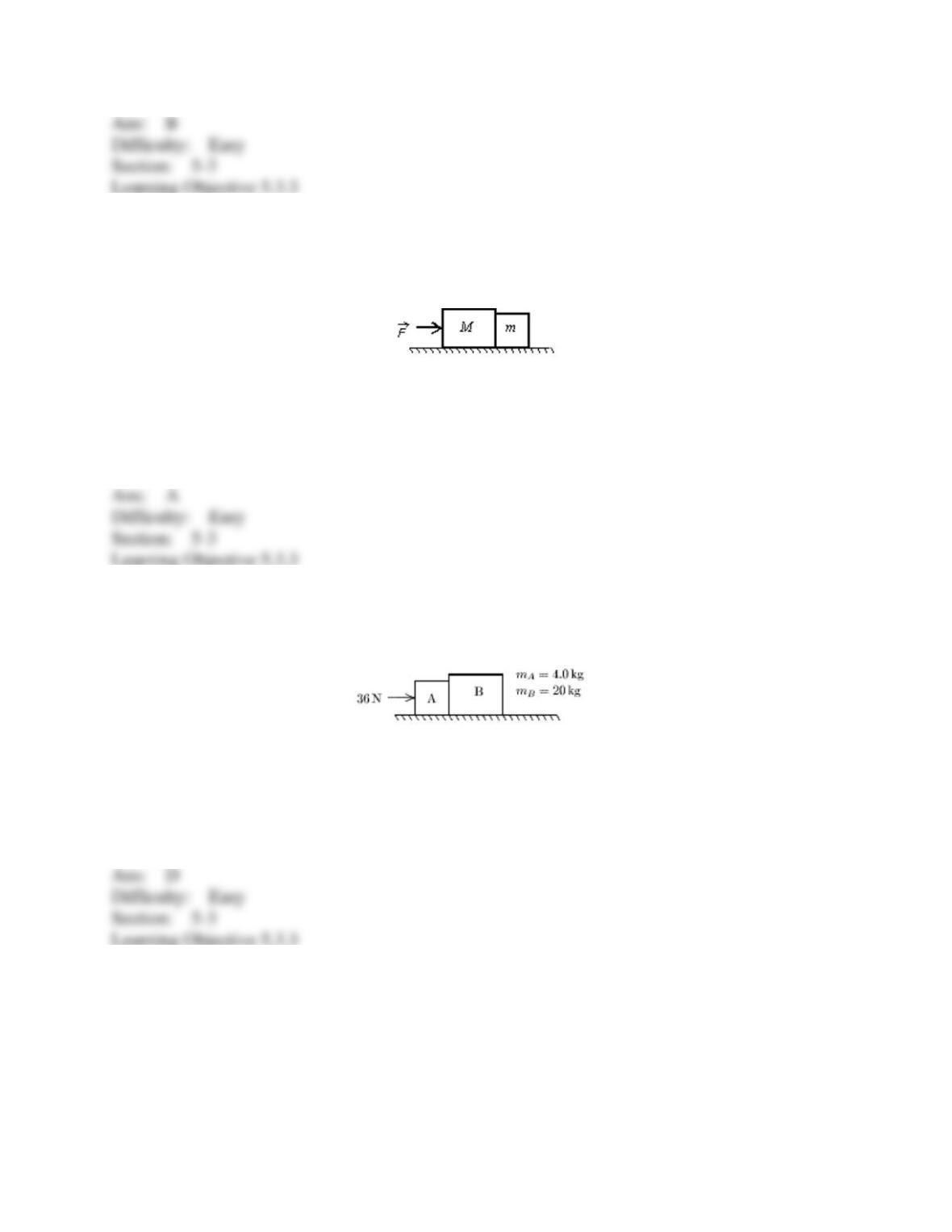
73. Three blocks (A, B, C), each having the same mass M, are connected by strings as shown.
Block C is pulled to the right by a force 𝐹
⃗ that causes the entire system to accelerate.
Neglecting friction, the net force acting on block B is:
A) 0
B) 𝐹
⃗/3
C) 𝐹
⃗/2
D) 2𝐹
⃗/3
E) 𝐹
⃗
74. Two blocks with masses m and M are pushed along a horizontal frictionless surface by a
horizontal applied force 𝐹
⃗ as shown. The magnitude of the force of either of these blocks on the
other is:
A) mF/(m + M)
B) mF/M
C) mF/(M – m)
D) MF/(M + m)
E) MF/m
75. Two blocks (A and B) are in contact on a horizontal frictionless surface. A 36-N constant
force is applied to A as shown. The magnitude of the force of A on B is:
A) 1.5 N
B) 6.0 N
C) 29 N
D) 30 N
E) 36 N