Learning Objective 18.4.6
49. The same energy Q enters five different substances as heat. Which of these has the greatest
specific heat?
A) The temperature of 3 g of substance A increases by 10 K
B) The temperature of 4 g of substance B increases by 4 K
C) The temperature of 6 g of substance C increases by 15 K
D) The temperature of 8 g of substance D increases by 5 K
E) The temperature of 10 g of substance E increases by 10 K
50. A cube of aluminum has an edge length of 20 cm. Aluminum has a density 2.7 times that of
water (1 g/cm3) and a specific heat 0.217 times that of water (1 cal/gC˚). When the internal
energy of the cube increases by 47000 cal its temperature increases by:
A) 5 C˚
B) 10 C˚
C) 20 C˚
D) 100 C˚
E) 200 C˚
51. Take the mechanical equivalent of heat as 4 J/cal. A 10-gram bullet moving at 2000 m/s
plunges into 1 kg of paraffin wax (specific heat 0.7 cal/g C). The wax was initially at 20C.
Assuming that all the bullet’s energy heats the wax, its final temperature is:
A) 20.14 C
B) 23.5 C
C) 20.006 C
D) 27.1 C
E) 48.6 C
52. The energy given off by 300 grams of an alloy as it cools by 50C raises the temperature of
300 grams of water from 30C to 40C. The specific heat of the alloy is:
A) 5.0 cal/g C˚
B) 0.10 cal/g C˚
C) 0.15 cal/g C˚
D) 0.20 cal/g C˚
E) 0.50 cal/g C˚
53. The specific heat of lead is 0.030 cal/g C. 300 g of lead shot at 100C is mixed with 100
g of water at 70C in an insulated container. The final temperature of the mixture is:
A) 100C
B) 85.5C
C) 79.5C
D) 74.5C
E) 72.5C
54. Object A, with heat capacity CA and initially at temperature TA, is placed in thermal contact
with object B, with heat capacity CB and initially at temperature TB. The combination is
thermally isolated. If the heat capacities are independent of the temperature and no phase
changes occur, the final temperature of both objects is:
A) (CATA – CBTB)/(CA + CB)
B) (CATA + CBTB)/(CA + CB)
C) (CATA – CBTB)/(CA – CB)
D) (CA – CB)TA – TB
E) (CA + CB)TA – TB
55. The heat capacity of object B is twice that of object A. Initially A is at 300 K and B is at
450 K. They are placed in thermal contact and the combination is isolated. The final temperature
of both objects is:
A) 300 K
B) 350 K
C) 400 K
D) 450 K
E) 600 K
56. The three phases of matter are:
A) new, half, full
B) earth, air, fire
C) static, kinetic, potential
D) solid, liquid, gas
E) plasma, vapor, fluid
57. The heat of fusion of water is 79.5 cal/g. This means 79.5 cal of energy are required to:
A) raise the temperature of 1 g of water by 1 K
B) turn 1 g of water to steam
C) raise the temperature of 1 g of ice by 1 K
D) melt 1 g of ice
E) increase the internal energy of 1 g of water by 1 J
58. During the time that latent heat is involved in a change of state:
A) the temperature does not change
B) the substance always expands
C) a chemical reaction takes place
D) molecular activity remains constant
E) kinetic energy changes into potential energy
59. The formation of ice from water is accompanied by:
A) absorption of energy as heat
B) temperature increase
C) decrease in volume
D) an evolution of heat
E) temperature decrease
60. A metal sample of mass M requires a power input P to just remain molten. When the heater
is turned off, the metal solidifies in a time T. The specific latent heat of fusion of this metal is:
A) P/MT
B) T/PM
C) PM/T
D) PMT
E) PT/M
61. Solid A, with mass M, is at its melting point TA. It is placed in thermal contact with solid B,
with heat capacity CB and initially at temperature TB (TB > TA). The combination is thermally
isolated. A has latent heat of fusion L and when it has melted has heat capacity CA. If A
completely melts the final temperature of both A and B is:
A) (CATA + CBTB – ML)/(CA + CB)
B) (CATA – CBTB + ML)/(CA + CB)
C) (CATA – CBTB – ML)/(CA + CB)
D) (CATA + CBTB + ML)/(CA – CB)
E) (CATA + CBTB + ML)/(CA – CB)
62. How many calories are required to change one gram of 0C ice to 100C steam? The latent
heat of fusion is 80 cal/g and the latent heat of vaporization is 540 cal/g. The specific heat of
water is 1.00 cal/g K.
A) 100 cal
B) 540 cal
C) 620 cal
D) 720 cal
E) 900 cal
63. Ten grams of ice at –20C is to be changed to steam at 130C. The specific heat of both ice
and steam is 0.5 cal/g C. The specific heat of water is 1.00 cal/g K. The heat of fusion is 80
cal/g and the heat of vaporization is 540 cal/g. The entire process requires:
A) 750 cal
B) 1250 cal
C) 6950 cal
D) 7450 cal
E) 7700 cal
64. Steam at 100C enters a radiator and leaves as water (at 80C). Take the heat of
vaporization to be 540 cal/g. Of the total energy given off as heat, what percent arises from the
cooling of the water?
A) 100%
B) 54%
C) 26%
D) 14%
E) 3.6%
65. A certain humidifier operates by raising water to the boiling point and then evaporating it.
Every minute 30 g of water at 20C are added to replace the 30 g that are evaporated. The heat of
fusion of water is 333 kJ/kg, the heat of vaporization is 2256 kJ/kg, and the specific heat is 4190
J/kg How many joules of energy per minute does this humidifier require?
A) 4800 J/min
B) 18,600 J/min
C) 24,600 J/min
D) 77,700 J/min
E) 10,100,000 J/min
66. Fifty grams of ice at 0C is placed in a thermos bottle containing one hundred grams of
water at 6C. How many grams of ice will melt? The heat of fusion of water is 333 kJ/kg and the
specific heat of water is 4190 J/kg K.
A) 7.5 g
B) 2.0 g
C) 8.3 g
D) 17 g
E) 50 g
67. Of the following which might NOT be zero over one cycle of a cyclic process?
A) the work done by the substance minus the energy absorbed by the substance as heat
B) the change in the pressure of the substance
C) the energy absorbed by the substance as heat
D) the change in the volume of the substance
E) the change in the temperature of the substance
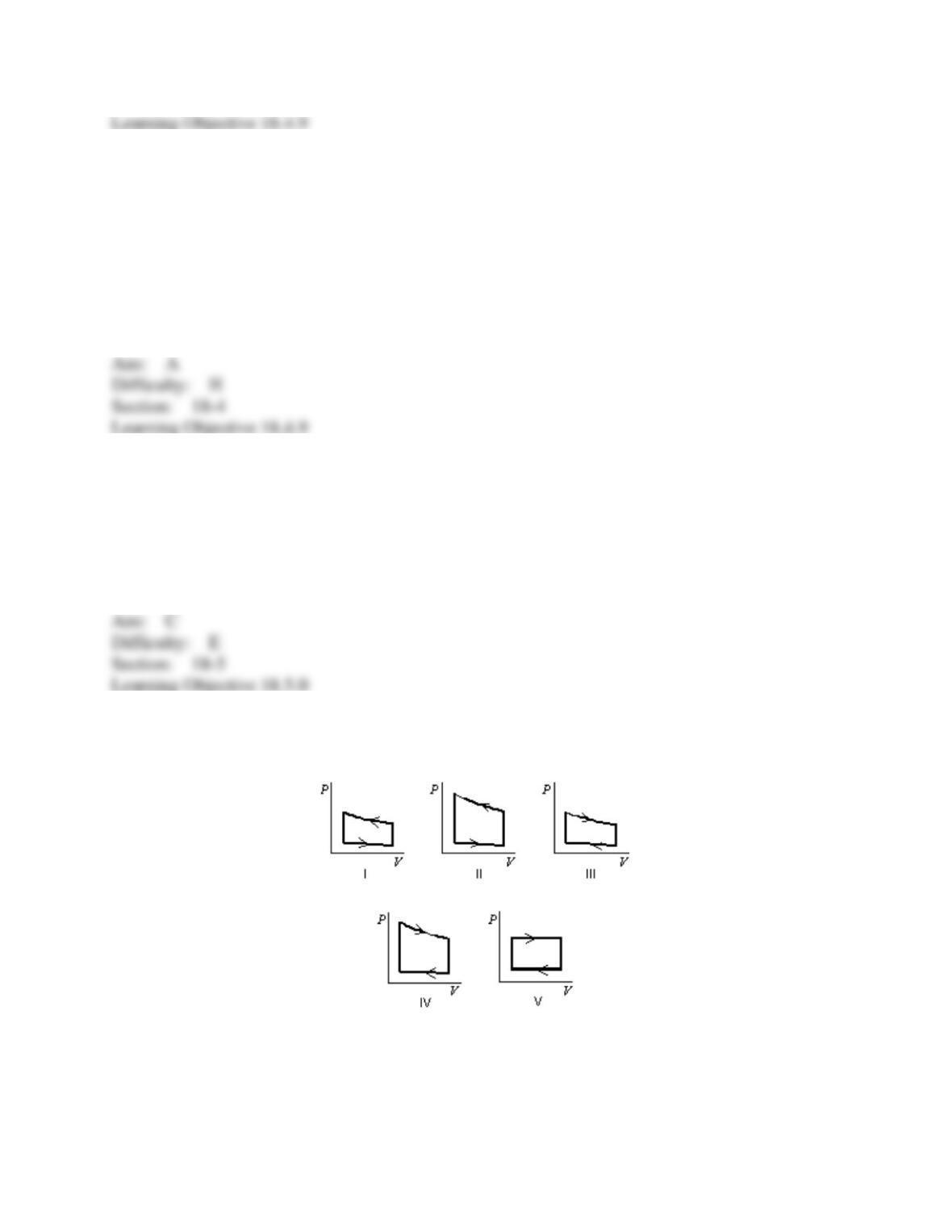
68. Pressure vs. volume graphs for a certain gas undergoing five different cyclic processes are
shown below. During which cycle does the gas do the greatest positive work?
A) I
B) II
C) III
D) IV
E) V
69. A gas:
A) does positive work as it expands.
B) does positive work as it contracts.
C) does no work if it expands adiabatically.
D) does negative work if it expands at constant pressure.
E) may do either positive or negative work as it expands, depending on the heat transfer.
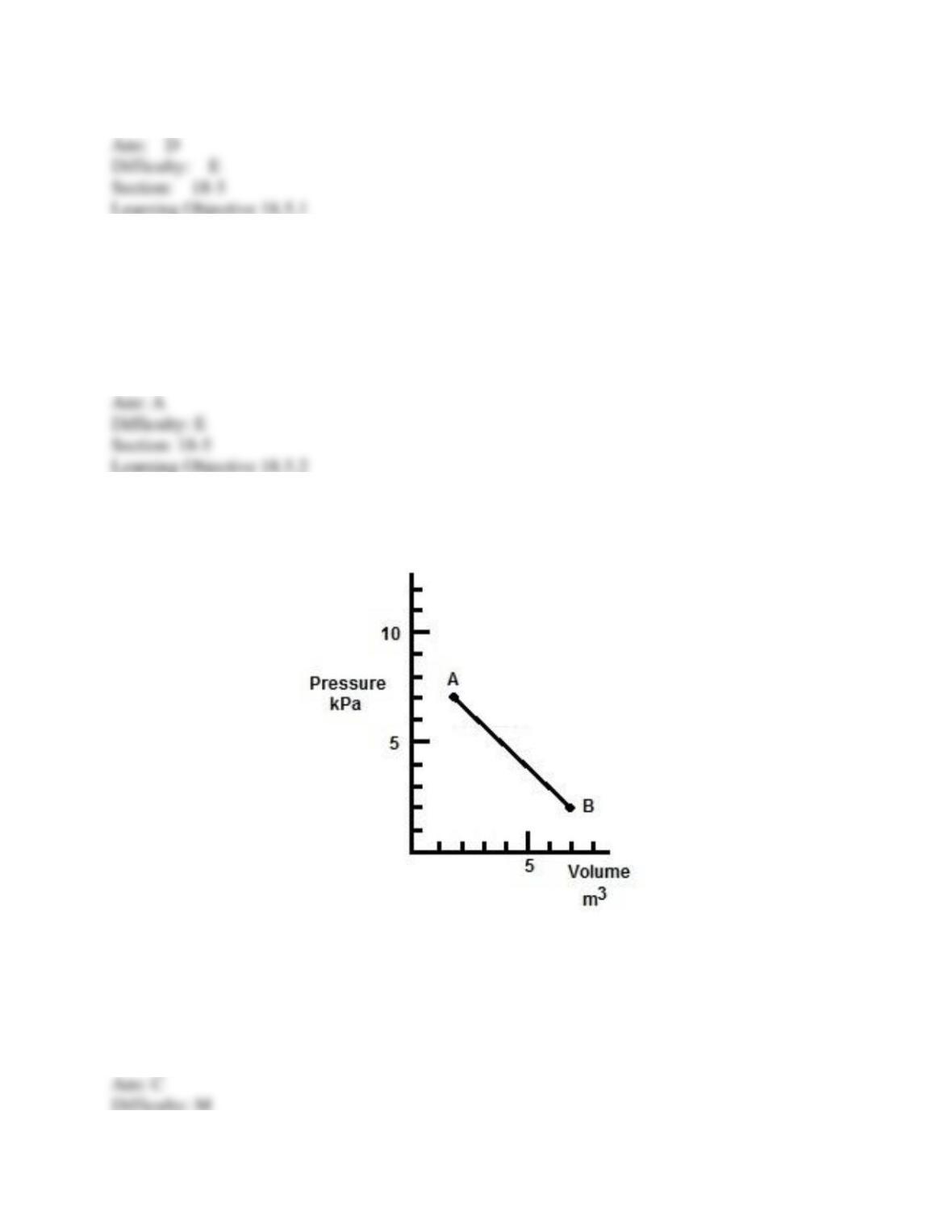
70. In the figure, a gas undergoes a transition from point A to point B along the path shown. How
much work is done by the gas?
A) 10 kJ
B) 13 kJ
C) 23 kJ
D) –23 kJ
E) 0 kJ
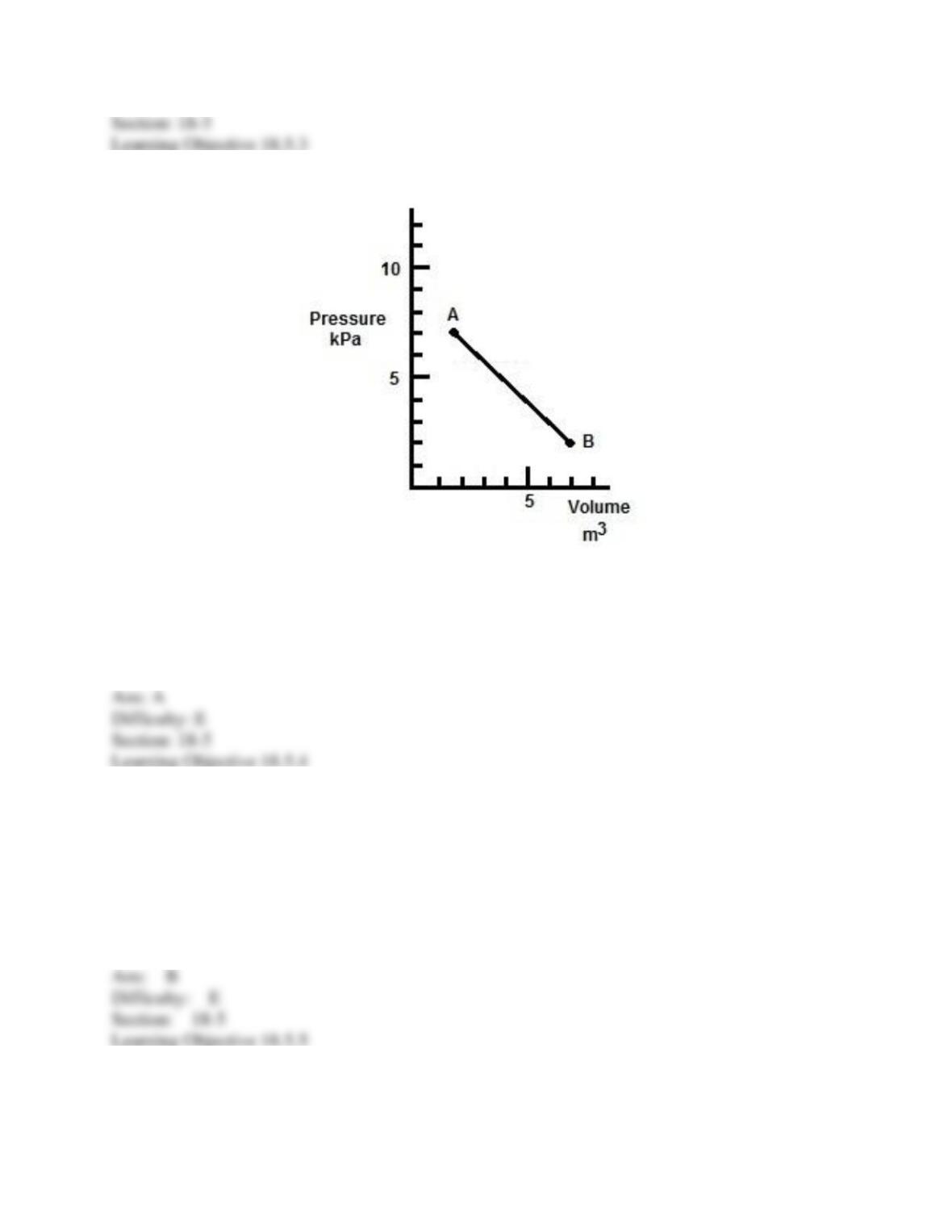
71. In the figure, what is the sign of the work done by the gas?
A) positive if the transition is A → B and negative if the transition is B → A
B) negative if the transition is A → B and positive if the transition is B → A
C) positive
D) negative
E) zero (no work is done)
72. According to the first law of thermodynamics, applied to a gas, the increase in the internal
energy during any process:
A) equals the heat input minus the work done on the gas
B) equals the heat input plus the work done on the gas
C) equals the work done on the gas minus the heat input
D) is independent of the heat input
E) is independent of the work done on the gas
73. During an adiabatic process an object does 100 J of work and its temperature decreases by
5 K. During another process it does 25 J of work and its temperature decreases by 5 K. Its heat
capacity for the second process is:
A) 20 J/K
B) 24 J/K
C) 5 J/K
D) 15 J/K
E) 100 J/K
74. In a certain process a gas ends in its original thermodynamic state. Of the following, which
is possible as the net result of the process?
A) It is adiabatic and the gas does 50 J of work
B) The gas does no work but absorbs 50 J of energy as heat
C) The gas does no work but rejects 50 J of energy as heat
D) The gas rejects 50 J of heat and does 50 J of work
E) The gas absorbs 50 J of energy as heat and does 50 J of work
75. In the first law of thermodynamics, the sign of the heat transfer Q:
A) is positive if the system gives energy as heat to the environment and negative if it absorbs
energy as heat from the environment
B) is negative if the system gives energy as heat to the environment and positive if it absorbs
energy as heat from the environment
C) is always positive
D) is always negative
E) depends on the sign of the work being done
76. In the first law of thermodynamics, the change in internal energy ΔEint:
A) is always positive
B) is always negative
C) cannot be zero
D) tends to increase if heat energy is transferred to the gas, and tends to decrease if the gas does
work on its environment
E) tends to decrease if heat energy is transferred to the gas, and tends to increase if the gas does
work on its environment
77. In an adiabatic process:
A) the energy absorbed as heat equals the work done by the system on its environment
B) the energy absorbed as heat equals the work done by the environment on the system
C) the energy absorbed as heat equals the change in internal energy
D) the work done by the environment on the system equals the change in internal energy
E) the work done by the system on its environment equals the change in internal energy
78. A system undergoes an adiabatic process in which its internal energy increases by 20 J.
Which of the following statements is true?
A) 20 J of work was done on the system
B) 20 J of work was done by the system
C) the system received 20 J of energy as heat
D) the system lost 20 J of energy as heat
E) none of the above are true
79. In a constant-volume process with a gas,
A) no heat is exchanged with the environment
B) the internal energy of the gas does not change
C) the gas does no work
D) the pressure of the gas does not change
E) the temperature of the gas does not change
80. Of the following which might NOT be zero over one cycle of a cyclic process?
A) the change in the internal energy of the substance
B) the change in pressure of the substance
C) the work done by the substance
D) the change in the volume of the substance
E) the change in the temperature of the substance
81. In the free expansion of a gas,
A) the work done is zero but the heat transfer and change in internal energy may not be zero
B) the heat transfer is zero but the work done and the change in internal energy may not be zero
C) the change in internal energy is zero but the work done and the heat transfer may not be zero
D) the work done, the heat transfer, and the change in internal energy all may not be zero
E) the work done, the heat transfer, and the change in internal energy all are zero
82. The units of thermal conductivity might be:
A) calcm/(sC)
B) cal/(cmsC)
C) cals/(cmC)
D) cmsC/cal
E) C/(calcms)
83. Inside a room at a uniform comfortable temperature, metallic objects generally feel cooler
to the touch than wooden objects do. This is because:
A) a given mass of wood contains more heat than the same mass of metal
B) metal conducts heat better than wood
C) heat tends to flow from metal to wood
D) the equilibrium temperature of metal in the room is lower than that of wood
E) the human body, being organic, resembles wood more closely than it resembles metal
84. Which of the following statements pertaining to a vacuum flask (thermos) is NOT correct?
A) Silvering reduces radiation loss
B) Vacuum reduces conduction loss
C) Vacuum reduces convection loss
D) Vacuum reduces radiation loss
E) Glass walls reduce conduction loss
85. A thermos bottle works well because:
A) its glass walls are thin
B) silvering reduces convection
C) vacuum reduces heat radiation
D) silver coating is a poor heat conductor
E) none of the above
86. On a very cold day, a child puts his tongue against a fence post. It is much more likely that
his tongue will stick to a steel post than to a wooden post. This is because:
A) steel has a higher specific heat
B) steel is a better radiator of heat
C) steel has a higher specific gravity
D) steel is a better heat conductor
E) steel is a highly magnetic material
87. A slab of material has area A, thickness L, and thermal conductivity k. One of its surfaces
(P) is maintained at temperature T1 and the other surface (Q) is maintained at a lower
temperature T2. The rate of heat flow from P to Q is:
A) kA(T1 – T2)/L2
B) kL(T1 – T2)/A
C) kA(T1 – T2)/L
D) k(T1 – T2)/(LA)
E) LA(T1 – T2)/k
88. The rate of heat flow by conduction through a slab does NOT depend upon the:
A) temperature difference between opposite faces of the slab
B) thermal conductivity of the slab
C) slab thickness
D) cross-sectional area of the slab
E) specific heat of the slab
89. The rate of heat flow through a slab is Pcond. If the slab thickness is doubled, its
cross-sectional area is halved, and the temperature difference across it is doubled, then the rate of
heat flow becomes:
A) 2Pcond
B) Pcond/2
C) Pcond
D) Pcond/8
E) 8Pcond
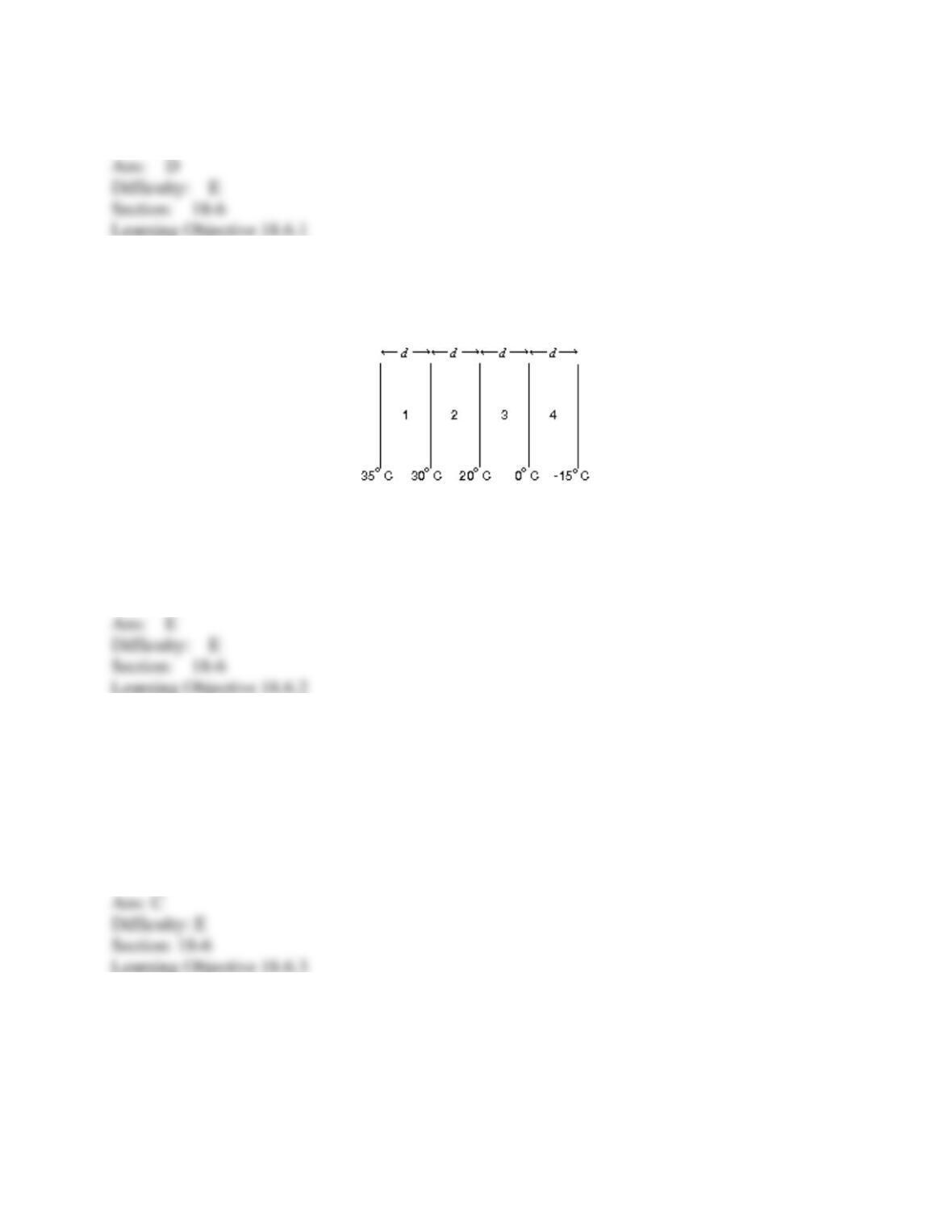
90. The diagram shows four slabs of different materials with equal thickness, placed side by
side. Heat flows from left to right and the steady-state temperatures of the interfaces are given.
Rank the materials according to their thermal conductivities, smallest to largest.
A) 1, 2, 3, 4
B) 2, 1, 3, 4
C) 1, 2, 4, 3
D) 3, 4, 2, 1
E) 4, 3, 2, 1
91. The diagram shows four slabs of different materials with equal thickness, placed side by side.
Heat flows from left to right and the steady-state temperatures of the interfaces are given. Rank
the materials according to their rates of thermal conduction, smallest to largest.
A) 1, 2, 3, 4
B) 2, 1, 3, 4
C) 1, 2, 4, 3
D) 3, 4, 2, 1
E) all are equal
92. A homeowner purchases insulation for her attic rated at R-15. She wants the attic insulated to
R-30. If the insulation she purchased is 10 cm thick, what thickness does she need to use?
A) 10 cm
B) 15 cm
C) 20 cm
D) 30 cm
E) 40 cm
93. Thermal energy can be transferred by convection:
A) only in solids
B) only in liquids
C) only in gases
D) through a vacuum
E) in either liquids or gases
94. An iron stove, used for heating a room by radiation, is more efficient if:
A) its inner surface is highly polished
B) its inner surface is covered with aluminum paint
C) its outer surface is covered with aluminum paint
D) its outer surface is rough and black
E) its outer surface is highly polished
95. An electric stove burner of diameter 20 cm is at a temperature of 250 °C. If σ = 5.67 x 10⁻⁸
W/m2·K4, at what rate is the burner radiating energy? Assume the emissivity ε = 0.6.
A) 4 W
B) 80 W
C) 320 W
D) 1600 W
E) 8000 W
96. To help keep buildings cool in the summer, dark colored window shades have been
replaced by light colored shades. This is because light colored shades:
A) are more pleasing to the eye
B) absorb more sunlight
C) reflect more sunlight
D) transmit more sunlight
E) have a lower thermal conductivity