aChapter: Chapter 33
Learning Objectives
LO 33.1.0 Solve problems related to electromagnetic waves.
LO 33.1.1 In the electromagnetic spectrum, identify the relative wavelengths (longer or shorter)
of AM radio, FM radio, television, infrared light, visible light, ultraviolet light, x rays, and
gamma rays.
LO 33.1.2 Describe the transmission of an electromagnetic wave by an LC oscillator and an
antenna.
LO 33.1.3 For a transmitter with an LC oscillator, apply the relationships between the oscillator’s
inductance L, capacitance C, and angular frequency ω, and the emitted wave’s frequency f and
wavelength λ.
LO 33.1.4 Identify the speed of an electromagnetic wave in vacuum (and approximately in air).
LO 33.1.5 Identify that electromagnetic waves do not require a medium and can travel through
vacuum.
LO 33.1.6 Apply the relationship between the speed of an electromagnetic wave, the straight-line
distance traveled by the wave, and the time required for the travel.
LO 33.1.7 Apply the relationships between an electromagnetic wave’s frequency f, wavelength λ,
period T, angular frequency ω, and speed c.
LO 33.1.8 Identify that an electromagnetic wave consists of an electric component and a
magnetic component that are (a) perpendicular to the direction of travel, (b) perpendicular to
each other, and (c) sinusoidal waves with the same frequency and phase.
LO 33.1.9 Apply the sinusoidal equations for the electric and magnetic components of an EM
wave, written as functions of position and time.
LO 33.1.10 Apply the relationship between the speed of light c, the permittivity constant ε0, and
the permeability constant μ0.
LO 33.1.11 For any instant and position, apply the relationship between the electric field
magnitude E, the magnetic field magnitude B, and the speed of light c.
LO 33.1.12 Describe the derivation of the relationship between the speed of light c and the ratio
of the electric field amplitude E to the magnetic field amplitude B.
LO 33.2.0 Solve problems related to energy transport and the Poynting vector.
LO 33.2.1 Identify that an electromagnetic wave transports energy.
LO 33.2.2 For a target, identify that an EM wave’s rate of energy transport per unit area is given
by the Poynting vector 𝑆
⃗, which is related to the cross product of the electric field 𝐸
⃗
⃗
and
magnetic field 𝐵
⃗
⃗
.
LO 33.2.3 Determine the direction of travel (and thus energy transport) of an electromagnetic
wave by applying the cross product for the corresponding Poynting vector 𝑆
⃗.
LO 33.2.4 Calculate the instantaneous rate S of energy flow of an EM wave in terms of the
instantaneous electric field magnitude E.
LO 33.2.5 For the electric field component of an electromagnetic wave, relate the rms value Erms
to the amplitude Em.
LO 33.2.6 Identify an EM wave’s intensity I in terms of energy transport.
LO 33.2.7 Apply the relationships between an EM wave’s intensity I and the electric field’s rms
value Erms and amplitude Em.
LO 33.2.8 Apply the relationship between average power Pavg, energy transfer ΔE, and the time
Δt taken by that transfer, and apply the relationship between the instantaneous power P and the
rate of energy of energy transfer dE/dt.
LO 33.2.9 Identify an isotropic point source of light.
LO 33.2.10 For an isotropic point source of light, apply the relationship between the emission
power P, the distance r to a point of measurement, and the intensity I at that point.
LO 33.2.11 In terms of energy conservation, explain why the intensity from an isotropic point
source of light decreases as 1/r2.
LO 33.3.0 Solve problems related to radiation pressure.
LO 33.3.1 Distinguish between force and pressure.
LO 33.3.2 Identify that an electromagnetic wave transports momentum and can exert a force and
a pressure on a target.
LO 33.3.3 For a uniform electromagnetic beam that is perpendicular to a target area, apply the
relationships between that area, the wave’s intensity, and the force on the target, for both total
absorption and total backward reflection.
LO 33.3.4 For a uniform electromagnetic beam that is perpendicular to a target area, apply the
relationships between the wave’s intensity and the pressure on the target, for both total
absorption and total backward reflection.
LO 33.4.0 Solve problems related to polarization.
LO 33.4.1 Distinguish between polarized light and unpolarized light.
LO 33.4.2 For a light beam headed toward you, sketch representations of polarized light and
unpolarized light.
LO 33.4.3 When a beam is sent into a polarizing sheet, explain the function of the sheet in
terms of its polarizing direction (or axis) and the electric field component that is absorbed and
the component that is transmitted.
LO 33.4.4 For light that emerges from a polarizing sheet, identify its polarization relative to the
sheet’s polarizing direction.
LO 33.4.5 For a light beam incident perpendicularly on a polarizing sheet, apply the one-half
rule and the cosine-squared rule, distinguishing their uses.
LO 33.4.6 Distinguish between a polarizer and an analyzer.
LO 33.4.7 Explain what is meant if two sheets are crossed.
LO 33.4.8 When a beam is sent into a system of polarizing sheets, work through the sheets one
by one, finding the transmitted intensity and polarization.
LO 33.5.0 Solve problems related to reflection and refraction.
LO 33.5.1 With a sketch, show the reflection of a light ray from an interface and identify the
incident ray, the reflected ray, the normal, the angle of incidence, and the angle of reflection.
LO 33.5.2 For a reflection, relate the angle of incidence and the angle of reflection.
LO 33.5.3 With a sketch, show the refraction of a light ray at an interface and identify the
incident ray, the refracted ray, the normal on each side of the interface, the angle of incidence,
and the angle of refraction.
LO 33.5.4 For refraction of light, apply Snell’s law to relate the index of refraction and the angle
of the ray on one side of the interface to those quantities on the other side.
LO 33.5.5 In the sketch and using a line along the undeflected direction, show the refraction of
light from one material into a second material that has a greater index, a smaller index, and the
same index, and, for each situation, describe the refraction in terms of the ray being bent toward
the normal, away from the normal, or not at all.
LO 33.5.6 Identify that refraction occurs only at an interface and not in the interior of a material.
LO 33.5.7 Identify chromatic dispersion.
LO 33.5.8 For a beam of red and blue light (or other colors) refracting at an interface, identify
which color has the greater bending and which has the greater angle of refraction when they
enter a material with a lower index than the initial material and a greater index.
LO 33.5.9 Describe how the primary and secondary rainbows are formed and explain why they
are circular arcs.
LO 33.6.0 Solve problems related to total internal reflection.
LO 33.6.1 With sketches, explain total internal reflection and include the angle of incidence, the
critical angle, and the relative values of the indexes of refraction on the two sides of the
interface.
LO 33.6.2 Identify the angle of refraction for incidence at a critical angle.
LO 33.6.3 For a given pair of indexes of refraction, calculate the critical angle.
LO 33.7.0 Solve problems related to polarization by reflection.
LO 33.7.1 With sketches, explain how unpolarized light can be converted to polarized light by
reflection from an interface.
LO 33.7.2 Identify Brewster’s angle.
LO 33.7.3 Apply the relationship between Brewster’s angle and the indexes of refraction on the
two sides of an interface.
LO 33.7.4 Explain the function of polarizing sunglasses.
Multiple Choice
1. The theoretical upper limit for the frequency of electromagnetic waves is:
A) just slightly greater than that of red light
B) just slightly less than that of blue light
C) the greatest x-ray frequency
D) none of the above (there is no upper limit)
E) none of the above (but there is an upper limit)
2. An electromagnetic wave is generated by:
A) any moving charge
B) any accelerating charge
C) only a charge with changing acceleration
D) only a charge moving in a circle
E) only a charge moving in a straight line
3. An electromagnetic wave is traveling in the positive x direction with its electric field along
the z axis and its magnetic field along the y axis. The fields are related by:
A) E/x =
00B/x
B) E/x =
00B/t
C) B/x =
00E/x
D) B/x =
00E/t
E) B/x = –
00E/t
4. Select the correct statement:
A) ultraviolet light has a longer wavelength than infrared
B) blue light has a higher frequency than X rays
C) radio waves have a higher frequency than gamma rays
D) gamma rays have a higher frequency than infrared waves
E) electrons are a type of electromagnetic wave
5. Consider radio waves (r), visible light (v), infrared (i), X rays (x), and ultraviolet (u). In
order of increasing frequency, they are:
A) r, v, i, x, u
B) r, i, v, u, x
C) i, r, v, u, x
D) x, u, v, i, r
E) r, i, v, x, u
6. The order of increasing wavelength for blue (b), green (g), red (r), and yellow (y) light is:
A) r, y, g, b
B) r, g, y, b
C) g, y, b, r
D) b, g, y, r
E) b, y, g, r
7. Of the following human eyes are most sensitive to:
A) red light
B) violet light
C) blue light
D) green light
E) none of these (they are equally sensitive to all colors)
8. Radio waves differ from visible light waves in that radio waves:
A) travel slower
B) have a higher frequency
C) travel faster
D) have a lower frequency
E) require a material medium
9. A transmitter consists of an LC circuit with an inductance of 15 µH and a capacitance of 23
pF. What is the wavelength of the electromagnetic waves it emits?
A) 29 mm
B) 65 mm
C) 5.6 m
D) 35 m
E) 220 m
10. Which of the following is NOT true for electromagnetic waves?
A) they consist of changing electric and magnetic fields
B) they travel at different speeds in vacuum, depending on their frequency
C) they transport energy
D) they transport momentum
E) they can be reflected
11. Maxwell’s equations predict that the speed of light in free space is:
A) an increasing function of frequency
B) a decreasing function of frequency
C) independent of frequency
D) a function of the distance from the source
E) a function of the size of the source
12. The speed of light in vacuum is about:
A) 1100 ft/s
B) 93 106 mi/s
C) 6 1023 m/s
D) 3 1010 cm/s
E) 186,000 mph
13. Which of the following types of electromagnetic radiation travels at the greatest speed in
vacuum?
A) Radio waves
B) Visible light
C) X rays
D) Gamma rays
E) All of these travel at the same speed
14. The sun is about 1.5 1011 m away. The time for light to travel this distance is about:
A) 4.5 1019 s
B) 8 s
C) 8 min
D) 8 hr
E) 8 yr
15. The time for a radar signal to travel to the Moon and back, a one-way distance of about 3.8
108 m, is:
A) 1.3 s
B) 2.5 s
C) 8 s
D) 8 min
E) 1 106 s
16. Visible light has a frequency of about:
A) 5 1018 Hz
B) 5 1016 Hz
C) 5 1014 Hz
D) 5 1012 Hz
E) 5 1010 Hz
17. Radio waves of wavelength 3 cm have a frequency of:
A) 1 MHz
B) 9 MHz
C) 100 MHz
D) 900 MHz
E) 10,000 MHz
18. Radio waves of wavelength 300 m have a frequency of:
A) 10–6 kHz
B) 108 kHz
C) 500 kHz
D) 1 MHz
E) 9 MHz
19. If the electric field in a plane electromagnetic wave is given by Emsin[(3 106 m–1 x) –
t],
the value of
is:
A) 0.01 rad/s
B) 10 rad/s
C) 100 rad/s
D) 9 1014 rad/s
E) 9 1016 rad/s
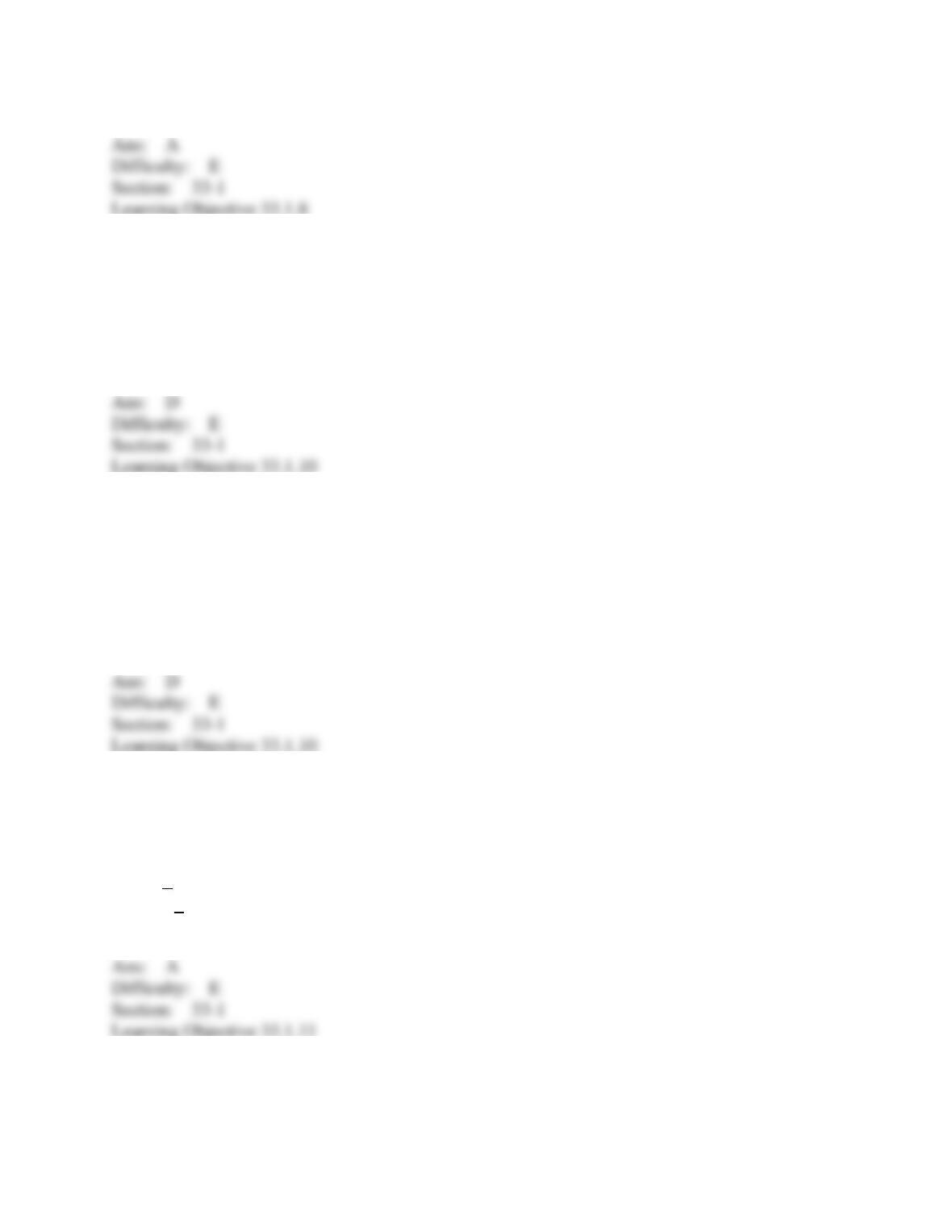
20. The electric field for a plane electromagnetic wave traveling in the +y direction is shown.
Consider a point where 𝐸
⃗
⃗
is in the +z direction. The 𝐵
⃗
⃗
field is:
A) in the +x direction and in phase with the 𝐸
⃗
⃗
field
B) in the –x direction and in phase with the 𝐸
⃗
⃗
field
C) in the +x direction and 1/4 wave out of phase with the 𝐸
⃗
⃗
field
D) in the +z direction and in phase with the 𝐸
⃗
⃗
field
E) in the +z direction and 1/4 wave out of phase with the 𝐸
⃗
⃗
field
21. The product µ0ε0 has the same units as:
A) (velocity)2
B) (velocity)1/2
C) 1/velocity
D) 1/velocity2
E) 1/velocity1/2
22. Maxwell’s equations predict that the speed of electromagnetic waves in free space is given
by:
A) µ0ε0
B) (µ0ε0)1/2
C) 1/ µ0ε0
D) 1/(µ0ε0)1/2
E) 1/(µ0ε0)2
23. In a plane electromagnetic wave in vacuum, the ratio E/B of the amplitudes in SI units of
the two fields is:
A) the speed of light
B) an increasing function of frequency
C) a decreasing function of frequency
D) √2
E) 1/√2
24. If the magnetic field in a plane electromagnetic wave is along the y axis and its magnitude is
given by Bm sin (kx –
t) in SI units, then the electric field is along the z axis and its magnitude
is given by
A) (cBm) cos (kx –
t)
B) –(cBm) cos (kx –
t)
C) (cBm) sin (kx –
t)
D) –(cBm) sin (kx –
t)
E) Bm cos (kx –
t)
25. If the electric field in a plane electromagnetic wave is along the y axis and its magnitude is
given by Em sin (kx +
t) in SI units, then the magnetic field is along the z axis and its magnitude
is given by:
A) (Em/c) cos (kx +
t)
B) –(Em/c) cos (kx +
t)
C) (Em/c) sin (kx +
t)
D) –(Em/c) sin (kx +
t)
E) Em cos (kx +
t)
26. If the amplitude of the electric field in a plane electromagnetic wave is 100 V/m then the
amplitude of the magnetic field is:
A) 3.3 10–7 T
B) 6.7 10–7 T
C) 0.27 T
D) 8.0 107 T
E) 3.0 1010 T
27. The dimensions of 𝑆
⃗=1
𝜇0𝐸
⃗
⃗
× 𝐵
⃗
⃗
are:
A) J/m2
B) J/s
C) W/s
D) W/m2
E) J/m3
28. The time averaged energy in a sinusoidal electromagnetic wave is:
A) overwhelmingly electrical
B) slightly more electrical than magnetic
C) equally divided between the electric and magnetic fields
D) slightly more magnetic than electrical
E) overwhelmingly magnetic
29. The rate of energy transport of an electromagnetic wave per unit area is given by:
A) the vector 𝐸
⃗
⃗
× 𝐵
⃗
⃗
B) the Poynting vector 𝑆
⃗
C) the Poynting vector 𝑆
⃗ divided by the area
D) the Poynting vector 𝑆
⃗ divided by time
E) the Poynting vector 𝑆
⃗ multiplied by time
30. For an electromagnetic wave the direction of the vector 𝐸
⃗
⃗
× 𝐵
⃗
⃗
gives:
A) the direction of the electric field
B) the direction of the magnetic field
C) the direction of wave propagation
D) the direction of the electromagnetic force on a proton
E) the direction of the emf induced by the wave
31. At a certain point and a certain time the electric field of an electromagnetic wave is in the
negative z direction and the magnetic field is in the positive y direction. Which of the following
statements is true?
A) Energy is being transported in the positive x direction but half a cycle later, when the
electric field is in the opposite direction, it will be transported in the negative x direction.
B) Energy is being transported in the positive x direction and half a cycle later, when the
electric field is in the opposite direction, it will still be transported in the positive x direction.
C) Energy is being transported in the negative x direction but half a cycle later, when the
electric field is in the opposite direction, it will be transported in the positive x direction.
D) Energy is being transported in the negative x direction and half a cycle later, when the
electric field is in the opposite direction, it will still be transported in the negative x direction.
E) None of the above is true.
32. An electromagnetic wave is transporting energy in the negative y direction. At one point
and one instant the magnetic field is in the positive x direction. The electric field at that point
and instant is:
A) positive y direction
B) negative y direction
C) positive z direction
D) negative z direction
E) negative x direction
33. A sinusoidal electromagnetic wave has an electric field whose rms value is 100 V/m. What is
the instantaneous rate S of energy flow for this wave?
A) 1.7 10–4 W/m2
B) 13 W/m2
C) 27 W/m2
D) 1.0 105 W/m2
E) 4.0 1010 W/m2
34. The magnetic field in a sinusoidal light wave has an amplitude of 3.3 10–7 T. The
intensity of the wave is:
A) 1.7 10–4 W/m2
B) 13 W/m2
C) 27 W/m2
D) 1.0 105 W/m2
E) 4.0 1010 W/m2
35. A sinusoidal electromagnetic wave with an electric field amplitude of 100 V/m is incident
normally on a surface with an area of 1 cm2 and is completely absorbed. The energy absorbed in
10 s is:
A) 1.3 mJ
B) 13 mJ
C) 27 mJ
D) 130 mJ
E) 270 mJ
36. A point source emits electromagnetic energy at a rate of 100 W. The intensity 10 m from
the source is:
A) 10 W/m2
B) 1.6 W/m2
C) 1.0 W/m2
D) 0.080 W/m2
E) 0.024W/m2
37. The light intensity 10 m from a point source is 1000 W/m2. The intensity 100 m from the
same source is:
A) 1000 W/m2
B) 100 W/m2
C) 10 W/m2
D) 1 W/m2
E) 0.1 W/m2
38. When the distance between a point source of light and a light meter is reduced from 6.0 m
to 2.0 m, the intensity of illumination at the meter will be the original value multiplied by:
A) 3
B) 9
C) 1/3
D) 1/9
E) 1
39. Evidence that electromagnetic waves carry momentum is:
A) the tail of a comet points away from the sun
B) electron flow through a wire generates heat
C) a charged particle in a magnetic field moves in a circular orbit
D) heat can be generated by rubbing two sticks together
E) the Doppler effect
40. A company claims to have developed material that absorbs light energy without a transfer
of momentum. Such material is:
A) impossible
B) possible, but very expensive
C) inexpensive and already in common use
D) in use by NASA but is not commercially available
E) a breakthrough in high technology
41. Light of uniform intensity shines perpendicularly on a totally absorbing surface, fully
illuminating the surface. If the area of the surface is decreased:
A) the radiation pressure increases and the radiation force increases
B) the radiation pressure increases and the radiation force decreases
C) the radiation pressure stays the same and the radiation force increases