Archives
BUA 132 Final
The view that effective leaders need to be aware of, feel comfortable with, and act consistently with their values, personality, and self-concept is known as transformational leadership. Job evaluation mainly supports the competency approach to rewards. Answer: FALSE Many organizations […]
BUA 134
The five interpersonal conflict management styles are distinguished by the level of interdependence between the conflicting parties. Goal setting potentially improves employee performance by increasing motivation and clarifying role perceptions. Answer: TRUE Goal setting is the process of motivating employees […]
BUA 169 Midterm
The ideas that form during the illumination stage of creativity need to be verified through logical evaluation and experimentation. Role perceptions are important because they represent how good an employee feels about their job and increase motivation. Answer: FALSE Role […]
BUA 184 Test 2
Language reflects an organization’s dominant values but not the values of its subcultures. Increasing the core job characteristics will not increase employee motivation for those who lack the required skills. Answer: TRUE Job design doesn’t increase work motivation for everyone […]
BUA 227 Midterm 1
Research suggests that decision makers do not evaluate several alternatives when they find an opportunity. Employees are more likely to quit their jobs and be absent from work if they are dissatisfied with their jobs. Answer: TRUE Job dissatisfaction builds […]
BUA 252 Test
Temporary cross-functional teams can be used to encourage informal communication as a coordinating mechanism. The “Big Five” personality dimensions represent five clusters that represent most personality traits. Answer: TRUE The most widely respected clustering of personality traits is the five-factor […]
BUA 301 Test 2
One problem with negotiation is that it tends to produce compliance rather than commitment to the change process. Fear of the unknown usually motivates employees to support organizational change. Answer: FALSE When employees do not know the probability of good […]
BUA 369 Test 2
Some team-building interventions clarify the team’s performance goals and increase the team’s motivation to accomplish these goals. People with strong Machiavellian values are more likely to engage in organizational politics. Answer: TRUE People with high Machiavellian values seldom trust coworkers […]
BUA 430
Continuance commitment motivates employees to increase their work effort beyond expectations. Job satisfaction represents a person’s evaluation of his or her job and work context. Answer: TRUE Job satisfaction is a person’s evaluation of his or her job and work […]
BUA 580 Midterm 2
In the achievement-oriented leadership style, leaders expect employees to perform at an optimal level and set subordinate goals. Workforce diversity potentially improves decision making and team performance on complex tasks. Answer: TRUE Diversity is an advantage because it provides diverse […]
BUA 717 Test
The expectancy theory of motivation states that people naturally direct their effort towards behaviors they believe are most likely to lead to desired outcomes. Employees are more likely to engage in self-monitoring in companies that emphasize infrequent measurement of performance. […]
BUA 771
Organizational rewards are powerful systems that refreeze behaviors. All organizations have a collective sense of purpose, whether it’s producing oil or creating the fastest Internet search engine. Answer: TRUE A key feature of organizations is that its members have a […]
BUA 899
Consistency occurs when we are confident about “who we are,” can describe our important identities to others, and provide the same description of ourselves across time. Employees are more committed to implementing a solution when they are involved in making […]
BUS 101
Organizations should use transformational leadership instead of managerial leadership. Display rules are norms that require employees to show certain emotions and to withhold others. Answer: TRUE Display rules are norms that require employees to show certain emotions and to withhold […]
BUS 469 Quiz 3
The nominal group technique removes the problems of evaluation apprehension and production blocking. An individual’s beliefs about the terms and conditions of a reciprocal exchange agreement between that person and an employer is called a mental model. Answer: FALSE The […]
BUS 666 Midterm
Many of the popular organizational culture models and measures oversimplify the variety of organizational cultures and correctly assume that organizations can easily be identified within these categories. Brooks’s law says that adding more people to a late software project only […]
BUS 730 Test 2
Corporate social responsibility has no effect on financial performance. People with a high need for achievement tend to avoid risks and prefer working in teams. Answer: FALSE People with a strong need for achievement (nAch) want to accomplish reasonably challenging […]
BUS 764 Test 2
The self-fulfilling prophecy tends to be stronger when employees are new to the job than when employees have worked in that job for a few years. Job status-based rewards potentially motivate employees to compete with each other. Answer: TRUE Job […]
BUS 773 Test
When employees apply a cost-benefit analysis to a potential change, they consider only their own self-interest. Work environments influence our behavior, so they necessarily encourage or discourage values-consistent behavior. Answer: TRUE Work environments influence our behavior, at least in the […]
BUS 879 Test 1
Managing and satisfying the interests of stakeholders is not very challenging because stakeholders all have the same interests and goals. Individualism and collectivism are mutually exclusive values found in certain countries and places. Answer: FALSE Contrary to popular belief, individualism […]
BUS 888 Quiz 3
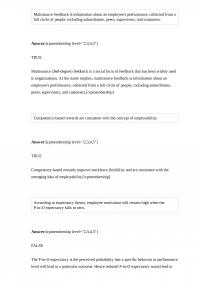
Multisource feedback is information about an employee’s performance, collected from a full circle of people, including subordinates, peers, supervisors, and customers. Competency-based rewards are consistent with the concept of employability. Answer: TRUE Competency-based rewards improve workforce flexibility and are consistent […]
EMBA 182 Final
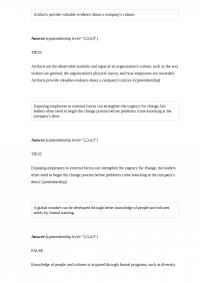
Artifacts provide valuable evidence about a company’s culture. Exposing employees to external forces can strengthen the urgency for change, but leaders often need to begin the change process before problems come knocking at the company’s door. Answer: TRUE Exposing employees […]
EMBA 242
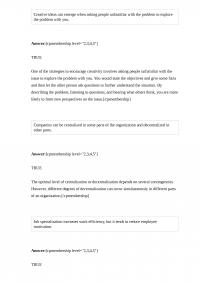
Creative ideas can emerge when asking people unfamiliar with the problem to explore the problem with you. Companies can be centralized in some parts of the organization and decentralized in other parts. Answer: TRUE The optimal level of centralization or […]
EMBA 676
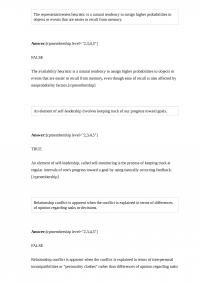
The representativeness heuristic is a natural tendency to assign higher probabilities to objects or events that are easier to recall from memory. An element of self-leadership involves keeping track of our progress toward goals. Answer: TRUE An element of self-leadership, […]
EMBA 783 Test
Organizations should view the grapevine as a competitor. If a company chooses a low-cost strategy, an organic structure is preferred because it maximizes production and service efficiency. Answer: FALSE If a company chooses a low-cost strategy, a mechanistic structure is […]
Management 206 Test
One type of factor that can change a person’s moral sensitivity is expertise or knowledge of prescriptive norms or rules. An organization’s structure is the same as its organizational chart. Answer: FALSE Although the topic of organizational structure typically conjures […]
Management 228 Midterm 2
Teams develop their first real sense of cohesion during the norming stage of team development. When conflict reduces each side’s motivation to communicate, they rely more on stereotypes to reinforce their perceptions of the other side. Answer: TRUE The verbal […]
Management 232 Quiz
Leadership is the ability to influence, motivate, and enable others to contribute to organizational effectiveness. Emotional dissonance occurs when two or more people with notable differences in emotional intelligence interact with each other. Answer: FALSE Emotional labor creates conflict between […]
Management 419 Quiz 2
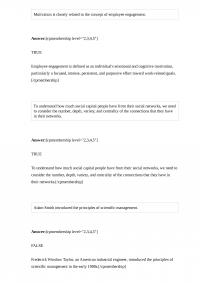
Motivation is closely related to the concept of employee engagement. To understand how much social capital people have from their social networks, we need to consider the number, depth, variety, and centrality of the connections that they have in their […]
Management 619
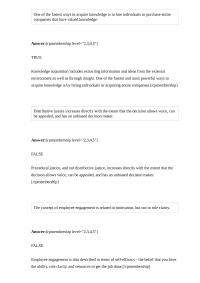
One of the fastest ways to acquire knowledge is to hire individuals or purchase entire companies that have valued knowledge. Distributive justice increases directly with the extent that the decision allows voice, can be appealed, and has an unbiased decision […]
Management 658 Midterm 1
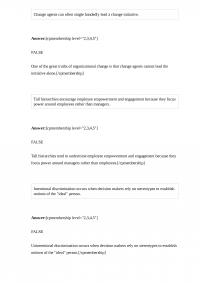
Change agents can often single handedly lead a change initiative. Tall hierarchies encourage employee empowerment and engagement because they focus power around employees rather than managers. Answer: FALSE Tall hierarchies tend to undermine employee empowerment and engagement because they focus […]
Management 696 Test 1
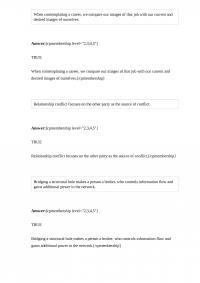
When contemplating a career, we compare our images of that job with our current and desired images of ourselves. Relationship conflict focuses on the other party as the source of conflict. Answer: TRUE Relationship conflict focuses on the other party […]
Management 718
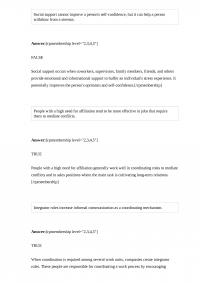
Social support cannot improve a person’s self-confidence, but it can help a person withdraw from a stressor. People with a high need for affiliation tend to be more effective in jobs that require them to mediate conflicts. Answer: TRUE People […]
Management 744 Quiz
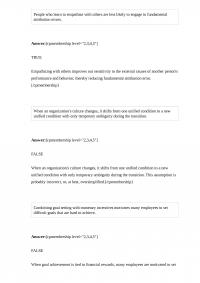
People who learn to empathize with others are less likely to engage in fundamental attribution errors. When an organization’s culture changes, it shifts from one unified condition to a new unified condition with only temporary ambiguity during the transition. Answer: […]
Management 876 Test
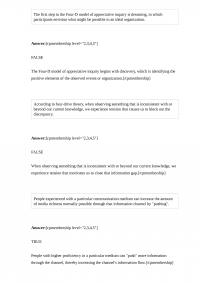
The first step in the Four-D model of appreciative inquiry is dreaming, in which participants envision what might be possible in an ideal organization. According to four-drive theory, when observing something that is inconsistent with or beyond our current knowledge, […]
MGMT 114
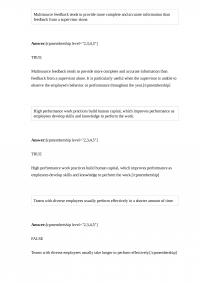
Multisource feedback tends to provide more complete and accurate information than feedback from a supervisor alone. High performance work practices build human capital, which improves performance as employees develop skills and knowledge to perform the work. Answer: TRUE High performance […]
MGMT 287 Final
The best way to manage resistance to change among those who will clearly lose out from the change is to introduce coercion practices. According to research, although telecommuting significantly increases employee stress and reduces productivity and job satisfaction, it makes […]
MGMT 343
Process losses are the resources expended to develop and maintain an effective team. Management by walking around minimizes the problem of filtering in the communication process. Answer: TRUE Direct communication strategies such as management by walking around potentially minimize filtering […]
MGMT 502 Midterm
Organizational politics tends to increase in situations where decisions become routine and programmed. Servant leaders try to understand employees’ needs and facilitate their work performance. Answer: TRUE Servant leaders are coaches, stewards, and facilitators. Leadership is an obligation to understand […]
MGMT 510
Morphological analysis is a test used to identify people with a creative personality. The kinds of desks an organization has can convey cultural meaning. Answer: TRUE Desks, chairs, office space, and wall hangings are just a few of the items […]
MGMT 633 Quiz 3
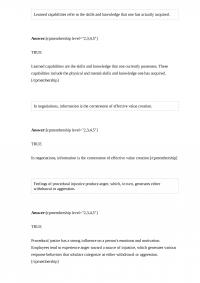
Learned capabilities refer to the skills and knowledge that one has actually acquired. In negotiations, information is the cornerstone of effective value creation. Answer: TRUE In negotiations, information is the cornerstone of effective value creation. Feelings of procedural injustice produce […]
MGMT 803 Midterm 2
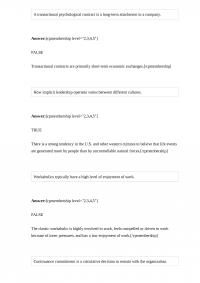
A transactional psychological contract is a long-term attachment to a company. How implicit leadership operates varies between different cultures. Answer: TRUE There is a strong tendency in the U.S. and other western cultures to believe that life events are generated […]
MGMT 826 Test 2
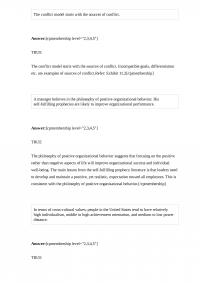
The conflict model starts with the sources of conflict. A manager believes in the philosophy of positive organizational behavior. His self-fulfilling prophecies are likely to improve organizational performance. Answer: TRUE The philosophy of positive organizational behavior suggests that focusing on […]
MGT 117
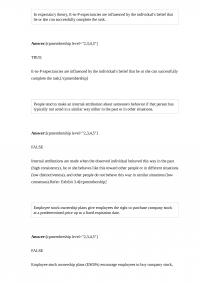
In expectancy theory, E-to-P expectancies are influenced by the individual’s belief that he or she can successfully complete the task. People tend to make an internal attribution about someone’s behavior if that person has typically not acted in a similar […]
MGT 128 Test 2
Scientific management is mainly associated with high levels of job specialization. Identification-based trust alone cannot sustain a team’s relationship, because it relies on deterrence. Answer: FALSE Calculus-based trust alone cannot sustain a team’s relationship, because it relies on deterrence. Supervisors […]
MGT 233 Test 2
People might gain power by convincing others that they have something of value. Exchange, ingratiation, and persuasion are considered “hard” influence tactics. Answer: FALSE Persuasion, ingratiation and impression management, and exchange are called ‘soft” tactics because they rely more on […]
MGT 242 Quiz 2
In most self-directed work teams, the supervisor assigns tasks that individual team members perform. Organizations with adaptive cultures are unable to maintain a stable value system and, consequently, tend to perform poorly in the long run. Answer: FALSE An adaptive […]
MGT 268 Quiz
A significant discovery in equity theory research is that people tend to keep one specific comparison other throughout their working lives. Shared leadership is the view that anyone in the organization may be a leader in various ways and at […]
MGT 275
Most organizational culture models oversimplify the diversity of cultural values in organizations. Teams are well-suited to complex work that can be divided into more specialized roles. Answer: TRUE Teams are particularly well suited when the complex work can be divided […]
MGT 376
In quiet settings, most information is communicated verbally rather than nonverbally. Social identity theory provides one of the reasons why people join informal groups. Answer: TRUE One reason people join informal groups is provided by social identity theory, which states […]
MGT 419 Final
Management by walking around occurs when senior executives get out of their offices and communicate face-to-face with employees. Emotional dissonance refers to the conflict experienced between the emotions we are required to display and our true emotions in that situation. […]
MGT 471 Quiz 1
University students tend to value people-oriented instructors over task-oriented instructors. Organizations tend to become less formalized as they age and grow larger in terms of the number of employees. Answer: FALSE Older companies tend to become more formalized because work […]
MGT 479 Quiz 3
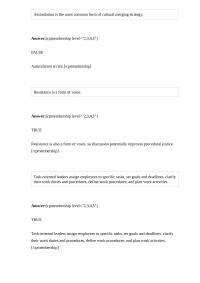
Assimilation is the most common form of cultural merging strategy. Resistance is a form of voice. Answer: TRUE Resistance is also a form of voice, so discussion potentially improves procedural justice. Task-oriented leaders assign employees to specific tasks, set goals […]
MGT 546 Homework
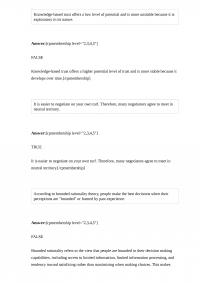
Knowledge-based trust offers a low level of potential and is more unstable because it is exploratory in its nature. It is easier to negotiate on your own turf. Therefore, many negotiators agree to meet in neutral territory. Answer: TRUE It […]
MGT 696 Midterm 1
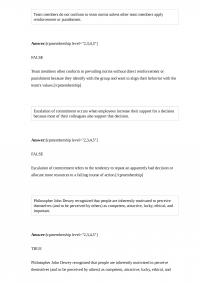
Team members do not conform to team norms unless other team members apply reinforcement or punishment. Escalation of commitment occurs when employees increase their support for a decision because most of their colleagues also support that decision. Answer: FALSE Escalation […]
MGT 838 Midterm 1
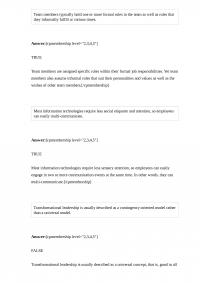
Team members typically hold one or more formal roles in the team as well as roles that they informally fulfill at various times. Most information technologies require less social etiquette and attention, so employees can easily multi-communicate. Answer: TRUE Most […]
MGT 873 Test
The sensing stage of active listening includes empathizing and organizing information. Countervailing power is the capacity of a person, team, or organization to keep a more powerful person or group in the exchange relationship. Answer: TRUE Countervailing power is the […]
MHR 137
Conflict tends to be higher when rules and procedures exist. Job performance leads to improved job satisfaction only when performance is linked to valued rewards. Answer: TRUE Job performance might lead to job satisfaction (rather than vice versa), but only […]
MHR 150 Midterm 1
Prevention, forecasting, and absorption are three types of expertise that cope with uncertainty in organizations. Homogenization and differentiation are two activities in the process of forming and maintaining our social identity. Answer: TRUE The combination of social identity and self-enhancement […]
MHR 150 Test 2
Organizational countercultures can potentially create conflict and dissension among employees. Equity theory research has found that employees who feel over-rewarded tend to alter their perceptions of inputs and outcomes rather than attempt to actually change them. Answer: TRUE A common […]
MHR 226
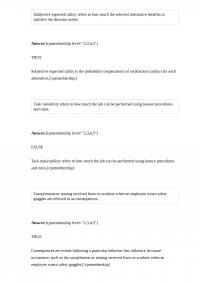
Subjective expected utility refers to how much the selected alternative benefits or satisfies the decision maker. Task variability refers to how much the job can be performed using known procedures and rules. Answer: FALSE Task analyzability refers to how much […]
MHR 304 Quiz 2
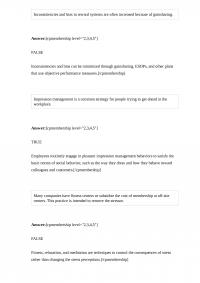
Inconsistencies and bias in reward systems are often increased because of gainsharing. Impression management is a common strategy for people trying to get ahead in the workplace. Answer: TRUE Employees routinely engage in pleasant impression management behaviors to satisfy the […]
MHR 376 Midterm
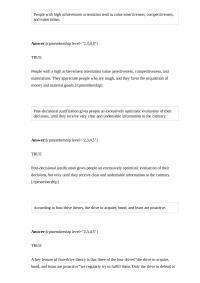
People with high achievement orientation tend to value assertiveness, competitiveness, and materialism. Post-decisional justification gives people an excessively optimistic evaluation of their decisions, until they receive very clear and undeniable information to the contrary. Answer: TRUE Post-decisional justification gives people […]
MHR 420 Test
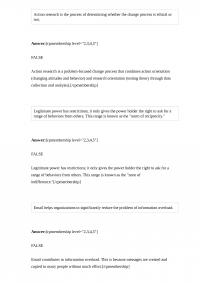
Action research is the process of determining whether the change process is ethical or not. Legitimate power has restrictions; it only gives the power holder the right to ask for a range of behaviors from others. This range is known […]
MHR 434 Homework
By avoiding written documentation of how to operate equipment or serve customers, employees are maximizing their expert power through non-substitutability. Mental imagery excludes visualizing completion of a task. Answer: FALSE One part of mental imagery helps us anticipate things that […]
MHR 458
Employee involvement potentially improves both the decision-making quality and the commitment of employees. Contingencies such as size, technology, and environment do not necessarily determine an organization’s structure. Answer: TRUE Although size, technology, and environment influence the optimal organizational structure, these […]
MHR 482 Quiz 3
Diversity awareness programs mainly educate employees about the value of diversity and problems with stereotyping. Buffers tend to resolve conflict by reducing the level of interdependence between the conflicting parties. Answer: TRUE A buffer is any mechanism that loosens the […]
MHR 762 Quiz 1
In a typical matrix structure, several satellite organizations are bee-hived around a core firm. Managers should arbitrate decisions when employees cannot resolve their differences alone. Answer: TRUE When employees cannot resolve their differences through mediation, arbitration seems to work best […]
MHR 834 Quiz 3
Cognitive dissonance occurs only when others observe an inconsistency between our beliefs, feelings, and behavior. Organizational socialization begins on the first day of employment and continues throughout one’s career within the company. Answer: FALSE Organizational socialization is a continuous process, […]
OBHR 129 Midterm
Like self-enhancement, self-verification does not include seeking feedback that is not necessarily flattering. Employees can minimize the stress from emotional labor by actually changing their emotions to match the job requirements (deep acting), rather than displaying emotions contrary to their […]
OBHR 171 Midterm
As people become more powerful they tend to become less goal-oriented, less motivated, and more focused on gaining additional power. Motivation is an external force on the person that causes him/her to engage in specific behaviors. Answer: FALSE Motivation represents […]
OBHR 319 Homework
Nonprogrammed decisions require all steps in the decision model because the problems they present are new, complex, or ill-defined. A potentially useful creative practice is to list different dimensions of a system and the elements of each dimension, then think […]
OBHR 323 Test
Task forces are temporary groups that typically investigate a particular problem and disband when the decision is made. When people join teams, they typically have a very low level of trust in the other team members. Answer: FALSE Employees typically […]
OBHR 388 Test
The distributive justice principle states that everyone should receive the same rewards in life. Organizations that have high employee turnover will be better able to retain intellectual capital within the organization. Answer: FALSE Human capital – the knowledge, skills, and […]
OBHR 392
According to the open systems perspective, most organizations have one working part rather than many sub-components. Goal setting is more effective when employees can easily complete the goals assigned to them. Answer: FALSE Challenging goals (rather than easy ones) cause […]
OBHR 485
Some level of stress is a necessary part of life for every individual. Organizational behavior takes the view that only people in management and other positions of formal authority in organizations can be leaders. Answer: FALSE According to the shared […]
OBHR 625 Quiz
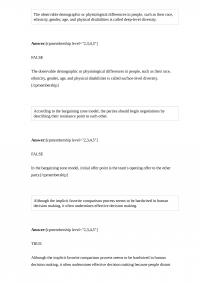
The observable demographic or physiological differences in people, such as their race, ethnicity, gender, age, and physical disabilities is called deep-level diversity. According to the bargaining zone model, the parties should begin negotiations by describing their resistance point to each […]
OBHR 632 Midterm 1
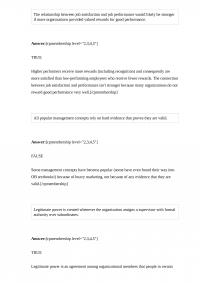
The relationship between job satisfaction and job performance would likely be stronger if more organizations provided valued rewards for good performance. All popular management concepts rely on hard evidence that proves they are valid. Answer: FALSE Some management concepts have […]
OBHR 682 Midterm
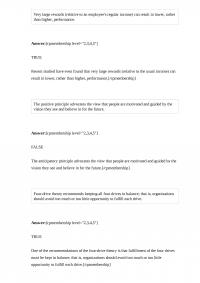
Very large rewards (relative to an employee’s regular income) can result in lower, rather than higher, performance. The positive principle advocates the view that people are motivated and guided by the vision they see and believe in for the future. […]
OBHR 706 Quiz 2
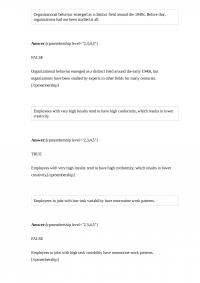
Organizational behavior emerged as a distinct field around the 1940s. Before that, organizations had not been studied at all. Employees with very high loyalty tend to have high conformity, which results in lower creativity. Answer: TRUE Employees with very high […]
OBHR 889 Quiz 3
People are empowered when they feel self-determination, meaning, competence, and impact regarding their role in the organization. Social identity is a comparative process, and the comparison begins with categorical thinking. Answer: TRUE Social identity is a comparative process, and the […]
PRST 100 Quiz 2
Mental imagery helps us to anticipate and work out solutions to potential obstacles in our work. Communication refers to the process by which information is transmitted and understood between two or more people. Answer: TRUE Communication refers to the process […]
PRST 223 Midterm
Individuals with high neuroticism usually experience lower stress levels because they are less prone to anxiety. Employees who experience job dissatisfaction, workplace incivility, or work-related stress are more likely to be absent or late for work because taking time off […]
PRST 295 Quiz
According to four-drive theory, organizations maximize motivation by focusing employees on opportunities to fulfill only one of the four drives. When work is divided among people, a coordinating mechanism is needed to ensure that everyone works in concert. Answer: TRUE […]
PRST 423
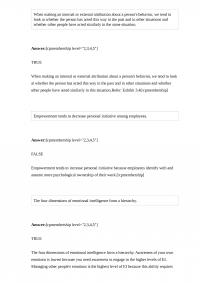
When making an internal or external attribution about a person’s behavior, we tend to look at whether the person has acted this way in the past and in other situations and whether other people have acted similarly in the same […]
PRST 436 Midterm
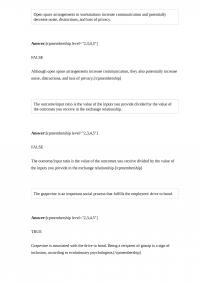
Open space arrangements in workstations increase communication and potentially decrease noise, distractions, and loss of privacy. The outcome/input ratio is the value of the inputs you provide divided by the value of the outcomes you receive in the exchange relationship. […]
PRST 514 Quiz 2
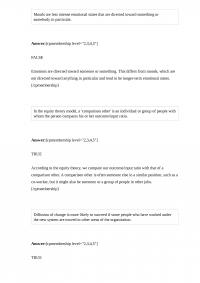
Moods are less intense emotional states that are directed toward something or somebody in particular. In the equity theory model, a ‘comparison other’ is an individual or group of people with whom the person compares his or her outcome/input ratio. […]
PRST 542 Test 2
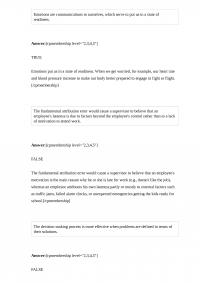
Emotions are communications to ourselves, which serve to put us in a state of readiness. The fundamental attribution error would cause a supervisor to believe that an employee’s lateness is due to factors beyond the employee’s control rather than to […]
PRST 564 Resource scarcity is a
Resource scarcity is a potential source of conflict in organizations. According to four-drive theory, social norms, past experience, and personal values translate emotional signals into goal-directed effort. Answer: TRUE Drives produce emotions; our self-concept, social norms, and past experience translate […]