Archives
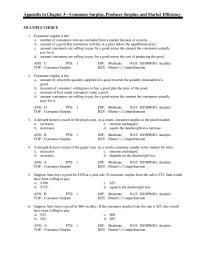
Appendix N If Bill is willing to pay $10 for one good X
Appendix to Chapter 3—Consumer Surplus, Producer Surplus, and Market Efficiency MULTIPLE CHOICE 1. Consumer surplus is the: a. number of consumers who are excluded from a market because of scarcity. b. amount of a good that consumers will buy at […]
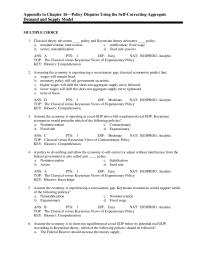
Appendix N Keynesian Government Stabilization Policy Designed To move The
Appendix to Chapter 16—Policy Disputes Using the Self-Correcting Aggregate Demand and Supply Model MULTIPLE CHOICE 1. Classical theory advocates ____ policy and Keynesian theory advocates ____ policy. a. nonintervention; intervention c. stabilization; fixed wage b. active; nonstabilization d. fixed rule; […]
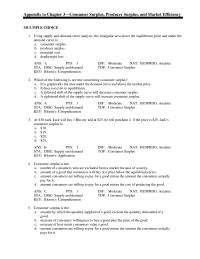
Appendix N the value between the price consumers are willing to pay
Appendix to Chapter 3—Consumer Surplus, Producer Surplus, and Market Efficiency MULTIPLE CHOICE 1. Using supply and demand curve analysis, the triangular area above the equilibrium price and under the demand curve is: a. consumer surplus. b. producer surplus. c. marginal […]
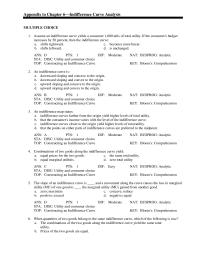
Appendix N Which of the following is a characteristic of an indifference
Appendix to Chapter 6—Indifference Curve Analysis MULTIPLE CHOICE 1. Assume an indifference curve yields a consumer 1,000 utils of total utility. If the consumer’s budget increases by 50 percent, then the indifference curve: a. shifts rightward. c. becomes more linear. […]
Appendix N Which of the following is used to illustrate an independent
Appendix to Chapter 1—Applying Graphs to Economics MULTIPLE CHOICE 1. A direct relationship exists when: a. there is no association between two variables. b. one variable increases and there is no change in the other variable. c. one variable increases […]
Appendix N Which of the following pairs is the most likely to exhibit
Appendix to Chapter 1—Applying Graphs to Economics MULTIPLE CHOICE 1. A direct relationship exists when: a. there is no association between two variables. b. one variable increases and there is no change in the other variable. c. one variable increases […]
Chapter 1 Economics The Study Scarcity And Choice key Blooms
Chapter 1—Introducing the Economic Way of Thinking MULTIPLE CHOICE 1. Which of the following illustrates the concept of scarcity? a. a. There is usually more than one use of your “free” time in the evening. b. More clean air is […]
Chapter 1 there are only a limited number of consumers who
Chapter 1—Introducing the Economic Way of Thinking MULTIPLE CHOICE 1. When economists say scarcity, they mean: a. there are only a limited number of consumers who would be interested in purchasing goods. b. the human desire for goods exceeds the […]
Chapter 1 To abstract from reality in an economic model means that
83. An economic model is: a. a plastic scaled version of the economy. b. a complete depiction of reality. c. an abstraction from reality. d. applicable to consumer behavior but not to producer behavior. e. not an accepted tool of […]
Chapter 10 Exhibit 108 Aggregate Demand Shifts From
TOP: Nonprice-Level Determinants of Aggregate Supply KEY: Bloom’s: Comprehension 99. How will an increase in the world price of crude oil influence the economy of an oil-importing country such as the United States? a. Aggregate supply will decrease, leading to […]
Chapter 10 The aggregate demand curve indicates the relationship between
Chapter 10—Aggregate Demand and Supply MULTIPLE CHOICE 1. The aggregate demand curve indicates the relationship between: a. the real wage rate and the quality of resources demanded by producers of goods and services. b. the interest rate and the amount […]
Chapter 10 They know with certainty what they other firms will do
a. They react slowly to actions taken by other firms b. They lower prices together c. They raise prices together d. They know with certainty what they other firms will do e. They take into consideration how other firms might […]
Chapter 10 Which of the following is not a characteristic of the monopolistic
Chapter 10—Monopolistic Competition and Oligopoly MULTIPLE CHOICE 1. Which of the following is not a characteristic of the monopolistic competition market structure? a. Many sellers, each small in size relative to the overall market. b. Few sellers. c. Differentiated product. […]
Chapter 11 A firm will employ an additional unit of labor as long as
Chapter 11—Labor Markets MULTIPLE CHOICE 1. If a product’s price increases, then its: a. MP will increase. b. MFC will increase. c. MRP will increase. d. MP will decrease. 2. The marginal revenue product of a resource: a. is defined […]
Chapter 11 Fiscal policy is government action to influence aggregate
Chapter 11—Fiscal Policy MULTIPLE CHOICE 1. A balanced budget is present when: a. the economy is at full employment. b. the actual level of aggregate spending equals the planned level of spending. c. public sector spending equals private sector spending. […]
Chapter 11 The demand curve for labor of Coca-Cola manufacturers will not
98. The demand curve for labor of Coca-Cola manufacturers will not shift to the right if: a. d and e. b. the price of Coca-Cola increases. c. the firms innovate with new technology that raises labor productivity. d. the price […]
Chapter 11 To help close an inflationary gap, the government
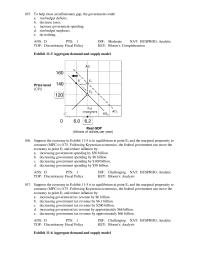
105. To help close an inflationary gap, the government could: a. run budget deficits. b. decrease taxes. c. increase government spending. d. run budget surpluses. e. do nothing. Exhibit 11-5 Aggregate demand and supply model 106. Suppose the economy in […]
Chapter 11 When Harlan County, Kentucky, has a monopsony coal mining firm
150. When Harlan County, Kentucky, has a monopsony coal mining firm, a. d and e. b. workers will work for the firm that pays the higher wage. c. coal buyers will continue to buy coal from other counties. d. coal […]
Chapter 12 Which of the following countries had the highest level of
Chapter 12—The Public Sector MULTIPLE CHOICE 1. Which of the following countries had the highest level of government expenditures as a share of GDP? a. Sweden. c. United States. b. Japan. d. Italy. 2. After 1970, the share of federal […]
Chapter 12 Which of the following government programs provides recipients
STA: DISC: Measuring the Economy TOP: Poverty KEY: Bloom’s: Knowledge 64. Which of the following government programs provides recipients with in-kind benefits? a. Temporary Assistance to Needy Families (TANF). b. Social Security. c. The food stamp program. d. Unemployment compensation. […]
Chapter 12 Which of the following most closely represents the share
Chapter 12—Income Distribution, Poverty, and Discrimination MULTIPLE CHOICE 1. Which of the following most closely represents the share of total U.S. income to the poorest 20 percent of all U.S. families? a. 47 percent. b. 23 percent. c. 10 percent. […]
Chapter 13 A firm that places its assets in the custody of a board
Chapter 13—Antitrust and Regulation MULTIPLE CHOICE 1. The purpose of antitrust laws is to: a. reduce anticompetitive activities. c. guarantee worker safety. b. regulate electric companies. d. promote quality products. 2. A firm that places its assets in the custody […]
Chapter 13 A merger between two manufacturers of computers would result
STA: DISC: The role of government TOP: Mergers and Global Antitrust Policy KEY: Bloom’s: Comprehension 104. A merger between two manufacturers of computers would result in which of the following? a. A vertical merger. c. A horizontal merger. b. A […]
Chapter 13 The federal budget process begins when federal agencies submit
Chapter 13—Federal Deficits, Surpluses, and the National Debt MULTIPLE CHOICE 1. The federal budget process begins when federal agencies submit their budget requests to the: a. Treasury Department. b. Council of Economic Advisors (CEA). c. Office of Management and Budget […]
Chapter 14 Members of the Federal Reserve Board of Governors serve one
a. Four years. c. Fourteen years. b. Six years. d. Life or until the member resigns. 80. Decisions to buy or sell securities at the Fed are made by the: a. Congress. b. Federal Open Market Committee. c. Federal Deposit […]
Chapter 14 Which of the following best describes social benefits
Chapter 14—Environmental Economics MULTIPLE CHOICE 1. Which of the following best describes social benefits? a. The external benefits to other members of society, ignoring the private benefits to market participants. b. The sum of external benefits and private benefits. c. […]
Chapter 14 Which One The Following Items Would The
Chapter 14—Money and the Federal Reserve System MULTIPLE CHOICE 1. A barter economy is one in which: a. money serves as a medium of exchange. b. only precious metals are accepted as money. c. goods are traded directly for other […]
Chapter 15 the benefits of trade between two nations
Chapter 15—International Trade and Finance MULTIPLE CHOICE 1. What country is our largest trading partner, as measured by exports and imports? a. Japan. d. Canada. b. The United Kingdom. e. Mexico. c. China. 2. In terms of production possibilities curves, […]
Chapter 15 The exchange rate for X’s currency is more than
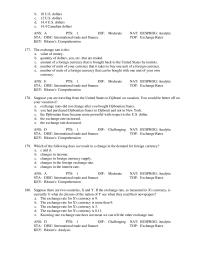
b. 10 U.S. dollars c. 12 U.S. dollars d. 14.4 U.S. dollars e. 14.4 Canadian dollars 177. The exchange rate is the: a. value of money. b. quantity of dollars, yen, etc. that are traded. c. amount of a foreign […]
Chapter 15 The Fed’s countercyclical policy during expansion
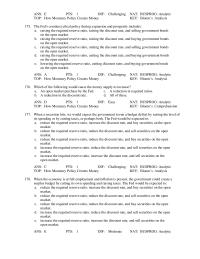
175. The Fed’s countercyclical policy during expansion and prosperity includes: a. raising the required reserve ratio, raising the discount rate, and selling government bonds on the open market. b. raising the required reserve ratio, raising the discount rate, and buying […]
Chapter 15 The Feds Countercyclical Policy Tools Eliminate
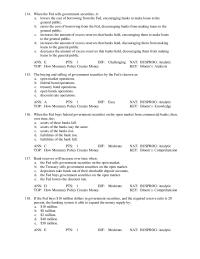
114. When the Fed sells government securities, it: a. lowers the cost of borrowing from the Fed, encouraging banks to make loans to the general public. b. raises the cost of borrowing from the Fed, discouraging banks from making loans […]
Chapter 15 Which of the following compose the reserves of a commercial bank
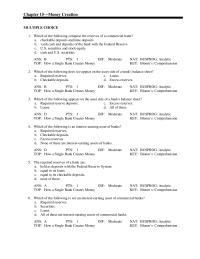
Chapter 15—Money Creation MULTIPLE CHOICE 1. Which of the following compose the reserves of a commercial bank? a. checkable deposits and time deposits b. vault cash and deposits of the bank with the Federal Reserve c. U.S. securities and stock […]
Chapter 15 You Were Told That The Exchange
STA: DISC: International trade and finance TOP: Free Trade versus Protectionism KEY: Bloom’s: Comprehension 98. Which of the following is the best example of a quota? a. a tax placed on all small cars sold in the domestic market b. […]
Chapter 16 Keynes called money people hold to make routine day-to-day
Chapter 16—Monetary Policy MULTIPLE CHOICE 1. Keynes called money people hold to make routine day-to-day purchases the: a. transactions demand for holding money. c. speculative demand for holding money. b. precautionary demand for holding money. d. store of value demand […]
Chapter 16 The economic system that answers the What, How and
Chapter 16—Economies in Transition MULTIPLE CHOICE 1. The economic system that answers the What, How and For Whom questions the way they have always been answered is a: a. market economy. c. soviet economy. b. command economy d. traditional economy. […]
Chapter 16 will raise real GDP because the economy is operating below the
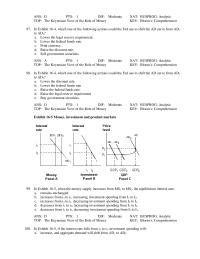
97. In Exhibit 16-4, which one of the following actions could the Fed use to shift the AD curve from AD1 to AD2? a. Lower the legal reserve requirement. b. Lower the federal funds rate. c. Print currency. d. Raise […]
Chapter 17 The Phillips curve illustrates the relationship between
Chapter 17—The Phillips Curve and Expectations Theory MULTIPLE CHOICE 1. The Phillips curve illustrates the relationship between: a. change in the money supply and change in unemployment. b. tax rates and tax revenues. c. the equilibrium level of income and […]
Chapter 17 The rational expectations theory indicates that expansionary
a. be ineffective, even in the short run. b. be effective in the short run but ineffective in the long run. c. be effective both in the short run and long run. d. make it possible to trade-off a higher […]
Chapter 17 Which of the following distinguishes industrially advanced countries
Chapter 17—Growth and the Less-Developed Countries MULTIPLE CHOICE 1. Which of the following distinguishes industrially advanced countries from less-developed countries? a. GDP per capita. b. Educational attainment of the workforce. c. Extent to which capital is technologically advanced. d. All […]
Chapter 17 Which one is not typical of a less-developed country
c. III d. IV e. V 60. The nation of Exland is considered a less-developed country and has the following characteristics. Which one is not typical of a less-developed country? a. High illiteracy. b. High unemployment. c. Rapid growth of […]
Chapter 18 The nice thing about foreign exchange markets
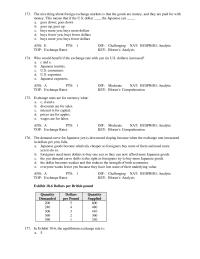
173. The nice thing about foreign exchange markets is that the goods are money, and they are paid for with money. This means that if the U.S. dollar ____ the Japanese yen ____. a. goes down; goes down b. goes […]
Chapter 18 the production possibilities curves of wheat and corn
Chapter 18—International Trade and Finance MULTIPLE CHOICE 1. In terms of production possibilities curves, the benefits of trade between two nations are that each nation moves to a higher: a. standard of living. c. both a and b. b. consumption […]
Chapter 18 When the value of our goods exports is less than the value
TOP: Arguments for Protection KEY: Bloom’s: Comprehension 109. The argument that foreign trade should be restricted to protect domestic employment and output is based on the idea that: a. consumers are willing to pay higher prices for domestic goods. b. […]
Chapter 19 An economic system is the organizations and methods used to
Chapter 19—Economies in Transition MULTIPLE CHOICE 1. The economic system that answers the What, How and For Whom questions the way they have always been answered is a: a. market economy. c. soviet economy. b. command economy d. traditional economy. […]
Chapter 2 Analysis Production Possibilities Curves Indicates That
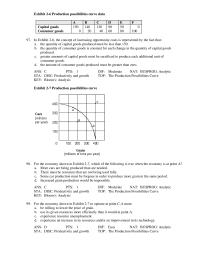
Exhibit 2-6 Production possibilities curve data A B C D E F Capital goods 150 140 120 90 50 0 Consumer goods 0 20 40 60 80 100 97. In Exhibit 2-6, the concept of increasing opportunity costs is represented […]
Chapter 2 Robinson Crusoe’s decision to produce more capital goods
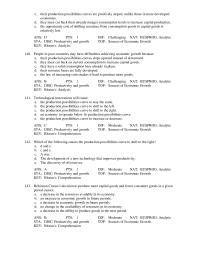
c. their production possibilities curves are positively sloped, unlike those in more developed economies. d. they must cut back their already meager consumption levels to increase capital production. e. the opportunity cost of shifting resources from consumption goods to capital […]
Chapter 2 Suppose an economy is faced with the production
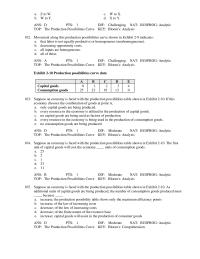
a. Z to W. c. W to X. b. W to Y. d. X to Y. 102. Movement along this production possibilities curve shown in Exhibit 2-9 indicates: a. that labor is not equally productive or homogeneous (nonhomogeneous). b. decreasing […]
Chapter 2 What happens when you add to or subtract from a current situation
Chapter 2—Production Possibilities, Opportunity Cost, and Economic Growth MULTIPLE CHOICE 1. Which of the following is not one of the three fundamental economic questions? a. What happens when you add to or subtract from a current situation? b. For whom […]
Chapter 2 Which of the following correctly lists the three fundamental
Chapter 2—Production Possibilities, Opportunity Cost, and Economic Growth MULTIPLE CHOICE 1. Which of the following correctly lists the three fundamental economic questions? a. If to produce? Why to produce? When to produce? b. If to produce? What to produce? How […]
Chapter 20 When per capita real GDP is increasing, real output is growing
Chapter 20—Growth and the Less-Developed Countries MULTIPLE CHOICE 1. When per capita real GDP is increasing, real output is growing: a. more rapidly than prices. c. less rapidly than prices. b. more rapidly than population. d. less rapidly than population. […]
Chapter 3 a fall in the price of Coca-Cola will increase the quantity
Chapter 3 Part 2—Market Demand and Supply TRUE/FALSE 1. According to the law of demand, if the price of a good increases, other things being equal, the quantity demanded will decrease. 2. Demand curves slope downward to the right. ANS: […]
Chapter 3 an increase in the price of gasoline will decrease
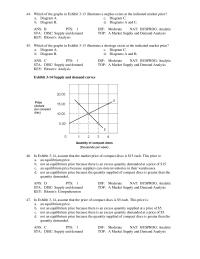
44. Which of the graphs in Exhibit 3-13 illustrates a surplus exists at the indicated market price? a. Diagram A. c. Diagram C. b. Diagram B. d. Diagrams A and C. 45. Which of the graphs in Exhibit 3-13 illustrates […]
Chapter 3 cause the demand curve for a good to shift to the right
d. A rise in buyers’ incomes (assuming large automobiles to be a normal good). 98. If consumer incomes go up and Harley Davidson motorcycles are a normal good, the effect on the demand for motorcycles, ceteris paribus, will be a(n): […]
Chapter 3 Consumers buy less of a good as its price increases because
Chapter 3 Part 1—Market Demand and Supply MULTIPLE CHOICE 1. In economics, the demand for a good refers to the amount of the good people: a. would like to have if the good were free. b. are willing to buy […]
Chapter 3 If a shortage of a product currently exists in the market
Chapter 3 Part 2—Market Demand and Supply MULTIPLE CHOICE 1. If a shortage of a product currently exists in the market, a. the market price is too high. b. the quantity demanded is less than the quantity supplied. c. the […]
Chapter 3 If the demand for a good increases when the price of another
TOP: Nonprice Determinants of Demand KEY: Bloom’s: Comprehension 109. If good X is an inferior good, a decrease in consumer income, other things being equal, will shift the: a. demand curve for good X to the right. c. supply curve […]
Chapter 3 the demand for a good refers to the amount of the good people
Chapter 3 Part 1—Market Demand and Supply MULTIPLE CHOICE 1. In economics, the demand for a good refers to the amount of the good people: a. would like to have if the good were free. b. are willing to buy […]
Chapter 3 The supply schedule shows the specific quantity of a good
KEY: Bloom’s: Comprehension 177. The law of supply states that: a. there is a negative relationship between the price of a good and the quantity of it purchased by suppliers. b. there is a positive relationship between the price of […]
Chapter 3 Which of the following will not cause a movement along the supply
c. illustrates the negative relationship between price and quantity supplied. d. illustrates the positive relationship between price and quantity supplied. e. shifts about in random fashion. 181. When economists say the quantity supplied of a product has increased, they mean […]
Chapter 4 customers will stand in line for gasoline when a price ceiling is in force
Chapter 4 Part 2—Markets in Action TRUE/FALSE 1. Assuming supply is held constant, an increase in demand for a product will cause an increase in the equilibrium price and the amount bought and sold. 2. Assume demand is held constant […]
Chapter 4 If the supply curve decreases while the demand curve
Chapter 4 Part 2—Markets in Action TRUE/FALSE 1. Suppose that X and Y are substitutes. If the price of Y increases, equilibrium price and quantity for X both rise. 2. If the cost of producing a good rises for sellers, […]
Chapter 4 If we observe a decrease in the price of a good and a decrease
Chapter 4 Part 1—Markets in Action MULTIPLE CHOICE 1. An increased equilibrium price and a decreased equilibrium quantity results from a(an): a. decrease in demand. b. increase in supply. c. decrease in supply. d. increase in demand. 2. A decrease […]
Chapter 4 Suppose Price Floor Set The Government
100. Suppose a price floor is set by the government above the market equilibrium price. Which of the following will result? a. There will be a surplus. b. The quantity demanded will exceed the quantity supplied. c. The demand curve […]
Chapter 4 Tammy installed a set of wind chimes in her backyard
d. Dina’s actions gave Sandy a negative externality. e. Dina’s and Sandy’s actions did not create any externalities. 166. If it costs $2,000 to pick up the litter along a highway, then the cost of the externality is: a. $0. […]
Chapter 4 The Presence Positive Externalities Free Market
91. A price ceiling: a. is the lowest price that the law will allow to be charged in the market. b. is the highest price that the law will allow to be charged in the market. c. is the price […]
Chapter 4 what would be the effect on the equilibrium price and quantity
Chapter 4 Part 1—Markets in Action MULTIPLE CHOICE 1. If the demand for a good decreased, what would be the effect on the equilibrium price and quantity? a. Price would increase, and quantity would decrease. b. Price would decrease, and […]
Chapter 4 Which of the following is not an example of an externality
161. Unintended costs that are imposed in third parties as a result of an economic activity are called: a. marginal costs. b. direct costs. c. negative externalities. d. positive externalities. e. positive costs. ANS: C PTS: 1 DIF: Moderate NAT: […]
Chapter 5 Analytic top Determinants Price Elasticity Demand Product Would
d. Total revenue increases by $15 when the price of corn dogs rises by $15. e. Total revenue increases by more than $15 when the price of corn dogs rises by $15. 95. A measure of sensitivity or responsiveness to […]
Chapter 5 Because of transactions which take place in the underground
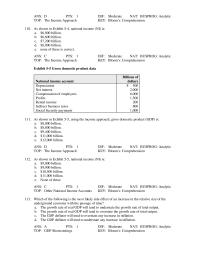
110. As shown in Exhibit 5-4, national income (NI) is: a. $6,000 billion. b. $6,600 billion. c. $7,200 billion. d. $8,000 billion. e. none of these is correct. ANS: C PTS: 1 DIF: Moderate NAT: BUSPROG: Analytic TOP: The Income […]
Chapter 5 Gross domestic product is the sum of the purchase price multiplied
Chapter 5—Gross Domestic Product MULTIPLE CHOICE 1. Gross domestic product is equal to the market value of all final goods and services: a. exchanged during a period. b. produced domestically during a period. c. produced by the citizens of a […]
Chapter 5 If the price elasticity of demand for a good is elastic
Chapter 5 Part 2—Price Elasticity of Demand and Supply MULTIPLE CHOICE 1. If an excise tax is placed on a product that has a perfectly inelastic demand, then: a. the entire tax will be paid by the consumer. b. the […]
Chapter 5 The number of cases of Coca-Cola bought increased by 50 percent
KEY: Bloom’s: Comprehension 173. If the cross-elasticity of demand for two goods is positive, this means that the goods are: a. normal goods. c. substitutes. b. inferior goods. d. complements. 174. The number of satellite dishes increased by 50 percent […]
Chapter 5 Which The Following Describes Situation Which
Chapter 5 Part 1—Price Elasticity of Demand and Supply MULTIPLE CHOICE 1. Suppose that a jewelry store found that when it increased prices by 10 percent, sales revenue increased by 3 percent. Which of the following is true about the […]
Chapter 6 what is the marginal utility per dollar for each of the three
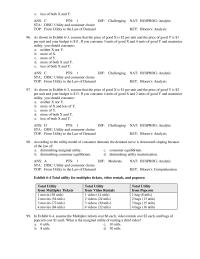
e. less of both X and Y. 96. As shown in Exhibit 6-3, assume that the price of good X is $2 per unit and the price of good Y is $1 per unit and your budget is $11. If […]
Chapter 6 The ability of a good to satisfy a want refers to its
Chapter 6—Consumer Choice Theory MULTIPLE CHOICE 1. Utility is most closely defined by which of the following terms? a. Useful. c. Necessary. b. Worthiness. d. Satisfaction. 2. The ability of a good to satisfy a want refers to its: a. […]
Chapter 6 The period of declining growth in real GDP between the peak of
Chapter 6—Business Cycles and Unemployment MULTIPLE CHOICE 1. Economists use the phrase “business cycle” when referring to fluctuations in: a. real GDP. c. the consumer price index. b. the chain price index. d. the general level of prices. 2. The […]
Chapter 6 Whom does the Bureau of Labor Statistics include in the
TOP: Unemployment KEY: Bloom’s: Comprehension 86. Whom does the Bureau of Labor Statistics include in the “discouraged workers” group? a. All those between 16 and 65 who are neither disabled nor in an institution and are also neither employed nor […]
Chapter 7 The total fixed cost remains constant as which of the following varies
KEY: Bloom’s: Comprehension 96. In the short run, if average variable cost equals $50, average total cost equals $75, and output equals 100, the total fixed cost must be: a. $25. c. $5,000. b. $2,500. d. $7,500. 97. The total […]
Chapter 7 Which of the following is an explicit cost
Chapter 7—Production Costs MULTIPLE CHOICE 1. Which of the following is an explicit cost? a. The opportunity cost of an owner/entrepreneur’s time invested in the firm. b. The opportunity cost of the money the business owner/entrepreneur has invested in the […]
Chapter 7 Which of the following must be true if average total cost is rising
170. In Exhibit 7-13, AFC is shown by the graph labeled: a. I. b. II. c. III. d. IV. e. V. ANS: A PTS: 1 DIF: Challenging NAT: BUSPROG: Analytic STA: DISC: Costs of production TOP: Short-Run Cost Formulas KEY: […]
Chapter 7 If the inflation rate was 10 percent last year
Chapter 7—Inflation MULTIPLE CHOICE 1. The best definition of inflation is a(n): a. temporary increase in prices. b. increase in the price of one important commodity such as food. c. persistent increase in the general level of prices as measured […]
Chapter 8 classical economists believed that a recessionary downturn would
Chapter 8—The Keynesian Model MULTIPLE CHOICE 1. Classical economists believed that: a. price flexibility automatically directs market economies to full employment. b. budget deficits and surpluses were necessary for the control of economic fluctuations. c. market economies suffer prolonged periods […]
Chapter 8 Introducing Classical Theory And The Keynesian Revolution key
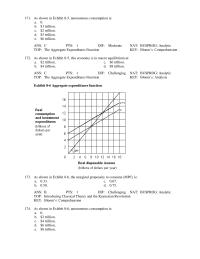
171. As shown in Exhibit 8-5, autonomous consumption is: a. 0. b. $1 trillion. c. $2 trillion. d. $3 trillion. e. $6 trillion. 172. As shown in Exhibit 8-5, this economy is in macro equilibrium at: a. $2 trillion. c. […]
Chapter 8 The change in saving divided by the change in disposable income
103. The marginal propensity to save (MPS) is computed as the change in: a. savings divided by the change in saving. b. savings divided by the change in disposable personal income. c. saving divided by the change in GDP. d. […]
Chapter 8 Three Types Long run Supply Curves Assume The
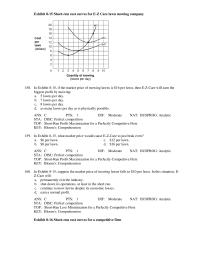
Exhibit 8-15 Short-run cost curves for E-Z Care lawn mowing company 158. In Exhibit 8-15, if the market price of mowing lawns is $16 per lawn, then E-Z-Care will earn the biggest profit by mowing: a. 5 lawns per day. […]
Chapter 8 When the price of a good is a constant, the marginal revenue
95. Marginal revenue is the change in: a. total revenue resulting from a one unit change in output. b. total revenue resulting from a change in marginal cost. c. price resulting from a one unit change in output. d. none […]
Chapter 8 The firms in the market produce differentiated products
Chapter 8—Perfect Competition MULTIPLE CHOICE 1. Which of the following is not a characteristic of the structure of perfectly competitive markets? a. Each individual firm is small in size relative to the overall market. b. Few sellers. c. Homogeneous product. […]
Chapter 9 Which of the following options could be used to eliminate a
106. An increase in government expenditures by $100 (unmatched by an increase in taxes) would, if the MPC = 0.90, result in an increase in real GDP by: a. $1,000. b. $9,000. c. $900. d. $190. e. inadequate information is […]
Chapter 9 limiting the entry of potential competitors into a market
Chapter 9—Monopoly MULTIPLE CHOICE 1. Which of the following is not associated with the monopoly market structure? a. Many sellers. b. A single seller. c. A unique product. d. Impossible entry into the market. 2. Which of the following factors […]
Chapter 9 the monopolist’s total cost is which of the following areas
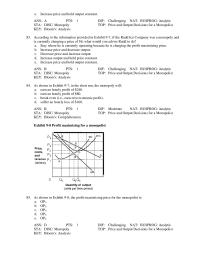
e. Increase price and hold output constant. 83. According to the information provided in Exhibit 9-7, if the Rudd Ice Company was a monopoly and is currently charging a price of $6, what would you advise Rudd to do? a. […]
Chapter 9 Within the framework of the Keynesian model
Chapter 9—The Keynesian Model in Action MULTIPLE CHOICE 1. Using the Keynesian aggregate expenditures model, which of the following is true? a. Macro equilibrium may occur at levels of real GDP other than full-employment real GDP. b. At any macro […]