Chapter 11—Labor Markets
MULTIPLE CHOICE
1. If a product’s price increases, then its:
a.
MP will increase.
b.
MFC will increase.
c.
MRP will increase.
d.
MP will decrease.
2. The marginal revenue product of a resource:
a.
is defined as the marginal product of the resource multiplied by the resource price.
b.
simply means that a firm should add to its capital stock as long as competition requires it.
c.
equals the extra output produced by an additional unit of the resource multiplied by the
price of that output.
d.
equals the average product of the resource multiplied by the cost of hiring an additional
(marginal) unit of the resource.
3. Which of the following is the most accurate definition of a worker’s “marginal revenue product”?
a.
The change in the firm’s profits as the result of hiring an additional worker.
b.
The change in the firm’s total revenue as the result of hiring an additional worker.
c.
The change in the firm’s output as the result of hiring an additional worker.
d.
The change in the firm’s cost as the result of hiring an additional worker.
4. A firm will employ an additional unit of labor as long as the employment of labor adds more to the
firm’s revenue than it does to the firm’s:
a.
product price.
c.
residual claim.
b.
accounting profit.
d.
cost.
5. Firms should hire additional units of a resource as long as the:
a.
marginal product of the resource exceeds the price of the resource multiplied by the
quantity of output produced.
b.
marginal product of the resource is less than the price of the resource.
c.
price of the output produced is positive.
d.
marginal revenue product of the resource exceeds the cost of an additional unit of the
resource.
6. The marginal revenue product of a resource is:
a.
the marginal product of the resource multiplied by the price of the product it helps to
produce.
b.
the price of the product times the price of the resource.
c.
larger when the product price is smaller.
d.
larger when the marginal product is smaller.
Exhibit 11-1
Use the information in the accompanying chart to answer the following question(s). The firm hires
labor competitively and sells its product in a competitive price-taker market.
Units of Labor
Total Output
Product
(per day)
(dollars)
Price
1
15
6
2
30
6
3
40
6
4
48
6
5
54
6
6
59
6
7
62
6
7. Refer to Exhibit 11-1. What is the marginal revenue product of the fifth unit of labor?
a.
$6.
c.
$54.
b.
$36.
d.
$324.
8. Refer to Exhibit 11-1. If the market wage rate is $25 per day, how many workers should the firm hire
if it wants to maximize profits?
a.
4.
c.
6.
b.
5.
d.
7.
9. Harold Brown runs a company that sells encyclopedia sets for $250 each. When he employs 10
workers, they can sell 60 sets per week, while only 54 sets are sold when 9 workers are employed.
What is the weekly marginal revenue product of the tenth worker?
a.
$250.
c.
$1,500.
b.
$1,250.
d.
$15,000.
10. Jim Smith runs a company that sells encyclopedia sets for $200 each. When he employs 5 workers,
they can sell 20 sets per week, while only 17 sets are sold when 4 workers are employed. If the wage
of workers in this skill category is $500 per week, should the fifth worker be hired?
a.
No, because the MRP of the fifth worker is less than $500 per week.
b.
No, because the MRP of the fifth worker is more than $500 per week.
c.
Yes, because the MRP of the fifth worker is less than $500 per week.
d.
Yes, because the MRP of the fifth worker is more than $500 per week.
11. The following chart indicates the reductions in total losses due to theft if a jewelry store hires
additional security guards.
Number
Dollar Value of
of Guards
Thefts Prevented
1
150
2
240
3
310
4
360
5
400
6
430
If the security guards can be hired for $45 per day, how many guards should the shop hire?
a.
2.
c.
4.
b.
3.
d.
5.
12. Which of the following is characteristic of the marginal revenue product schedule for a resource?
a.
It approximates the firm’s demand curve for the resource.
b.
It measures the change in total revenue resulting from employing an additional unit of the
resource.
c.
It is determined by multiplying the marginal product of the resource by the marginal
revenue of the good produced.
d.
All of these are true.
13. The increase in a firm’s total revenues resulting from hiring an additional unit of labor is known as the
marginal:
a.
product.
c.
cost.
b.
revenue product.
d.
none of these.
14. For a perfectly competitive firm, marginal revenue product is equal to:
a.
price minus marginal cost.
c.
price times marginal product.
b.
price times marginal revenue.
d.
none of these.
15. Alan Jones owns a company that sells life insurance. When he employs 10 salespersons his firm sells
$200,000 worth of contracts per week, and when he employs 11 salespersons, total revenue is
$210,000. The marginal revenue product of the 11th salesperson is:
a.
$410,000.
c.
$20,000.
b.
$10,000.
d.
$210,000.
16. Troll Corporation sells dolls for $10.00 each in a market that is perfectly competitive. Increasing the
number of workers from 100 to 101 would cause output to rise from 500 to 550 dolls per day. The
marginal revenue product for the 101st worker is:
a.
$10.00.
c.
$5,000.
b.
$500.
d.
$1,010.
17. Tucker Corporation sells its product for $5.00. Tucker’s industrial engineers have informed
management that hiring one additional worker will increase output by five units per hour. Tucker
should hire the additional worker only if the wage rate is:
a.
$5.00 or less per hour.
c.
$25.00 or less per hour.
b.
$1.00 or more per hour.
d.
none of these.
18. For a competitive firm, workers’ marginal revenue product equals the marginal product of labor times
the:
a.
wage rate.
c.
interest rate.
b.
price of the firm’s product.
d.
firm’s total revenue.
19. A competitive car wash currently hires 4 workers, who together can wash 80 cars per day. The market
price of car washes is $5 per wash, and the price of workers is $60 per day. The car wash should hire a
fifth worker if it would increase total production to at least:
a.
92 cars per day.
c.
104 cars per day.
b.
100 cars per day.
d.
110 cars per day.
20. An apple orchard currently hires 10 workers. The owner estimates that hiring an additional worker
would increase apple yields by 20 bushels per day. The price of apples is $15 per bushel. The owner
should hire the extra worker if the wage rate is no greater than:
a.
$50 per day.
c.
$200 per day.
b.
$150 per day.
d.
$300 per day.
21. A firm’s demand curve for labor coincides with the:
a.
marginal cost curve.
c.
marginal revenue curve.
b.
average cost curve.
d.
marginal revenue product curve.
22. When a firm hires an additional unit of labor, the increase in a firm’s total revenues is known as the
marginal:
a.
cost.
c.
utility product.
b.
product.
d.
revenue product.
23. Assume Ajax Company employs 100 workers and total revenue is $400,000 per week. When Ajax
Company employs 101 workers, total revenue is $405,000. The marginal revenue product of the 101st
worker is:
a.
$40,000.
c.
$405,000.
b.
$5,000.
d.
none of these.
24. Assume consumer demand for CD-ROMs increases. The result is a(n):
a.
increase in derived demand for workers in the CD-ROM industry.
b.
increase in the marginal revenue product of firms in the CD-ROM industry.
c.
rightward shift in the market demand for labor curve in the CD-ROM industry.
d.
all of the above.
e.
none of the above.
Exhibit 11-2 Labor and output data
Labor
Output
0
0
1
20
2
45
3
80
4
100
5
110
25. In Exhibit 11-2, the marginal product of the 3rd unit of labor is equal to:
a.
80.
b.
45.
c.
35.
d.
100.
e.
25.
26. In Exhibit 11-2, the marginal product of the 4th unit of labor is equal to:
a.
80.
b.
45.
c.
35.
d.
100.
e.
20.
27. In Exhibit 11-2, if product price is fixed at $5, the MRP of the third worker is equal to:
a.
$35.
b.
$125.
c.
$25.
d.
$175.
e.
$100.
28. In Exhibit 11-2, if product price is fixed at $5, the MRP of the 4th worker is equal to:
a.
$35.
b.
$125.
c.
$25.
d.
$175.
e.
$100.
29. In Exhibit 11-2, if product price is fixed at $8, the MRP of the 2nd worker is equal to:
a.
$25.
b.
$125.
c.
$200.
d.
$175.
e.
$45.
30. In Exhibit 11-2, if product price is fixed at $8, the MRP of the 5th worker is equal to:
a.
$50.
b.
$80.
c.
$10.
d.
$100
e.
$160.
31. Marginal revenue product is defined as the extra:
a.
output a firm would receive after hiring one more unit of resource.
b.
cost of hiring one more unit of resource
c.
revenue earned by selling one more unit of product.
d.
revenue earned by hiring one more unit of resource
e.
output received by spending one more dollar on resources
32. Marginal revenue product is measured by:
a.
MR price.
b.
MR MC.
c.
TR / MP.
d.
MP price.
e.
TC / MP.
33. The demand for labor curve is identical to the:
a.
total wage cost curve.
b.
marginal resource curve.
c.
total revenue curve.
d.
marginal revenue product curve.
e.
marginal revenue curve.
34. Dividing the change in total revenue by the change in labor gives:
a.
marginal product of labor.
b.
marginal revenue product of labor.
c.
the price of the output.
d.
demand for the output.
e.
economic efficiency.
35. The marginal revenue product can be written as:
a.
TR / P.
b.
w / Q.
c.
MP P.
d.
MRP P.
e.
w L.
36. The firm’s demand for labor curve is exactly the same as the:
a.
wage rate.
b.
price of the output.
c.
MRP curve.
d.
MP curve.
e.
labor supply curve.
37. The marginal revenue product curve is:
a.
c and d are correct.
b.
c and e are correct.
c.
given by the marginal product curve multiplied by the price of the good.
d.
the marginal contribution of an additional worker to firm’s revenues.
e.
the change in total cost that results from employing an additional worker.
38. The marginal revenue product of labor is:
a.
how much labor can be purchased with the revenue from the sale of one more unit of the
good.
b.
how much does the marginal revenue change when you add more labor.
c.
the same as the marginal revenue product of capital in equilibrium.
d.
determined by the wage rate.
e.
the contribution to total revenue made by the marginal laborer.
39. The number of workers hired by a firm at a particular wage rate can be calculated if you know which
of the following?
a.
c and d.
b.
Product supply curve.
c.
Marginal product of labor.
d.
Marginal factor cost.
e.
Marginal revenue product of labor.
40. Which of the following most clearly illustrates the concept of derived demand?
a.
An increase in the price of steak causes the demand for poultry to increase.
b.
An increase in the demand for new houses leads to an increase in the demand for
construction workers.
c.
An increase in consumer income leads to an increase in the demand for services provided
by the government.
d.
An increase in the demand for new cars causes the demand for used automobiles to rise.
41. Which of the following best illustrates the concept of derived demand?
a.
A decrease in the price of glass causes the demand for plastic to decrease.
b.
An increase in the demand for bread leads to an increase in the demand for flour.
c.
A decrease in the price of air travel leads to an increase in the quantity demanded of air
travel.
d.
An increase in the demand for peanut butter leads to an increase in the demand for jelly.
42. The demand for a factor of production depends on the:
a.
supply of the factor.
b.
supply of other factors of production.
c.
demand for other factors of production.
d.
demand for the products that it helps to produce.
43. A firm’s demand for labor depends on, in part, the demand for the firm’s product. To summarize this
idea, economists say that the demand for labor is:
a.
derived demand.
c.
secondary demand.
b.
marginal demand.
d.
monopsonistic demand.
44. The demand for labor is:
a.
derived demand.
c.
marginal utility demand.
b.
featherbedding demand.
d.
all of these.
45. Other things equal, assume consumer demand for children’s toys increases. The result is a(n):
a.
rightward shift in the market demand for labor curve in the toy industry.
b.
increase in the marginal revenue product of firms in the toy industry.
c.
increase in derived demand for workers in the toy industry.
d.
all of these.
46. Since the demand for labor depends on the demand for the product labor produces, the demand for
labor is called:
a.
primary demand.
c.
dependent demand.
b.
secondary demand.
d.
derived demand.
47. Which of the following statements concerning the supply of labor is true?
a.
The wage rate has no effect on the supply of labor.
b.
The labor supply curve is downward sloping.
c.
The supply of labor is determined by the prevailing wage rate.
d.
The typical labor supply curve is upward sloping.
48. A union may attempt to obtain stricter certification requirements or longer apprenticeships. These
changes would raise workers’ wages because they:
a.
create unnecessary unemployment.
b.
shift in labor supply curve leftward.
c.
decrease the marginal product of labor.
d.
reduce management’s use of featherbedding.
49. Which of the following statements concerning the supply of labor is true?
a.
The supply of labor is determined by the prevailing wage rate.
b.
The labor supply curve is downward sloping.
c.
The wage rate has no effect on the supply of labor.
d.
None of these.
50. One reason the supply of carpenters is greater than the supply of physicians is because:
a.
physicians do not belong to a union.
c.
carpenters belong to unions.
b.
carpenters demand less income.
d.
none of the above.
51. If the wage rate is fixed at a certain level, the:
a.
labor supply curve is horizontal.
b.
labor supply is a straight upward sloping line.
c.
MP must be constant.
d.
labor supply will increase at an increasing rate.
e.
labor supply will increase at a decreasing rate.
52. If the wage rate is fixed at a certain level, the:
a.
total wage cost curve is horizontal.
b.
total wage cost curve is a straight upward sloping line.
c.
MP must be constant.
d.
total wage cost curve will increase at an increasing rate.
e.
total wage cost curve will increase at a decreasing rate.
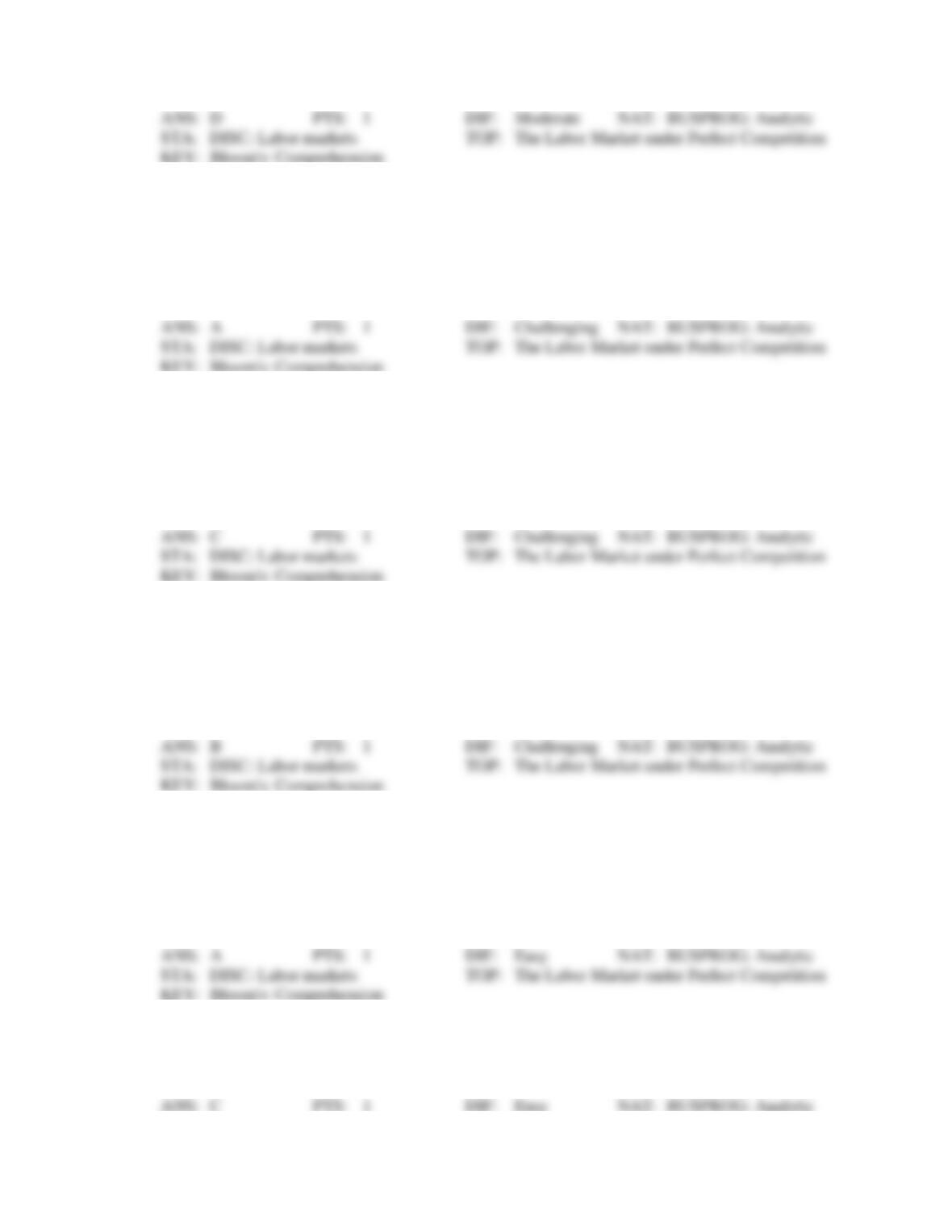
Exhibit 11-3 Labor supply curve
53. In Exhibit 11-3, the wage for the 6th employee is equal to:
a.
$18.
b.
$36.
c.
$3.
d.
$108.
e.
unable to determine with this information.
54. In Exhibit 11-3, the total wage cost of hiring 6 employees is:
a.
$18 per hour.
b.
$36 per hour.
c.
$3 per hour.
d.
$108 per hour.
e.
$648 per hour.
55. An individual firm in a competitive labor market faces a(n):
a.
horizontal labor supply curve.
b.
backward-bending labor supply curve.
c.
downward-sloping labor supply curve.
d.
upward-sloping labor supply curve.
e.
vertical labor supply curve.
56. The labor supply curve facing an individual employer in a perfectly competitive labor market is:
a.
upward sloping.
b.
downward sloping.
c.
horizontal.
d.
greater than MFC.
e.
the MRP curve.
57. The marginal cost of labor for a perfectly competitive firm is given by:
a.
the change in total revenue that results from employing an additional worker.
b.
the market wage rate.
c.
its marginal revenue product curve.
d.
the demand curve for labor.
e.
the marginal product of labor.
58. Which of the following is the best example of an investment in human capital?
a.
on-the-job training received by an apprentice electrician
b.
an increase in the number of hours worked per week by a worker in an unskilled laboring
job
c.
the purchase of company stock by a worker
d.
payments into a retirement pension plan by a skilled laborer
59. One reason the supply of carpenters is greater than the supply of physicians is because:
a.
carpenters demand less income.
c.
of differences in human capital.
b.
physicians do not belong to a union.
d.
carpenters belong to unions.
60. Which of the following would be a human capital investment?
a.
On-the-job training programs.
c.
Formal education.
b.
Health care programs.
d.
All of these.
61. A worker’s accumulated investment in education, training, experience, and health is called:
a.
derived labor demand.
c.
seniority.
b.
collective entrepreneurship.
d.
human capital.
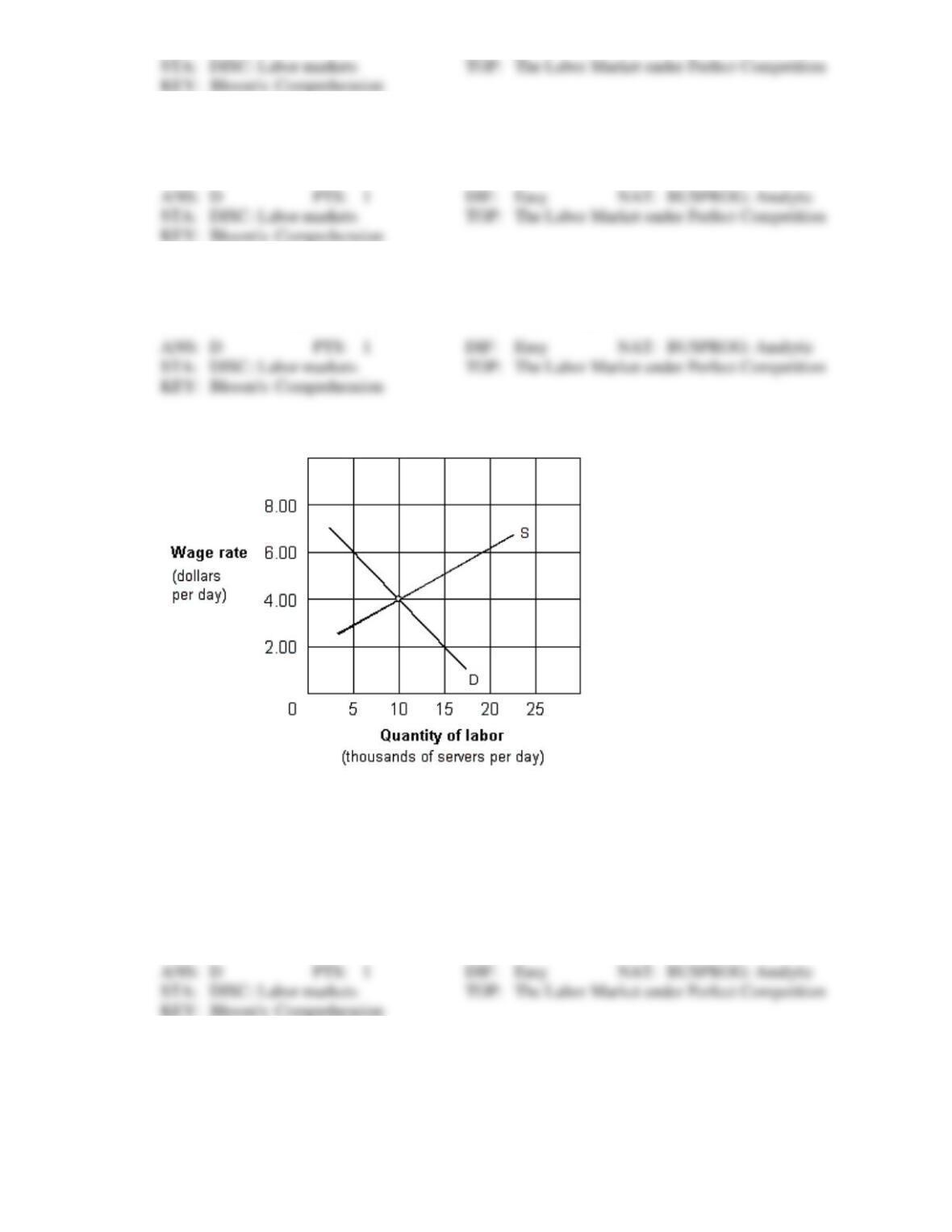
Exhibit 11-4 Supply and demand curves for food servers
62. In Exhibit 11-4, assume that both input and output markets are perfectly competitive. If one additional
server increases the number of meals sold by four per day and each meal sells for $10, each additional
food server will be paid:
a.
$16 per day.
b.
$32 per day.
c.
$36 per day.
d.
$40 per day.
e.
none of these.
63. In Exhibit 11-4, the equilibrium wage and the number of food servers employed per day, respectively,
are:
a.
$2.00 and 5,000.
c.
$6.00 and 15,000
b.
$4.00 and 10,000.
d.
$8.00 and 20,000.
64. In Exhibit 11-4, suppose that in the interest of boosting incomes of the working poor, Congress
imposes a minimum wage of $6.00 per hour. This minimum wage rate creates a(n):
a.
new labor market equilibrium.
b.
excess demand for labor of 10 thousand food servers.
c.
excess supply of labor of food servers.
d.
situation of full employment for food servers.
65. If the equilibrium wage rate in Exhibit 11-4 increased, the cause could be that:
a.
the supply of labor increased.
b.
the demand for labor decreased.
c.
either the demand for labor increased or the supply of labor decreased.
d.
none of these.
Exhibit 11-5 Sally‘s labor supply data
Wage
Quantity of
Labor Supplied (hours)
$ 0
0
5
20
10
30
50
40
100
35
66. In Exhibit 11-5, if the wage rate is $10, how many hours will Sally work?
a.
20.
b.
30.
c.
35.
d.
40.
e.
50.
67. In Exhibit 11-5, if Sally can produce 2 units of output for every hour that she works, then:
a.
she will earn a wage of $50.
b.
she is not productive enough to be hired at all.
c.
her MRP is less than her wage.
d.
she will work 30 hours.
e.
her wage cannot be determined.
68. In Exhibit 11-6, when the marginal revenue product is $20.00, firms should ____ workers.
a.
continue hiring
b.
stop hiring
c.
start firing
d.
pay a wage above $15.00 to its workers
69. In Exhibit 11-6, how many thousands of workers are firms willing to hire?
a.
20.
c.
15.
b.
10.
d.
All 25 workers.
70. In Exhibit 11-6, at what wage rate will the firms hire these workers?
a.
$25.00.
b.
$20.00.
c.
$15.00.
d.
$10.00.
e.
0.
71. In Exhibit 11-7, which of the following could have caused the shift in labor demand from D1 to D2?
a.
Increase in wages.
b.
Decrease in wages.
c.
Decrease in price of product.
d.
Decrease in demand for the product.
e.
Increase in the demand for the product.
72. A technological advance that increases the productivity of teachers can be expected to have what
effects on the equilibrium labor market for teachers?
a.
Wages will rise, and quantity of labor will fall.
b.
Wages will rise, and quantity of labor will rise.
c.
Wages will fall, and quantity of labor will fall.
d.
Wages will fall, and quantity of labor will rise.
e.
Wages and quantity of labor will remain the same.
73. Which of the following determines equilibrium wages in perfectly competitive labor markets?
a.
The government.
b.
Monopoly employers.
c.
Where the supply and demand of labor are equal.
d.
The requirements of a living wage.
74. If the market price of bicycle frames is $500, and frame welders earn a wage of $50, how many
welders will be hired?
a.
10.
b.
More than 10.
c.
Fewer than 10.
d.
Hiring will stop when the MP is 10.
e.
Hiring will stop when the MP is 0.1.
75. If the marginal product of labor is always positive, the total revenue will grow with each additional
worker. Firms do not continuously hire new workers because:
a.
there isn’t enough room in the factory.
b.
there isn’t an infinite number of workers.
c.
wages would have to increase.
d.
they stop when MRP = wage
e.
marginal revenue product will become negative.
76. The optimal hiring rule is to employ labor up to the point where:
a.
wage = MFC.
b.
wage = MP.
c.
wage = MR
d.
wage = MRP
e.
wage = TWC.
77. In a competitive labor market, the change in total labor costs divided by the change in labor is always
equal to:
a.
one.
b.
the wage rate.
c.
the number of firms in the market.
d.
the change in total revenue.
e.
the competitive market price of the output.
78. The optimal number of workers to be hired by a firm operating in a competitive labor market is where:
a.
P = MRP.
b.
MP = MRP.
c.
MRP = w.
d.
P = w.
e.
TWC = w.
79. Suppose there are 100 identical firms producing package delivery services. One of the firms finds that
when it has to pay a wage rate of $7, it hires 20 delivery people. The firm charges an average price of
$10 to deliver a package. From this information, we know that the package delivery industry is hiring a
total of:
a.
100 workers.
b.
200 workers.
c.
700 workers.
d.
2,000 workers.
e.
10,000 workers.
80. According to the economic theory of labor markets, if unions are successful in raising wages, with no
accompanying increase in labor productivity, then which of the following is true?
a.
The quantity of labor demanded by profit-maximizing firms will decline.
b.
The quantity of labor demanded by profit-maximizing firms will increase.
c.
The quantity of labor supplied by workers will decline.
d.
There will be a shortage of labor in the unionized labor market.
81. A decrease in the marginal product of labor would be represented by a(n):
a.
increase in labor demand.
b.
decrease in labor demand.
c.
increase in the quantity demanded of labor.
d.
decrease in the quantity demanded of labor.
e.
increase in wages.
82. If more and better technology is used for producing wheat in the United States than in a lesser-
developed country, then the:
a.
MRP of the U.S. workers will be higher than the MRP of the workers in the lesser-
developed country.
b.
MRP of the U.S. workers will be lower than the MRP of the workers in the lesser-
developed country.
c.
demand for the U.S. workers will be lower than the demand for the workers in the lesser
developed country.
d.
price of wheat will be higher in the United States than in the lesser-developed country.
e.
wages of the U.S. workers will be lower than the wages of the workers in the lesser-
developed country.
83. An increase in the demand for a product will shift the demand for labor used to produce the product:
a.
downward.
b.
leftward.
c.
rightward.
d.
none of these, the curve will not shift.
84. Suppose a change in technology increases the marginal product of labor. The result is a(n):
a.
downward movement along the demand for labor curve.
b.
rightward shift in the demand for labor curve.
c.
leftward shift in the demand for labor curve.
d.
upward movement along the demand for labor curve.
85. Featherbedding allows unions to increase wages by:
a.
limiting the supply of labor.
b.
increasing firms’ demand for labor.
c.
forcing firms to accept higher-than-equilibrium wages.
d.
reducing labor share of payroll taxes.
86. An increase in demand for French fries will cause equilibrium wage rates:
a.
and quantities of potato workers hired to rise.
b.
and quantities of potato workers hired to fall.
c.
to rise and quantities of potato workers hired to fall.
d.
to fall and quantities of potato workers hired to rise.
e.
and quantities of potato workers hired to stay the same.
87. If product price increases, then:
a.
MP will increase.
c.
MRP will increase.
b.
MFC will increase.
d.
MP will decrease.
88. If product price decreases, then:
a.
MP will increase.
c.
MRP will increase.
b.
MFC will increase.
d.
MRP will decrease.
89. Which of the following statements is true?
a.
Derived demand for labor depends on the demand for the product labor produces.
b.
Unions can either increase demand or decrease the supply of labor.
c.
Investment in human capital is expected to increase the demand for those workers.
d.
All of these.
90. If the demand for the finished product increases, the:
a.
demand for the resources will increase.
b.
demand for the resources will decrease.
c.
marginal factor cost will increase.
d.
marginal factor cost will decrease.
e.
MP will increase.
91. Which of the following can shift the labor demand curve to the right?
a.
Decrease in product price.
b.
Increase in wages.
c.
Decrease in wages.
d.
Decrease in the MP.
e.
Increase in productivity.
92. An advance in technology which increases labor productivity will shift the:
a.
labor demand curve to the left.
b.
MFC curve to the left.
c.
MP curve downward.
d.
labor demand curve to the right.
e.
product demand to the right.
93. If the price of labor falls, we can expect:
a.
demand for labor will increase.
b.
quantity demanded of labor will increase.
c.
demand for labor will decrease.
d.
quantity demanded of labor will decrease.
e.
marginal factor cost to rise in a competitive market.
94. If cats become a more popular pet in the United States than dogs, what can we expect to happen to the
market for cat food workers?
a.
MP increases.
b.
MRP increases.
c.
MP decreases.
d.
MRP decreases.
e.
Wage decreases.
95. If the MRP of labor decreases, labor:
a.
demand will decrease.
b.
demand will increase.
c.
supply will increase.
d.
supply will decrease.
e.
demand and supply will be unaffected.
96. A technological advance that increases labor productivity will:
a.
lower wages.
b.
decrease the demand for labor as fewer workers are needed.
c.
decrease the supply of labor as fewer workers are needed.
d.
increase the demand for labor as MP rises.
e.
decrease the demand for labor as MP falls.
97. Which of the following will decrease the demand for fast-food burger workers’ labor?
a.
More people start working two jobs and eat more fast food.
b.
The price of pizza, a substitute for burgers, decreases.
c.
A new technology allows burgers to be produced faster.
d.
Workers get additional training that increases productivity.
e.
Workers form a union and get higher wages.