Chapter 11—Fiscal Policy
MULTIPLE CHOICE
1. A balanced budget is present when:
a.
the economy is at full employment.
b.
the actual level of aggregate spending equals the planned level of spending.
c.
public sector spending equals private sector spending.
d.
government revenues equal government expenditures.
2. When the federal government is running a budget deficit:
a.
government tax revenues exceed government expenditures.
b.
government expenditures exceed government tax revenues.
c.
the economy must be in an economic recession.
d.
the size of the national debt will decline.
3. Changes in government spending and/or taxes as the result of legislation is called:
a.
open market operations of the Federal Reserve.
b.
discretionary fiscal policy.
c.
balanced budget operations.
d.
discretionary monetary policy.
4. The Keynesian analysis of fiscal policy argues that:
a.
fiscal policy should generally be expansionary except during periods of economic
recession.
b.
fiscal policy should generally be restrictive except during inflationary booms.
c.
the federal budget should be balanced annually except during war.
d.
the federal budget should be used to maintain aggregate demand at a level consistent with
full employment.
5. Contractionary fiscal policy is deliberate government action to influence aggregate demand and the
level of real GDP through:
a.
expanding and contracting the money supply.
b.
encouraging business to expand or contract investment.
c.
regulating net exports.
d.
decreasing government spending or increasing taxes.
6. A government spending and taxation policy to achieve macroeconomic goals is known as:
a.
countercyclical policy.
b.
fiscal policy.
c.
monetary policy.
d.
a balanced budget.
e.
presidential discretion.
7. Fiscal policy is government action to influence aggregate demand and in turn to influence the level of
real GDP and the price level, through:
a.
expanding and contracting the money supply.
b.
regulation of net exports.
c.
changes in government spending and/or tax revenues.
d.
encouraging businesses to invest.
8. Expansionary fiscal policy consists of:
a.
increasing government spending.
b.
increasing payroll taxes to finance health care.
c.
decreasing government spending.
d.
raising the minimum wage.
9. The government is pursuing an expansionary policy if it:
a.
decreases its spending and increases its tax revenues.
b.
increases its spending or increases its tax revenues.
c.
decreases its spending or reduces its tax revenues.
d.
increases its spending and/or reduces its tax revenues.
10. An expansionary fiscal policy may include:
a.
increases in government spending.
b.
discretionary increases in transfer payments.
c.
reductions in taxes.
d.
All of these.
11. Suppose the economy is on the classical range of the aggregate supply curve and has a problem with
inflation. According to Keynesian theory, which of the following is an appropriate discretionary fiscal
policy to use in this situation?
a.
A reduction in the money supply.
c.
Increase federal spending.
b.
Less government regulation.
d.
Higher taxes.
12. Fiscal policy is concerned with:
a.
encouraging businesses to invest.
b.
regulation of net exports.
c.
changes in government spending and/or tax revenues.
d.
expanding and contracting the money supply.
13. Which of the following statements is true?
a.
Fiscal policy is the manipulation of the nation’s money supply to influence the nation’s
output, employment and price level.
b.
Discretionary fiscal policy is the deliberate use of changes in government spending and
taxes to stabilize the economy.
c.
The tax multiplier is the change in aggregate demand resulting from an initial change in
government spending.
d.
A budget deficit exists when government tax revenues exceed government spending.
14. When an economy is operating below its potential capacity, Keynesian economists argue that:
a.
taxes should be raised if the government is currently running a budget deficit.
b.
taxes should be lowered but only if the government is running a budget surplus.
c.
the government should cut taxes and/or increase spending in order to stimulate aggregate
demand.
d.
all of these.
15. Keynesian analysis stresses that a tax cut that increases the government’s budget deficit or reduces its
budget surplus:
a.
is appropriate during a period of inflation.
b.
will increase the money supply.
c.
will stimulate aggregate supply and, thereby, promote employment.
d.
will stimulate aggregate demand and, thereby, promote employment.
16. If an economy were experiencing a high rate of unemployment as the result of insufficient aggregate
demand, a Keynesian economist would favor:
a.
a reduction in taxes coupled with a reduction in government expenditures of equal size.
b.
an increase in government expenditures coupled with an increase in taxes of equal size.
c.
a reduction in taxes, without any offsetting reduction in government expenditures.
d.
maintenance of a balanced budget.
17. ‘If the marginal propensity to consume (MPC) is 0.80, and if policy makers wish to increase real GDP
$200 billion, then by how much would they have to change taxes?
a.
−$240 million.
c.
−$180 million.
b.
−$200 million.
d.
−$50 million.
18. If the MPC is 0.80, and if the goal is to increase real GDP by $200 million, then by how much would
government spending have to change to generate this increase in real GDP?
a.
$240 million.
c.
$180 million.
b.
$200 million.
d.
$40 million.
19. Which of the following would be an appropriate discretionary fiscal policy to use when the economy is
in a recession?
a.
Increased government spending.
b.
Higher taxes.
c.
A balanced-budget reduction in both spending and taxes.
d.
An expansion in the money supply.
20. To combat a recession, Keynesian fiscal policy recommends:
a.
an increase in taxes.
b.
an increase in government spending.
c.
an increase in taxes and a decrease in government purchases to balance the budget.
d.
a reduction in both taxes and government spending.
21. Assume the economy is in recession and real GDP is below full employment. The marginal propensity
to consume (MPC) is 0.75, and the government follows Keynesian economics by using expansionary
fiscal policy to increase aggregate demand (total spending). If an increase of $1,000 billion aggregate
demand can restore full employment, the government should:
a.
increase spending by $250 billion.
c.
increase spending by $1,000 billion.
b.
decrease spending by $750 billion.
d.
increase spending by $750 billion.
22. Assume the economy is in recession and real GDP is below full employment. The marginal propensity
to consume (MPC) is 0.50, and the government follows Keynesian economics by using expansionary
fiscal policy to increase aggregate demand (total spending). If an increase of $1,000 billion aggregate
demand can restore full employment, the government should:
a.
increase spending by $250 billion.
c.
increase spending by $1,000 billion.
b.
decrease spending by $500 billion.
d.
increase spending by $500 billion.
23. Assume the economy is in recession and real GDP is below full employment. The marginal propensity
to consume (MPC) is 0.90, and the government follows Keynesian economics by using expansionary
fiscal policy to increase aggregate demand (total spending). If an increase of $1,000 billion aggregate
demand can restore full employment, the government should:
a.
increase spending by $100 billion.
c.
increase spending by $1,000 billion.
b.
decrease spending by $790 billion.
d.
increase spending by $250 billion.
24. Assume that we want to drive our economy out of recession by generating a $400 billion change in
real GDP. The MPC is 0.80. Which of the following policy prescriptions would generate the targeted
$400 billion change in income?
a.
$120 billion increase in government spending and $50 billion increase in tax revenue.
b.
$140 billion increase in government spending and $70 billion increase in tax revenue.
c.
$160 billion increase in government spending and $120 billion increase in tax revenue.
d.
$220 billion increase in government spending and $100 billion increase in tax revenue.
e.
$400 billion increase in government spending and $300 billion increase in tax revenue.
25. Assume the marginal propensity to consume (MPC) is 0.75 and the economy is in recession with real
GDP $1 trillion below full-employment real GDP. To achieve full employment, aggregate demand
(AD) must be increased $2 trillion. Following discretionary fiscal policy, government spending should
be increased:
a.
$0.25 trillion.
c.
$0.5 trillion.
b.
$1 trillion.
d.
$2 trillion.
26. The ratio of the change in GDP to an initial change in aggregate spending is the:
a.
spending multiplier.
c.
marginal expenditure rate.
b.
permanent income rate.
d.
marginal propensity to consume.
27. The formula to compute the spending multiplier is:
a.
1 / (MPC + MPS).
c.
1 / (1 − MPS).
b.
1 / (1 − MPC).
d.
1 / (C + I).
28. As the marginal propensity to consume (MPC) decreases, the spending multiplier:
a.
increases.
c.
remains constant.
b.
decreases.
d.
becomes undefinable.
29. As the marginal propensity to consume (MPC) increases, the spending multiplier:
a.
increases.
c.
remains constant.
b.
decreases.
d.
becomes undefinable.
30. If the marginal propensity to consume (MPC) is 0.96, the value of the spending multiplier is:
a.
25.
c.
96.
b.
40.
d.
100.
31. If the marginal propensity to consume (MPC) is 0.80, the value of the spending multiplier is:
a.
2.
c.
8.
b.
5.
d.
10.
32. If the marginal propensity to consume (MPC) is 0.75, the value of the spending multiplier is:
a.
0.
c.
4.
b.
1.
d.
5.
33. If the marginal propensity to consume (MPC) is 0.50, the value of the spending multiplier is:
a.
5.
c.
2.
b.
1.
d.
5.
34. If the marginal propensity to save (MPS) is 0.10, the value of the spending multiplier is:
a.
1.
c.
10.
b.
9.
d.
90.
35. If the marginal propensity to save (MPS) is 0.25, the value of the spending multiplier is:
a.
1.
c.
4.
b.
2.
d.
9.
36. If the marginal propensity to save (MPS) is 0.50, the value of the spending multiplier is:
a.
1.
c.
4.
b.
2.
d.
9.
37. When households’ marginal propensity to consume (MPC) increases, the size of the spending
multiplier:
a.
also increases.
c.
remains unchanged.
b.
decreases.
d.
reacts unpredictably.
38. Mathematically, the value of the spending multiplier in terms of the marginal propensity to consume
(MPC) is given by the formula:
a.
MPC − 1.
c.
1 / MPC.
b.
(MPC −1) / MPC.
d.
1 / (1 − MPC).
39. The spending multiplier is defined as:
a.
the ratio of the change in equilibrium real GDP to the initial change in spending.
b.
the change in initial spending divided by the change in personal income.
c.
1 / (marginal propensity to consume).
d.
1 / (1 − marginal propensity to save).
40. If the marginal propensity to consume (MPC) is 0.75, a $50 decrease in government spending, other
things being equal, would cause equilibrium real GDP to:
a.
increase by $50.
c.
increase by $200.
b.
decrease by $50.
d.
decrease by $200.
41. The spending multiplier is:
a.
1 / (1 − MPC).
c.
MPC.
b.
1 − MPC.
d.
MPC / (1 − MPC).
42. When the MPC gets smaller, the spending multiplier:
a.
gets larger.
b.
gets smaller.
c.
stays the same.
d.
gets smaller at low real GDP, and larger at high real GDP.
e.
gets larger at low real GDP, and smaller at high real GDP.
43. If the MPC = .75, the spending multiplier is:
a.
4.
b.
5.
c.
1.33.
d.
1.20.
e.
.25.
44. If the MPC = 1, the spending multiplier is:
a.
infinite.
b.
zero.
c.
10.
d.
100.
e.
1.
45. An increase in government spending by $100 would, if the MPC = 0.90, result in an increase in real
GDP by:
a.
$1,000.
b.
$9,000.
c.
$900.
d.
$190.
e.
inadequate information is given.
46. The equation for the spending multiplier is:
a.
1 / (1 − MPC).
b.
1 − MPC.
c.
1 − (MPC − MPS).
d.
MPC / MPS.
e.
none of these.
47. Assume that an economy’s real GDP multiplier is 4. If this economy is in equilibrium at $2,000 billion,
then which one of the following actions will bring it to a full-employment equilibrium of $1,500
billion?
a.
$500 billion spending cut.
b.
$500 billion spending increase.
c.
$125 billion spending cut.
d.
$125 billion spending increase.
e.
$2,000 billion spending cut.
48. Given full-employment output = $2,800, equilibrium real GDP = $2,500, and MPS = 0.25, which of
the following changes would most likely bring the economy to a full-employment level of real GDP?
a.
$300 decrease in taxes.
b.
$75 increase in government spending.
c.
$75 decrease in taxes.
d.
$300 increase in government spending.
e.
$75 decrease in government spending.
49. If MPC = 0.80, how much should government spending change to increase real GDP by $500?
a.
-100.
b.
+80.
c.
-80.
d.
+500.
e.
+100.
50. If MPC = 0.9, equilibrium real GDP is $1,000, and full-employment real GDP is $2,000, then how
much should government spending change to bring about full employment?
a.
+1,000.
b.
−100.
c.
+900.
d.
+100.
e.
−0.9.
51. The fraction of each added dollar of income that is used for consumption is called the:
a.
average propensity to consumer (APC).
c.
marginal consumption propensity (MCP).
b.
autonomous consumption rate (ACR).
d.
marginal propensity to consume (MPC).
52. The marginal propensity to consume (MPC) is computed as the change in:
a.
consumption divided by the change in savings.
b.
consumption divided by the change in income.
c.
consumption divided by the change in GDP.
d.
None of these.
53. If your income increases from $30,000 to $35,000 and your consumption increases from $11,000 to
$12,000, your marginal propensity to consume (MPC) is:
a.
0.2.
b.
0.4.
c.
0.5.
d.
0.8.
e.
1.0.
54. If your income increases from $33,000 to $41,000 and your consumption increases from $8,000 to
$12,000, your marginal propensity to consume (MPC) is:
a.
0.2.
b.
0.4.
c.
0.5.
d.
0.8.
e.
1.0.
55. The marginal propensity to consume (MPC) is computed as the change in consumption divided by the
change in:
a.
GDP.
c.
saving.
b.
income.
d.
none of these.
56. If your income increases from $40,000 to $48,000 and your consumption increases from $35,000 to
$39,000, your marginal propensity to consume (MPC) is:
a.
0.20.
b.
0.40.
c.
0.50.
d.
0.80.
e.
1.00.
57. The change in consumption divided by a change in income is defined as:
a.
the marginal propensity to consume.
b.
autonomous consumption.
c.
the consumption function.
d.
Keynes’ absolute income hypothesis.
e.
transitory consumption.
58. The nation has its own MPC. When national income increases from $300 billion to $400 billion,
national consumption increases from $300 billion to $360 billion. At Y = $400 billion, the MPC is:
a.
0.2.
b.
0.5.
c.
0.6.
d.
0.67.
e.
1.33.
59. The marginal propensity to consume is:
a.
the change in income divided by the change in consumption.
b.
consumption spending divided by income.
c.
income divided by consumption spending.
d.
the change in consumption divided by the change in income.
e.
the change in consumption divided by income.
60. The change in consumption divided by a change in income is called the:
a.
consumption function.
b.
marginal propensity to consume.
c.
marginal propensity to spend.
d.
spending function.
e.
changing propensity to consume.
61. The ratio of a change in consumption to a change in income is the:
a.
consumption function.
b.
propensity to consume.
c.
average propensity to consume.
d.
extra propensity to consume.
e.
marginal propensity to consume.
62. The marginal propensity to consume measures the ratio of the:
a.
average amount of our income that we spend.
b.
average amount of our savings that we spend.
c.
change in consumer spending to a change in money holdings.
d.
change in consumer spending to a change in interest rates.
e.
change in consumer spending to a change in income.
Exhibit 11-1 Disposable income and consumption data
Income (Y)
Change in
Disposable Income
Consumption (C)
0
500
1,000
1,000
1,400
2,000
1,000
2,200
3,000
1,000
2,900
4,000
1,000
3,500
5,000
1,000
4,000
63. In Exhibit 11-1, when disposable income (Y) is increased from $1,000 to $2,000, the marginal
propensity to consume is:
a.
0.2.
b.
0.6.
c.
0.8.
d.
1.0.
e.
1.25.
64. In Exhibit 11-1, when disposable income is increased from $2,000 to $3,000 to $4,000,
a.
total consumption increases by $1,000.
b.
the marginal propensity to consume remains constant.
c.
the marginal propensity to consume increases from 0.6 to 0.7.
d.
the marginal propensity to consume decreases from 0.8 to 0.7.
e.
the marginal propensity to consume decreases from 0.7 to 0.6.
65. In Exhibit 11-1, when disposable income (Y) is increased from $0 to $1,000 to $2,000, the marginal
propensity to consume:
a.
is 1.
b.
decreases from 0.9 to 0.8.
c.
decreases from 0.8 to 0.7.
d.
increases from 0.8 to 0.9.
e.
is negative.
66. The marginal propensity to save (MPS) is computed as the change in:
a.
savings divided by the change in saving.
c.
saving divided by the change in GDP.
b.
savings divided by the change in income.
d.
None of these.
67. If your income increases from $30,000 to $40,000 and your savings increases from $2,000 to $4,000,
your marginal propensity to save (MPS) is:
a.
0.2.
b.
0.4.
c.
0.5.
d.
0.8.
e.
1.0.
68. The sum of the marginal propensity to consume (MPC) and the marginal propensity to save (MPS)
always equals:
a.
1.
c.
the interest rate.
b.
0.
d.
the marginal propensity to invest (MPI).
69. The marginal propensity to save is:
a.
the change in saving induced by a change in consumption.
b.
(change in S) / (change in Y).
c.
1 − MPC / MPC.
d.
(change in Y − bY) / (change in Y).
e.
1 − MPC.
70. The change in saving divided by the change in income is the:
a.
propensity to save.
b.
saving function.
c.
average propensity to save.
d.
extra propensity to save.
e.
marginal propensity to save.
71. The marginal propensity to save is
a.
the change in saving divided by the change in income.
b.
the change in income divided by the change in saving.
c.
saving divided by income.
d.
income divided by saving.
e.
saving divided by consumption.
72. The relationship between MPC and MPS is:
a.
1 + MPC = MPS.
c.
1 + MPS = MPC.
b.
1 − MPC = MPS.
d.
MPC − MPS = 1.
73. If the marginal propensity to consume = 0.75, then:
a.
the marginal propensity to save = 0.75.
b.
the marginal propensity to save = 1.33.
c.
the marginal propensity to save = 0.20.
d.
the marginal propensity to save = 0.25.
e.
since the marginal propensity to save and the marginal propensity to consume are
unrelated, we cannot determine the marginal propensity to save from the information
given.
Exhibit 11-2 Aggregate demand and supply model
74. Suppose the economy in Exhibit 11-2 is in equilibrium at point E1 and the marginal propensity to
consume (MPC) is 0.75. Following Keynesian economics, the federal government can move the
economy to full employment at point E2 by:
a.
decreasing government spending by $750 billion.
b.
decreasing government spending by $100 billion.
c.
increasing government spending by $25 billion.
d.
decreasing government spending by $25 billion.
e.
None of these.
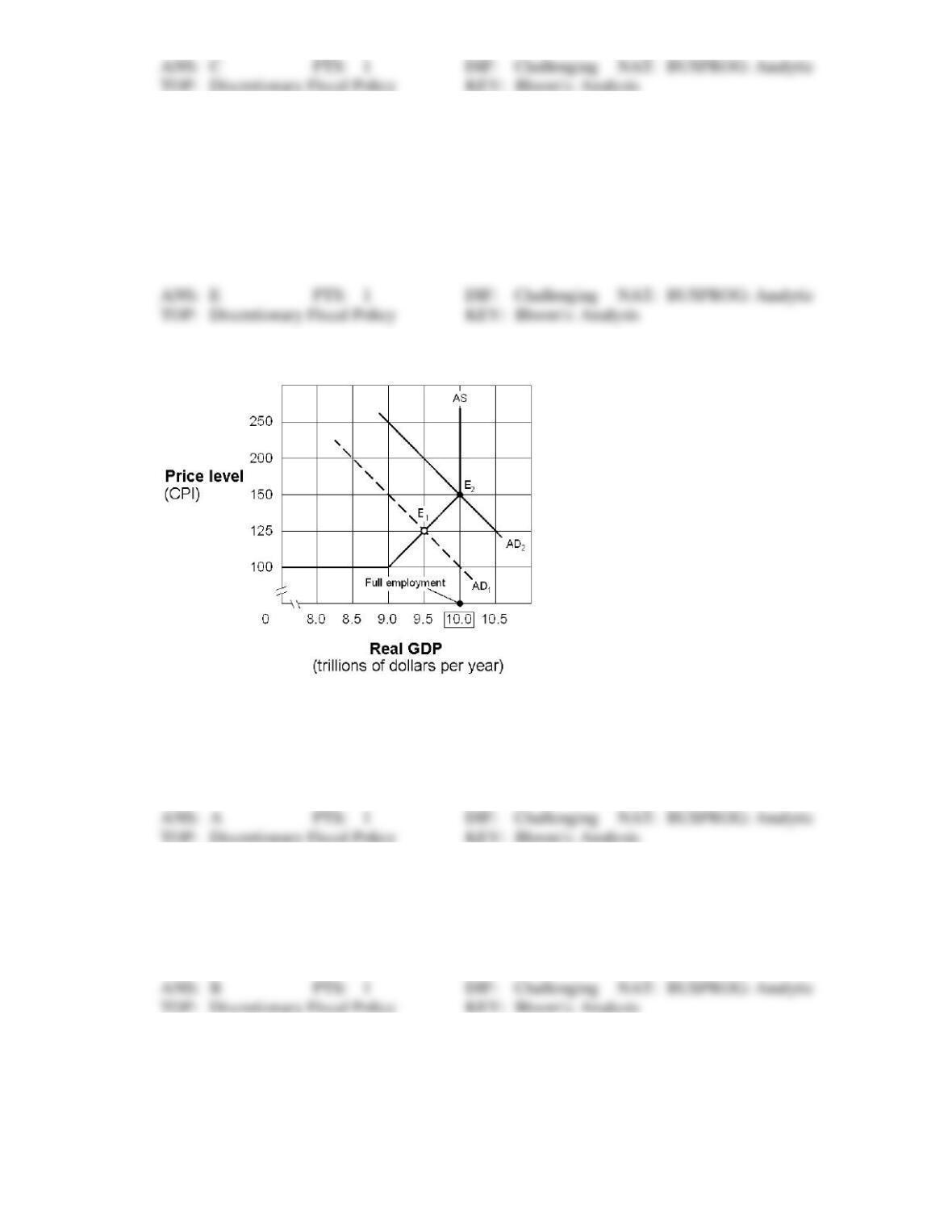
75. Suppose the economy in Exhibit 11-2 is in equilibrium at point E1 and the marginal propensity to
consume (MPC) is 0.75. Following Keynesian economics, the federal government can move the
economy to full employment at point E2 by:
a.
decreasing government tax revenue by $100 billion.
b.
decreasing government tax revenue by $750 billion.
c.
increasing government tax revenue by $100 billion.
d.
increasing government tax revenue by approximately $33 billion.
e.
decreasing government tax revenue by approximately $33 billion.
Exhibit 11-3 Aggregate demand and supply model
76. Suppose the economy in Exhibit 11-3 is in equilibrium at point E1 and the marginal propensity to
consume (MPC) is 0.80. Following Keynesian economics, to restore full employment, the government
should increase its spending by:
a.
$200 billion.
c.
$500 billion.
b.
$250 billion.
d.
$1 trillion.
77. Suppose the economy in Exhibit 11-3 is in equilibrium at point E1, and the marginal propensity to
consume (MPC) is 0.80. Following Keynesian economics, to restore full employment, the government
should cut taxes by:
a.
$0.20 trillion.
c.
$0.50 trillion.
b.
$250 billion.
d.
$1 trillion.
78. Beginning at equilibrium E1 in Exhibit 11-3, when the government increases spending or cuts taxes the
economy will experience:
a.
an inflationary recession.
c.
cost-push inflation.
b.
stagflation.
d.
demand-pull inflation.
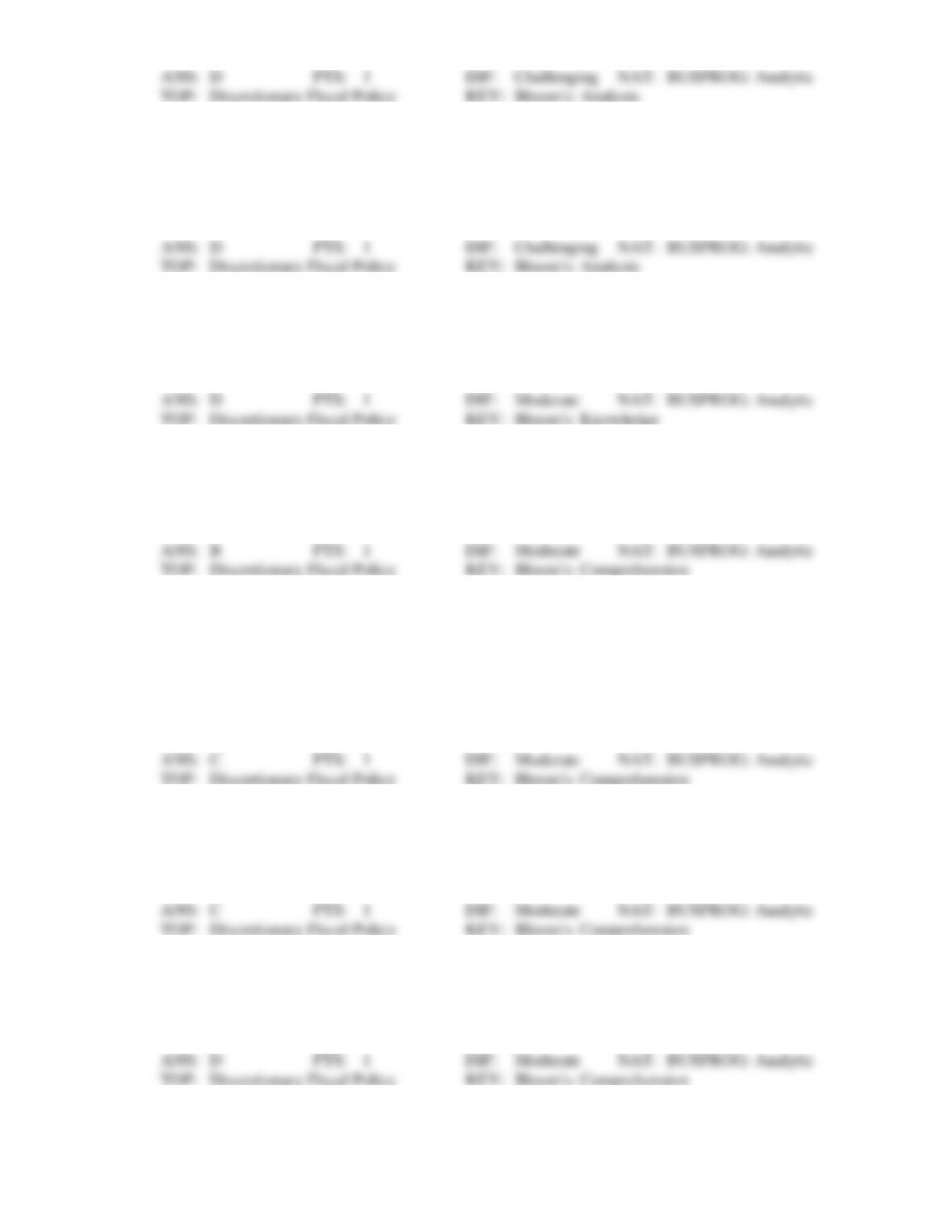
79. Suppose the economy in Exhibit 11-3 is in equilibrium at point E1, and the marginal propensity to
consume (MPC) is 0.75. Following Keynesian economics, to restore full employment, the government
should cut taxes by:
a.
$0.20 trillion.
c.
$0.5 trillion.
b.
$1 trillion.
d.
$0.25 trillion.
80. Mathematically, the value of the tax multiplier in terms of the marginal propensity to consume (MPC)
is given by the formula:
a.
MPC − 1.
c.
1 / MPC.
b.
(MPC − 1) / MPC.
d.
1 − [1 / (1 − MPC)].
81. Assume the marginal propensity to consume (MPC) is 0.75 and the government cuts taxes by $250
billion. The aggregate demand curve will shift to the:
a.
right by $1,000 billion.
c.
left by $1,000 billion.
b.
right by $750 billion.
d.
left by $750 billion.
82. Assume the marginal propensity to consume (MPC) is 0.80 and the government cuts taxes by $100
billion. The aggregate demand curve will shift to the:
a.
right by $80 billion.
b.
left by $200 billion.
c.
right by $400 billion.
d.
left by $400 billion.
e.
None of these.
83. Assume the marginal propensity to consume (MPC) is 0.75 and the government increases taxes by
$250 billion. The aggregate demand curve will shift to the:
a.
left by $1,000 billion.
c.
left by $750 billion.
b.
right by $1,000 billion.
d.
right by $750 billion.
84. Assume the marginal propensity to consume (MPC) is 0.80 and the government increases taxes by
$100 billion. The aggregate demand curve will shift to the:
a.
left by $80 billion.
c.
right by $400 billion.
b.
right by $200 billion.
d.
left by $400 billion.
85. Find the tax multiplier if the MPC is 0.75.
a.
−4.
b.
−3.
c.
0.33.
d.
3.
e.
4.
86. A tax multiplier equal to −4.30 would imply that a $100 tax increase would lead to a:
a.
$430 decline in real GDP.
b.
$430 increase in real GDP.
c.
4.3 percent increase in real GDP.
d.
4.3 percent decrease in real GDP.
e.
43 percent decrease in real GDP.
87. Which of the following would most likely occur if the federal government increased its spending and
enlarged the size of the budget deficit during a period of full employment?
a.
The rate of inflation would decline.
c.
A recession would develop.
b.
The r ate of inflation would rise.
d.
Interest rates would fall.
88. Which of the following would most likely occur if the federal government decreased its spending and
reduced the size of the budget deficit during a period of full employment?
a.
The rate of inflation would decline.
c.
A recession would develop.
b.
The rate of inflation would rise.
d.
Interest rates would fall.
89. If the economy was about to enter an inflationary boom, which of the following would be the most
appropriate policy?
a.
A tax increase.
c.
An increase in government spending.
b.
A decrease in government spending.
d.
A tax decrease.
90. If an inflationary boom exists, the appropriate fiscal policy is to:
a.
increase the budget deficit.
b.
increase government spending and hold taxes constant.
c.
decrease government spending and/or raise taxes.
d.
hold government spending constant and decrease taxes.
91. “Last month unemployment fell to 4 percent, its lowest level in years. The economy is growing
rapidly, but consumer prices have risen at an annual rate of 10 percent during the last six months.”
Which of the following policies would be most appropriate under these circumstances?
a.
An increase in both government spending and taxes.
b.
An increase in taxes.
c.
A reduction in taxes.
d.
An increase in government spending.
92. It is inflationary for government to increase spending if:
a.
it also cuts taxes.
b.
the aggregate supply curve is flat.
c.
the economy is at full employment.
d.
equilibrium real GDP is well below full employment.
93. If no fiscal policy changes are made, suppose the current aggregate demand curve will increase
horizontally (shift rightward) by $1,000 billion and cause inflation. If the marginal propensity to
consume is 0.90, federal policymakers could follow Keynesian economics and restrain inflation by
decreasing:
a.
government spending by $100 billion.
c.
taxes by $1,000 billion.
b.
taxes by $100 billion.
d.
government spending by $1,000 billion.
94. If no fiscal policy changes are made, suppose the current aggregate demand curve will increase
horizontally by $1,000 billion and cause inflation. If the marginal propensity to consume is 0.75,
federal policymakers could follow Keynesian economics and restrain inflation by decreasing:
a.
government spending by $250 billion.
c.
taxes by $1,000 billion.
b.
taxes by $100 billion.
d.
government spending by $1,000 billion.
95. If no fiscal policy changes are implemented to fight inflation, suppose the aggregate demand curve
will exceed the current aggregate demand curve by $900 billion at any level of prices. Assuming the
marginal propensity to consume is 0.90, this increase in aggregate demand could be prevented by:
a.
increasing government spending by $500 billion.
b.
increasing government spending by $140 billion.
c.
decreasing taxes by $40 billion.
d.
increasing taxes by $100 billion.
96. Suppose inflation is a threat because the current aggregate demand curve will increase by $600 billion
at any price level. If the marginal propensity to consume is 0.75, federal policymakers can follow
Keynesian economics and restrain inflation by:
a.
decreasing tax revenues by $600 billion.
b.
decreasing government spending by $200 billion.
c.
increasing tax revenues by $200 billion.
d.
increasing government purchases by $150 billion.
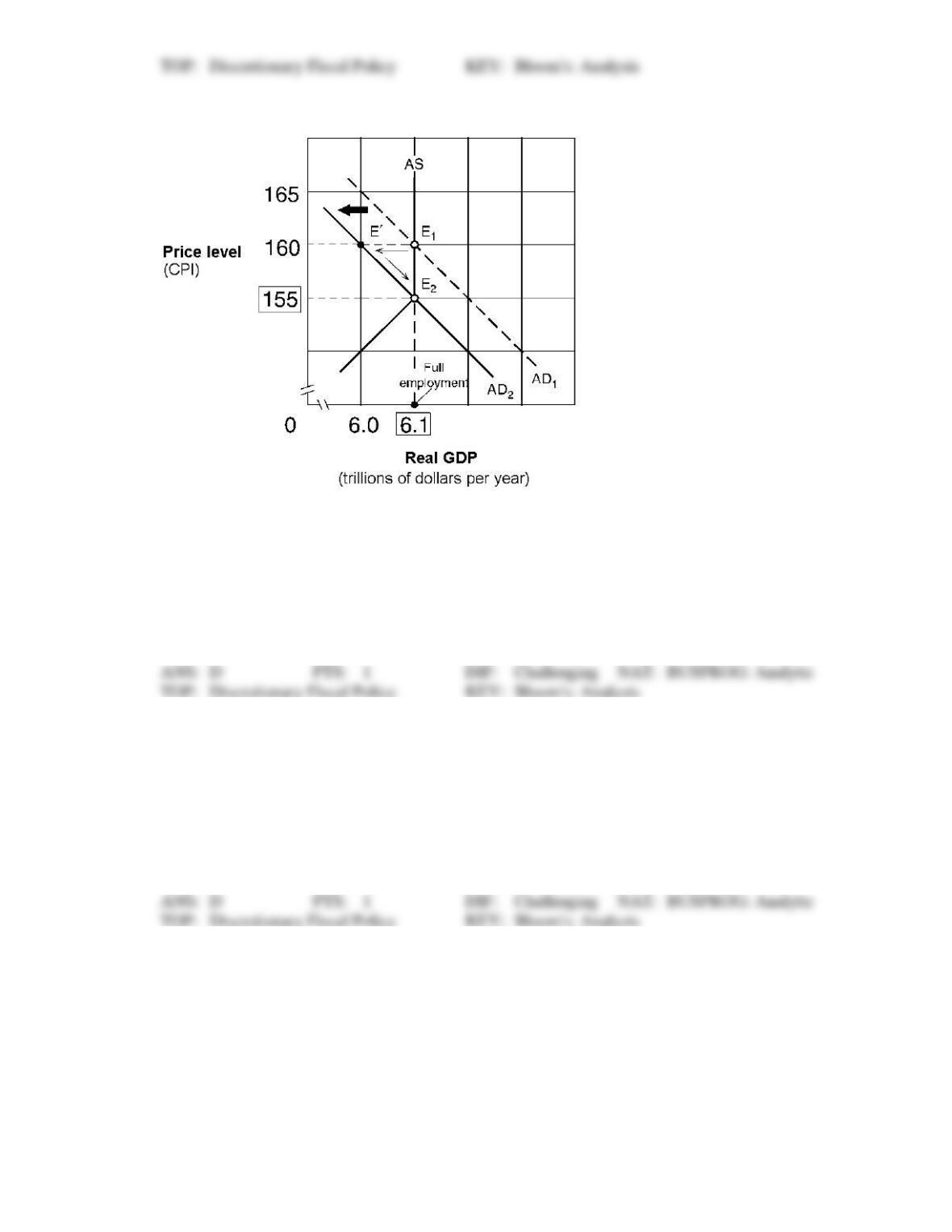
Exhibit 11-4 Aggregate demand and supply model
97. Suppose the economy in Exhibit 11-4 is in equilibrium at point E1 and the marginal propensity to
consume (MPC) is 0.75. Following Keynesian economics, the federal government can move the
economy to point E2 and reduce inflation by:
a.
decreasing government spending by $750 billion.
b.
decreasing government spending by $100 billion.
c.
increasing government spending by $25 billion.
d.
decreasing government spending by $25 billion.
98. Suppose the economy in Exhibit 11-4 is in equilibrium at point E1 and the marginal propensity to
consume (MPC) is 0.75. Following Keynesian economics, the federal government can move the
economy to point E2 and reduce inflation by:
a.
decreasing government tax revenue by $100 billion.
b.
decreasing government tax revenue by $750 billion.
c.
increasing government tax revenue by $100 billion.
d.
increasing government tax revenue by approximately $33 billion.
e.
decreasing government tax revenue by approximately $33 billion.
99. If the economy is experiencing demand-pull inflation, then the appropriate government policy would
be to shift the:
a.
aggregate demand curve by using a tax increase coupled with spending cuts.
b.
aggregate demand curve by using a tax increase coupled with more spending.
c.
aggregate demand curve by using a tax cut coupled with spending cuts.
d.
aggregate demand curve by using a tax cut coupled with more spending.
e.
aggregate supply curve by using a tax cut coupled with spending cuts.
100. If no fiscal policy changes are made, suppose the current aggregate demand curve will increase
horizontally by $1,000 billion and cause inflation. If the marginal propensity to consume (MPC) is
0.80, federal policymakers could follow Keynesian economics and restrain inflation by decreasing:
a.
government spending by $200 billion.
c.
taxes by $1,000 billion.
b.
taxes by $100 billion.
d.
government spending by $1,000 billion.
101. If the economy is experiencing unemployment, then the most appropriate government policy would be
to:
a.
shift the aggregate demand curve by using a tax increase coupled with spending cuts.
b.
shift the aggregate demand curve by using a tax increase coupled with more spending.
c.
shift the aggregate demand curve by using a tax cut coupled with spending cuts.
d.
shift the aggregate demand curve by using a tax cut coupled with more spending.
e.
shift the aggregate supply curve by using a tax cut coupled with spending cuts.
102. If the economy is experiencing inflation, then the most appropriate government policy would be to:
a.
shift the aggregate demand curve by using a tax increase coupled with spending cuts.
b.
shift the aggregate demand curve by using a tax increase coupled with more spending.
c.
shift the aggregate demand curve by using a tax cut coupled with spending cuts.
d.
shift the aggregate demand curve by using a tax cut coupled with more spending.
e.
shift the aggregate supply curve by using a tax cut coupled with spending cuts.
103. The government can reduce unemployment or reduce inflation by:
a.
manipulating aggregate demand.
b.
manipulating the availability of natural resources.
c.
manipulating the availability of capital goods.
d.
manipulating the availability of qualified workers.
e.
curbing the level of immigration.
104. The government wishes to close an inflationary gap by reducing real GDP by $400 billion. Assuming a
tax multiplier of 4 and an income multiplier of 5, which of the following policy prescriptions would
reduce the inflationary gap by $400 billion?
a.
Decreasing government spending by $400 billion and increasing taxes by $400 billion.
b.
Decreasing government spending by $160 billion and decreasing taxes by $100 billion.
c.
Decreasing government spending by $40 billion and decreasing taxes by $40 billion.
d.
Decreasing government spending by $80 billion and keeping taxes the same.
e.
Doing absolutely nothing to the economy.