Chapter 12—The Public Sector
MULTIPLE CHOICE
1. Which of the following countries had the highest level of government expenditures as a share of GDP?
a.
Sweden.
c.
United States.
b.
Japan.
d.
Italy.
2. After 1970, the share of federal spending allocated to national defense:
a.
declined sharply, while the share allocated to income security increased substantially.
b.
rose sharply, while the share allocated to income security declined substantially.
c.
was relatively constant, while the share allocated to income security declined modestly.
d.
declined modestly, while the share allocated to income security was relatively constant.
3. Government expenditures as a share of the U.S. economy are:
a.
the largest in the world.
b.
the smallest in the world.
c.
smaller than most Western European countries.
d.
larger than Canada, France, and the United Kingdom but slightly smaller than Germany
and Italy.
4. Total government spending (federal, state, and local) sums to approximately:
a.
10 percent of the U.S. economy.
c.
40 percent of the U.S. economy.
b.
20 percent of the U.S. economy.
d.
one-half of the U.S. economy.
5. Measured as a share of the economy, government expenditures:
a.
have been between 10 and 15 percent of the U.S. economy since 1930.
b.
have been between 20 and 25 percent of the U.S. economy since 1930.
c.
rose from less than 10 percent in 1929 to nearly 40 percent in 2009.
d.
declined from more than 50 percent in 1929 to approximately 25 percent in 2009.
6. Currently, total government expenditures in the United States:
a.
are close to 40 percent of GDP.
b.
fell by half, to 10 percent of GDP.
c.
nearly doubled to one half of GDP.
d.
nearly tripled to about 60 percent of GDP.
7. Currently, total private sector expenditures in the United States:
a.
remained close to one third of GDP.
c.
fell by half to 65 percent of GDP.
b.
fell by half to 50 percent of GDP.
d.
remained close to 60 percent of GDP.
8. Currently, total government expenditures in the United States have totaled about:
a.
one-tenth of GDP.
c.
40 percent of GDP.
b.
one-fifth of GDP.
d.
one-half of GDP.
9. Which of the following categories accounted for the lowest percent of the total federal government
expenditures in recent years?
a.
Income security.
c.
Education and health.
b.
National defense.
d.
Interest on the national debt.
10. Which of the following categories accounted for the largest percentage of total federal government
expenditures in recent years?
a.
Income security.
c.
Education and health.
b.
National defense.
d.
Interest on the national debt.
11. Since 1970, the composition of federal expenditures has:
a.
been virtually unchanged, but federal spending as a share of GDP has declined
substantially.
b.
been virtually unchanged, but federal spending as a share of GDP has increased sharply.
c.
shifted away from national defense and toward spending on income security.
d.
shifted away from income security income transfers and toward spending on national
defense.
12. Which of the following categories accounted for the third largest percentage of total federal
government expenditures?
a.
Education and health.
c.
Income security.
b.
National defense.
d.
Interest on the national debt.
13. The income security program category for federal government outlays includes spending for:
a.
Social Security.
b.
Medicare.
c.
Welfare.
d.
Unemployment compensation.
e.
All of these.
14. How does total taxes as a percentage of GDP in the United States compare to those of Western
European countries, such as the United Kingdom, Germany, and Sweden?
a.
U.S. taxation is smaller.
c.
U.S. taxation is slightly larger.
b.
U.S. taxation is about the same.
d.
U.S. taxation is substantially larger.
15. Which of the following countries devote the smallest percentage of its GDP to taxes?
a.
The United Kingdom.
c.
Germany.
b.
Sweden.
d.
The United States.
16. In which of the following countries are taxes (measured as a percentage of GDP) the lowest?
a.
Canada.
c.
Sweden.
b.
France.
d.
The United States.
17. Since 1929, total government taxes as a percentage of GDP:
a.
climbed from 10 percent to about 30 percent.
b.
remained close to 30 percent.
c.
climbed from 30 percent to about 50 percent.
d.
climbed from 15 percent to about 50 percent.
18. Which of the following is the largest source of revenue for the federal government?
a.
corporate income tax
c.
personal income tax
b.
payroll tax
d.
user charges
19. Which of the following taxes contributed the greatest percentage of total federal government tax
revenues in recent years?
a.
Individual income taxes.
c.
Social Security taxes.
b.
Corporate income taxes.
d.
Excise taxes.
20. The primary source of revenue at the federal level is:
a.
the corporate income tax.
b.
the personal income tax.
c.
property taxes.
d.
sales taxes.
e.
customs duties.
21. At the federal level, the single most important tax, accounting for slightly less than half of revenue, is
the:
a.
corporate income tax.
b.
personal income tax.
c.
estate tax.
d.
property tax.
e.
sales tax.
22. When the tax structure of a nation is progressive, as incomes increase, the tax rate:
a.
declines.
c.
increases.
b.
remains the same.
d.
is proportional.
23. “It would be an undue hardship to require people whose income is below $15,000 per year to pay
income taxes.” This statement reflects which of the following principles for a tax?
a.
Benefits-received.
c.
Ability-to-pay.
b.
Inexpensive-to–collect.
d.
Fairness of contribution.
24. “He who pays a tax should receive the benefit from the expenditure financed by the tax.” This
statement reflects which of the following principles for a tax?
a.
Fairness of contribution.
c.
Benefits-received.
b.
Ability-to-pay.
d.
Inexperience-to-collect.
25. The benefits-received principle of taxation is most evident in:
a.
progressive tax rates.
c.
the personal income tax.
b.
excise taxes on gasoline.
d.
the corporate income tax.
26. Which of the following answers best reflects the ability-to-pay philosophy of taxation?
a.
Property tax.
c.
Excise tax on gasoline.
b.
Progressive income tax.
d.
Excise tax on cigarettes.
27. Which of the following is an example of a progressive tax?
a.
The excise tax on cigarettes.
c.
The federal personal income tax.
b.
The federal tax on gasoline.
d.
All of these.
28. Sharon pays a tax of $4,000 on her income of $40,000, while Brad pays a tax of $1,000 on his income
of $20,000. This tax is:
a.
regressive.
c.
proportional.
b.
progressive.
d.
a flat tax.
29. If a person is concerned that an additional $1,000 income will move him/her into a new tax bracket,
that person is worried about the:
a.
proportional rate.
c.
marginal tax rate.
b.
regressive tax rate.
d.
flat tax rate.
30. A tax is regressive if it collects a:
a.
larger amount as income rises.
b.
constant amount as income rises.
c.
smaller fraction of income as income falls.
d.
smaller fraction of income as income rises.
31. Suppose George’s income is $10,000 and he pays a tax of $1,000, but Laura’s income is $50,000 and
she pays a tax of $4,000. Such a tax is:
a.
regressive.
c.
proportional.
b.
progressive.
d.
flat.
32. Which of the following can be classified as a regressive tax?
a.
Federal corporate income tax.
c.
Federal gasoline tax.
b.
Federal personal income tax.
d.
All of these.
33. The social security tax is a:
a.
progressive tax at all income levels.
b.
regressive tax above a certain income level.
c.
proportional tax at all income levels.
d.
none of these.
34. Which of the following is a regressive tax?
a.
A state tax of 5 percent of income.
c.
The federal individual income tax.
b.
A local sales tax of 5 percent.
d.
A federal flat tax of 30 percent.
35. A tax that is structured so that people pay the same percentage of their income in taxes is called a(n):
a.
flat tax.
c.
progressive tax.
b.
regressive tax.
d.
excise tax.
36. Generally, most economists feel that a sales tax is:
a.
regressive.
c.
progressive.
b.
proportional.
d.
fair.
37. A tax where the percentage of income paid in taxes is the same regardless of the size of the income is
a:
a.
proportional tax.
c.
progressive tax.
b.
regressive tax.
d.
mix of a and b.
38. Which of the following statements is false?
a.
The largest source of state and local governments tax revenue is sales and excise taxes.
b.
The largest source of federal government tax revenue is individual income taxes.
c.
A sales tax on food is a regressive tax.
d.
A proportional tax is equal to a fixed dollar amount.
39. When a tax is regressive, as a person’s income rises, the tax rate:
a.
stays the same.
b.
decreases.
c.
increases.
d.
increase and then decreases.
e.
decreases and then increases.
40. If a tax rate falls as a person’s income rises, the tax is a:
a.
proportional tax.
b.
progressive tax.
c.
regressive tax.
d.
poll tax.
e.
constant tax.
41. When the tax rate is constant when a person’s income rises, the tax is a:
a.
regressive tax.
b.
poll tax.
c.
progressive tax.
d.
constant tax.
e.
proportional tax.
42. A tax is proportional if, as a person’s income rises, the:
a.
tax rate is constant.
b.
tax rate falls.
c.
tax rate rises.
d.
amount of the tax is constant.
e.
amount of the tax falls.
43. The federal personal income tax was designed to be a:
a.
progressive tax.
b.
regressive tax.
c.
proportional tax.
d.
poll tax.
e.
payroll tax.
44. If a person is taxed $100 on an income of $1,000, taxed $180 on an income of $2,000, and taxed $220
on an income of $3,000, this person is paying a:
a.
progressive tax.
b.
poll tax.
c.
proportional tax.
d.
regressive tax.
e.
retro tax.
45. If a person is taxed $100 on an income of $1,000, taxed $200 on an income of $2,000, and taxed $300
on an income of $3,000, this person is paying a(n):
a.
progressive tax.
b.
poll tax.
c.
regressive tax.
d.
excise tax.
e.
proportional tax.
46. If a person is taxed $100 on an income of $1,000, taxed $220 on an income of $2,000, and taxed $390
on an income of $3,000, this person is paying a(n):
a.
progressive tax.
b.
poll tax.
c.
regressive tax.
d.
excise tax.
e.
proportional tax.
47. If a person is taxed $1,000 on an income of $10,000, taxed $2,000 on an income of $20,000, and taxed
$3,000 on an income of $30,000, this person is paying a(n):
a.
progressive tax.
b.
regressive tax.
c.
proportional tax.
d.
poll tax.
e.
excise tax.
Exhibit 12-1 Income for two persons
Name
Income
Elaine
$100,000
Daniel
$ 40,000
48. In Exhibit 12-1, if the income tax system is proportional, then:
a.
Elaine and Daniel will face the same tax rate and will have tax bills the same size.
b.
Elaine and Daniel will face the same tax rate but Elaine’s tax bill will be larger.
c.
Elaine will face a higher tax rate and will have a larger tax bill than Daniel.
d.
Elaine will face a lower tax rate and will have a smaller tax bill than Daniel.
e.
Elaine will face a lower tax rate but will have a larger tax bill than Daniel.
49. In Exhibit 12-1, if the income tax system is progressive, then:
a.
Elaine and Daniel will face the same tax rate and will have tax bills the same size.
b.
Elaine and Daniel will face the same tax rate but have tax bills that are different sizes.
c.
Elaine will face a higher tax rate and will have a larger tax bill than Daniel.
d.
Elaine will face a lower tax rate and will have a smaller tax bill than Daniel.
e.
Elaine will face a lower tax rate but will have a larger tax bill than Daniel.
Exhibit 12-2 Income and taxes for two persons
Name
Income
Income
Tax Bill
Mitchell
$60,000
$6,000
Ryan
$10,000
$1,000
50. In Exhibit 12-2, we can tell that the tax shown here is:
a.
a poll tax.
b.
proportional.
c.
progressive.
d.
equitable.
e.
regressive.
Exhibit 12-3 Income for two persons
Name
Income
Meredith
$124,000
Hillary
$ 45,000
51. In Exhibit 12-3, if the income tax system is currently proportional, we know that:
a.
Meredith would probably prefer a progressive income tax system while Hillary would
probably prefer a regressive income tax system.
b.
Meredith and Hillary would both probably prefer a regressive income tax system.
c.
Meredith and Hillary would both probably prefer a progressive income tax system.
d.
Meredith would probably prefer a regressive income tax system while Hillary would
probably prefer a progressive income tax system.
e.
Meredith would probably prefer a progressive income tax system while Hillary would
probably prefer a head tax.
52. In Exhibit 12-3, if the income tax system is currently proportional, we know that:
a.
Meredith has a larger tax bill than Hillary, although they pay the same tax rate.
b.
Meredith has a larger tax bill than Hillary and pays a higher tax rate.
c.
Hillary has a larger tax bill than Meredith, although they pay the same tax rate.
d.
Hillary has a larger tax bill than Meredith and pays a higher tax rate.
e.
Meredith and Hillary’s tax bills are equal.
53. In Exhibit 12-3, if the income tax system is currently progressive, we know that:
a.
Meredith has a larger tax bill than Hillary, although they pay the same tax rate.
b.
Hillary has a larger tax bill than Meredith, although they pay the same tax rate.
c.
Meredith has a larger tax bill than Hillary and pays a higher tax rate.
d.
Hillary has a larger tax bill than Meredith and pays a higher tax rate.
e.
Meredith’s and Hillary’s tax bills are equal.
54. A tax system in which the tax rate on everyone’s first $10,000 of income is 10 percent, the tax rate on
everyone’s second $10,000 of income is 15 percent, and the tax rate on all income over $20,000 is 25
percent is a(n):
a.
proportional tax.
b.
equitable tax.
c.
head tax.
d.
unit tax.
e.
progressive tax.
55. A tax whose impact varies inversely with the income of the person taxed, and poor people have a
higher percentage of their income taxed than rich people, is known as a:
a.
regressive tax.
b.
progressive tax.
c.
proportional tax.
d.
flat tax.
e.
tax holiday.
56. When the government levies a tax where everyone is taxed the same fixed percentage of their incomes,
this tax is known as a(n):
a.
regressive tax.
b.
progressive tax.
c.
proportional tax.
d.
excise tax.
e.
luxury tax.
57. Consider two people, Sandy Ross, who earns $25,000, and Gary Belcher, who earns $50,000. If the
flat-tax rate is 20 percent, then:
a.
the government collects a total of $20,000.
b.
Gary pays twice the tax amount Sandy pays.
c.
Gary pays three times the tax amount Sandy pays.
d.
Gary and Sandy pay exactly the same tax amount.
e.
Gary pays $15,000 in taxes.
58. A tax for which the rate varies directly with the income of the person taxed is known as a(n):
a.
regressive tax.
b.
progressive tax.
c.
proportional tax.
d.
flat tax.
e.
excise tax.
59. A tax where wealthy people pay a larger percentage of their income than poor people is known as a(n):
a.
excise tax.
b.
flat tax.
c.
proportional tax.
d.
progressive tax.
e.
regressive tax.
60. Consider two people, Sandy Smith, who earns $25,000, and Gary Carver, who earns $50,000. If the
government has decided to tax everyone’s first $25,000 at 20 percent and everyone‘s second $25,000 at
40 percent, then:
a.
Gary and Sandy both pay taxes of the same percentage of total income.
b.
Gary and Sandy pay the same amount of taxes.
c.
Gary pays twice the tax amount Sandy pays.
d.
Gary pays three times the tax amount Sandy pays.
e.
Sandy does not pay taxes.
61. Consider two people, Sandy Smith, who earns $25,000, and Gary Carver, who earns $50,000. If the
government has decided to tax everyone’s first $25,000 at 20 percent and everyone‘s second $25,000 at
40 percent, then Gary pays:
a.
$10,000 in taxes and Sandy pays $5,000 in taxes.
b.
$10,000 in taxes and Sandy pays $10,000 in taxes.
c.
$15,000 in taxes and Sandy pays $5,000 in taxes.
d.
$15,000 in taxes and Sandy pays $10,000 in taxes.
e.
$17,000 in taxes and Sandy pays $5,000 in taxes.
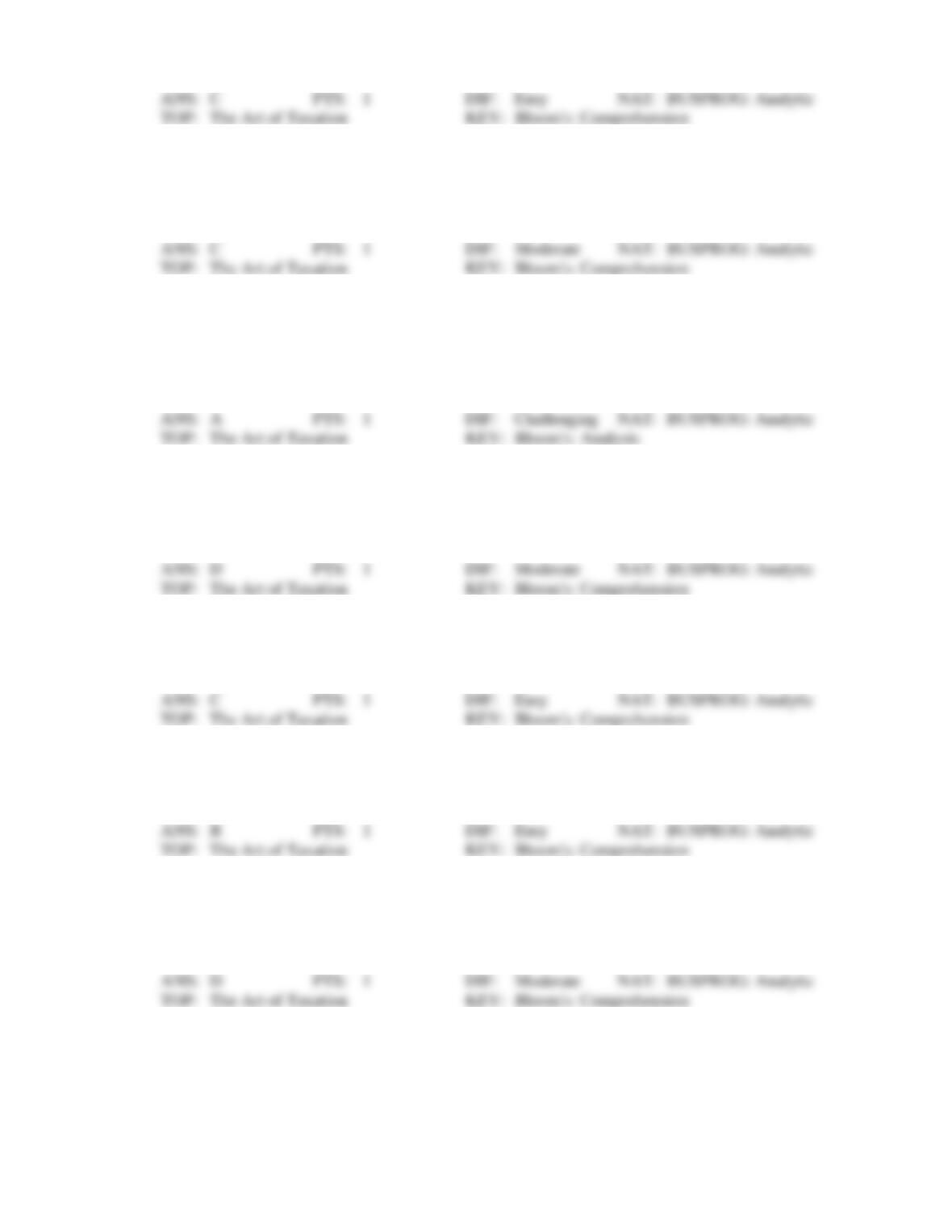
Exhibit 12-4 Marginal tax rate lines
62. In Exhibit 12-4, line A represents a(n):
a.
regressive tax.
c.
proportional tax.
b.
progressive tax.
d.
ability-to-pay tax.
63. In Exhibit 12-4, line B represents a:
a.
regressive tax.
c.
proportional tax.
b.
progressive tax.
d.
flat tax.
64. In Exhibit 12-4, line C represents a(n):
a.
regressive tax.
c.
proportional tax.
b.
progressive tax.
d.
ability-to-pay tax.
65. In Exhibit 12-4, if A represents state and local taxes and B represents federal income taxes, what is the
result of imposing both types of taxes?
a.
regressive tax.
c.
proportional tax.
b.
progressive tax.
d.
ability-to-pay tax.
66. Some cities finance their airports with a departure tax: every person leaving the city by plane is
charged a small fixed dollar amount that is used to help pay for building and running the airport. The
departure tax follows the:
a.
benefits-received principle.
c.
flat-rate taxation principle.
b.
ability-to-pay principle.
d.
public-choice principle.
67. Suppose a person with an income of $20,000 pays a tax of $2,000. If the tax is progressive, then how
large of a tax will a person with an income of $40,000 pay?
a.
Exactly $2,000.
c.
Exactly $4,000.
b.
Between $2,000 and $4,000.
d.
More than $4,000.
68. Sales and excise taxes are:
a.
progressive.
c.
regressive.
b.
proportional.
d.
fixed-revenue.
69. Which of the following U.S. taxes is the most consistent with the ability-to-pay principle?
a.
The excise tax on gasoline.
c.
State sales taxes.
b.
The federal income tax.
d.
The Social Security payroll tax.
70. Jan has an income of $30,000 and pays $4,500 in taxes. When Jan’s income rises to $40,000, her tax
bill rises to $6,500. What is Jan’s marginal tax rate?
a.
5 percent.
c.
16.25 percent.
b.
15 percent.
d.
20 percent.
71. A progressive tax means the percentage of income paid as taxes:
a.
increases as income increases.
c.
remains the same as income increases.
b.
decreases as income increases.
d.
none of these.
72. Which of the following statements is true?
a.
The most important source of revenue to the federal government is personal income taxes.
b.
The most important source of revenue to state governments are sales and property taxes.
c.
The most important source of revenue to local governments are local property taxes.
d.
The taxation burden, measured by taxes as a percentage of GDP, is lighter in the United
States than in most other advanced industrial countries.
e.
All of these.
73. Jose pays a tax of $24,000 on his income of $60,000, while Richard pays a tax of $3,000 on his
income of $30,000. This tax is:
a.
a flat tax.
c.
proportional.
b.
progressive.
d.
regressive.
74. Which of the following can be classified as a regressive tax?
a.
Excise tax.
c.
Gasoline tax.
b.
Sales tax.
d.
All of these.
75. A tax is structured so that the tax as a percentage of income declines as the level of income increases is
called a(n):
a.
flat tax.
c.
progressive tax.
b.
regressive tax.
d.
excise tax.
76. Which of the following statements is true?
a.
A sales tax on food is a regressive tax.
b.
The largest source of federal government tax revenue is individual income taxes.
c.
The largest source of state and local governments tax revenue is sales and excise taxes.
d.
All of the above are true.
e.
None of the above are true.
77. Which of the following statements is true?
a.
Sales, excise, and flat-rate taxes violate the ability-to-pay principle of taxation fairness
because each results in a greater burden on the poor than the rich.
b.
Government failure may occur if voters are rationally ignorant.
c.
Government failure may occur because of special-interest group political pressure.
d.
All of these.
78. The study of the decision-making process of government is the study of:
a.
Keynesian economics.
c.
rational expectations theory.
b.
public choice theory.
d.
social economics.
79. Cost-benefit principles can be applied to the decision of:
a.
profit-maximizing firms.
b.
majority-rule voting.
c.
which project receives the most votes.
d.
rational ignorance.
e.
all of these.
80. People who often create benefits for the minority and impose the cost on the majority are called:
a.
fair-interest groups.
c.
laissez-faire groups.
b.
encounter groups.
d.
special-interest groups.
81. The choice of a voter to remain uninformed because the marginal cost of obtaining information is
greater than the marginal benefit from obtaining knowledge is called:
a.
irrational ignorance.
c.
collective interest.
b.
rational ignorance.
d.
choice.
82. Who is recognized as the founder of public choice theory?
a.
James Buchanan.
c.
Joseph Pechman.
b.
Steve Forbes.
d.
Adam Smith.
83. Voters may choose to remain uninformed about an issue because of:
a.
the special-interest effect.
c.
bureaucratic inefficiency.
b.
rational ignorance.
d.
the shortsightedness effect.
84. According to the shortsightedness effect, politicians tend to favor projects with:
a.
short-run benefits and short-run costs.
c.
long-run benefits and short-run costs.
b.
short-run benefits and long-run costs.
d.
long-run benefits and long-run costs.
85. Which of the following offers theories to explain why the government, like the private sector, may also
“fail”?
a.
Social economics.
c.
Rational expectations theory.
b.
Public choice theory.
d.
Keynesian economics.
86. People who often impose cost on the majority in order to benefit certain groups are called:
a.
laissez-faire groups.
b.
encounter groups.
c.
fair-interest groups.
d.
special-interest groups.
e.
none of these.
TRUE/FALSE
1. The term “public sector” refers only to federal government purchases of goods and services.
2. Since the 1950s, total expenditures in the United States nearly tripled to about 60 percent of GDP.
3. Since the 1950s, total private sector expenditures in the United States fell by half to 50 percent of
GDP.
4. Since World War II, most of the growth in U.S. government outlays is attributable to rapidly growing
federal government transfer programs.
5. There is no difference between government expenditures or outlays and government purchases or
spending.
6. A problem with the income security program category for federal government outlays is that it
excludes unemployment compensation.
7. The largest revenue source in the U.S. federal tax system is the corporate income tax.
8. Under a progressive tax system, the tax rate increases as income increases.
9. Taxes in the United States as a percentage of GDP are among the highest in the world.
10. The major source of tax revenues collected by the Federal government is the corporate income tax.
11. The three major revenue sources for the federal government in order of decreasing percentages are
individual income taxes, corporate taxes, and social security insurance.
12. A progressive income tax means the percentage of income paid in taxes decreases as income increases.
13. The ability-to-pay philosophy of taxation argues for a progressive form of taxation.
14. A person who is in the 15 percent marginal tax bracket and has a total taxable income of $100,000 will
owe $15,000 in taxes.
15. The federal income tax is progressive because poor people pay little or no taxes.
16. State and local sales taxes are typically progressive.
17. A proportional tax charges the same percentage of income, regardless of the size of income.
18. The Social Security payroll tax tends to be regressive.
19. A person who is in a 31 percent marginal tax bracket and has a total taxable income of $100,000 will
owe $31,000 in taxes.
20. The federal income tax is progressive because the tax rates increase at higher income levels.
21. State and local property taxes are regressive.
22. The ability-to-pay philosophy of taxation argues for a progressive form of taxation.
23. Many public choice economists believe that elected political officials would make better choices if
they had to vote for higher taxes in order to adopt new spending programs.
24. Public choice theory argues that one reason for rational voter ignorance is the indivisibility of public
service.
25. The amount of government expenditures on a project or program should continue to increase for as
long as the marginal benefits exceed the marginal costs.
26. According to the public choice theory, voters who choose to remain uninformed about the issues are
behaving irrationally.
27. The results of majority voting sometimes, but not always, agree with the results of benefit-cost
analysis.
28. Cost-benefit analysis can be applied to individual decision-making and public choice theory.
29. A special interest group cannot impose its will on the majority because the perceived costs and
benefits from government programs are the same for both groups.
30. A rational person may remain less than fully informed on an issue to be decided in an election.
31. Rational ignorance might explain low voter turnout because people apply marginal analysis to voting.
32. Cost-benefit analysis cannot be applied to collective or public choice decision-making.
33. Rational voter ignorance occurs because the marginal cost of obtaining information is higher than the
marginal benefit from obtaining the information.
ESSAY
1. Describe the major sources of tax revenue and expenditures for the federal government.
2. Describe the two basic philosophies of taxation fairness.
3. What are the public choice theory arguments against government involvement in the economy?