Chapter 6—Business Cycles and Unemployment
MULTIPLE CHOICE
1. Economists use the phrase “business cycle” when referring to fluctuations in:
a.
real GDP.
c.
the consumer price index.
b.
the chain price index.
d.
the general level of prices.
2. The period of declining growth in real GDP between the peak of the business cycle and the trough is
called a(n):
a.
recessionary phase.
c.
expansionary phase.
b.
recovery.
d.
stationary phase.
3. The period of growth in real GDP between the trough of the business cycle and the next peak is called
the:
a.
recessionary phase.
c.
contractionary phase.
b.
recovery phase.
d.
cyclical phase.
4. Which of the following will most likely occur during the recessionary phase of a business cycle?
a.
Real GDP rises, and the unemployment rate falls.
b.
Real GDP declines, and the rate of inflation rises.
c.
The sales of most businesses decline, and the unemployment rate rises.
d.
Inflation rises, and employment/population ratio falls.
5. Which of the following will most likely occur during the recovery phase of a business cycle?
a.
Real GDP rises, and unemployment falls.
b.
Real GDP declines, and inflation rises.
c.
Interest rates rise, and the number of business failures rise.
d.
Inflation rises, and employment falls.
6. Economists usually use the term “recession” to refer to:
a.
any slowdown in the growth of real GDP.
b.
zero real GDP growth.
c.
two or more consecutive quarters of declining real GDP.
d.
a reduction in nominal GDP lasting more than six months.
7. Which of the following is true of the business cycle record of the United States?
a.
Recessions have been lengthier during the last two decades than was true prior to 1980.
b.
Real GDP contracted throughout most of the 1950s.
c.
Real GDP in 2000 was approximately the same as 1950.
d.
Since 1950, the fluctuations in GDP have been less severe than before 1950.
8. A business cycle is the:
a.
period of time in which expansion and contraction of economic activity are equal.
b.
period of time in which there are three phases: peak, depression, and recovery.
c.
recurring growth and decline in real GDP.
d.
period of time in which a business is established and ceases operations.
9. The point at which real output reaches a maximum during a business cycle is called the:
a.
peak.
c.
recovery.
b.
recession.
d.
trough.
10. The period during which real output falls during a business cycle is called:
a.
peak.
c.
recovery.
b.
recession.
d.
trough.
11. The phase of the business cycle that follows a recession is known as the:
a.
peak.
c.
recovery.
b.
recession.
d.
trough.
12. As a general rule, a recession is a decline in real GDP lasting at least:
a.
one year.
c.
three months.
b.
six months.
d.
one month.
13. As a general rule, a recession occurs when there is a six consecutive month fall in:
a.
nominal GDP.
c.
the price level.
b.
real GDP.
d.
the trade balance.
14. Since World War II, the average length of recessions in the United States has been:
a.
2 months.
c.
2 years.
b.
11 months.
d.
3 1/2 years.
15. A business cycle is the period of time in which:
a.
a business is established and ceases operations.
b.
there are four phases: peak, recession, trough and recovery.
c.
the price level varies with real GDP.
d.
expansion and contraction of economic activity are equal.
e.
none of these are true.
16. What stage of the business cycle immediately follows the trough?
a.
Peak.
c.
Recession.
b.
Recovery.
d.
Depression.
17. The ____ phase of the business cycle follows a recession.
a.
recovery
c.
peak
b.
recession
d.
trough
18. A phase in the business cycle in which the economy’s real GDP declines is known as:
a.
a depression.
b.
a recession.
c.
a downtick.
d.
disequilibrium.
e.
limited demand.
19. A long and deep recession in the business cycle is:
a.
unemployment.
b.
a trough.
c.
a recession.
d.
a depression
e.
unavoidable.
20. The business cycle consists of four phases. At the top we have:
a.
recovery, followed by peak, and then recession followed by a recession.
b.
recovery, followed by a recession, and then peak followed by recession.
c.
peak, then an upturn followed by a recession, and then recession.
d.
peak, then a recession followed by recovery, and then recession.
e.
peak, then a recession followed by recession, and finally, recovery.
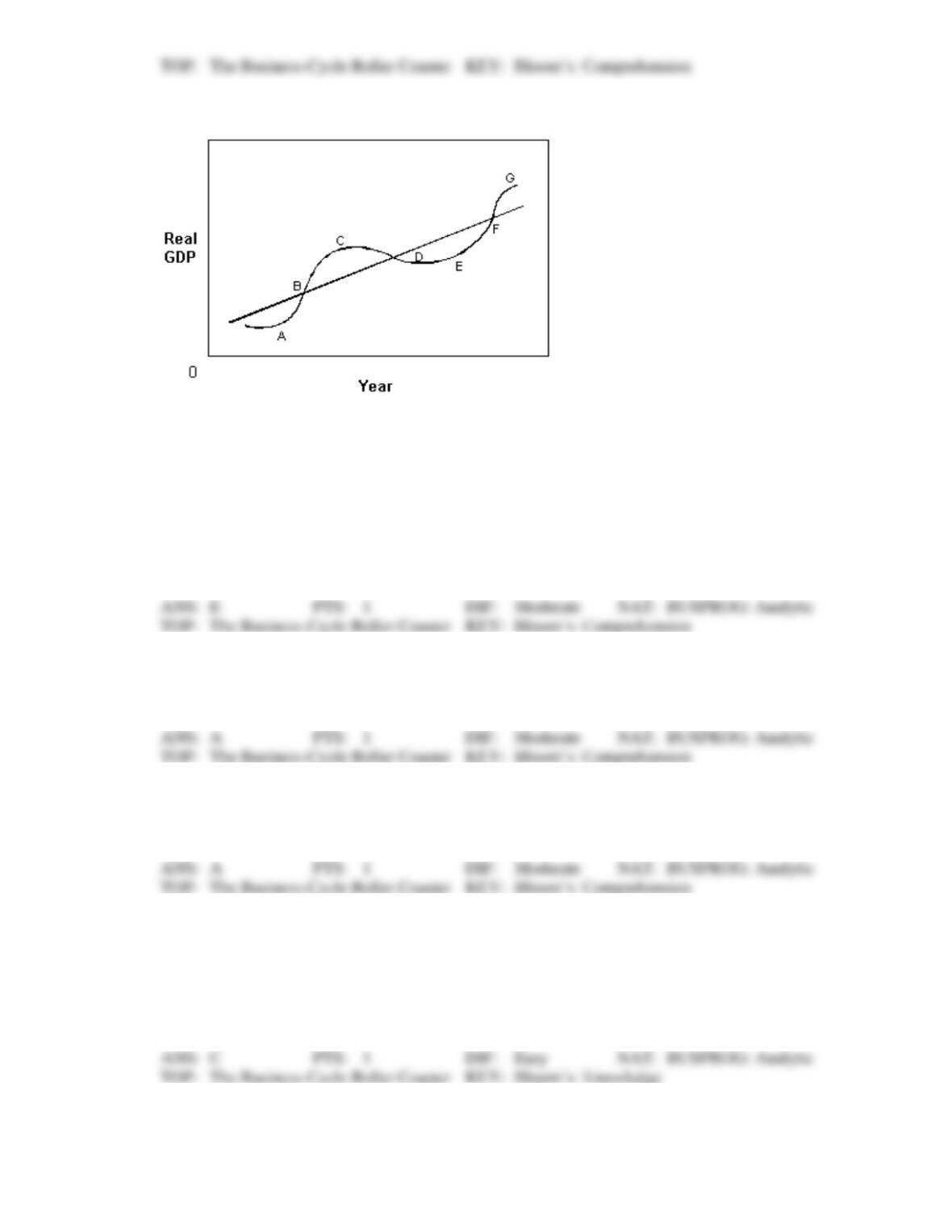
Exhibit 6-1 Business cycle
21. In Exhibit 6-1, the recovery phase of the business cycle can be represented by points:
a.
a.
CHOICE BLANK
b.
C.
c.
E.
d.
C to E.
e.
E to G.
22. In Exhibit 6-1, point E represents:
a.
recession and a trough.
c.
recession and a peak.
b.
peak and a trough.
d.
recovery and a peak.
23. In Exhibit 6-1, the recession phase of the business cycle can be represented by point(s):
a.
CDE.
c.
EFG.
b.
BCD.
d.
A and E.
24. The phase in the business cycle in which real GDP declines is called a:
a.
trendline.
b.
peak.
c.
recession.
d.
recovery.
e.
trough.
25. If you look for a job for eighteen months after graduation, but fail to generate an offer, even after
lowering your expectations, the economy is probably in the business cycle phase called a:
a.
recession.
b.
peak.
c.
boom.
d.
recovery.
e.
trough.
26. If real GDP declines for at least one-half year, the economy is experiencing a:
a.
depression.
b.
decline.
c.
recession.
d.
growth recession.
e.
deflation.
27. A general rule is that economy is experiencing a recession when:
a.
real GDP declines for at least three months.
b.
real GDP declines for at least nine months.
c.
nominal GDP declines for at least nine months.
d.
real GDP declines for at least six months.
e.
nominal GDP declines for at least six months.
28. Since 1929, real GDP in the United States has grown at an average annual rate of about:
a.
0.5 percent.
c.
3 percent.
b.
1 percent.
d.
7.5 percent.
29. Economic growth is measured by the annual percentage increase in a nation’s level of:
a.
nominal GDP.
c.
real GDP deflator.
b.
real GDP.
d.
economic indicators.
30. The government’s chief forecasting gauge for business cycles is the:
a.
unemployment rate.
c.
personal income index.
b.
real GDP.
d.
index of leading indicators.
31. Which of the following is not a variable in the index of leading indicators?
a.
Average work week.
c.
Employment claims.
b.
Duration of unemployment.
d.
New businesses.
32. Suppose the index of leading economic indicators begins to decline for several months. Which of the
following economic events will likely follow?
a.
A recession.
c.
Greater employment.
b.
Severe inflation.
d.
Higher investment.
33. Economic indicators, like unemployment claims and the average workweek, which change before real
GDP changes, are called:
a.
leading.
c.
coincident.
b.
lagging.
d.
structural.
34. Variables that change before real GDP changes are measured by the:
a.
personal income index.
c.
forecasting gauge.
b.
real GDP index.
d.
index of leading indicators.
35. Which of the following is not a coincident indicator?
a.
Personal income.
c.
Manufacturing and trade sales.
b.
Industrial production.
d.
All of these.
36. Which of the following is a lagging indicator?
a.
Outstanding commercial loans.
c.
Prime rate.
b.
Duration of unemployment.
d.
All of these.
37. Which of the following is not a lagging indicator?
a.
Duration of unemployment.
b.
Stock prices.
c.
Outstanding commercial and industrial loans.
d.
Prime rate.
38. Which one of the following persons would be considered unemployed?
a.
A person not working who has given up searching for a job.
b.
A part-time worker looking for a full-time job.
c.
A construction worker who was laid off due to cold weather.
d.
A full-time college student who is not a member of the labor force.
39. Which of the following groups of people are members of the labor force?
a.
People in prison.
b.
Full-time students.
c.
People over 16 years of age who are employed.
d.
Anyone not actively looking for work during the past 30 days.
40. The civilian labor force consists of:
a.
all civilians over the age of 16.
b.
the employed plus the unemployed who are not in the military.
c.
only individuals who are actually at work during a given week.
d.
civilians who are not in prisons or mental hospitals.
41. Retired persons are officially classified as:
a.
unemployed.
c.
underemployed.
b.
self-employed.
d.
not in the labor force.
42. Find the size of the civilian labor force from the following data: frictional unemployment = 150,
structural unemployment = 200, cyclical unemployment = 225, discouraged workers = 25,
underemployed workers = 75, fully employed workers = 850, total population = 2,000.
a.
1,425
b.
1,450
c.
1,500
d.
1,525
e.
2,000
43. Stephen Moreno reported to the government interviewer that he worked 40 hours last week as a
stocker at a Target department store. He is:
a.
a member of the civilian labor force who is employed.
b.
a member of the civilian labor force who is unemployed.
c.
a member of the civilian labor force who is underemployed.
d.
a discouraged worker who is not a member of the labor force.
e.
not a member of the labor force.
44. Martin Shore lost his job when General Motors closed down its local plant. He has been visiting the
personnel offices of the other factories in the area, looking for a new job. He is:
a.
a member of the civilian labor force who is employed.
b.
a member of the civilian labor force who is unemployed.
c.
a member of the civilian labor force who is underemployed.
d.
a discouraged worker who is not a member of the labor force.
e.
not a member of the labor force.
45. Mallory Trammell is a homemaker. Last week, she was busy with her normal household chores. She
is:
a.
a member of the civilian labor force who is employed.
b.
a member of the civilian labor force who is unemployed.
c.
a member of the civilian labor force who is underemployed.
d.
a discouraged worker who is not a member of the labor force.
e.
not a member of the labor force.
46. Ryan Black does not work and has not looked for work because of a disability. He is:
a.
a member of the civilian labor force who is employed.
b.
a member of the civilian labor force who is unemployed.
c.
a member of the civilian labor force who is underemployed.
d.
a discouraged worker who is not a member of the labor force.
e.
not a member of the labor force.
47. Which one of the following people is not a member of the labor force?
a.
A full-time student who devotes all her time to her classes.
b.
A person who works 30 hours a week at Burger King and goes to school at night.
c.
The man who was fired last week and is searching for a new job.
d.
The President of the United States.
e.
A professional athlete.
48. Which one of the following people would not be considered a part of the labor force?
a.
A steel worker who was laid off last week and is seeking work.
b.
A steel worker who was laid off last year and is no longer seeking work.
c.
A student who also works part-time.
d.
A member of the U.S. Navy.
e.
A retired college professor paid to teach a summer course.
49. The civilian labor force consists of all the:
a.
people in the economy who are not retired.
b.
people in the economy over 16 years of age.
c.
adults in the economy between 18 and 65 years old who are able to work.
d.
noninstitutionalized adults in the economy who hold jobs or are looking for them.
e.
citizens in the economy who are graduates of high school.
50. Which of the following people is counted in the labor force?
a.
Jerry, who lost his job and last looked for work three months ago.
b.
Bob, who holds an MBA in management but can only find part-time employment at a fast-
food restaurant.
c.
Phil, who would like to work as a stockbroker but is now a househusband.
d.
Mickey, who thinks he could easily become a millionaire, despite the opinion of the
psychiatrist at the state hospital where he is a patient.
e.
Donna Jean, age 90, who is enjoying her retirement in Montana.
51. People who are not currently employed, but say they want a job, are counted as unemployed only if
they:
a.
have previously held a job.
b.
are actively seeking employment.
c.
are willing to accept a reasonable offer.
d.
are between 16 and 65 years of age.
e.
are willing to accept any offer of employment.
52. Consider an economy made up of 100 people, 60 of whom hold jobs, 10 of whom are looking for
work, and 15 of whom are retired. The number of people in the civilian labor force is:
a.
30.
b.
60.
c.
85.
d.
90.
e.
70.
53. Consider an economy made up of 100 people, 60 of whom old jobs, 10 of whom are looking for work,
and 15 of whom are retired. The number counted as unemployed is:
a.
10.
b.
15.
c.
40.
d.
30.
e.
90.
54. Which of the following is not a way to become officially unemployed?
a.
Quit your job to look for a better job in another part of the country.
b.
Be fired from your job.
c.
Look for a job after being out of the civilian labor force for five years.
d.
Retire.
e.
Look for a job only for the period in the summer that you are out of school.
55. The unemployment rate equals the number of persons:
a.
unemployed divided by the number employed.
b.
unemployed divided by the number in the labor force.
c.
unemployed divided by the population age 16 and over.
d.
not working divided by the population age 16 and over.
56. In a dynamic economy under ideal conditions:
a.
the unemployment rate should be near zero.
b.
some unemployment would be present due to workers temporarily being out of work while
changing jobs.
c.
unemployment would tend to move upward slightly as prices increased.
d.
unemployment would tend to move slightly downward as unemployment compensation
benefits increased.
57. An individual who is employed part time, but is looking for a full-time job, is classified as:
a.
frictionally unemployed.
c.
structurally unemployed.
b.
cyclically unemployed.
d.
employed.
58. Which of the following groups of people are counted as employed?
a.
People who work at least one hour a week.
b.
People who work at least 15 hours a week as unpaid employees of a family business.
c.
People who are out of work due to bad weather.
d.
All of these are counted as employed.
59. The unemployment rate measures the percentage of:
a.
people in the civilian labor force who are without jobs and actively seeking jobs.
b.
the U.S. population that is out of work and actively seeking a job.
c.
the civilian noninstitutionalized population that is out of work and actively seeking a job.
d.
people over age 21 who are without jobs and actively seeking jobs.
60. One problem with the unemployment rate is that:
a.
discouraged workers are included in the calculation.
b.
the data includes part-time workers as fully employed.
c.
underemployment is measured in the calculation.
d.
all of these are problems.
61. Which of the following people would be officially counted as unemployed?
a.
A person who works only 5 hours per week for pay.
b.
A full-time college student who chooses not to have a paying job.
c.
A family member who works 20 hours per week without pay.
d.
A jobless high-school graduate who is actively looking for work.
62. If a sizable number of workers were switched from full-time to half-time employment, then the official
unemployment rate would:
a.
rise.
c.
remain unchanged.
b.
fall.
d.
react unpredictably.
63. A criticism of the unemployment rate is that:
a.
underemployment is measured in the calculation.
b.
the data includes part-time workers as fully employed.
c.
discouraged workers are included in the calculation.
d.
all of these are problems.
64. Which of the following statements would come from someone classified as unemployed?
a.
I’m not working because I’m going to Jamaica with my buddy.
b.
I haven’t had a job in a year, and I stopped looking for a job nine months ago.
c.
I’m a full-time student at the University of Illinois who doesn’t have time to work.
d.
I can’t stand my current job as a telemarketer. I used to be a nuclear engineer.
e.
I’m not working. I had three interviews this week, and I‘m trying to find a job.
65. The unemployment rate is the percentage of the:
a.
civilian labor force that is unemployed or working part-time.
b.
civilian labor force that is unemployed.
c.
civilian labor force that is unemployed less the number of government workers.
d.
adult population that is unemployed.
e.
adult population that is unemployed or looking for a better job.
Exhibit 6-2 Unemployment categories
Category
# of
Individuals
Frictional unemployment
20
Structural unemployment
35
Cyclical unemployment
60
Discouraged workers
5
Underemployed workers
10
Fully employed workers
410
Population
900
66. The unemployment rate for the economy in Exhibit 6-2 is:
a.
28 percent.
b.
30.5 percent.
c.
31.7 percent.
d.
12.8 percent.
e.
21.5 percent.
67. Find the BLS’s rate of unemployment from the following data: frictional unemployment = 150,
structural unemployment = 200, cyclical unemployment = 225, discouraged workers = 25,
underemployed workers = 75, fully employed workers = 850, total population = 2,000.
a.
17.5 percent
b.
23.3 percent
c.
24.6 percent
d.
28.8 percent
e.
38.3 percent
68. Consider an economy made up of 100 people, 50 of whom hold jobs, 10 of whom are looking for
work, and 15 of whom are retired. The unemployment rate is approximately:
a.
10 percent.
b.
12 percent.
c.
17 percent.
d.
20 percent.
e.
25 percent.
69. The unemployment rate will increase whenever there is a(n):
a.
increase in the number of persons classified as unemployed.
b.
increase in the number of unemployed persons relative to the size of the labor force.
c.
increase in the size of the U.S. population and there is no change in the number of persons
classified as employed.
d.
reduction in the size of the labor force.
e.
reduction in the size of the civilian labor force while the number of unemployed decreases.
70. Suppose u = those adults who are unemployed and seeking work; e = those adults who are employed;
and NLF = those adults not in the labor force. Which expression would equal the BLS definition of the
unemployment rate?
a.
u / (e + NLF)
b.
u / e
c.
u / (u + e)
d.
u / (e + NLF)
e.
u / (u + e − NLF)
71. Suppose the official unemployment rate is 10 percent. We can conclude without question that:
a.
the same 10 percent of the people in the economy were out of work for the entire ear.
b.
one of every 10 people in the civilian labor force is currently unemployed.
c.
the same 10 percent of the people in the civilian labor force were out of work for the entire
year.
d.
every person in the civilian labor force was out of work for 10 percent of the year.
e.
10 percent of the people in the economy were out of work for 10 percent of the year.
72. The unemployment rate will decrease whenever there is a(n):
a.
increase in the number of persons classified as unemployed.
b.
decrease in the number of unemployed relative to the size of the labor force.
c.
decrease in the size of the population and there is no change in the number of persons
classified as employed.
d.
reduction in the size of the labor force.
e.
decrease in the number of unemployed and the population does not change.
Exhibit 6-3 Unemployment categories
Category
Workers
Frictional unemployment
250
Structural unemployment
350
Cyclical unemployment
600
Discouraged workers
400
Underemployment
450
73. According to data in Exhibit 6-3 and assuming the total number of workers is 8,400, the civilian labor
force is:
a.
7,550.
b.
8,000.
c.
8,400.
d.
8,800.
e.
9,250.
74. According to data in Exhibit 6-3 and assuming the total number of workers is 8,400, the
unemployment rate is:
a.
14 percent.
b.
15 percent.
c.
16 percent.
d.
19 percent.
e.
24 percent.
75. A person who has given up searching for work is called:
a.
frictionally unemployed.
c.
a discouraged worker.
b.
structurally unemployed.
d.
unemployed.
76. The number of people officially unemployed is not the same as the number of people who can’t find a
job because:
a.
the armed forces is included.
b.
some people have jobs but continue to look for a better one.
c.
some people who can’t find a job become discouraged and quit looking.
d.
none of these.
77. The number of people officially unemployed is not the same as the number of people who can’t find a
job because:
a.
people who have jobs continue to look for better ones.
b.
the armed forces is included.
c.
discouraged workers are not counted.
d.
none of the above.
78. Brian Vargo, an auto repair mechanic who remains unemployed because he refuses to work for less
than $1,000 an hour, is:
a.
counted as part of the labor force.
b.
considered frictionally unemployed.
c.
an underemployed worker.
d.
not counted as part of the labor force.
e.
considered as productively active.
79. John Steinbeck’s Cannery Row describes a character who takes his own life because of poor job
prospects. If he was an unemployed person who gave up looking for work, he would be considered:
a.
chronically unemployed.
c.
a member of the labor force.
b.
a discouraged worker.
d.
frictionally unemployed.
80. Elisa Kilhafer, a housewife in St. Louis, Missouri, who claims on a Bureau of Labor Statistics (BLS)
survey that she is neither gainfully employed nor looking for work, is, according to the BLS,
a.
considered retired.
b.
counted as unemployed.
c.
considered reemployable.
d.
counted as a member of the labor force.
e.
not counted as a member of the labor force.
81. Andrea Burris lost her job in a company layoff 5 months ago. She would take a job if one was offered,
but she has given up looking for work until the economy improves. She is:
a.
a member of the civilian labor force who is employed.
b.
a member of the civilian labor force who is unemployed.
c.
a member of the civilian labor force who is underemployed.
d.
a discouraged worker who is not a member of the labor force.
e.
now structurally unemployable.
82. The presence of discouraged workers may cause:
a.
the employment rate to be overstated.
b.
the employment rate to be understated.
c.
the unemployment rate to be overstated.
d.
the unemployment rate to be understated.
e.
GDP to be too large.
83. A discouraged worker is one who:
a.
is underqualified for the current job.
b.
dislikes the current job but is afraid to quit.
c.
drops out of the civilian labor force because he/she cannot find a job.
d.
quits his/her job because the possibility of advancement was very low.
e.
is overqualified for the current job.
84. Whom does the Bureau of Labor Statistics include in the discouraged workers group?
a.
All those between 16 and 65 who are neither disabled nor in an institution and are also
neither employed nor seeking employment.
b.
Civilian labor force members who have chosen early retirement because they dislike their
work or think the pay is too low.
c.
Members of the noninstitutional population who say they want to be employed but aren’t
searching for a job.
d.
Members of the civilian labor force who are looking for a job but cannot find one.
e.
Anyone in the population who is not working.
85. Exclusion of which of the following tends to understate the true level of unemployment in the
economy?
a.
Children.
b.
Retired persons.
c.
Students.
d.
People who do not want to work.
e.
Discouraged workers.