173. The nice thing about foreign exchange markets is that the goods are money, and they are paid for with
money. This means that if the U.S. dollar ____ the Japanese yen ____.
a.
goes down; goes down
b.
goes up; goes up
c.
buys more yen; buys more dollars
d.
buys fewer yen; buys fewer dollars
e.
buys more yen; buys fewer dollars
174. Who would benefit if the exchange rate with yen (in U.S. dollars) increased?
a.
c and e.
b.
Japanese tourists.
c.
U.S. consumers.
d.
U.S. exporters.
e.
Japanese exporters.
175. Exchange rates are for currency what:
a.
c, d and e.
b.
discounts are for sales.
c.
interest is for capital.
d.
prices are for apples.
e.
wages are for labor.
176. The demand curve for Japanese yen is downward sloping because when the exchange rate (measured
in dollars per yen) falls,
a.
Japanese goods become relatively cheaper so foreigners buy more of them and need more
yen to do so.
b.
foreigners need more dollars to buy one yen so they can now afford more Japanese goods.
c.
the yen demand curve shifts to the right as foreigners try to buy more Japanese goods.
d.
the dollar becomes weaker and this reduces the strength of both economies.
e.
everyone wants fewer yen because they have lost some of their underlying value.
Exhibit 18-6 Dollars per British pound
Quantity
Demanded
Dollars
per Pound
Quantity
Supplied
200
5
600
240
4
480
300
3
410
360
2
360
390
1
330
177. In Exhibit 18-6, the equilibrium exchange rate is:
a.
5.
b.
4.
c.
3.
d.
2.
e.
1.
178. In Exhibit 18-6, when the exchange rate is 3 dollars per pound,
a.
there is an excess supply of 110 pounds.
b.
there is an excess demand of 110 pounds.
c.
there is an excess supply of 110 dollars.
d.
there is an excess demand of 110 dollars.
e.
the market is in equilibrium.
179. In Exhibit 18-6, when the exchange rate is 1 dollar per pound,
a.
the market is in equilibrium.
b.
there is a surplus of 30 pounds.
c.
there is a surplus of 60 pounds.
d.
there is a shortage of 30 pounds.
e.
there is a shortage of 60 pounds.
180. In Exhibit 18-6, the exchange rate will have no tendency to change when it is equal to:
a.
4.
b.
2.
c.
5.
d.
1.
e.
3.
181. When an exchange rate is determined strictly by the demands and supplies for a nation’s currency, it is
called:
a.
fixed.
b.
arbitrage.
c.
floating.
d.
unilateral.
e.
balance of payments.
182. Suppose the exchange rate changes so that more Japanese yen are required to buy a dollar. We could
conclude that:
a.
the Japanese yen has appreciated in value.
b.
U.S. citizens will buy more Japanese imports.
c.
Japanese will demand more U.S. exports.
d.
U.S. citizens will buy less Japanese imports.
183. Which of the following would cause the U.S. demand curve for Japanese yen to shift to the right?
a.
An increase in the U.S. inflation rate compared to the rate in Japan.
b.
A higher real rate of interest on investments in Japan than on investments in the United
States.
c.
The popularity of Japanese products increases in the United States.
d.
All of these.
184. A shift of the U.S. demand curve for Mexican pesos to the left and a decrease in the pesos price per
dollar would likely result from:
a.
an increase in the U.S. inflation rate relative to the rate in Mexico.
b.
a change in U.S. consumers’ tastes away from Mexican products and toward products
made in South Korea, India, and Taiwan.
c.
U.S. buyers perceiving that domestically-produced products are of a lower quality than
products made in Mexico.
d.
all of these.
185. Which of the following would cause the supply of dollars curve in the United States to shift to the
right?
a.
Japanese imports become less popular.
c.
The supply of dollars decreases.
b.
The value of the dollar falls.
d.
Japanese imports became more popular.
186. An increase in inflation in the United States relative to the rate in France would make:
a.
U.S. goods relatively less expensive in the United States and in France.
b.
French goods relatively less expensive in the United States and U.S. goods relatively more
expensive in France.
c.
French goods relatively more expensive in the United States and in France.
d.
French goods relatively more expensive in the United States and U.S. goods relatively less
expensive in France.
187. An increase in the real rate of interest that can be earned on U.S. investments above the rate that can be
earned on investments in India would:
a.
increase the price of the dollar in Indian rupees.
b.
increase the supply of dollars by those holding U.S. dollars.
c.
decrease the equilibrium exchange rate of Indian rupees per dollar.
d.
all of these.
188. An increase in the equilibrium price of Japanese yen per dollar could be caused by a(n):
a.
increase in the general level of prices in Japan.
b.
increase in the U.S. demand for domestically-built automobiles.
c.
decrease in the U.S. income relative to the income in Japan.
d.
increase in the supply of dollars on the foreign market.
189. A decrease in the supply of dollars to holders of Mexican pesos would cause the:
a.
equilibrium quantity of dollars to decrease.
b.
equilibrium quantity of dollars to increase.
c.
equilibrium quantity to remain unchanged.
d.
all of these.
190. If the dollar appreciates (becomes stronger) this causes:
a.
the relative price of U.S. goods to increase for foreigners.
b.
the relative price of foreign goods to decrease for Americans.
c.
U.S. exports to fall and U.S. imports to rise.
d.
a balance of trade deficit for the U.S.
e.
all of these.
191. Which of the following would cause the U.S. dollar to depreciate against the Japanese yen?
a.
Greater popularity of U.S. exports in Japan.
b.
A higher price level in Japan.
c.
Higher real interest rates in the United States.
d.
Higher incomes in the United States.
192. If the Japanese price level falls relative to the price level in the United States, then:
a.
Japanese buy less U.S. exports.
b.
the demand for dollars decreases.
c.
the supply of dollars increases.
d.
the value of the dollar falls.
e.
all of these are true.
Exhibit 18-7 Foreign exchange market for U.S. dollars and British pounds
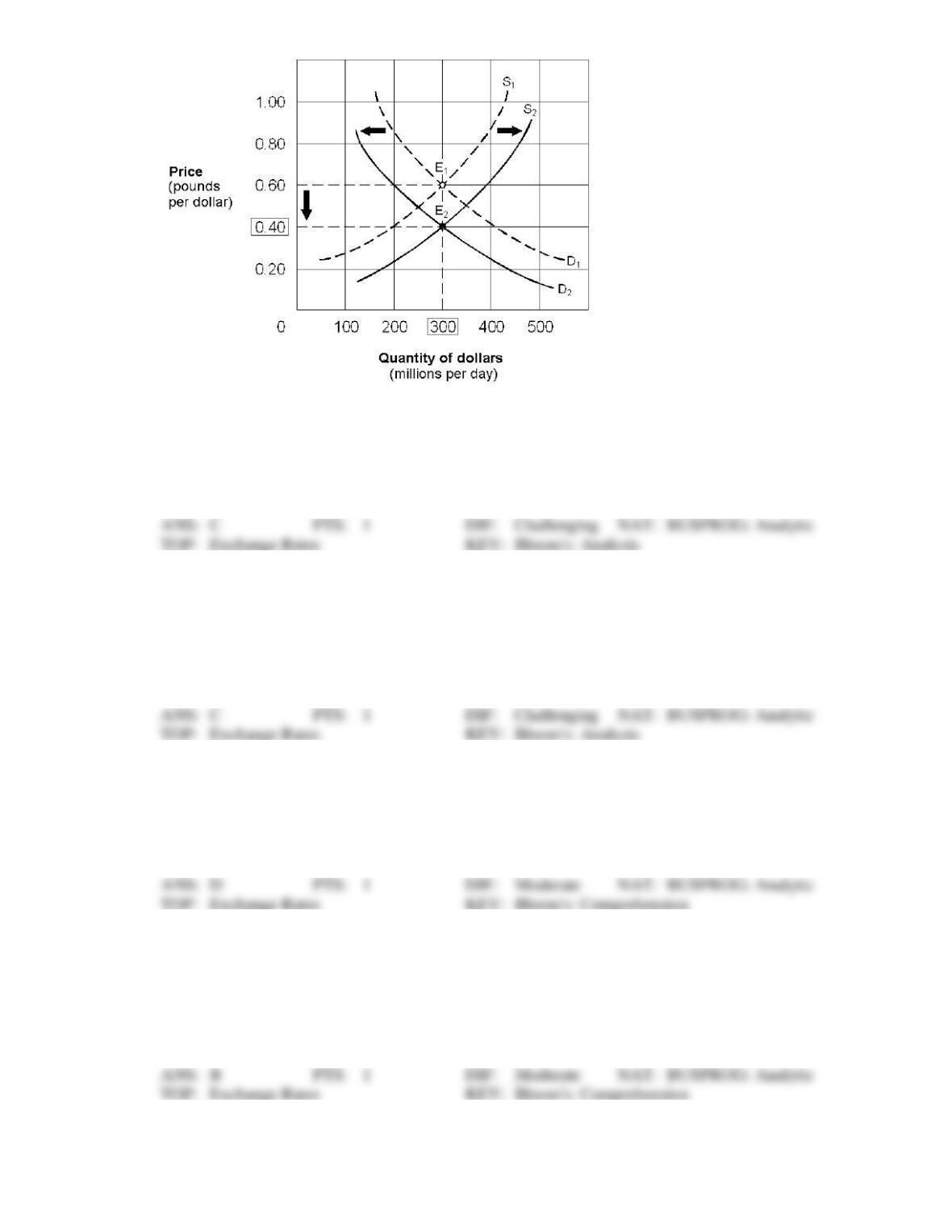
193. Exhibit 18-7 shows a situation in which:
a.
both the dollar and the pound have depreciated.
b.
both the dollar and the pound have appreciated.
c.
the dollar has depreciated and the pound has appreciated.
d.
the dollar has appreciated and the pound has depreciated.
194. Which of the following could cause the dollar-pound exchange rates to change as shown in Exhibit 18-
7?
a.
American goods become more popular in Great Britain.
b.
British incomes rise, while U.S. incomes remain unchanged.
c.
The U.S. price level rises, while the British price level remains unchanged.
d.
The U.S. real interest rate rises, while the British real interest rate remains unchanged.
195. A depreciation in the value of the U.S. dollar would:
a.
encourage foreigners to travel on American owned airlines.
b.
make U.S. goods more expensive to foreign consumers.
c.
decrease the number of dollars it takes to buy a Swiss franc.
d.
make it more expensive for U.S. citizens to travel abroad.
196. A depreciation of one’s currency means that:
a.
the country’s exports will become more expensive.
b.
the country’s imports will become more expensive.
c.
the country’s imports will become less expensive.
d.
it now requires less of this currency in exchange for one unit of another currency.
e.
it now requires more units of other currencies in exchange for one unit of this currency.
197. A depreciation of one’s currency means that:
a.
the country’s exports will become more expensive.
b.
it now requires less of this currency in exchange for one unit of another currency.
c.
the country’s imports will become less expensive.
d.
it now requires more of this currency in exchange for one unit of another currency.
e.
it now requires more units of other currencies in exchange for one unit of this currency.
198. Which of the following changes in the exchange rate represents a depreciation of the dollar?
a.
100 yen = $1 to 110 yen = $1
c.
1 peso = $10 to 1 peso = $11
b.
1 yen = $.10 to 1 yen = $.08
d.
200 francs = $10 to 250 francs = $10
199. Which of the following changes in the exchange rate represents an appreciation of the dollar?
a.
100 yen = $1 to 90 yen = $1
c.
1 peso = $10 to 1 peso = $11
b.
1 yen = $.10 to 1 yen = $.08
d.
200 francs = $10 to 190 francs = $10
200. A weak U.S. dollar is one that has:
a.
c and e.
b.
d and e.
c.
depreciated.
d.
appreciated.
e.
helped U.S. exporters.
201. If real interest rates in the United States are higher than those of our trading partners, what will tend to
happen to the foreign exchange value of the dollar and the U.S. current account deficit or surplus?
a.
The dollar will depreciate; the current account will move toward a deficit.
b.
The dollar will depreciate; the current account will move toward a surplus.
c.
The dollar will appreciate; the current account will move toward a deficit.
d.
The dollar will appreciate; the current account will move toward a surplus.
202. A nation’s trade deficit will expand when its:
a.
currency appreciates.
b.
economy is shrinking.
c.
investment environment is less attractive to foreigners.
d.
all of these are true.
203. An increase in demand for a nation’s currency in the foreign exchange market will:
a.
cause the nation’s currency to appreciate.
b.
make it more expensive for the nation to import goods.
c.
cause the nation’s balance on current account to shift toward a surplus.
d.
make it less expensive for foreigners to buy the nation’s goods.
204. Which of the following will most likely cause a nation’s currency to appreciate on the foreign
exchange market?
a.
A decrease in domestic interest rates
b.
An increase in foreign interest rates
c.
Domestic inflation of 10 percent while the nation’s trading partners are experiencing stable
prices
d.
Stable domestic prices while the nation’s trading partners are experiencing 10 percent
inflation
205. An appreciation of one’s currency means that:
a.
the country’s exports will become less expensive.
b.
the country’s imports will become more expensive.
c.
the country’s imports will become less expensive.
d.
it now requires more of this currency in exchange for one unit of another currency.
e.
it now requires less units of other currencies in exchange for one unit of this currency.
206. If the dollar appreciates:
a.
imports to the United States become more expensive for foreigners
b.
exports from the United States become more expensive for foreigners
c.
imports become more expensive for U.S. citizens.
d.
exports from the United States become cheaper
e.
the dollar will exchange for fewer units of a foreign currency
207. A strong U.S. dollar is one that has:
a.
c and e.
b.
d and e.
c.
depreciated.
d.
appreciated.
e.
helped U.S. exporters.
208. An appreciation in the U.S. dollar benefits which of the following groups of people?
a.
All people living in the United States
b.
U.S. producers who export farm equipment to other countries
c.
U.S. consumers who buy imported automobiles
d.
Foreigners who wish to travel to the United States
e.
U.S. consumers who buy only goods made entirely in the United States
TRUE/FALSE
1. If free trade is opened between two countries, then one country must gain at the other country’s
expense.
2. Trade can increase the consumption possibilities of nations.
3. Opening trade between nations enables each nation’s consumption possibilities to go beyond the
confines of its own production possibilities curve.
4. A country has a comparative advantage in producing a good when it has the lowest opportunity cost of
producing that good.
5. International specialization and trade according to the principle of comparative advantage is mutually
beneficial for all economies involved.
6. It is possible for a nation to have an absolute advantage in the production of a product, but not a
comparative advantage in the production of the same product.
7. A country should export the goods in which it has an absolute advantage.
8. Absolute advantage governs the potential for gains from trade.
9. Protectionist policies such as tariffs and quotas are beneficial to the nation imposing those trade
barriers.
10. Tariffs help consumers by lowering the price of imported goods.
11. A tariff will decrease the supply of the product.
12. According to the infant industry argument, a new domestic industry needs protection because it has
higher costs than established foreign competitors.
13. An increase in a nation’s trade deficit occurs when that nation’s exports rise and/or its imports fall.
14. A country’s balance on current account will always equal its balance on capital account.
15. The current account balance tabulates the value of a country’s exports of goods and services minus the
value of its imports of goods and services.
16. A country’s imports of goods minus its exports of goods is reported in the goods balance.
17. Other things being equal, an increase in U.S. interest rates would be likely to cause an increase in the
capital account surplus or a decrease in the capital account deficit.
18. Borrowing from foreign banks by U.S. firms represents a capital inflow.
19. If the current account and capital account are both in surplus, the official reserve account does not have
to be in deficit.
20. Under a fixed exchange rate system, a government is at risk of running out of foreign currency
reserves when the country’s imports exceed its exports.
21. An increase in the value of the dollar in international exchange rate markets will cause the relative
price of U.S. produced goods to foreigners to rise, the relative price of foreign produced goods to
Americans to fall, causing U.S. exports to fall and U.S. imports to rise.
22. Most industrialized nations today use a gold standard to establish exchange rates.
23. If the yen price of dollars falls, then the dollar price of yen rises.
24. If people’s incomes decrease, their demand for other currencies shifts to the right.
25. If the U.S. dollar appreciates relative to the British pound, then we pay fewer dollars for a pound.
26. An increase in the price level in Japan relative to the price level in the United States will shift the
demand curve for dollars leftward and the dollar depreciates or becomes weaker.
27. A weaker dollar will stimulate sales of U.S. exports.
ESSAY
1. What are the benefits and costs to a nation that participates in international trade? Do the benefits
outweigh the costs or do the costs outweigh the benefits?
2. What are the different types of trade barriers? What are the arguments for trade barriers? What are the
consequences of trade barriers?
3. Discuss the determinants of a nation’s exchange rate value for its currency in foreign exchange
markets. What happens to a nation’s balance of trade if the nation’s currency appreciates? Why?