STA: DISC: International trade and finance
TOP: Free Trade versus Protectionism KEY: Bloom’s: Comprehension
98. Which of the following is the best example of a quota?
a.
a tax placed on all small cars sold in the domestic market
b.
a limit imposed on the number of men’s suits that can be imported from a foreign country
c.
a subsidy from the U.S. government to domestic manufacturers of men’s suits so they can
compete more effectively with foreign producers of men’s suits
d.
a $100-per-car fee imposed on all small imported cars
99. Imposing a restrictive quota on imported plasma TVs will:
a.
increase the price of the plasma TVs and decrease the quantity consumed.
b.
increase both the price of the plasma TVs and the quantity consumed.
c.
leave the price of the plasma TVs unchanged but decrease the quantity consumed.
d.
leave the price and the quantity consumed of plasma TVs unchanged, because domestic
producers will expand production to make up for the reduction in imports
100. A restriction on the quantity of a good that can be imported into a country is a(n):
a.
tariff.
c.
embargo.
b.
quota.
d.
restricted exchange rate.
101. Suppose a quota on foreign-made automobiles is proposed in Congress. Which of the following groups
is most likely to oppose the bill?
a.
American Automobiles Manufacturers.
c.
American Steel Workers.
b.
Consumers.
d.
United Auto Workers.
102. A limit on the quantity of a good that may be imported in a given time period is called:
a.
an embargo.
c.
a quota.
b.
a tariff.
d.
dumping.
103. A quota is a:
a.
tax on a specific quantity of imported goods.
b.
limited number of foreign firms that can sell imported goods.
c.
restrictive health and safety standard that raises costs.
d.
tax on domestic producers so that they can make higher profits.
e.
limit on the quantity of a good that can be imported.
104. Which of the following is not an argument used in favor of protectionism?
a.
To protect an “infant” industry.
b.
To protect domestic jobs.
c.
To preserve national security.
d.
To protect against “unfair” competition because of cheap foreign labor.
e.
To reduce prices paid by domestic consumers.
105. The infant-industry argument about tariffs argues that:
a.
it is unfair to levy tariffs on items intended for use by infants.
b.
tariffs should be levied on foreign products that compete with new domestic industries
only in the short run.
c.
if a newly established domestic industry can survive in the short run, a tariff should be
levied to protect it from foreign competition in the long run.
d.
permanent tariffs should be levied on foreign products that compete with those produced
by newly established domestic industries.
106. A basic problem with the infant-industry argument is that:
a.
most industries need protection when they are mature, not when they are first established.
b.
the amount of the tariff is unlikely to have much impact on the success of an infant
industry.
c.
political pressure will likely prevent the withdrawal of the tariff when the industry
matures.
d.
domestic consumers will continue to buy the foreign products anyway, regardless of the
tariff.
107. In international trade, an infant industry is one:
a.
that protects firms that produce products for infants.
b.
with a large number of very small firms.
c.
in which the firms are experiencing very small profits.
d.
in the early stages of its development.
108. The infant industry argument is based on the idea that:
a.
competitive pressure from established foreign firms would encourage the infant industry’s
prospects for future growth.
b.
failure to shelter these infant industries tends to lead to political instability.
c.
small firms must be protected.
d.
none of these.
109. Which of the following is an infant-industry argument in favor of restrictions on foreign trade?
a.
Foreign producers must be stopped from selling their products in this country below cost
of production.
b.
Domestic workers must be protected from the lower wages paid in foreign countries.
c.
The nation’s security demands we ensure an adequate domestic supply capacity of certain
products.
d.
Do unto others as they do unto you.
e.
Industries in the early stages of development must be protected from more mature
producers.
110. The main problem with using the infant industries argument to justify protecting an industry from
foreign competition is that:
a.
all industries will claim that they are infant industries in order to gain protection.
b.
the protected industry will become too efficient and drive out foreign competition.
c.
once in place, it is difficult to remove protection even as the industry matures.
d.
it causes the goods that are produced in the protected industry to have lower prices.
e.
this policy compromises national security if the infant industry produces military goods.
111. Which of the following is a partially valid economic argument for restricting free trade?
a.
Restrictions on foreign trade will increase employment and permanently reduce
unemployment.
b.
Removal of restrictions that have existed for years will initially cause inflation.
c.
Infant industries need permanent protection to develop and gain productive efficiency.
d.
A nation needs to protect industries that are vital to national defense in case of future
international conflict.
112. Trade restrictions imposed in the name of national security have been recommended by protectionists
in order to:
a.
develop strong defense-related industries.
b.
avoid dependence on foreign suppliers during wartime.
c.
reduce the necessity of stockpiling strategic supplies.
d.
all of these.
113. The argument that import restrictions save jobs and promote prosperity fails to recognize that:
a.
there are no secondary effects of import restrictions.
b.
import restrictions will lower prices in the protected industries.
c.
import restrictions cannot create jobs in any industries.
d.
U.S. imports provide people in other countries with the dollars power required for the
purchase of U.S. exports.
114. The argument that foreign trade should be restricted to protect domestic employment and output is
based on the idea that:
a.
consumers are willing to pay higher prices for domestic goods.
b.
producers will not exploit reduced foreign competition by charging higher prices.
c.
foreign companies are more costly to deal with than domestic companies.
d.
sales of imports come at the expense of domestic goods and jobs.
115. “More productive workers receive higher wages than less productive workers.” This observation is a
major flaw in which of the following arguments for protectionism?
a.
The infant industry argument.
c.
The employment argument.
b.
The national security argument.
d.
The cheap foreign labor argument.
116. The main explanation for why the cheap foreign labor argument is a poor reason for restricting
international trade is that:
a.
workers who get paid less tend to have lower productivity than those who get paid more.
b.
all firms and workers gain when there are no restrictions on international trade.
c.
infant industries such as steel and automobiles need to be protected.
d.
specialization and free trade usually raise the prices of all the traded goods, so that the
workers can get paid more.
e.
labor costs tend to be the same worldwide in the long run because of worker mobility.
117. Which of the following is the correct name of the free-trade agreement between Mexico, the U.S., and
Canada?
a.
The American Free Trade Agreement (AFTA).
b.
The North American Free Trade Agreement (NAFTA).
c.
The Pacific Free Trade Agreement (PFTA).
d.
The Trans-American Free Trade Agreement (TAFA).
118. The North American Free Trade Agreement affects trade between:
a.
the United States, Cuba, and Brazil.
b.
the United States, Canada, and Mexico.
c.
the United States, Puerto Rico, and Cuba.
d.
Brazil, Bolivia, Peru, and Columbia.
e.
China and the United States.
119. The balance of trade is the value of a nation’s ____________.
a.
goods and service exports times goods and service imports
b.
goods exports subtracted from goods imports
c.
goods imports subtracted from goods exports
d.
net goods imports plus net capital inflows
120. The term “balance of payments” refers to a nation’s:
a.
goods exports minus imports.
b.
record of all international transactions.
c.
capital inflows minus outflows.
d.
official reserves inflows minus outflows.
121. Which of the following statements is true?
a.
A tariff is a physical limit on the quantity of a good allowed to enter a country.
b.
An embargo is a tax on an imported good.
c.
A quota is a law that bars trade with another country.
d.
When a nation exports more than it imports it is running a balance of trade surplus.
122. The account which records a nation’s foreign economic transactions is called the:
a.
Trade Account.
c.
Exchange Market.
b.
T account.
d.
Balance of Payments.
123. The balance of payments ____.
a.
b and e
b.
is always zero
c.
is positive when the nation runs a trade surplus
d.
is negative when the nation runs a trade deficit
e.
is an itemized account of a nation’s foreign economic transactions
124. The balance of payments ____.
a.
b and e
b.
is always zero
c.
with some nations is different than it is with others
d.
is negative when the nation runs a trade deficit
e.
can only be expanded when the government has foreign exchange reserves
125. An itemized account of a nation’s foreign economic transactions is its:
a.
gross domestic product.
b.
goods exports.
c.
goods imports.
d.
balance of payments.
e.
foreign exchange reserves.
126. The term “balance of trade” refers to a nation’s:
a.
goods exports minus imports.
b.
current account balance.
c.
capital account balance.
d.
net balance of all international transactions.
127. If U.S. buyers purchased $500 billion of foreign goods and foreign buyers purchased $400 billion of
U.S. goods, the U.S. balance of trade would be:
a.
−$100 billion.
c.
$400 billion.
b.
$100 billion.
d.
none of these.
128. The term “balance of trade” refers to the:
a.
importing and exporting of goods.
b.
importing and exporting of goods and services.
c.
current account trade balance.
d.
capital outflows minus inflows.
129. A favorable balance of trade occurs when:
a.
exports equal imports.
b.
the balance of payments balances.
c.
the current and capital account in the BOP are equal.
d.
the value of the exports of goods exceeds the value of the imports of goods.
e.
the value of the exports of goods is less than the value of the imports of goods .
130. An unfavorable balance of trade occurs when:
a.
exports equal imports.
b.
the balance of payments balances.
c.
the current and capital account in the BOP are equal.
d.
the value of the exports of goods exceeds the value of the imports of goods.
e.
the value of the exports of goods is less than the value of the imports of goods .
131. If goods imports are greater than goods exports, the nation is experiencing a:
a.
negative balance on current account.
b.
goods trade deficit.
c.
capital account imbalance.
d.
weakening of its currency.
e.
growth in foreign reserves.
132. When the value of our goods exports is less than the value of our goods imports,
a.
d and e.
b.
the value of the dollar must fall.
c.
there will be domestic unemployment.
d.
there will be an unfavorable balance of trade.
e.
foreign currency reserves must fall.
133. The balance of trade is measured by which of the following expressions?
a.
The value of exported goods and services minus the value of imported goods and services
b.
The value of income receipts on investments minus income payments on investments
c.
The value of goods exports minus the value of goods imports
d.
The value of government spending minus the value of all taxes received
e.
The balance on capital account plus the balance on current account
134. A favorable balance of trade occurs when:
a.
goods exports are greater than goods imports.
b.
goods imports are greater than goods exports.
c.
international trade is an increasing share of total output.
d.
the balance on capital account equals the balance on current account.
e.
unilateral transfers are positive.
135. If a country’s goods exports are less than its goods imports, then it experiences a:
a.
balance of payments surplus.
c.
balance of trade surplus.
b.
balance of payments deficit.
d.
balance of trade deficit.
136. Which of the following would be recorded in the U.S. goods export account?
a.
Harry, an American citizen, spends 1,000 francs on vacation in the south of France.
b.
A machine shop in Ohio purchases a grinder made in Italy.
c.
Martha receives a $50 dividend check on stock she owns in a business in Germany.
d.
The U.S. government subsidizes American farmers for planting corn for export.
e.
France purchases a new jet fighter aircraft from the Boeing Company in the United States.
137. Which of the following is not included in the current account?
a.
Exports of goods.
c.
U.S. capital inflow and outflow.
b.
Imports of goods.
d.
Unilateral transfers.
138. Expenditures for services such as tourism, income for foreign investment, and foreign gifts are
tabulated in the:
a.
current account.
c.
official reserve account.
b.
capital account.
d.
goods account.
139. A U.S. citizen’s gift for famine relief in Somalia would be considered a:
a.
capital inflow.
c.
current account transaction.
b.
capital outflow.
d.
service trade transaction.
140. Which of the following is excluded in the current account?
a.
Goods exports.
c.
Capital inflow and outflow.
b.
Goods imports.
d.
Net unilateral transfers.
141. Which of the following transactions would be recorded as a credit in the U.S. current account?
a.
A Japanese bank’s purchase of IBM stock.
b.
A Japanese consumer’s purchase of an Apple computer.
c.
An American tourist’s payment to a Japanese hotel.
d.
An American consumer’s purchase of a Toshiba VCR.
142. If Japan has a current account surplus, then it must:
a.
have an offsetting capital account deficit.
b.
also have a surplus in its capital account.
c.
import more goods than it exports.
d.
have a positive balance of payments.
143. Which of the following is included in the current account?
a.
Net unilateral transfers.
b.
Goods imports.
c.
Goods exports.
d.
All are included in the current account.
144. In the U.S. balance of payments, purchases of foreign assets by U.S. residents are tabulated as a:
a.
unilateral transfer.
c.
current account outflow.
b.
capital outflow.
d.
capital inflow.
145. The current account in the BOP records:
a.
all money flowing between countries.
b.
a nation’s yearly exports and imports of goods and services.
c.
only the transactions involving capital goods in international trade.
d.
only the transactions involving consumer goods in international trade.
e.
only those goods and services purchased on credit in international transactions.
146. Which of the following would not be counted in the U.S. BOP current account?
a.
Helen, an American oil engineer, is a paid adviser to Middle Eastern countries in the area
of petroleum extraction.
b.
General Motors Corporation owns buildings that are situated in Mexico.
c.
France purchases a new jet fighter aircraft from the Boeing Company in the U.S.
d.
Martha receives a $50 dividend check on stock she owns in a business in Germany.
e.
A wealthy Italian purchases numerous antiques in the United States for his villa.
147. The balance on the current account ____.
a.
d and e
b.
c and d
c.
will show a trade deficit or surplus, if one exists
d.
must always be zero
e.
multiplied by −1 becomes the capital account
148. Persistent negative current account balances will lead to ____.
a.
c and d
b.
d and e
c.
budget deficits
d.
appreciation of foreign currency
e.
depreciation of domestic currency
149. Which of the following transactions would be excluded in the capital account?
a.
A Japanese citizen purchases a U.S. Treasury bill.
b.
A Japanese citizen purchases an office building in Manhattan.
c.
A U.S. citizen purchases a share of stock from a Japanese company.
d.
An American purchases a Toyota.
150. Suppose a German bank purchases a U.S. Treasury bond. This transaction would be recorded in the:
a.
capital account.
c.
goods trade balance.
b.
current account.
d.
unilateral transfers.
151. Capital accounts are a measure of how much ____ have invested ____.
a.
c and d
b.
d and e
c.
U.S. stockholders; in the market
d.
foreign stockholders; in foreign firms
e.
U.S. firms; in foreign nations
152. The purchase of U.S. assets by foreigners is a:
a.
capital inflow.
c.
current account deficit.
b.
capital outflow.
d.
unilateral transfer.
153. Purchases of foreign assets by U.S. residents are tabulated in the U.S. balance of payments as a:
a.
capital inflow.
c.
current account outflow.
b.
capital outflow.
d.
unilateral transfer.
154. If there is bilateral currency trade between Japan and the U.S., then as the supply of U.S. dollars on the
world foreign exchange market ________, the price of a dollar in terms of Japanese yen will
________.
a.
increases, fall
b.
decreases, fall
c.
increases, increases
d.
decreases, stays the same
155. An exchange rate is the number of units of:
a.
a nation’s money that is equal to one unit of another nation’s money.
b.
a nation’s output that is equal to one unit of another nation’s output.
c.
gold backing a nation’s money.
d.
none of these.
156. If a hotel room priced at 120,000 Venezuela bolivar per night can be purchased for 80 U.S. dollars, the
exchange rate is:
a.
9,600 bolivar per dollar.
c.
1,500 bolivar per dollar.
b.
1,500 dollars per lira.
d.
.00066 bolivar per dollar.
157. If a box of Swiss chocolate priced at 100 francs can be purchased for $50, the exchange rate is:
a.
0.50 francs per dollar.
c.
0.50 dollars per franc.
b.
4.00 francs per dollar.
d.
none of these.
158. A fixed exchange rate is:
a.
determined by the forces of supply and demand.
b.
the value of a nation’s money in gold.
c.
the value of a nation’s money determined by the World Bank.
d.
none of these.
159. Flexible, or floating, exchange rate is determined by the:
a.
World Bank.
c.
price of gold.
b.
forces of supply and demand.
d.
Federal Reserve.
160. The Japanese demand curve for dollars is downward-sloping because a:
a.
higher number of yen per dollar means U.S. goods are cheaper in Japan.
b.
lower number of yen per dollar means U.S. goods are cheaper in Japan.
c.
lower number of yen per dollar means U.S. goods are more expensive in Japan.
d.
lower number of yen per dollar means U.S. goods are less expensive in the U.S.
161. The U.S. supply curve of dollars is upward-sloping because a:
a.
higher number of yen per dollar means Japanese goods are cheaper in Japan.
b.
higher number of yen per dollar means Japanese goods are cheaper in the U.S.
c.
lower number of yen per dollar means Japanese goods are cheaper in the U.S.
d.
none of these.
162. If one U.S. dollar can be exchanged for 5 Swiss francs, then 1 franc can be exchanged for:
a.
5 cents.
c.
50 cents.
b.
20 cents.
d.
2 dollars.
163. If a Japanese stereo priced at 1,000,000 yen can be purchased for $1,000, the exchange rate is:
a.
1,000 yen per dollar.
c.
0.001 dollars per yen.
b.
1,000 dollars per yen.
d.
none of these.
164. The exchange rate is:
a.
the rate at which goods will exchange for each other in the international market.
b.
the number of units of one currency required in exchange for one unit of another currency.
c.
set by the International Trade Commission.
d.
established by the ratio of the values of gold to silver.
e.
set by each individual country.
165. If one dollar exchanges for 20 Thailand baht, then:
a.
a baht is worth $20.
b.
$20 will exchange for one baht.
c.
a baht is worth $2.
d.
the United States and Thailand would not engage in trade.
e.
a baht is worth a nickel.
166. If the exchange rate of yen for dollars increases from 100 yen = $1 to 110 yen = $1, then:
a.
Japanese-produced goods would become more expensive.
b.
the dollar has depreciated.
c.
the yen has appreciated.
d.
U.S.-produced goods would become more expensive.
e.
U.S. exports would increase.
Exhibit 15-5 International currency markets
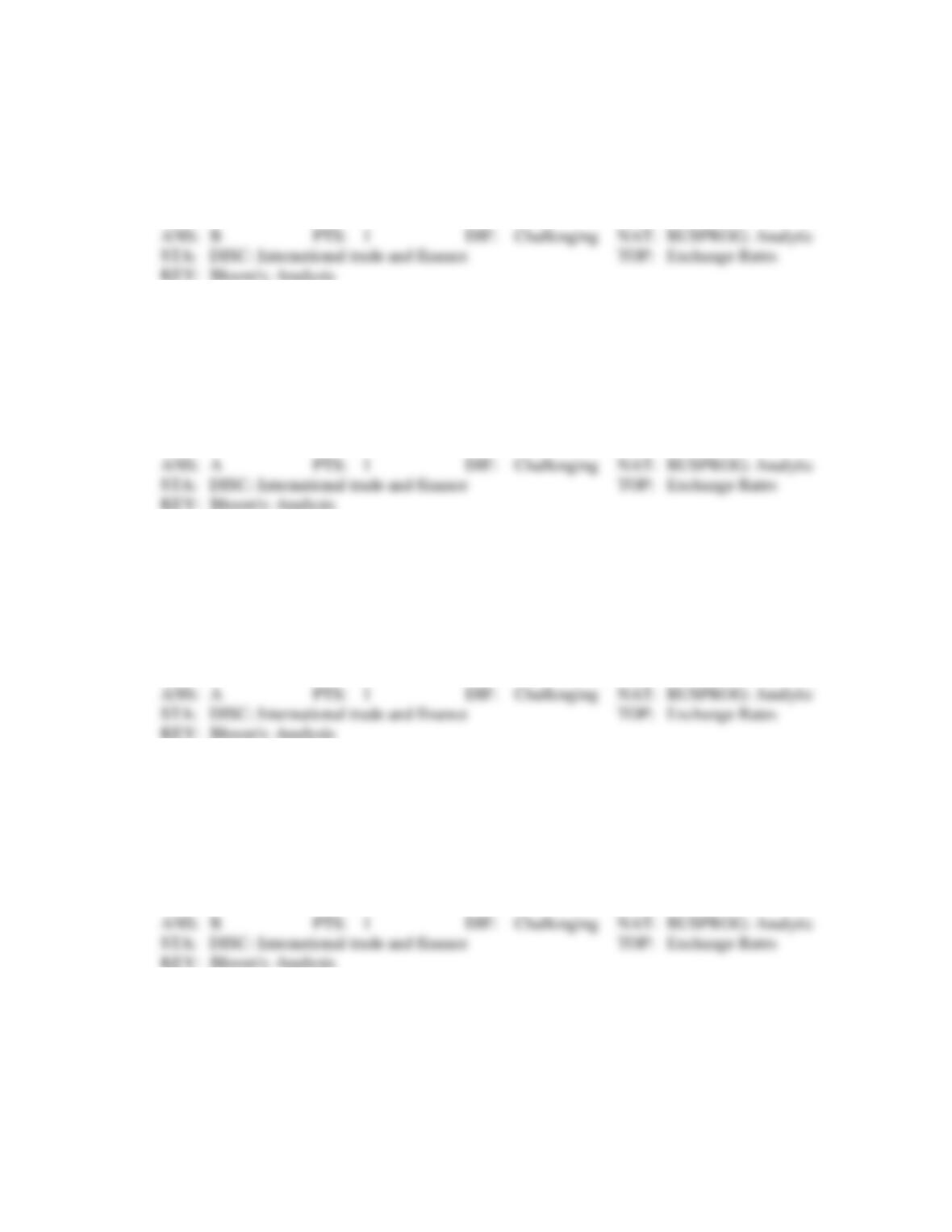
167. Exhibit 15-5 displays the international currency market for yen in terms of dollars and dollars in terms
of yen. The demand curve in graph 15-5(A) is determined by:
a.
U.S. citizens attempting to purchase Japanese-made goods.
b.
Japanese attempting to purchase U.S.-made goods.
c.
U.S. businesses attempting to sell to the Japanese.
d.
Japanese businesses attempting to sell to the U.S.
e.
the U.S. government attempting to unload dollars to the international market.
168. Exhibit 15-5 displays the international currency market for yen in terms of dollars and dollars in terms
of yen. The supply curve in graph 15-5(A) is determined by:
a.
U.S. citizens attempting to purchase Japanese-made goods.
b.
Japanese attempting to purchase U.S.-made goods.
c.
U.S. businesses attempting to sell to the Japanese.
d.
Japanese businesses attempting to sell to the U.S.
e.
the U.S. government attempting to unload dollars to the international market.
169. Exhibit 15-5 displays the international currency market for yen in terms of dollars and dollars in terms
of yen. The demand curve in graph 15-5(B) is determined by:
a.
U.S. citizens attempting to purchase Japanese-made goods.
b.
Japanese attempting to purchase U.S.-made goods.
c.
U.S. businesses attempting to sell to the Japanese.
d.
Japanese businesses attempting to sell to the U.S.
e.
the U.S. government attempting to unload dollars to the international market.
170. Exhibit 15-5 displays the international currency market for yen in terms of dollars and dollars in terms
of yen. The supply curve in graph 15-5(B) is determined by:
a.
U.S. citizens attempting to purchase Japanese-made goods.
b.
Japanese attempting to purchase U.S.-made goods.
c.
U.S. businesses attempting to sell to the Japanese.
d.
Japanese businesses attempting to sell to the U.S.
e.
the U.S. government attempting to unload dollars to the international market.
171. If the exchange rate between the yen and the dollar changes from 100 yen = $1 to 110 yen = $1, then:
a.
the dollar has depreciated in value.
b.
U.S.-made goods will become less expensive to Japanese citizens.
c.
the dollar has appreciated in value.
d.
Japanese-made goods will become more expensive to U.S. citizens.
e.
there will be an increase in the demand for dollars in the foreign exchange market.
172. If the exchange rate between the yen and the dollar changes from 110 yen = $1 to 100 yen = $1, then:
a.
the dollar has depreciated in value.
b.
U.S.-made goods will become more expensive to Japanese citizens.
c.
the dollar has appreciated in value.
d.
Japanese-made goods will become less expensive to U.S. citizens.
e.
there will be a decrease in the demand for dollars in the foreign exchange market.
173. Suppose a U.S.-made machine costs $500 and the exchange rate is 100 yen = $1. A Japanese citizen
purchasing this machine would pay:
a.
100 yen.
b.
500 yen.
c.
5,000 yen.
d.
10,000 yen.
e.
50,000 yen.
174. Suppose a U.S.-made machine costs $500 and the exchange rate is 100 yen = $1. Now the exchange
rate changes to 90 yen = $1. Then the:
a.
machine would now cost more dollars.
b.
machine would now cost the Japanese citizen less yen.
c.
machine would now cost less dollars.
d.
machine would now cost the Japanese citizen more yen.
e.
yen has depreciated in value.
175. If foreign exchange rates are determined by the interaction of supply and demand forces for the various
currencies, then the exchange rate is:
a.
fixed.
b.
government-determined.
c.
set by the value of gold.
d.
floating.
e.
improper.
176. If you were told that the exchange rate between the U.S. dollar and the Canadian dollar was 1.2, that
would mean that Canadians would have to spend ____ to buy a $12 watch in New York City.
a.
c and e