Chapter 20—Growth and the Less-Developed Countries
MULTIPLE CHOICE
1. When per capita real GDP is increasing, real output is growing:
a.
more rapidly than prices.
c.
less rapidly than prices.
b.
more rapidly than population.
d.
less rapidly than population.
2. Which of the following is most important if the living standards of people residing in a country are
going to improve?
a.
growth of population
b.
growth of per capita GDP
c.
growth of the money supply
d.
growth of government expenditures as a share of GDP
3. If real GDP is increasing more rapidly than population:
a.
population must be declining.
b.
the country will have to export more than it imports.
c.
the general level of prices must be increasing.
d.
per capita real GDP will be increasing.
4. An industrially advanced country (IAC) is defined as a country with a GDP per capita among the top
____ countries in the world.
a.
5
c.
20
b.
10
d.
27
5. According to the classification in the text, which of the following is not an industrially advanced
country (IAC)?
a.
United Arab Emirates.
b.
Israel.
c.
Greece.
d.
All of the above are IACs.
e.
None of the above are IACs.
6. According to the classification in the text, which of the following is not an industrially advanced
country (IAC)?
a.
Singapore.
c.
United Arab Emirates.
b.
Hong Kong.
d.
Ireland.
7. The number of the countries of the world classified as a less developed country (LDC) is about:
a.
50.
b.
75.
c.
100.
d.
150.
e.
300.
8. Which of the following is a problem when comparing GDPs per capita between nations?
a.
GDP per capita fails to measure income distribution.
b.
Fluctuations in exchange rates affect differences in GDP per capita.
c.
GDP per capita is subject to greater measurement errors for LDCs compared to IACs.
d.
All of these.
9. The economies of most less-developed countries (LDCs) are based on:
a.
agriculture.
c.
services.
b.
manufacturing.
d.
oil.
10. The poorest regions in the world, as measured by GDP per capita, are:
a.
Latin America and the Caribbean.
c.
Sub-Saharan Africa and South Asia.
b.
the Middle East and North Africa.
d.
Australia and New Zealand.
11. GDP per capita is a relatively good measurement of:
a.
the distribution of income.
c.
household production.
b.
purchasing power.
d.
the standard of living.
12. What is the economic criterion most often used to compare living standards across countries?
a.
Real GDP growth.
b.
Unemployment rate.
c.
Incidence of AIDS.
d.
Rate of population growth.
e.
Real per capita GDP.
13. Which of the following is not evidence of the lower standard of living among less-developed
countries?
a.
High per capita real GDP.
b.
High percentage of households headed by females.
c.
High infant mortality rate.
d.
Low life expectancy.
e.
High birth rate.
14. Which of the following is not a characteristic of less-developed countries?
a.
High rates of illiteracy.
b.
High unemployment.
c.
Over half of the labor force in agriculture.
d.
Low savings and investment rates.
e.
Low infant mortality rates.
15. Compared to IACs, LDCs are often characterized by:
a.
higher life expectancy.
c.
higher daily calorie supply.
b.
higher adult literacy rates.
d.
lower per capita energy consumption.
16. Compared to IACs, LDCs are often characterized by:
a.
lower life expectancy.
c.
lower per capita energy consumption.
b.
lower adult literacy.
d.
All of these.
17. Which of the following is not a common characteristic of IACs?
a.
Market-based economies.
b.
Large stocks of technologically advanced capital.
c.
Well-educated labor.
d.
Low per capita energy consumption.
18. Real GDP per capita and other alternative measures of the quality of life are:
a.
independent.
c.
poorly correlated.
b.
directly correlated.
d.
inversely related.
19. Which of the following is not a characteristic of most less-developed countries?
a.
Inadequate human capital.
b.
Inadequate capital goods.
c.
High population growth rate.
d.
Inadequate water supplies.
e.
High productivity.
20. In order to achieve a high economic freedom rating, a country must:
a.
provide secure protection of privately owned property and evenhanded enforcement of
contracts.
b.
refrain from creating barriers that limit domestic and international trade.
c.
rely more fully on markets rather than governments to allocate goods and resources.
d.
do all of these.
21. Investment in both physical and human capital enhances economic growth because it:
a.
increases consumption during the current period.
b.
makes it possible for individuals to produce more goods and services per hour worked.
c.
encourages firms to expand output by employing more low-productivity workers.
d.
encourages workers to unionize and, thereby, fight for higher wages.
22. Which of the following is most likely to be a major source of growth in per capita GDP?
a.
A high investment / GDP ratio
c.
Rapid population growth
b.
A high rate of inflation
d.
Rapid growth in the money supply
23. Which of the following would be most likely to cause the per capita income of less-developed
countries to rise?
a.
Development of strong labor unions.
b.
More rapid population growth.
c.
Investment expenditures that enhance the human capital of labor force participants.
d.
An international minimum wage law.
24. Which of the following would be most likely to improve the standard of living of the residents of a
less-developed country?
a.
The development of strong labor unions.
b.
A sharp increase in the legal minimum wage.
c.
An increase in expenditures on education and capital investment.
d.
Rapid growth rate of the money supply.
25. Which of the following is most likely to help the residents of a nation produce more goods and
services and achieve higher income levels?
a.
Higher tax rates.
b.
A higher rate of investment.
c.
A smaller trade sector.
d.
Greater use of taxation to transfer income from the rich to the poor.
26. Which of the following helps low-income countries grow rapidly relative to high-income countries?
a.
Low-income countries are in a better position to save a larger share of their income.
b.
Low-income countries can employ technologies and practices that have been successful in
high-income countries.
c.
Low-income countries generally have legal systems that protect property rights and
enforce contracts in a more evenhanded manner.
d.
Low-income countries generally have more favorable weather conditions.
27. The recent growth records of Japan and Hong Kong during the last 50 years indicate that a nation can
grow rapidly without:
a.
securely defined property rights.
c.
significant capital formation.
b.
adopting modern technology.
d.
abundant domestic natural resources.
28. Which of the following is true?
a.
Nations achieve high rates of economic growth primarily because of their natural resource
endowments.
b.
Human and physical capital investments are largely irrelevant to economic growth.
c.
Poor nations grow slowly because they do not have access to modern technology.
d.
A favorable political environment attracts more investment in human and physical capital.
29. When a nation’s political environment is more favorable, it will:
a.
attract more physical investment.
b.
encourage individuals to invest more heavily in human capital.
c.
encourage the development and efficient use of natural resources.
d.
do all of these.
30. Which of the following would be most likely to improve the standard of living of a less-developed
country?
a.
Development of strong labor unions.
b.
More foreign investment, attracted by the expectation of economic and political stability.
c.
Adoption of trade barriers (higher tariffs and quotas).
d.
Widespread use of price controls to allocate goods and resources.
31. Which of the following would be most likely to encourage capital formation in a less-developed
country?
a.
The expectation of sustained high inflation.
b.
The expectation that property rights will be highly secure in the years ahead.
c.
The imposition of high tariffs and other restraints limiting imports.
d.
Higher personal and corporate tax rates.
32. Which of the following factors would be most likely to encourage investment and capital formation in
a less-developed nation?
a.
High and variable rates of inflation.
b.
Tariffs and quotas that restrict international trade.
c.
A legal system that provides for secure property rights and evenhanded enforcement of
contracts.
d.
High marginal tax rates.
33. Which of the following would be most likely to improve the standard of living of people in less-
developed nations?
a.
The development of strong labor unions.
b.
An increase in foreign investment.
c.
An increase in the share of the population under 15 years of age.
d.
Higher tariffs and the imposition of other restraints designed to restrict international trade.
34. Which of the following provides the best explanation of why low-income countries generally remain
poor?
a.
Their political environment and policies often discourage productive activity and reduce
the potential gains from specialization and exchange.
b.
They are oppressed by developed nations that benefit from the cheap goods available from
countries with low wage rates.
c.
They are poorly endowed with natural resources, which are essential for long-term rapid
growth.
d.
When the average income level is low, workers have little incentive to earn higher
incomes.
35. An outward shift of an economy’s production possibilities curve is caused by:
a.
an increase in capital.
c.
an advance in technology.
b.
an increase in labor.
d.
all of these.
36. There is a direct link between a nation’s per capita real GDP and its:
a.
c and e.
b.
c, d, and e.
c.
human capital investment.
d.
population.
e.
life expectancy.
37. Economic development encompasses which of the following measures?
a.
Economic growth.
c.
Education.
b.
The political environment.
d.
All of these.
38. Economic development encompasses which of the following measures?
a.
Distribution of income.
c.
Transportation structures.
b.
Legal system.
d.
All of these.
39. Which of the following characterizes the IACs?
a.
High per capita GDP growth and high population growth.
b.
Low per capita GDP growth and low population growth.
c.
Low per capital GDP growth and high savings rate.
d.
Low human capital investment.
40. Which of the following is a characteristic of an LDC?
a.
Capital flight.
c.
Lack of entrepreneurs.
b.
Vicious circle of poverty.
d.
All of these.
41. Which of the following is infrastructure?
a.
Highways.
c.
Airports.
b.
Bridges.
d.
All of these.
42. Which of the following is infrastructure?
a.
Schools.
c.
Public health and sanitation services.
b.
Roads.
d.
All of these.
43. Which of the following is infrastructure?
a.
IBM computer plant.
c.
Services of doctors.
b.
Training and education.
d.
None of these.
44. Economic growth and development in LDCs are low because many of them lack:
a.
saving.
b.
infrastructure.
c.
a political environment favorable to growth.
d.
All of these.
45. Domestic law and order, the infrastructure, and the climate of international trade are all aspects of a
country’s:
a.
natural resources endowment.
c.
capital investment.
b.
human resources investment.
d.
political environment.
46. Which of the following can be a barrier to an LDC‘s economic growth and development?
a.
Low population growth.
c.
Faster capital accumulation.
b.
A low level of human capital.
d.
More infrastructure.
47. Which of the following is correct?
a.
Economic development is more quantitative than economic growth.
b.
A country cannot achieve economic growth with a limited base of natural resources.
c.
Infrastructure is capital provided by the private sector.
d.
All of the above are true.
e.
All of the above are false.
48. The “Four Tigers” of East Asia are the newly industrialized countries of Taiwan, South Korea, Hong
Kong, and:
a.
Japan.
c.
the Philippines.
b.
Singapore.
d.
Vietnam.
49. Which of the following is not generally considered to be an ingredient for economic growth?
a.
Investment in human capital.
b.
Political instability.
c.
High savings rate and investment in capital.
d.
Growth in technology.
e.
Investment in infrastructure.
50. Which of the following statements is true?
a.
A less developed country (LDC) is a country with a low GDP per capita, low levels of
capital, and uneducated workers.
b.
The vicious circle of poverty exists because GDP must rise before people can save and
invest.
c.
LDCs are characterized by rapid population growth and low levels of investment in human
capital.
d.
All of these.
51. Which of the following statements is true?
a.
There is no single correct strategy for economic growth and development.
b.
In general, GDP per capita is highly correlated with alternative quality of life measures.
c.
The World Bank is affiliated with the United Nations and makes long-term low-interest
loans to LDCs.
d.
All of these.
52. Which of the following is a true statement?
a.
The LDC classification is of the questionable accuracy.
b.
GDP per capita ignores the degree of income distribution.
c.
GDP per capita is affected by exchange rate changes.
d.
GDP per capita does not account for the difference in the cost of living among nations.
e.
All of these are true.
53. If an economy’s population grows at 3 percent and real GDP grows at 2 percent, then:
a.
per capita real GDP is declining.
b.
the economy’s standard of living is increasing.
c.
per capita real GDP is negative.
d.
per capita real GDP is growing.
e.
the economy is experiencing unemployment.
54. If an economy’s population grows at 3 percent and real GDP grows at 3 percent, then:
a.
per capita real GDP is declining.
b.
the economy’s standard of living is increasing.
c.
per capita real GDP is negative.
d.
per capita real GDP is constant.
e.
the economy is experiencing unemployment.
55. If an economy’s population grows at 3 percent and GDP grows at 4 percent, then:
a.
per capita real GDP is declining.
b.
the economy’s standard of living is decreasing.
c.
per capita real GDP is negative.
d.
per capita real GDP is growing.
e.
the economy is experiencing unemployment.
56. To grow and prosper, less-developed countries must not:
a.
invest in human capital.
b.
build a strong infrastructure.
c.
shift resources out of the production of consumer goods and into the production of capital
goods.
d.
shift resources out of the production of capital goods and into the production of consumer
goods
e.
improve the quality of the water supply
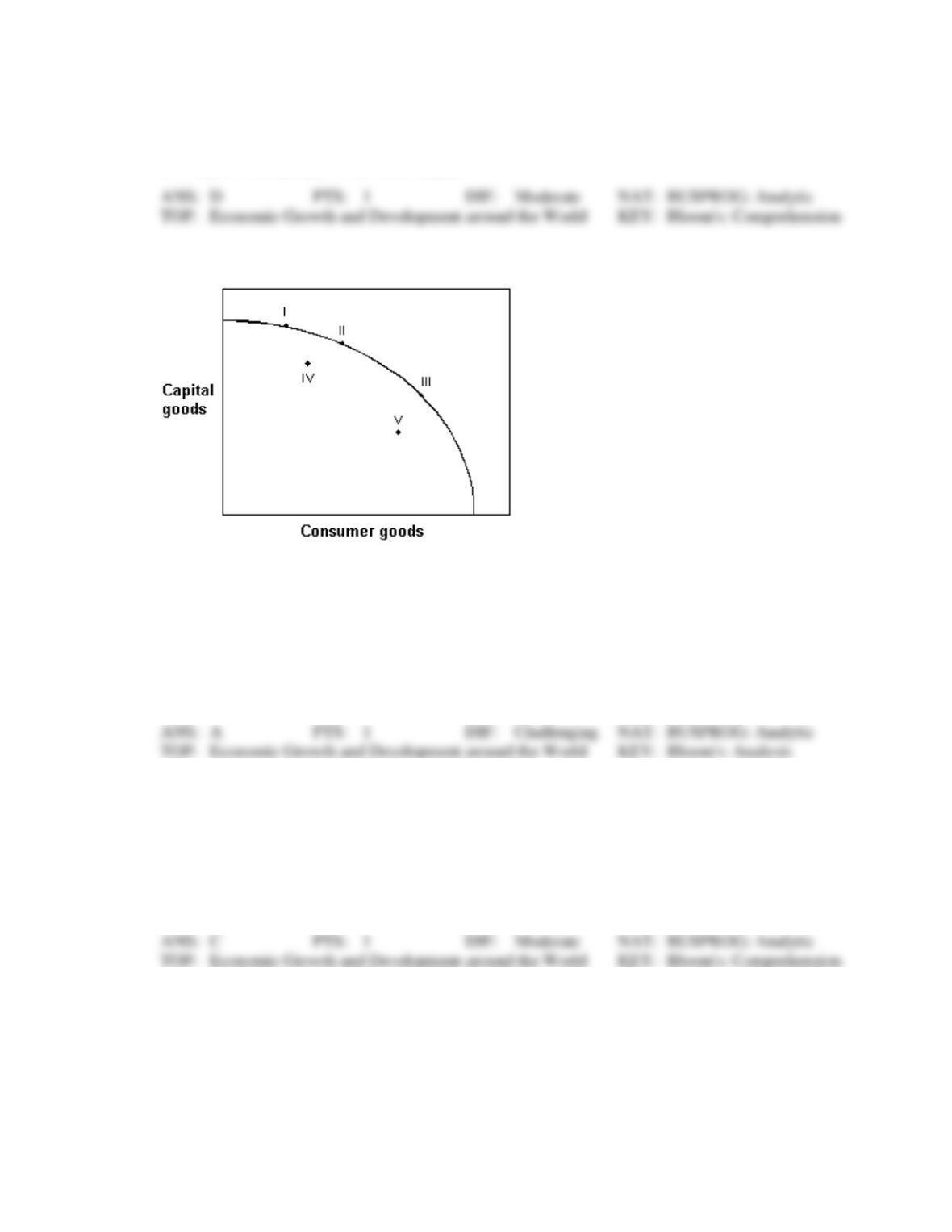
Exhibit 20-1 Nation of Padia
57. Exhibit 20-1 shows the production possibility curve of the nation of Padia. Based only on this
information, the point which would produce the highest rate of growth would be:
a.
I
b.
II
c.
III
d.
IV
e.
V
58. The nation of Exland is considered a less-developed country and has the following characteristics.
Which one is not typical of a less-developed country?
a.
High illiteracy.
b.
High unemployment.
c.
Rapid growth of technology.
d.
Low growth in technology.
e.
Rapid population growth.
59. Which of the following is not a problem for less-developed countries?
a.
Poor health and nutrition.
b.
Shortages of labor.
c.
High unemployment rates.
d.
Low labor productivity.
e.
low life expectancy
60. If a country’s real GDP is growing at 5 percent and the population is also growing at 5 percent, its:
a.
per capita real GDP grows at an increasing rate.
b.
per capita real GDP grows at a constant rate.
c.
population growth will eventually exceed real GDP.
d.
per capita real GDP decreases at a constant rate.
e.
per capita real GDP does not change.
61. If a country’s population grows at the same rate as its real GDP, then real per capita GDP:
a.
grows at an increasing rate.
b.
grows at a constant rate.
c.
doesn’t change.
d.
decreases at a decreasing rate.
e.
decreases at a constant rate.
62. Which of the following does not hinder economic development?
a.
Low birth rates.
b.
Low GDP that limits saving and investment.
c.
Lack of knowledge.
d.
Lack of technology.
e.
Lack of physical capital.
63. Which of the following does not hinder economic development?
a.
Lack of education
b.
Poor agricultural productivity
c.
Low investment in human capital
d.
Lack of technology
e.
Good nutrition
64. Less-developed countries are poor for all of the following reasons except one. Which one?
a.
They do not produce many goods and services.
b.
Labor productivity is low.
c.
Investment funds tend to flow abroad
d.
Investment in human capital is very low.
e.
The labor force is too small.
65. One reason that a poor nation remains poor over time is that even though total national real GDP
grows,
a.
c and e.
b.
c, d, and e.
c.
it is too small to begin with.
d.
the growth rate is smaller than the growth rate of industrialized nations.
e.
it does not grow faster than population.
66. If a nation remains poor over time, it could be that:
a.
c and e.
b.
d and e.
c.
the population growth rate is at least as much as the national GDP growth rate.
d.
the per capita real GDP growth rate is larger than the population growth rate.
e.
the national real GDP growth rate is lower than the population growth rate.
67. Which of the following statements draws a false conclusion?
a.
Life expectancy in an average African country is lower than in an average European
country; therefore Europeans can expect to outlive Africans.
b.
Nations that currently produce no capital goods, and whose inhabitants are hungry, risk
famine with internally funded capital investments.
c.
Some African nations have substantially more food and capital investment than others;
therefore, their standard of living is higher.
d.
Population reduction policies, if effective, can improve the nation’s wealth by increasing
real per capita GDP.
e.
The vicious circle of poverty argument states that poverty precludes capital investment
and that no capital investment perpetuates poverty.
68. If national real GDP grows at twice the rate of population growth,
a.
c and e.
b.
eventually there will be too much GDP.
c.
per real capita GDP will double each year.
d.
per real capita GDP will be reduced by half each year.
e.
per real capita GDP growth will double each year.
69. In order for Ethiopia to increase its future economic growth, it must choose a point that is:
a.
below its production possibilities curve.
b.
further along on its production possibilities curve toward the capital goods axis.
c.
further along on its production possibilities curve toward the consumption goods axis.
d.
further along on its production possibilities curve away from the population axis.
e.
above its production possibilities curve.
70. “Countries are poor because they cannot afford to save and invest” is called the:
a.
vicious circle of poverty.
c.
LDC trap.
b.
savings-investment trap.
d.
cycle of insufficient credit.
71. Which of the following explains the vicious circle of poverty?
a.
By investing in education and infrastructure at the same time, the country can overcome
the problems of poverty.
b.
Poverty arises out of the lack of investment, but they cannot invest because they are poor.
c.
A nation can shift its production possibilities curve inward by shifting more resources into
the production of capital goods.
d.
A nation can shift its production possibilities curve outward by shifting more resources
into the production of consumer goods.
e.
There are dual economies in the world: Some are meant to be rich and others are meant to
be poor.
72. The vicious circle of poverty refers to a condition where:
a.
c and d.
b.
c and e.
c.
people are poor because they cannot invest in capital goods and they cannot invest in
capital goods because they are poor.
d.
people cannot invest in capital goods because they are poor and they are poor because they
cannot invest in capital goods.
e.
poverty is relative and poor people remain poor because the wealthy grow wealthier.
73. The vicious circle of poverty refers to the fact that in LDCs,
a.
low living standards lead to declines in population growth.
b.
too much spending leads to periods of recession.
c.
people are poor because too much is spent on capital goods.
d.
there are not enough people in the under-15 age groups.
e.
poverty leads to low investment in capital goods.
74. Which of the following best defines the vicious circle of poverty?
a.
Countries are poor because they cannot afford to save and invest.
b.
Countries are poor because of high population growth.
c.
Countries are poor because of lack of education and training for workers.
d.
Countries are poor because of poor international credit.
75. The vicious circle of poverty makes it difficult for an LDC to:
a.
establish political institutions.
c.
save and invest.
b.
control inflation.
d.
fix its exchange rate.
76. Which of the following is infrastructure?
a.
Police.
b.
Training and education.
c.
Highways.
d.
All of the above.
e.
None of the above.
77. Which of the following is not an example of a country’s infrastructure?
a.
Transportation system.
b.
Communications system.
c.
Political system.
d.
Educational system.
e.
Energy system.
78. Of the following choices, which is the best example of a nation’s economic infrastructure?
a.
Natural resources.
b.
Highway system.
c.
Government.
d.
Religious and cultural beliefs.
e.
Population growth rate.
79. Suppose Embryonica is an LDC with few skilled workers, a primitive banking system, and very little
electric power. What do we know for sure that Embryonica is lacking?
a.
Infrastructure.
b.
Political stability.
c.
Agricultural sector.
d.
Traditional values.
e.
Poverty.
80. A nation’s infrastructure includes all of the following except its:
a.
market system.
b.
educational system.
c.
energy system.
d.
railroad system.
e.
religious system.
81. Which of the following is in charge of U.S. aid to foreign countries?
a.
Agency for International Development (AID).
b.
World Bank.
c.
International Monetary Fund (IMF).
d.
New International Economic Order (NIEO).
82. How much of the U.S. federal budget is spent on foreign aid?
a.
About 1 percent.
c.
About 25 percent.
b.
About 5 percent.
d.
About 50 percent.
83. Which of the following makes long-term low-interest loans to LDCs?
a.
Agency for International Development (AID).
b.
World Bank.
c.
International Monetary Fund (IMF).
d.
New International Economic Order (NIEO).
84. Which of the following makes short-term conditional low-interest loans to LDCs?
a.
World Bank.
b.
Agency for International Development (AID).
c.
Agency for International Finance (AIF).
d.
International Monetary Fund (IMF).
TRUE/FALSE
1. A country with a high GDP per capita can be classified as an industrially advanced country (IAC)
regardless of its industrial development.
2. According to the text, Singapore and Hong Kong are classified as industrially advanced countries
(IACs).
3. According to the text, Ireland and Israel are classified as less developed countries (LDCs).
4. GDP per capita provides a reasonably accurate measurement of a country’s income distribution.
5. GDP per capita is about 10 times higher in industrially advanced countries (IACs) than in the poorer
less-developed countries (LDCs).
6. A country with a high GDP per capita is classified as an industrially advanced country (IAC).
7. According to the text, Singapore is classified as a less developed country (LDC).
8. According to the text, Ireland and Israel are classified as industrially advanced countries (IACs).
9. In general, GDP per capita is highly correlated with alternative measures of quality of life.
10. Waste systems and highways are part of a nation’s infrastructure.
11. In general, GDP per capita is not highly correlated with alternative measures of quality of life.
12. Most less-developed countries have sufficient infrastructure in place to become a developed country.
13. Total GDP is the best way to identify a less-developed country
14. A country cannot develop without a large natural resource base.
15. A country can develop without a large natural resource base.
16. Political instability is a deterrent to long-term private investment.
17. If population grows faster than GDP, then per capita GDP must fall.
18. Economists believe that political instability can facilitate economic development in an LDC by making
its citizens more open to change and new technology.
19. The vicious circle of poverty is the trap that parents with low education tend to have children with low
education.
20. The vicious circle of poverty refers to the fact that LDCs are poor because other countries do not want
to buy their goods and services.
21. The vicious circle of poverty is the trap in which the LDC is too poor to save and therefore it cannot
invest and remains poor.
22. Most LDCs face the problems of low population growth and excessive saving.
23. The main purpose of the International Monetary Fund is to manage and distribute U.S. foreign aid.
24. The world bank is the agency of the U.S. State Department that is in charge of U.S. loans to foreign
countries.
25. Receipt of foreign aid permits less-developed countries to move to a point outside their production
possibilities curve.
ESSAY
1. Describe in general terms four or five characteristics of less-developed countries.
2. What role does population growth play in economic development?
3. Describe the vicious cycle of poverty. What are the consequences of this cycle?
4. Explain why the LDCs are unable to invest much in capital goods and human capital.