Chapter 7—Inflation
MULTIPLE CHOICE
1. The best definition of inflation is a(n):
a.
temporary increase in prices.
b.
increase in the price of one important commodity such as food.
c.
persistent increase in the general level of prices as measured by a price index.
d.
increase in the purchasing power of the dollar.
2. Inflation:
a.
reduces the cost-of-living of the typical worker.
b.
is measured by changes in the cost of a typical market basket of goods between time
periods.
c.
causes the purchasing power of a dollar to rise.
d.
has no effect on real income.
3. Which of the following is true of inflation?
a.
It is an increase in the general price level of goods and services.
b.
The purchasing power of money increases as the result of inflation.
c.
Inflation is similar to interest payments on future money income, such as pensions and
receipts from outstanding loans.
d.
Inflation has no effect on real income.
4. Inflation is an increase in:
a.
prices of all products in the economy.
c.
the general price level of products.
b.
homes, autos and basic resources.
d.
none of these.
5. Inflation is defined as an increase in:
a.
real wages of workers.
c.
the average price level.
b.
real GDP.
d.
all consumer products.
6. In which of the following years was inflation in the United States the highest?
a.
1960.
b.
1970.
c.
1980.
d.
1990.
e.
2007.
7. Inflation is measured by an increase in:
a.
homes, autos and basic resources.
c.
the consumer price index (CPI).
b.
prices of all products in the economy.
d.
none of these.
8. An increase in the general price level is termed:
a.
the Consumer Price Index.
b.
inflation.
c.
deflation.
d.
stagflation.
e.
nominal pricing.
9. Tina Eckstrom and her husband bought a deferred annuity that started paying them $700 a month in
retirement benefits. They, along with millions of other people who live on fixed incomes, are examples
of:
a.
those who are responsible for inflation.
b.
the big winners from inflation.
c.
the big losers from inflation.
d.
the paradox of thrift.
e.
stock market losers.
10. Losers from inflation include:
a.
savers and borrowers.
b.
landlords and the government.
c.
borrowers and the government.
d.
those on a fixed income and borrowers.
e.
those on a fixed income and savers.
11. Suppose that last year you borrowed $100 at 5 percent interest to purchase a $100 pair of Nike cross-
training shoes. This year you repaid the bank with interest. If the inflation rate was 10 percent last
year, your purchase of the shoes would:
a.
make you an inflation winner as you saved $5 on the shoes.
b.
make you an inflation loser as you paid $5 more than you should have for the shoes.
c.
not be affected at all by the inflation rate.
d.
be taxed according to COLA adjustments.
e.
make you an inflation loser because of bracket creep.
12. Union contracts with built-in cost-of-living adjustments and home mortgages that vary with the rate of
inflation are:
a.
inappropriate ways of combating inflation.
b.
examples of bracket creep.
c.
means of implementing fiscal policy.
d.
steps that can be taken to decrease the adverse impacts of inflation.
e.
examples of failed discarded policies of the 1970s.
13. Those hurt by inflation include:
a.
labor unions with COLA clauses.
b.
borrowers.
c.
savers.
d.
owners of real estate.
e.
owners of precious metals, antiques, and works of art.
14. Which one of the following groups benefits from inflation?
a.
Borrowers.
c.
Landlords.
b.
Savers.
d.
Lenders.
15. In periods of high inflation,
a.
people want to hold on to as much money as possible.
b.
the purchasing power of money is decreasing.
c.
nobody wants to work and earn income.
d.
low nominal interest rates are likely to result.
e.
nobody wants to buy goods and services.
16. Which of the following is true about inflation?
a.
Inflation promotes social harmony by uniting people against the government.
b.
Inflation is more damaging if it is anticipated.
c.
Accurate anticipation of inflation is possible for everyone who is well informed about
economic events.
d.
Those who lend money at a rate below the rate of inflation suffer economic losses.
e.
If people accurately anticipate inflation, their actions will prevent it.
17. Suppose that the consumer price index of a country was 160 at Year X and 168 at the end of Year Y.
What was the country’s inflation rate during Year Y?
a.
5 percent.
c.
60 percent.
b.
8 percent.
d.
68 percent.
18. Suppose that the consumer price index (CPI) was 160 in Year X and 166 in Year Y, inflation during
Year Y was approximately:
a.
zero; prices were stable.
c.
6 percent.
b.
3.8 percent.
d.
66 percent.
19. The salary of the president of the United States in 2000 was $400,000. In 1940, the president’s salary
was $75,000. If the Consumer Price Index was 8.1 in 1940 and 100 in 2000, the 1940 presidential
salary measured in terms of the purchasing power of the dollar in 2000 would be:
a.
less than $75,000.
c.
approximately $668,850.
b.
less than $400,000.
d.
approximately $926,000.
20. One way the consumer price index (CPI) differs from the GDP chain price index is that the CPI:
a.
uses current year quantities of goods and services.
b.
includes separate market baskets of goods and services for both base and current years.
c.
includes only goods and services bought by typical urban consumers.
d.
is bias free.
21. One way the consumer price index (CPI) differs from the GDP chain price index is that it:
a.
includes only purchases of items bought by typical urban consumers.
b.
uses only current year quantities.
c.
is based on all final goods and services.
d.
includes only services.
22. If the consumer price index (CPI) in Year 1 was 200 and the CPI in Year 2 was 215, the rate of
inflation was:
a.
215 percent.
b.
15 percent.
c.
5 percent.
d.
7.5 percent.
e.
8 percent.
23. Suppose the consumer price index (CPI) for Year X is 130. This means the average price of goods and
services is:
a.
currently $130.
b.
130 percent more in Year X than in the base year.
c.
130 percent more in the base year than in Year X.
d.
priced at 30 percent more in Year X than in the base year.
24. Suppose a market basket of goods and services costs $400 in the base year and the consumer price
index (CPI) is currently 125. This indicates the price of the market basket of goods is now:
a.
$275.
c.
$500.
b.
$425.
d.
$525.
25. According to the Bureau of Labor Statistics’ survey, which category represents the largest expense for
the typical urban family?
a.
Housing.
c.
Transportation.
b.
Food and beverages.
d.
Medical care.
26. Suppose the consumer price index (CPI) stands at 250 this year. If the inflation rate is 10 percent, then
next year’s CPI will equal:
a.
250.
c.
275.
b.
260.
d.
500.
27. Suppose hypothetically that the consumer price index (CPI) was 150 in Year 1 and was 180 in Year 2.
What would be the inflation rate for this period?
a.
12 percent.
c.
20 percent.
b.
16.7 percent.
d.
30 percent.
28. Consider an economy with only two goods: bread and wine. In 1982, the typical family bought 4
loaves of bread at 50¢ per loaf and 2 bottles of wine for $9 per bottle. In Year X, bread cost 75¢ per
loaf and wine cost $10 per bottle. The CPI for Year X (using a 1982 base year) is:
a.
100.
c.
126.
b.
115.
d.
130.
29. The consumer price index (CPI):
a.
adjusts for changes in product quality.
b.
includes separate market baskets of goods and services for both base and current years.
c.
includes only goods and services bought by typical urban consumer.
d.
uses current year quantities of goods and services.
30. Which of the following statements is true?
a.
Deflation is an increase in the general level of prices.
b.
The consumer price index (CPI) measures changes in the average prices of consumer
goods and services.
c.
Disinflation is an increase in the rate of inflation.
d.
Real income is the actual number of dollars received over a period of time.
e.
The real interest rate equals the nominal rate of interest plus the inflation rate.
31. If the consumer price index in Year 1 was 200 and the CPI for Year 2 was 230, the rate of inflation
was:
a.
15 percent.
c.
30 percent.
b.
7.5 percent.
d.
230 percent.
32. Suppose a market basket of goods and services costs $1,000 in the base year and the consumer price
index (CPI) is currently 110. This indicates the price of the market basket of goods and services is
now:
a.
$110.
c.
$1,100.
b.
$1,000.
d.
$1,225.
33. A measure comparing the prices of consumer goods and services that a household typically purchases
to the prices of those goods and services purchased in a base year is:
a.
the GDP deflator.
b.
the consumer price index.
c.
the price level.
d.
inflation.
e.
the base measure.
34. Suppose we shopped for a basket of goods in Year 1 and it cost $350. Suppose the same basket of
goods adds up to $385 in Year 2. If we use Year 1 as a base year, what would be the Year 2 CPI?
a.
35.
b.
90.
c.
100.
d.
110.
e.
135.
35. The Consumer Price Index compares the:
a.
prices of all goods and services in the economy compared to the prices of those goods and
services in a base year.
b.
prices of consumer goods and services that a household purchases to the prices of those
goods and services purchased in a base year.
c.
prices of producer goods and services that are made for consumers to the prices of those
goods and services in a base year.
d.
prices of goods and services that are purchased by producers to the prices of those goods
and services in a base year.
e.
prices of goods and services that are purchased by consumer manufacturers to the prices of
those goods and services in a base year.
Exhibit 7-1 Consumer Price Index
Year
Consumer
Price Index
1
100
2
110
3
115
4
120
5
125
36. As shown in Exhibit 7-1, the rate of inflation for Year 2 is:
a.
5 percent.
c.
20 percent.
b.
10 percent.
d.
25 percent.
37. As shown in Exhibit 7-1, the rate of inflation for Year 5 is:
a.
4.2 percent
c.
20 percent.
b.
5 percent.
d.
25 percent.
38. Suppose the price of banana rises over time and consumers respond by buying fewer bananas. This
situation contributes to which bias in the consumer price index?
a.
Substitution bias.
c.
Quality bias.
b.
Transportation bias.
d.
Indexing bias.
39. Suppose a market basket of goods and services costs $400 in the base year and $500 this year. The
consumer price index (CPI) for this year is:
a.
25.
c.
125.
b.
100.
d.
500.
40. Which of the following would understate the consumer price index?
a.
Substitution bias.
c.
Improving quality of products.
b.
Deteriorating quality of products.
d.
Law of demand bias.
41. As the price of gasoline rose during the 1970s, consumers cut back on their use of gasoline relative to
other consumer goods. This situation contributed to which bias in the consumer price index?
a.
Substitution bias.
c.
Quality bias.
b.
Transportation bias.
d.
Indexing bias.
42. The substitution bias is believed to cause the consumer price index to:
a.
overstate the true rate of inflation.
c.
understate the true GDP deflator.
b.
understate the true rate of inflation.
d.
none of these.
43. As inflation drives up prices, people attempt to find substitutes and adjust what they buy. The resulting
substitution bias problem causes the CPI to:
a.
overstate the impact of higher prices on consumers.
b.
consistently underestimate the true inflation rate.
c.
omit the benefits of product quality improvements.
d.
have larger fluctuations than other price indexes.
44. Suppose the price of gasoline rises and consumers cut back on their use of gasoline relative to other
consumer goods. This situation would contribute to which bias in the consumer price index?
a.
Substitution bias.
c.
Quality bias.
b.
Transportation bias.
d.
Indexing bias.
Exhibit 7-2 Consumer Price Index
Year
Consumer
Price Index
1
80
2
100
3
105
4
125
5
150
45. As shown in Exhibit 7-2, the rate of inflation for Year 2 is:
a.
5 percent.
c.
20 percent.
b.
10 percent.
d.
25 percent.
46. As shown in Exhibit 7-2, the rate of inflation for Year 3 is:
a.
5 percent.
c.
20 percent.
b.
10 percent.
d.
25 percent.
47. As shown in Exhibit 7-2, the rate of inflation for Year 4 is:
a.
5 percent.
b.
10 percent.
c.
19 percent.
d.
20 percent.
e.
25 percent.
48. As shown in Exhibit 7-2, the rate of inflation for Year 5 is:
a.
5 percent
c.
20 percent.
b.
10 percent.
d.
25 percent.
49. Deflation refers to a:
a.
decreasing relative prices.
b.
decreasing price level.
c.
slowing down of the rate of inflation.
d.
federal government policy of running budget surpluses.
50. Deflation means a decrease in:
a.
the rate of inflation.
b.
the prices of all products in the economy.
c.
homes, autos, and basic resources.
d.
the general level of prices in the economy.
51. Deflation:
a.
was prevalent during the oil shocks of the 1970s.
b.
will cause consumers’ purchasing power to shrink.
c.
has been persistent in the U.S. economy since the Great Depression.
d.
none of these.
52. The base year in the consumer price index (CPI) is:
a.
given a value of zero.
b.
a year chosen as a reference for prices in all other years.
c.
always the first year in the current decade.
d.
established by law.
53. Price indexes like the CPI are calculated using a base year. The term base year refers to:
a.
the first year that price data are available.
b.
any year in which inflation was higher than 5 percent.
c.
the most recent year in which the business cycle hit the trough.
d.
an arbitrarily chosen reference year.
54. A reduction in the rate of inflation is called:
a.
deflation.
c.
hyperinflation.
b.
disinflation.
d.
cost-push inflation.
55. Disinflation means a decrease in:
a.
the rate of inflation.
b.
the general level of prices in the economy.
c.
the prices of all products in the economy.
d.
the circular flow.
56. A worker would be hurt least by inflation when the:
a.
worker anticipates inflation and increases savings at the bank.
b.
worker is protected by a cost-of-living adjustment clause in an employment contract.
c.
price level increases but at a decreasing rate.
d.
worker is protected by fixed annual increases in wages and benefits in an employment
contract.
57. Suppose you received a 5 percent increase in your nominal wage. Over the year, inflation ran about 2
percent. Which of the following is true?
a.
Your real wage increased.
b.
Your nominal wage decreased.
c.
Both your nominal and real wages decreased.
d.
Although your nominal wage rose, your real wage decreased.
58. When the inflation rate rises, the purchasing power of nominal income:
a.
remains unchanged.
c.
increases.
b.
decreases.
d.
changes by the inflation rate minus one.
59. Which of the following is correct?
a.
People whose nominal incomes rise faster than the rate of inflation gain purchasing power.
b.
Real income equals nominal income divided by the CPI as a decimal.
c.
The percentage change in real income equals the percentage change in nominal income
minus the percentage change in CPI.
d.
All of these.
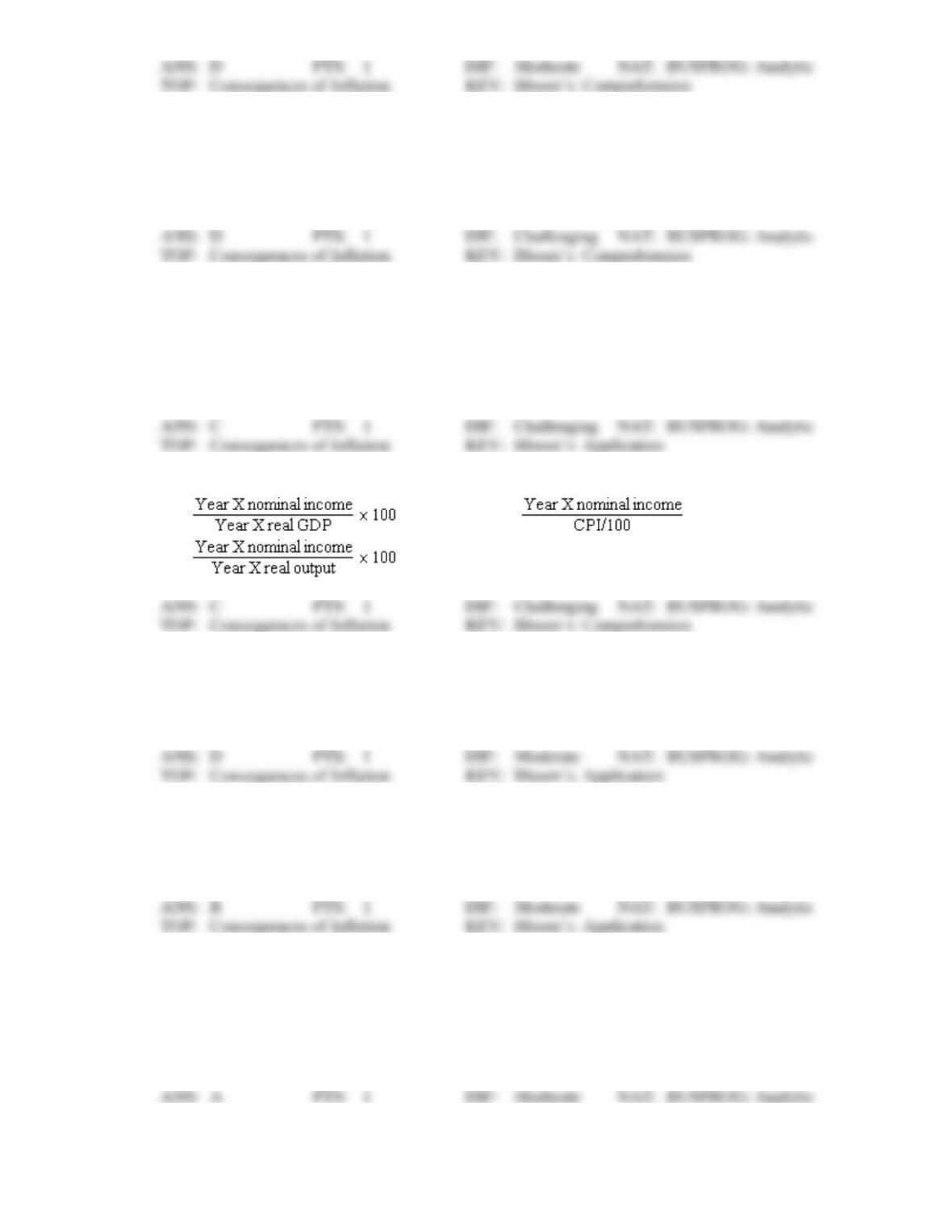
60. Real income for a given year would be less than nominal income in that year if:
a.
the consumer price index was less than 100 in that year.
b.
nominal income in that year was greater than nominal income in the previous year.
c.
nominal income in that year was less than nominal income in the previous year.
d.
the consumer price index was greater than 100 in that year.
61. Last year the Jones family earned $40,000. This year their income is $42,000. In an economy with an
inflation rate of 10 percent, which of the following is correct?
a.
The Jones’ nominal income and real income have both fallen.
b.
The Jones’ nominal income and real income have both risen.
c.
The Jones’ nominal income has increased and their real income has fallen.
d.
The Jones’ nominal income has decreased and their real income has risen.
62. Real income in Year X is equal to:
a.
c.
b.
d.
Year X nominal income CPI.
63. The CPI (using a 2000 base year) for 1965 is 26.0. Suppose a household’s annual take-home pay in
1965 was $8,320. What would be an equivalent home pay in 2000?
a.
$10,483.
c.
$23,680.
b.
$21,632.
d.
$32,000.
64. Suppose your nominal income this year is 5 percent higher than last year. If the inflation rate for the
period was 3 percent, then your real income was:
a.
increased by 1.67 percent.
c.
increased by 8 percent.
b.
increased by 2 percent.
d.
decreased by 0.6 percent.
65. Last year the Olsen family earned $70,000. This year their income is $77,000. In an economy with an
inflation rate of 8 percent, we can conclude that the Olsen’s nominal income:
a.
and real income both increased.
b.
and real income both decreased.
c.
increased, but their real income decreased.
d.
decreased, but their real income increased.
66. If the nominal interest rate is 5 percent and there is no inflation, then the real interest rate:
a.
exceeds 5 percent.
c.
is 5 percent.
b.
is less than 5 percent.
d.
is zero.
67. The real interest rate can be expressed as the:
a.
nominal interest rate minus the real interest rate.
b.
inflation rate minus the nominal interest rate.
c.
nominal interest rate minus the inflation rate.
d.
nominal interest rate plus the inflation rate.
68. If the rate of inflation in a given time period turns out to be higher than lenders and borrowers
anticipated, then the effect will be:
a.
a redistribution of wealth from borrowers to lenders.
b.
a net gain in purchasing power for lenders relative to borrowers.
c.
no change in the distribution of wealth between lenders and borrowers.
d.
none of these.
69. The real interest rate is defined as the:
a.
actual interest rate.
b.
fixed-rate on consumer loans.
c.
nominal interest rate minus the inflation rate.
d.
expected interest rate minus the inflation rate.
70. If the inflation rate exceeds the nominal rate of interest,
a.
the real interest rate is negative.
c.
savers lose.
b.
lenders lose.
d.
all of these.
71. If the rate of inflation in a given time period turns out to be lower than lenders and borrowers
anticipated, then the effect will be:
a.
a redistribution of wealth from borrowers to lenders.
b.
a redistribution of wealth from lenders to borrowers.
c.
a net loss in purchasing power for lenders relative to borrowers.
d.
a net gain in purchasing power for borrowers relative to lenders.
72. If the rate of inflation in a given time period turns out to be higher than lenders and borrowers
anticipated, then the effect will be:
a.
no change in the distribution of wealth between lenders and borrowers.
b.
a net gain in purchasing power for lenders relative to borrowers.
c.
a redistribution of wealth from borrowers to lenders.
d.
a redistribution of wealth from lenders to borrowers.
73. Assume that the real rate of interest is 5 percent and a lender charges a nominal interest rate of 15
percent. If a borrower expects that the rate of inflation next year will be 10 percent and the actual rate
of inflation next year is 12 percent:
a.
neither the borrower nor the lender benefits from inflation.
b.
both the borrower and the lender lose from inflation.
c.
the borrower benefits from inflation, while the lender loses from inflation.
d.
the lender benefits from inflation, while the borrower loses from inflation.
74. Assume that the real rate of interest is 5 percent and a lender charges a nominal interest rate of 15
percent. If a borrower expects that the rate of inflation next year will be 10 percent and the actual rate
of inflation next year is 10 percent,
a.
the lender benefits from inflation, while the borrower loses from inflation.
b.
the borrower benefits from inflation, while the lender loses from inflation.
c.
neither the borrower nor the lender benefits from inflation.
d.
both the borrower and the lender lose from inflation.
75. Suppose you place $10,000 in a retirement fund that earns a nominal interest rate of 8 percent. If you
expect inflation to be 5 percent or lower, then you are expecting to earn a real interest rate of at least:
a.
1.6 percent.
c.
4 percent.
b.
3 percent.
d.
5 percent.
76. Consider borrowers and lenders who agree to loans with fixed nominal interest rates. If inflation is
higher than what the borrowers and lenders expected, then who benefits from lower real interest rates?
a.
Only the borrowers benefit.
c.
Both borrowers and lenders benefit.
b.
Only the lenders benefit.
d.
Neither borrowers nor lenders.
77. Demand-pull inflation is associated with:
a.
decreasing total spending (demand).
c.
decreasing costs of production (supply).
b.
increasing total spending (demand).
d.
increasing costs of production (supply).
78. A dramatic and sustained increase in oil prices would most likely:
a.
increase demand-pull inflation.
c.
increase cost-push inflation.
b.
decrease demand-pull inflation.
d.
decrease cost-push inflation.
79. Demand-pull inflation is due to:
a.
minimum wage laws.
c.
excess total spending.
b.
labor cost increases.
d.
tax increase.
80. Demand-pull inflation occurs:
a.
at or close to full employment.
b.
because of excess total spending.
c.
when “too much money is chasing too few goods.”
d.
all of these.
81. The likely result of an economy operating at full employment is:
a.
cost-push inflation.
c.
a lower rate of growth.
b.
demand-pull inflation.
d.
hyperinflation.
82. Which of the following can create demand-pull inflation?
a.
Excessive aggregate spending.
c.
Higher labor costs.
b.
Sharply rising oil prices.
d.
Recessions and depressions.
83. Suppose the Organization of Petroleum Exporting Countries (OPEC) sharply increased the price of oil,
which triggered higher inflation rates in the United States. This type of inflation is best classified as:
a.
pseudo-inflation.
c.
cost-push inflation.
b.
demand-pull inflation.
d.
hyperinflation.
84. Cost-push inflation is due to:
a.
“too much money chasing too few goods”.
b.
the economy operating at full employment.
c.
increases in production costs.
d.
all of these.
85. Which of the following statements is true?
a.
Demand-pull inflation is caused by excess total spending.
b.
Cost-push inflation is caused by an increase in resource costs.
c.
If nominal interest rates remain the same and the inflation rate falls, real interest rates
increase.
d.
If real interest rates are negative, lenders incur losses.
e.
All of these.
86. Cost-push inflation is due to:
a.
labor cost increases.
c.
raw material cost increases.
b.
energy cost increases.
d.
all of these.
87. When OPEC raised the price of oil, it created a:
a.
demand-pull inflation.
b.
cost-push inflation.
c.
demand-push inflation.
d.
cost-pull inflation.
e.
cost-push deflation.
88. Hyperinflation refers to a situation in which:
a.
prices are rising extremely rapidly.
c.
the price level is extremely high.
b.
prices are falling extremely rapidly.
d.
the price level is extremely low.
89. During periods of hyperinflation, which of the following is the most likely response of consumers?
a.
Save as much as possible.
c.
Invest as much as possible.
b.
Spend money as fast as possible.
d.
Lend money.
TRUE/FALSE
1. Inflation refers only to rising prices at a given time period.
2. Inflation occurs when there is an increase in the purchasing power of money.
3. During periods of inflation, all prices of all products are rising.
4. Inflation was a major problem in the United States during the early years of the Great Depression.
5. During periods of inflation, the general price level of goods and services in the economy rises.
6. The consumer price index (CPI) is a number that measures movements in the average (general) level
of prices.
7. The consumer price index (CPI) is computed as the ratio of nominal GDP to real GDP.
8. The consumer price index (CPI) includes only a market basket of goods and services purchased by the
typical urban consumer.
9. Suppose the consumer price index (CPI) for a given year is 150. This means the rate of inflation for
the given year is 50 percent.
10. Unlike the GDP deflator, the CPI does not consider goods and services purchased by business and
government.
11. A consumer price index of 110 for a given year indicates that prices in that year are 10 percent higher
than prices in the base year.
12. A sustained decrease in the price level is known as deflation.
13. Disinflation and deflation mean a decrease in the average price level.
14. If consumers reduce the purchase of goods whose relative prices rise (substitution bias), the consumer
price index (CPI) will tend to have an upward bias over time (overstates inflation).
15. Changes in the quality of some goods and services, such as electromechanical calculators, are thought
to give a downward bias to the consumer price index.
16. People with fixed incomes fare best in an inflationary period.
17. During the period 1980-1986, the U.S. economy experienced disinflation.
18. Real income is the purchasing power of nominal (money) income.
19. Inflation reduces the purchasing power of nominal income and increases the purchasing power of fixed
income.
20. The nominal rate of interest is any rate of interest below 3 percent.
21. The nominal rate of interest is equal to the real interest rate plus the inflation rate.
22. The real interest rate can be negative.
23. The real interest rate is the annual percentage amount of money that is earned on a sum loaned or
deposited in a bank.
24. Demand-pull inflation is typically caused by rapidly rising costs of production.
25. Demand-pull inflation occurs during a period of time in which total spending is increasing less than
total output (GDP) is increasing.
26. Demand-pull inflation is most pronounced during a recession (as opposed to the recovery phase of the
business cycle).
27. Demand-pull inflationary pressure increases as the economy approaches full employment.
28. Cost-push inflation is a result of an increase in the per unit costs of production.
29. Cost-push inflation is caused by too much money chasing too few goods.
30. Inflation psychosis and wage-price spirals are two types of hyperinflation.
ESSAY
1. What are some criticisms of the CPI as a measure of inflation?
2. How is inflation typically measured? What are the different types of inflation? Why is it important to
know which type of inflation we may be experiencing?
3. Who is hurt and who benefits from inflation? Why?