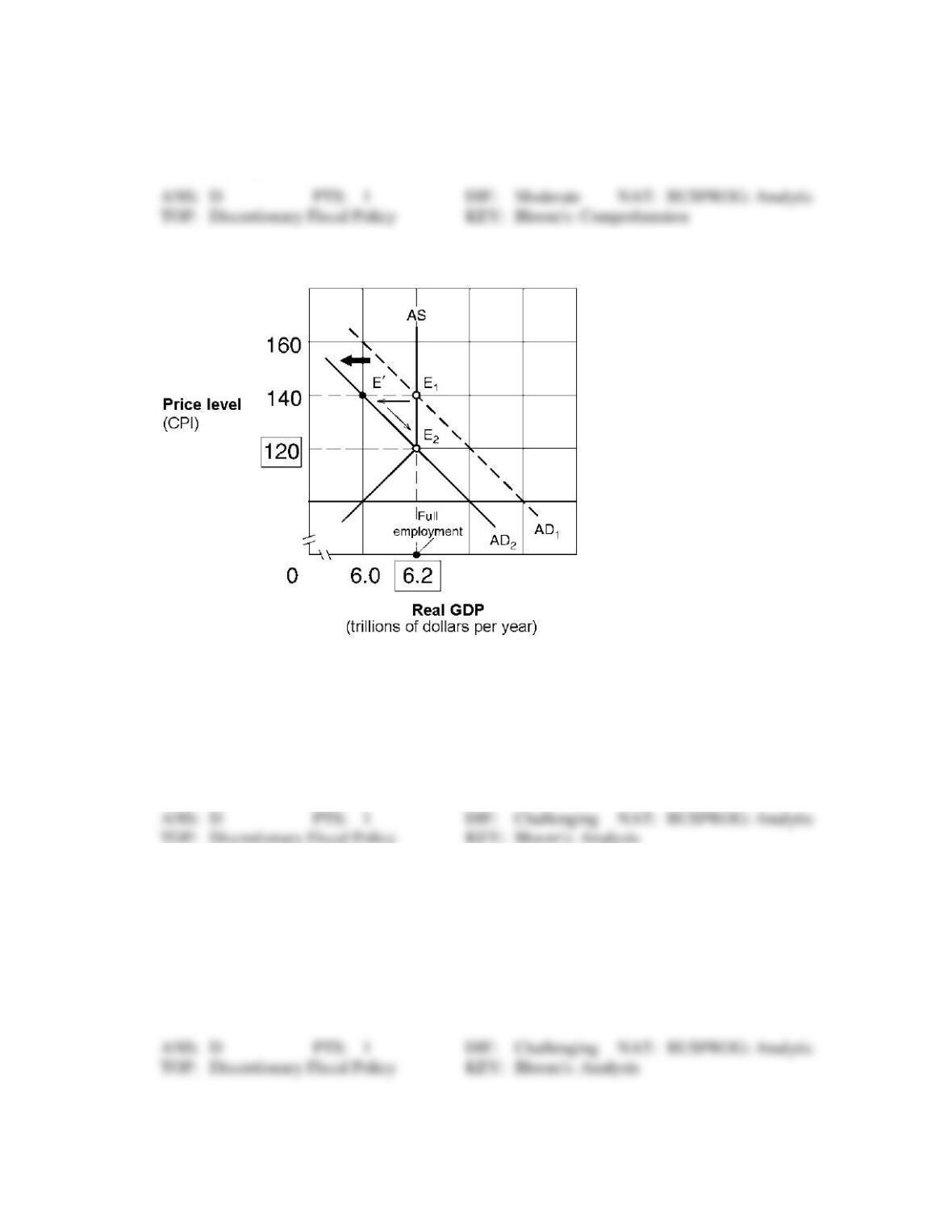
105. To help close an inflationary gap, the government could:
a.
run budget deficits.
b.
decrease taxes.
c.
increase government spending.
d.
run budget surpluses.
e.
do nothing.
Exhibit 11-5 Aggregate demand and supply model
106. Suppose the economy in Exhibit 11-5 is in equilibrium at point E1 and the marginal propensity to
consume (MPC) is 0.75. Following Keynesian economics, the federal government can move the
economy to point E2 and reduce inflation by:
a.
increasing government spending by $50 billion.
b.
decreasing government spending by $6 billion.
c.
decreasing government spending by $100 billion.
d.
decreasing government spending by $50 billion.
107. Suppose the economy in Exhibit 11-5 is in equilibrium at point E1 and the marginal propensity to
consume (MPC) is 0.75. Following Keynesian economics, the federal government can move the
economy to point E2 and reduce inflation by:
a.
increasing government tax revenue by $6 billion.
b.
decreasing government tax revenue by $6.1 billion.
c.
decreasing government tax revenue by $200 billion.
d.
increasing government tax revenue by approximately $66 billion.
e.
decreasing government tax revenue by approximately $66 billion.
Exhibit 11-6 Aggregate demand and supply model
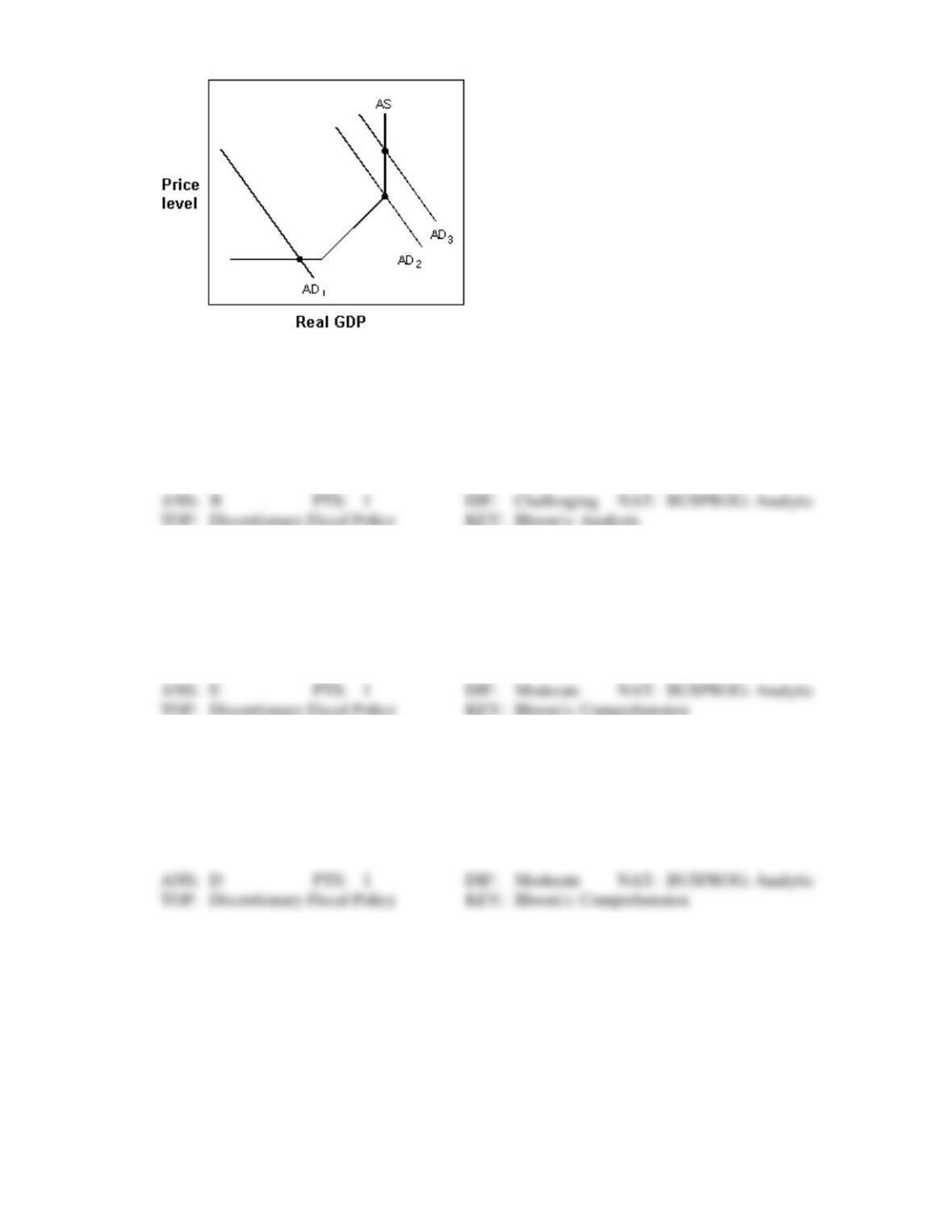
108. In Exhibit 11-6, if the aggregate demand curve is at AD1, the government should:
a.
raise taxes to move to AD2.
b.
cut taxes to move to AD2.
c.
cut taxes to move to AD3.
d.
cut spending to move to AD2.
e.
not change its behavior.
109. In Exhibit 11-6, if the aggregate demand curve is at AD2, the government should:
a.
raise taxes to move to AD1.
b.
cut taxes to move to AD3.
c.
cut taxes to move to AD3.
d.
cut spending to move to AD3.
e.
not change its policy.
110. In Exhibit 11-6, if the aggregate demand curve is at AD3, the government should:
a.
raise taxes to move to AD1.
b.
cut taxes to move to AD2.
c.
cut taxes to move to AD1.
d.
cut spending to move to AD2.
e.
not change its behavior.
Exhibit 11-7 Aggregate demand and supply model
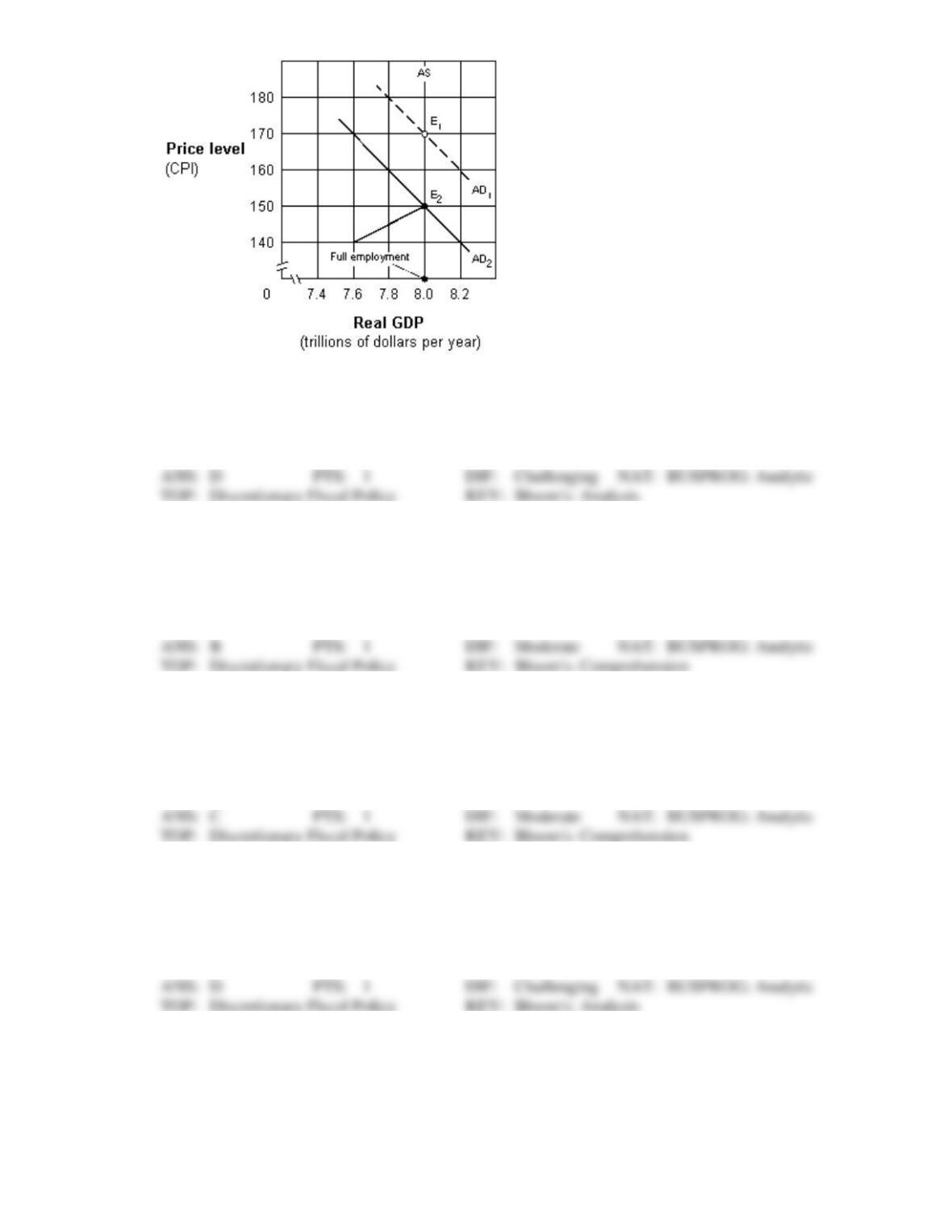
111. Beginning at equilibrium E1 in Exhibit 11-7, assume the marginal propensity to consume (MPC) is
0.90 and the government increases taxes by $100 billion. The aggregate demand curve will shift to the:
a.
left by $1,000 billion.
c.
right by $900 billion.
b.
right by $1,000 billion.
d.
left by $900 billion.
112. Suppose the economy in Exhibit 11-7 is in equilibrium at point E1 and the marginal propensity to
consumer (MPC) is 0.75. Following Keynesian economics, to lower the price level from 170 to 150,
the government should reduce its spending by:
a.
$20 billion.
c.
$133 billion.
b.
$100 billion.
d.
$400 billion.
113. Suppose the economy in Exhibit 11-7 is in equilibrium at point E1 and the marginal propensity to
consume (MPC) is 0.75. Following Keynesian economics, to lower the price level from 170 to 150 the
government should raise taxes by:
a.
$20 billion.
c.
$133 billion.
b.
$100 billion.
d.
$400 billion.
114. Beginning at equilibrium E1 in Exhibit 11-7, suppose the marginal propensity to consume (MPC) is
0.75, and the government wishes to lower the price level form 170 to 150 while maintaining a
balanced budget. The government should reduce both spending and taxes by:
a.
$20 billion.
c.
$133 billion.
b.
$100 billion.
d.
$400 billion.
115. When the government levies a $100 million tax on people’s income and puts the $100 million back
into the economy in the form of a spending program, such as new interstate highway construction, the:
a.
tax, then, generates a $100 million decline in real GDP.
b.
level of real GDP expands by $100 million.
c.
effect on real GDP is uncertain.
d.
tax multiplier overpowers the income multiplier, triggering a rollback in real GDP.
116. Equal increases in government spending and taxes will:
a.
cancel each other out so that the equilibrium level of real GDP will remain unchanged.
b.
lead to an equal decrease in the equilibrium level of real GDP.
c.
lead to an equal increase in the equilibrium level of real GDP.
d.
lead to an increase in the equilibrium level of real GDP real GDP that is larger than the
initial change in government spending and taxes.
e.
lead to an increase in the equilibrium level of output that is smaller than the initial change
in government spending and taxes.
117. Assume Congress enacts a $500 billion increase in spending and a $500 billion tax increase to finance
the additional government spending. The result of this balanced-budget approach is a:
a.
$500 billion decrease in aggregate demand.
b.
$500 billion increase in aggregate demand.
c.
$1,000 billion increase in aggregate demand.
d.
$1,000 billion decrease in aggregate demand.
118. An increase in government spending will have the greatest expansionary impact on the economy if it is
combined with:
a.
an increase in tax revenue equal to the increase in spending.
b.
a decrease in tax revenue equal to the increase in spending.
c.
unchanged tax revenue.
d.
none of these is true.
119. The result of the balanced budget multiplier is that aggregate demand changes by the amount of the
change in:
a.
government spending.
c.
government spending plus tax revenue.
b.
tax revenue.
d.
government spending minus tax revenue.
120. Assume Congress enacts a $10 billion increase in spending and a $10 billion tax increase to finance
the additional government spending. The result of this balanced-budget approach is a:
a.
$20 billion increase in aggregate demand.
b.
$10 billion increase in aggregate demand.
c.
$100 billion increase in aggregate demand.
d.
$10 billion decrease in aggregate demand.
121. Assume Congress enacts a $10 billion decrease in spending and a $10 billion decrease in tax revenue.
The result of this balanced-budget approach is a:
a.
$10 billion decrease in aggregate demand.
b.
$20 billion decrease in aggregate demand.
c.
$100 billion decrease in aggregate demand.
d.
$10 billion increase in aggregate demand.
122. The balanced budget multiplier is always equal to:
a.
0.50.
c.
1 / MPC.
b.
0.75.
d.
1.
123. Automatic stabilizers are government programs that:
a.
exaggerate the ups and downs in aggregate demand without legislative action.
b.
bring expenditures and revenues automatically into balance without legislative action.
c.
shift the budget toward a deficit when the economy slows but shift it toward a surplus
during an expansion.
d.
increase tax collections automatically during a recession.
124. When an economy dips into recession, automatic stabilizers will:
a.
enlarge the budget deficit (or reduce the surplus).
b.
reduce the budget deficit (or increase the surplus).
c.
ensure that the budget remains in balance.
d.
expand the supply of money and, thereby, stimulate aggregate demand.
125. Which of the following is an example of an automatic stabilizer?
a.
Congress legislates lower tax rates to increase consumption and investment.
b.
Tax rates are increased during a recession to maintain a balanced budget.
c.
A regressive income tax system reduces tax revenues (as a share of income) as income
expands.
d.
Revenues from the corporate income tax increase sharply during a business boom but
decline substantially during a recession, even though no new tax legislation has been
enacted.
126. ]Programs that automatically increase government spending (relative to revenue) during a recession
and automatically decrease government spending (relative to revenue) during an economic boom are
called:
a.
discretionary fiscal policy.
c.
automatic stabilizers.
b.
supply-side programs.
d.
tax credits.
127. Government programs that automatically shift the government budget toward a deficit during
recessions and a surplus during recoveries are called:
a.
discretionary fiscal policy.
c.
progressive taxation.
b.
automatic stabilizers.
d.
price deflators.
128. An advantage of automatic stabilizers is that this type of fiscal policy is not subject to:
a.
imprecise knowledge of full-employment real GDP.
b.
special interest groups.
c.
lag time problems.
d.
All of these are true.
129. Automatic stabilizers stabilize the level of real GDP because:
a.
Congress quickly changes spending and tax revenue.
b.
federal expenditures and tax revenues change as the level of real GDP changes.
c.
the spending and tax multiplier are constant.
d.
wages are controlled by the minimum wage law.
130. Which of the following is an automatic stabilizer that moves the federal budget toward deficit during
an economic contraction and toward surplus during an economic expansion?
a.
Personal income tax revenues.
c.
Unemployment benefits.
b.
Corporate income tax revenues.
d.
All of these.
131. A decrease in real GDP would affect the U.S. economy by:
a.
cutting tax revenues and raising government expenditures.
b.
cutting government expenditures and raising tax revenues.
c.
raising both tax revenues and government expenditures.
d.
cutting both government expenditures and tax revenues.
132. In the U.S. economy, the effect on federal tax revenues and spending of an increase in the
unemployment rate is to:
a.
cut tax revenues and raise expenditures.
c.
raise both tax revenues and expenditures.
b.
cut expenditures and raise tax revenues.
d.
cut both expenditures and tax revenues.
133. Which of the following is the best example of an automatic stabilizer?
a.
Welfare payments.
c.
Defense spending.
b.
Foreign aid
d.
Highway construction.
134. When the economy enters a recession, automatic stabilizers create:
a.
higher taxes.
c.
budget deficits.
b.
more discretionary spending.
d.
budget surpluses.
135. Automatic stabilizers “lean against the prevailing wind” of the business cycle because:
a.
wages are controlled by the minimum wage law.
b.
federal expenditures and tax revenues change as the level of real GDP changes.
c.
the spending and tax multipliers are constant.
d.
they include the power of special interests.
136. In the U.S. economy, the effect on federal tax revenues and spending of a decrease in employment is
to:
a.
cut tax revenues and raise expenditures.
c.
raise both tax revenues and expenditures.
b.
cut spending and raise tax revenues.
d.
cut both spending and tax revenues.
137. Because of the automatic stabilizers, a decline in the level of economic activity will cause:
a.
a reduction in tax revenues collected.
c.
a greater budget deficit.
b.
an increase in government expenditures.
d.
all of these.
138. Which of the following is not an automatic stabilizer?
a.
Personal income tax revenue.
c.
Unemployment compensation benefits.
b.
Corporate income tax revenue.
d.
Property tax revenue.
139. Structures in the economy increase aggregate demand when the economy is in recession and decrease
aggregate demand when the economy is inflationary are known as:
a.
tax transfers.
b.
inventory investment.
c.
accelerators.
d.
depreciation.
e.
automatic stabilizers.
140. Unemployment insurance payments act as automatic stabilizers by:
a.
allowing for more consumer spending during prosperity.
b.
making the unemployment rate worse during a recession.
c.
allowing for more consumer spending during a recession.
d.
changing the Phillips curve to a Laffer curve.
141. The unemployment compensation program:
a.
makes recessions more severe.
b.
makes recession less severe.
c.
makes recessions more severe and inflationary episodes less severe.
d.
makes recessions less severe and inflationary episodes more severe.
e.
has no effect on the severity of recessions and inflationary episodes.
142. Personal income taxes:
a.
make recessions and inflationary episodes more severe.
b.
make recessions and inflationary episodes less severe.
c.
make recessions more severe and inflationary episodes less severe.
d.
make recessions less severe and inflationary episodes more severe.
e.
have no effect on the severity of recessions and inflationary episodes.
143. Unemployment compensation payments:
a.
rise during a recession and thus reduce the severity of the recession.
b.
rise during a recession and thus increase the severity of the recession.
c.
rise during inflationary episodes and thus reduce the severity of the inflation.
d.
fall during a recession and thus increase the severity of the recession.
144. Unemployment compensation payments:
a.
fall during periods of prosperity and thus reduce federal budget deficits.
b.
fall during periods of prosperity and thus increase federal budget deficits.
c.
fall during recessions and thus increase the problem of unemployment.
d.
rise during periods of prosperity and thus increase federal budget deficits.
e.
rise during recessions and thus increase the problem of unemployment.
145. Income tax collections:
a.
rise during a recession, thus reduce the severity of the recession.
b.
rise during a recession, thus increase the severity of the recession.
c.
fall during inflationary episodes, thus increase the severity of the inflation.
d.
fall during a recession, thus reducing the severity of the recession.
146. Income tax collections:
a.
fall during periods of prosperity, thus increase federal budget deficits.
b.
rise during periods of prosperity, thus reduce federal budget deficits.
c.
fall during recessions, thus increase the problem of unemployment.
d.
rise during recessions, thus increase the problem of unemployment.
147. Unemployment compensation is an example of a(n):
a.
discretionary stabilizer.
b.
countercyclical stabilizer.
c.
procyclical stabilizer.
d.
seasonal stabilizer.
e.
automatic stabilizer.
148. Supply-side economics is based on the theory that:
a.
budget deficits will stimulate demand, output, and employment.
b.
budget deficits will lead to higher interest rates, which will weaken their expansionary
impact.
c.
higher tax rates will increase tax revenues.
d.
increases in aggregate supply lower the price level.
149. Which of the following is emphasized by supply-side economics?
a.
The impact of budget deficits on interest rates and aggregate demand.
b.
The impact of government spending on aggregate demand, output, and employment.
c.
The impact of marginal tax rates on aggregate supply.
d.
The impact of budget deficits on the rate of taxation in the future.
150. “Lower marginal tax rates encourage people to work, save, and invest, resulting in more output and a
larger tax base.” This statement most closely reflects which of the following schools of economic
thought?
a.
Keynesian.
c.
Aggregate demandian.
b.
Adam Smithian.
d.
Supply-side economics.
151. “Tax cuts, by providing incentives to work, save, and invest, will raise employment and lower the
price level.” This argument is made by the:
a.
Keynesian economists.
c.
classical economists.
b.
supply-side economists.
d.
monetarists.
152. According to supply-side fiscal policy, reducing tax rates on wages and profits will:
a.
create demand-pull inflation.
b.
lower the price level but may trigger a recession.
c.
result in stagflation.
d.
reduce both unemployment and inflation.
153. An advocate of supply-side fiscal policy would advocate which of the following?
a.
Subsidies to produce technological advances.
b.
Reduction in regulation.
c.
Reduction in resource prices.
d.
Reduction in taxes.
e.
All of these.
154. Which of the following favors government policies to stimulate the economy by creating incentives for
individuals and businesses to increase their productive efforts?
a.
supply-side economics.
c.
monetarist economics.
b.
Keynesian economics.
d.
Marxian economics.
155. Which of the following policies is a supply-side policy?
a.
Reduction in taxes.
b.
Reduction in regulation.
c.
Reduction in resource prices.
d.
Subsidies to produce technological advances.
e.
All of these.
156. Supply-side economics calls for:
a.
lower taxes on businesses and individuals.
b.
regulatory reforms to increase productivity.
c.
government subsidies to promote technological advance.
d.
All of these.
157. Those who favor government policies to stimulate the economy by creating incentives for individuals
and businesses to increase their productive efforts are supporting:
a.
supply-side economics.
c.
monetarist economics.
b.
Keynesian economics.
d.
Marxian economics.
158. The school of economic thought which argues that through tax reductions, and deregulation,
government creates the proper incentives for the private sector to increase aggregate supply is known
as the:
a.
rational expectations school.
b.
neo-Keynesian school.
c.
supply-side school.
d.
new classical school.
e.
classical school.
159. According to supply-side economists, lowering corporate income taxes:
a.
results in wage hikes for employees but no economic growth.
b.
moves society toward greater income equality.
c.
checks the expansion of real GDP and employment.
d.
stimulates investment and economic growth.
e.
does not create enough incentive for producers to increase production.
160. Supply-side economists:
a.
saw influence beyond in both the Bush and Clinton administrations.
b.
disagreed with economist Arthur Laffer’s views on taxes.
c.
were influential in President Reagan’s decision to change the tax structure.
d.
believe that government regulations do not reduce productivity and undermine industrial
efficiency.
161. Which of the following groups believes that the economy can achieve full employment without
inflation through tax reductions, lower resource prices, and deregulation?
a.
Classical school.
b.
Keynesian school.
c.
Neo-Keynesian school.
d.
Rational expectations school.
e.
Supply-side school.
162. Supply-siders’ policy recommendations include:
a.
lower tax rates, spending cuts, and increased government regulation.
b.
lower tax rates, lower resource prices, and decreased government regulation.
c.
lower tax rates, spending increases, and decreased government regulation.
d.
lower tax rates, spending increases, and increased government regulation.
e.
higher tax rates, spending cuts, and decreased government regulation.
Exhibit 11-8 Aggregate demand and supply curves
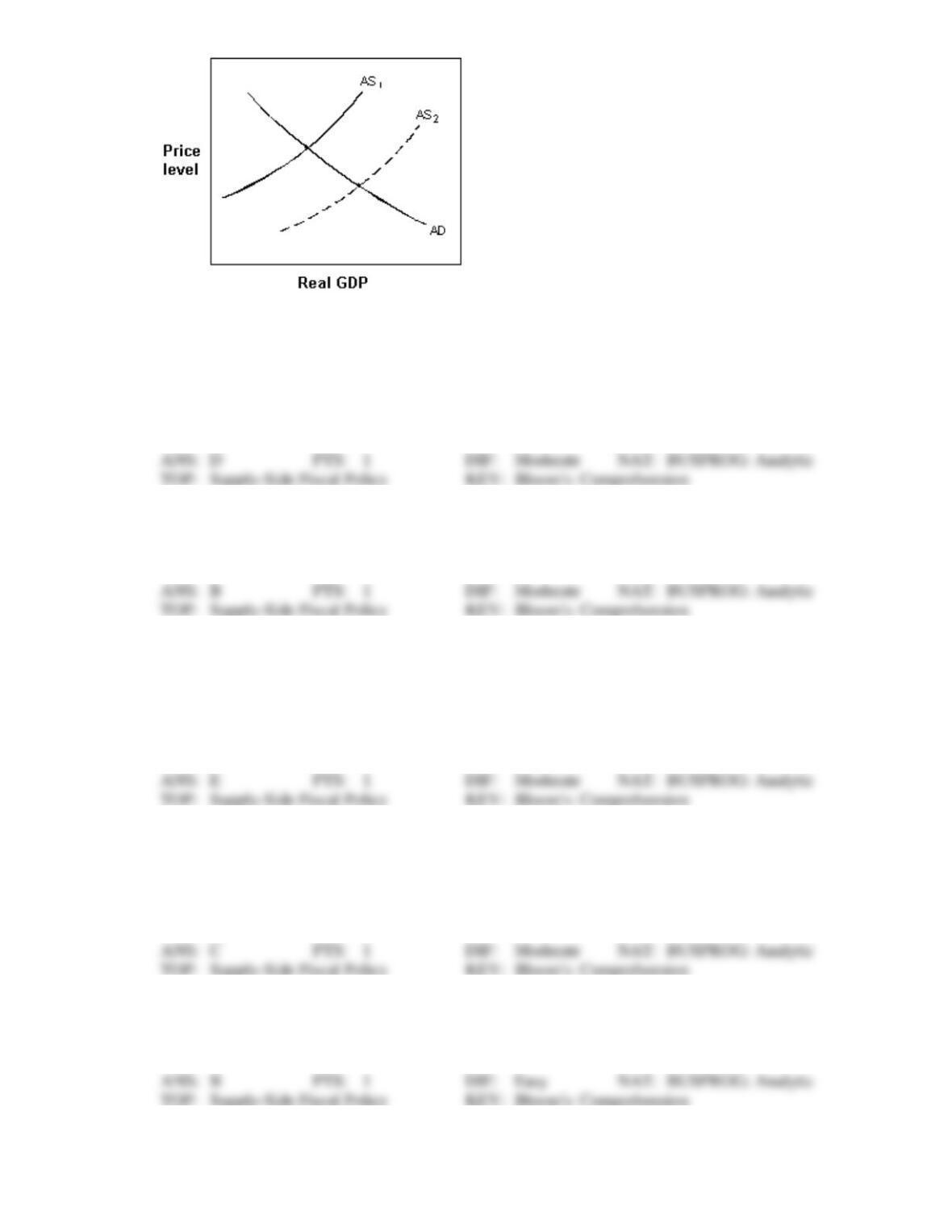
163. In Exhibit 11-8, supply-siders claimed that the shift from AS1 to AS2 would occur if the government:
a.
increased tax rates and increased the amount of government regulation.
b.
increased tax rates and decreased the amount of government regulation.
c.
increased tax rates and decreased the amount of government regulation.
d.
decreased tax rates and decreased the amount of government regulation.
e.
decreased tax rates and decreased the amount of government regulation.
164. The Laffer curve belongs to which of the following schools of economic thought?
a.
Keynesian.
c.
Demand management.
b.
Supply-side.
d.
Classical.
165. According to the Laffer curve, the federal tax rate affects:
a.
incentive to work.
b.
savings.
c.
investment.
d.
tax revenue.
e.
All of these.
166. During the Reagan administration, the Laffer curve was used to ague that:
a.
the supply-side effects of tax cuts are relatively small.
b.
discretionary tax cuts are unwise because they create stagflation.
c.
lower income tax rates could increase tax revenues.
d.
a “flat tax” would simplify the tax code and stimulate economic growth.
167. The Laffer curve is a graph of the relationship between tax rates and:
a.
real GDP.
c.
government spending.
b.
total tax revenues.
d.
inflation.
168. Which of the following statements is true?
a.
Above the optimal tax rate, a reduction in tax rates along the downward-sloping portion of
the Laffer curve would increase tax revenues.
b.
According to supply-side fiscal policy, lower tax rates would shift the aggregate demand
curve to the right, expanding the economy and creating some inflation.
c.
The presence of the automatic stabilizers tends to destabilize the economy.
d.
To combat inflation, Keynesians recommend lower taxes and greater government
spending.
169. The curve that reflects the view that when tax rates are too high, lowering them not only creates
greater incentive for suppliers to increase production, but ends up generating higher tax revenues, is
known as the:
a.
Phillips curve.
b.
Laffer curve.
c.
Engel curve.
d.
Rational expectations curve.
e.
consumption curve.
170. The Laffer curve is representative of which of the following schools?
a.
Supply-side school.
b.
Rational expectations school.
c.
Keynesians.
d.
Neo-Keynesians.
e.
Classical school.
171. QUESTION BLANK
a.
CHOICE BLANK
c.
CHOICE BLANK
b.
CHOICE BLANK
d.
CHOICE BLANK
172. The Laffer curve shows the relationship between tax:
a.
revenue and tax rates.
b.
revenue and take-home pay.
c.
revenue and government spending.
d.
rates and take-home pay.
e.
rates and government spending.
173. The Laffer curve shows as tax rates rise, tax revenue:
a.
rises.
b.
first rises, then falls, and then rises again.
c.
falls.
d.
first rises, and then falls.
e.
remains at a constant level.
174. According to the Laffer curve, when the tax rate is 100 percent, tax revenue will be:
a.
0.
b.
at the maximum value.
c.
the same as it would be at a 50 percent tax rate.
d.
greater than it would be at a 50 percent tax rate.
e.
the same as it would be at a 20 percent tax rate.
TRUE/FALSE
1. Fiscal policy is the manipulation of government spending and taxes.
2. According to Keynesian economics, fiscal policy should create a deficit during economic contractions.
3. Fiscal policy is the management of aggregate demand through changes in taxes and government
spending.
4. According to Keynesian economics, fiscal policy should be coordinated to create a surplus during
economic expansions.
5. Keynesian economics focuses on the role of aggregate spending in determining the level of real GDP.
6. Using the aggregate demand and supply model, expansionary fiscal policy will not affect the price
level, but will restore full-employment GDP.
7. Following Keynesian economics, and assuming a marginal propensity to consume (MPC) of 0.75, an
increase in federal government spending of $100 billion at below full employment would be expected
to shift the aggregate demand curve by $300 billion to the right.
8. Following Keynesian economics, and assuming a marginal propensity to consume (MPC) of 0.80, an
increase in federal government spending of $100 billion at below full employment would be expected
to shift the aggregate demand curve by $500 billion to the right.
9. The greater the marginal propensity to consume (MPC) in the economy, the greater the spending
multiplier.
10. If the marginal propensity to consume (MPC) is 0.80, the value of the spending multiplier is 2.
11. If the marginal propensity to consume (MPC) is 0.90, the value of the spending multiplier is 90.
12. The size of the spending multiplier depends on the level of real GDP.
13. An increase in the marginal propensity to consume (MPC) leads to a increase in the spending
multiplier.
14. The greater the marginal propensity to consume in the economy, the smaller the spending multiplier.
15. If the marginal propensity to consume is 0.80, the value of the spending multiplier will be 5.
16. The size of the spending multiplier depends on the marginal propensity to consume (MPC).
17. The marginal propensity to consume (MPC) is the change in consumption divided by the change in
income.
18. The marginal propensity to consume (MPC) is the change in consumption divided by the change in
saving.
19. If consumption is $800 when income is $1,000, the marginal propensity to consume (MPC) must be
0.80.
20. The marginal propensity to save plus the marginal propensity to consume always equals 1.
21. The tax multiplier is equal to the spending multiplier.
22. The tax multiplier equals 1 − spending multiplier.
23. The tax multiplier is greater than the spending multiplier regardless of the value of the marginal
propensity to consume (MPC).
24. Contractionary fiscal policy is designed to combat demand-pull inflation and consists of a decrease in
government spending and/or an increase in taxes.
25. Following Keynesian economics, and assuming a marginal propensity to consume (MPC) of 0.75, an
increase in taxes of $100 billion would be expected to shift the aggregate demand curve by $300
billion to the left.
26. The balanced budget multiplier is always equal to 1.
27. A $10 million increase in government spending has the same economic impact as a $10 million tax
cut.
28. The balanced budget multiplier is equal to one.
29. A simultaneous $10 million increase in both taxes and government spending will have no net effect on
aggregate demand.
30. Automatic stabilizers combine changes in discretionary fiscal policy with changes in government
spending and taxes influenced by the business cycle in order to stabilize the economy.
31. The presence of the automatic stabilizers means an increase in the budget deficit will be automatically
experienced during an economic expansion whereas a budget surplus will be automatically
experienced during a recession.
32. The presence of the automatic stabilizers means an increase in the budget deficit will be automatically
experienced during a recession whereas a budget surplus will be automatically experienced during an
economic expansion.
33. Automatic stabilizers are government programs that tend to push the federal budget toward surplus as
the real GDP rises and toward deficit as the real GDP falls.
34. Supply-side economic policies are designed to shift the aggregate supply curve to the right, whereas
Keynesian economic policies focus on shifting the aggregate demand curve to the right during
recessions and to the left during an economic expansion.
35. Supply-side economic policies are designed to shift the aggregate supply curve to the left, whereas
Keynesian economic policies focus on shifting the aggregate demand curve to the right during
recessions and to the left during economic expansions.
36. Supply-side fiscal policies were advocated by the Reagan administration.
37. Supply-side fiscal policies focus on improving the incentives to work, save, and invest.
38. The Laffer curve represents the relationship between real GDP and various possible tax rates.
39. Supply-siders believe that high tax rates are a disincentive to labor supply.
ESSAY
1. Describe appropriate discretionary fiscal policy according to Keynesian economics to smooth out the
business cycle.
2. According to Keynesian economics, what impact would a balanced budget amendment to our
constitution have on our national economy?
3. Discuss the differences between Keynesian and supply-side fiscal policies.