
c.
their production possibilities curves are positively sloped, unlike those in more developed
economies.
d.
they must cut back their already meager consumption levels to increase capital production.
e.
the opportunity cost of shifting resources from consumption goods to capital goods is
relatively low.
140. People in poor countries may have difficulties achieving economic growth because:
a.
their production possibilities curves slope upward instead of downward.
b.
they must cut back on current consumption to increase capital goods.
c.
they have a solid consumption base already in place.
d.
their resource bases are fully developed.
e.
the law of increasing costs makes it hard to produce more goods.
141. Technological innovations will cause:
a.
the production possibilities curve to stay the same.
b.
the production possibilities curve to shift to the left.
c.
the production possibilities curve to shift to the right.
d.
an economy to operate below its production possibilities curve.
e.
the production possibilities curve to increase or decrease.
142. Which of the following causes the production possibilities curve to shift to the right?
a.
d and e.
b.
c and e.
c.
A war.
d.
The development of a new technology that improves productivity.
e.
The discovery of oil reserves.
143. Robinson Crusoe’s decision to produce more capital goods and fewer consumer goods in a given
period causes:
a.
a decrease in the resources available in its economy.
b.
an increase in economic growth in future periods.
c.
a decrease in economic growth in future periods.
d.
no change in the availability of resources in its economy.
e.
a decrease in the ability to produce goods in the next period.

144. A major technological advance would be represented on a production possibilities curve by a(n):
a.
movement off the production possibilities curve toward a point outside the curve.
b.
movement toward the curve from a point inside the curve.
c.
outward shift of the entire curve.
d.
movement to the left along the curve to a higher point.
145. Other things being equal, a decreased supply of natural resources would be represented on a
production possibilities curve by a(n):
a.
movement off the curve to a point inside the curve.
b.
movement down along the curve.
c.
movement up along the curve.
d.
inward shift of the entire curve.
146. Which would be least likely to cause the production possibilities curve to shift to the right?
a.
An increase in the labor force.
b.
Improved methods of production.
c.
An increase in the education and training of the labor force.
d.
A decrease in unemployment.
147. Which of the following would most likely cause the production possibilities curve for DVDs and food
to shift outward?
a.
A choice of more food and more DVDs.
b.
A choice of more food and less DVDs.
c.
A choice of more DVDs and less food.
d.
An increase in the quantity of natural resources.
148. On a production possibilities curve diagram, greater entrepreneurship:
a.
causes the curve to shift outward.
b.
keeps the economy on the curve.
c.
prevents movement along the curve.
d.
keeps the economy at the corners of the curve.
149. In order for an economy to shift its production possibilities curve rightward, it must:
a.
suffer resource unemployment.
b.
experience an increase in its resources and/or an improvement in its technology.

c.
use its resources more efficiently than at points along the curve.
d.
all of these.
150. Reductions in available resources will cause the production possibilities curve to:
a.
expand.
c.
become vertical.
b.
disappear.
d.
shift inward.
151. A rightward (an outward) shift of a nation’s production possibilities curve could be caused by:
a.
a decrease in technology.
b.
an increase in resources.
c.
producing more consumer and fewer capital goods.
d.
a decline in the labor force’s level of education and skills.
152. An outward shift of an economy’s production possibilities curve is caused by:
a.
an increase in capital.
c.
an advance in technology.
b.
an increase in labor.
d.
all of these.
153. The production possibilities curve for the nation of Economania shifts to the right. This could have
been caused by:
a.
a decrease in Economania’s capital stock.
b.
a decrease in the Economania’s labor supply.
c.
high unemployment in Economania the previous time period.
d.
Economania producing all consumer goods in the previous period.
e.
technological innovation in the production of Economania goods.
154. The production possibilities curve for the nation of Economagic shifts to the left. This could have been
caused by:
a.
an increase in Economagic’s labor supply.
b.
innovation in the production of goods in Economagic.
c.
a war that destroyed some of Economagic’s resource base.
d.
unemployment among Economagic’s workers.
e.
Economagic’s choice of more consumption and less capital last period.

155. Which of the following cause(s) economic growth?
a.
c and d.
b.
d and e.
c.
The production of more scarce goods
d.
A technological improvement
e.
The production of more capital goods
156. Economic growth may be represented by a(n):
a.
leftward shift of a production possibilities curve.
b.
outward shift of a production possibilities curve.
c.
movement along a production possibilities curve.
d.
production possibilities curve that remains fixed.
157. A source of economic growth is:
a.
unemployment.
c.
less resources.
b.
inefficiency.
d.
greater entrepreneurship.
158. One source of economic growth is:
a.
producing inside the production possibilities curve.
b.
producing outside the production possibilities curve.
c.
increasing capital.
d.
discouraging profit-seeking entrepreneurs.
159. Which of the following statements is false?
a.
Marginal analysis is an examination of the effects of additions or subtractions from a
current situation.
b.
The production possibilities curve shows the maximum combination of two outputs that an
economy can produce, given its available resources and technology.
c.
Technology is the body of knowledge and skills applied to how goods are produced.
d.
Economic growth is illustrated as an inward shift of the production possibilities curve.
Exhibit 2-17 Production possibilities curve
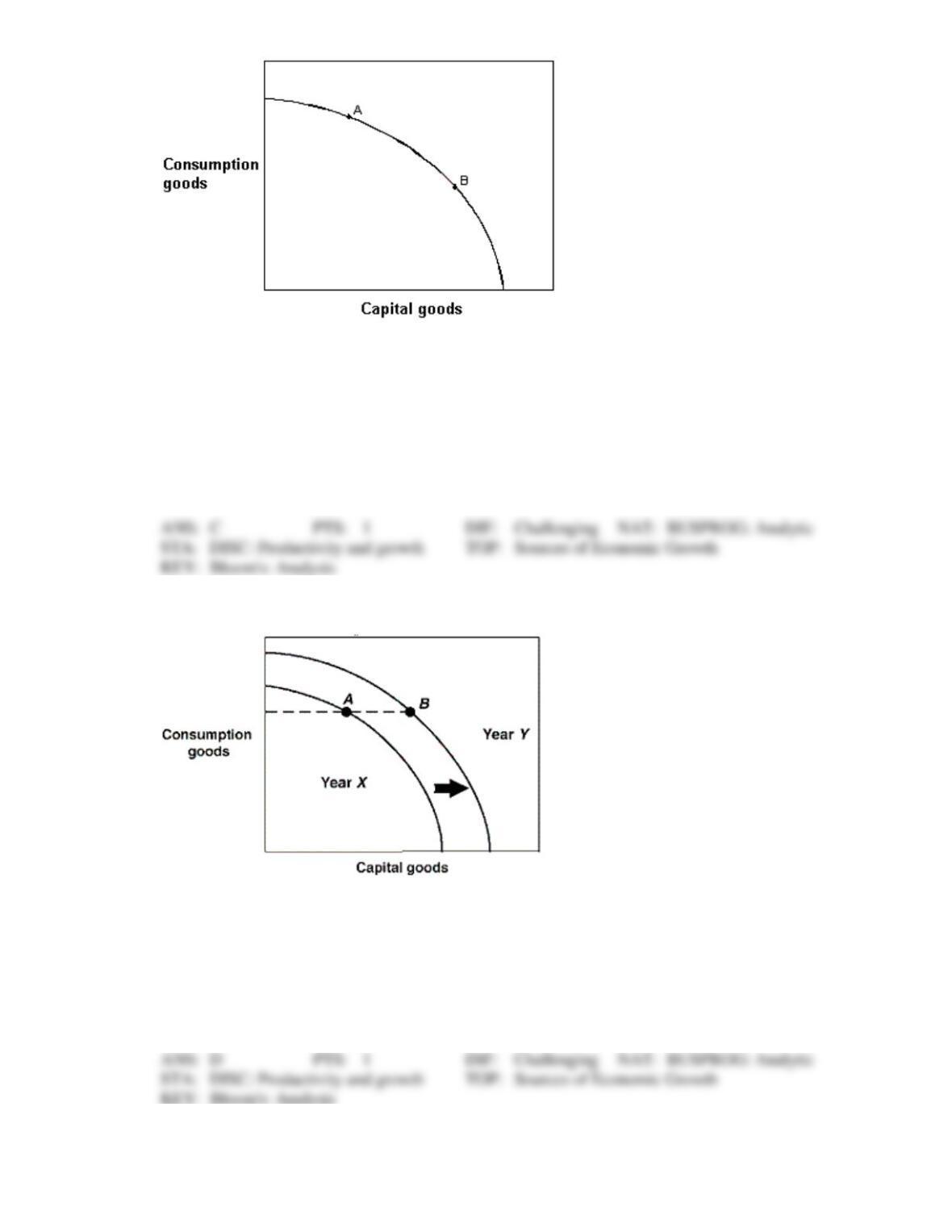
160. In Exhibit 2-17, if countries A and B currently have the same production possibilities curve (PPC) as
given in the figure, but this year country A locates at point A on its PPC and country B locates at point
B on its PPC, then country A:
a.
is better off than country B.
b.
will grow at a faster rate than country B.
c.
will grow at a slower rate than country B.
d.
is producing more capital goods than country B.
e.
is more efficient than country B.
Exhibit 2-18 Production possibilities curves
161. In Exhibit 2-18, a country is located at point A on its Year X production possibilities curve. In Year Y
this same country is located at point B on its Year Y production possibilities curve. Which of the
following could have brought about this outward shift in production possibilities curves?
a.
More efficient production in Year X.
b.
A natural disaster in Year X which leads to a destruction of resources.
c.
Higher unemployment in Year X.
d.
An advance in technology occurred in Year X.
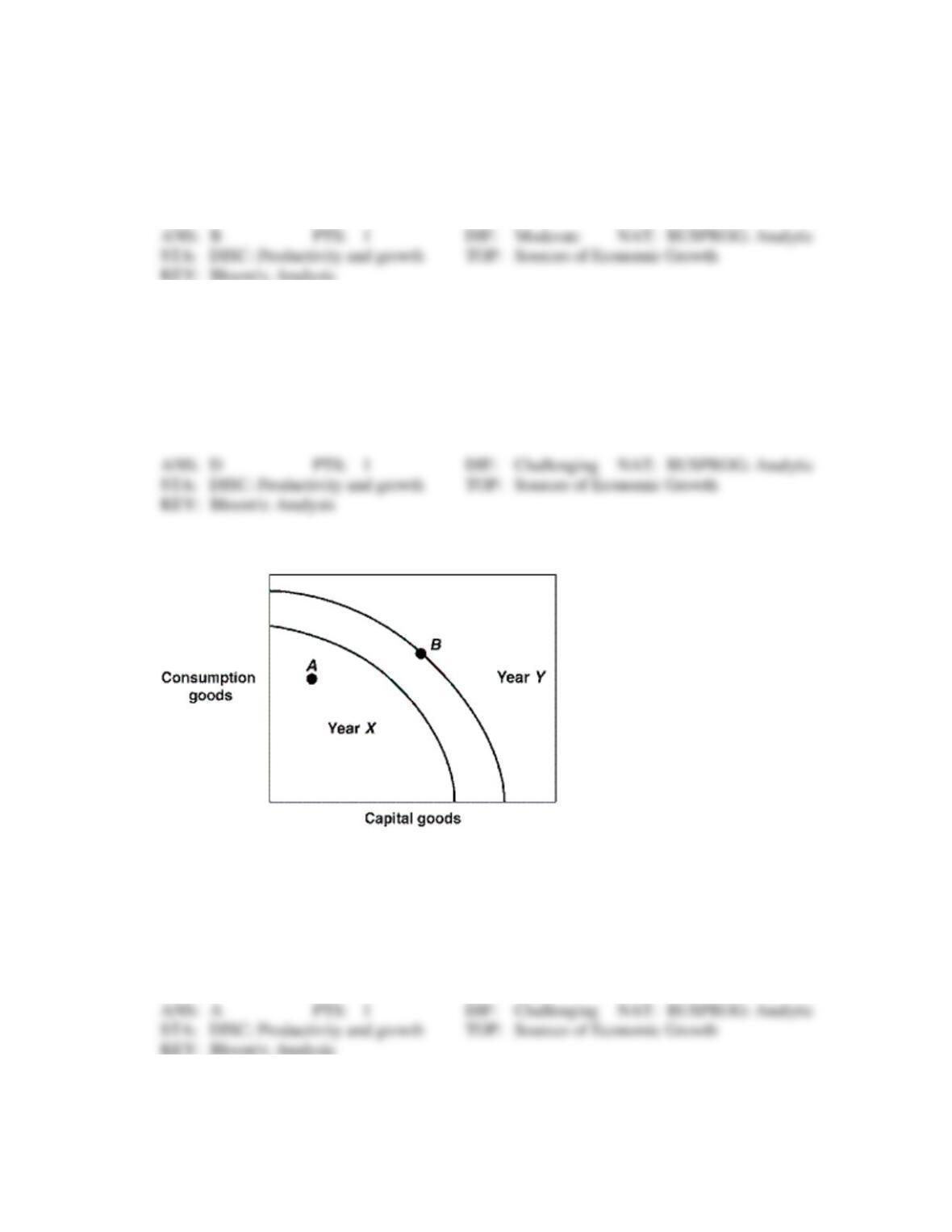
162. In Exhibit 2-18, the production possibilities curves for a country are shown for the years Year X and
Year Y. Suppose this country was located at point A in Year X and point B in Year Y. This country:
a.
is producing the same number of capital goods in both years.
b.
is producing the same number of consumption goods in both years.
c.
has shown no growth between Year X and Year Y.
d.
has higher unemployment in Year X than in Year Y.
e.
has higher unemployment in Year Y than in Year X.
163. In Exhibit 2-18, the production possibilities curves for a country are shown for the years Year X and
Year Y. Suppose this country was located at point A in Year X and point B in Year Y. This economy:
a.
is worse off in Year Y than in Year X.
b.
has stagnated production in this two year period.
c.
is more efficient in Year Y than in Year X.
d.
has shown growth between these two years.
e.
has higher unemployment in Year Y than in Year X.
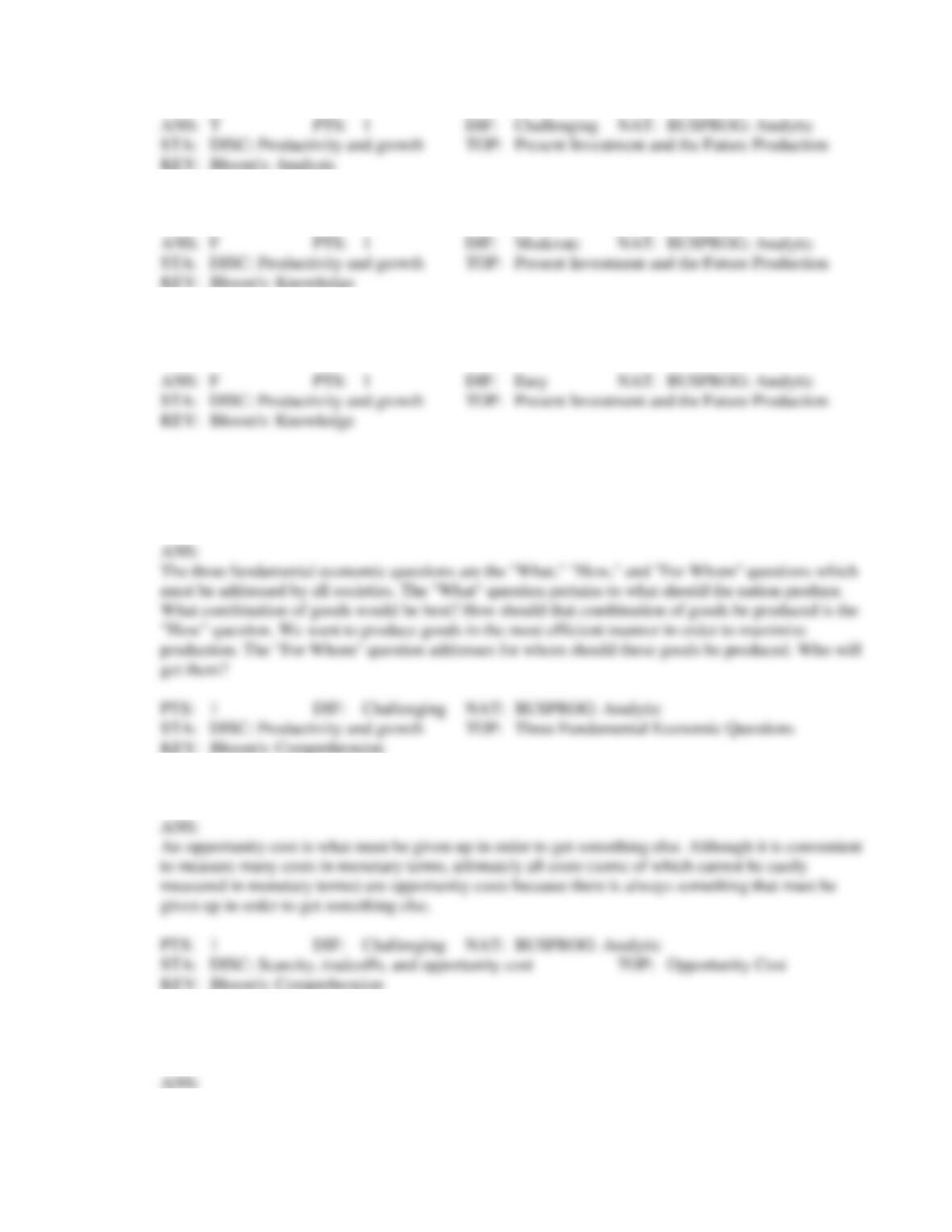
Exhibit 2-19 Production possibilities curves
164. In Exhibit 2-19, the production possibilities curves for a country are shown for the years Year X and
Year Y. Suppose this country was located at point A in Year X and point B in Year Y. This economy:
a.
has lower unemployment in Year Y than in Year X.
b.
was more efficient in Year X than in Year Y.
c.
achieved full employment in Year X and in Year Y.
d.
showed no growth between Year X and Year Y.
e.
is worse off in Year Y than in Year X.

165. In Exhibit 2-19, the production possibilities curves for a country are shown for the years Year X and
Year Y. Which of the following could have caused a shift for Year X to Year Y in production
possibilities curves?
a.
An increase in unemployment.
b.
A decline in technology.
c.
An increase in the stock of capital goods.
d.
A natural disaster.
e.
More efficient production.
166. With time, which one of the following strategies would most likely result in an outward shift in the
production possibilities curve of an economy?
a.
passage of legislation reducing the workweek to 30 hours.
b.
instituting a tax policy encouraging consumption at the expense of investment.
c.
instituting a tax policy encouraging investment at the expense of consumption.
d.
an increase in the marginal income tax rate, which would reduce the work effort of
individuals.
167. Which of the following is true?
a.
The production possibilities curve indicates that it will be impossible to expand total
output with the passage of time.
b.
As long as resources are scarce, output cannot be increased.
c.
The size of the economic pie is fixed, and therefore, if one individual has more income,
others must have less.
d.
Over time, the output of goods and services can be increased through human ingenuity and
discovery of better ways of doing things.
168. The process through which an economy’s production possibilities curve shifts outward is:
a.
full-employment management.
c.
resource renewal.
b.
investment.
d.
out-resourcing.
169. The process of accumulating capital is called:
a.
capitalization.
c.
investment.
b.
loanable funds.
d.
debt management.
170. In economics, investment refers to the process of accumulating:

a.
capital goods.
c.
money.
b.
consumer goods.
d.
stocks and bonds.
171. A nation can accelerate its economic growth by:
a.
reducing the number of immigrants allowed into the country.
b.
adding to its stock of capital.
c.
printing more money.
d.
imposing tariffs and quotas on imported goods.
TRUE/FALSE
1. What to produce, how to produce, and for who to produce are the three fundamental economic
questions.
2. Only socialist economies need to answer the What, How, and For Whom questions.
3. Opportunity cost is the best alternative sacrificed for a chosen alternative.
4. When making a rational decision which requires the consideration of costs and benefits involved, the
opportunity cost of a decision is often not taken into consideration when indeed it should be.
5. An opportunity cost is the highest valued alternative foregone whenever one chooses an alternative.
6. The opportunity cost of producing a good or service is the good or service that is foregone by choosing
to produce another good with the same resources in a given period of time.

7. The opportunity cost of attending a movie is the purchase price of a ticket.
8. Every economic choice has an opportunity cost.
9. The basic approach in marginal analysis is to compare a policy’s total benefits with its total costs.
10. Marginal analysis examines the effects of additions to or subtractions from a current situation.
11. Unemployment or underemployment of labor might explain why an economy would be operating
inside its production possibilities curve (PPC).
12. If more of one good can be produced without producing less of another output, the economy must have
been operating efficiently.
13. If some resources went to waste rather to use in production, the economy would operate outside its
production possibility curve.
14. Each and every point along a production possibilities curve represents an efficient output option for an
economy.

15. If some resources were used inefficiently, the economy would operate outside its production
possibilities curve.
16. Of all the points on the production possibilities curve, only one point represents an efficient point.
17. The most efficient point on the production possibilities curve is the midpoint on the curve.
18. On the production possibilities curve, a movement between points that yields a loss of one good in
order to raise the output of another good will maintain efficient production.
19. All points on the production possibilities curve represent efficient levels of production.
20. A nation’s current location on its production possibilities curve can determine the future location of
that nation’s production possibilities curve.
21. Assuming an economy is already experiencing full employment, then it must produce more consumer
goods and fewer capital goods if it wishes to experience greater rates of economic growth over time.
22. A nation can accelerate economic growth by increasing its production of consumer goods.
23. Investment in capital accumulation, as well as investment in education and other labor productivity
enhancing programs, is necessary for economic growth.
24. In economics terminology, the process of accumulating money is investment.
25. Investment is an economic term for the act of increasing the stock of money available for business
loans.
ESSAY
1. Discuss the three fundamental economic questions that all nations must address.
2. Why are all costs really “opportunity costs”?
3. What can a nation do to increase its economic growth? Why is economic growth among the major
national economic goals of all countries?

4. Graphically express a production possibilities curve. What do points on, inside and outside the curve
represent? What does a rightward shift of the curve represent? How is economic growth expressed in
terms of the production possibilities model?