Chapter 10—Monopolistic Competition and Oligopoly
MULTIPLE CHOICE
1. Which of the following is not a characteristic of the monopolistic competition market structure?
a.
Many sellers, each small in size relative to the overall market.
b.
Few sellers.
c.
Differentiated product.
d.
Easy, low-cost entry and exit.
2. Which of the following is true about long-run equilibrium in a monopolistically competitive market?
a.
Firms earn zero economic profit because price equals long-run average cost, but the
equilibrium is not allocatively efficient because price exceeds the marginal cost of the last
unit produced.
b.
They may earn negative, zero, or positive economic profit because monopolistically
competitive firms are price takers.
c.
Each firm faces a perfectly elastic demand curve and earns zero economic profit because
price equals long-run average cost, and are allocatively efficient because price equals
marginal cost for the last unit sold.
d.
None of the above are correct.
3. Which of the following most closely approximates the conditions of a monopolistically competitive
market?
a.
The market for Grade A eggs, which is characterized by a large number of firms
producing a homogeneous product.
b.
The restaurant industry, which is characterized by firms producing a differentiated product
in a market with low entry barriers.
c.
Local cable television service, where a licensed supplier competes with firms offering
satellite service.
d.
The market for jumbo aircraft, where one major domestic firm competes with one major
foreign firm.
4. Which of the following is the best example of a firm operating in a monopolistically competitive
market?
a.
A Kansas wheat farmer.
c.
U.S. Postal Service.
b.
TGI Fridays, a family restaurant.
d.
Boeing, an aircraft manufacturer
5. Which of the following is characteristic of a monopolistically competitive firm?
a.
The firm faces an upward-sloping demand curve.
b.
The firm faces an inelastic demand curve.
c.
The firm faces a horizontal demand curve.
d.
The firm produces a differentiated product.
6. The marginal revenue curve of a monopolistically competitive firm will always lie:
a.
below the firm’s demand curve.
c.
parallel to the firm’s quantity axis.
b.
parallel to the firm’s demand curve.
d.
above the firm’s demand curve.
7. A profit-maximizing monopolistically competitive firm will expand output to the point where:
a.
total revenue equals total cost.
b.
marginal revenue equals marginal cost.
c.
price equals average total cost.
d.
price equals marginal cost.
8. The monopolistic competition market structure is characterized by:
a.
few firms and similar products.
b.
many firms and differentiated products.
c.
many firms and a homogeneous product.
d.
few firms and a homogeneous product.
9. Video rental stores in cities are an illustration of:
a.
perfect competition.
c.
monopolistic competition.
b.
monopoly.
d.
oligopoly.
10. Which of the following is the best example of a monopolistic competitor?
a.
Wheat farmers.
c.
American Telephone and Telegraph.
b.
Diet centers.
d.
General Motors.
11. Firms in a monopolistically competitive industry produce:
a.
homogeneous goods and services.
c.
competitive goods only.
b.
differentiated products.
d.
consumption goods only.
12. Which of the following is the best example of a monopolistically competitive market?
a.
Wheat.
c.
Diamonds.
b.
Automobiles.
d.
Retail sales.
13. Which of the following is a characteristic of the monopolistic competition market structure?
a.
Many firms and a homogeneous product.
b.
Few firms and differentiated products.
c.
Few firms and similar products.
d.
Few firms and a homogeneous product.
e.
Many firms and differentiated products.
14. In the long run, both monopolistic competition and perfect competition result in:
a.
a wide variety of brand-name choices for consumers.
b.
an efficient allocation of resources.
c.
zero economic profit for firms.
d.
excess capacity.
15. Product differentiation makes the demand for a monopolistically competitive firm’s product:
a.
perfectly elastic.
c.
more inelastic than for a monopoly.
b.
more elastic than for a monopoly.
d.
perfectly inelastic.
16. In the long run, monopolistically competitive firms have:
a.
excess capacity.
c.
minimal average costs.
b.
positive profits.
d.
homogeneous production.
17. A monopolistically competitive market is characterized by:
a.
many small sellers selling a differentiated product.
b.
a single seller of a product that has few suitable substitutes.
c.
very strong barriers to entry.
d.
mutual interdependence in pricing decisions.
18. A monopolistically competitive firm will:
a.
maximize profits by producing where MR = MC.
b.
not likely earn an economic profit in the long run.
c.
shut down if price is less than average variable cost.
d.
all of these.
19. The theory of monopolistic competition predicts that in long-run equilibrium a monopolistically
competitive firm will:
a.
produce the output level at which price equals long-run marginal cost.
b.
operate at minimum long-run average cost.
c.
overutilize its insufficient capacity.
d.
produce the output level at which price equals long-run average cost.
20. A monopolistic competitive firm is inefficient because the firm:
a.
earns positive economic profit in the long run.
b.
is producing at an output corresponding to the condition that marginal cost equals price.
c.
is not maximizing its profit.
d.
produces an output where average total cost is not minimum.
21. Firms in a monopolistically competitive market structure maximize their profit by producing an output
where:
a.
price equals average total cost.
b.
marginal cost equals average total cost.
c.
marginal cost equals price.
d.
marginal revenue equals marginal cost.
22. Which of the following statements best describes firms under monopolistic competition?
a.
There is little price or quality competition.
b.
The firms compete, using quality, location, advertising, and price.
c.
Firms do not compete using advertising.
d.
There is little competition between firms.
23. Monopolistic competitive firms in the long run earn:
a.
positive economic profits.
c.
negative economic profits.
b.
zero pure economic profits.
d.
none of these.
24. In the long-run, surviving firms in monopolistic competition earn:
a.
higher pure economic profits.
c.
below-normal profits.
b.
zero pure economic profits.
d.
substantial economic losses.
25. The theory of monopolistic competition predicts that in long-run equilibrium a monopolistically
competitive firm will:
a.
produce at the level in which price equals long-run average cost.
b.
operate at minimum long-run average cost.
c.
overutilize its insufficient capacity.
d.
none of these.
26. Which of the following statements best describes the price, output, and profit conditions of
monopolistic competition?
a.
Price will equal marginal cost at the profit-maximizing level of output; profits will be
positive in the long-run.
b.
Price will always equal average variable cost in the short run and either profits or losses
may result in the long run.
c.
Marginal revenue will equal marginal cost at the short run, profit-maximizing level of
output; in the long run, economic profit will be zero.
d.
Marginal revenue will equal average total cost in the short run; long-run economic profits
will be zero.
27. In the long run, a monopolistic competitive firm will operate at a price which:
a.
is higher than minimum long-run average cost.
b.
equals minimum long-run average cost.
c.
equals marginal cost.
d.
none of these.
28. Which of the following statements best describes firms under monopolistic competition?
a.
Profits will be positive in the long run.
b.
Price always equals average variable cost.
c.
In the long run, positive economic profit will be eliminated.
d.
Marginal revenue equals minimum average total cost in the short run.
29. A monopolistic competitive firm is inefficient because the firm:
a.
is not maximizing its profit.
b.
is producing at an output where average total cost is not minimum.
c.
earns positive economic profit in the long run.
d.
none of these.
30. Monopolistic competition is inefficient because:
a.
firms earn positive economic profits.
b.
the firms’ marginal costs and marginal revenues are not equal.
c.
firms have excess capacity in the long run.
d.
entry is difficult.
31. Which of the following is true in long-run equilibrium for both perfect competition and monopolistic
competition?
a.
Accounting profit is zero.
b.
Marginal cost equals price.
c.
Long-run average cost is at a minimum.
d.
Economic profit is zero.
32. Which of the following is true for a firm operating under perfect competition, monopolistic
competition, and monopoly?
a.
Firms earn positive economic profits in the long run.
b.
Firms earn zero economic profits in the long run.
c.
Profits are maximized when marginal cost equals marginal revenue.
d.
Price equals marginal cost.
33. In monopolistic competition if there is profit, there is:
a.
a signal for new firms to enter.
b.
a motive for existing firms to increase prices.
c.
proof that advertising works.
d.
a motive for existing firms to decrease prices.
e.
product differentiation.
34. Which of the following is always associated with monopolistic competition?
a.
Identical products
b.
Economic profits in the short run
c.
MR lies above the demand curve
d.
Demand curves become more inelastic as new entry occurs
e.
Product differentiation
35. We can represent the entry of new firms into a monopolistically competitive market by shifting the
existing firms’:
a.
demand curves downward.
b.
demand curves upward.
c.
demand curves more inelastic.
d.
cost curves upward.
e.
cost curves downward.
36. Compared to monopoly, the market results with monopolistic competition are usually expected to be:
a.
worse because consumers get fewer choices.
b.
worse because consumers pay a higher price.
c.
the same.
d.
better because consumers get less output.
e.
better because consumers pay a lower price.
37. A picture frame company operates in a monopolistically competitive market. Its short-run equilibrium
price is $80 and its ATC is $65. It sells 100 picture frames a week. From this we can tell:
a.
this firm is making a normal profit.
b.
other picture frame companies will want to exit the market.
c.
there are no other picture frame companies in the area.
d.
economic profits are $1,500.
e.
total profits are being maximized.
38. Tombstones are produced in a monopolistic competitive market. One producer, Rolling Stones, sells
20 tombstones a week at a price of $500 each. Its average total cost is $600. From this information, we
can tell:
a.
new tombstone firms will want to enter.
b.
this producer is losing $2,000 a week.
c.
this producer is making an economic profit of $400.
d.
this producer is setting MR = MC.
e.
this producer should increase production.
39. Costume jewelry is produced in a monopolistically competitive market. One producer finds that MR =
MC = $3 when output is 700 necklaces. An economist studying this information can conclude that:
a.
the producer is charging a price of $3.
b.
economic profit is $2,100.
c.
the producer charges a price greater than $3.
d.
new firms will want to enter.
e.
this producer should produce more than 700 necklaces.
40. In the long run in monopolistic competition,
a.
economic profits are zero.
b.
P = MC.
c.
P = minimum ATC.
d.
firms have an incentive to leave.
e.
the demand curve is tangent to the MC curve.
41. When a perfectly competitive firm or a monopolistically competitive firm is making zero economic
profit,
a.
no firms will want to enter or exit.
b.
some firms will want to leave.
c.
some firms will want to enter.
d.
market demand shifts to the left.
e.
the price of the output will rise in the long run.
42. The demand curve in monopolistic competition slopes downward because of:
a.
strong barriers to entry.
b.
product differentiation.
c.
the small number of firms.
d.
government regulation.
e.
the similarities of the businesses.
43. The short-run equilibrium for a monopolistically competitive firm is at P = $28.47, ATC = $22.13, and
MC = MR = $17.47. Which of the following is true?
a.
Per-unit profit is $11.
b.
Additional firms will be attracted into the industry.
c.
The firm could raise price and increase profits.
d.
The firm could lower price and increase profits.
e.
Average cost must be rising.
44. Perfect competition and monopolistic competition are similar because under both market structures,
a.
there are zero economic profits in the long run.
b.
production takes place at the least-cost combination.
c.
there are few firms.
d.
entry is difficult.
e.
differentiated products are produced.
45. If a monopolistically competitive firm can earn a profit, it will increase production until:
a.
MR > AVC.
b.
MR = ATC.
c.
MC > MR.
d.
MR = AR.
e.
MR = MC.
46. In the long run, the economic profits of Hoot’s Chicken ‘n’ Ribs, a monopolistic competitor, are:
a.
not eliminated, because competition is not perfect.
b.
not eliminated, because the demand curve slopes downward.
c.
eliminated due to firms entering the industry.
d.
eliminated due to firms leaving the industry.
e.
not eliminated, because firms cannot enter the industry.
47. For both a monopolist and a monopolistically competitive firm:
a.
price equals average total cost.
c.
marginal revenue equals zero.
b.
price is above marginal revenue.
d.
marginal cost equals zero.
48. The entry of new firms into a monopolistic competitive industry will shift the:
a.
market demand curve to the right.
b.
market demand curve to the left.
c.
existing firm’s demand curve to the right.
d.
existing firm’s demand curve to the left.
e.
market supply curve to the left.
49. As new firms enter a monopolistic competitive industry, it can be expected that:
a.
market price will increase.
b.
the output of existing firms will increase.
c.
profits of existing firms will increase.
d.
market demand should decrease.
e.
profits of existing firms will decrease.
50. Entry of new firms will occur in a monopolistic competitive industry until:
a.
marginal cost equals zero.
b.
marginal revenue equals zero.
c.
marginal revenue equals marginal cost.
d.
economic profit equals zero.
e.
economic profit is negative.
51. In the long run in a monopolistic competitive industry,
a.
economic profits will be positive.
b.
price will be driven to zero.
c.
the firm will not operate where MR = MC.
d.
economic profit will be zero.
e.
price will exceed average cost.
52. Which of the following is the result of competing through advertising for a monopolistically
competitive firm?
a.
Long-run average costs shift downward.
b.
The firm’s demand curve become flatter and shifts inward.
c.
The firm’s demand curve keeps the same slope and shifts inward.
d.
Long-run average costs shift upward.
53. Which of the following is true about advertising?
a.
If monopolistically competitive firms compete through advertising, that creates brand
loyalty, then advertising can be an effective entry cost.
b.
Advertising may be the only way that a new entrant can penetrate a market dominated by
long-established firms.
c.
Advertising has no impact on entry costs or market structure.
d.
Both a. and b. above are correct.
54. Supporters of advertising claim that it:
a.
increases the variety of products.
c.
allows new firms to compete.
b.
attacks established brand loyalties.
d.
all of these.
55. Defenders of advertising argue that it:
a.
informs buyers and broadens the market for goods.
b.
enhances economic efficiency by lowering prices.
c.
enables small firms to compete more effectively with large ones.
d.
all of these.
56. Critics of advertising argue that it:
a.
lowers price by increasing competition.
b.
results in more variety of products.
c.
establishes brand loyalty, which promotes competition.
d.
serves as a barrier to entry for new firms.
57. Supporters of advertising claim that it:
a.
makes demand for a firm’s product more elastic.
b.
is a barrier to entry.
c.
promotes better quality products.
d.
all of these.
58. Which of the following is true about advertising by a firm?
a.
It is not always successful in increasing demand for a firm’s product.
b.
It attempts to increase demand and to make demand more inelastic.
c.
It may reduce per unit costs of production when economies of scale are experienced.
d.
All of these.
59. Product differentiation:
a.
refers to the attempt of firms to make their products look like those of the other firms in
the industry.
b.
refers to the attempt of firms to make real or apparent differences in essentially
substitutable products look different in the minds of the consumers.
c.
refers to the advantage big firms have in research and development.
d.
is a common characteristic of a perfectly competitive market structure.
e.
is only employed in a monopoly market structure.
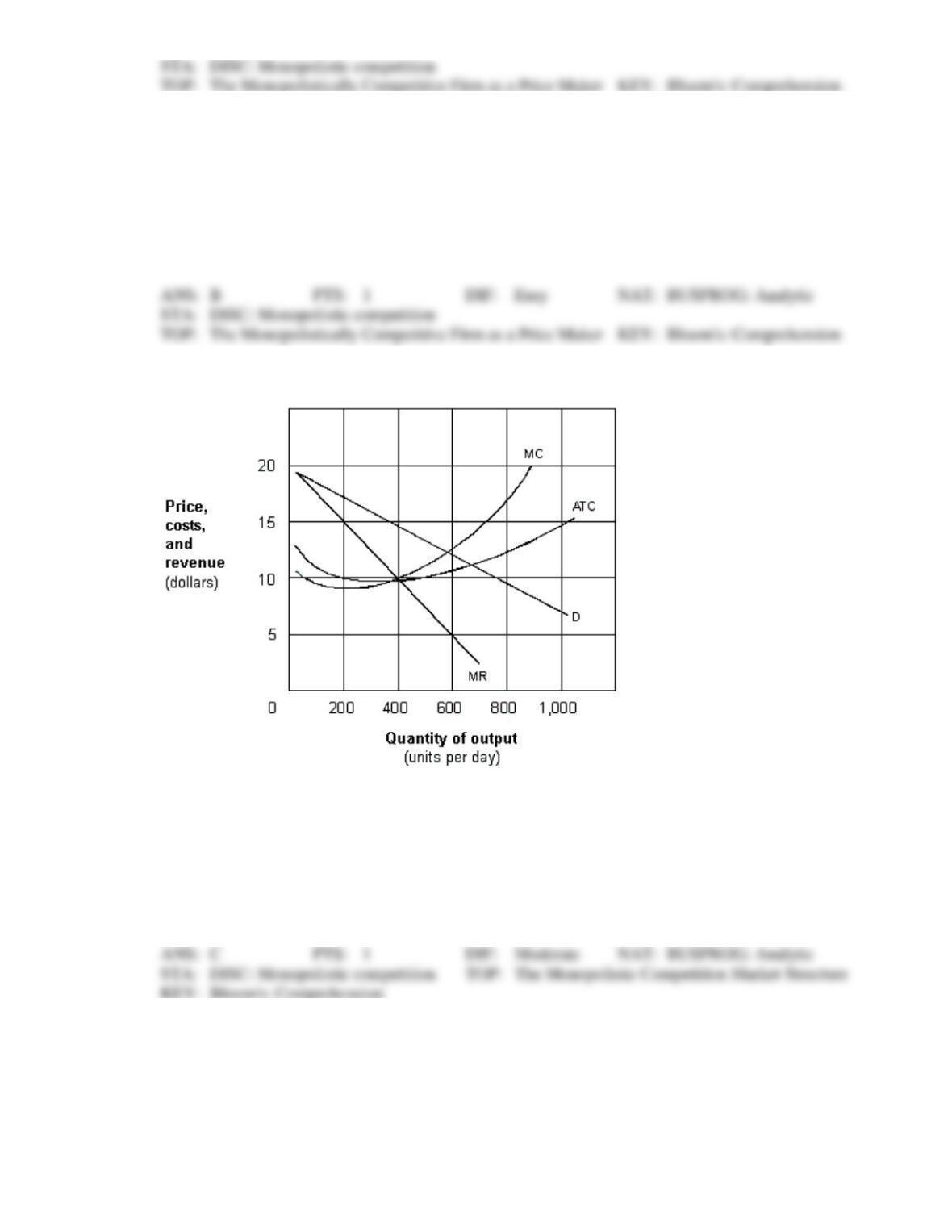
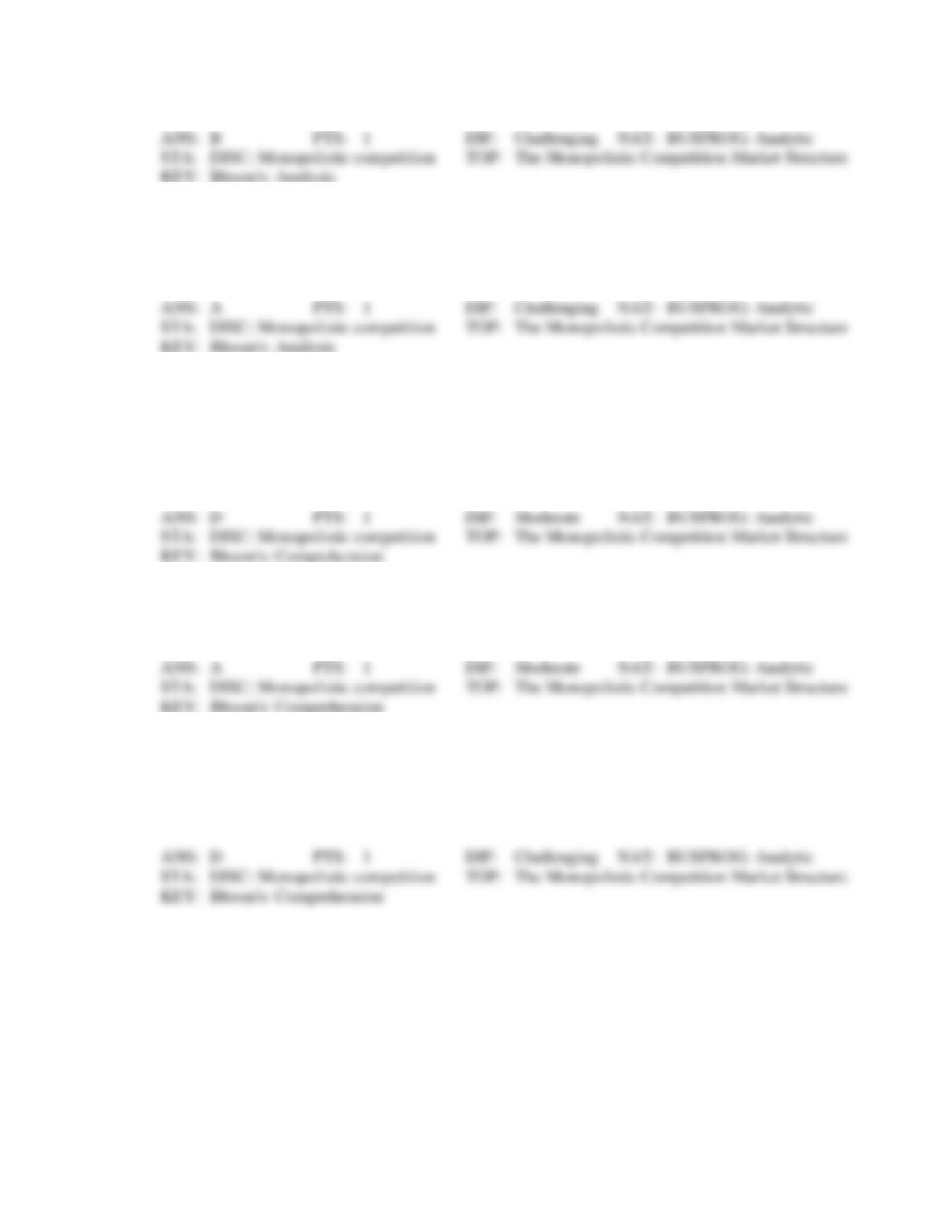
Exhibit 10-1 A monopolistic competitive firm
60. As presented in Exhibit 10-1, the short-run profit-maximizing output for the monopolistic competitive
firm is:
a.
zero units per day.
b.
200 units per day.
c.
400 units per day.
d.
600 units per day.
e.
800 units per day.
61. As presented in Exhibit 10-1, the short-run profit per unit of output for the monopolistic competitive
firm is:
a.
zero.
b.
$5.
c.
$10.
d.
$15.
e.
$20.
62. As represented in Exhibit 10-1, the maximum long-run economic profit earned by this monopolistic
competitive firm is:
a.
zero.
c.
$1,000 per day.
b.
$200 per day.
d.
$20,000 per day.
63. If all firms in the industry are the same as the monopolistic competitive firm shown in this Exhibit 10-
1, firms in the long run will:
a.
leave the industry.
b.
earn positive economic profits.
c.
experience less competition because firms will exit the industry.
d.
experience competition from new firms that enter the industry.
64. In the long run, the demand curve for the monopolistic competitive firm shown in Exhibit 10-1:
a.
shifts leftward.
c.
shifts rightward.
b.
remains the same.
d.
none of these.
65. In the long run, which of the following is true for the firm shown in Exhibit 10-1?
a.
The firm’s demand curve shifts leftward.
b.
The firm’s average total cost curve shifts upward.
c.
Neither a nor b are possible.
d.
Both a and b are possible.
Exhibit 10-2 A monopolistic competitive firm
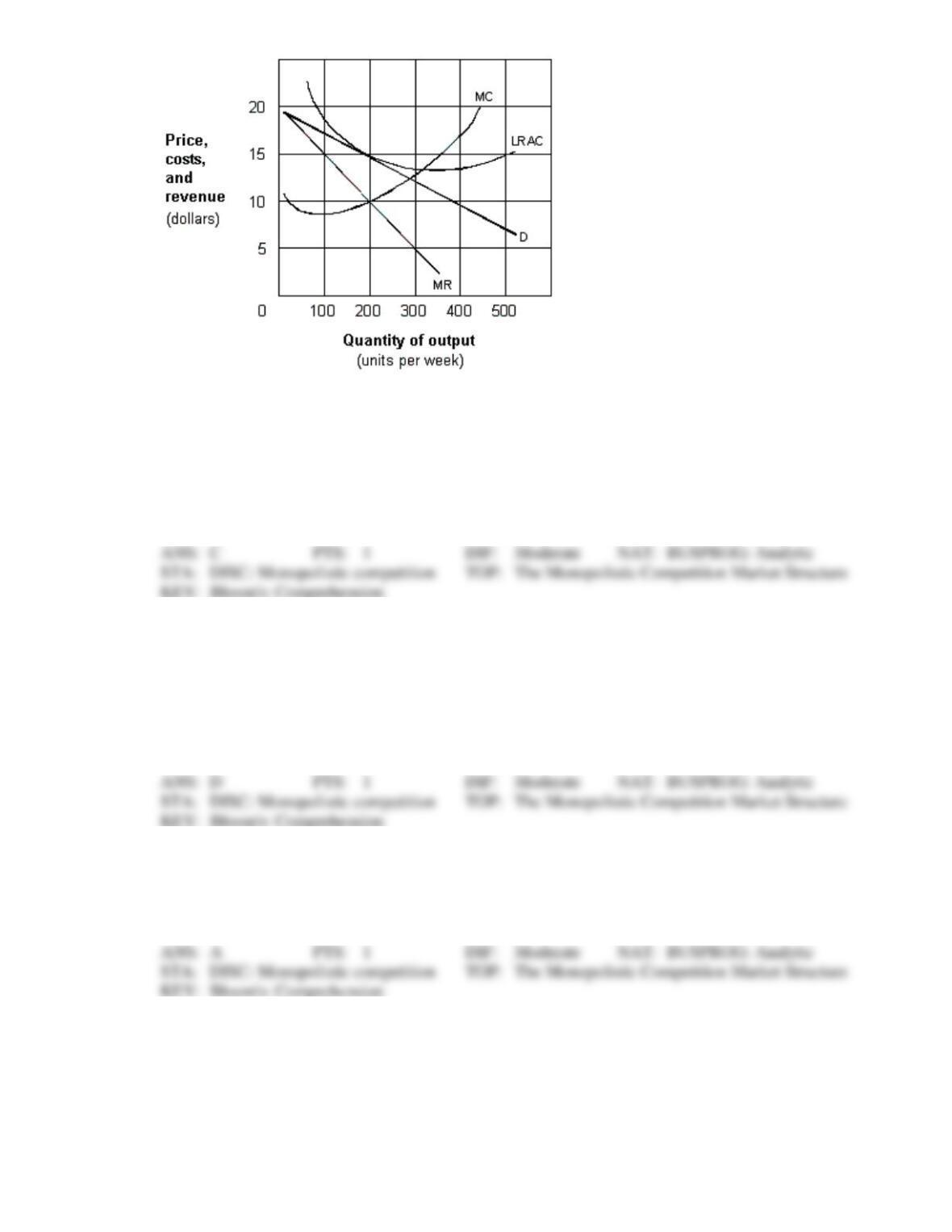
66. As presented in Exhibit 10-2, the long-run profit-maximizing output for the monopolistic competitive
firm is:
a.
zero units per week.
b.
100 units per week.
c.
200 units per week.
d.
300 units per week.
e.
400 units per week.
67. To maximize long-run profits, the monopolistically competitive firm shown in Exhibit 10-2 will
charge a price per unit of:
a.
zero.
b.
$5.
c.
$10.
d.
$15.
e.
$20.
68. As represented in Exhibit 10-2, the maximum long-run economic profit earned by this monopolistic
competitive firm is:
a.
zero.
c.
$1,000 per week.
b.
$200 per week.
d.
$20,000 per week.
69. If all firms in a monopolistic competitive industry have demand and cost curves like those shown in
Exhibit 10-2, we would expect that in the long run:
a.
all firms will leave the industry.
b.
some firms will leave the industry.
c.
firms in the industry earn zero economic profits.
d.
a number of new firms will enter the industry.
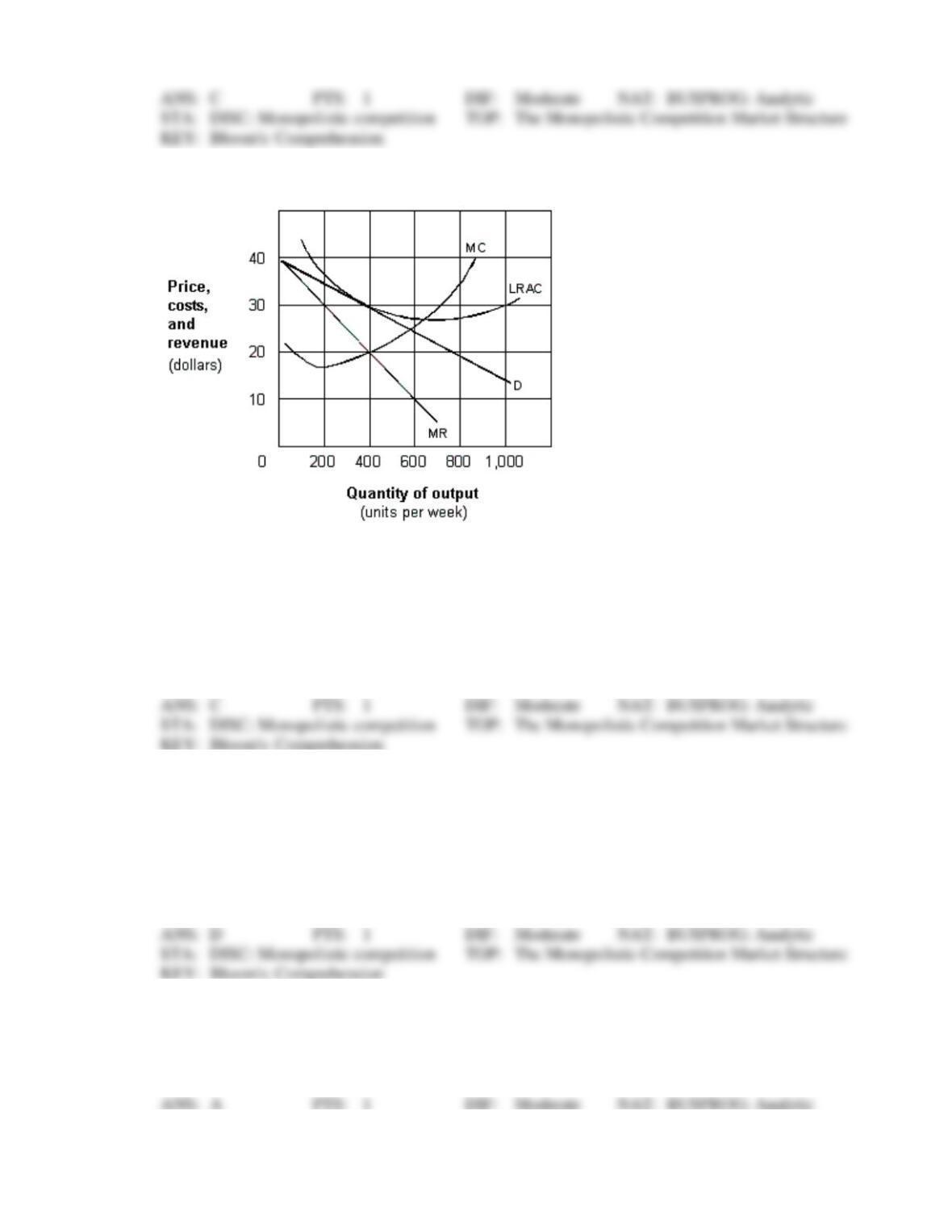
Exhibit 10-3 A monopolistic competitive firm in the long run
70. As presented in Exhibit 10-3, the long-run profit-maximizing output for the monopolistic competitive
firm is:
a.
zero units per week.
b.
200 units per week.
c.
400 units per week.
d.
600 units per week.
e.
800 units per week.
71. To maximize long-run profits, the monopolistically competitive firm shown in Exhibit 10-3 will
charge a price per unit of:
a.
zero.
b.
$10
c.
$20.
d.
$30.
e.
$40.
72. As represented in Exhibit 10-3, the maximum long-run economic profit earned by this monopolistic
competitive firm is:
a.
zero.
c.
$4,000 per week.
b.
$10 per week.
d.
$40,000 per week.
73. If all firms in a monopolistic competitive industry have demand and cost curves like those shown in
Exhibit 10-3, we would expect that in the long run:
a.
a number of new firms will enter the industry.
b.
some firms will leave the industry.
c.
firms in the industry earn zero economic profits.
d.
all firms will leave the industry.
74. A market situation where a small number of sellers dominate the entire industry is called:
a.
monopolistic competition.
c.
monopoly.
b.
monopsony.
d.
oligopoly.
75. Which of the following is always a characteristic of the oligopoly market structure?
a.
Many sellers, each small in size relative to the overall market.
b.
Few sellers.
c.
All sellers produce identical products.
d.
Easy, low-cost entry and exit.
76. One key characteristic that is distinctive of an oligopoly market is that:
a.
the demand curve facing each firm is downward sloping, with a marginal revenue curve
that lies below the firm’s demand curve.
b.
the decisions of one seller often influences the price of products, the output, and the profits
of rival firms.
c.
there is only one firm that produces a product for which there are no good substitutes.
d.
there are many sellers in the market and each is small relative to the total market.
77. The industry that most closely approximates the conditions of the oligopoly model is:
a.
Restaurant.
c.
Home construction.
b.
Retail clothing.
d.
Airlines.
78. An oligopoly is a market structure in which:
a.
one firm has 100 percent of a market.
b.
there are many small firms.
c.
there are many firms with no control over price.
d.
there are few firms selling either a homogeneous or differentiated product.
79. Excluding foreign competition, which of the following is an oligopoly in the United States?
a.
The computer industry.
c.
The steel industry.
b.
The automobile industry.
d.
All of these are oligopolies.
80. In which of the following market structures must the price and output decisions of an individual firm
include the possible price and output reactions of the firm’s rivals?
a.
Monopoly.
c.
Perfect competition.
b.
Oligopoly.
d.
Cartel.
81. A characteristic of an oligopoly is:
a.
mutual interdependence in pricing decisions.
b.
independent pricing decisions.
c.
lack of control over prices.
d.
none of these.
82. Mutual interdependence among firms in an oligopoly means that:
a.
firms never practice price leadership.
b.
firms never form a cartel.
c.
it is difficult to know how firms will react to decisions of rivals.
d.
no formal agreement is possible among firms.
83. A common characteristic of oligopolies is:
a.
interdependence in pricing decisions.
b.
independent pricing decisions.
c.
low industry concentration.
d.
few or no plant-level economies of scale.
84. In an oligopoly industry, price:
a.
will be lower than the competitive price, due to cost savings.
b.
will exceed the monopoly price, due to the destructiveness of competitive forces.
c.
cannot be predicted exactly, because it is likely to lie between the competitive and
monopoly prices.
d.
none of these.
85. A major characteristic of the theory of oligopoly is that:
a.
there are no real-world examples.
b.
the reactions of each firm depends on how the firm believes rivals will react.
c.
in reality few oligopolies survive more than 10 years.
d.
none of these.
86. The automobile, steel, and oil markets are all examples of:
a.
perfectly competitive markets.
b.
monopolies.
c.
monopolistically competitive markets.
d.
oligopolies.
87. What is the key feature shared by all oligopoly markets?
a.
A large number of sellers.
c.
Product differentiation.
b.
Mutual interdependence.
d.
Easy entry and exit.
88. When Pepsi is considering a price hike, it needs to consider how Coke may react. This situation is
called:
a.
mutual interdependence.
c.
collusion.
b.
price leadership.
d.
monopolistic competition.
89. Which of the following is a characteristic of an oligopoly?
a.
Mutual interdependence in pricing decisions.
b.
Independent pricing decisions.
c.
Lack of control over prices.
d.
All of these are true.
90. An oligopoly:
a.
and monopolistically competitive market produce less and charge higher prices than if
their markets were perfectly competitive.
b.
is characterized by mutual interdependence of pricing decisions.
c.
may be characterized by a kinked demand curve.
d.
all of these.
91. Which of the following is the best example of an oligopoly?
a.
Area restaurants.
b.
The automobile industry.
c.
Agricultural markets free of government support.
d.
Local utilities.
92. If a firm has substantial market power, it must be operating in an industry that would be classified as:
a.
a monopoly or oligopoly.
b.
perfectly competitive.
c.
monopolistically competitive.
d.
perfectly competitive or monopolistically competitive.
e.
perfectly competitive or a monopoly.
93. Nonprice competition, price leadership, and cartels are models in the ____ market structure(s).
a.
perfectly competitive
b.
monopolistically competitive
c.
oligopoly
d.
monopoly
e.
perfectly competitive and monopolistically competitive
94. If a firm reacts to other firms’ market decisions by anticipating how the other will then react, this is:
a.
not profit-maximizing behavior
b.
a monopolistic competitive market
c.
a market with a low concentration ratio
d.
mutual interdependence
e.
collusion by definition
95. Which of the following statements is always true with respect to oligopolists?