Chapter 3 Part 1—Market Demand and Supply
MULTIPLE CHOICE
1. In economics, the demand for a good refers to the amount of the good people:
a.
would like to have if the good were free.
b.
are willing to buy at various prices.
c.
need to achieve a minimum standard of living.
d.
will buy at alternative income levels.
2. The law of demand refers to the:
a.
inverse relationship between the price of a good and the willingness of consumers to buy
it.
b.
price increase that results from an increase in demand for a good of limited supply.
c.
inverse relationship between the price of a good and the quantity offered for sale.
d.
increase in the quantity of a good available when its price increases.
3. The law of demand indicates that:
a.
every physical good has a use.
b.
when people want a good badly enough, they will find a way to pay for it.
c.
the desire for a good is unrelated to its price.
d.
the quantity of a good that people will buy is inversely related to the price of the good.
4. The law of demand indicates that as the price of a good increases:
a.
suppliers sell less of it.
c.
buyers buy less of it.
b.
suppliers sell more of it.
d.
buyers buy more of it.
5. Consumers buy less of a good as its price increases because:
a.
production costs have risen.
b.
substitute goods are now relatively cheaper.
c.
the income of consumers has effectively risen.
d.
the higher price will make the good more valuable to each consumer.
6. The law of demand states that:
a.
as the price of a good increases, more units are demanded.
b.
there is a direct relationship between the price of a good and the quantity of the good
produced.
c.
there is a negative relationship between the price of a good and the quantity of the good
demanded.
d.
there is an increase in the need for a good as the price of the good increases.
7. The law of demand states that, ceteris paribus, price and quantity demanded are:
a.
directly related.
c.
uniformly related.
b.
inversely related.
d.
horizontally related.
8. According to the law of demand, when will higher corn prices reduce the quantity demanded of corn?
a.
Always.
b.
When the supply of corn is fixed.
c.
When nonprice determinants, like income and the number of buyers, are unchanged.
d.
When there are no shortages or surpluses of corn.
9. The law of demand is illustrated by a demand curve that is:
a.
horizontal.
c.
vertical.
b.
downward-sloping.
d.
upward-sloping.
10. Which of the following is true for the law of demand?
a.
Sellers increase the quantity of a good available as the price of the good increases.
b.
An increase in price results from false needs.
c.
There is an inverse relationship between the price of a good and the quantity of the good
demanded.
d.
Prices increase as more units of a product are demanded.
11. The “ceteris paribus” clause in the law of demand does not allow which of the following factors to
change?
a.
Consumer tastes and preferences.
c.
Expectations.
b.
The prices of other goods.
d.
All of these.
12. The law of demand says that the lower the price charged for a good, ceteris paribus, the:
a.
greater the quantity demanded per period of time.
b.
greater the demand for the good per period of time.
c.
smaller the demand for the good per period of time.
d.
smaller the quantity demanded per period of time.
e.
larger the supply of the good per period of time.
13. The fact that price and quantity demanded are related negatively illustrates the:
a.
law of supply.
b.
law of quantity supply.
c.
law of demand.
d.
law of quantity demanded.
e.
point that some facts are unobservable.
14. The “other things being equal” clause in the law of demand does not allow which of the following
factors to change?
a.
Consumer income.
c.
Consumer tastes and preferences.
b.
The prices of other goods.
d.
All of these.
15. According to the law of demand, if:
a.
product price increases, quantity demanded will decrease.
b.
consumer income increases, quantity demanded will increase.
c.
product price increases, quantity demanded will increase.
d.
consumer income increases, quantity demanded will decrease.
e.
supply increases, demand will increase.
16. The law of demand is graphically demonstrated by a(n):
a.
perfectly vertical demand curve.
b.
perfectly horizontal demand curve.
c.
downward-sloping demand curve.
d.
upward-sloping demand curve.
e.
curved demand line.
17. The law of demand shows that:
a.
there is an inverse relationship between price and quantity demanded.
b.
the demand curve is positively sloped.
c.
when the price of a good increases, the quantity demanded increases.
d.
the supply curve is vertical.
e.
individual demand is the same as market demand.
18. Which of the following is closest to the definition of demand?
a.
People’s willingness to supply goods at specific prices.
b.
People’s willingness to buy goods and services at given prices.
c.
People’s expectations of lower prices of goods and services.
d.
Producer’s expectations of selling more goods.
e.
The interaction of people’s willingness to buy and sell goods.
19. The demand schedule for a good shows:
a.
the specific quantity of the good that people are willing and able to sell at different prices.
b.
the positive relationship between the price and the quantity of the good.
c.
no relationship between the price and the quantity of the good.
d.
the specific quantity of the good that people are willing and able to buy at different prices.
e.
the quantity of the good that is sold in the market.
20. The negative slope of the demand curve reflects the:
a.
positive relationship between price and quantity.
b.
proportional relationship between price and quantity.
c.
inverse relationship between price and quantity.
d.
positive relationship between income and quantity.
e.
inverse relationship between income and price.
21. A decrease in quantity demanded is given by a(n):
a.
downward shift of the demand curve.
b.
upward shift of the demand curve.
c.
downward movement to the right along the demand curve.
d.
upward movement to the left along the demand curve.
e.
downward shift of both demand and supply curves.
22. An increase in the quantity demanded of a good is most often due to:
a.
current prices.
b.
higher prices.
c.
higher income.
d.
lower prices.
e.
technological change.
23. Demand curves are negatively sloped when people buy:
a.
less as the price decreases.
b.
more as the price increases.
c.
the same amount as the price changes.
d.
more as the price decreases.
e.
less as incomes decrease.
24. The law of demand refers to the:
a.
tendency of prices to increase as more units of a product are demanded.
b.
increase in price that results from an increase in demand for a good with a limited supply.
c.
inverse relationship between the price of a good and the quantity of the good demanded.
d.
increase in the quantity of a good available as the price of the good increases.
25. The curve that shows the relationship between the price of a good and the quantity that consumers are
willing to purchase at each price is the
a.
supply curve.
c.
production possibilities curve.
b.
demand curve.
d.
consumption curve.
26. A demand curve for The Steel Porcupines’ concert tickets would show the:
a.
number of tickets the box office is willing to sell at various prices.
b.
number of people who need tickets.
c.
quality of people who want to buy these concert tickets.
d.
number of tickets that will be purchased at various prices.
27. A demand curve for The Steel Porcupines’ concert tickets would show the:
a.
quality of service that customers demand when they buy a ticket.
b.
number of people who like to attend the concert.
c.
number of tickets the promoters are willing to sell at each price.
d.
number of concert tickets that will be purchased at each price.
28. A demand curve shows the relationship between:
a.
price and quantity demanded.
b.
the demand and supply schedules.
c.
demand and supply equilibrium.
d.
leakages and injections.
e.
price and technology.
29. A demand curve:
a.
has a positive slope.
b.
illustrates the negative relationship between price and quantity demanded.
c.
illustrates the positive relationship between price and quantity demanded.
d.
is based on the assumption of a stable supply curve.
e.
shifts about in a random fashion.
30. The horizontal summation of individual demand curves gives:
a.
a supply curve.
b.
a Phillips curve.
c.
a market demand curve.
d.
the quantity supplied.
e.
a production function.
31. A market demand curve:
a.
is the sum of the demand curves of all the individuals in a particular market.
b.
is determined by the demand of those who purchase in quantity.
c.
is always horizontal.
d.
cannot be estimated.
e.
never includes demand by the government.
32. Which of the following can bring about a change in the quantity demanded?
a.
Change in supply.
b.
Change in quality.
c.
Change in income.
d.
Change in product price.
e.
Change in taste.
33. At a price of $5, Sam buys 10 units of a product; when the price increases to $6, Sam buys 8 units.
Martha says Sam’s demand has decreased. Is Martha correct?
a.
Yes, Martha is correct. Sam‘s demand has decreased.
b.
No, Martha is incorrect. Sam’s demand has increased.
c.
No, Martha is incorrect. Sam’s quantity demanded has decreased, and his demand has not
changed.
d.
No, Martha is incorrect. Sam’s quantity demanded has increased, and his demand has
increased.
e.
No, Martha is incorrect. Sam’s demand has increased, and his quantity demanded has
decreased.
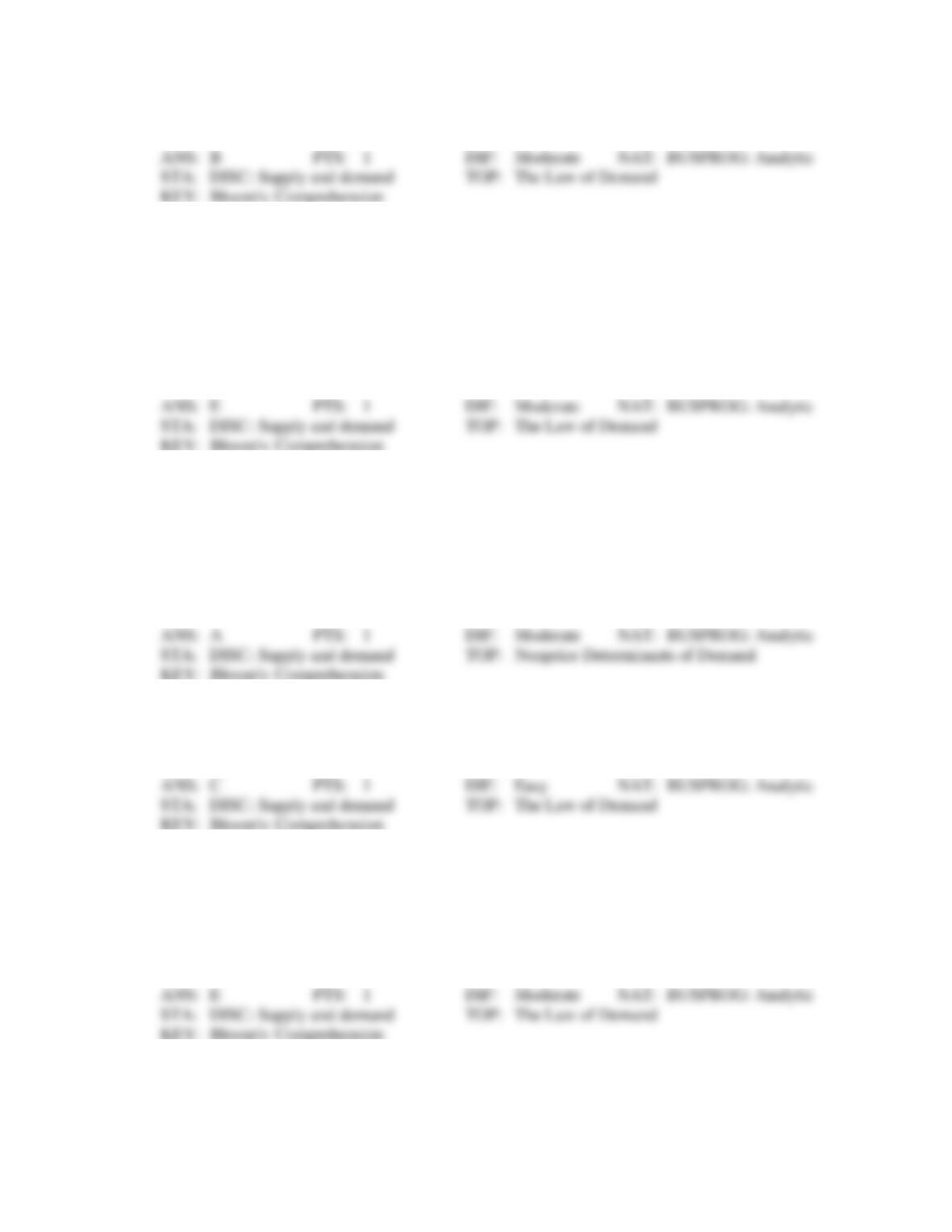
Exhibit 3-1 Market Demand
34. Suppose there are only three people in the economy: Jane, Harry, and Bob. The individual demand for
corn for each of these consumers is given in Exhibit 3-1. The total quantity demanded of corn if the
market price is $5 is ____.
a.
3
b.
25
c.
17
d.
8
e.
26
35. Suppose there are only three people in the economy: Jane, Harry, and Bob. The individual demand for
corn for each of these consumers is given in Exhibit 3-1. The total quantity demanded of corn if the
market price is $4 is ____.
a.
3
b.
25
c.
17
d.
8
e.
36
36. In Exhibit 3-2, which of the following could not have caused the shift in the demand curve from
D1 to D2?
a.
Decrease in the number of consumers.
b.
Increase in expected future prices.
c.
Increase in the price of a substitute.
d.
Decrease in the price of a complement.
e.
Increase in income.
37. A curve that depicts the relationship between price and quantity demanded is the:
a.
supply curve.
c.
demand curve.
b.
supply schedule.
d.
equilibrium price.
38. We can find the market demand for pears by:
a.
adding up all the prices people are willing to pay for pears.
b.
multiplying the number of people times the price of pears.
c.
adding up the number of pears that producers are willing to sell.
d.
multiplying the number of pears by the price of pears.
e.
adding up all the individual demand curves for pears.
39. Suppose there are 100 consumers with identical individual demand curves. When the price of a movie
ticket is $8, the quantity demanded for each person is 5. When the price is $4, the quantity demanded
for each person is 9. Assuming the law of demand holds, which of the following choices is the most
likely quantity demanded in the market when the price is $6?
a.
700
b.
1,200
c.
400
d.
1,000
e.
100
40. The market demand is the:
a.
sum of all individual demand curves in a market.
b.
sum of all individual prices in a market.
c.
sum of all individual demand curves and supplies in a market.
d.
vertical sum of all individual demand curves.
41. The horizontal summation of all individual demands at different given prices results in the:
a.
market supply curve.
b.
individual supply curve.
c.
individual demand curve.
d.
equilibrium demand and supply curves.
e.
market demand curve.
42. When economists say the quantity demanded of a product has increased, they mean the:
a.
demand curve has shifted to the left.
b.
demand curve has shifted to the right.
c.
price of the product has fallen, and consequently, consumers are buying more of it.
d.
price of the product has risen, and consequently, consumers are buying less of it.
43. Which of the following is least likely to increase the demand for new tires?
a.
a decrease in the price of tires
b.
a decrease in the price of cars
c.
an increase in consumer income
d.
an increase in the number of miles people drive per year
44. A movement along a demand curve is called a change in:
a.
income.
b.
quantity demanded.
c.
demand.
d.
tastes.
e.
population.
45. Ceteris paribus, a change in the price of a good always results in a change in:
a.
income.
b.
tastes.
c.
quantity demanded.
d.
both income and tastes.
e.
the price of other goods.
46. A movement along the demand curve for automobiles is caused by a change in:
a.
the price of automobiles.
c.
the price of steel.
b.
the price of gasoline.
d.
consumers’ incomes.
47. Other things being equal, the effect of an increase in the price of Coca-Cola would cause a(n):
a.
upward movement along the demand curve for Coca-Cola.
b.
leftward shift in the demand curve for Coca-Cola.
c.
downward movement along the demand curve for Coca-Cola.
d.
rightward shift in the demand curve for Coca-Cola.
48. Other things being equal, the effect of a decrease in the price of Coca-Cola would cause which of the
following?
a.
A rightward shift in the demand curve for Coca-Cola.
b.
A downward movement along the demand curve for Coca-Cola.
c.
A leftward shift in the demand curve for Coca-Cola.
d.
An upward movement along the demand curve for Coca-Cola.
49. Which of the following would not cause market demand for a normal good to decline?
a.
An increase in the price of a substitute.
b.
An increase in the price of a complement.
c.
A decline in consumer income.
d.
Consumer expectations that the good will go on sale in the near future.
e.
An announcement by the Surgeon General that the product contributes to premature death.
50. A fall in the price of a good causes an increase in its:
a.
quantity demanded.
c.
quantity supplied.
b.
demand.
d.
supply.
51. Other things being equal, the effects of an increase in the price of computers would best be represented
by which of the following?
a.
A movement up along the demand curve for computers.
b.
A movement down along the demand curve for computers.
c.
A leftward shift in the demand curve for computers.
d.
A rightward shift in the demand curve for computers.
52. Which of the following best represents the effects of a decrease in the price of tomato juice, other
things being equal?
a.
An upward movement along the demand curve for tomato juice.
b.
A downward movement along the demand curve for tomato juice.
c.
A rightward shift in the demand curve for tomato juice.
d.
A leftward shift in the demand curve for tomato juice.
53. Other things being equal, the effects of an increase in the price of orange juice would best be
represented by a(n):
a.
upward movement along the demand curve for orange juice.
b.
leftward shift in the demand curve for orange juice.
c.
downward movement along the demand curve for orange juice.
d.
rightward shift in the demand curve for orange juice.
54. Which of the following best represents the effects of a decrease in the price of coffee, other things
being equal?
a.
A leftward shift in the demand curve for coffee.
b.
A downward movement along the demand curve for coffee.
c.
A rightward shift in the demand curve for coffee.
d.
An upward movement along the demand curve for coffee.
55. Which of the following best represents the effects of an increase in the price of coffee, other things
being equal?
a.
A leftward shift in the demand curve for coffee.
b.
A downward movement along the demand curve for coffee.
c.
A rightward shift in the demand curve for coffee.
d.
An upward movement along the demand curve for coffee.
56. A rightward shift in the demand curve is called a(an):
a.
decrease in output.
b.
decrease in demand.
c.
increase in demand.
d.
increase in income.
57. A decrease in the price of coffee, other things being equal, causes a(n):
a.
leftward shift in the demand curve for coffee.
b.
downward movement along the demand curve for coffee.
c.
rightward shift in the demand curve for coffee.
d.
upward movement along the demand curve for coffee.
58. Other things being equal, the effects of a decrease in the price of orange juice, is represented by which
of the following?
a.
A rightward shift in the demand curve for orange juice.
b.
An increase in the quantity demanded for orange juice.
c.
A leftward shift in the demand curve for orange juice.
d.
A decrease in the quantity demanded orange juice.
59. When economists say the demand for a product has increased, they mean the:
a.
demand curve has shifted to the right.
b.
price of the product has fallen, and consequently, consumers are buying more of it.
c.
cost of producing the product has risen.
d.
amount of the product that consumers are willing to purchase at various prices has
decreased.
60. Suppose the prices of petroleum products, including gasoline and fuel oil, fell sharply. Which of the
following would most likely occur as the result of the lower prices of petroleum products?
a.
A reduction in the consumption of gasoline.
b.
An increase in demand for solar heating systems.
c.
An increase in demand for smaller, more efficient automobiles.
d.
A reduction in the demand for home insulation products.
61. Which of the following would most likely cause the demand for veggi burgers to increase?
a.
A decline in the price of veggie burger.
b.
An increase in the price of tofu burgers, perceived as a substitute by veggie burger
consumers.
c.
An increase in the price of burger buns.
d.
A technological innovation that lowers the cost of producing veggie burgers.
62. An increase in the expected future price of a good will cause the current demand for the good to:
a.
decrease, which is a shift to the left of the demand curve.
b.
decrease, which is a shift to the right of the demand curve.
c.
increase, which is a shift to the left of the demand curve.
d.
increase, which is a shift to the right of the demand curve.
63. Suppose all of the major computer manufacturers announced that beginning next month there would
be major price reductions on their computers. This would cause the current demand for computers to:
a.
increase.
c.
remain unchanged.
b.
decrease.
d.
increase and then decrease.
64. Which of the following is most likely to shift the demand curve for electricity to the left?
a.
consumers becoming more energy conscious.
b.
an increase in income.
c.
a decrease in the price of electricity.
d.
an increase in the price of natural gas, a substitute source of energy.
65. Which of the following will not cause a shift in the demand curve for good X?
a.
A change in the price of a complementary good.
b.
A change in the price of good X.
c.
A change in consumer tastes and preferences for good X.
d.
An increase in consumer income.
66. An increase in the demand for a good means that:
a.
the demand curve has shifted to the left.
b.
the good’s price has fallen and, as a result, consumers are buying more of the good.
c.
the good has become scarce.
d.
consumers are willing to purchase more of the good at each possible price.
67. Which of the following will increase the demand for motorcycles?
a.
A fall in the price of motorcycles.
b.
A fall in insurance rates for motorcycles.
c.
A fall in the price of automobiles.
d.
A fall in buyers’ incomes (assuming motorcycles are a normal good).
e.
A fall in consumer preference for motorcycles.
68. Which of the following would shift the demand curve for autos to the right?
a.
A fall in the price of autos.
c.
A fall in consumers’ incomes.
b.
A fall in the price of auto insurance.
d.
A fall in the price of steel.
69. In economic terms, to say that there has been an increase in demand for a product means that:
a.
the demand curve has shifted to the left.
b.
the product’s price has fallen and as a result consumers are buying a larger quantity of the
product.
c.
the product has become scarce for some reason.
d.
consumers are now willing to purchase more of the product at each possible price.
70. An increase in demand:
a.
results in a leftward shift of the demand curve.
b.
could be caused by a decrease in the price of the good.
c.
could be caused by an increase in the price of a substitute good.
d.
is shown as movement down along a demand curve.
71. Which of the following would cause a shift in the demand curve for a good?
a.
An increase in consumers’ income.
b.
A decrease in the number of consumers.
c.
The expectation that the price of a good will increase in the future.
d.
All of these.
72. Three of the four events described below might reasonably be expected to shift the demand curve for
beef to a new position. One would not shift that demand curve. The single exception is a(n):
a.
change in people’s tastes for beef.
b.
increase in the money incomes of beef consumers.
c.
fall in the price of beef.
d.
change in the price of a product competitive with beef (e.g. pork).
73. Which of the following will not shift the demand curve for televisions?
a.
An increase in the price of televisions.
b.
An increase in consumer income.
c.
An increase in the price of radios (a substitute).
d.
An increase in the price of cable service (a complement).
74. When firms advertise their products, they are attempting to:
a.
shift the supply curve of the product to the right.
b.
shift the supply curve of the product to the left.
c.
shift the demand for the product to the right.
d.
shift the demand for the product to the left.
e.
create a surplus of the product.
75. If consumer tastes are changing more in favor of the consumption of a particular good the:
a.
market demand curve will shift to the left.
b.
consumer will move up a given demand curve, decreasing the quantity demanded.
c.
consumer would move down a given demand curve, decreasing the quantity demanded.
d.
consumer would move down a given demand curve, increasing the quantity demanded.
e.
market demand curve would shift to the right.
76. Which of the following will not cause a change in demand for crackers?
a.
A change in consumers’ income.
b.
A change in the price of crackers.
c.
A change in the price of cheese.
d.
A change in the number of cracker-eaters.
e.
A change in consumers’ tastes for crackers.
77. If people expect the price of packaged coffee to rise next week, coffee demand will:
a.
decrease now.
b.
increase now.
c.
stay the same now and increase next week.
d.
stay the same now and decrease next week.
e.
stay the same now and next week.
78. A baby boom will have what immediate effect on the disposable diaper market?
a.
Supply decreases.
b.
Supply increases.
c.
Demand decreases.
d.
Demand increases.
e.
Supply and demand remains the same.
79. A rightward shift of a demand curve is called a(n):
a.
increase in demand.
b.
decrease in demand.
c.
increase in quantity demanded.
d.
decrease in quantity demanded.
e.
increase in supply.
80. A change in demand cannot be caused by a change in:
a.
tastes.
b.
population.
c.
the prices of other goods.
d.
expectations of future prices.
e.
the price of the good itself.
81. If income increases, then with regard to expensive cuts of steak, it is likely that the demand curve:
a.
shifts to the right.
b.
shifts to the left.
c.
becomes steeper.
d.
does not change.
e.
becomes flatter.
82. Which of the following is true if the price of coffee increases?
a.
The demand for tea, a substitute good, will decrease.
b.
The demand for coffee will increase.
c.
The demand for coffee and tea will decrease.
d.
Both the demand for coffee and tea will increase.
e.
The demand for tea, a substitute good, will increase.
83. Three of the four events described below might reasonably be expected to shift the demand curve for
Tacos to a new position. One would not shift the demand curve. The single exception is:
a.
a change in people’s tastes with respect to Tacos.
b.
an increase in the money income of beef consumers.
c.
a widespread advertising campaign undertaken by the producers of a product competitive
with Tacos.
d.
a fall in the price of Tacos.
84. Which of the following will not shift the demand curve for grapefruit?
a.
An announcement that eating a grapefruit before every meal will induce weight loss.
b.
A technical development that allows machines to replace the workers who harvest
grapefruit.
c.
An announcement that eating lots of grapefruit causes skin problems.
d.
A newspaper story reporting that the preference for oranges has skyrocketed.
e.
An announcement that grapefruit will definitely cost more next week.
85. An increase in the demand for a product means that the:
a.
demand curve shifts to the left.
b.
demand curve shifts to the right.
c.
supply curve shifts to the right.
d.
supply curve shifts to the left.
e.
quantity supplied has increased.
86. Which of the following would most likely not cause market demand for a normal good to decline?
a.
An increase in the price of a substitute.
b.
An increase in the price of a complement.
c.
A decline in consumer income.
d.
Consumer expectations that the good will go on sale in the near future.
e.
An announcement by the Surgeon General that the product contributes to premature
.death.
87. Ceteris paribus, which of the following would cause a decrease in the demand for HD TVs?
a.
decline in the price of HD TVs.
c.
increase in consumers’ income.
b.
increase in the price of HD TVs.
d.
decrease in consumers’ income.
Exhibit 3-2 Demand curves
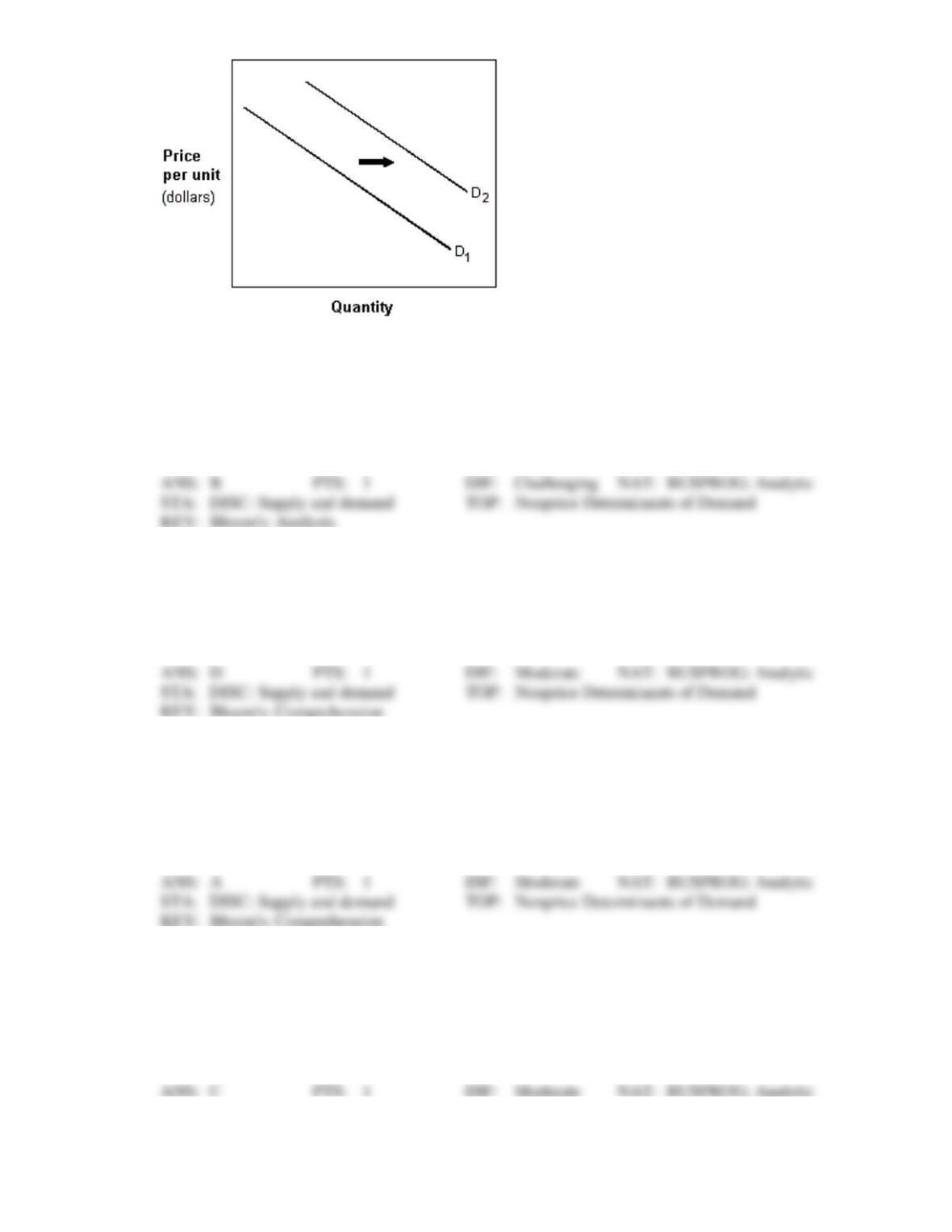
88. In Exhibit 3-2, the shift in the demand curve from D1 to D2 could have been caused by which of the
following?
a.
Decrease in price.
b.
Increase in expected future prices.
c.
Increase in the price of a complement.
d.
Decrease in income if it is a normal good.
89. For a normal good, an increase in consumer income will cause the market demand for the product to:
a.
decrease, which is a shift to the left of the demand curve.
b.
decrease, which is a shift to the right of the demand curve.
c.
increase, which is a shift to the left of the demand curve.
d.
increase, which is a shift to the right of the demand curve.
90. Assuming that dry cleaning is a normal good, an increase in consumer income, other things being
equal, will:
a.
increase the demand for dry cleaning.
b.
decrease the demand for dry cleaning.
c.
increase the quantity demanded of dry cleaning.
d.
decrease the quantity of dry cleaning demanded.
91. Assuming that travel from New York to Los Angeles is a normal good, a decrease in consumer
income, other things being equal, will:
a.
decrease the quantity demanded of travel to Los Angeles.
b.
increase the demand for travel to Los Angeles.
c.
decrease the demand for travel to Los Angeles.
d.
increase the quantity of travel to Los Angeles demanded.
92. Assuming that automobiles are normal goods, a rise in consumer income, other things being equal,
will cause:
a.
the demand curve for automobiles to shift to the left.
b.
the demand curve for automobiles to shift to the right.
c.
a downward movement along the demand curve for automobiles.
d.
an upward movement along the demand curve for automobiles.
93. Assuming that wine is a normal good, an increase in consumer income, other things being equal, will:
a.
cause an upward movement along the demand curve for wine.
b.
shift the demand curve for wine to the left.
c.
cause a downward movement along the demand curve for wine.
d.
shift the demand curve for wine to the right.
94. If X is a normal good, a rise in consumer income will shift the:
a.
demand curve for X to the right.
c.
supply curve for X to the right.
b.
demand curve for X to the left.
d.
supply curve for X to the left.
95. If the demand for a good increases because consumer income increases, the good is a(n):
a.
inferior good.
c.
necessity good.
b.
normal good.
d.
luxury good.
96. Assume that a computer is a normal good. An increase in consumer income, other things being equal,
would:
a.
cause an upward movement along the demand curve for computers.
b.
cause a downward movement along the demand curve for computers.
c.
shift the demand curve for computers to the left.
d.
shift the demand curve for computers to the right.
97. Which of the following will increase the demand for large automobiles?
a.
A fall in the price of small automobiles.
b.
A rise in insurance rates for large automobiles.
c.
A fall in the price of large automobiles.