Chapter 5 Part 1—Price Elasticity of Demand and Supply
MULTIPLE CHOICE
1. Suppose that a jewelry store found that when it increased prices by 10 percent, sales revenue increased
by 3 percent. Which of the following is true about the price elasticity of demand for the store’s goods?
a.
Demand is perfectly inelastic.
b.
Demand is inelastic, but not perfectly.
c.
Demand is unitary classic.
d.
Demand is elastic, but not perfectly.
e.
Demand is perfectly elastic.
2. Suppose an increase in symphony tickets prices reduces the total revenue. This is evidence that
demand is:
a.
price elastic.
b.
price inelastic.
c.
unitary elastic.
d.
perfectly elastic.
3. Suppose the Pleasant Corporation cuts the price of its American Girl dolls by 10 percent, and as a
result, the quantity of the dolls sold increases by 25 percent. This indicates that the price elasticity of
demand for the dolls over this range is:
a.
2.5.
c.
0.5.
b.
0.4.
d.
5.0.
4. An increase in total revenue results occurs from which of the following?
a.
Price decreases when demand is inelastic.
b.
Price increases when demand is elastic.
c.
Price decreases when demand is elastic.
d.
Price increases when demand is unitary elastic.
5. Suppose that Starbucks reduces the price of its premium coffee from $2.20 to $1.80 per cup, and as a
result, the quantity sold per day increased from 350 to 450. Over this price range, the price elasticity of
demand for Starbucks coffee is:
a.
0.40.
c.
1.25.
b.
0.80.
d.
2.50.
6. Suppose you are the manager of a local water company, and you are instructed to get consumers to
reduce their water consumption by 10 percent. If the price elasticity of demand for water is 0.25, by
how much would you have to raise the price of water?
a.
10 percent
c.
40 percent
b.
25 percent
d.
100 percent
7. If the quantity demanded increases by 20 percent in response to a 10 percent decrease in price, demand
is classified as:
a.
unstable.
c.
relatively elastic.
b.
relatively inelastic.
d.
of unitary elasticity.
8. A local Krispy Kreme doughnut shop reduced the price of its doughnuts from $4 per dozen to $3.50
per dozen, and as a result, the daily sales increased from 300 to 400 dozen. This indicates that the price
elasticity of demand for the doughnuts was:
a.
elastic.
b.
inelastic.
c.
of unitary elasticity.
d.
indeterminate; more information is needed to determine the price elasticity of demand.
9. If a demand curve for a good were completely vertical, it would be considered:
a.
perfectly elastic.
c.
of unitary elasticity.
b.
perfectly inelastic.
d.
relatively inelastic.
10. If the demand for cigarettes is highly inelastic, this indicates that:
a.
higher cigarette prices will increase the demand for cigarettes.
b.
the price elasticity coefficient of cigarettes exceeds 1.
c.
the price elasticity coefficient of cigarettes equals 1.
d.
the quantity of cigarettes purchased by consumers is not very responsive to a change in the
price of cigarettes.
11. The price elasticity of demand for gasoline measures the:
a.
responsiveness of gasoline producers to changes in the quality of gasoline.
b.
responsiveness of customers to changes in the price of gasoline.
c.
responsiveness of consumer preferences to changes in the quality of gasoline.
d.
both a and c above.
12. When demand is price inelastic:
a.
price and total revenue move in the same direction.
b.
price and total revenue move in the opposite direction.
c.
total revenue increases whether price goes up or down.
d.
total revenue decreases whether price goes up or down.
13. If demand is inelastic, an increase in the price of a good will cause total revenue to:
a.
fall.
b.
remain constant since the decrease in quantity sold is exactly offset by the price increase.
c.
rise.
d.
rise if it is a normal good and fall if it is an inferior good.
14. Price elasticity of demand refers to the ratio of the:
a.
percentage change in price of a good in response to a percentage change in quantity
demanded.
b.
percentage change in price of a good to a percentage increase in income.
c.
percentage change in the quantity demanded of a good to a percentage change in its price.
d.
none of these.
15. Price elasticity of demand is defined as the ratio of the:
a.
percentage increase in price to an increase in quantity demanded.
b.
unit change in quantity demanded to the dollar change in price.
c.
maximum amount that consumers will pay to increase quantity.
d.
percentage change in quantity demanded to the percentage change in price, other things
being equal.
16. Price elasticity of demand refers to the:
a.
percentage increase in price in response to a percentage increase in quantity demanded.
b.
percentage decrease in price in response to a percentage increase in income.
c.
minimum amount that consumers will pay for a percentage change in quantity demanded
or supplied.
d.
responsiveness of quantity demanded to a change in the price of a good.
17. If demand is price elastic, a decrease in price causes:
a.
an increase in total revenue.
b.
a decrease in total revenue.
c.
no change in total revenue.
d.
an increase in quantity, but anything can happen to revenue.
18. If a decrease in the price of movie tickets increases the total revenue of movie theaters, this is evidence
that demand is:
a.
price elastic.
c.
unit elastic with respect to price.
b.
price inelastic.
d.
perfectly inelastic.
19. A perfectly elastic demand curve has an elasticity coefficient of:
a.
0.
c.
less than 1.
b.
1.
d.
infinity.
20. Over the elastic portion of a demand curve, a decrease in price causes:
a.
an increase in total revenue.
b.
a decrease in total revenue.
c.
no change in total revenue.
d.
an increase in quantity demanded, but anything can happen to revenue.
21. Using the midpoints formula, what would be price elasticity of demand for a gallbladder operation if
the number of operations fell from 6,000 to 4,000 per week after its price increased from $6,000 to
$10,000?
a.
0.25.
c.
0.80.
b.
0.50.
d.
1.25
22. If the percentage change in the quantity demanded of a good is less than the percentage change in
price, price elasticity of demand is:
a.
elastic.
c.
perfectly inelastic.
b.
inelastic.
d.
unitary elastic.
23. If the percentage change in the quantity demanded of a good is greater than the percentage change in
price, price elasticity of demand is:
a.
elastic.
c.
perfectly inelastic.
b.
inelastic.
d.
perfectly elastic.
24. If the percentage change in the quantity demanded of a good equals the percentage change in price,
price elasticity of demand is:
a.
elastic.
c.
perfectly elastic.
b.
inelastic.
d.
unitary elastic.
25. Along the elastic range of a demand curve, a decrease in price causes:
a.
no change in total revenue.
b.
a decrease in total revenue.
c.
an increase in total revenue.
d.
an unpredictable change in total revenue.
26. If a decrease in the price of theater tickets increases the total revenue earned by the theater, this is
evidence that demand is:
a.
price elastic.
c.
unitary elastic.
b.
price inelastic.
d.
perfectly inelastic.
27. Along the elastic range of a demand curve, a price change causes:
a.
a change in total revenue in the opposite direction.
b.
a change in total revenue in the same direction.
c.
no change in total revenue.
d.
an unpredictable change in the total revenue.
28. Suppose the president of a college argues that a 25 percent tuition increase will raise revenues for the
college. It can be concluded that the president thinks that demand to attend this college is:
a.
elastic.
c.
unitary elastic.
b.
inelastic, but not perfectly inelastic.
d.
perfectly elastic.
29. Suppose Good Food’s supermarket raises the price of its steak and finds its total revenue from steak
sales does not change. This is evidence that price elasticity of demand for steak is:
a.
perfectly elastic.
b.
perfectly inelastic.
c.
unitary elastic.
d.
inelastic.
e.
elastic.
30. The price elasticity of demand for a vertical demand curve is:
a.
perfectly elastic.
b.
perfectly inelastic.
c.
unitary elastic.
d.
elastic.
e.
inelastic.
31. The president of Tucker Motors says, “Lowering the price won’t sell a single additional Tucker car.”
The president believes that the price elasticity of demand is:
a.
perfectly elastic.
b.
perfectly inelastic.
c.
unitary elastic.
d.
elastic.
e.
inelastic.
32. If the price elasticity of demand is computed for two products, and product A measures .79, and
product B measures 1.6, then:
a.
product A is more price elastic than product B.
b.
product B is more price elastic than product A.
c.
consumers are more sensitive to price changes in product A than in product B.
d.
product B is more price inelastic than product A.
e.
products A and B must be substitutes.
33. Demand price elasticity measures:
a.
how much supply will change as price changes.
b.
how consumers change their purchases in response to a change in income.
c.
how consumers change their purchases in response to a change in the price of a substitute
good.
d.
how consumers change their purchases in response to a change in the price of a product.
e.
the change in price brought about by a change in consumer demand.
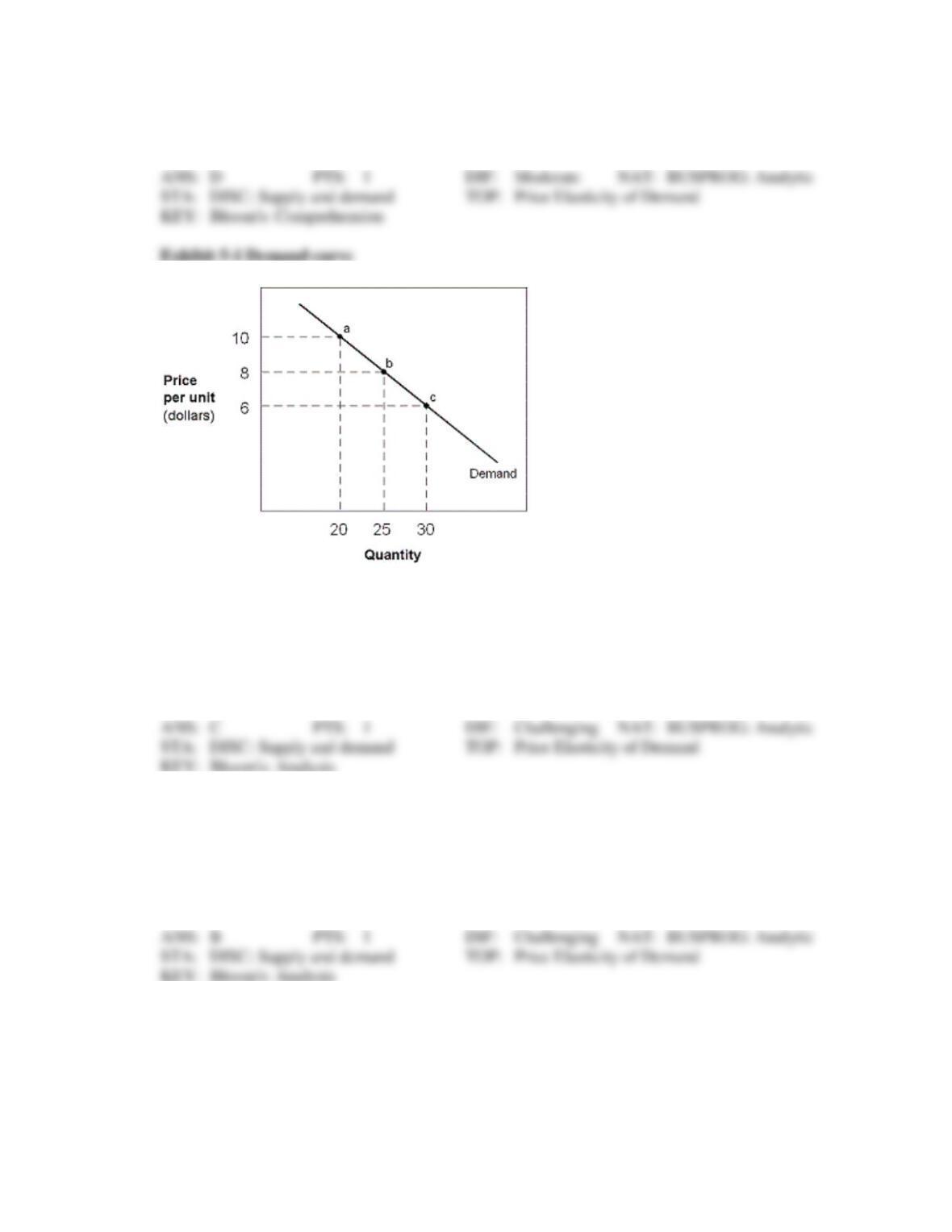
34. In Exhibit 5-1, the demand curve between points a and b is:
a.
price elastic.
b.
price inelastic.
c.
unit elastic.
d.
perfectly elastic.
e.
perfectly inelastic.
35. In Exhibit 5-1, the demand curve between points b and c is:
a.
price elastic.
b.
price inelastic.
c.
unit elastic.
d.
perfectly elastic.
e.
perfectly inelastic.
36. In Exhibit 5-1, between points a and b, the price elasticity of demand measures:
a.
0.67.
b.
1.5.
c.
2.0.
d.
1.56.
e.
1.0.
37. In Exhibit 5-1, between points b and c, the price elasticity of demand measures
a.
4.27.
b.
1.5.
c.
1.56.
d.
0.636.
e.
0.425.
38. If demand price elasticity measures 2, this implies that consumers would:
a.
buy twice as much of the product if the price drops 10 percent.
b.
require a 2 percent drop in price to increase their purchases by 1 percent.
c.
buy 2 percent more of the product in response to a 1 percent drop in price.
d.
require at least a $2 increase in price before showing any response to the price increase.
e.
buy twice as much of the product if the price drops 1 percent.
39. If the demand curve over a certain range is “price elastic,” this implies that the:
a.
percentage change in the quantity demanded exceeds one.
b.
percentage change in the quantity demanded exceeds the percentage change in product
price.
c.
percentage change in price exceeds the percentage change in quantity demanded.
d.
product is non-reactive.
e.
product has no good substitute.
40. If the demand curve is unit elastic, this implies that:
a.
consumers do not react to a change in product price.
b.
the good can only be purchased in units of 1.
c.
this good has no good substitutes.
d.
the good is a basic food staple.
e.
the percentage change in the quantity demanded = the percentage change in product price.
41. Which of the statements below does not describe a demand curve that is unit elastic?
a.
The percentage change in the quantity demanded = percentage change in product price.
b.
An increase in product price will not change total revenue.
c.
The price elasticity of demand equals one.
d.
A change in price does not change quantity demanded.
e.
A decrease in product price will not change total revenue.
42. Demand price elasticity is measured by the:
a.
percentage change in income / percentage change in price.
b.
percentage change in quantity demanded / percentage change in income.
c.
percentage change in price / percentage change in quantity demanded.
d.
percentage change in quantity demanded / percent change in price.
e.
percentage change in total revenue / percentage change in price.
43. If Sam, the Pizza Man, lowers the price of his pizzas from $6 to $5 and finds that sales increase from
400 to 600 pizzas per week, then the demand for Sam’s pizzas in this range is:
a.
price inelastic.
b.
price elastic.
c.
unit elastic.
d.
cross elastic.
e.
income inelastic.
44. If Herbert, the hair stylist, raises the price of his cuts from $13 to $15 and finds the number of cuts
falls from 300 to 260, then the demand for Herbert’s cuts in this range is:
a.
price inelastic.
b.
price elastic.
c.
unit elastic.
d.
cross elastic.
e.
income inelastic.
45. If a 10 percent cut in price causes a 15 percent increase in sales, then:
a.
total revenue will decrease.
b.
demand is price inelastic in this range.
c.
demand is price elastic in this range.
d.
demand is unit elastic in this range.
e.
total revenue will remain the same.
46. If Pete raises his price of muffins from $2 to $3 and his sales revenue increases from $35,000 to
$38,000, then:
a.
the demand for Pete’s muffins in this range is price elastic.
b.
the demand for Pete’s muffins in this range is price inelastic.
c.
the demand for Pete’s muffins in this range is unit elastic.
d.
the percentage change in quantity demanded must exceed the percentage change in
product price.
e.
this is impossible since this would violate the law of demand.
47. You are part of a local community theater group. It is the goal of the group to increase the amount of
revenue earned through ticket sales. Mary says the obvious solution is to increase ticket prices. Is
Mary correct?
a.
Mary is correct if the demand for tickets is price inelastic.
b.
Mary is incorrect if the demand for tickets is price inelastic.
c.
Mary is correct. The increase in ticket prices will always increase revenue.
d.
Mary is incorrect. The increase in ticket prices will never increase revenue.
e.
Mary is incorrect. The way to increase revenue is to decrease ticket prices.
48. Elasticity measures how “sensitive” consumers are by measuring their change in ____ as the price of
the product changes.
a.
attitude
b.
income
c.
quantity demanded
d.
supply
e.
taxes
49. If the price elasticity of demand for a product measures .45,
a.
this good has many available substitutes.
b.
this good must be a nonessential good.
c.
this good is a high-priced good.
d.
a decrease in price will increase total revenue.
e.
this good is demand price inelastic.
50. If a straight-line demand curve slopes down, price elasticity will:
a.
remain the same at all points on the demand curve.
b.
change between any two points along the demand curve.
c.
always be greater than one.
d.
always equal one.
e.
always be less than one.
51. As one moves down a straight-line, down-sloping demand curve, price elasticity will:
a.
change from elastic, to unit elastic, then to inelastic.
b.
remain the same between any two points.
c.
change from inelastic, to elastic, then to unit elastic.
d.
change from unit elastic, to elastic, then to inelastic.
e.
change from elastic, to inelastic, then to unit elastic.
52. Since it is always a negative number, economists use the convention of taking the absolute value of:
a.
income elasticity of demand.
b.
cross price elasticity of demand.
c.
price elasticity of supply.
d.
price elasticity of demand.
e.
any elasticity calculation.
53. Leo’s Bakery reduces the price of wheat bread from $3 to $1 and finds that quantity demanded
increases from 100 to 122 loaves. Leo calculates that his price elasticity of demand for wheat bread is:
a.
0.
b.
0.2.
c.
1.0.
d.
1.5.
e.
2.0
54. Tara buys four music cassettes when the price is $10 and two cassettes when the price is $14. Her
price elasticity of demand is:
a.
0.
b.
1.
c.
2.
d.
3.
e.
4.
55. As price decreases and we move down further along a linear demand curve, the price elasticity of
demand will:
a.
decrease.
b.
increase.
c.
stay the same.
d.
approach infinity.
e.
increase or decrease.
56. If the price elasticity of demand for football tickets is estimated to be 4.5, then a 10 percent increase in
football ticket prices would be expected to cause a:
a.
4.5 percent decrease in quantity demanded.
b.
4.5 percent increase in quantity demanded.
c.
45 percent decrease in quantity demanded.
d.
45 percent increase in quantity demanded.
e.
450 percent increase in quantity demanded
57. A health club sells 50 memberships when the monthly price is $60 and 70 memberships when the
monthly price is $40. The price elasticity of demand for memberships at this health club is (using the
average values method):
a.
0.25.
b.
0.6.
c.
1.0.
d.
1.1.
e.
0.83
58. Within different price ranges along a linear demand curve, elasticities are:
a.
constant.
b.
different.
c.
equal.
d.
the same as slope.
e.
negative 1.
59. If demand for a good is price elastic, then the price elasticity will be:
a.
equal to one.
b.
equal to zero.
c.
greater than one.
d.
less than one.
e.
less than zero.
60. An economist estimates that .67 is the price elasticity of demand for disposable diapers. This suggests
that disposable diaper producers could:
a.
advertise more to raise the price elasticity of demand.
b.
encourage more parents to use cloth diapers.
c.
lower the price of disposable diapers to raise more revenue.
d.
raise the price of disposable diapers to raise more revenue.
e.
maximize revenues by staying at the current price.
61. If demand is price elastic, then when price decreases, total revenue:
a.
decreases.
b.
increases.
c.
does not change.
d.
is less than one.
e.
is negative.
62. When a 2 percent increase in price generates a greater than 2 percent decrease in quantity demanded,
then:
a.
demand is price inelastic.
b.
total revenue increases.
c.
demand is positively sloped.
d.
demand is unit elastic.
e.
total revenue decreases.
63. The short-run price elasticity of demand for airline travel is .05, while the long-run elasticity is 2.36.
This means that a significant increase in airline ticket prices will cause airline companies to:
a.
collect less revenue from short-notice travelers.
b.
collect more revenue from travelers who book well in advance.
c.
lose money on short-notice travelers.
d.
collect less revenue from travelers who book well in advance.
e.
lose many of its short-notice travelers.
64. On a part of the demand curve where the price elasticity of demand is less than 1, a decrease in price:
a.
is impossible.
b.
will increase total revenue.
c.
will decrease total revenue.
d.
raises the price elasticity of demand.
e.
decreases quantity demanded.
65. A public transit company finds that when it reduces the price of a bus ticket, total revenues remain the
same. One can conclude from this that:
a.
the demand curve is horizontal, reflecting infinite price elasticity.
b.
the company sells the same number of bus tickets both before and after the price change.
c.
the demand curve for bus tickets must have shifted to the right.
d.
the firm is operating in a range of the demand curve that is unit elastic.
e.
the price should be lowered further so that a larger quantity can be sold.
66. It is Valentine’s Day and Jason is desperately looking all over town for a dozen roses to give to Judy.
Most likely, Jason’s price elasticity of demand is:
a.
infinitely large.
b.
negative.
c.
equal to one.
d.
greater than one.
e.
less than one.
67. Sally is an average shopper, with average income. When she is in the store she buys a few items which
cost more than $20, several items which cost between $5 and $20, and many items which cost less
than $1. The price elasticity of Sally’s demand for these goods most likely ____.
a.
increases as the price decreases
b.
decreases as the price decreases
c.
increases as the price increases
d.
decreases as the price increases
e.
remains constant over all price ranges
68. Elasticity has which special meaning for economists?
a.
b and c.
b.
A ratio of percentage changes.
c.
How easily prices adjust to market changes.
d.
How price changes as quantities demanded change.
e.
When consumers will no longer react to price changes.
69. Which statement about price elasticity of demand along a linear demand curve is true?
a.
As the quantity demanded increases, so does the buyer’s sensitivity to price.
b.
When price elasticity of demand is equal to 1, consumers are indifferent to subtle price
changes.
c.
The ratio of current price to quantity demanded is a good estimate of the elasticity of
demand.
d.
As the prices of goods increase, the elasticity of demand increases.
e.
When an individual buys 4 units of a good his/her elasticity of demand for each unit
increases.
70. Looking at the relationship between elasticity and total revenue, we can see that ____.
a.
b and c
b.
when demand is unit elastic, small price changes don’t change total revenue
c.
when a good is price inelastic, revenue increases when prices increase
d.
when a good is price elastic, revenue increases when prices increase
e.
total revenue is maximized when the elasticity has stopped changing
71. Which of the following statements is true?
a.
b and d.
b.
Total revenue is maximized when elasticity is one.
c.
Goods are said to be price inelastic when the elasticity is greater than two.
d.
Demand for milk is more elastic than demand for football tickets.
e.
Demand for 5-cent candy is more elastic than demand for sweaters.
72. Larissa is a famous attorney with a great reputation in court. She charges her clients $300 for each
hour she spends working on their cases. If she earned $450,000 in hourly wages last year, and by
raising her rates to $350 per hour her income increased to $490,000 what can we say about the
elasticity of demand for Larissa’s legal services?
a.
It is approximately equal to 2.3.
b.
It is approximately equal to 1.6.
c.
It is approximately equal to 1.0.
d.
It is approximately equal to 0.45.
e.
It is approximately equal to 0.1.
73. Dana is an art historian who needs to travel to Italy to do research. Art historians usually don’t have a
lot of money, and therefore are very sensitive to price changes. Dana’s funding agency pays her a fixed
amount to travel. At current exchange rates, Dana can stay in Italy for 35 days. If the exchange rate
improves by 10 percent, she can stay for 40 days. What is Dana’s price elasticity of demand for days
spent in Italy?
a.
It is approximately equal to 2.3.
b.
It is approximately equal to 1.6.
c.
It is approximately equal to 1.4.
d.
It is approximately equal to 0.4.
e.
It is approximately equal to 0.1.
Exhibit 5-2 Price and quantity demanded data
Price
Quantity Demanded
5
20
4
25
3
30
2
35
1
40
74. The data in Exhibit 5-2 shows that price elasticity of demand is:
a.
increasing as the price decreases.
b.
decreasing as the price increases.
c.
increasing as the quantity increases.
d.
decreasing as the quantity decreases.
e.
decreasing as the quantity increases.
75. Using Exhibit 5-2, what is the price elasticity of demand when the price falls from five dollars to four?
a.
1.
b.
1.25.
c.
0.8.
d.
2.0.
e.
0.4.
76. One of the reasons that price elasticities of demand are always stated as positive numbers is because:
a.
the numerators and denominators of the formula are both negative.
b.
the numerators and denominators of the formula are both positive.
c.
price increases always lead to increases in quantity demanded.
d.
price decreases always lead to decreases in quantity demanded.
e.
price elasticities are always negative, so we ignore the sign.
77. Avital and Joshua each have their own business selling lemonade in front of their houses. When they
each charge 25 cents per glass, their total revenues are equal. However, when they each charge 40
cents per glass, Avital’s revenues are bigger than Joshua’s revenues. This is because:
a.
Joshua faces a more inelastic demand curve.
b.
Avital faces a more elastic demand curve.
c.
Joshua faces a more elastic demand curve.
d.
Avital faces a less inelastic demand curve.
e.
there is a market failure.
78. The price elastic portion of the linear demand curve lies:
a.
b and c.
b.
above the point of unit elasticity.
c.
anywhere to the left of current market prices.
d.
below the point where total revenue is maximized.
e.
at the intersection with the supply curve.
79. If a supplier faces a perfectly horizontal demand curve and sets his price slightly higher than the
demand curve itself, he can expect:
a.
no change in his total revenues.
b.
everyone to begin buying his product.
c.
a complete loss of revenues.
d.
a new demand curve.
e.
a relative increase in income.
Exhibit 5-3 Demand curves for gallons of orange juice
Price
Albert
Betty
Carl
Dana
Edward
10
0
1
2
0
0
9
0
1.5
2
0.5
0
8
0
2
2
2
4
7
0
2.5
2
3.5
8
6
1
3
3
5
12
5
3
3.5
3
6.5
16
4
5
4
3
8
20
3
7
4.5
3
9.5
24
2
9
5
3
11
28
1
11
5.5
3
12.5
32
80. Using Exhibit 5-3, whose elasticity of demand is greatest when the price falls from $7 to $6?
a.
Albert
b.
Betty
c.
Carl
d.
Dana
e.
Edward
81. Using Exhibit 5-3, in general, whose demand for orange juice is the most inelastic?
a.
Albert
b.
Betty
c.
Carl
d.
Dana
e.
Edward
82. Using Exhibit 5-3, in general, whose demand for orange juice is the most elastic?
a.
Albert
b.
Betty
c.
Carl
d.
Dana
e.
Edward
83. Using Exhibit 5-3, whose “quantity demanded” experiences the largest percentage increase when the
price falls from $2 to $1?
a.
Albert
b.
Betty
c.
Carl
d.
Dana
e.
Edward
84. If a revenue-maximizing firm is told that the price elasticity of demand is equal to one, it should:
a.
raise prices 1 percent.
b.
lower prices 1 percent.
c.
raise prices until the elasticity becomes very high.
d.
keep the price where it is.
e.
lower prices until the elasticity becomes very high.
85. Another word for elasticity is:
a.
responsiveness.
b.
happiness.
c.
bonus
d.
profit.
e.
surplus.
86. Firms would like to know the price elasticity of demand for their products because it helps determine
the effect of price changes on the firms’:
a.
property taxes.
b.
competitors’ profits.
c.
quantity supplied.
d.
revenues.
e.
total costs.
87. If the price of Pepsi-Cola increases from 40 cents to 50 cents per bottle and the quantity demanded
decreases from 100 bottles to 50 bottles, then according to the averaging equation, the value of price
elasticity of demand for Pepsi-Cola is:
a.
0.5.
b.
0.25.
c.
1.
d.
3.
e.
2.
88. If the value of the price elasticity of demand is 0.2, this means that:
a.
a 20 percent decrease in price causes a 1 percent increase in quantity demanded.
b.
a 0.2 percent decrease in price causes a 1 percent increase in quantity demanded.
c.
a 5 percent decrease in price causes a 1 percent increase in quantity demanded.
d.
a 0.2 percent decrease in price causes a 0.2 percent increase in quantity demanded.
e.
a 100 percent decrease in price causes a 200 percent increase in quantity demanded.
89. If an increase in the price of a product from $1 to $2 per unit leads to a decrease in the quantity
demanded from 100 to 80 units, then demand is:
a.
elastic.
b.
inelastic.
c.
of unitary elasticity.
d.
0.
e.
inferior.
90. If an increase in the price of a product from $1 to $2 per unit leads to a decrease in the quantity
demanded from 100 to 80 units, then according to the averaging equation, the value of price elasticity
of demand in absolute terms is:
a.
0.33.
b.
2.33.
c.
0.25.
d.
3.
e.
0.66.
91. If Stimpson University increases tuition in order to increase its revenue, it will:
a.
not be successful if the demand curve slopes downward.
b.
be successful if demand is elastic.
c.
be successful if demand is inelastic.
d.
be successful if supply is elastic.
e.
be successful if supply is inelastic.
92. If New York City expects that an increase in bus fares will raise mass transit revenues, it must think
that the demand for bus travel is:
a.
elastic.
b.
unit elastic.
c.
inelastic.
d.
perfectly inelastic.
e.
10.
93. Which of the following describes a situation in which demand must be inelastic?
a.
Total revenue decreases by 10 percent when the price of spats rises by 10 percent.
b.
Total revenue decreases by less than 10 percent when the price of spats rises by 10
percent.
c.
Total revenue increases by more than 10 percent when the price of spats rises by 10
percent.
d.
Total revenue decreases by $10 when the price of spats rises by $10.
e.
Total revenue decreases by more than $10 when the price of spats rises by $10.
94. Which of the following describes a situation in which demand must be elastic?
a.
Total revenue increases by 15 percent when the price of corn dogs rises by 15 percent.
b.
Total revenue increases by less than 15 percent when the price of corn dogs rises by 15
percent.
c.
Total revenue decreases by more than 15 percent when the price of corn dogs rises by 15
percent.