110. As shown in Exhibit 5-4, national income (NI) is:
a.
$6,000 billion.
b.
$6,600 billion.
c.
$7,200 billion.
d.
$8,000 billion.
e.
none of these is correct.
Exhibit 5-5 Gross domestic product data
National income account
Billions of
dollars
Depreciation
$ 500
Net interest
2,000
Compensation of employees
6,000
Profits
1,500
Rental income
200
Indirect business taxes
800
Social Security payments
1,000
111. As shown in Exhibit 5-5, using the income approach, gross domestic product (GDP) is:
a.
$8,000 billion.
b.
$8,800 billion.
c.
$9,400 billion.
d.
$11,000 billion.
e.
$12,000 billion.
112. As shown in Exhibit 5-5, national income (NI) is:
a.
$9,000 billion.
b.
$9,900 billion.
c.
$10,500 billion.
d.
$11,000 billion.
e.
None of these.
113. Which of the following is the most likely side effect of an increase in the relative size of the
underground economy with the passage of time?
a.
The growth rate of real GDP will tend to understate the growth rate of total output.
b.
The growth rate of real GDP will tend to overstate the growth rate of total output.
c.
The GDP deflator will tend to overstate any increase in inflation.
d.
The GDP deflator will tend to understate any increase in inflation.
114. GDP overstates the productive capacity of a country when:
a.
economic bads like pollution are produced and then must be cleaned up.
b.
there is a sizable underground economy.
c.
nonmarket production represents a large portion of the economy.
d.
working conditions improve, allowing jobs to be completed safer and faster.
115. Which of the following is a shortcoming of GDP?
a.
GDP measures nonmarket transactions.
b.
GDP includes an estimate of illegal transactions.
c.
GDP includes an estimate of the value of household services.
d.
None of these are true.
116. Which of the following is a shortcoming of GDP?
a.
GDP measures used goods and services.
b.
GDP includes changes in inventories.
c.
GDP includes the value of net exports.
d.
GDP does not make an allowance for leisure time.
117. Which of the following is a shortcoming of GDP?
a.
GDP excludes changes in inventories.
b.
GDP includes an estimate of illegal transactions.
c.
GDP excludes nonmarket transactions.
d.
GDP excludes business investment spending.
118. GDP does not count:
a.
the estimated value of homemaker production.
b.
state and local government purchases.
c.
spending for new homes.
d.
changes in inventories.
119. In recent years, people have benefited from greater amounts of leisure time. This trend:
a.
has caused GDP to rise.
c.
made GDP fluctuate randomly.
b.
has caused GDP to fall.
d.
is not accounted for in GDP.
120. If the underground economy is sizable, then GDP will:
a.
understate the economy’s performance.
b.
overstate the economy’s performance.
c.
fluctuate unpredictably.
d.
accurately reflect this subterranean activity.
121. Because of transactions which take place in the underground economy, the:
a.
GDP calculation tends to overstate the actual value of goods sold in the economy.
b.
GDP calculation tends to accurately portray the value of goods sold in the economy.
c.
GDP calculation tends to understate the actual value of goods sold in the economy.
d.
value of the GDP calculation will be equal to the value of the national income calculation.
e.
value of the GDP calculation through the expenditure approach will be greater then the
value calculated through the income approach.
122. Because GDP does not account for improvements in the quality of goods, the GDP calculation:
a.
tends to overstate the true value of output in the United States.
b.
tends to understate the true value of output in the United States.
c.
provides an accurate value of output in the United States.
d.
provides the best measure of output in the United States.
e.
measures the value correctly because price changes always capture the value of quality
changes.
123. If a man marries his hired housekeeper, the value of GDP:
a.
rises.
c.
is unchanged.
b.
falls.
d.
rises, but the value of GDP falls.
124. GDP underestimates our economic well-being:
a.
for of all the following reasons.
b.
because it includes the value of work done by nannies.
c.
because it ignores leisure.
d.
because it includes the value of work done by householders.
e.
because it includes the value of work done by illegal immigrants.
125. National income is calculated as GDP:
a.
plus depreciation.
c.
minus imports.
b.
plus exports.
d.
minus depreciation.
126. National income is derived from gross domestic product by subtracting:
a.
transfer payments.
b.
profits.
c.
an allowance for depreciation of capital equipment.
d.
net exports.
127. National income:
a.
represents total wages and salaries in an economy.
b.
equals GDP minus indirect business taxes.
c.
equals GDP minus depreciation.
d.
equals C + I + G + (X − M).
e.
is the value of existing capital stock used up in making goods.
128. National income is equal to gross domestic product minus:
a.
indirect business taxes.
b.
depreciation.
c.
personal taxes.
d.
retained earnings.
e.
consumption spending.
129. When depreciation is subtracted from:
a.
personal income, we get national income.
b.
gross domestic product, we get national income.
c.
gross domestic product, we get personal income.
d.
disposable personal income, we get gross domestic product.
130. The sum of payments made to resource owners for the use of their resources is:
a.
gross domestic product.
b.
net domestic product.
c.
national income.
d.
personal income.
e.
disposable personal income.
131. National income is calculated by subtracting ____ from GDP.
a.
depreciation.
b.
investment and net exports.
c.
Social Security insurance contributions and transfer payments.
d.
corporate and personal income taxes.
132. National income:
a.
is included in gross private domestic investment.
b.
includes the sum of all payments made to resource owners for the use of their resources.
c.
includes depreciation.
d.
is often measured as C + I + G + (X − M).
133. In order to compute national income from GDP,
a.
national income is first calculated, and then depreciation of capital and indirect business
taxes are subtracted from it to get GDP.
b.
GDP is first calculated, and then gross private domestic investment is subtracted from it to
get national income.
c.
GDP is first calculated, and then capital depreciation and proprietors’ income are
subtracted from it to get national income.
d.
GDP is first calculated, and then depreciation of capital is subtracted from it to get
national income.
134. The income that people earn in resource or factor markets is called:
a.
national income.
b.
personal income.
c.
disposable personal income.
d.
transfer payments.
e.
net national product.
135. Personal income equals disposable personal income plus:
a.
personal income taxes.
c.
dividend payments
b.
transfer payments.
d.
personal savings.
136. Personal income is:
a.
total income received by households before taxes.
b.
the amount households have available for consumption, savings, and payment of personal
taxes.
c.
national income minus corporate profits and Social Security (FICA) plus transfer
payments, and other income.
d.
all of these.
137. To get personal income from national income, one must:
a.
subtract out retained earnings, Social Security taxes, and transfer payments, and add in
corporate business taxes.
b.
subtract corporate profits and Social Security taxes, and add in transfer payments and
other income.
c.
subtract retained earnings, corporate business taxes, and transfer payments, and add in
Social Security taxes.
d.
subtract out corporate business taxes, Social Security taxes and transfer payments, and add
in retained earnings.
138. Which of the following is included in personal income but not in national income?
a.
Compensation for workers.
b.
Proprietors’ income.
c.
Corporate profits.
d.
Social Security payments.
e.
Rent.
139. The income that people receive is called:
a.
national income.
c.
disposable personal income.
b.
personal income.
d.
transfer payments.
140. Disposable personal income:
a.
includes personal income taxes.
b.
excludes personal income taxes.
c.
excludes transfer payments.
d.
is income spent for personal items such as homes and cars.
141. Personal income minus personal taxes is:
a.
disposable personal income.
b.
net national income.
c.
proprietors’ income.
d.
indirect business taxes.
e.
savings income.
142. Income received minus personal taxes is called:
a.
national income.
b.
personal income.
c.
disposable personal income.
d.
transfer payments.
e.
net national product.
143. Which national income account should be examined to discover trends in the after-tax income that
people have to save and spend?
a.
Gross domestic product (GDP).
c.
National income (NI).
b.
Personal income (PI).
d.
Disposable personal income (DI).
144. Which of the following statements is true?
a.
National income is total income earned by households whereas personal income is total
income received by households (including transfer payments).
b.
Disposable personal income equals personal income minus personal taxes.
c.
The expenditures approach and the income approach yield the same GDP figure.
d.
All of these.
145. Nominal gross domestic product is based on:
a.
the existing prices at which final goods and services are actually sold.
b.
prices of final goods and services adjusted for inflation.
c.
prices at which intermediate goods are sold.
d.
none of these.
146. Gross domestic product that is based on existing prices is called:
a.
nominal GDP.
c.
money GDP.
b.
current GDP.
d.
all of these.
147. Real GDP means GDP:
a.
valued at prices in a base year.
b.
that does not change from year to year.
c.
corrected for changes in quality.
d.
valued at prices at which goods are actually sold.
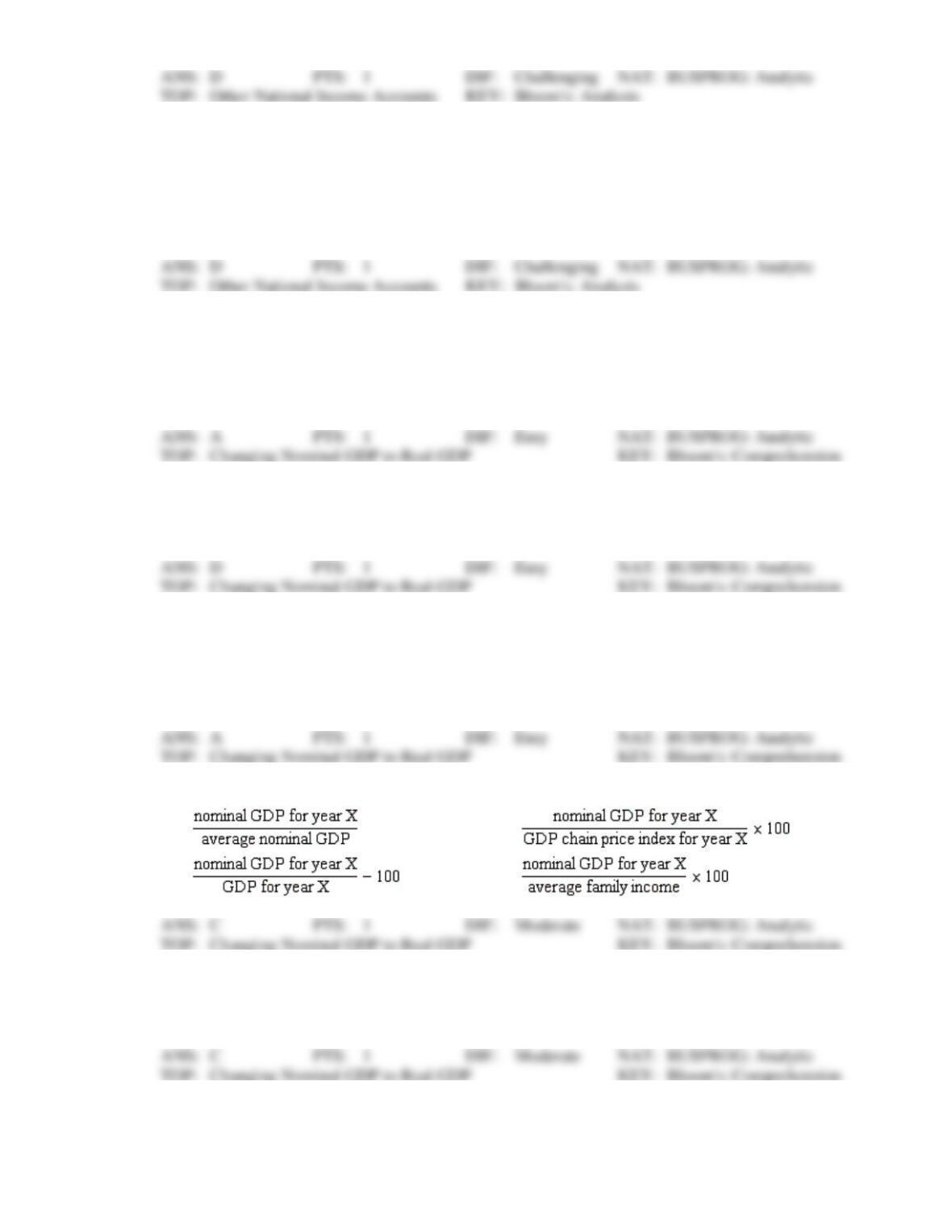
148. The equation for determining real GDP for year X is:
a.
c.
b.
d.
149. Increased production, but not increased inflation, will result in higher:
a.
nominal GDP.
c.
real GDP.
b.
money GDP.
d.
current dollar GDP.
150. In an economy with persistent inflation,
a.
real GDP will grow faster than nominal GDP.
b.
nominal GDP will grow faster than real GDP.
c.
nominal and real GDP will grow at the same rate.
d.
nominal and real GDP will both fall.
151. Which of the following statements is true?
a.
The inclusion of intermediate goods and services into GDP calculations would
underestimate our nation’s production level.
b.
The expenditures approach sums the compensation of employees, rents, profits, net
interest, and nonincome expenses for depreciation and indirect business taxes.
c.
Real GDP has been adjusted for changes in the general level of prices due to inflation.
d.
Real GDP equals nominal GDP multiplied by the GDP deflator.
152. Why is it important to use real GDP rather than nominal GDP figures when making comparisons of
output across time periods?
a.
The real GDP figures are a better measure of changes in the general level of prices.
b.
The real figures will reflect changes in the quantity of output and not changes in the
general level of prices.
c.
The real figures will reflect changes in the general level of prices as well as changes in the
quantity of output.
d.
The real GDP figures adjust for changes in the level of employment.
153. In contrast with nominal GDP, real GDP refers to nominal GDP:
a.
minus exports.
c.
corrected for price changes.
b.
minus personal income taxes.
d.
corrected for depreciation.
154. When economists speak of changes in GDP measured in constant dollars, they mean that:
a.
money GDP is constant.
b.
the price level is constant.
c.
a price index has been used to adjust money GDP for the effects of inflation.
d.
the growth rate of money GDP has been adjusted for changes in population.
155. The GDP chain price index is designed to adjust nominal GDP for changes in:
a.
the level of transfer payments.
b.
the quality of goods over time.
c.
the costs of economic bads such as pollution and crime.
d.
the general level of prices over time.
Exhibit 5-6
Use the table below to answer the following question(s).
Nominal GDP
GDP
Year
(billions)
deflator
2003
600
100.0
2008
1,000
133.3
156. Refer to Exhibit 5-6. Between 2003 and 2008, the general level of prices increased by approximately:
a.
16.7 percent.
c.
66.7 percent.
b.
33.3 percent.
d.
133.3 percent.
157. Refer to Exhibit 5-6. Measured in terms of 2003 prices, real GDP in 2008 was:
a.
600.
c.
900.
b.
750.
d.
1,333.
158. The most broadly based price index is the:
a.
real GDP price index.
c.
producer price index.
b.
consumer price index.
d.
GDP chain price index.
159. In 1960, U.S. nominal GDP was $527 billion and the GDP chain price index is 23.3. Real GDP in
1996 dollars is:
a.
$1,228 billion.
c.
$3,000 billion.
b.
$2,262 billion.
d.
$3,262 billion.
160. In 1990, U.S. nominal GDP was $5,744 billion and the GDP chain price index is 93.6. Real GDP in
1996 dollars is:
a.
$6,137 billion.
c.
$6,000 billion.
b.
$5,376 billion.
d.
$6,376 billion.
161. Suppose in 2000, GDP was $7,242 billion and the GDP chain price index is 117.5. Real GDP in
constant 1996 dollars is:
a.
$5,488 billion.
c.
$6,740 billion.
b.
$6,163 billion.
d.
$7,789 billion.
162. In 1980, U.S. nominal GDP was $2,784 billion and the GDP chain price index is 60.4. Real GDP in
1996 dollars is:
a.
$1,682 billion.
c.
$3,889 billion.
b.
$4,609 billion.
d.
$4,000 billion.
Exhibit 5-7 GDP data (billions of dollars)
Personal consumption expenditures
$5,207
Interest
425
Corporate profits
735
Government spending
1,406
Depreciation
830
Rental income
146
Gross private domestic investment
1,116
Compensation of employees
4,426
Exports
870
Imports
965
Indirect business taxes
553
Proprietors’ income
520
Personal taxes
886
Social Security taxes
432
Transfer payments
376
163. In Exhibit 5-7, and using the expenditures approach, gross domestic product (GDP) is:
a.
$6,807 billion.
b.
$7,082 billion.
c.
$7,634 billion.
d.
$7,637 billion.
e.
$7,730 billion.
164. In Exhibit 5-7, national income (NI) is:
a.
$6,254 billion.
b.
$6,495 billion.
c.
$6,805 billion.
d.
$7,082 billion.
e.
$7,637.7 billion.
165. In Exhibit 5-7, personal income (PI) is:
a.
$6,254 billion.
b.
$6,495 billion.
c.
$6,013 billion.
d.
$7,082 billion.
e.
$7,637 billion.
166. In Exhibit 5-7, disposable personal income (DI) is:
a.
$5,127 billion.
b.
$5,608 billion.
c.
$6,254 billion.
d.
$6,495 billion.
e.
$7,082 billion.
Exhibit 5-8 GDP data (billions of dollars)
Personal consumption expenditures
$850
Interest
90
Corporate profits
150
Government spending
400
Depreciation
100
Rental income
70
Gross private domestic investment
120
Compensation of employees
830
Exports
120
Imports
70
Indirect business taxes
80
Proprietors’ income
120
Personal income taxes
110
Social Security taxes
50
Transfer payments
160
167. In Exhibit 5-8, and using the expenditures approach, gross domestic product (GDP) equals:
a.
$1,540 billion.
b.
$2,460 billion.
c.
$2,430 billion.
d.
$1,450 billion.
e.
$1,420 billion.
168. In Exhibit 5-8, personal income (PI) equals:
a.
$1,280 billion.
b.
$2,290 billion.
c.
$1,310 billion.
d.
$2,320 billion.
e.
$1,400 billion.
169. In Exhibit 5-8, disposable personal income (PI) is:
a.
$2,180 billion.
b.
$1,200 billion.
c.
$2,210 billion.
d.
$1,180 billion.
e.
$1,290 billion.
170. In Exhibit 5-8, national income (NI) equals:
a.
$2,330 billion.
b.
$1,350 billion.
c.
$1,320 billion.
d.
$2,360 billion.
e.
$1,440 billion.
Exhibit 5-9 GDP data (billions of dollars)
Depreciation
$ 438
Compensation of employees
2,000
Rental income
100
Net interest
300
Corporate profits
700
Social Security taxes
519
Transfer payments
650
Personal consumption expenditures
2,582
Gross Private Domestic Investment
669
Government spending
815
Net exports
−78
Personal taxes
590
Indirect business taxes
450
171. In Exhibit 5-9, and using the expenditures approach, gross domestic product (GDP) equals:
a.
$4,066 billion.
b.
$4,144 billion.
c.
$3,988 billion.
d.
$4,884 billion.
e.
$5,782 billion.
172. In Exhibit 5-9, national income (NI) equals:
a.
$3,628 billion.
b.
$3,706 billion.
c.
$4,446 billion.
d.
$3,550 billion.
e.
$5,344 billion.
173. In Exhibit 5-9, personal income (PI) equals:
a.
$3,472 billion.
b.
$3,691 billion.
c.
$4,291 billion.
d.
$3,384 billion.
e.
$3,175 billion.
174. In Exhibit 5-9, personal disposable personal income (DI) equals:
a.
$2,882 billion.
b.
$3,101 billion.
c.
$2,794 billion.
d.
$3,701 billion.
e.
$4,588 billion.
175. In Exhibit 5-10, and using the expenditures approach, compute personal consumption expenditures.
Which of the following is correct?
a.
$6,750 billion.
b.
$6,600 billion.
c.
$6,550 billion.
d.
$6,100 billion.
e.
$5,000 billion.
176. In Exhibit 5-10, using the expenditure approach, compute business investment spending (I). Which of
the following is correct?
a.
$950 billion.
c.
$600 billion.
b.
$50 billion.
d.
$1,000 billion.
177. In Exhibit 5-10, and using the expenditures approach, compute net exports (NX). Which of the
following is correct?
a.
−$100 billion.
b.
$150 billion.
c.
$250 billion.
d.
−$50 billion.
e.
−$60 billion.
178. In Exhibit 5-10, compute national income (NI). Which of the following is correct?
a.
$7,400 billion.
b.
$7,250 billion.
c.
$8,150 billion.
d.
$8,200 billion.
e.
$8,350 billion.
179. In Exhibit 5-10, compute personal income (PI). Which of the following is correct?
a.
$7,110 billion.
b.
$7,410 billion.
c.
$6,740 billion.
d.
$7,760 billion.
e.
$6,780 billion.
180. In Exhibit 5-10, compute disposable personal income (DI). Which of the following is correct?
a.
$5,178 billion.
b.
$6,450 billion.
c.
$5,740 billion.
d.
$7,740 billion.
e.
$8,350 billion.
Exhibit 5-10 GDP data (billions of dollars)
Indirect business taxes
$ 600
Depreciation
950
Change in business inventories
50
Compensation of employees
5,400
Corporate profits
700
Durable goods
600
Exports
100
Social Security taxes
360
Transfer payments
300
Fixed investment
950
Government spending
800
Imports
150
Net interest
500
Nondurable goods
2,000
Personal taxes
1,000
Rental income
200
Services
4,000
181. In Exhibit 5-10, and using the expenditures approach, compute gross domestic product (GDP). Which
of the following is correct?
a.
$8,500 billion.
b.
$8,400 billion.
c.
$7,400 billion.
d.
$8,650 billion.
e.
$8,350 billion.
Exhibit 5-11 GDP data (billions of dollars)
Personal consumption expenditures
$4,750
Exports
810
Government spending
1,400
Social Security taxes
600
Depreciation
450
Indirect business taxes
550
Imports
850
Gross private domestic investment
900
Corporate income taxes
200
Personal taxes
800
Corporate profits
50
Transfer payments
700
182. In Exhibit 5-11, and using the expenditures approach, gross domestic product (GDP) equals:
a.
$7,010 billion.
b.
$10,360 billion.
c.
$9,660 billion.
d.
$7,860 billion.
e.
$12,060 billion.
183. In Exhibit 5-11, national income (NI) equals:
a.
$9,910 billion.
b.
$6,210 billion.
c.
$9,210 billion.
d.
$7,410 billion.
e.
$6,560 billion.
184. In Exhibit 5-11, personal income (PI) is:
a.
$9,210 billion.
b.
$8,510 billion.
c.
$6,560 billion.
d.
$6,610 billion.
e.
$10,910 billion.
185. In Exhibit 5-11, disposable personal income (DI) equals:
a.
$5,810 billion.
b.
$7,710 billion.
c.
$5,910 billion.
d.
$5,310 billion.
e.
$5,060 billion.
TRUE/FALSE
1. Intermediate goods are included and final goods are not included in calculating gross domestic
product.
2. Fixed investment refers to investment in stocks, bonds, and improvements to land.
3. Capital goods, like factories and machinery, are classified as intermediate goods.
4. The government (G) category of gross domestic product (GDP) excludes welfare and other transfer
payments.
5. Gross domestic product is the total dollar value at current prices of all final and intermediate goods
produced by a nation during a given time period.
6. The circular flow model illustrates that aggregate spending in the product markets equals 70 percent of
aggregate income earned in the factor markets.
7. Personal consumption expenditures are the largest component of GDP.
8. Net exports equal imports minus exports.
9. Personal consumption expenditures is the smallest component of total spending.
10. The expenditure approach measures GDP by adding the spending of households, businesses,
government, and foreigners.
11. Compensation of employees is the largest component of GDP using the income approach.
12. Gross domestic product (GDP) is a satisfactory measure of both economic “goods” and “bads”.
13. The value of child-rearing and other household production are not included in GDP.
14. GDP provides substantial information about an economy’s income distribution.
15. National income (NI) is the total income earned by resource owners, including wages, rents, interest,
and profits.
16. Social Security payments are included in personal income.
17. Personal income minus personal taxes equals disposable personal income.
18. Nominal gross domestic product is based on the existing prices at which final goods are actually sold.
19. In any year, nominal GDP divided by the GDP chain price index times 100 equals real GDP.
20. Real GDP, as opposed to money (nominal) GDP, has been adjusted for changes in the general level of
prices.
21. Nominal values are values measured in terms of the prices at which goods and services are actually
sold.
22. All changes in nominal GDP are due to price changes.
23. If the GDP chain price index in a given year is less than 100, real GDP in that year would be greater
than nominal GDP.
24. A GDP price chain price index number of 120.0 for a given year indicates that prices in that year are
20 percent higher than prices in the base year.
25. Nominal GDP is greater than GDP because of the effects of inflation as measured by the GDP chain
price index.
26. In any year, nominal GDP divided by the GDP chain price index equals real GDP.
ESSAY
1. Discuss the components of GDP using the expenditure approach.
2. Explain why GDP was never intended to be a measure of social well being.
3. Discuss how economists calculate NI, PI and DI.
4. Why is it important to distinguish nominal GDP from real GDP?