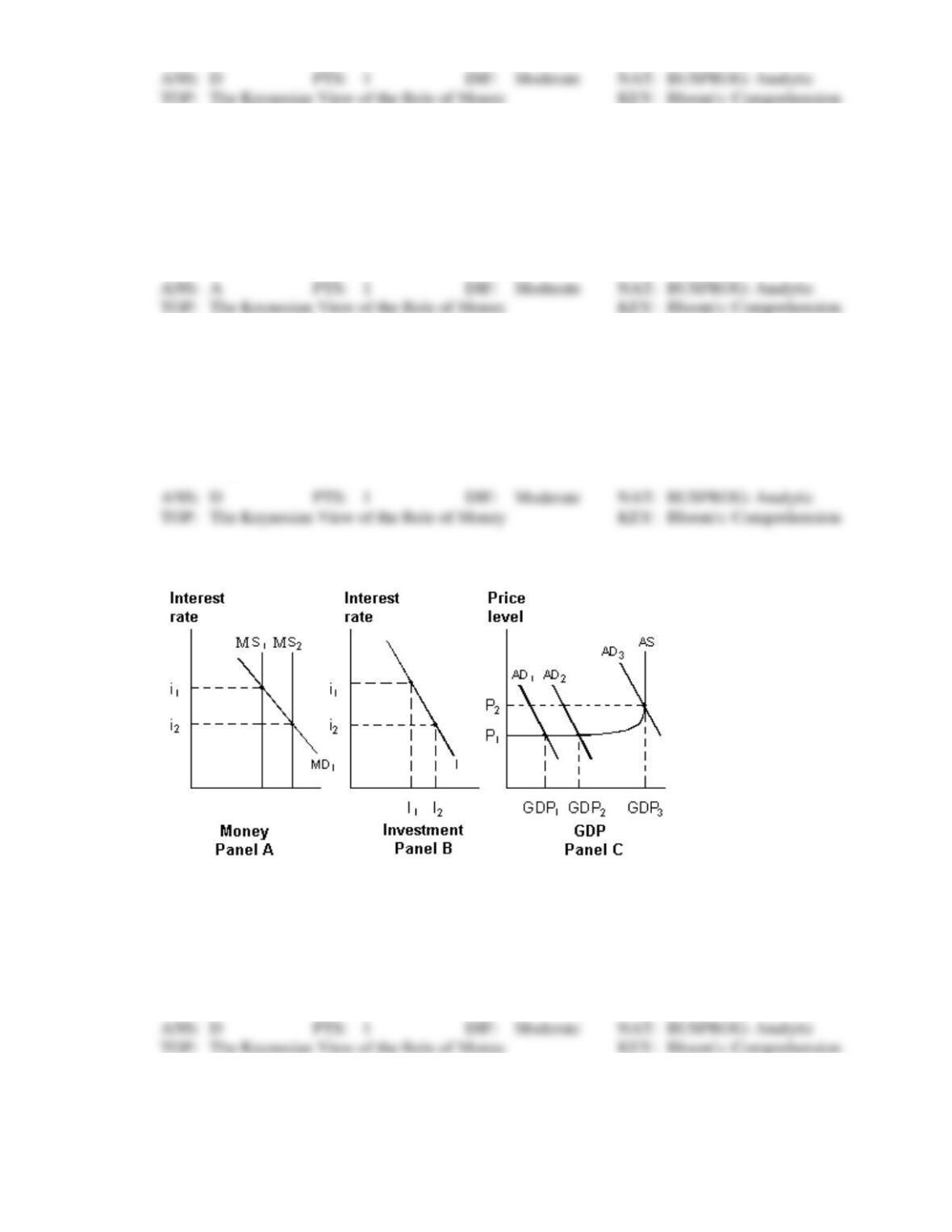
97. In Exhibit 16-4, which one of the following actions could the Fed use to shift the AD curve from AD1
to AD2?
a.
Lower the legal reserve requirement.
b.
Lower the federal funds rate.
c.
Print currency.
d.
Raise the discount rate.
e.
Sell government securities.
98. In Exhibit 16-4, which one of the following actions could the Fed use to shift the AD curve from AD3
to AD2?
a.
Lower the discount rate.
b.
Lower the federal funds rate
c.
Raise the federal funds rate.
d.
Raise the legal reserve requirement
e.
Buy government securities.
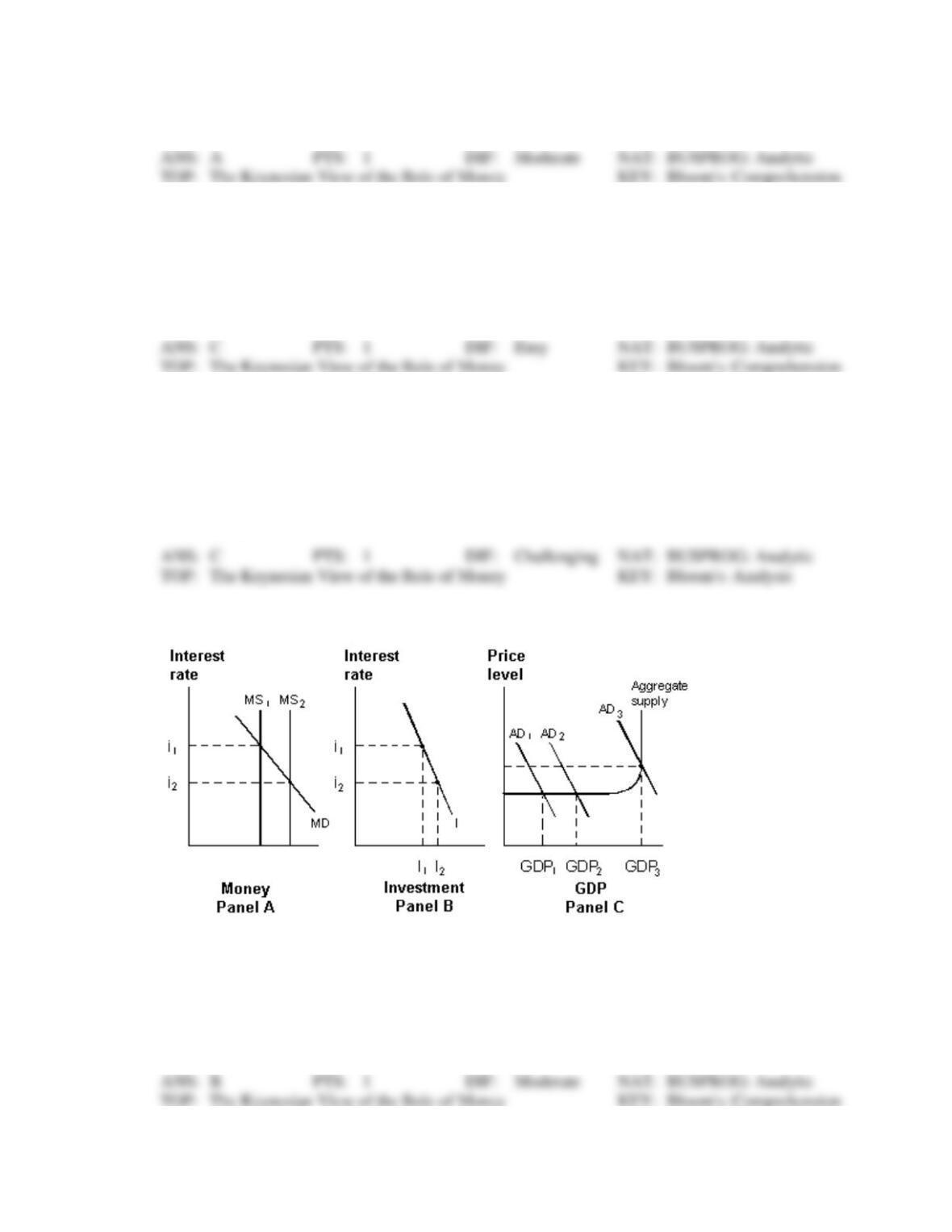
Exhibit 16-5 Money, investment and product markets
99. In Exhibit 16-5, when the money supply increases from MS1 to MS2, the equilibrium interest rate:
a.
remains unchanged.
b.
increases from i2 to i1, increasing investment spending from I1 to I2.
c.
increases from i2 to i1, decreasing investment spending from I2 to I1.
d.
decreases from i1 to i2, increasing investment spending from I1 to I2.
e.
decreases from i1 to i2, decreasing investment spending from I2 to I1.
100. In Exhibit 16-5, if the interest rate falls from i1 to i2, investment spending will:
a.
increase, and aggregate demand will shift from AD1 to AD2.
b.
decrease, and aggregate demand will shift from AD2 to AD1.
c.
remain the same, and aggregate demand will shift from AD2 to AD3.
d.
increase, and aggregate demand will shift from AD2 to AD1.
e.
decrease, and aggregate demand will shift from AD1 to AD2.
101. In Exhibit 16-5, a shift in aggregate demand from AD1 to AD2:
a.
cannot raise real GDP because the economy is at full employment.
b.
cannot raise real GDP because the aggregate supply curve is upward sloping at GDP2.
c.
will raise real GDP because the economy is operating below the full-employment level.
d.
will cause the interest rate to increase from i2 to i1.
e.
will raise real GDP but will also significantly raise the price level.
102. In Exhibit 16-5, a shift in aggregate demand from AD2 to AD3:
a.
increases real GDP, and lowers the price level.
b.
decreases real GDP, and lowers the price level.
c.
increases real GDP, and raises the price level.
d.
decreases real GDP, and raises the price level.
e.
has no effect on real GDP and the price level because the economy can never reach full
employment.
Exhibit 16-6 Money, investment and product markets
103. In Exhibit 16-6, a move from MS1 to MS2:
a.
increases the money supply, causing the interest rate to rise from i2 to i1.
b.
increases the money supply, causing the interest rate to fall from i1 to i2.
c.
decreases the money supply, causing the interest rate to rise from i2 to i1.
d.
decreases the money supply, causing the interest rate to fall from i1 to i2.
e.
has no effect on the money supply or the interest rate.
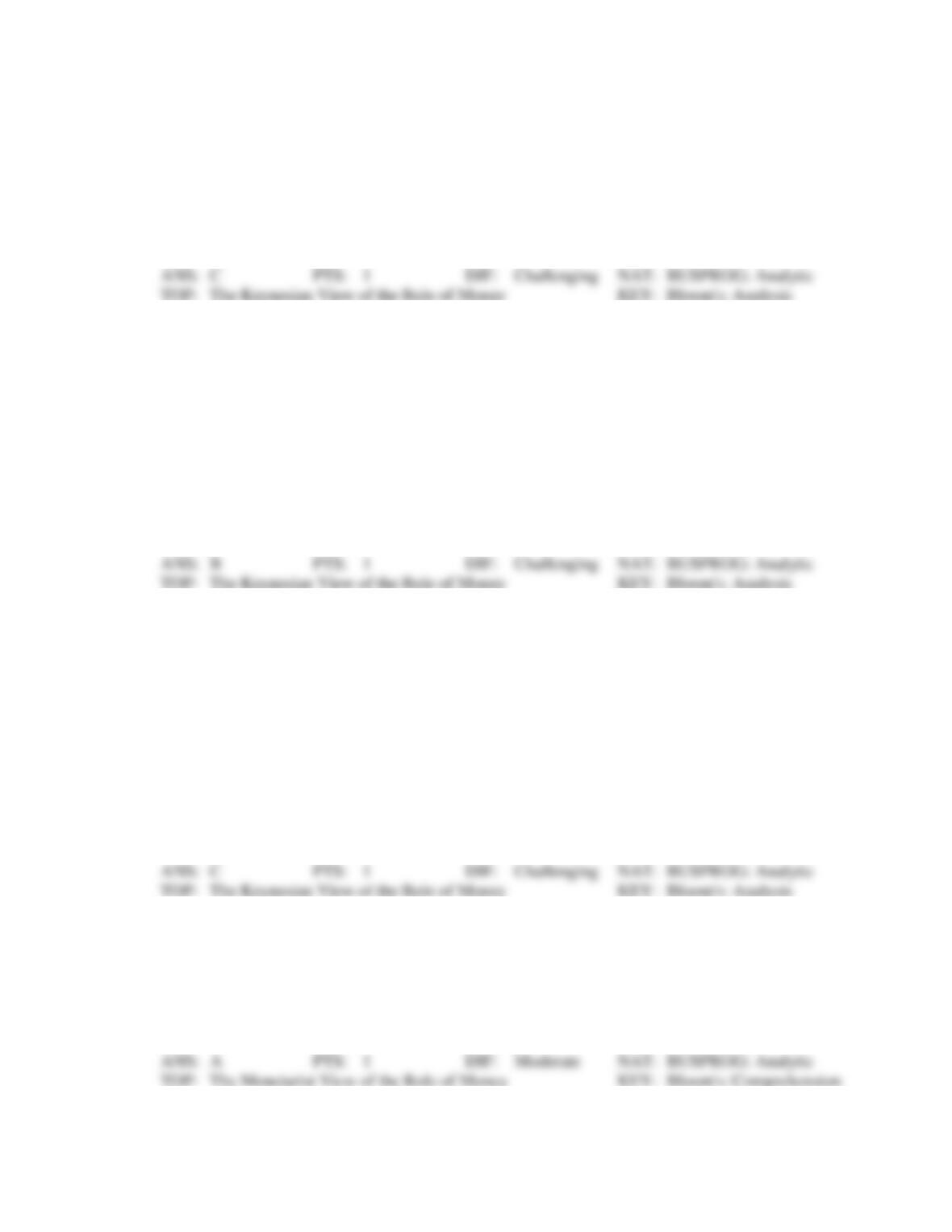
104. In Exhibit 16-6, an increase in the money supply from MS1 to MS2 causes:
a.
interest rates to fall from i1 to i2 and the quantity demanded of investment to decrease from
I2 to I1.
b.
interest rates to fall from i1 to i2 and aggregate demand to shift from AD2 to AD1.
c.
interest rates to fall from i1 to i2 and the quantity demanded of investment to increase from
I1 to I2.
d.
interest rates to rise from i2 to i1 and the quantity demanded of investment to remain the
same.
e.
interest rates to rise from i2 to i1 and aggregate demand to shift from AD1 to AD2.
105. In Exhibit 16-6, if the interest rate falls from i1 to i2, then:
a.
the quantity demanded of investment increases from I1 to I2 and investment spending shifts
the aggregate demand curve from AD2 to AD1, decreasing the level of real GDP.
b.
the quantity demanded of investment increases from I1 to I2 and investment spending shifts
the aggregate demand curve from AD1 to AD2, increasing the level of real GDP.
c.
the quantity demanded of investment decreases from I2 to I1 and investment spending
shifts the aggregate demand curve from AD1 to AD2, decreasing the level of real GDP.
d.
the quantity demanded of investment decreases from I2 to I1 and investment spending
shifts the aggregate demand curve from AD2 to AD1, increasing the level of real GDP.
e.
the quantity demanded of investment stays the same causing the aggregate demand curve
to shift from AD2 to AD1 decreasing the level of real GDP.
106. In Exhibit 16-6, if the Fed believes the economy is at AD3, how might it engineer a decline in the price
level?
a.
By decreasing the money supply, the interest rate falls, investment rises, and aggregate
demand falls, causing the price level to fall.
b.
By decreasing the money supply, the interest rate rises, investment rises, and aggregate
demand rises, causing the price level to fall.
c.
By decreasing the money supply, the interest rate rises, investment falls, and aggregate
demand falls, causing the price level to fall.
d.
By increasing the money supply, the interest rate rises, investment rises, and aggregate
demand falls, causing the price level to fall.
e.
By increasing the money supply, the interest rate rises, investment falls, and aggregate
demand rises, causing the price level to fall.
107. According to the monetarists, which of the following is true?
a.
Instability in the money supply is the primary cause of economic instability.
b.
A reduction in the money supply will cause consumers to increase spending.
c.
A reduction in the money supply will cause a proportional reduction in wages and prices,
leaving output unchanged.
d.
A rapid growth rate of the money supply will lead to a rapid growth rate of real GDP.
108. According to monetarists, which of the following would be most important for the control of inflation?
a.
a steady increase in federal expenditures
b.
the imposition of price controls
c.
keeping the growth rate of the money supply low and steady
d.
a steady increase in the size of the budget deficit
109. “Monetary instability has been the major cause of economic instability in this country. Expansion in
the money supply has been the source of every major inflation. Every major recession has been either
caused or perpetuated by monetary contraction.” Who among the following would most likely adhere
to this view?
a.
Monetarists.
c.
Demand-side economists.
b.
Keynesians.
d.
Quantity theorists.
110. Monetarists reject using discretionary monetary policy as an effective stabilization tool because they
believe:
a.
if the money supply grows at a rate equal to the economy’s long-run rate of economic
growth, then the economy will be unstable.
b.
that changes in the money stock do not affect output or prices.
c.
the Fed will miss its money supply targets and make the economy worse.
d.
monetary policy can stimulate aggregate demand, but it cannot affect inflation.
111. Monetarists believe that an increase in the money supply will lead to:
a.
both c and d.
b.
all of the following.
c.
an increase in the price level.
d.
an increase in nominal GDP
e.
an increase in real GDP.
112. The Monetarist transmission mechanism through which monetary policy affects the price level, real
GDP, and employment depends on the:
a.
indirect impact of changes on the interest rate.
b.
indirect impact of changes on profit expectations.
c.
direct impact of changes in fiscal policy on aggregate demand.
d.
direct impact of changes in the money supply on aggregate demand.
113. If the velocity of the M1 money supply is 4 and nominal GDP is $200 billion, the stock of money in
circulation must be:
a.
$25 billion.
c.
$100 billion.
b.
$50 billion.
d.
$800 billion.
114. The equation of exchange states that:
a.
money supply multiplied by real output equals velocity.
b.
velocity multiplied by money supply equals the selling price times the quantity of actual
output.
c.
money supply divided by velocity equals nominal GDP.
d.
money supply divided by velocity equals real GDP.
115. If M stands for the money supply, V for the velocity of money, P for the average selling price, and Q
for the output of goods and services, the equation of exchange is:
a.
MP = VQ.
c.
MQ = VP.
b.
MV = PQ.
d.
MP = PQ.
116. The equation of exchange states:
a.
MV = PQ.
c.
MP = V/Q.
b.
MP = VQ.
d.
V = M/PQ.
117. According to the equation of exchange, if M = 200, P = 100, and Q = 10, the V is:
a.
20.
b.
2.
c.
10.
d.
5.
e.
2,000.
118. According to the equation of exchange, if V = 5, P = 100, and Q = 10, the M is:
a.
20.
b.
10.
c.
500.
d.
1,000.
e.
200.
119. The V in the equation of exchange represents the:
a.
variation in the GDP.
b.
variation in the CPI.
c.
variation in real GDP.
d.
average number of times per year a dollar is spent on final goods and services.
120. The velocity of money is:
a.
money supply divided by prices.
b.
spending divided by output.
c.
required monetary reserves divided by income.
d.
GDP divided by the money supply.
121. The velocity of money is the:
a.
rate at which the price index for consumer goods rises.
b.
multiple by which an increase in government expenditures will cause output to expand.
c.
average number of times a dollar is used to buy goods and services included in GDP.
d.
number of times a dollar is taken out of the country during a year.
122. Suppose nominal GDP equaled $10,988 billion while the M2 money supply was $6,063 billion. What
was the velocity of the M2 money stock?
a.
0.45
c.
1.81
b.
0.55
d.
2.36
123. If the money supply is $250 billion and nominal GDP is $1 trillion, the velocity of money is:
a.
0.25.
c.
2.50.
b.
0.40.
d.
4.00.
124. If the nominal GDP is $500 billion and the money supply is $100 billion, the velocity of money is:
a.
500.
c.
2.50.
b.
5.00
d.
0.40.
125. The average number of times per year each dollar is used to transact an exchange is known as the:
a.
liquidity of money.
b.
velocity of money.
c.
quantity theory of money.
d.
equation of exchange
e.
rapidity index
126. The number of times per year each dollar is used to transact an exchange is the:
a.
quantity theory of money.
b.
velocity of money.
c.
equation of exchange.
d.
turnover rate.
e.
expenditure rate.
127. The velocity of money is the:
a.
number of times per year each dollar is used to transact an exchange.
b.
rapidity of price increases during inflation.
c.
number of times the price level increases during a year.
d.
time it takes for checks to clear banks.
e.
number of times per year each product is purchased during the year.
128. According to the quantity theory of money, which one of the following economic variables would
change in response to an increase in the money supply?
a.
prices
c.
velocity
b.
real income
d.
employment
129. Given the strict quantity theory of money, if the quantity of money were decreased by 50 percent,
prices would:
a.
fall by 50 percent.
c.
increase by 100 percent.
b.
rise by 50 percent.
d.
decrease by 100 percent.
130. Given the strict quantity theory of money, if the quantity of money doubled, prices would:
a.
fall by half.
c.
remain constant.
b.
double.
d.
increase somewhat but less than double.
131. The quantity theory of money of the Classical economists says that a change in the money supply will
produce a:
a.
proportional change in the price level.
b.
greater than proportional change in the price level.
c.
less than proportional change in the price level.
d.
wide variation in the velocity of money.
132. According to the quantity theory of money, a 10 percent increase in the money supply leads to a 10
percent increase in:
a.
velocity.
c.
the price level.
b.
unemployment.
d.
real GDP.
133. According to classical economists,
a.
prices are rigid.
b.
both V and Q are variable for an economy in short-run equilibrium.
c.
changes in M cause changes in V.
d.
the velocity of money is constant.
134. Since classical economists believe that both V and Q are constants for an economy in short-run
equilibrium, the equation of exchange becomes a theory in which:
a.
the quantity of money explains prices.
b.
the quantity of money explains velocity.
c.
the quantity of money explains real GDP.
d.
changes in M cause changes in V.
e.
prices are never flexible
135. According to the quantity theory of money:
a.
the velocity of money is highly variable.
b.
the money supply directly affects real GDP.
c.
the money supply inversely affects velocity.
d.
real GDP increases as the price level increases.
e.
P = MV/Q.
136. Causality is clear and mechanical with the quantity theory of money. If M increases because:
a.
V and Q are variable, the price level, P, increases.
b.
V and Q are variable, the price level, P, decreases.
c.
V and Q are constant, the price level, P, increases.
d.
V and Q are constant, the price level, P, decreases.
e.
P and Q are constant, velocity, V, increases.
137. According to the quantity theory of money, if M’s growth is lower than Q’s, then:
a.
V falls.
b.
V rises.
c.
P stays the same
d.
P falls.
e.
P rises
138. Monetarists accept the idea that velocity is not constant; nonetheless, they believe that it is still highly:
a.
constant.
b.
unpredictable, ill-behaved, and independent of money supply.
c.
unpredictable, well-behaved, and dependent of money supply.
d.
predictable.
e.
variable.
139. Since classical economists and monetarists believe that the economy operates at full employment, real
GDP, that is, along the vertical segment of aggregate supply:
a.
any increase in the money supply can only end up raising the price level.
b.
any increase in the money supply can only end up lowering the price level.
c.
any decrease in the money supply can only end up raising the price level.
d.
changes in the money supply will not affect the price level.
e.
any increase in the money supply will cause both nominal and real GDP to increase.
140. According to the quantity theory of money, if an economy produces 5,000 units of output, its money
supply equals $40,000 and the velocity of money equals one, then the price level will equal:
a.
$0.13.
b.
$1.25.
c.
$8.
d.
$200.
e.
$8,000.
141. According to the quantity theory of money, if an economy produces 100 units of output and has a
money supply equal to $500, then if the money supply doubles while velocity remains constant, the
new price level will:
a.
fall to half its initial level.
b.
fall, but it will not fall all the way to half its initial level.
c.
increase, but it will not double.
d.
double.
e.
more than double.
142. The quantity theory of money assumes that the velocity of money:
a.
is constant.
b.
will rise if the money supply rises and fall if the money supply falls.
c.
will rise if the money supply rises, but it will not change if the money supply falls.
d.
will fall if the money supply rises, and it will rise if the money supply falls.
e.
will fall if the money supply rises, but it will not change if the money supply falls.
143. Monetarists believe that:
a.
velocity is constant.
b.
velocity is highly predictable.
c.
there are three motives for demanding money.
d.
changes in the money supply cause changes in velocity.
e.
a change in the money supply can affect real GDP.
144. Classical economists believe that:
a.
velocity is not constant.
b.
changes in the money supply affect real GDP.
c.
the quantity of money explains prices.
d.
the money supply affects velocity.
145. Classical economists traditionally believed that:
a.
there are three motives for demanding money.
b.
a change in the money supply can affect real GDP.
c.
the transactions demand for money influences the velocity of money.
d.
the velocity of money is constant.
e.
the economy does not always operate at full employment.
146. Classical economists believe that an increase in the money supply will lead to:
a.
only c and d.
b.
all of the following.
c.
an increase in the price level.
d.
an increase in nominal GDP.
e.
an increase in real GDP.
147. In the quantity theory of money:
a.
the price level is a function of the supply of money.
b.
the supply of money is a function of the price level.
c.
the money supply and the price level are inversely related.
d.
the money supply is controlled by the government.
148. According to the classical view,
a.
velocity is constant, which means changes in price will cause changes in price or quantity.
b.
quantity is constant, which means changes in the money supply could cause either changes
in velocity or changes in prices.
c.
velocity and price are constant so that changes in the money supply causes changes in
quantity.
d.
velocity and quantity are constant so that changes in the money supply cause changes in
prices.
e.
velocity is constant while quantity is variable so that changes in the money supply change
both price and quantity.
149. The assumption that the velocity of money and the quantity being produced is constant is held by the:
a.
Keynesian school.
b.
supply-side school.
c.
neo-Keynesian school.
d.
rational expectations school.
e.
classical school.
150. The belief that the velocity of money is not constant but highly predictable is associated with the:
a.
classical school.
b.
Keynesian school.
c.
supply-side school.
d.
rational expectations school
e.
monetarist school.
151. Monetarists believe:
a.
the cause-and-effect relationship hypothesized by the Keynesians understates the impact
of stimulative monetary policy.
b.
the cause-and-effect relationship hypothesized by the Keynesians is an accurate
description of how monetary policy works.
c.
since the economy is operating at full employment, any stimulative monetary policy will
cause the inflation rate to rise.
d.
the cause-and-effect relationship hypothesized by the Keynesians is backwards, and
decreases in the money supply actually stimulate economic activity.
e.
the cause-and-effect relationship hypothesized by Keynesians will not work because
investment does not respond to changes in interest rates.
152. If M = 200, P = 100, and Q = 10, then V is:
a.
20.
b.
2.
c.
10.
d.
5.
e.
2,000.
153. If V = 5, P = 100, and Q = 10, then M is:
a.
20.
b.
10.
c.
500.
d.
1,000.
e.
200.
154. The equation specifying a direct relationship between the money supply and prices is the quantity
theory of:
a.
money.
b.
prices.
c.
exchange.
d.
spending.
e.
dollars.
155. Monetarists and classical economists:
a.
assume that stimulative monetary policy will create high levels of GDP without inflation.
b.
assume that stimulative monetary policy will create high levels of GDP and slightly high
prices.
c.
assume the economy operates at full employment and stimulative monetary policy will
only cause the price level to rise.
d.
assume that the economy operates at full employment and stimulative monetary policy
will increase both aggregate supply and aggregate demand.
e.
assume that the Keynesian description of monetary policy underestimates the true
stimulative effect of an increase in the money supply.
156. The monetary rule is the view of the:
a.
Keynesians that monetary policy is most important.
b.
Monetarists that monetary policy is most important.
c.
Classical economists that monetary policy is most important.
d.
Monetarists that the Fed should expand the money supply at a constant rate.
157. Monetarists argue that the Federal Reserve should allow the money supply to grow:
a.
counter to the business cycles.
c.
only during recessions.
b.
faster than 10 percent annually.
d.
at a constant rate.
158. According to the Monetarist view, the impact of expansionary monetary policy will be:
a.
the same in the long run as in the short run.
b.
the same regardless of whether the effects of the policy are anticipated or unanticipated.
c.
a higher price level (inflation).
d.
a decrease in short-run prices and an increase in long-run prices.
159. According to the Monetarists, the primary cause of inflation is:
a.
large budget deficits.
b.
high taxes.
c.
rapid expansion of the money supply.
d.
government expenditures that are large relative to the size of the economy.
160. Which of the following is a reason for the Keynesian view that monetary policy plays a minor role in
affecting the economy?
a.
The money demand curve is vertical.
b.
The investment curve is very steep.
c.
The money demand curve is horizontal at any interest rate.
d.
The monetary rule.
161. Which of the following is an important issue in the Keynesian-Monetarist debate?
a.
The relative importance of monetary and fiscal policy.
b.
The nature of the transmission mechanism through which a change in the money supply
affects the economy.
c.
The shape of the investment-demand curve.
d.
All of these.
162. Which of the following characterizes the Monetarist viewpoint?
a.
They believe that money can never affect investment.
b.
They believe that monetary policy is transmitted to the economy only through its effects
on the interest rate and investment.
c.
Both a and b are part of the debate.
d.
Neither a nor b are part of the debate.
163. Most monetarists favor:
a.
frequent changes in the growth rate of the money supply to avoid inflation.
b.
placing the Federal Reserve under the Treasury.
c.
a steady, gradual shrinkage of the money supply.
d.
a constant increase in the money supply year after year equal to the potential annual
growth rate in real GDP.
164. Which of the following is a belief of the monetarists?
a.
They think the Great Depression was made worse by poor conduct of monetary policy.
b.
They do not believe monetary policy is transmitted to the economy only through its effect
on interest rates and planned investment.
c.
They believe that the interest-investment curve is vertical.
d.
All of these.
165. Which of the following is true?
a.
Keynesians advocate increasing the money supply during economic recessions but
decreasing the money supply during economic expansions.
b.
Monetarists advocate increasing the money supply by a constant rate year after year.
c.
Keynesians argue that the crowding-out effect is rather insignificant.
d.
Monetarists argue that the crowding-out effect is rather large.
e.
All of these.
166. Which economic theory argues that changes in velocity are predictable and the crowding-out effect is
substantial?
a.
Classical theory.
c.
Monetarist theory.
b.
Keynesian theory.
d.
Marxist theory.
167. Monetarists argue that fiscal policy is ineffective because:
a.
the velocity of money is predictable.
b.
the crowding-out effect reduces investment.
c.
prices and wages are sticky in the short run.
d.
it causes the value of the dollar to depreciate.
168. Keynesians reject the influence of monetary policy on the economy. One argument supporting this
Keynesian view is that the:
a.
money demand curve is horizontal at any interest rate.
b.
aggregate demand curve is nearly flat.
c.
investment demand curve is nearly vertical.
d.
money demand curve is vertical.
TRUE/FALSE
1. The opportunity cost of holding money is measured by the rate of interest.
2. Adam Smith listed three types of motives for people holding money⎯transaction, precautionary, and
speculative.
3. John Maynard Keynes listed three types of motives for people holding money⎯transactions,
precautionary, and speculative.
4. The opportunity cost of holding money is properly measured by the rate of interest on financial assets
such as bonds.
5. Bond prices and interest rates are directly related.
6. When there is an excess demand for money, individuals and businesses will attempt to purchase bonds.
7. An increase in the supply of money, other things being equal, will raise the equilibrium interest rate.
8. Starting from equilibrium in the money market, suppose the money supply increases. Other things
being equal, this will cause an excess demand for money, leading people to sell bonds.
9. If the Fed uses its tools to expand the money supply, bond prices will be bid up and interest rates will
fall.
10. A rightward shift in the money supply curve is likely to produce a rightward shift in the money
demand curve.
11. Starting from equilibrium in the money market, suppose the money supply increases. Other things
being equal, this will cause an excess supply of money, leading people to buy bonds.
12. If the money supply increases this will cause the interest rate to rise, investment to fall and GDP to
fall.
13. Starting from equilibrium in the money market, suppose the money supply increases. Other things
being equal, this will cause an excess demand for money, leading people to buy bonds.
14. A decrease in the supply of money, other things being equal, will raise the equilibrium interest rate.
15. If the Fed uses its tools to expand the money supply, bond prices will be bid down and interest rates
will rise.
16. The transmission mechanism is the effect of changes in monetary policy on prices, real GDP, and
employment.
17. The transmission mechanism is the effect of changes in monetary policy on the stock market.
18. The Keynesian viewpoint is that the investment curve is highly responsive to the changes in the rate of
interest.
19. A rightward shift in the money supply curve is likely to produce a rightward shift in the aggregate
demand curve.
20. Keynesian economists believe monetary policy is more effective than fiscal policy in stabilizing the
business cycle.
21. According to Keynesian theory, changes in the money supply have a direct and immediate impact on
aggregate demand.
22. If the investment curve is relatively vertical, the Keynesian conclusion is that the transmission
mechanism has little effect on the economy.
23. Investment is lowered by expansionary monetary policy.
24. If the investment curve is relatively flat, the Keynesian conclusion is that the transmission mechanism
has little effect on the economy.
25. If M stand for the money supply, V for the velocity of money, P for the average selling price, and Q
for the output of goods and services, the equation of exchange is MV = PQ.
26. The Monetarists advocate the monetary rule in order to stabilize the business cycle which states that
the money supply should be increased by a constant rate year after year.
27. Monetarists argue that the Fed should frequently adjust the money supply in response to ever-changing
economic conditions.
28. The Monetarists advocate the monetary rule in order to stabilize the business cycle which states that
the money supply should be decreased by a constant rate year after year.
29. Monetarists argue that the Treasury’s conduct of fiscal policy is the most important factor affecting real
GDP and interest rates.
30. The monetarists totally reject the importance of changes in the money stock as determinants of
changes in real GDP, the price level, and employment.
31. Keynesian economists argue that the velocity of money is unstable and has unpredictable variations.
ESSAY
1. Discuss the determinants of the equilibrium interest rate and how it may change. What can the Fed do
to change the interest rate?
2. Contrast the Keynesian and Monetarist views on how a change in the money supply impacts the
economy.
3. Contrast the Keynesian and Monetarist views on the effectiveness of fiscal policy.