TOP: Nonprice Determinants of Demand KEY: Bloom’s: Comprehension
109. If good X is an inferior good, a decrease in consumer income, other things being equal, will shift the:
a.
demand curve for good X to the right.
c.
supply curve for good X to the right.
b.
demand curve for good X to the left.
d.
supply curve for good X to the left.
110. Assuming that generic brands are inferior goods, an increase in consumer income, other things being
equal, will cause a(n):
a.
leftward shift in the demand curve for generic goods.
b.
downward movement along the demand curve for generic goods.
c.
rightward shift in the demand curve for generic goods.
d.
upward movement along the demand curve for generic goods.
111. Assuming that hamburger is an inferior good, an increase in consumer income, other things being
equal, will cause a(n):
a.
upward movement along the demand curve for hamburger.
b.
rightward shift in the demand curve for hamburger.
c.
downward movement along the demand curve for hamburger.
d.
leftward shift in the demand curve for hamburger.
112. Travel by bus and pawn-shop services would be expected to be examples of:
a.
normal goods.
c.
substitute goods.
b.
inferior goods.
d.
complementary goods.
113. Assuming that shoe repair services are an inferior good, an increase in consumer income, other things
being equal, will cause a(n):
a.
leftward shift in the demand curve.
b.
downward movement along the demand curve.
c.
rightward shift in the demand curve.
d.
upward movement along the demand curve.
114. Assume that brand X is an inferior good and name brand Y is a normal good. An increase in consumer
income, other things being equal, will cause a(n):
a.
upward movement along the demand curve for name brand Y.
b.
downward movement along the demand curve for brand X.
c.
rightward shift in the demand curve for brand X.
d.
leftward shift in the demand curve for brand X.
115. Coke and Pepsi are an example of:
a.
inferior goods.
c.
substitutes.
b.
unrelated goods.
d.
complements.
116. Which of the following goods are most likely to be substitutes?
a.
potato chips and chip dip
c.
ketchup and French fries
b.
bread and peanut butter
d.
bananas and apples
117. If the price of coffee decreases, the demand curve for tea (a substitute good) will:
a.
remain unchanged.
c.
shift to the left.
b.
shift to the right.
d.
do none of these
118. If a decrease in the price of good Y causes the demand for good Z to decrease, this indicates that:
a.
Y and Z are complements.
b.
Y and Z are substitutes.
c.
Y and Z are unrelated.
d.
Y is a normal good and Z is an inferior good.
119. If two goods are substitutes in consumption, a(n):
a.
decrease in the price of one product will cause an increase in the demand for the other
product.
b.
decrease in the price of one product will cause a decrease in the demand for the other
product.
c.
increase in the price of one product will cause an increase in the supply of the other
product.
d.
increase in the price of one product will cause a decrease in the supply of the other
product.
e.
increase in the price of one product will cause a decrease in the demand for the other
product.
120. Which of the following pairs of goods would be considered substitutes?
a.
Milk and cookies.
b.
Tires and automobiles.
c.
Ink and pens.
d.
Coca-Cola and Pepsi.
e.
Computers and computer software.
121. Two goods that are substitutes are:
a.
bacon and eggs.
b.
camera and film.
c.
tennis racket and tennis balls.
d.
movie theater tickets and video rentals.
e.
coffee and cream.
122. Suppose that X and Y are substitute goods. If the price of good X increases, we can expect:
a.
the demand for good X to shift to the left.
b.
an upward movement along the demand curve for good Y.
c.
the demand curve for good Y to shift to the right.
d.
a downward movement along the demand curve for good Y.
e.
the demand curve for good Y to shift to the left.
123. If the demand for a good increases when the price of another good increases, then these goods are:
a.
complementary in consumption.
b.
complementary in production.
c.
substitute in production.
d.
substitute in consumption.
e.
neither substitutes nor complementary.
124. Assuming compact discs and cassettes are substitute goods, a decrease in the price of cassettes will
cause the demand curve for compact discs to:
a.
shift to the left as consumers switch from buying discs to cassettes.
b.
shift to the right as consumers switch from buying discs to cassettes.
c.
shift to the left as producers increase cassette production and reduce disc production.
d.
remain unchanged since discs and cassettes are sold in separate markets.
125. Assuming that Pepsi-Cola and Coca-Cola are substitutes, a rise in the price of Pepsi-Cola, other things
being equal, results in a(n):
a.
upward movement along the demand curve for Coca-Cola.
b.
downward movement along the demand curve for Coca-Cola.
c.
leftward shift in the demand curve for Coca-Cola.
d.
rightward shift in the demand curve for Coca-Cola.
126. Assuming that hamburgers and hot dogs are substitutes, an increase in the price of hamburgers, other
things being equal, results in a:
a.
rightward shift in the demand curve for hot dogs.
b.
leftward shift in the demand curve for hamburgers.
c.
rightward shift in the demand curve for hamburgers.
d.
leftward shift in the demand curve for hot dogs.
127. Assuming that professional and college football are substitutes, an increase in the ticket price for
professional football, other things being equal, will:
a.
increase the demand for college football tickets.
b.
decrease the demand for college football tickets.
c.
not change the demand for college football tickets.
d.
decrease the demand for professional football games.
128. Assuming that chicken and beef are substitutes, a decrease in the price of beef, other things being
equal, will:
a.
decrease the demand for beef.
c.
decrease the demand for chicken.
b.
increase the demand for chicken.
d.
increase the demand for beef.
129. Assuming that beef and chicken are substitutes, an increase in the price of beef, other things being
equal, will:
a.
increase the demand for chicken.
c.
not change the demand for chicken.
b.
decrease the demand for chicken.
d.
decrease the demand for beef.
130. An economist has conducted extensive research and has found that Jones Cola is a substitute for
Tucker Cola. Ceteris paribus, the price of Jones Cola increases. The impact on the demand curve for
Tucker Cola is a(n):
a.
increase in demand.
c.
increase in quantity demanded.
b.
decrease in demand.
d.
decrease in quantity demanded.
131. Assume that Coca-Cola and Pepsi-Cola are substitutes. A rise in the price of Coca-Cola will have
which of the following effects on the market for Pepsi?
a.
A movement down along the Pepsi demand curve.
b.
A rightward shift in the Pepsi demand curve.
c.
A movement up along the Pepsi demand curve.
d.
A leftward shift in the Pepsi demand curve.
132. Substitute goods are goods that are:
a.
jointly consumed.
b.
competing for consumer spending.
c.
used late in the game.
d.
inferior.
e.
normal.
133. Coffee and tea are:
a.
complements.
b.
substitutes.
c.
inferior goods.
d.
unrelated goods.
e.
nonmarket goods.
134. Which of the following pairs is the best example of substitutes?
a.
Coffee and cream.
c.
Tortillas and salsa.
b.
Honey and biscuits.
d.
Hiking boots and athletic shoes.
135. Two goods are considered substitutes only if a(n):
a.
decrease in the demand for one leads to a decrease in the supply of the other.
b.
increase in the demand for one leads to a decrease in the supply of the other.
c.
increase in the price of one leads to an increase in the demand for the other.
d.
decrease in the price of one leads to an increase in the demand for the other.
e.
decrease in the supply of one leads producers to switch to production of the other.
136. If butter is a substitute for margarine, then an increase in the price of butter would be most likely to
cause:
a.
a rightward shift of demand for margarine.
b.
a leftward shift of demand for margarine.
c.
the quantity demanded for margarine to increase.
d.
the quantity demanded for margarine to decline.
e.
a decline in the price of margarine.
137. Sugar and honey are viewed as substitutes for each other in many cooking applications. If the price of
sugar rises, we would expect the:
a.
demand for honey to increase.
b.
demand for honey to decrease.
c.
quantity demanded of honey to decrease.
d.
price of honey to decrease.
e.
quantity demanded of honey to increase.
138. Assuming coffee and tea are substitutes, a rise in the price of coffee will have which of the following
effects on the market for tea?
a.
A movement up along the tea demand curve.
b.
A movement down along the tea demand curve.
c.
A leftward shift in the tea demand curve.
d.
A rightward shift in the tea demand curve.
139. Which of the following would lead to an increase in the demand for computer software?
a.
A decrease in the price of computer software.
b.
A decrease in the price of personal computers.
c.
An decrease in the cost of producing computer software.
d.
An decrease in personal income.
140. Which of the following would most likely increase the demand for televisions?
a.
A decrease in the price of televisions.
b.
A decline in consumer income.
c.
A decrease in the price of home stereo systems, a substitute for televisions.
d.
A decrease in the price of DVD players, a product that is complementary with televisions.
141. Assume that eggnog and cookies are complements. If the price of eggnog goes up, what happens to the
demand for cookies?
a.
Demand for cookies increases.
b.
Demand for cookies decreases.
c.
Demand for cookies remains unchanged.
d.
The shift in demand will depend on the original price of cookies.
142. Assuming gasoline and oil to be complementary goods, the effect on the oil market of an increase in
the price of gasoline (other things being equal) would best be described as a(n):
a.
increase in the demand for oil.
c.
increase in the quantity of oil demanded.
b.
decrease in the demand for oil.
d.
increase in the quantity of oil demanded.
143. Assuming DVDs and DVD players are complements, the effect of an increase in the price of DVD
players on the market for DVDs is a(n):
a.
downward movement along the demand curve for DVDs.
b.
upward movement along the demand curve for DVDs.
c.
rightward shift in the demand curve for DVDs.
d.
leftward shift in the demand curve for DVDs.
144. Other things being equal, the effect of a decrease in the price of DVDs on the market for DVD players
is a(n):
a.
leftward shift in the demand curve for DVD players.
b.
upward movement along the demand curve for DVD players.
c.
rightward shift in the demand curve for DVD players.
d.
downward movement along the demand curve for DVD players.
145. Assuming steak and potatoes are complements, other things being equal, an increase in the price of
steak, will:
a.
increase the demand for potatoes.
c.
increase the demand for steak.
b.
decrease the demand for potatoes.
d.
decrease the demand for steak.
146. Other things being equal, the effects of an increase in the price of crackers on the market for soup is
represented by a(n):
a.
downward movement along the demand curve for soup.
b.
upward movement along the demand curve for soup.
c.
rightward shift in the demand curve for soup.
d.
leftward shift in the demand curve for soup.
147. Assume that crackers and soup are complementary goods. The effect on the soup market of an increase
in the price of crackers (other things being equal) would best be described as a(n):
a.
decrease in the quantity of soup demanded.
b.
decrease in the demand for soup.
c.
increase in the quantity of soup demanded.
d.
increase in the demand for soup.
148. Demand for a good will always rise when:
a.
the price of a complementary good falls.
b.
the price of a substitute good falls.
c.
tastes change.
d.
incomes decrease.
e.
the price of the good falls.
149. Which of the following pairs is the best example of complements?
a.
Coffee and tea.
c.
Hiking boots and athletic shoes.
b.
DVDs and tapes.
d.
Tortillas and salsa.
150. If the price of potato chips increases, other things constant, demand for potato-chip dip will:
a.
not change; only quantity demanded will change.
b.
increase, because the goods are substitutes.
c.
decrease, because the goods are substitutes.
d.
decrease, because the goods are complements.
e.
increase, because the goods are complements.
151. If two goods are complementary, a(n):
a.
decrease in the price of one product will cause a decrease in the demand for the other
product.
b.
decrease in the price of one product will cause an increase in the demand for the other
product.
c.
increase in the price of one product will cause an increase in the supply of the other
product.
d.
increase in the price of one product will cause a decrease in the supply of the other
product.
e.
increase in the price of one product will cause an increase in the demand for the other
product.
152. Which of the following pairs of goods would be considered complementary?
a.
Coca-Cola and Pepsi.
b.
Computers and computer software.
c.
Radios and televisions.
d.
Mass transit and private automobiles.
e.
Compact discs and cassette tapes.
153. If the price of hot dogs increases, what will happen in the market for potato chips, a complementary
good?
a.
Demand will increase.
b.
Quantity demanded will increase.
c.
Demand will decrease.
d.
Quantity demanded will decrease.
e.
Supply will decrease.
154. If a decrease in price of good X causes the demand curve for good Y to increase, then these two goods
are:
a.
normal goods.
b.
complementary goods.
c.
substitute goods.
d.
equilibrium goods.
e.
market-day goods.
155. Two goods that are complementary are:
a.
wrapping paper and scotch tape.
b.
letter and fax.
c.
beef and chicken.
d.
bicycle and motorcycle.
e.
Coke and Pepsi.
156. Suppose that X and Y are complementary goods. If the price of good X decreases, we can expect the:
a.
demand for good X to increase.
b.
quantity demanded of good Y to decrease.
c.
quantity demanded of good Y to increase.
d.
demand for good Y to decrease.
e.
demand for good Y to increase.
157. Assume that peanut butter and jelly are complementary goods. A decrease in the number of peanut
butter suppliers will cause the:
a.
demand for peanut butter to increase.
b.
supply of peanut butter to increase.
c.
demand for jelly to increase.
d.
demand for jelly to decrease.
e.
supply of jelly to decrease.
158. Two goods, X and Y, are complementary goods if the demand for X:
a.
increases when the price of Y increases.
b.
increases when income increases.
c.
decreases when the price of Y increases.
d.
increases as the price of its substitute good increases.
e.
decreases as the price of its substitute good decreases.
159. Complementary goods are goods:
a.
that are consumed jointly.
b.
that are consumed one in place of the other.
c.
for which demand increases when the price of its complementary goods increases.
d.
for which demand decreases when the price of its complementary goods decreases.
e.
that are inversely related.
160. There is news that the price of Tucker’s Root Beer will increase significantly next week. If the demand
for Tucker’s Root Beer reacts only to this factor and shifts to the right, the position of this demand
curve has reacted to a change in:
a.
tastes.
b.
income levels.
c.
the price of other goods.
d.
the number of buyers.
e.
expectations.
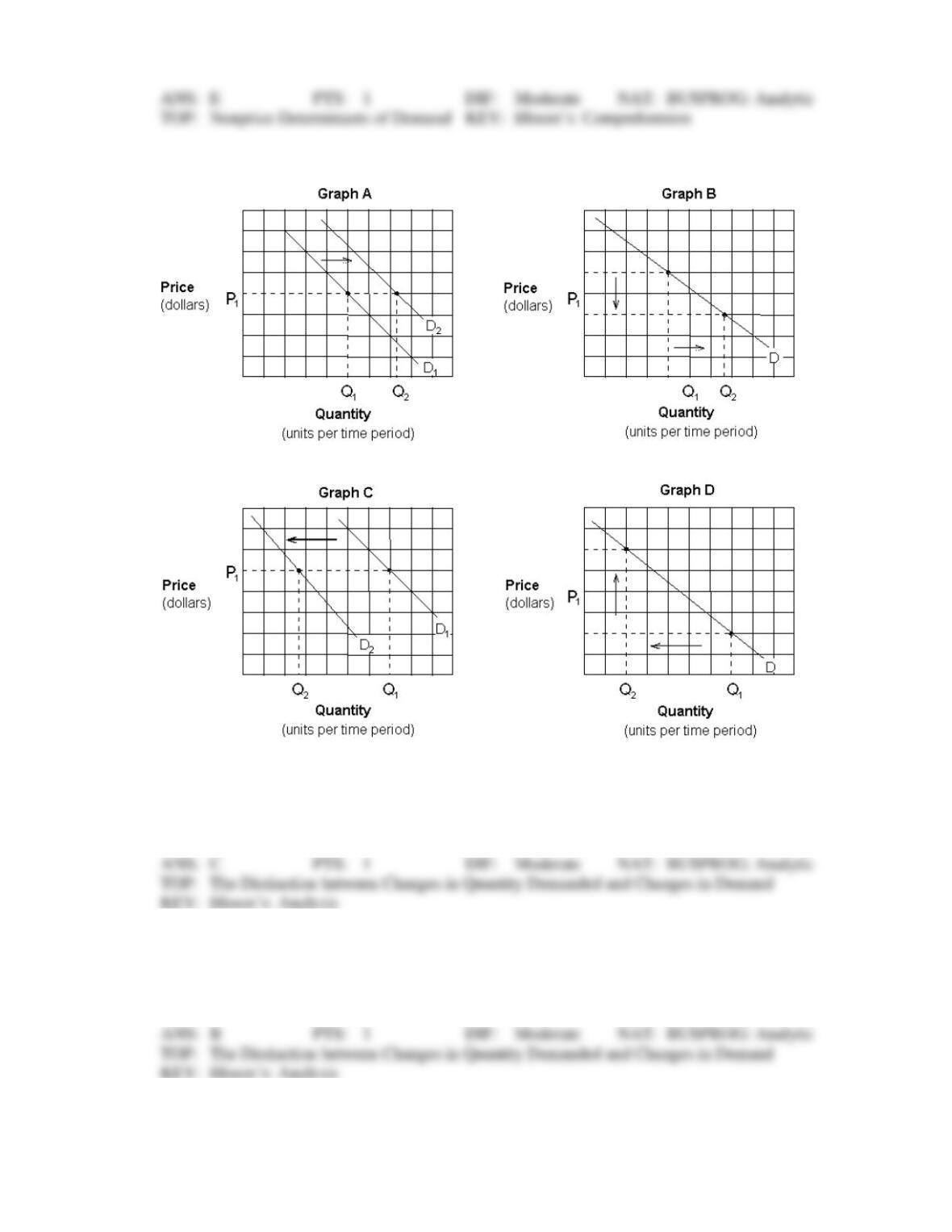
Exhibit 3-3 Demand curves
161. Which of the graphs in Exhibit 3-3 depicts the effect of a decrease in the price of domestic cars on the
demand for foreign cars?
a.
Graph A.
c.
Graph C.
b.
Graph B.
d.
Graph D.
162. Which of the graphs in Exhibit 3-3 depicts the effect of a decrease in the price of pizza on the demand
curve for pizza?
a.
Graph A.
c.
Graph C.
b.
Graph B
d.
Graph D.
163. Assume that crackers and soup are complementary goods. Which of the graphs in Exhibit 3-3 depicts
the effect of a promotional discount that decreases the price of crackers on the demand for soup?
a.
Graph A.
c.
Graph C.
b.
Graph B.
d.
Graph D.
164. Which of the graphs in Exhibit 3-3 depicts the effect of an increase in income on the demand for
DVDs (a normal good)?
a.
Graph A.
c.
Graph C.
b.
Graph B.
d.
Graph D.
165. Which of the graphs in Exhibit 3-3 depicts the effect of an increase in income on the demand for pork
and beans (an inferior good)?
a.
Graph A.
c.
Graph C.
b.
Graph B.
d.
Graph D.
166. Assume that consumers expect the price of gasoline to rise sharply in the future. Which of the graphs
in Exhibit 3-3 depicts this effect?
a.
Graph A.
c.
Graph C.
b.
Graph B.
d.
Graph D.
167. According to the law of supply:
a.
producers are willing to supply larger amounts of a good as its price increases.
b.
a direct relationship exists between the price of a good and the amount buyers choose to
buy.
c.
an inverse relationship exists between the price of a good and the amount buyers wish to
buy.
d.
an inverse relationship exists between the price of a good and the amount producers
supply.
168. According to the law of supply:
a.
more of a good is desired by consumers as the price falls.
b.
less of a good is desired by consumers as the price rises.
c.
more of a good will be offered by suppliers as the price rises.
d.
less of a good will be offered by suppliers as the price rises.
169. Which of the following states the definition of supply?
a.
More of a good is supplied at a lower price.
b.
There is a positive relationship between the price of a good and the quantity that buyers
purchase.
c.
There is a positive relationship between the price of a good and the quantity offered for
sale by suppliers.
d.
There is a negative relationship between the price of a good and the quantity offered for
sale by suppliers.
170. In general, supply curves slope upward because:
a.
increases in the price of a good result in lower opportunity costs.
b.
rising prices provide producers with a greater profit incentive.
c.
consumers buy a greater quantity.
d.
technology improves the ability of firms to produce more at each possible price.
171. According to the law of supply, there is a direct relationship between quantity supplied and:
a.
the number of sellers.
c.
technology.
b.
costs of resources.
d.
the price of the good.
172. In accordance with the law of supply, both individual and market supply curves are drawn:
a.
horizontal.
c.
downward-sloping.
b.
vertical.
d.
upward-sloping.
173. The law of supply states that:
a.
there is a negative relationship between the price of a good and the quantity of it
purchased by suppliers.
b.
there is a positive relationship between the price of a good and the quantity that buyers
choose to purchase.
c.
there is a positive relationship between the price of a good and the quantity of it offered
for sale by suppliers.
d.
at a lower price, a greater quantity will be supplied.
174. Supply curves slope upward because:
a.
the quality is assumed to vary with price.
b.
technology improves over time, increasing the ability of firms to produce more at each
possible price.
c.
increases in the price of a good lead to rightward shifts of the supply curve.
d.
rising prides provide producers with the incentives needed to increase the quantity
supplied.
175. A supply schedule shows the relationship between:
a.
demand and supply.
b.
supply and income.
c.
price and income.
d.
quantity supplied and price.
e.
income and quantity supplied.
176. The supply schedule shows the specific quantity of a good that suppliers are willing and able to:
a.
demand at various prices.
b.
produce at various costs.
c.
hold back from the market when competition is reduced.
d.
provide at different prices.
e.
demand at various costs.
177. Tasha decides that when homes in her neighborhood are selling for $150,000 she will not sell her
home. When average prices rise to $175,000, she decides that she will put her home on the market.
This is an example of:
a.
market demand.
b.
market-day supply.
c.
an excess supply of homes.
d.
a positively-sloped supply curve.
e.
a negatively-sloped supply curve.
178. Which of the following corresponds to the definition of the supply curve?
a.
It depicts a positive relationship between income and quantity supplied.
b.
It depicts a positive relationship between technology and prices.
c.
It depicts a positive relationship between prices and quantity supplied.
d.
It depicts a negative relationship between prices and quantity supplied.
e.
It depicts a proportional relationship between prices and quantity supplied.
179. The supply curve reflects the:
a.
inverse relationship between price and quantity offered.
b.
positive relationship between demand and supply.
c.
negative relationship between price and quantity bought.
d.
positive relationship between price and quantity bought.
e.
positive relationship between price and quantity offered.
180. A supply curve:
a.
has a negative slope.
b.
is based on the assumption of a stable demand curve.