Appendix to Chapter 16—Policy Disputes Using the Self-Correcting Aggregate
Demand and Supply Model
MULTIPLE CHOICE
1. Classical theory advocates ____ policy and Keynesian theory advocates ____ policy.
a.
nonintervention; intervention
c.
stabilization; fixed wage
b.
active; nonstabilization
d.
fixed rule; passive
2. Assuming the economy is experiencing a recessionary gap, classical economists predict that:
a.
wages will remain fixed.
b.
monetary policy will sell government securities.
c.
higher wages will shift the short-run aggregate supply curve leftward.
d.
lower wages will shift the short-run aggregate supply curve rightward.
e.
none of these.
3. Assume the economy is operating at a real GDP above full-employment real GDP. Keynesian
economists would prescribe which of the following policies?
a.
Nonintervention
c.
Contractionary
b.
Fixed rule
d.
Expansionary
4. A policy to do nothing and allow the economy to self-correct or adjust without interference from the
federal government is also called a(n) ____ policy.
a.
Nonintervention
c.
Stabilization
b.
Active
d.
fixed rule
5. Assume the economy is experiencing a recessionary gap. Keynesian economists would support which
of the following policies?
a.
Nonstabilization
c.
Nonintervention
b.
Expansionary
d.
Fixed wage
6. Assume the economy is in short-run equilibrium at a real GDP below its potential real GDP.
According to Keynesian theory, which of the following policies should be followed?
a.
The Federal Reserve should increase the money supply.
b.
The federal government should increase spending.
c.
The federal government should do nothing because the economy will self correct to
potential real GDP.
d.
All of these.
7. Assuming the economy is in a recession, Keynesian economists predict that:
a.
wages will remain fixed.
b.
monetary policy will sell government securities.
c.
higher wages will shift the short-run aggregate supply curve leftward.
d.
lower wages will shift the short-run aggregate supply curve rightward.
8. Assume the economy is operating at a real GDP above full-employment real GDP. Classical
economists would prescribe which of the following policies?
a.
Nonintervention
c.
Contractionary
b.
Active monetary policy
d.
Expansionary
9. Assume the economy is in short-run equilibrium at a real GDP above its potential real GDP.
According to classical theory, which of the following policies should be followed?
a.
The Federal Reserve should use open market operations and buy U.S. government
securities.
b.
The Federal Reserve should not follow a fixed rule.
c.
The federal government should cut taxes.
d.
Fiscal policy and monetary policy should not be activist.
10. Assume the economy is experiencing an inflationary gap, classical economists believe that:
a.
flexible wages will restore full employment.
b.
the federal government should decrease spending to shift the aggregate demand curve
leftward.
c.
the Federal Reserve should lower the interest rate.
d.
the federal government should increase spending to shift the aggregate demand curve
rightward.
Exhibit 16A-1 Policy Alternatives
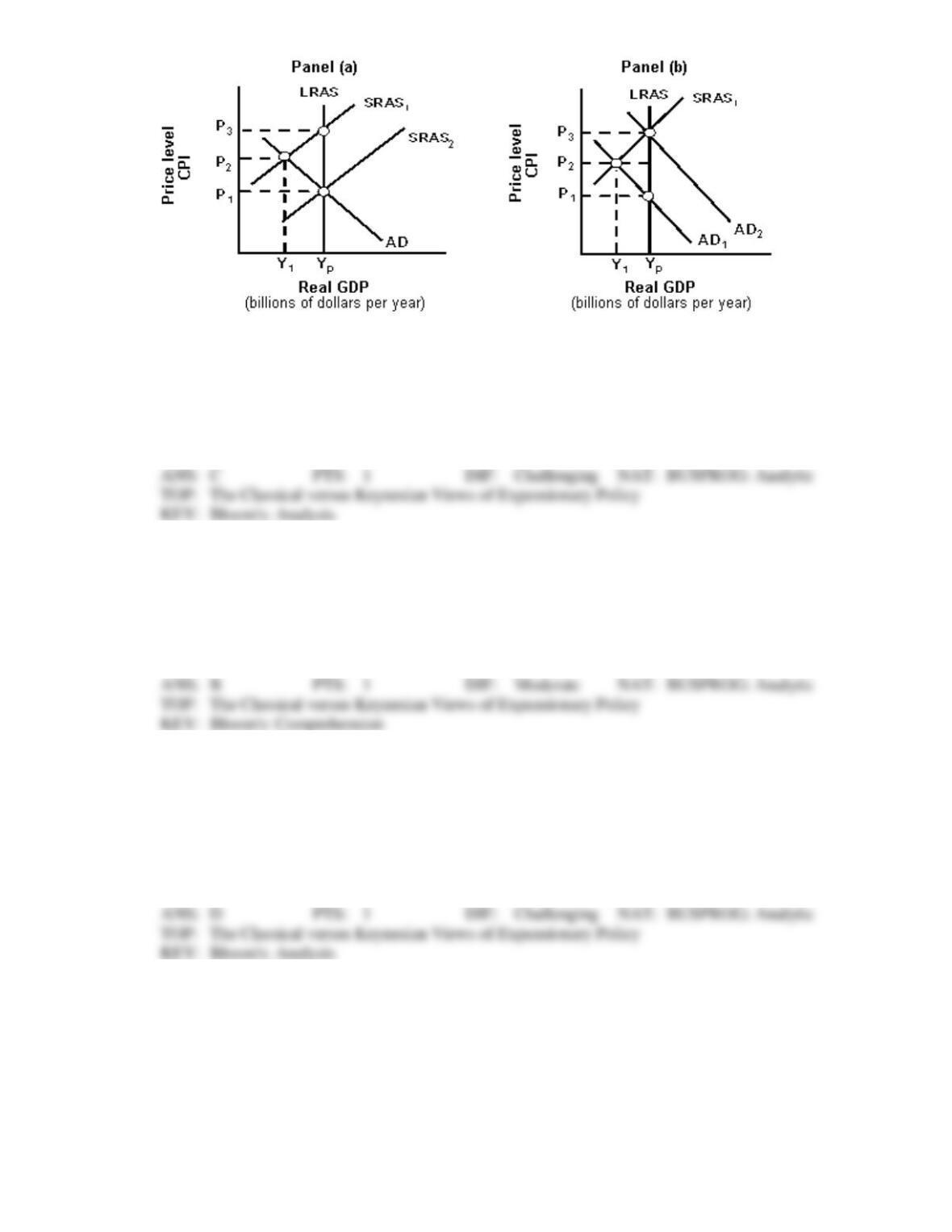
11. In Panel (a) of Exhibit 16A-1, the economy is initially in short-run equilibrium at real GDP level Y1
and price level P2. Classical theory argues:
a.
the federal government must shift AD1 to AD2 as shown in Panel (b).
b.
the federal government must shift SRAS1 to SRAS2.
c.
that SRAS1 will shift to SRAS2 without government intervention.
d.
that AD will shift rightward without government intervention.
12. Assume that the economy depicted in Panel (a) of Exhibit 16A-1 is in short-run equilibrium where AD
equals SRAS1. If the economy is left to correct itself according to classical theory:
a.
wages will fall as long as real GDP is above Yp.
b.
lower wages will result in a shift from SRAS1 to SRAS2.
c.
long-run equilibrium will be established at Yp and P3.
d.
all of these will take place.
13. Assume that the economy depicted in Panel (b) of Exhibit 16A-1 is in short-run equilibrium where
AD1 equals SRAS1. Keynesian theory argues:
a.
nominal wages will fall as long as employment remains above the natural level of
unemployment.
b.
lower wages will result in a shift from SRAS1 to SRAS2.
c.
long-run equilibrium will be established at Yp and P1.
d.
government intervention must shift AD1 rightward to AD2.
14. In Panel (b) of Exhibit 16A-1, the economy is initially in short-run equilibrium at real GDP level Y1
and price level P2. If the federal government decides to intervene, it would most likely:
a.
increase taxes.
b.
decrease the money supply.
c.
increase the level of government spending for goods and services.
d.
decrease the level of government spending for goods and services.
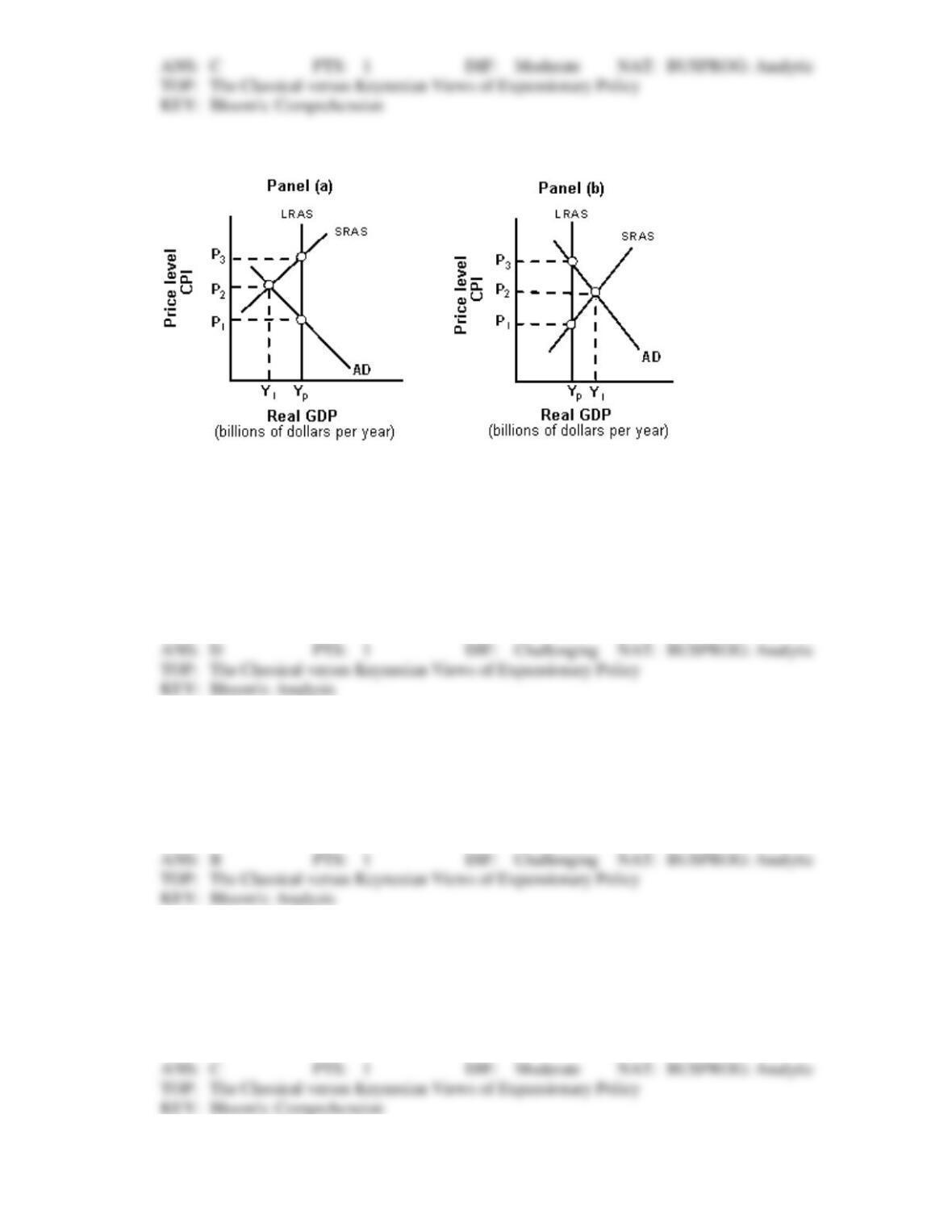
Exhibit 16A-2 Macro AD/AS Models
15. As shown in Panel (a) of Exhibit 16A-2, assume the economy adopts a classical nonintervention
policy. Which of the following would cause the economy to self-correct?
a.
Competition among firms for workers increases the nominal wage and SRAS shifts
rightward.
b.
Long-run equilibrium will be established at Y1 and P2.
c.
Long-run equilibrium will be established at Y1 and P3.
d.
Competition among unemployed workers decreases nominal wages and SRAS shifts
rightward.
16. In Panel (a) of Exhibit 16A-2, an expansionary Keynesian government stabilization policy designed to
move the economy from Y1 to Yp would shift the:
a.
aggregate demand curve (AD) to the left.
b.
aggregate demand curve (AD) to the right.
c.
SRAS rightward.
d.
LRAS rightward.
17. In Panel (a) of Exhibit 16A-2, the economy is initially in short-run equilibrium at real GDP level Y1
and price level P2. If the federal government or Fed decides to intervene, it would most likely:
a.
increase taxes.
b.
decrease the money supply.
c.
increase the level of government spending for goods and services.
d.
decrease the level of government spending for goods and services.
18. In Panel (a) of Exhibit 16A-2, the economy is initially in short-run equilibrium at real GDP level Y1
and price level P2. Classical theory argues that:
a.
SRAS will shift to leftward and establish full employment at P3Yp without government
intervention.
b.
higher wages will result in a leftward shift of SRAS.
c.
long-run equilibrium will be established at Yp and P1.
d.
all of these will take place.
19. In Panel (b) of Exhibit 16A-2, the economy is initially in short-run equilibrium at real GDP level Y1
and price level P2. If the federal government or Fed decides to intervene, it would most likely:
a.
decrease taxes.
b.
increase the money supply.
c.
increase the level of government spending for goods and services.
d.
decrease the level of government spending for goods and services.
20. In Panel (b) of Exhibit 16A-2, the economy is initially in short-run equilibrium at real GDP level Y1
and price level P2. Classical theory argues that:
a.
SRAS will shift to leftward and establish full employment at P3Yp without government
intervention.
b.
higher wages will result in a leftward shift of SRAS.
c.
long-run equilibrium will be established at Y and P3.
d.
all of these will take place.
21. In Panel (b) of Exhibit 16A-2, a Keynesian expansionary stabilization policy designed to move the
economy from Y1 to Yp would attempt to shift the:
a.
aggregate demand curve (AD) leftward.
c.
aggregate demand curve (AD) rightward.
b.
SRAS curve leftward.
d.
LRAS curve rightward.
22. As shown in Panel (b) of Exhibit 16A-2, assume the economy adopts a classical nonintervention
policy. Which of the following would cause the economy to self-correct?
a.
Competition among firms for workers increases the nominal wage and SRAS shifts
rightward.
b.
Long-run equilibrium will be established at Y1 and P2.
c.
Long-run equilibrium will be established at Yp and P3.
d.
Competition among unemployed workers decreases nominal wages and SRAS shifts
rightward.
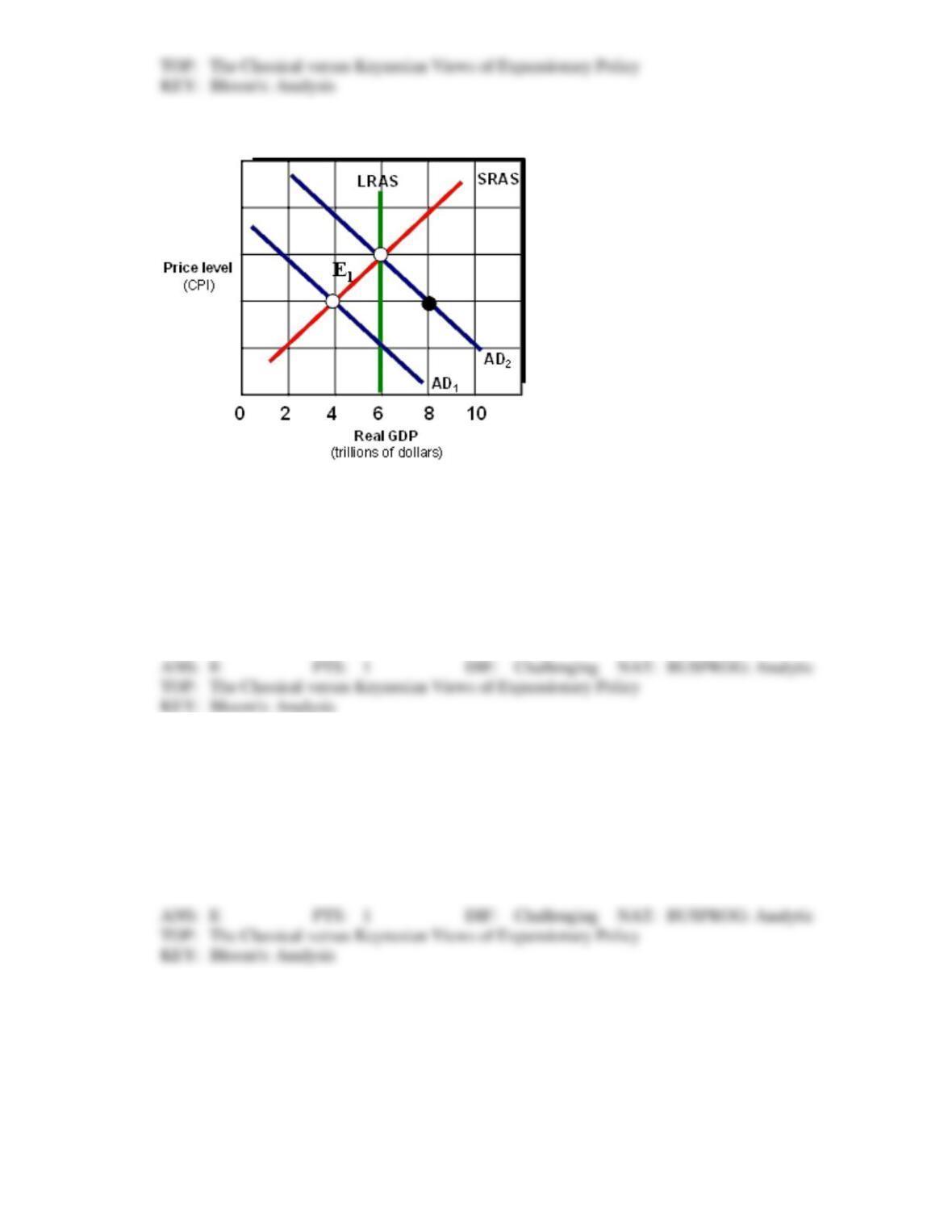
Exhibit 16A-3 Macro AD/AS Models
23. As shown in Exhibit 16A-3, assume the marginal propensity to consume MPC equals 0.80. Using
discretionary fiscal policy, federal government spending should be ____ in order to restore the
economy from E1 to full employment.
a.
increased by $2 trillion
b.
decreased by $2 trillion
c.
decreased by $.40 trillion
d.
increased by $.40 trillion
e.
increased by $.80 trillion
24. As shown in Exhibit 16A-3, assume the marginal propensity to consume MPC equals 0.75. Using
discretionary fiscal policy, federal government spending should be ____ in order to restore the
economy from E1 to full employment.
a.
increased by $1 trillion
b.
increased by $2 trillion
c.
decreased by $2 trillion
d.
increased by $.50 trillion
e.
increased by $.80 trillion
Exhibit 16A-4 Macro AD/AS Models
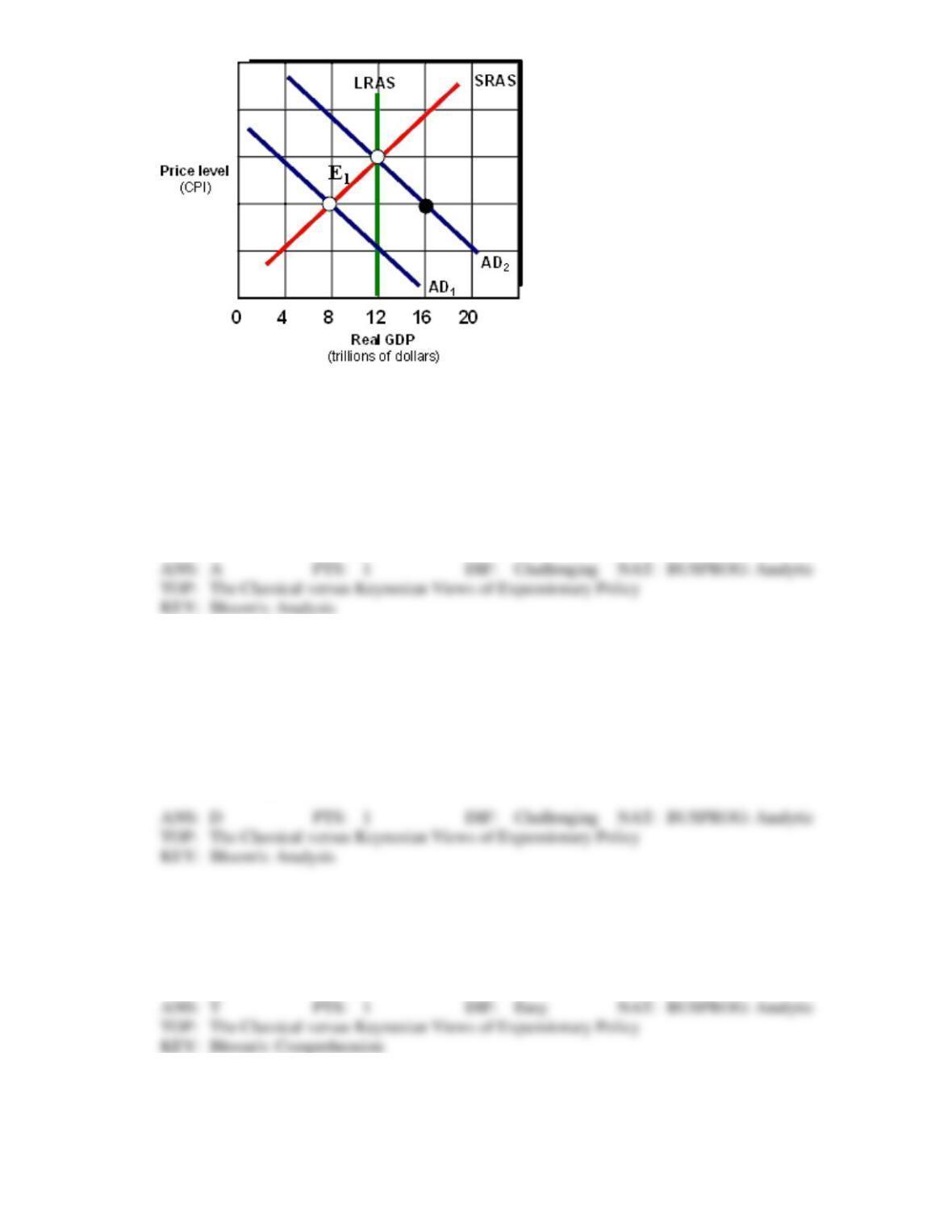
25. As shown in Exhibit 16A-4, assume the marginal propensity to consume MPC equals 0.80. Using
discretionary fiscal policy, federal government spending should be ____ in order to restore the
economy from E1 to full employment.
a.
increased by $1.6 trillion
b.
decreased by $1.6 trillion
c.
increased by $.20 trillion
d.
increased by $.20 trillion
e.
increased by $.80 trillion
26. As shown in Exhibit 16A-4, assume the marginal propensity to consume MPC equals 0.75. Using
discretionary fiscal policy, federal government spending should be ____ in order to restore the
economy from E1 to full employment.
a.
increased by $.25 trillion
b.
decreased by $.25 trillion
c.
decreased by $2 trillion
d.
increased by $2 trillion
e.
increased by $1 trillion
TRUE/FALSE
1. If the economy is not operating at full-employment real GDP, classical economists prescribe a
government policy of nonintervention.
2. Assuming an inflationary gap exists, classical economists believe that flexible wages will restore full
employment.
3. If the economy is experiencing an inflationary gap, classical economists argue that the Federal Reserve
should lower interest rates.
4. Assuming the economy is in a recession, Keynesian economists predict that lower wages will shift the
short-run aggregate supply curve rightward.
5. If the economy is experiencing an inflationary gap, Keynesian economists advocate allowing flexible
wages to shift the short-run aggregate supply curve (SRAC) upward and restore full employment.