a.
be ineffective, even in the short run.
b.
be effective in the short run but ineffective in the long run.
c.
be effective both in the short run and long run.
d.
make it possible to trade-off a higher rate of inflation for a lower rate of unemployment.
65. If the government accelerates money supply growth and enlarges the budget deficit to stimulate
aggregate demand, the rational expectations hypothesis indicates that decision makers will:
a.
ignore the policy until it exerts an observable impact on prices, output, and employment.
b.
quickly take steps to adjust their decision making in light of the more expansionary
policies.
c.
be fooled at the outset but eventually adjust their decision making in accordance with the
change in policy.
d.
be unaware that this policy change has been implemented until a higher rate of inflation is
observed.
66. The rational expectations theory indicates that expansionary policy will:
a.
stimulate real output in the long run but not in the short run.
b.
expand real output and employment if the public quickly anticipates the effects of the
expansionary policy.
c.
equalize real and nominal interest rates during lengthy periods of inflation.
d.
fail to increase employment because individuals will anticipate it and take actions that will
offset its impact.
67. The hypothesis that people use all available information to predict the future is known as:
a.
rational expectations.
c.
lagged expectations.
b.
adaptive expectations.
d.
trend expectations.
68. If people behave according to rational expectations theory, people would expect the rate of inflation
this year to be:
a.
the same as last year.
b.
zero, regardless of the rate last year.
c.
the rate based on predictable monetary and fiscal policies.
d.
All of these.
69. According to rational expectations theory, predictable expansionary monetary and fiscal policies to
reduce the unemployment rate are:
a.
desirable because the result is to lower inflation.
b.
harmful because the only result is higher inflation.
c.
ineffective on the price level.
d.
None of these.
70. According to rational expectations theory, which of the following is the best approach to lower the
inflation rate?
a.
Preannounced stable government policies.
b.
Unpredictable government policies.
c.
First predictable and then unpredictable government policies.
d.
None of these.
71. “Preannounced, stable policies to achieve a low and constant money supply growth and a balanced
federal budget are therefore the best way to lower the inflation rate.” This statement best illustrates the:
a.
Keynesian theory.
c.
incomes policy.
b.
rational expectations theory.
d.
supply-side theory.
72. Which of the following models emphasizes the importance of credible, predictable government
policies for maintaining full employment with low inflation?
a.
The monetarist model.
c.
The supply-side model.
b.
The Keynesian model.
d.
The rational expectations model.
73. According to rational expectations theory, what information do businesses and workers use when they
form their expectations regarding inflation?
a.
Recent events and data.
b.
Keynesian and monetarist models.
c.
Forecasts by public-and private-sector economists.
d.
All the relevant information that is available.
74. This school of thought argues that because people anticipate the consequences of announced
government policy and incorporate these anticipated consequences into their present decision making,
people end up undermining the government policy. What is it?
a.
Neo-Keynesian.
b.
Keynesian.
c.
Monetarist.
d.
Supply-side.
e.
Rational expectations.
75. According to rational expectations theory,
a.
there is absolutely nothing government can do, even in the short run, to reduce the
economy’s unemployment rate.
b.
the government can use fiscal policy such as increased government spending or lower tax
rates to reduce unemployment.
c.
a modern extension of Keynesian economics exists.
d.
discretionary fiscal policy is essential for prolonged growth.
e.
market participants can be fooled in the long run by monetary and fiscal policy rules.
76. According to the theory of rational expectations,
a.
workers’ experience tells them that government action to lower unemployment will not
affect inflation.
b.
consumers and investors generally behave so that rationally formed government attempts
to stimulate aggregate demand have their desired effects.
c.
policy goals can be achieved easily in the short run.
d.
workers’ wage demands include anticipated inflation.
e.
expansionary monetary policy will lead to permanent interest rate declines.
77. Which of the following groups believes that government policy is undermined by people’s
incorporation of the anticipated consequences of the policy into their present decisions?
a.
Classical school.
b.
Keynesian school.
c.
Neo-Keynesian school.
d.
Rational expectations school.
e.
Supply-side school.
78. The belief that the government can do absolutely nothing in either the short run or the long run to
reduce the unemployment rate, because people will anticipate the government’s actions, is held by the:
a.
rational expectations school.
b.
neo-Keynesian school.
c.
classical school.
d.
supply-side school.
e.
Keynesian school.
Exhibit 17-2 Aggregate demand and aggregate supply curves
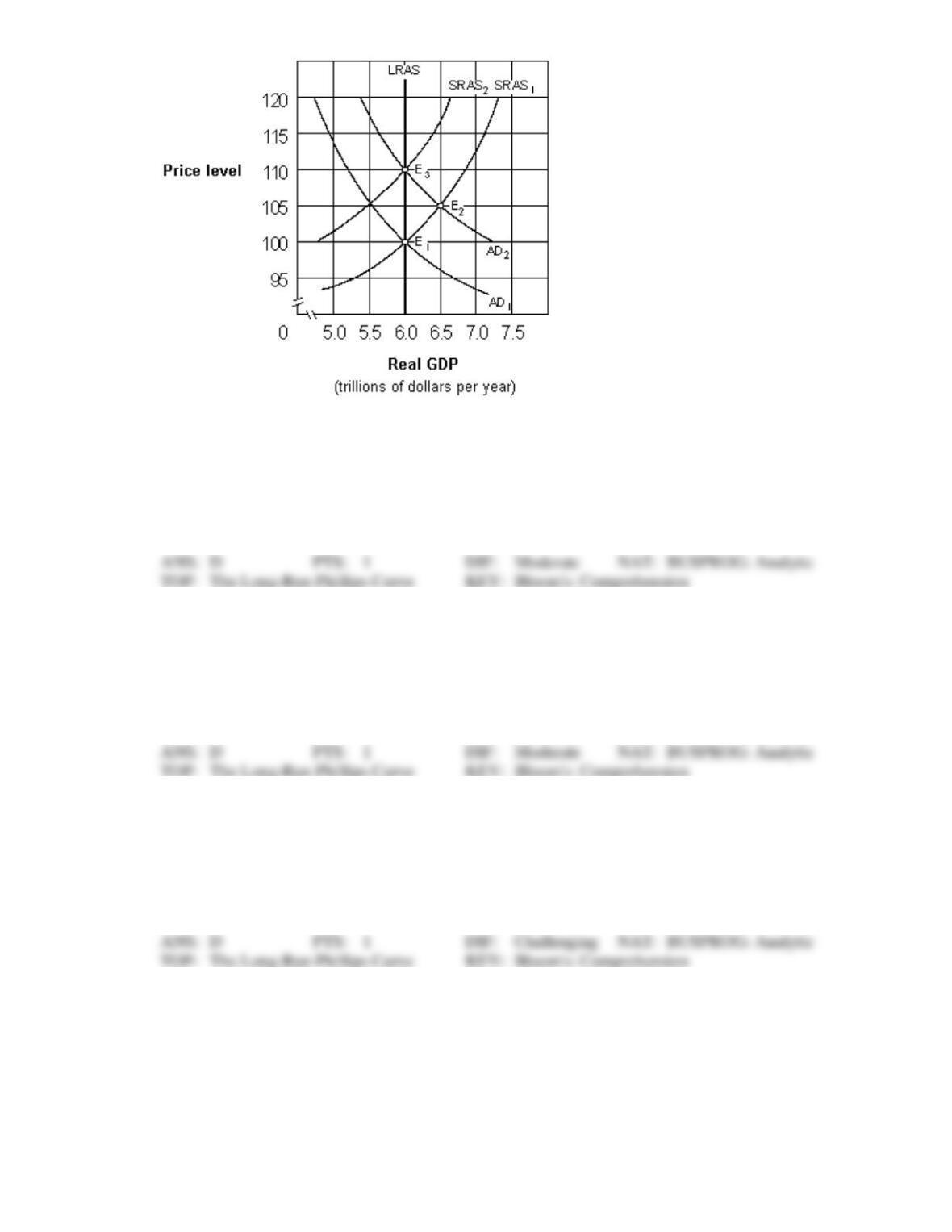
79. As shown in Exhibit 17-2, if people behave according to adaptive expectations theory, an increase in
the aggregate demand curve from AD1 to AD2 will cause the economy to move:
a.
directly from E1 to E3 and then remain at E3.
b.
directly from E1 to E2 and then remain at E2.
c.
from E1 to E2 initially and then eventually move back to E1.
d.
from E1 to E2 initially and then eventually move to E3.
80. As shown in Exhibit 17-2, if people behave according to adaptive expectations theory, an increase in
the aggregate demand curve from AD1 to AD2 will cause the price level to move:
a.
directly from 100 to 110 and then remain at 110.
b.
directly from 100 to 105 and then remain at 105.
c.
from 100 to 105 initially and then eventually move back to 100.
d.
from 100 to 105 initially and then eventually move to 110.
81. As shown in Exhibit 17-2, if people behave according to adaptive expectations theory, an increase in
the aggregate demand curve from AD1 to AD2 will cause:
a.
labor to adjust nominal wages sluggishly.
b.
the aggregate supply curve to shift from SRAS1 to SRAS2
c.
the price level to eventually rise from 100 to 110.
d.
All of these.
82. As shown in Exhibit 17-2, if people behave according to rational expectations theory, an increase in
the aggregate demand curve from AD1 to AD2 will cause the price level to move:
a.
directly from 100 to 105 and then remain at 105.
b.
directly from 100 to 110 and then remain at 110.
c.
from 100 to 105 initially and then eventually move back to 100.
d.
from 100 to 105 initially and then eventually move to 110.
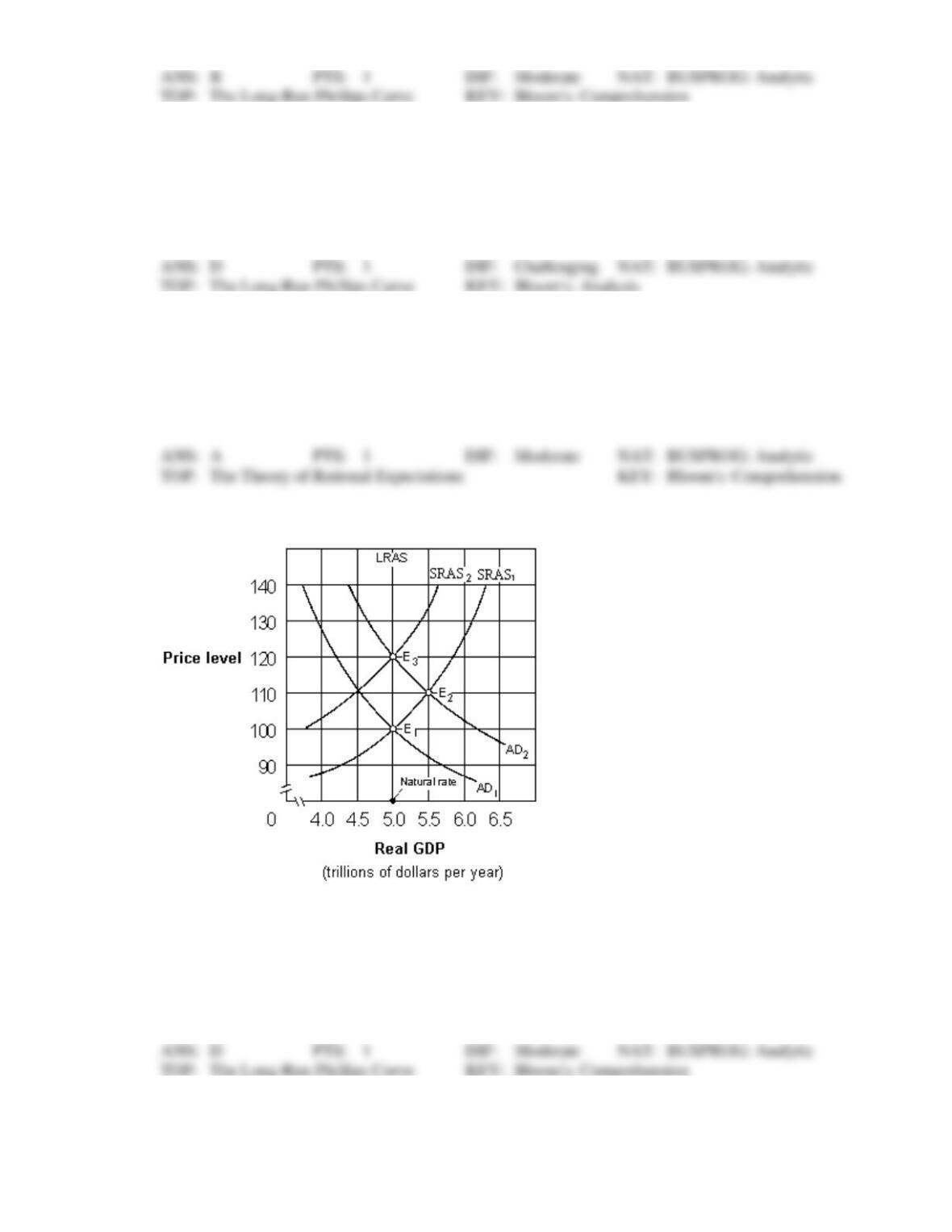
83. As shown in Exhibit 17-2, if people behave according to rational expectations theory, an increase in
the aggregate demand curve from AD1 to AD2 will cause:
a.
labor to adjust nominal wages sluggishly.
b.
the aggregate supply curve to remain at SRAS1.
c.
the price level to eventually rise from 100 to 110.
d.
none of these.
84. As shown in Exhibit 17-2, if people behave according to rational expectations theory, an increase in
the aggregate demand curve from AD1 to AD2 will cause the economy to move:
a.
directly from E1 to E3 and then remain at E3.
b.
directly from E1 to E2 and then remain at E2.
c.
from E1 to E2 initially and then eventually move back to E1.
d.
from E1 to E2 initially and then eventually move to E3.
Exhibit 17-3 Aggregate demand and aggregate supply curves
85. As shown in Exhibit 17-3, if people behave according to adaptive expectations theory, an increase in
the aggregate demand curve from AD1 to AD2 will cause the economy to move:
a.
from E1 to E2 initially and then eventually move back to E1.
b.
directly from E1 to E2 and then remain at E2.
c.
directly from E1 to E3 and then remain at E3.
d.
from E1 to E2 initially and then eventually move to E3.
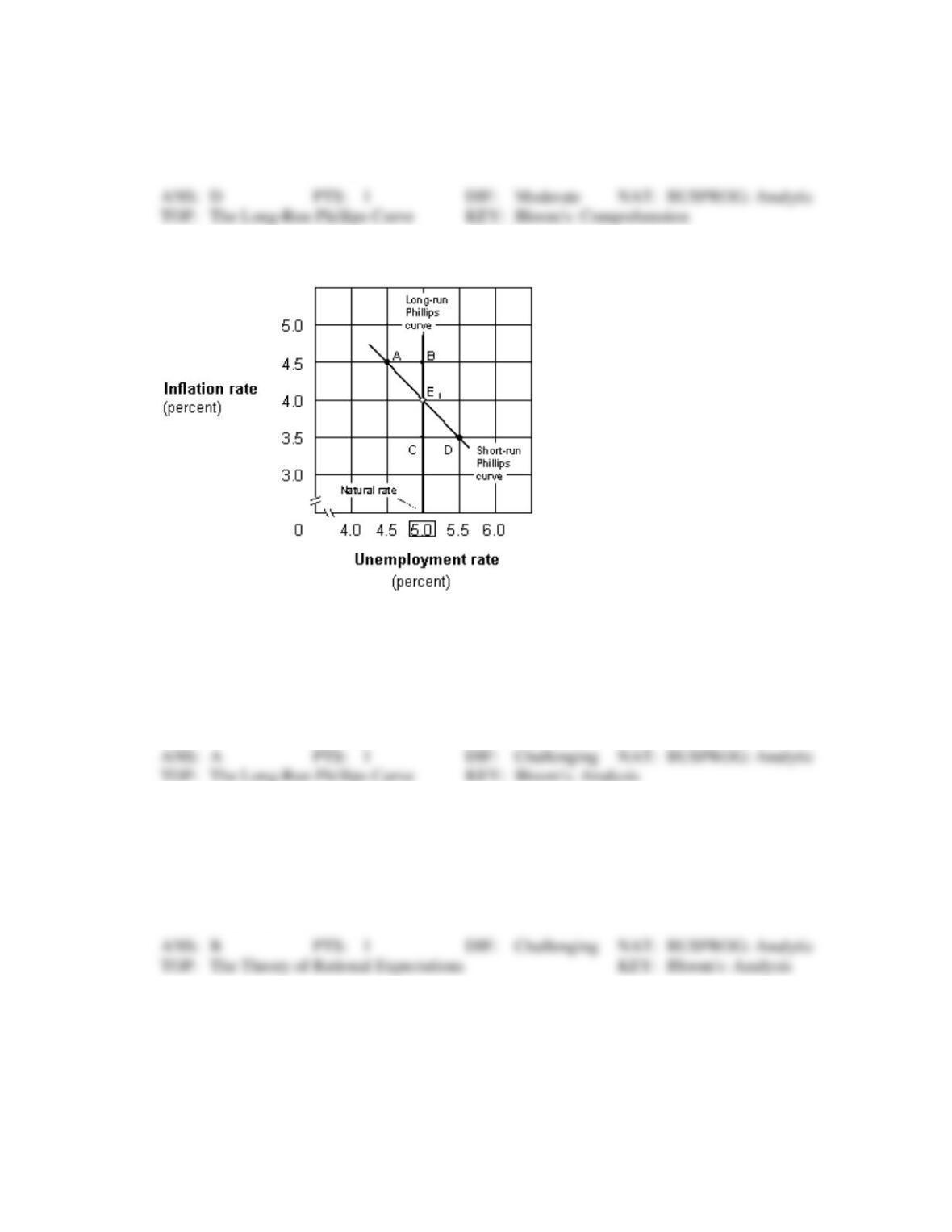
86. As shown in Exhibit 17-3, if people behave according to adaptive expectations theory, an increase in
the aggregate demand curve from AD1 to AD2 will cause the price level to move:
a.
from 100 to 110 initially and then eventually move back to 100.
b.
directly from 100 to 110 and then remain at 110.
c.
directly from 100 to 120 and then remain at 120.
d.
from 100 to 110 initially and then eventually move to 120.
Exhibit 17-4 Short-run and long-run Phillips curves
87. Suppose the economy in Exhibit 17-4 is at point E1, and the Fed increases the money supply. If people
have adaptive expectations, then the economy will move:
a.
to point A in the short run and point B in the long run.
b.
directly to point B.
c.
to point C in the short run and point D in the long run.
d.
directly to point D.
88. Suppose the economy in Exhibit 17-4 is at point E1, and the Fed increases the money supply. If people
have rational expectations, then the economy will move:
a.
to point A in the short run and point B in the long run.
b.
directly to point B.
c.
to point C in the short run and point D in the long run.
d.
directly to point D.
Exhibit 17-5 Short-run and long-run Phillips curve
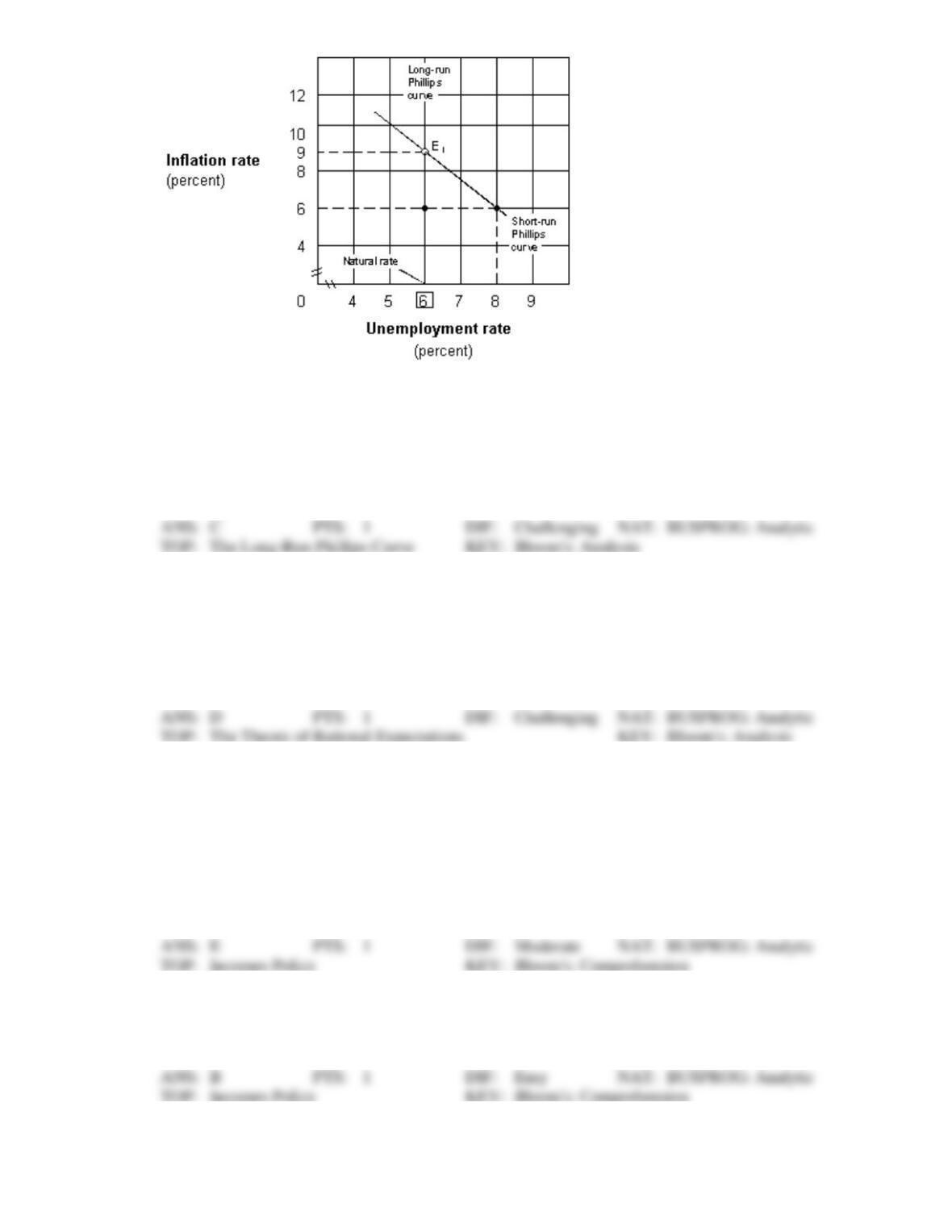
89. Suppose the government shown in Exhibit 17-5 uses contractionary monetary policy to reduce
inflation from 9 to 6 percent. If people have adaptive expectations, then:
a.
the economy will remain stuck at point E1.
b.
the natural rate will permanently increase to 8 percent.
c.
unemployment will rise to 8 percent in the short run.
d.
unemployment will remain at 6 percent as the inflation rate falls.
90. Suppose the government shown in Exhibit 17-5 uses contractionary monetary policy to reduce
inflation from 9 to 6 percent. If people have rational expectations, then:
a.
the economy will remain stuck at point E1.
b.
the natural rate will permanently increase to 8 percent.
c.
unemployment will rise to 8 percent in the short run.
d.
unemployment will remain at 6 percent as the inflation rate falls.
91. Which of the following statements is true?
a.
A political business cycle is one created by the incentive for politicians to manipulate the
economy to get re-elected.
b.
Adaptive expectations theory argues that the best indicator of the future is recent
information.
c.
Incomes policies tend to be ineffective over time.
d.
Incomes policies include jawboning, wage-price guidelines, and wage-price controls.
e.
All of these.
92. Which of the following is not an example of an incomes policy?
a.
Presidential jawboning.
c.
Wage and price guidelines.
b.
Unemployment insurance.
d.
Wage and price controls.
93. In the United States, the most recent use of wage and price controls occurred during the:
a.
Nixon administration.
c.
Reagan administration.
b.
Carter administration.
d.
Clinton administration.
94. Incomes policies of the federal government include:
a.
presidential jawboning.
c.
wage-price controls.
b.
wage-price guidelines.
d.
All of these.
95. Most economists consider the case for jawboning to control inflation is strongest when this policy is
used:
a.
for a long period of time.
c.
to combat cost-push inflation.
b.
to combat inflation that is out of control.
d.
All of these are true.
96. Wage and price controls imposed for an extended period of time are likely to result in:
a.
shortages.
c.
black markets.
b.
rationing.
d.
All of these.
TRUE/FALSE
1. The Phillips curve represents a direct relationship between the inflation rate and the unemployment
rate.
2. During the 1960s, the inflation rate and the unemployment rate were inversely related.
3. U.S. macroeconomic data show that a stable Phillips curve existed during the 1960s.
4. The Phillips curve represents an inverse relationship between the inflation rate and the unemployment
rate.
5. During the 1970s, the inflation rate and the unemployment rate were inversely related.
6. According to the natural rate hypothesis, the unemployment rate should equal 0 percent in the long
run.
7. The long-run Phillips curve is a upward-sloping line at the natural rate of unemployment.
8. The long-run Phillips curve is a vertical line at the natural rate of unemployment.
9. According to the adaptive expectations theory, people form their expectations of the future on the basis
of recent experiences.
10. According to the adaptive expectations theory, after many years of rising prices, people tend to ignore
past experience in predicting the future rate of inflation.
11. According to the adaptive expectations theory, people form their expectations of the future on the basis
of future expectations.
12. Rational expectations theory rejects the concept that only unanticipated or surprise policies can
influence inflation.
13. A preannounced contractionary money policy is more likely to create unemployment when people
have rational, rather than adaptive, expectations.
14. In the rational expectations model, only unexpected or unpredictable changes cause unemployment to
deviate from its natural rate.
15. Rational expectations theory is the concept that only unanticipated or surprise policies can influence
inflation.
16. Incomes policies are based on discretionary monetary and fiscal policies.
17. Incomes policies reject wage-price controls and guidelines.
18. The “WIN” button approach to breaking a wage-price spiral was proposed by President Ford to a joint
session of Congress.
19. Most economists agree that the government should use incomes policies to control inflation during
peacetime.
20. Compliance with wage and price controls by unions and businesses is strictly voluntary.
21. The “WIN” button approach to breaking a wage-price spiral was proposed by President Nixon to a
joint session of Congress.
ESSAY
1. If the economy is in recession, explain what advice you would give the President, if you were a
monetarist economist. What if you were a Keynesian?
2. What is the difference between the Keynesian and rational expectations theories concerning the
success of stabilization policy?
3. Explain why rational expectations theorists do not support government intervention to alleviate
unemployment. Explain their views on the effectiveness of fiscal policy and monetary policy.