d.
Total revenue increases by $15 when the price of corn dogs rises by $15.
e.
Total revenue increases by more than $15 when the price of corn dogs rises by $15.
95. A measure of sensitivity or responsiveness to changes in price or income is called:
a.
elasticity.
b.
technology.
c.
supply and demand.
d.
social pressure.
e.
kickback.
96. Elasticity is a measure of:
a.
the slope of a linear demand curve.
b.
the slope of a supply curve.
c.
relative responsiveness.
d.
economic welfare.
e.
consumer tastes.
97. Consider the market for bicycles. If a dealer cuts prices by 10 percent and sells 20 percent more bikes,
then demand for bicycles is:
a.
inelastic, and total revenue will increase.
b.
elastic, and total revenue will increase.
c.
inelastic, and total revenue will decrease.
d.
elastic, and total revenue will decrease.
e.
unit elastic, and total revenue will remain the same.
98. The percentage change in the quantity demanded of film divided by the percentage change in the price
of cameras indicates:
a.
the price elasticity of demand for film.
b.
the price elasticity of demand for cameras.
c.
the price elasticity of supply for film.
d.
the price elasticity of supply for cameras.
e.
nothing, because the two goods fall into the broadly defined category of photographic
equipment.
99. Governments can use price elasticity of demand to estimate how changes in excise tax rates will affect:
a.
income.
b.
prices.
c.
tax revenues.
d.
government spending.
e.
profits.
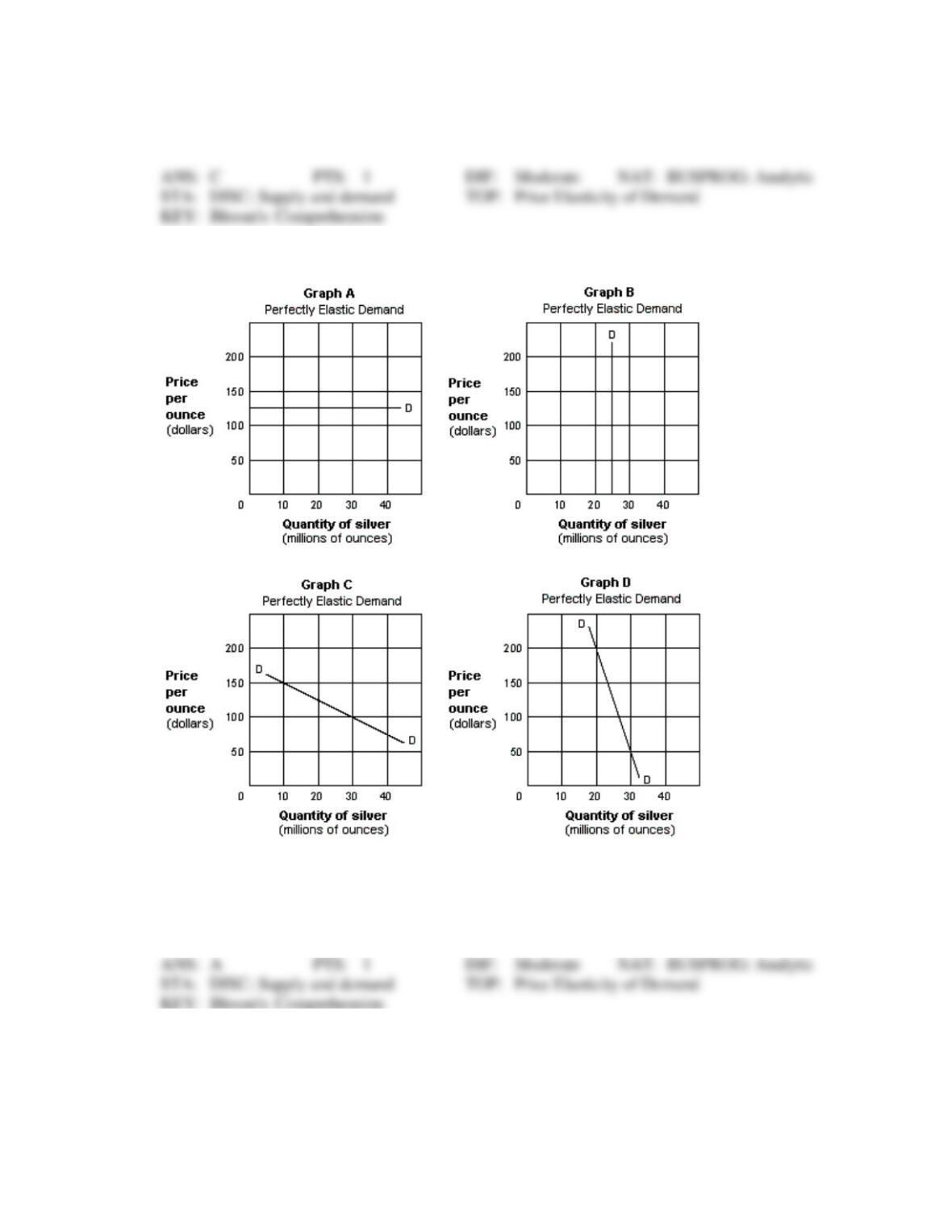
Exhibit 5-4 Demand curves for silver
100. Assume that a wealthy buyer, Mr. Hunt, declares that he will purchase any amount of silver at a price
of $125 an ounce. In Exhibit 5-4, which graph illustrates the shape of the demand curve for silver?
a.
Graph A.
c.
Graph C.
b.
Graph B.
d.
Graph D.
101. If the quantity of concert tickets sold decreases by 10 percent when the price increases by 5 percent,
the price elasticity of demand over this range of the demand curve is:
a.
price elastic.
c.
perfectly inelastic.
b.
price inelastic.
d.
unitary elastic.
102. \Suppose the quantity demanded of steak is 200 million pounds per year when the price is $6 per
pound and 400 million pounds per year when the price is $2 per pound. The price elasticity of demand
for steak over this range is:
a.
elastic.
b.
inelastic.
c.
unitary elastic.
d.
perfectly elastic.
e.
perfectly inelastic.
103. Suppose the Good Food supermarket increases the price of a pound of bananas from $.75 to $1.25 and
finds that the quantity of bananas it sells per month drops from 1,500 to 1,000. The price elasticity of
demand coefficient for bananas in this price range is:
a.
0.80.
c.
2.00.
b.
3.00.
d.
0.50.
104. Suppose the quantity demanded is 1,000 million bushels of peaches per year when the price is $3 per
bushel and 1,500 million bushels when the price is $1 per bushel. The price elasticity of demand in this
range of the demand curve is:
a.
elastic.
c.
unitary elastic.
b.
inelastic.
d.
infinitely elastic.
105. If a 5 percent decrease in the price of a good produces a 5 percent increase in the quantity demanded,
the price elasticity of demand is:
a.
perfectly elastic.
b.
perfectly inelastic.
c.
elastic.
d.
inelastic.
e.
unitary elastic.
106. Suppose there is no change in total revenue when the price changes. The demand curve for this
good is:
a.
perfectly elastic.
b.
perfectly inelastic.
c.
elastic.
d.
inelastic.
e.
unitary elastic.
107. Any change in price along a perfectly inelastic demand curve produces:
a.
greater change in the quantity demanded.
b.
less change in the quantity demanded.
c.
no change in the quantity demanded.
d.
infinite change in the quantity demanded.
108. A perfectly elastic demand curve has a price elasticity of demand coefficient of:
a.
zero.
b.
1.
c.
greater than 1, but less than infinity.
d.
less than 1, but greater than zero.
e.
infinity.
109. A demand curve that has constant price elasticity of demand coefficient equals to one at all points is
a(n):
a.
rectangular hyperbola.
c.
upward-sloping straight line.
b.
downward-sloping straight line.
d.
none of these.
Exhibit 5-5 Demand curve for computers
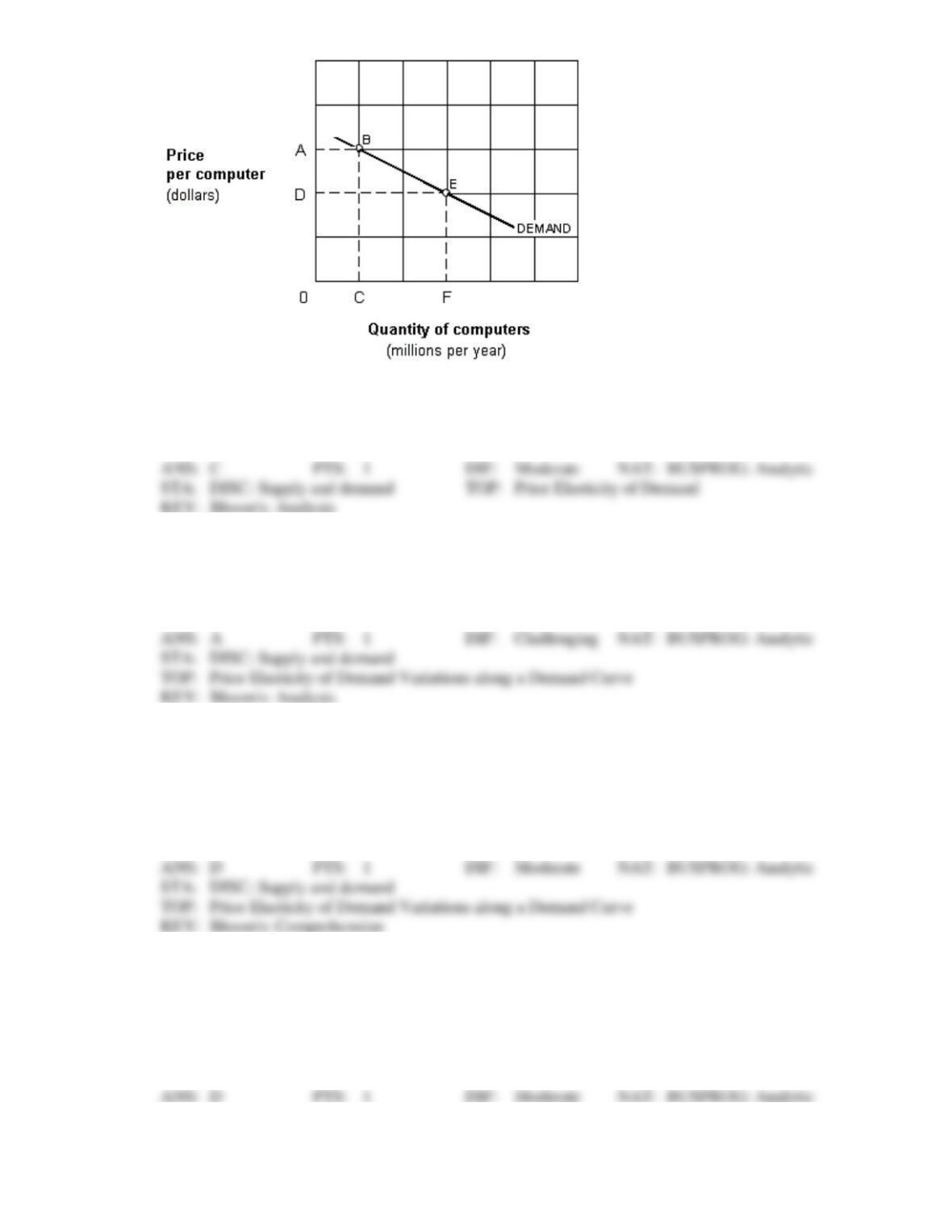
110. In Exhibit 5-5, if the area OABC equals the area ODEF, the demand curve is:
a.
elastic.
c.
unitary elastic.
b.
inelastic.
d.
nonelastic.
111. In Exhibit 5-5, the change in total revenue resulting from a change in price from A to D indicates that
the demand curve is:
a.
elastic.
c.
unitary elastic.
b.
inelastic.
d.
nonelastic.
112. In Exhibit 5-5, the total revenue at point B on the demand curve equals:
a.
OA.
b.
CB.
c.
AB.
d.
OABC.
e.
None of these.
113. In Exhibit 5-5, the total revenue at point E on the demand curve equals:
a.
OD.
b.
FE.
c.
DE.
d.
ODEF.
e.
None of these.
114. You are on a campus committee which sets the ticket prices for basketball games. The committee
wants to increase the total money generated from ticket sales. When should the committee choose to
lower its ticket prices?
a.
Always.
b.
Never.
c.
When demand for basketball tickets is elastic.
d.
When demand for basketball tickets is inelastic.
115. A 10 percent rise in the price of housing reduces the quantity demanded of housing by 3 percent. We
can conclude that the demand for housing is:
a.
inelastic.
c.
unitary elastic.
b.
elastic.
d.
perfectly elastic.
116. Suppose an oil company wants to make its total revenue as large as possible. It should charge a price at
which the demand for oil is:
a.
elastic.
c.
inelastic.
b.
unitary elastic.
d.
perfectly inelastic.
117. If a decrease in the price of football tickets increases the total revenue of the athletic department, this is
evidence that demand is:
a.
price elastic.
c.
unit elastic with respect to price.
b.
price inelastic.
d.
perfectly inelastic.
118. If the percentage change in the quantity demanded of a good is greater than the percentage change in
price, price elasticity of demand is:
a.
elastic.
c.
perfectly inelastic.
b.
inelastic.
d.
perfectly elastic.
119. Suppose the president of a textbook publisher argues that a 10 percent increase in the price of
textbooks will raise total revenue for the publisher. It can be concluded that the company president
thinks that demand for textbooks is:
a.
unitary elastic.
c.
elastic.
b.
inelastic.
d.
perfectly inelastic.
120. If the quantity of tickets to the fair sold decreases by 10 percent when the price increases by 5 percent,
the price elasticity of demand over this range of the demand curve is:
a.
price elastic.
c.
perfectly inelastic.
b.
price inelastic.
d.
unitary elastic.
121. There is no change in total revenue when the demand curve for a good is:
a.
unitary elastic.
b.
perfectly inelastic.
c.
elastic.
d.
inelastic.
e.
perfectly elastic.
122. If a good has a price elasticity of demand coefficient less than one, then:
a.
this good has an elastic demand.
b.
this good has an inelastic demand.
c.
a 10 percent increase in the price will result in a greater than 10 percent decrease in the
quantity demanded.
d.
the demand curve will be vertical.
123. If the price elasticity of demand coefficient equals 2 then:
a.
a 7 percent decrease in the price will result in a 14 percent decrease in the quantity
demanded.
b.
a price decrease will increase total revenue.
c.
the good has an inelastic demand.
d.
there is likely few substitutes, a short time period under consideration, or this good
accounts for a relatively small percentage of consumers’ budgets.
124. Which of the following statements is true?
a.
If the income elasticity of demand is less than zero, the good is an inferior good.
b.
Only if the demand curve is vertical will sellers raise the price by the full amount of a tax.
c.
Two goods are substitutes if the cross-elasticity of demand coefficient is positive.
d.
A price elasticity of supply coefficient equal to 1.5 means the product exhibits an elastic
supply and a 10 percent increase in the price will increase the quantity supplied by 15
percent.
e.
All of these.
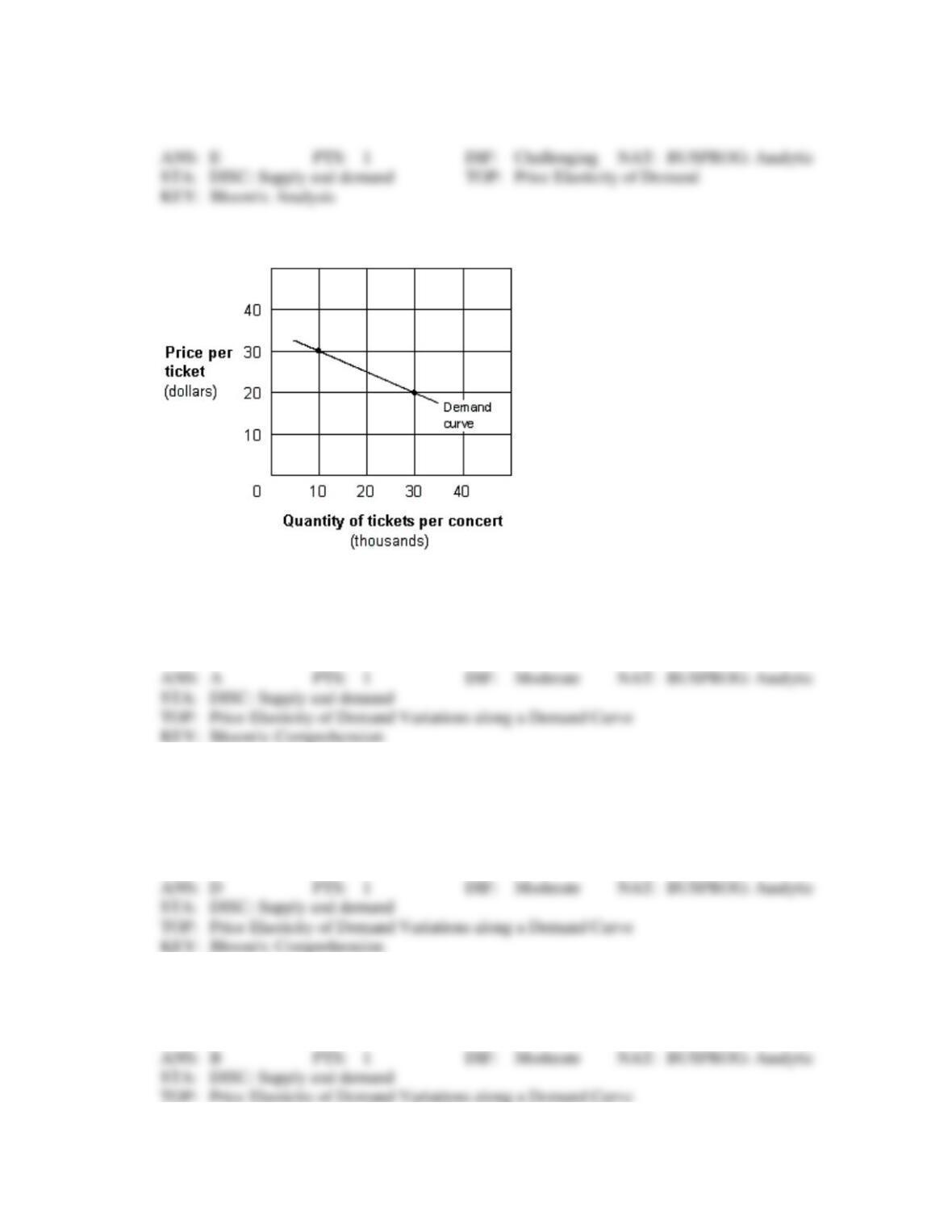
Exhibit 5-6 Demand curve for concert tickets
125. In Exhibit 5-6, suppose promoters charge a price of $30 per ticket. How much total revenue will their
sales generate?
a.
$300,000.
c.
$500,000.
b.
$400,000.
d.
$600,000.
126. In Exhibit 5-6, if promoters lower their ticket price form $30 to $20, then:
a.
they will receive less money from their ticket sales.
b.
people will continue to buy the same number of tickets.
c.
customers will spend less total money on concert tickets.
d.
both ticket sales and total revenue will rise.
127. In Exhibit 5-6, the demand curve for concert tickets shown above is classified as:
a.
inelastic.
c.
unitary elastic.
b.
elastic.
d.
cross elastic.
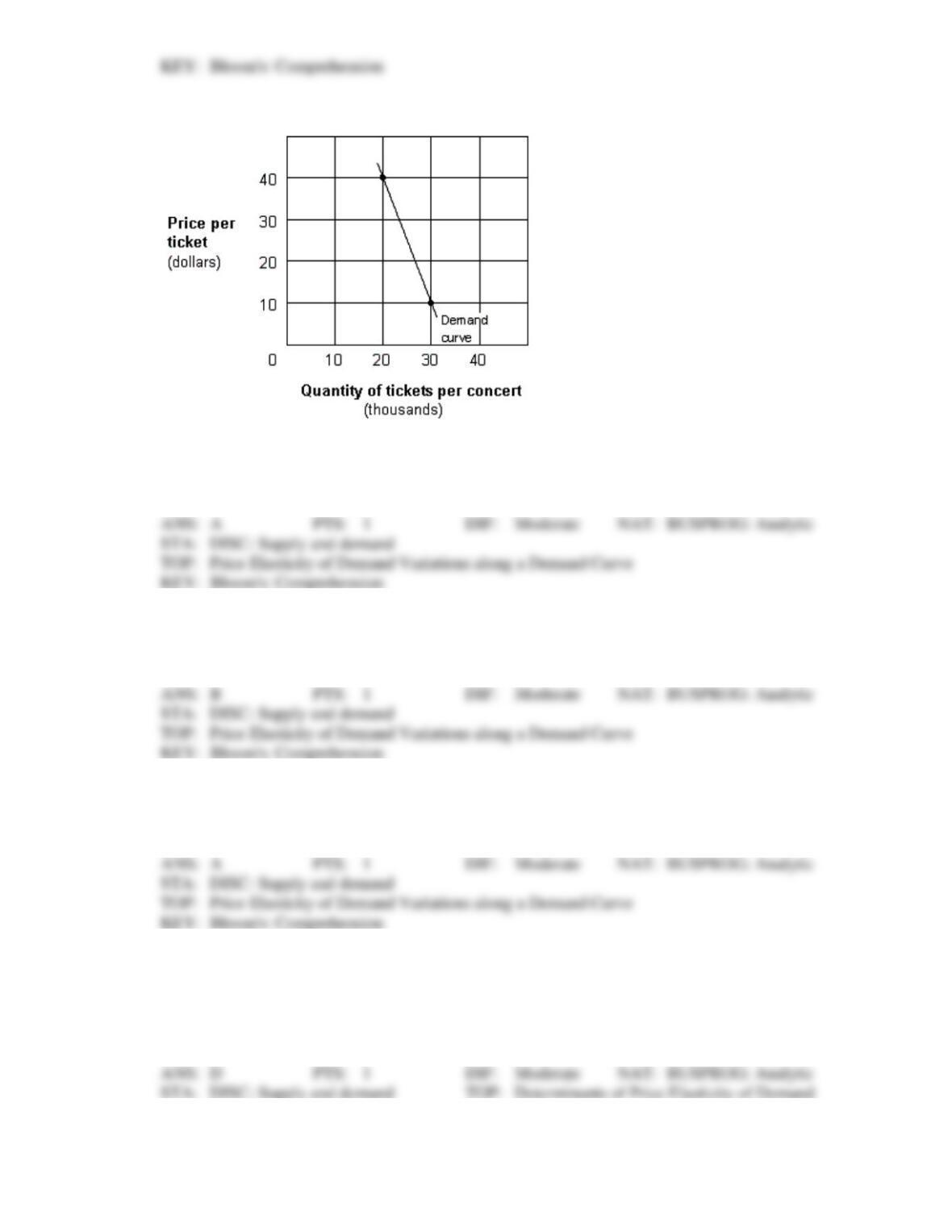
Exhibit 5-7 Demand curve for concert tickets
128. According to Exhibit 5-7, the demand for concert tickets is:
a.
inelastic.
c.
unitary elastic
b.
elastic.
d.
perfectly elastic.
129. In Exhibit 5-7, if promoters charge a price of $10 per ticket, then their total revenue is:
a.
$240,000.
c.
$333,333.
b.
$300,000.
d.
$800,000.
130. In Exhibit 5-7, if promoters raise their prices from $10 to $40 per ticket, then their total revenue will:
a.
increase.
c.
remain unchanged.
b.
decrease.
d.
react unpredictably.
131. The demand for a product is likely to be more elastic:
a.
the smaller the share of the total budget spent on the product.
b.
when more complementary products are available.
c.
in the short run than in the long run.
d.
when more good substitutes for the product are available.
132. Which of the following factors is associated with products with a highly price elastic demand?
a.
Few close substitutes.
b.
A very short time period for consumers to respond to price changes.
c.
Many very close substitutes.
d.
A per unit price that is only a very small portion of most peoples’ budgets.
133. Other things constant, the price elasticity of demand for a product will be smaller (more inelastic) if:
a.
people spend a large share of their income on the product.
b.
people spend an insignificant share of their income on the product.
c.
the population in the market area is large.
d.
there are many good substitutes for the product.
134. A product would be more demand price elastic:
a.
the shorter the time the consumer has to adjust to price changes.
b.
the lower the price of the good.
c.
the fewer the number of good substitutes.
d.
the less the essential nature of the good.
e.
if the supply is more price elastic.
135. A product would be more demand price inelastic:
a.
the shorter the time the consumer has to adjust to price changes.
b.
the higher the price of the good.
c.
the more the number of good substitutes.
d.
the less the essential nature of the good.
e.
if the supply is more price elastic.
136. The longer the time period under study,
a.
the more elastic is the price elasticity of demand.
b.
the less sensitive consumers will be to price changes.
c.
the less adjustment consumers will make to price changes.
d.
the more inelastic is the price elasticity of demand.
e.
the more likely any given price cut will result in a smaller reaction by the consumer.
137. Demand sensitivity depends on all of the following except:
a.
how low is the price of the good.
b.
the sensitivity of firms’ output to changes in its price.
c.
the consumer’s income.
d.
the availability and closeness of substitutes.
e.
the amount of time a consumer has to adjust to price changes.
138. In the short run, consumers typically ____ to price changes (when compared to the long run).
a.
are very responsive
b.
are more demand sensitive
c.
are less demand sensitive
d.
do not respond at all
e.
overreact
139. Which of the following events would increase the price elasticity of demand for Chicago Bears tickets
that sell at a price of $20?
a.
b and c.
b.
The Bears are having a successful season.
c.
The visiting team is having a successful season.
d.
The Bears have been defeated in their previous seven games.
e.
The weather on game day will be warm.
140. The price elasticity of demand for a particular good is influenced by which of the following factors?
a.
b and c.
b.
The income of the buyers.
c.
The availability of substitutes.
d.
The level of competition among sellers.
e.
How many uses the good has.
141. If the short-run price elasticity of demand for hospital care is .27, then the long-run price elasticity is
expected to be:
a.
greater than .27.
b.
greater than 1.
c.
less than .27.
d.
equal to .27.
e.
less than 0.
142. The long-run price elasticity of demand is usually larger than the short-run price elasticity of demand
because:
a.
demand curves tend to become steeper over time.
b.
economists take the absolute value of long-run price elasticities but not of short-run
elasticities.
c.
people have more time to find substitute goods.
d.
incomes tend to rise over time.
e.
supply curves change over time.
143. A lower price elasticity of demand coefficient occurs when:
a.
many substitutes exist.
b.
the quantity demanded is more responsive.
c.
few substitutes exist.
d.
the market is broadly defined.
144. In the long run, price elasticities of demand are usually ____.
a.
less than they are in the short run because people can adjust
b.
the same as they are in the short run because tastes don’t change
c.
greater than they are in the short run because prices rise over time
d.
less than they are in the short run because real prices fall over time
e.
greater than they are in the short run because consumers have time to adjust
145. The price elasticity of demand coefficient for a good will be greater:
a.
if close substitutes exist.
b.
if minor complements exist.
c.
in the short-run.
d.
if a small portion of the budget will be spent on it.
146. Which of the following goods is likely to have the most elastic demand curve?
a.
Tobacco products.
c.
Medical care.
b.
Gasoline.
d.
Honda automobiles.
147. If the price elasticity of demand is elastic, then:
a.
Ed < 1.
b.
consumers are relatively not very responsive to a price increase.
c.
an increase in the price will increase total revenue.
d.
there are likely a large number of substitute products available.
148. Which of the following statements is not true?
a.
Price elasticity of demand for basic foods is low.
b.
When price elasticity of demand is very high, we say there is brand loyalty.
c.
The availability and price of substitutes affect the elasticity of demand for a good or
service.
d.
When goods have very low prices, the elasticity of demand is usually quite low.
e.
Elasticities increase as the price of the good increases.
149. In differentiating between the short- and long-run elasticities, when economists talk about short-run
elasticities,
a.
b and c.
b.
there is no need to mention short versus long run.
c.
the only issues are price and quantity.
d.
short-run elasticities are usually higher.
e.
short-run elasticities are usually lower.
150. A lower price elasticity of demand coefficient occurs when:
a.
many substitutes exist.
b.
the quantity demanded is more responsive.
c.
few substitutes exist.
d.
the market is broadly defined.
151. The price elasticity of demand coefficient for a good will be greater:
a.
if close substitutes exist.
b.
if minor complements exist.
c.
in the short-run.
d.
if a small portion of the budget will be spent on it.
152. The price elasticity of demand coefficient for a good will be lower:
a.
if there are few substitutes for the good.
b.
if expenditure on it is a small part of one’s budget.
c.
both a and b are true.
d.
neither a nor b are true.
153. Which of the following is true for a lower price elasticity of demand coefficient?
a.
The market is broadly defined.
b.
The quantity demanded is more responsive.
c.
Few substitutes exist.
d.
Many substitutes exist.
e.
All of these.
154. Sally recently got a 15 percent raise. She now purchases 7.5 percent more steak dinners. Sally’s income
elasticity for steak dinners is:
a.
0.5.
c.
1.5.
b.
0.75.
d.
2.0.
155. The sign of the price elasticity coefficient for a normal good will:
a.
always be negative.
b.
always be positive.
c.
be positive if demand is elastic but negative if demand is inelastic.
d.
be positive if demand is inelastic but negative if demand is elastic.
156. If the income elasticity of demand for a good is negative, this means that:
a.
only the poor will buy the good.
b.
as incomes fall, less will be spent on the good.
c.
as incomes rise, the demand for the good will fall.
d.
the good does not obey the law of demand.
157. A study of consumers in an area found that as family income increased from $25,000 per year to $35,
000 per year, other factors held constant, the number of houses purchased increased from 7,000 per
year to 11,000 per year. This finding indicates an income elasticity of demand coefficient for housing
over this family income range of:
a.
0.22.
c.
1.33.
b.
0.75.
d.
4.50.
158. If bus travel is an inferior good, then its income elasticity of demand will be:
a.
strictly greater than one.
c.
equal to zero.
b.
positive.
d.
negative.
159. For which of the following medical goods or services is the income elasticity of demand largest?
a.
Emergency services after a car accident.
b.
Measles shots.
c.
Physical examinations for life insurance applications.
d.
Medical tests to diagnose specific symptoms.
e.
Face-lifts.
160. The income elasticity of demand for shoes is estimated to be 1.50. We can conclude that shoes:
a.
have a relatively steep demand curve.
c.
are a normal good.
b.
have a relatively flat demand curve
d.
are an inferior good.
161. The number of CDs purchased increased by 50 percent when consumer income increased by 10
percent. Assuming other factors are held constant, CDs would be classified as:
a.
social goods.
c.
Giffen goods.
b.
normal goods.
d.
inferior goods.
162. A good is classified as inferior if:
a.
consumers buy less when the price rises.
b.
consumers buy less when income rises.
c.
consumers buy less when the price falls.
d.
consumers buy more when income rises.
e.
better quality goods exist.
163. If a good is inferior in an economic sense, income elasticity will:
a.
be less than one.
b.
exceed one.
c.
be zero.
d.
be inelastic.
e.
be negative.
164. If we measure the income elasticity of a good as −1.8, this means this good is a(n):
a.
luxury good.
b.
substitute good.
c.
complementary good.
d.
inferior good.
e.
good from the food group.
165. If a consumer’s purchases of a product increases as income increases, this good is classified as a(n):
a.
superior good.
b.
inferior good.
c.
substitute good.
d.
complementary good.
e.
normal good.
166. When economists look at the percentage change in quantity demanded generated by a change in
income, they are looking at:
a.
price elasticity of demand.
b.
income elasticity of demand.
c.
price elasticity of supply.
d.
cross elasticity of demand.
e.
cross elasticity of supply.
167. If a 1 percent change in income generates a greater than 1 percent change in quantity demanded of
boating expenditures, then boating is an:
a.
example of Engel’s law.
b.
inferior good.
c.
income inelastic good.
d.
income elastic good.
e.
example of a substitute good.
168. Suppose the value of income elasticity of demand for a private college education is equal to 1.5. This
means that:
a.
every $1 increase in income provides an incentive for a $1.50 increase in expenditures on
private college education.
b.
every $1.50 increase in income provides an incentive for a $1 increase in expenditures on
private college education.
c.
a 10 percent increase in income causes a 15 percent increase in the quantity of private
college education purchased.
d.
a 15 percent increase in income causes a 10 percent increase in the quantity of private
college education purchased.
e.
a 10 percent decrease in private college tuition will have a large enough income effect to
increase spending on private college education by 15 percent.
169. If the income elasticity of demand for a good is .59, then it is what type of good?
a.
Price elastic.
b.
Price inelastic.
c.
Income inelastic.
d.
Income elastic.
e.
Inferior.
170. The Smith family buys much more macaroni when someone in the family is laid off. This means that
the Smiths’ ____ is negative.
a.
demand curve for macaroni
b.
income elasticity for macaroni
c.
Engel’s law
d.
income
e.
price elasticity of demand for macaroni
171. If the income elasticity for a particular good is 0.8, we would expect to see more of that good:
a.
d and e.
b.
consumed in wealthier countries.
c.
on supermarket shelves.
d.
consumed in poorer countries.
e.
consumed in low-income communities.
172. If the cross-elasticity of demand for two goods is negative, this means that:
a.
only the poor will buy the goods.
c.
the goods are substitutes.
b.
they are normal goods.
d.
the goods are complements.