Chapter 5 Part 2—Price Elasticity of Demand and Supply
MULTIPLE CHOICE
1. If an excise tax is placed on a product that has a perfectly inelastic demand, then:
a.
the entire tax will be paid by the consumer.
b.
the entire tax will be paid by the producer.
c.
the consumer and producer will each pay a share of the tax.
d.
the incidence of the tax cannot be determined unless we know the coefficient of price
elasticity of supply.
e.
the tax is progressive.
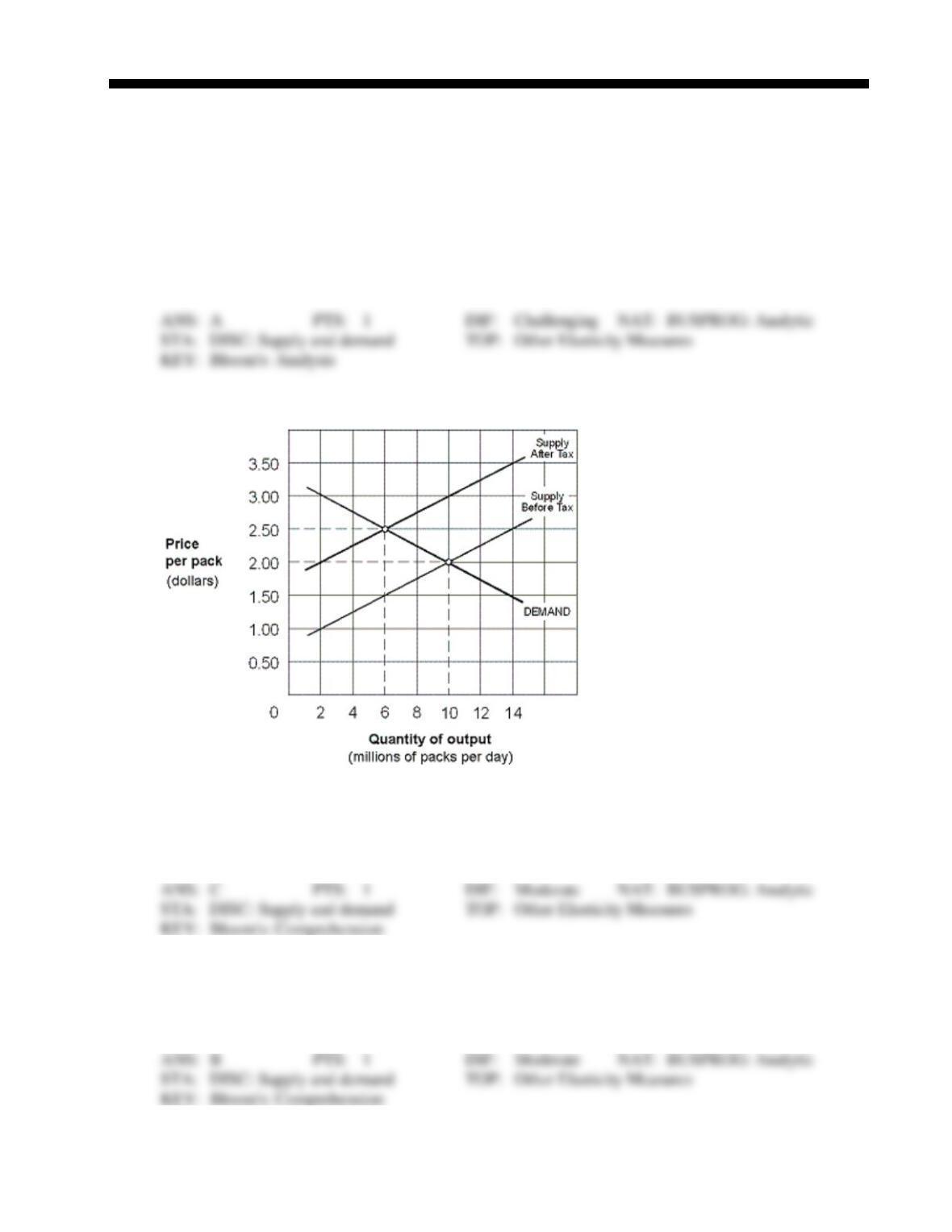
Exhibit 5-10 Supply and demand curves for cigarettes
2. As shown in Exhibit 5-10, assume the government places a $1 per pack sales tax on cigarettes. The
percentage of the burden of taxation paid by consumers of a pack of cigarettes is:
a.
zero.
c.
50 percent.
b.
25 percent.
d.
100 percent.
3. As shown in Exhibit 5-10, assume the government places a $1 per pack sales tax on cigarettes. The
percentage of the burden of taxation paid by tobacco sellers is:
a.
zero.
c.
75 percent.
b.
50 percent.
d.
100 percent.
4. As shown in Exhibit 5-10, the $1 per pack tax on cigarettes raises tax revenue per day totaling:
a.
$5 million.
c.
$10 million.
b.
$6 million.
d.
$15 million.
5. Per-unit taxes have which effect on the equilibrium price of a good?
a.
They cause demand curves to shift downward, thus lowering price.
b.
They cause demand curves to shift downward, thus raising price.
c.
They cause supply curves to shift downward, thus lowering price.
d.
They cause supply curves to shift upward, thus lowering price.
e.
They cause supply curves to shift upward, thus raising price.
6. Imagine the government would like to increase revenues by taxing the people. If they place a unit tax
on certain goods, this is equivalent to:
a.
c and e.
b.
shifting the demand curve to the right.
c.
reducing everyone’s income by the amount of the unit tax.
d.
raising the fixed costs of producers.
e.
shifting the supply curve to the left.
7. Governments seeking to maximize total tax revenue will place unit taxes on goods with the:
a.
b and c.
b.
lowest income elasticity.
c.
highest cross elasticity.
d.
lowest price elasticity.
e.
fewest complements.
TRUE/FALSE
1. The price elasticity of demand measures consumer responsiveness to a price change.
2. If the price elasticity of demand for a good is elastic, then consumers are relatively unresponsive with
respect to the quantity purchased when the price changes.
3. If the price elasticity of demand coefficient equals 2, this means a 10 percent increase in price will
result in a 20 percent decrease in the quantity demanded.
4. If the managers of the bus system found that revenues increase when fares are raised, they would
conclude that price elasticity demand for subway service is inelastic.
5. A horizontal demand curve indicates perfectly elastic demand.
6. Price elasticity remains constant along a straight-line demand curve.
7. If demand is perfectly inelastic, then the demand curve will be vertical.
8. If a 10 percent price increase causes the quantity demanded for a good to decrease by 20 percent,
demand is elastic.
9. If a 10 percent price increase causes the quantity demanded for a good to decrease by 5 percent,
demand is elastic.
10. If a 10 percent price increase causes the quantity demanded for a good to decrease by 10 percent,
demand is unitary elastic.
11. If the demand curve for a good is elastic, consumers will spend more on that good when its price
increases.
12. Suppose an economist found that total revenues increase for the bus system when fares were raised,
the conclusion is that the price elasticity demand for subway services over the range of fare increase is
inelastic.
13. A horizontal demand curve is perfectly elastic.
14. If a good has a price elasticity of demand coefficient greater than 1, total revenue can be increased by
raising the price.
15. Other factors held constant, if there are few close substitutes for a good, demand is more elastic for it.
16. Necessities have a much smaller price elasticity of demand, ceteris paribus, than goods that have many
close substitutes.
17. If the demand for a product is inelastic, then a price increase will result in a decrease in total revenue.
18. The fewer the substitutes for a good the greater will be the value of the price elasticity of demand
coefficient.
19. Goods with few available substitutes tend to have inelastic demand curves.
20. If demand for a good is price elastic, it must also be income elastic.
21. If the income elasticity of demand for a good is negative, the good is an inferior good.
22. If the income elasticity of demand for a good is positive, the good is a normal good.
23. If demand for a good is price elastic, it must also be income elastic.
24. For an inferior good, the income elasticity of demand is negative.
25. In response to a price change for good Y, if the cross-elasticity of demand for good Y is negative, good
X and good Y are substitutes.
26. In response to a price change for good Y, if the cross-elasticity of demand for good Y is positive, good
X and good Y are complements.
27. If a supply curve has a constant slope throughout its length, it must have a constant price elasticity
throughout its length.
28. If the supply of a good is inelastic, a decrease in price must increase total revenue.
29. Applying supply and demand analysis, other factors held constant, the steeper the supply curve (more
inelastic), the larger the burden of a sales tax that is borne by the sellers.
30. When the government imposes a tax, sellers raise their price by the full amount of the tax.
31. Supply-demand analysis shows that a tax collected from sellers is always fully shifted to buyers.
32. Applying supply and demand analysis, other factors held constant, the steeper the supply curve (more
elastic), the larger the burden of a sales tax that is borne by the sellers.
ESSAY
1. What does the “price elasticity of demand” measure? What does a price elasticity of demand
coefficient of 1.2 mean? Does the product have an elastic, unitary elastic or inelastic demand?
2. What happens to total revenue given a price increase and demand is inelastic? Why?
3. What are the characteristics of the product that has an inelastic demand?