Chapter 10—Aggregate Demand and Supply
MULTIPLE CHOICE
1. The aggregate demand curve indicates the relationship between:
a.
the real wage rate and the quality of resources demanded by producers of goods and
services.
b.
the interest rate and the amount of loanable funds demanded by borrowers.
c.
the natural rate of unemployment and the demand for goods and services when the
economy is in long-run equilibrium.
d.
the general price level and the aggregate quantity of goods and services demanded.
2. For an economy, aggregate demand equals:
a.
consumption plus investment plus government spending plus exports.
b.
consumption plus investment plus government spending plus (exports minus imports).
c.
consumption plus investment plus (taxes minus transfers) plus (exports minus imports).
d.
consumption plus investment plus government spending plus net exports (imports minus
exports).
3. The aggregate demand curve slopes downward indicating that:
a.
an increase in the general price level will reduce the aggregate quantity of goods and
services demanded.
b.
an increase in the general price level will increase the aggregate quantity of goods and
services demanded.
c.
a change in the interest rate will alter the aggregate quantity of goods and services
demanded.
d.
consumers substitute between domestic-made and foreign-made goods as their relative
prices change.
4. Which of the following is not a component of the aggregate demand curve?
a.
Consumption (C).
b.
Investment (I).
c.
Government spending (G).
d.
Net exports (X-M).
e.
All of these are components.
5. Which of the following is not a reason for the downward slope of an aggregate demand curve?
a.
Real balances effect.
c.
Net exports effect.
b.
Real interest-rate effect.
d.
All of these are reasons.
6. The aggregate demand curve shows how real GDP purchased varies with changes in:
a.
unemployment.
c.
the price level.
b.
output.
d.
the interest rate.
7. The aggregate demand curve is drawn downward-sloping, because increases in the price level cause
decreases in:
a.
unemployment.
c.
households’ savings.
b.
total spending (real GDP).
d.
the value of the dollar.
8. Which of the following is not a reason for the downward slope of the aggregate demand curve?
a.
Real balances effect
c.
Net exports effect
b.
Interest-rate effect
d.
Government spending effect
9. Which of the following is not a component of the aggregate demand curve?
a.
Government spending (G).
b.
Investment (I).
c.
Consumption (C).
d.
Net exports (X-M).
e.
Saving.
10. The aggregate demand curve:
a.
shows the level of real GDP purchased in the economy at different possible price levels
during a period of time.
b.
shows the level of real GDP produced in the economy at different possible price levels
during a period of time.
c.
shifts to the left whenever there is an increase in aggregate expenditures.
d.
slopes upward.
11. Aggregate demand’s downward-sloping character reflects three principal influences as shown in which
of the following?
a.
People’s desire to maintain real wealth holdings, the interest rate, and international trade.
b.
People’s desire to increase the price level, the interest rate, and the economic growth
effect.
c.
The interest rate, the economic growth effect, and international trade.
d.
Cost-pull inflation, demand-pull inflation, and the need to maintain real wealth holdings.
e.
Recession phases of the business cycle, upturns, and downturns.
12. When price level in the United States rises,
a.
there is a increased demand for borrowed money.
b.
producers’ demand for new machinery increases, contributing to an increase in aggregate
demand.
c.
Americans tend to buy more foreign goods and services.
d.
the French, Canadians, and Japanese would find our exports more attractive.
e.
to replenish the value of your real wealth, you would save less and consume more.
13. The aggregate demand curve:
a.
would be little affected by a technological advancement.
b.
shifts to the right when spending decreases.
c.
shifts to the left when there is a decrease in taxes.
d.
cannot move independently of the aggregate supply curve.
e.
shifts to the right when there is an expectation that future income will fall.
14. The total quantity of goods and services demanded by households, firms, foreigners, and government
at varying price levels is:
a.
gross domestic product.
b.
aggregate demand.
c.
aggregate expenditure.
d.
total demand.
e.
total expenditure.
15. When the price level falls, the total quantities of goods and services demanded:
a.
decreases.
b.
stays the same.
c.
increases.
d.
increases and then decreases.
e.
decreases and then increases.
16. Which of the following helps explain why real GDP is inversely related to the price level within the
framework of the AD-AS model?
a.
As prices fall, domestic consumers have an incentive to buy more of the cheaper goods
and services.
b.
As prices fall, the monetary authorities will have to increase the money supply, which will
lead to an increase in the quantity of goods and services purchased.
c.
As prices fall, the government will have to reduce taxes, which will lead to an increase in
the quantity of goods and services purchased.
d.
As prices fall, the wealth of people holding the fixed quantity of money increases, causing
them to expand their purchases of goods and services.
17. Which of the following is true, other things equal?
a.
A reduction in prices will increase the real wealth of those holding a fixed quantity of
money.
b.
A reduction in prices will lead to a decline in net exports.
c.
A reduction in prices will increase the scarcity of money, raise the real interest rate, and,
thereby, encourage investment and consumption.
d.
A reduction in prices will increase profit margins and, thereby, stimulate additional
investment.
18. The real balance effect (wealth effect), the interest rate effect, and the net exports effect all help to
explain the:
a.
decrease in supply in the loanable funds market.
b.
large federal budget deficit.
c.
increase in short-run aggregate supply.
d.
downward-sloping aggregate demand curve.
19. As prices rise, people will buy fewer goods and services because:
a.
the interest rate has declined.
b.
aggregate demand has increased.
c.
the purchasing power of the fixed quantity of money has declined.
d.
the income of households has increased.
20. The real balances effect occurs because a higher price level will reduce the real value of people’s:
a.
financial assets.
c.
unpaid debt.
b.
wages.
d.
physical investments.
21. The real balances effect is the impact on real GDP caused by the ____ relationship between the price
level and the real value of financial assets.
a.
direct
c.
independent
b.
inverse
d.
linear
22. The idea that higher prices reduce the purchasing power of financial assets and lead to less
consumption is known as the:
a.
real balances effect.
b.
interest rate effect.
c.
foreign purchases effect.
d.
income effect.
e.
aggregate demand effect.
23. The real balances effect predicts that higher prices:
a.
make people worse off by reducing the value of their wealth, leading them to save more
and spend less.
b.
make people worse off by reducing the value of their wealth, leading them to save less and
spend more.
c.
make people better off by increasing the value of their wealth, leading them to save less
and spend more.
d.
increase borrowing, leading to higher interest rates and less investment.
e.
make domestic goods relatively more expensive, increasing the demand for domestic
goods and decreasing the demand for foreign goods.
24. The negative slope of the aggregate demand curve is caused by:
a.
the real balances effect, the interest rate effect, and the price level effect.
b.
the real balances effect, the money supply effect, and the net exports effect.
c.
the interest rate effect, the net exports effect, and the real GDP effect.
d.
the real balances effect, the interest rate effect, and the net exports effect.
e.
the real balances effect, the interest rate effect, and the net export effect.
25. Suppose the price level falls. The result is that the:
a.
aggregate supply curve would shift to the right.
b.
aggregate supply curve would shift to the left.
c.
general price level would rise causing a movement up the aggregate demand curve.
d.
aggregate demand curve would slope downward because of the real balances effect.
26. When prices rise, consumers and businesses hold larger money balances. This reduces the supply of
loanable funds, increases the interest rate, and discourages both consumption and investment. This
process is called the:
a.
interest-rate effect.
c.
investment effect.
b.
real balance effect.
d.
disinvestment effect.
27. The interest-rate effect is the impact on real GDP caused by the ____ relationship between the price
level and the interest rate.
a.
direct
c.
linear
b.
independent
d.
inverse
28. When the supply of credit is fixed, an increase in the price level stimulates the demand for credit,
which in turn reduces consumption and investment spending. This argument is called the:
a.
real balances effect.
c.
net exports effect.
b.
interest-rate effect.
d.
substitution effect.
29. The interest-rate effect is the impact on real GDP caused by the direct relationship between the interest
rate and the:
a.
price level.
c.
consumption.
b.
exports.
d.
investment.
30. The interest rate effect predicts that higher prices:
a.
make it more expensive to borrow, leading to higher interest rates and less investment.
b.
make people worse off by reducing the value of their wealth, leading them to save more
and spend less.
c.
decrease borrowing, leading to higher interest rates and less investment.
d.
decrease borrowing, leading to lower interest rates and more investment.
e.
increase borrowing, leading to higher interest rates and less investment.
31. According to the interest rate effect, as the price level:
a.
rises, people feel poorer and buy less.
b.
rises, United States products become more expensive and foreigners buy less U.S. goods.
c.
rises, interest rates fall, and people buy less.
d.
rises, interest rates rise, and people buy less.
e.
falls, interest rates fall, and people buy less.
32. The net exports effect exists because a:
a.
higher price level will reduce interest rates and stimulate foreign investment.
b.
lower price level will make domestically produced exports less expensive relative to
foreign goods.
c.
higher price level will reduce the purchasing power of money.
d.
lower price level will encourage Americans to import more foreign goods.
33. According to the net exports effect, as the price level falls relative to the rest of the world,
a.
foreigners buy fewer goods.
b.
foreigners buy more U.S. goods.
c.
the aggregate demand curve shifts to the left.
d.
the aggregate demand curve shifts to the right.
e.
the supply of U.S.-made goods increases.
34. The net exports effect is the inverse relationship between net exports and the ____ of an economy.
a.
potential real GDP
c.
price level
b.
chain-price deflator
d.
consumption spending
35. The net exports effect is the ____ relationship between net exports and the price level of an economy.
a.
inverse
c.
direct
b.
independent
d.
linear
36. The aggregate demand curve is downward sloping because:
a.
an increase in the price level will cause an increase in spending.
b.
at lower price levels, real wealth decreases, causing a decrease in the quantities of goods
and services demanded.
c.
at lower price levels, interest rates decrease, causing a decrease in the quantities of goods
and services demanded.
d.
at lower price levels, exports increase, causing an increase in real GDP.
e.
increases in the price level do not affect people’s real wealth.
37. Which of the following will most likely increase aggregate demand?
a.
A decrease in stock market prices.
b.
An increase in business investment spending.
c.
A decrease in the expected inflation rate.
d.
A decrease in real GDP.
38. Which of the following will increase aggregate demand in the United States?
a.
A higher price level.
b.
An increase in the real interest rate.
c.
An increase in wealth due to a substantial appreciation in the value of stocks.
d.
A decrease in real income in Japan and Western Europe.
39. Using the AD-AS model, if consumers and business become more optimistic about the future direction
of the economy and increase spending, then:
a.
aggregate demand will decrease.
c.
long-run aggregate supply will increase.
b.
aggregate demand will increase.
d.
long-run aggregate supply will decrease.
40. Which one of the following factors will most likely cause an increase in aggregate demand?
a.
An increase in net exports.
b.
An increase in the real interest rate.
c.
A decrease in net exports due to falling incomes abroad.
d.
A technological development that decreases the cost of producing computer chips.
41. Which of the following would shift the aggregate demand curve to the left?
a.
An increase in exports.
c.
An increase in government spending.
b.
An increase in investment.
d.
A decrease in government spending.
42. Which of the following will not shift the aggregate demand curve to the right?
a.
Consumers becoming more optimistic about the future.
b.
An increase in government spending.
c.
Business optimism increases.
d.
Consumers become pessimistic about the future.
43. Which of the following could be expected to shift the aggregate demand curve?
a.
An increase in government spending.
c.
Net exports fall.
b.
Consumption spending decreases.
d.
All of these.
44. Which of the following could not be expected to shift the aggregate demand curve?
a.
Net exports fall.
c.
An increase in government spending.
b.
Consumption spending decreases.
d.
A change in real GDP.
45. Which of the following will not shift the aggregate demand cure to the left?
a.
Consumers become more optimistic about the future.
b.
Government spending decreases.
c.
Business optimism decreases.
d.
Consumers become pessimistic about the future.
46. A rightward shift in the aggregate demand curve can be caused by an increase in:
a.
the price level.
c.
taxes.
b.
business investment spending.
d.
production costs.
47. Suppose workers become pessimistic about their future employment, which causes them to save more
and spend less. If the economy is on the intermediate range of the aggregate supply curve, then:
a.
both real GDP and the price level will fall.
b.
real GDP will fall and the price level will rise.
c.
real GDP will rise and the price level will fall.
d.
both real GDP and the price level will rise.
48. A cut in government spending, a decrease in income abroad, an increase in taxes, or an expectation
that future consumer income will fall will all cause aggregate:
a.
demand to shift rightward.
b.
demand to shift leftward.
c.
supply to shift rightward.
d.
supply to shift leftward.
e.
supply and aggregate demand to both shift equally inward.
49. The aggregate demand curve will shift rightward when there is:
a.
a decrease in government spending.
b.
a decrease in incomes abroad.
c.
a tax increase.
d.
the expectation that future consumer income will rise.
50. A change in which of the following would shift the aggregate demand curve?
a.
Consumption (C)
b.
Investment (I)
c.
Government spending (G)
d.
Net Exports (NX)
e.
All of these
51. The aggregate supply curve indicates the:
a.
relationship between prices and the aggregate quantity of goods and services purchased by
consumers, investors, governments, and foreigners (net exports).
b.
relationship between prices and the natural rate of unemployment.
c.
relationship between the real wage rate and the quantity of labor supplied by households.
d.
quantity of goods and services producers will supply at different price levels.
52. The aggregate supply curve is defined as:
a.
net national product.
b.
the sum of wages, rent, interest, and profits.
c.
the real GDP produced at different price levels.
d.
the total dollar value of household expenditures.
53. The aggregate supply curve:
a.
shows the level of real GDP produced in the economy at different possible price levels
during a period of time.
b.
is horizontal in the Keynesian range.
c.
is vertical in the classical range.
d.
all of these.
54. Suppose an increase in government spending stimulates real GDP without affecting the price level.
What is the relevant range of the aggregate supply curve in this case?
a.
The classical range.
c.
The Keynesian range.
b.
The intermediate range.
d.
The monetarist range.
55. In the intermediate range of the aggregate supply curve, higher aggregate demand will increase:
a.
both the price level and real GDP.
b.
real GDP without raising the price level.
c.
the price level without affecting real GDP.
d.
the price level but reduce real GDP.
56. Which of the following would cause a rightward shift in the aggregate supply curve?
a.
Larger-than-expected wage increases.
c.
Increased investment spending.
b.
Lower oil prices.
d.
Greater government regulation.
57. In the aggregate demand/aggregate supply model, a country’s full-employment real GDP is represented
by:
a.
prices.
c.
aggregate supply.
b.
aggregate demand.
d.
an increase in the general level of prices.
58. The aggregate supply curve reflects the relationship between the price:
a.
of a particular good and the quantity supplied by all firms producing that good.
b.
of a particular good and the quantity supplied by the aggregate economy.
c.
level and the quantity supplied of all goods in the economy.
d.
level and the quantity of all goods purchased in the economy.
59. To illustrate the classical argument that “supply creates its own demand,” the aggregate supply curve
should be drawn:
a.
downward-sloping.
c.
horizontal.
b.
upward-sloping.
d.
vertical.
60. The pre-Keynesian or classical economic theory predicted that in the long-run the economy would
experience:
a.
long periods of high unemployment.
b.
rising rates of inflation.
c.
only temporary periods of high unemployment.
d.
idle factors of production.
61. The pre-Keynesian or classical economic theory viewed the long-run aggregate supply curve for the
economy to be:
a.
horizontal at the full-employment level of real GDP.
b.
positively sloped at the full-employment level of real GDP.
c.
vertical at the full-employment level of real GDP.
d.
backward bending at the full-employment level of real GDP.
62. According to classical theory, if the aggregate demand curve decreased and the economy experienced
unemployment, then:
a.
the economy would remain in this condition indefinitely.
b.
the government must increase spending to restore full employment.
c.
prices and wages would fall quickly to restore full employment.
d.
the supply of money would increase until the economy returned to full employment.
63. Which of the following characterizes the classical view of the economy?
a.
The economy is inherently unstable.
b.
Prices and wages are not flexible.
c.
The economy will “self-adjust” to full employment.
d.
None of these.
64. Which of the following are inherent in classical theory?
a.
Flexible prices.
c.
Long-run full employment.
b.
Flexible wages.
d.
All of these.
65. Which of the following are beliefs of classical theory?
a.
Long-run full employment.
c.
Inflexible prices.
b.
Inflexible wages.
d.
All of these.
66. The vertical portion of the aggregate supply curve shows that at full employment an increase in the
price level will:
a.
not alter the economy’s full-employment real GDP.
b.
increase the economy’s full-employment real GDP.
c.
reduce the quantity of goods and services purchasers will demand.
d.
improve the overall efficiency of resource use.
67. Assuming prices and wages are fully flexible, the aggregate supply curve will be:
a.
upward sloping, but not vertical.
c.
horizontal.
b.
vertical.
d.
downward sloping.
68. Which of the following is a range on the eclectic or general view of the aggregate supply curve?
a.
Keynesian range.
c.
Classical range.
b.
Intermediate range.
d.
All of these.
69. Gradual adjustment of prices and wages to an increase in the aggregate demand curve implies that the
aggregate supply curve is:
a.
horizontal.
c.
upward sloping but not vertical.
b.
vertical.
d.
downward sloping.
70. In the classical range of the aggregate supply curve, greater spending for consumer and investment
goods results in:
a.
stagflation.
c.
greater output.
b.
more unemployment.
d.
a higher price level.
71. The horizontal segment of the aggregate supply curve:
a.
shows that real GDP can increase only by affecting the economy’s price level.
b.
shows that real GDP can increase without affecting the economy’s price level.
c.
depicts a positive relationship between real GDP and the price level.
d.
depicts a negative relationship between real GDP and the price level.
e.
marks the full-employment level of real GDP.
72. The aggregate supply curve relating the price level to real GDP has three distinguishing segments.
Which one of the following indicates the segments?
a.
The horizontal segment reflects the increasing pressure on the price level as firms bid for
resources. The upward-sloping segment reflects the availability of unused resources. The
vertical segment reflects the full employment of all resources.
b.
The horizontal segment reflects the availability of unused resources. The upward-sloping
segment reflects the full employment of all resources. The vertical segment reflects the
increasing pressure on the price level as firms bid for resources.
c.
The horizontal segment reflects the full employment of all resources. The upward-sloping
segment reflects the increasing pressure on the price level as firms bid for resources. The
vertical segment reflects the availability of unused resources.
d.
The horizontal segment reflects the availability of unused resources. The downward-
sloping segment reflects decreasing pressure on the price level as firms bid for resources.
The vertical segment reflects the full employment of all resources.
e.
The horizontal segment reflects the availability of unused resources. The upward-sloping
segment reflects increasing pressure on the price level as firms bid for resources. The
vertical segment reflects the full employment of all resources.
73. In the upward-sloping segment of the aggregate supply curve,
a.
increases in output are linked to decreases in the price level.
b.
increasing prices drag down resource costs.
c.
producers can hire more workers without having to raise the wage rate.
d.
the economy can increase aggregate supply without prices going up.
e.
firms are willing to pay higher wages to get more labor.
74. In the vertical segment of the aggregate supply curve,
a.
different levels of GDP correspond with high unemployment.
b.
competition among producers for already-employed resources can succeed only in
lowering the economy’s price level.
c.
full employment is achieved.
d.
producers are able to hire more workers at lower wages.
e.
increases in GDP are due solely to production gains.
75. In the horizontal segment of the aggregate supply curve, when GDP:
a.
increases, the price level rises.
b.
decreases, the price level falls.
c.
increases, the price level does not change.
d.
increases, the price level falls.
e.
increases, the price level first rises and then falls.
76. In the upward-sloping segment of the aggregate supply curve,
a.
when GDP increases, the price level rises.
b.
when GDP increases, the price level does not change.
c.
when GDP decreases, the price level rises.
d.
when GDP increases, the price level falls.
e.
there is no relationship between changes in GDP and changes in the price level.
77. During the Great Depression of the 1930s, the aggregate demand curve intersected the aggregate
supply curve in the:
a.
horizontal portion of the aggregate supply curve.
b.
upward-sloping part of the aggregate supply curve.
c.
vertical portion of the aggregate supply curve.
d.
early years in the horizontal portion, but in the later years in the vertical portion.
e.
early years in the vertical portion, but in the later years in the horizontal portion.
78. At low levels of employment, the Keynesian aggregate supply curve:
a.
tilts downward to the right.
b.
tilts upward to the right.
c.
is vertical.
d.
shows a constant price level.
e.
shows a rising price level.
79. The aggregate supply curve will be vertical when:
a.
output can be increased without an increase in the price level.
b.
the economy is operating at full-employment capacity.
c.
output and price level rise together.
d.
the aggregate demand curve is shifting to the left.
e.
aggregate demand is absent.
Exhibit 10-1 Aggregate supply curve
80. In Exhibit 10-1, resources are fully employed, and competition among producers for resources will
lead to a higher price level in:
a.
the segment labeled ab.
b.
the segment labeled bc.
c.
the segment labeled cd.
d.
both segment bc and segment cd.
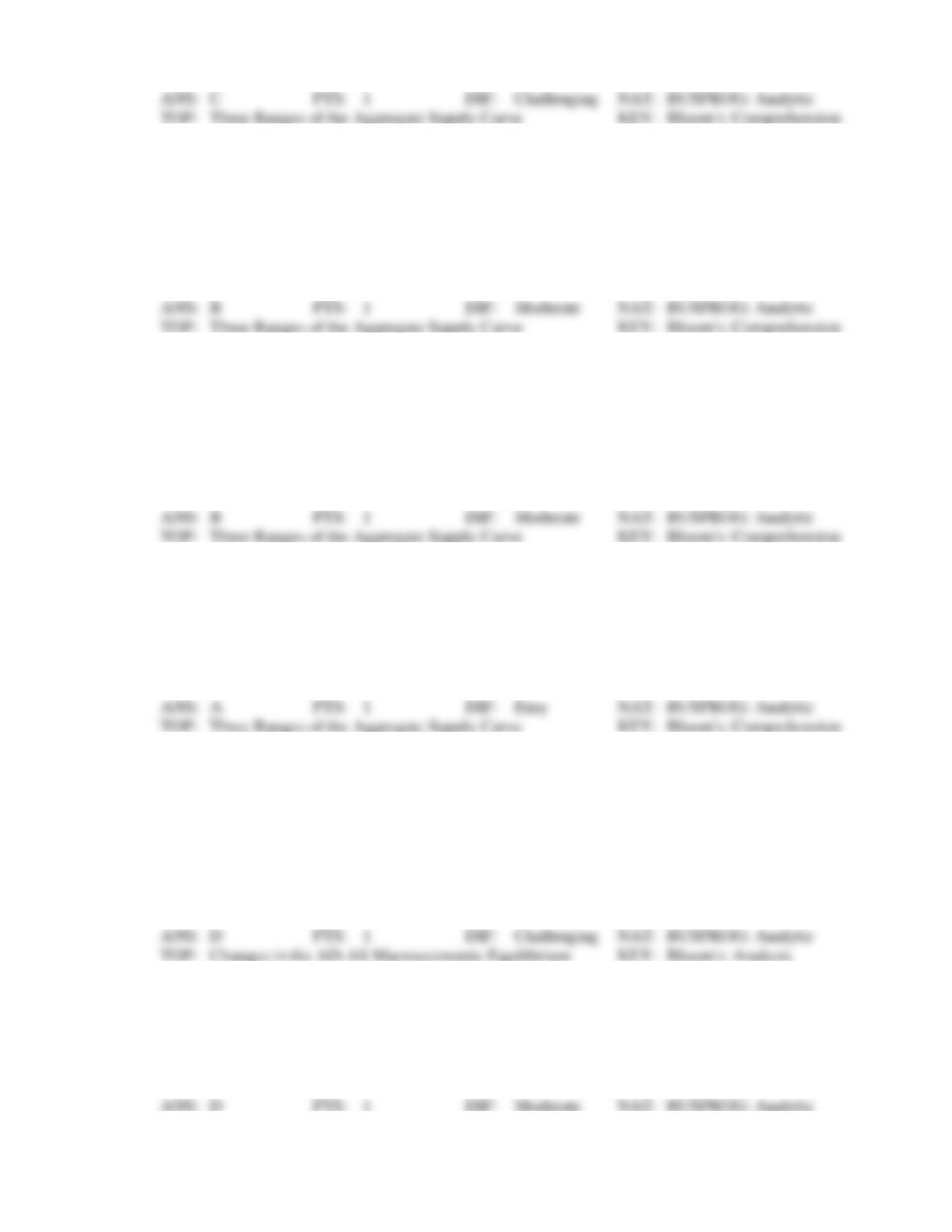
e.
the entire curve.
81. In Exhibit 10-1, higher price levels allow producers to earn higher profits, stimulating production and
employment in:
a.
the segment labeled ab.
b.
the segment labeled bc.
c.
the segment labeled cd.
d.
both segment bc and segment cd.
e.
the entire curve.
82. In Exhibit 10-1, as production increases, firms resort to offering higher-wage rates to attract the
dwindling supply of unemployed resources in:
a.
the segment labeled ab.
b.
the segment labeled bc.
c.
the segment labeled cd.
d.
both segment bc and segment cd.
e.
the entire curve.
83. In Exhibit 10-1, there are plenty of idle resources and no upward pressure on prices in:
a.
the segment labeled ab.
b.
the segment labeled bc.
c.
the segment labeled cd.
d.
both segment bc and segment cd.
e.
the entire curve.
84. In the aggregate demand and aggregate supply model,
a.
the factors that cause the demand curves in both models to slope downward are the same.
b.
the factors that cause the supply curves in both models to slope upward are the same.
c.
the upward-sloping aggregate demand curve intersects the downward-sloping aggregate
supply curve to determine the economy’s price level and GDP.
d.
the upward-sloping aggregate supply curve intersects the downward-sloping aggregate
demand curve to determine the economy’s price level and GDP.
e.
the price level never changes even with shifts in aggregate demand and aggregate supply.
85. In the aggregate demand and supply model, the:
a.
vertical axis measures the average price level.
b.
horizontal axis measures real GDP.
c.
aggregate supply curve is vertical at full-employment real GDP.
d.
All of these.
86. The full employment level of real GDP can be represented on an aggregate supply and demand
diagram as a(n):
a.
vertical line.
c.
horizontal line.
b.
upward-sloping line.
d.
downward-sloping line.
87. Suppose the economy is on the intermediate range of the aggregate supply curve. Which of the
following would reduce both real GDP and the price level?
a.
A decrease in aggregate supply.
c.
A decrease in aggregate demand.
b.
An increase in aggregate supply.
d.
An increase in aggregate demand.
88. In the aggregate demand and supply model, the:
a.
aggregate supply curve is horizontal at full-employment real GDP.
b.
vertical axis measures real GDP.
c.
vertical axis measures the average price level.
d.
All of the above.
e.
None of the above.
89. Along the intermediate range of the aggregate supply curve, an increase in the aggregate demand curve
will increase:
a.
both the price level and real GDP.
c.
only the price level.
b.
only real GDP.
d.
real GDP and reduce the price level.
90. Along the Keynesian range of the aggregate supply curve, an increase in the aggregate demand curve
will increase:
a.
both the price level and real GDP.
c.
only the price level.
b.
only real GDP.
d.
real GDP and reduce the price level.
91. Along the classical or vertical range of the aggregate supply curve, an increase in the aggregate
demand curve will increase:
a.
both the price level and real GDP.
c.
only the price level.
b.
only real GDP.
d.
real GDP and reduce the price level.
92. If aggregate demand increases in the intermediate range of the aggregate supply curve then the:
a.
price level rises and real GDP falls.
c.
price level falls and real GDP falls.
b.
price level rises and real GDP rises.
d.
price level falls and real GDP rises.
93. Given aggregate demand, a decrease in aggregate supply creates:
a.
a higher price level and a higher GDP level.
b.
a lower price level and a higher GDP level.
c.
cost-push inflation.
d.
demand-pull inflation.
94. When the economy is operating well below capacity, an increase in spending tends to be reflected
primarily in a(n):
a.
lower level of employment.
b.
increase in price.
c.
lower level of output.
d.
higher level of output and employment.
e.
increase in business failures.
95. Suppose workers become pessimistic about their future employment, which causes them to save more
and spend less. If the economy is on the intermediate range of the aggregate supply curve, then:
a.
both real GDP and the price level will fall.
b.
real GDP will fall and the price level will rise.
c.
real GDP will rise and the price level will fall.
d.
real GDP and the price level will rise.
96. Which of the following will most likely cause an increase in the aggregate supply curve?
a.
a reduction in the general level of prices
b.
an increase in the general level of prices
c.
an improvement in technology that substantially reduces the cost of generating energy
d.
an increase in taxes that makes it more expensive for Americans to import crude oil
97. Other things constant, an increase in resource prices will:
a.
increase aggregate demand.
c.
decrease aggregate supply.
b.
decrease aggregate demand.
d.
increase aggregate supply.
98. The effect of an increase in aggregate supply is a(n):
a.
increase in the general level of prices and a decrease in real output.
b.
increase in the general level of prices and an increase in real output.
c.
decrease in the general level of prices and a decrease in real output.
d.
decrease in the general level of prices and an increase in real output.