Chapter 9—Monopoly
MULTIPLE CHOICE
1. Which of the following is not associated with the monopoly market structure?
a.
Many sellers.
b.
A single seller.
c.
A unique product.
d.
Impossible entry into the market.
2. Which of the following factors is not a barrier limiting the entry of potential competitors into a
market?
a.
legally enforced patent rights
c.
licensing
b.
an inelastic demand for a product
d.
control over an essential resource
3. A monopoly is:
a.
a seller of a highly advertised and differentiated product in a market with low barriers to
entry in the long run.
b.
the only seller of a good for which there are no good substitutes in a market with high
barriers to entry.
c.
the only buyer of a unique raw material.
d.
the producer of a product subsidized by the government.
4. A monopolist faces a downward-sloping demand curve because:
a.
the demand for its product is inelastic.
b.
the industry demand curve is horizontal.
c.
resource prices increase as the monopolist expands output.
d.
the entire market demand curve is the monopolist’s demand curve.
5. Which of the following firms best fits the definition of a monopoly?
a.
General Motors
c.
Local electric utility
b.
Exxon Mobile
d.
AT&T
6. Monopoly is a market structure characterized by a:
a.
single firm operating as a price taker.
c.
single firm that is not a price taker.
b.
few firms operating as price takers.
d.
none of these.
7. Alcoa had a monopoly in the U.S. aluminum market from the late nineteenth century until the end of
World War II. Which barrier to entry was the source of Alcoa’s monopoly power?
a.
Ownership of a vital resource.
c.
Patents and copyrights.
b.
Government franchises and licenses.
d.
Economies of scale.
8. Which of the following is a market structure of monopoly?
a.
Few firms operating as price takers.
c.
Single firm that is a price maker.
b.
Single firm operating as a price taker.
d.
All of these are true.
9. A monopolized market is characterized by:
a.
a sole seller of a product for which there are few suitable substitutes.
b.
very strong barriers to entry.
c.
a single firm facing the market demand curve.
d.
all of these.
10. The monopolist’s demand curve is:
a.
identical to the market demand curve.
b.
identical to the marginal revenue curve.
c.
below the marginal revenue curve.
d.
a horizontal line at the market price.
e.
a U-shaped curve.
11. What is the name of the monopolist having a declining long-run average cost throughout the market?
a.
Monopolistic competition.
b.
Monopoly by legal barrier.
c.
Natural monopoly.
d.
Contrived monopoly.
12. A natural monopoly is a market where:
a.
a single firm has control over a vital natural resource.
b.
many smaller firms can produce the entire market output at the same per-unit cost as could
one large firm.
c.
a single large firm can produce the entire market output at a lower per-unit cost than a
group of smaller firms.
d.
many smaller firms can produce the entire market output at a lower per-unit cost than
could one large firm.
13. An industry is said to be a natural monopoly when:
a.
legal barriers limit entry into the market.
b.
diseconomies of scale are present in the market.
c.
the market demand for the product supplied by a firm is inelastic.
d.
long-run average cost continues to decline as the quantity of output increases.
14. Which of the following is true under natural monopoly?
a.
The marginal cost curve will be above the average cost curve.
b.
The monopolist will set price equal to marginal cost and will earn economic profits.
c.
Economies of scale exist.
d.
Output is produced under conditions of constant cost.
15. An industry in which total costs are kept to a minimum because only one firm serves the whole market
is called a:
a.
natural monopoly.
c.
patent monopoly.
b.
competitive monopoly.
d.
limit monopoly.
16. Which of the following firms operates in a natural monopoly?
a.
Telephone company.
c.
Water company.
b.
Electric company.
d.
All of these.
17. Which barrier to entry results in the creation of a natural monopoly?
a.
Legal barriers like government franchises.
b.
Economies of scale.
c.
Ownership of a vital resource.
d.
Patents and copyrights.
18. A monopolist faces a downward sloping demand curve that is equal to which of the following?
a.
The prevailing market price.
b.
The market demand curve.
c.
Its marginal cost curve.
d.
Marginal revenue.
19. The demand curve any monopolist uses in making output decisions is:
a.
the same as the demand curve facing a perfectly competitive firm.
b.
vertical, because there are no close substitutes for its product.
c.
horizontal, because there are no close substitutes for its product.
d.
the same as the market demand curve.
e.
perfectly inelastic.
20. The demand curve a monopolist faces:
a.
is more elastic than a perfectly competitive firm’s demand curve.
b.
is the market demand curve.
c.
is as elastic as a perfectly competitive firm’s demand curve.
d.
is not affected by the prices of complements.
e.
will not shift in response to a change in consumer tastes.
21. The demand curve for a monopolist is:
a.
the demand curve for the industry.
b.
less than the market demand curve.
c.
below the marginal revenue curve.
d.
nonexistent.
e.
the sum of the demand curves of the perfectly competitive firms in the industry.
22. For a monopolist:
a.
price equals average total cost.
b.
price is above marginal revenue.
c.
marginal revenue equals zero.
d.
marginal cost equals zero.
e.
average total cost equals marginal cost.
23. Which of the following is true for a pure monopolist?
a.
The firm has a perfectly elastic demand curve.
b.
The firm will always earn an economic profit.
c.
The demand curve is above the marginal revenue curve.
d.
None of these is true.
24. Which of the following best explains why the monopolist’s marginal revenue is less than the selling
price?
a.
To sell more units, the monopolist must reduce price on all units sold.
b.
As the monopolist expands output, the average total cost will decline.
c.
The monopolist charges each consumer the highest possible price.
d.
When a firm has a monopoly, consumers have no choice other than to pay the price set by
the monopolist.
25. Graphically, the marginal revenue curve of a monopolist:
a.
will sometimes lie below the demand curve of the monopolist.
b.
will always lie below the demand curve of the monopolist.
c.
is the same as the demand curve of the monopolist.
d.
will equal −1 when the elasticity of demand is unitary.
26. Which of the following is a difference between a monopolist and a firm in perfect competition?
a.
The marginal revenue curve is downward-sloping.
b.
Marginal revenue equals price.
c.
Economic profits are zero in the long-run.
d.
The marginal revenue curve lies above the demand curve.
27. The monopolist faces:
a.
a perfectly inelastic demand curve.
c.
the entire market demand curve.
b.
a perfectly elastic demand curve.
d.
all of these.
28. A monopolist always faces a demand curve that is:
a.
perfectly inelastic.
b.
perfectly elastic.
c.
unit elastic.
d.
the same as the entire market demand curve.
29. At the point where the marginal revenue equals zero for a monopolist facing a straight-line demand
curve, total revenue is:
a.
greater than 1.
c.
less than 1.
b.
maximum.
d.
equal to zero.
30. To maximize its profit, a monopoly should choose a price where demand is:
a.
elastic.
c.
unitary elastic.
b.
inelastic.
d.
vertical.
31. When marginal revenue is zero for a monopolist facing a downward-sloping straight-line demand
curve, the price elasticity of demand is:
a.
greater than 1.
c.
less than 2.
b.
equal to 1.
d.
equal to 0.
32. At any point where a monopolist’s marginal revenue is positive, the downward-sloping straight-line
demand curve is:
a.
perfectly elastic.
c.
unit elastic.
b.
elastic, but not perfectly elastic.
d.
inelastic.
33. For a monopolist with a downward-sloping demand curve,
a.
the coefficient of price elasticity of demand is infinite.
b.
the coefficient of price elasticity of demand is zero.
c.
as price increases, marginal revenue decreases.
d.
as price decreases, marginal revenue decreases.
e.
when the price is equal to zero, marginal revenue is equal to zero.
34. For a monopolist, marginal revenue is always:
a.
below market price.
b.
equal to market price.
c.
greater than market price.
d.
equal to total revenue.
e.
equal to total cost.
35. There is only one gas station within hundreds of miles. The owner finds that when she charges $3 a
gallon, she sells 199 gallons a day, and when she charges $2.99 a gallon, she sells 200 gallons a day.
The marginal revenue of the 200th gallon of gas is:
a.
$.01.
b.
$1.
c.
$2.99.
d.
$3.
e.
$600.
36. At a price of $5, 24 units of the good would be sold; at a price of $7, 25 units of output would be sold.
The marginal revenue of the 25th unit of output is:
a.
$14.
b.
$55.
c.
$6.
d.
$168.
e.
$175.
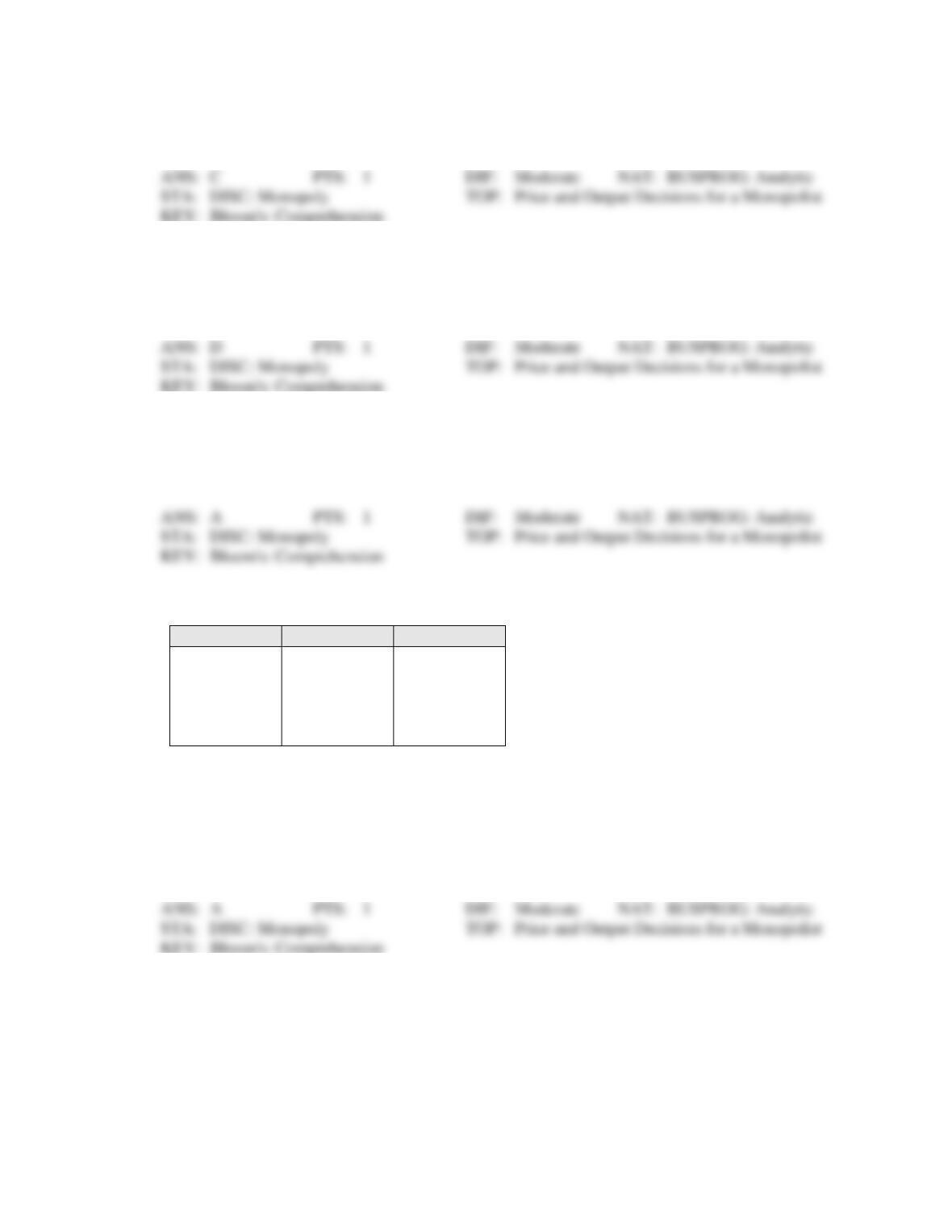
Exhibit 9-1 Monopolist’s demand curve
37. In Exhibit 9-1, the marginal revenue curve corresponding to the monopolist’s demand curve would be
a straight line drawn between points:
a.
A to B.
b.
A to C.
c.
A to D.
d.
C to B.
e.
C to D.
38. Which of the following points in Exhibit 9-1 would not lie on the marginal revenue curve
corresponding to the monopolist’s straight-line demand curve?
a.
A.
c.
C.
b.
B.
d.
C and B.
39. At an output of 100 units, marginal revenue for a monopolist with the demand curve shown in Exhibit
9-1 would be:
a.
positive.
c.
negative.
b.
zero.
d.
infinity.
Exhibit 9-2 Demand and cost information for a monopoly
Q
P
TC
0
40
10
1
30
15
2
20
25
3
10
40
4
0
60
40. The marginal revenue of the second unit of output in Exhibit 9-2 is:
a.
10.
b.
20.
c.
30.
d.
40.
e.
60.
41. Refer to Exhibit 9-2. Using the rule that focuses on the marginal approach to maximizing profits, the
monopolist maximizes profit by choosing price equal to:
a.
$40.
b.
$20.
c.
$0.
d.
$10.
e.
$30.
42. In Exhibit 9-3, how much vaccine should GeneTech produce to maximize its profit?
a.
300 doses per hour.
c.
Between 400 and 500 doses per hour.
b.
400 doses per hour.
d.
500 doses per hour.
43. As shown in Exhibit 9-3, in order to maximize its profit, what price should GeneTech charge for its
vaccine?
a.
$20 per dose.
c.
$35 per dose
b.
$25 per dose.
d.
$50 per dose.
44. In Exhibit 9-3, what is the maximum hourly profit that GeneTech can earn from its vaccine?
a.
$1,500.
c.
$4,500.
b.
$3,000.
d.
$10,500.
45. At the long-run equilibrium level of output, the monopolist’s marginal cost will:
a.
exceed price.
c.
be less than price.
b.
equal price.
d.
be less than marginal revenue.
46. A profit-maximizing monopolist will continue expanding output as long as:
a.
marginal revenue exceeds marginal cost.
b.
marginal revenue is positive.
c.
the cost of producing an additional unit exceeds the marginal revenue derived from the
unit.
d.
economic profit is more than zero.
47. If marginal cost exceeds marginal revenue, a profit-maximizing monopolist will:
a.
restrict output to increase the price even higher.
b.
raise price and expand output to increase profit.
c.
lower price and expand output to increase profit.
d.
attempt to maintain this position because it is consistent with profit maximization.
48. A monopolist will earn economic profits as long as his price exceeds:
a.
marginal revenue.
c.
average variable cost.
b.
average fixed cost.
d.
average total cost.
49. A monopolist will maximize profits by:
a.
setting his price as high as possible.
b.
setting his price at the level that will maximize per-unit profit.
c.
producing the output where marginal revenue equals marginal cost.
d.
producing the output where price equals marginal cost.
50. Under monopoly, a firm:
a.
is a price taker.
b.
maximizes profit by setting marginal cost equal to marginal revenue.
c.
will shut down in the short-run if price falls short of average total cost.
d.
always earns a pure economic profit.
51. Both a perfectly competitive firm and a monopolist:
a.
always earn an economic profit.
b.
maximize profit by setting marginal cost equal to marginal revenue.
c.
maximize profit by setting marginal cost equal to average total cost.
d.
are price takers.
52. Assume a monopolist’s marginal cost and marginal revenue curves intersect and the demand curve
passes above its average total cost curve. The firm will:
a.
make an economic profit.
b.
stay in operation in the short run, but shut down in the long run.
c.
shut down in the short run.
d.
lower the price.
53. A monopolist can earn an economic profit only when:
a.
marginal cost equals marginal revenue.
b.
marginal cost equals price.
c.
average total cost is less than price.
d.
all of these.
54. A monopolist earns an economic profit only when:
a.
average total cost equals than price.
c.
marginal revenue equals price.
b.
marginal cost equals price.
d.
average total cost is less than price.
55. A monopoly will price its product:
a.
where total revenue is maximized.
b.
where total costs are minimized.
c.
at that point on the market demand curve corresponding to an output level in which
marginal revenue equals marginal cost.
d.
at that point on the market demand curve which intersects the marginal cost curve.
56. To maximize its profits, a monopoly should produce the quantity where its marginal cost equals its:
a.
average total cost.
c.
demand.
b.
average variable cost.
d.
marginal revenue.
57. Suppose a monopolist’s demand curve lies below its average variable cost curve. The firm will:
a.
stay in operation in the short-run.
b.
earn an economic profit.
c.
earn an economic profit in the long run.
d.
shut down.
58. Assume a monopolist charges a price corresponding to the intersection of the marginal cost and
marginal revenue curves. If this price is between its average variable cost and average total cost
curves, the firm will:
a.
earn an economic profit.
c.
shut down.
b.
continue to operate in the short run.
d.
all of these are true.
59. Which of the following statements best describe the price, output, and profit conditions of monopoly?
a.
Price will equal marginal cost at the profit-maximizing level of output and profits will be
positive in the long-run.
b.
Price will always equal average variable cost in the short-run and either profits or losses
may result in the long run.
c.
In the long-run, positive economic profit will be earned.
d.
All of these are true.
60. A monopoly:
a.
faces the market demand curve which is downward sloping.
b.
has a marginal revenue curve which slopes downward and lies below its demand curve.
c.
will maximize profits by producing an output level where MR = MC.
d.
all of these.
61. Which of the following is true for a monopolist?
a.
The firm has a perfectly elastic demand curve.
b.
The firm has a perfectly inelastic demand curve.
c.
The straight-line demand curve is above the marginal revenue curve.
d.
The marginal revenue curve is above the demand curve.
e.
All of these.
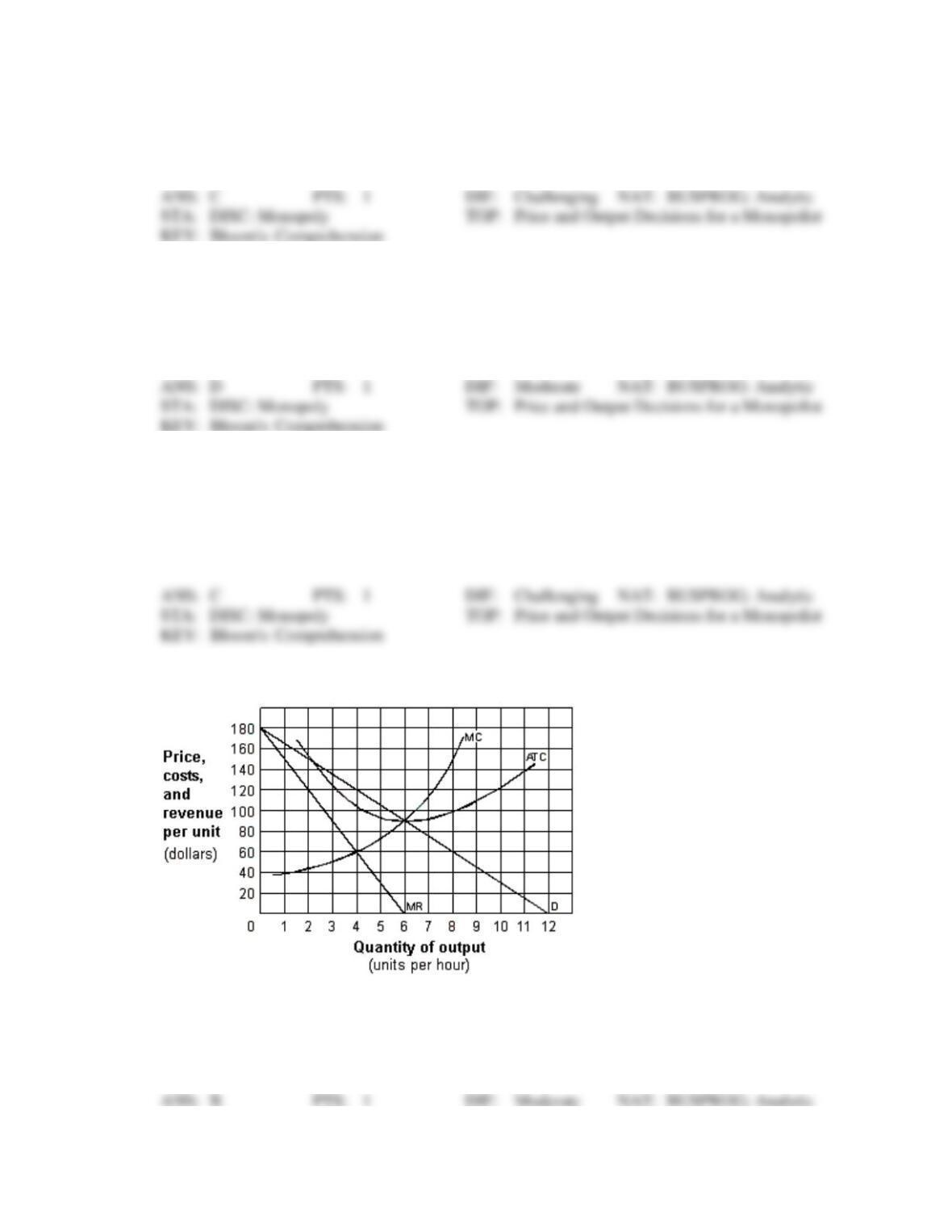
Exhibit 9-4 Demand and cost curves for a monopolist
62. As shown in Exhibit 9-4, in order to maximize its profit (or minimize its loss), how much output
should the monopoly produce?
a.
2 units per hour.
c.
6 units per hour.
b.
4 units per hour.
d.
8 units per hour.
63. As shown in Exhibit 9-4, in order to maximize its profit (or minimize its loss), what price should the
monopoly charge for its product?
a.
$60 per unit.
c.
$120 per unit.
b.
$90 per unit.
d.
$150 per unit.
64. What should a profit maximizing monopolist do if she is currently producing where MC < MR?
a.
Increase output until MC = MR.
b.
Decrease output until MC = MR.
c.
Shut down in the long run.
d.
Keep producing at this level.
e.
Operate only in the short run.
65. Although a monopoly can charge any price it wishes, it chooses:
a.
the highest price.
b.
price equal to marginal cost.
c.
the price that maximizes profit.
d.
competitive prices.
e.
a fair price.
Exhibit 9-5 Demand and cost data for a monopolist
Price
Quantity
TR
MR
TC
Profit
$10
1
10
10
4
9
2
8
8
3
12
7
4
16
6
5
20
5
6
24
4
7
28
3
8
32
2
9
36
1
10
40
66. Refer to Exhibit 9-5. The demand schedule and cost schedule for a monopolist are provided. Which
output level maximizes profit?
a.
2.
b.
6.
c.
4.
d.
5.
e.
7.
67. By calculating the data provided in Exhibit 9-5, how much is the profit if the firm decides to produce 7
units?
a.
0.
b.
24.
c.
16.
d.
12.
e.
6.
68. If a monopolist finds that at the present level of output marginal revenue exceeds marginal cost, the
firm should:
a.
shut down.
b.
expand output.
c.
maintain the current output.
d.
reduce output (but still produce).
e.
raise prices.
69. A monopolist earning economic profit in the short run determines that at its present level of output,
marginal revenue is $23 and marginal cost is $30. Which of the following should the firm do to
increase profit?
a.
Raise price and lower output.
b.
Lower price and lower output.
c.
Raise price and raise output.
d.
Lower price and raise output.
e.
Lower output, but leave price unchanged.
70. If marginal costs increase, a monopolist will:
a.
decrease price and increase output.
b.
decrease both price and output.
c.
increase price and decrease output.
d.
increase both price and output.
e.
keep both price and output at the same level.
71. A monopoly firm can sell its fourth unit of output for a price of $250. In order to sell more than five
units, it must expect to receive a price:
a.
equal to $250.
b.
greater than $250.
c.
less than $250.
d.
equal to $340.
e.
the price is impossible to calculate with the information given.
72. The profit-maximizing output level for a monopolist is where the:
a.
price is maximized.
b.
output sold is maximized.
c.
ATC curve is minimized.
d.
maximum efficiency is achieved.
e.
MR = MC.
73. Using the rule that focuses on the marginal approach to maximizing profits, a monopolist charges a
price where the:
a.
output sold is maximized.
c.
MR = MC.
b.
ATC curve is minimized.
d.
MR = 0.
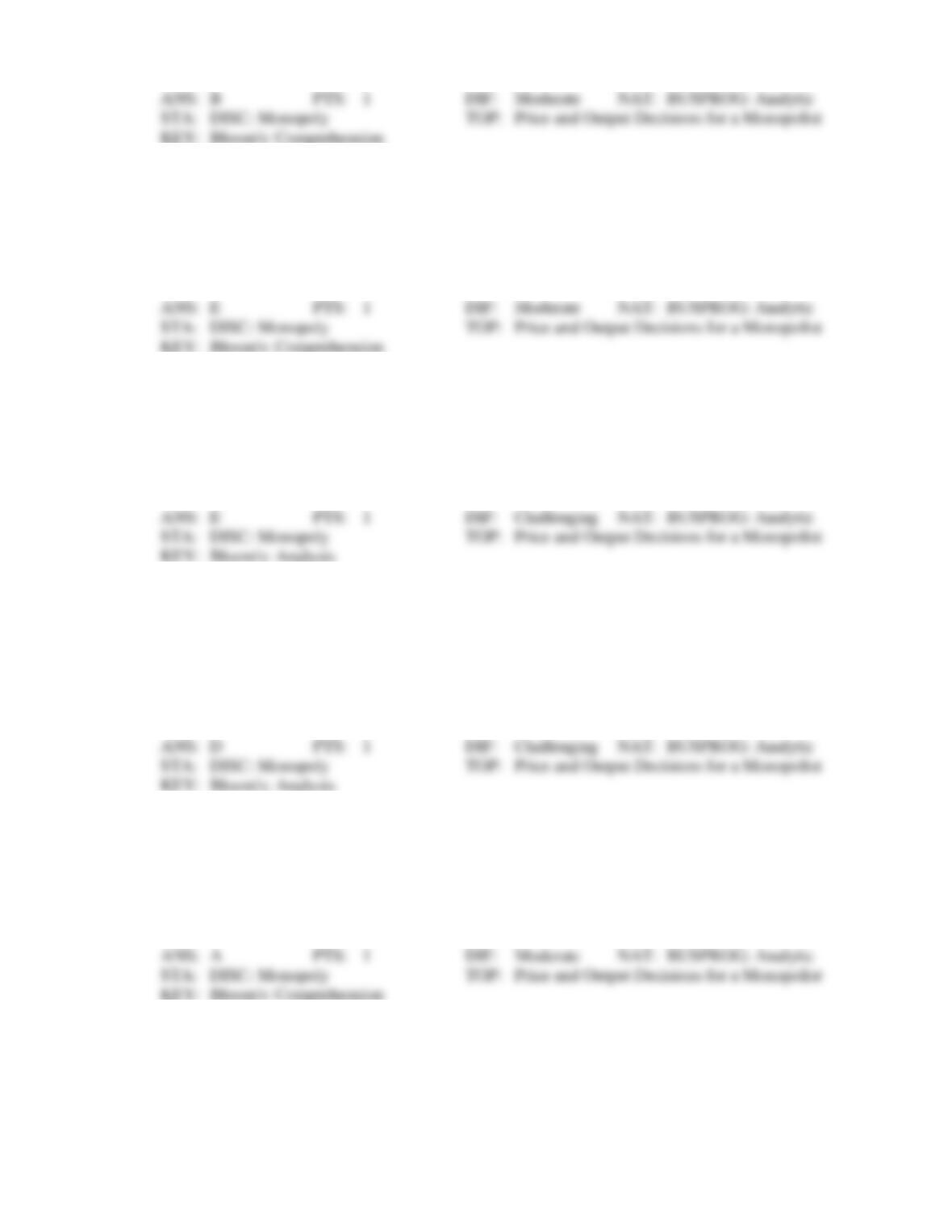
Exhibit 9-6 Monopoly
74. Exhibit 9-6 indicates that a monopolist maximizes profits at output equal to:
a.
0.
b.
6.
c.
8.
d.
9.
e.
10.
75. The monopoly price that maximizes profits in Exhibit 9-6 is:
a.
$4.
b.
$6.
c.
$7.
d.
$8.
e.
$10.
76. The maximum possible total monopoly profit in Exhibit 9-6 is:
a.
$60.
b.
$36.
c.
$24.
d.
$18.
e.
$12.
77. When the monopolist is maximizing total profit in Exhibit 9-6, the average total cost of producing that
output level is:
a.
$4.
b.
$6.
c.
$7.
d.
$8.
e.
$10.
78. The goal of any monopolist is to maximize:
a.
economic profits.
b.
normal profits.
c.
price.
d.
consumer welfare.
e.
output.
79. A monopoly:
a.
can increase price and increase output at the same time.
b.
can charge any price it wants and still sell all of its output.
c.
can sell any output it produces provided it accepts the market price.
d.
must lower price in order to increase output.
e.
faces a perfectly elastic demand curve.
80. A monopoly will be maximizing profits if it is operating at the point where:
a.
price is at a maximum.
b.
average cost is at a minimum.
c.
average cost is at a maximum.
d.
marginal cost is at a minimum.
e.
marginal revenue = marginal cost.
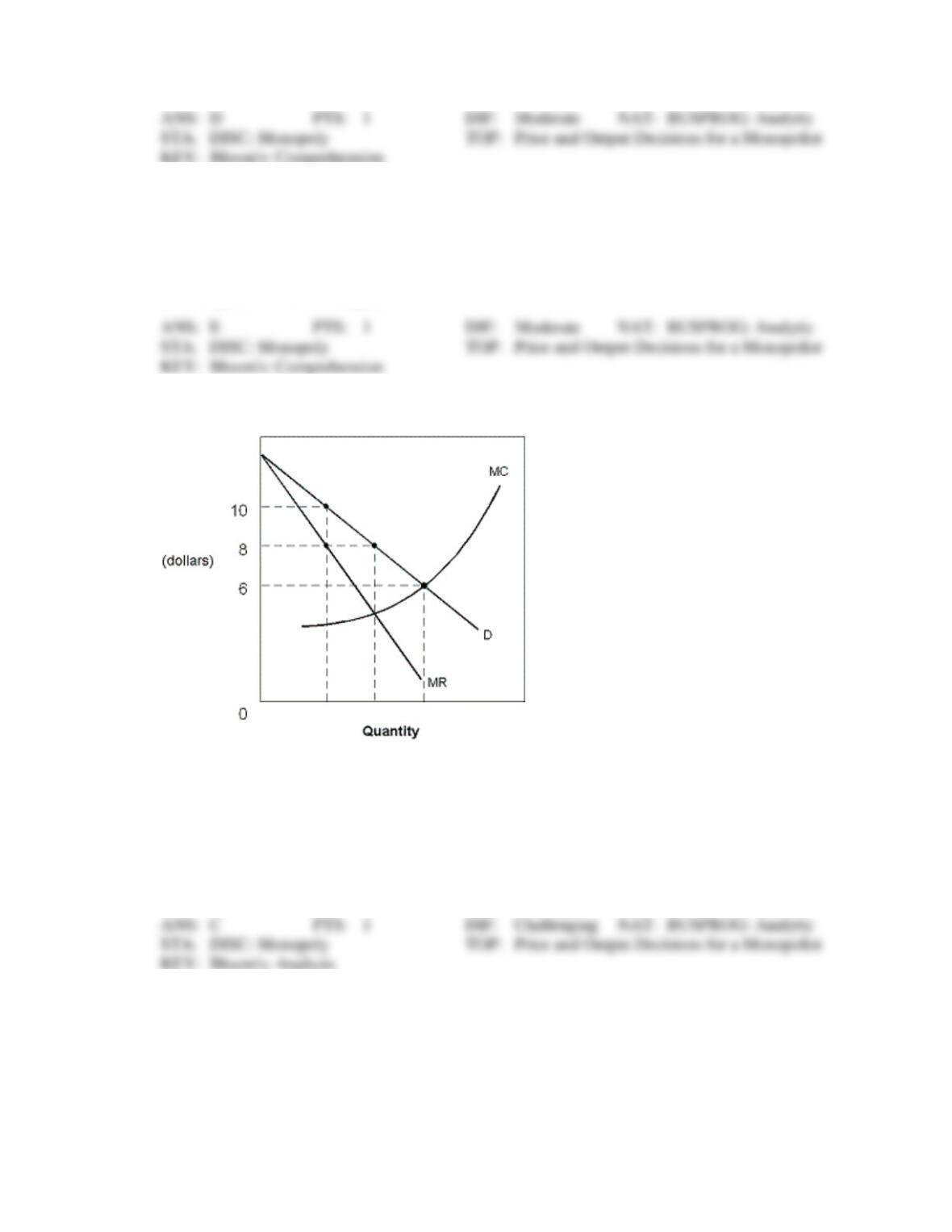
Exhibit 9-7 Monopolist
81. According to the information provided in Exhibit 9-7, if the Rudd Ice Company was a monopoly and
is currently charging a price of $10, what would you advise Rudd to do?
a.
Stay where he is currently operating because he is charging the profit-maximizing price.
b.
Increase price and increase output.
c.
Decrease price and increase output.
d.
Increase output and hold price constant.
e.
Increase price and hold output constant.
82. According to the information provided in Exhibit 9-7, if the Rudd Ice Company was a monopoly and
is currently charging a price of $8, what would you advise Rudd to do?
a.
Stay where he is currently operating because he is charging the profit maximizing price.
b.
Increase price and increase output.
c.
Decrease price and increase output.
d.
Increase output and hold price constant.