STA: DISC: The role of government TOP: Mergers and Global Antitrust Policy
KEY: Bloom’s: Comprehension
104. A merger between two manufacturers of computers would result in which of the following?
a.
A vertical merger.
c.
A horizontal merger.
b.
A conglomerate merger.
d.
A monopoly merger.
105. A merger of firms with a supplier is a:
a.
vertical merger.
c.
monopoly merger.
b.
conglomerate merger.
d.
horizontal merger.
106. A merger between an auto manufacturer and a steel mill would result in which of the following?
a.
A conglomerate merger.
c.
A horizontal merger.
b.
A vertical merger.
d.
A monopoly merger.
107. Which of the following mergers would result from the purchase of a computer chip company by IBM?
a.
A horizontal merger.
c.
A conglomerate merger.
b.
A vertical merger.
d.
An interlocking merger.
108. Which of the following mergers would result from the purchase of a retail clothing chain by a
computer software company?
a.
A horizontal merger.
c.
A conglomerate merger.
b.
A vertical merger.
d.
A monopoly merger.
109. A merger between a leather supplier and a shoe manufacturer would be classified as a:
a.
horizontal merger.
c.
conglomerate merger.
b.
vertical merger.
d.
keiretsu.
110. Which of the following mergers would result from the purchase of a paper mill by a textbook
publishing company?
a.
An interlocking merger.
c.
A conglomerate merger.
b.
A vertical merger.
d.
A horizontal merger.
111. A horizontal merger between two firms occurs when:
a.
the products of the merging firms were not related in any manner before the merger.
b.
one firm is a producer of products, and the other firm is a producer of services.
c.
one firm is a domestic firm, and the other is a foreign company.
d.
the firms stood in a buyer-seller relationship before the merger.
e.
the merger partners were competitors.
112. If two steel firms decide to merge, this merger would be classified as:
a.
a horizontal merger.
b.
a vertical merger.
c.
a conglomerate merger.
d.
either a vertical or conglomerate merger depending on the nationality of the companies.
e.
either a vertical or conglomerate merger depending on the market shares of the two
companies.
113. A vertical merger occurs when:
a.
the products of the merging firms were not related in any manner before the merger.
b.
one firm is a producer of products, and the other firm is a producer of services.
c.
one firm is a domestic firm, and the other is a foreign company.
d.
the firms stood in a buyer-seller relationship before the merger.
e.
the merger partners were competitors.
114. Suppose a steel firm and a cookware company merge. This merger would be classified as:
a.
a horizontal merger.
b.
a vertical merger.
c.
a conglomerate merger.
d.
either a horizontal or conglomerate merger, depending on the nationality of the companies.
e.
either a horizontal or conglomerate merger, depending on the market shares of the two
companies.
115. A conglomerate occurs when:
a.
the products of the merging firms were not related in any manner before the merger
b.
one firm is a producer of products, and the other firm is a producer of services
c.
one firm is a domestic firm, and the other is a foreign company
d.
the firms stood in a buyer-seller relationship before the merger
e.
the merger partners were competitors
116. If a steel company and an ice cream company decide to merge, this merger would be classified as:
a.
a horizontal merger.
b.
a vertical merger.
c.
a conglomerate merger.
d.
either a horizontal or vertical merger, depending on the nationality of the companies.
e.
either a horizontal or vertical merger, depending on the market shares of the two
companies.
117. A merger between McDonald’s and Burger King would be called a:
a.
horizontal merger.
b.
vertical merger.
c.
conglomerate merger.
d.
cartel.
e.
game theory.
118. A horizontal merger is one in which the merging firms:
a.
are about the same size.
b.
produce the same good in the same industry.
c.
will control greater than 50 percent of the market.
d.
have never directly competed in the past.
e.
will pay twice as much in taxes.
119. A merger between two firms that have a supplier-purchaser relationship is:
a.
horizontal.
b.
vertical.
c.
conglomerate.
d.
illegal.
e.
inefficient.
120. Which of the following is not a type of merger?
a.
b and e.
b.
Diversified merger.
c.
Horizontal merger.
d.
Vertical merger.
e.
Conglomerate merger.
121. For which pair of firms would a merger be horizontal?
a.
Avis Rentals and United Airlines
b.
Rawlings and Nike
c.
Barnes and Noble and Wordsworth Booksellers
d.
Starbucks and Baskin and Robbins
e.
Samuel Adams and Samsonite
122. Ever since the creation of the interstate highway system, the railroads have had to compete with trucks
for freight shipments. Union Pacific, the nation’s largest railroad, now offers door-to-door services to
clients, using their own trains and trucks. This must be the result of:
a.
horizontal merger.
b.
vertical merger.
c.
conglomerate merger.
d.
deregulation.
e.
high fuel prices.
123. Paul Bergen and Virginia Clancy each own a 100-acre soybean farm in Soyburg, Illinois. Together
they grow 1/1000th of 1 percent of the nation’s soybeans. When they merge, it will:
a.
b and e.
b.
be a horizontal merger.
c.
reduce competition in the soy market.
d.
increase the market power of Paul and Virginia.
e.
probably go unnoticed outside of Soyburg.
124. The Interstate Commerce Commission (ICC) was established in 1887 to regulate:
a.
banking.
b.
railroads and all surface transportation.
c.
nationwide advertising.
d.
interstate sales of food and drugs.
125. The airline and trucking industries came under regulation during the:
a.
1920s.
c.
1960s.
b.
1930s.
d.
1970s.
126. The federal agency established in 1934 to regulate telephones and broadcasting industries is the:
a.
Interstate Commerce Commission (ICC).
b.
Federal Trade Commission (FTC).
c.
Securities and Exchange Commission (SEC).
d.
Equal Employment Opportunity Commission (EEOC).
e.
Federal Communications Commission (FCC).
127. The Consumer Product Safety Commission (CPSC) was established in:
a.
1887.
c.
1934.
b.
1931.
d.
1972.
128. During the first phase of regulation in the United States (from 1887 to the Great Depression), the
primary target of regulation was the:
a.
labor unions.
c.
food and drug industries.
b.
communication industry.
d.
railroads.
129. Deregulation, especially for the transportation and telecommunication industries, was the trend in the
United States during the:
a.
1930s.
c.
1970s.
b.
1950s.
d.
1980s.
130. In the United States, regulation increased steadily in the areas of health, safety, and the environment
during:
a.
the Great Depression.
c.
the 1970s.
b.
World War II.
d.
the 1980s.
131. Which of the following involved deregulation?
a.
Airline Deregulation Act of 1978.
c.
Motor Carrier Act of 1982.
b.
Staggers Rail Act of 1980.
d.
All of these.
132. The Civil Aeronautics Board (CAB) was:
a.
established in 1934 and reorganized in 1984.
b.
established in 1938 and eliminated in 1984.
c.
established in 1938 and reorganized in 1991.
d.
never a regulatory agency.
133. Marginal cost pricing is a system of pricing in which the price charged equals the marginal cost of:
a.
the first unit produced.
c.
the last unit produced.
b.
each unit produced.
d.
the profit-maximization unit.
134. Government regulators can achieve efficiency for a natural monopoly by setting a price ceiling equal
to the intersection of the demand curve and the:
a.
marginal revenue curve.
c.
marginal cost curve.
b.
average cost curve.
d.
average fixed cost curve.
135. Regulatory commissions may focus on establishing a “fair-return” price to be charged by a monopolist.
Under this policy, the monopolist would earn:
a.
positive economic profits.
c.
negative economic profits.
b.
zero economic profits.
d.
monopoly profits.
136. Consider a regulated natural monopoly. If the regulatory commission wants to establish a fair-return
price, then it should set a price ceiling where the demand curve crosses the monopoly’s long-run:
a.
marginal revenue curve.
c.
marginal cost curve.
b.
average revenue curve.
d.
average cost curve.
137. If regulation imposes marginal cost pricing on a natural monopoly, then the monopoly will:
a.
suffer persistent economic losses.
b.
earn a fair, but not excessive, return on its assets.
c.
produce too little output to achieve efficiency.
d.
experience diseconomies of scale.
138. The government will have to subsidize a natural monopoly in the long run if regulators choose to
pursue:
a.
marginal cost pricing
c.
per se pricing.
b.
fair-return pricing.
139. Which of the following statements is true?
a.
A vertical merger is a merger of firms that compete in the same market.
b.
The rule of reason doctrine declares that the existence of monopoly alone is illegal.
c.
Government regulation is economically justifiable for a natural monopoly.
d.
Deficient information on unsafe products causes underconsumption.
140. Economic regulation occurs when:
a.
monopoly is the optimal market structure
b.
the industry is highly competitive
c.
the product is important to economic welfare
d.
the government owns the assets of the industry
e.
the product price, if left unregulated, would be too low
141. The task of economic regulation is to:
a.
protect monopoly profits.
b.
approximate the results of the competitive market.
c.
replace competition with government ownership.
d.
ensure laissez faire.
e.
increase competition within the market.
142. If a regulatory commission sets the regulated price equal to marginal cost for a natural monopoly:
a.
losses will result.
b.
government subsidies will be unnecessary.
c.
the firm will earn economic profits.
d.
new firms will want to enter.
e.
resource use will not be optimal.
143. A local cable company has its rates set at P = $15 by a regulatory commission. Its current output is
10,000 households and its costs are as follows: ATC = $17; AVC = $14; and MC = $15. From this, we
can tell that this is:
a.
a fair price, and the firm earns a normal profit.
b.
a fair price, and the firm earns an economic loss.
c.
marginal cost pricing, and the firm earns a normal profit.
d.
marginal cost pricing, and the firm earns an economic loss.
e.
the same price that an unregulated monopolist would charge.
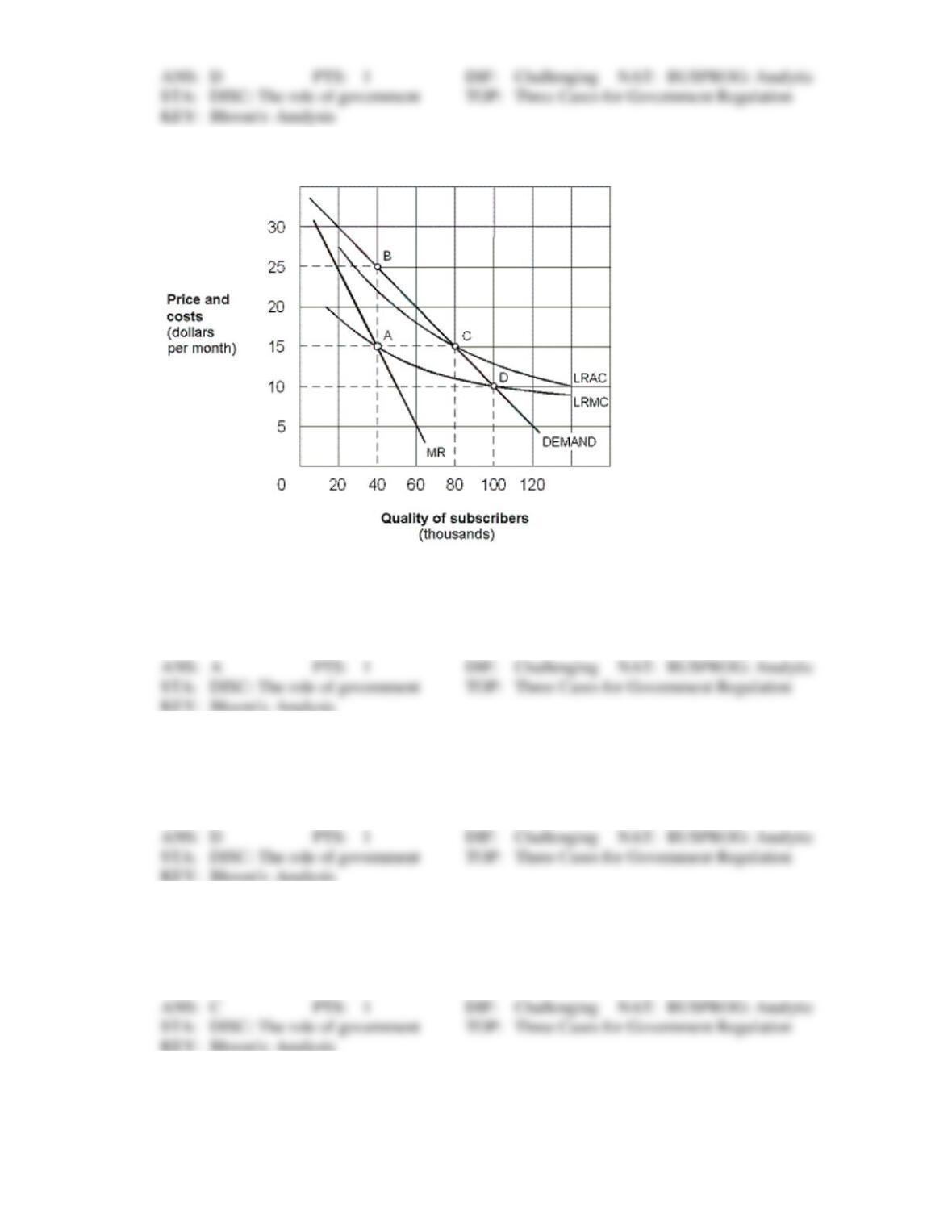
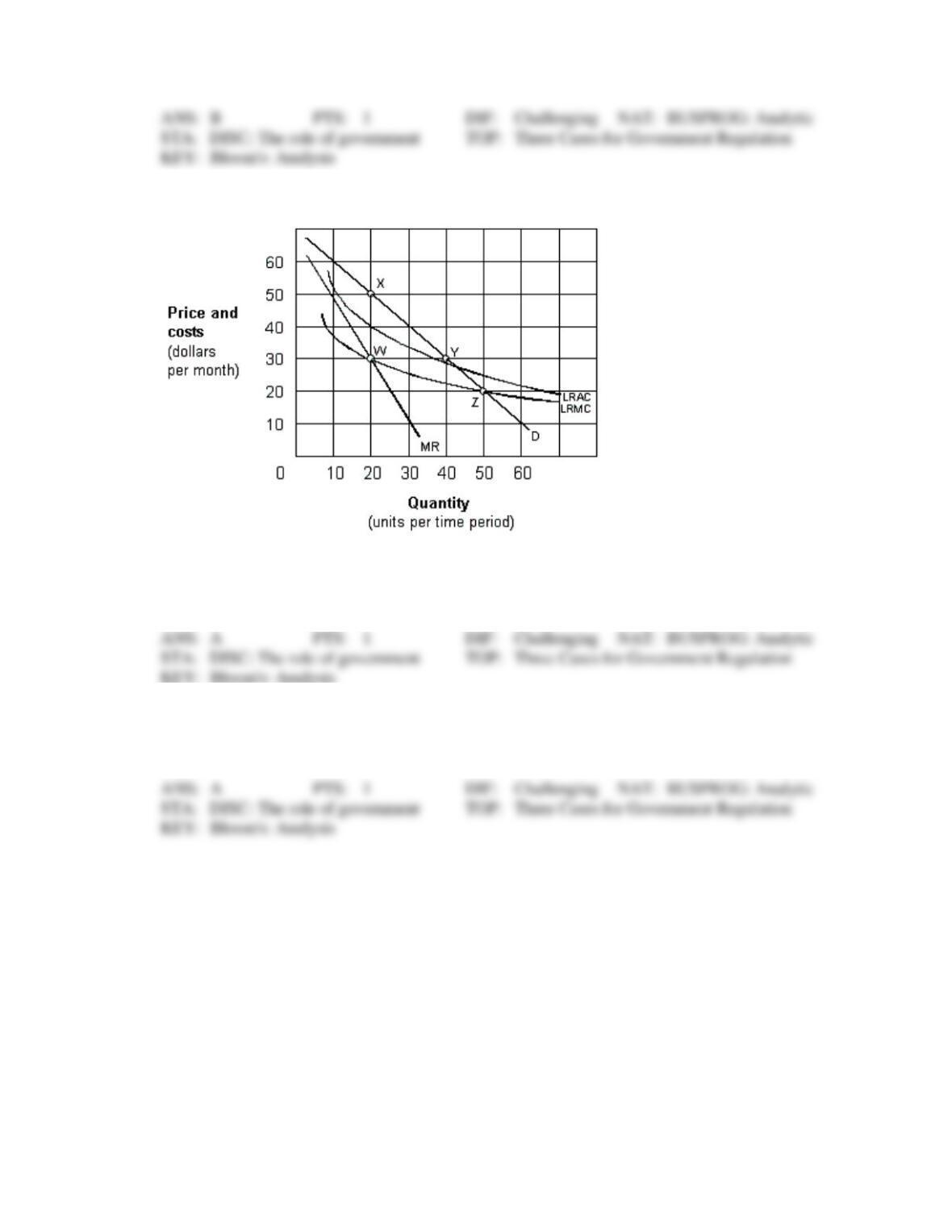
Exhibit 13-1 Cable television monopolist
144. As shown in Exhibit 13-1, an unregulated cable television monopolist would operate at which point on
its demand curve:
a.
A.
c.
C.
b.
B.
d.
D.
145. As shown in Exhibit 13-1, regulators might follow a marginal cost pricing strategy and require the
cable television monopolist to operate at point:
a.
A.
c.
C.
b.
B.
d.
D.
146. As shown in Exhibit 13-1, regulators might follow a fair return pricing strategy and require the cable
television monopolist to operate at point:
a.
A.
c.
C.
b.
B.
d.
D.
147. As shown in Exhibit 13-1, if the cable television monopolist is allowed to maximize profits, it will
operate at point:
a.
A.
c.
C.
b.
B.
d.
D.
Exhibit 13-2 Public utility monopolist
148. As shown in Exhibit 13-2, an unregulated monopolist would operate at point:
a.
W.
c.
Z.
b.
Y.
d.
None of these.
149. As shown in Exhibit 13-2, if the monopolist is allowed to maximize profits, it will operate at point:
a.
X.
c.
Z.
b.
Y.
d.
None of these.
Exhibit 13-3 A monopolist
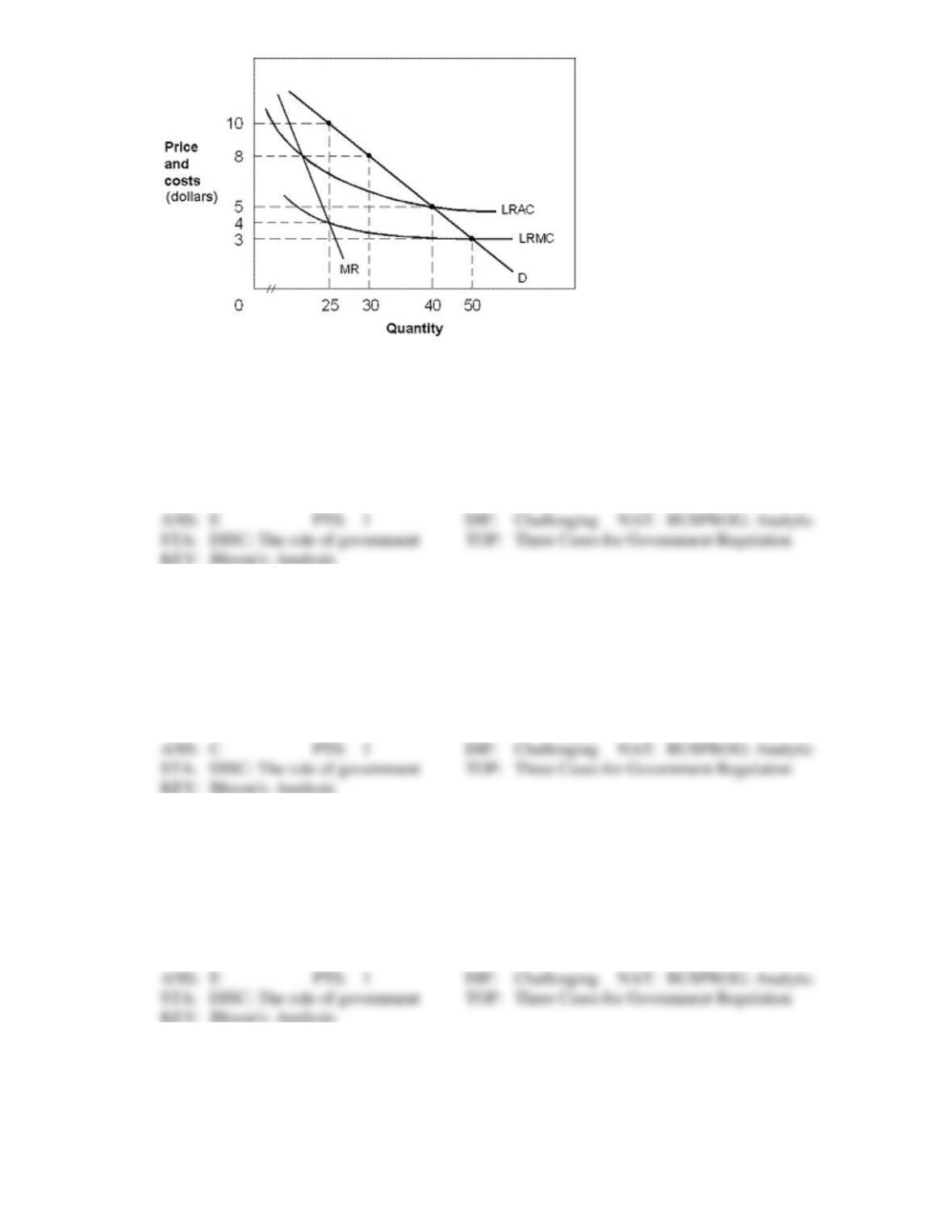
150. In Exhibit 13-3, if this is an unregulated monopoly firm, the price and output which would maximize
profits are:
a.
price = $8; output = 25.
b.
price = $8; output = 30.
c.
price = $5; output = 40.
d.
price = $4; output = 25.
e.
price = $10; output = 25.
151. In Exhibit 13-3, if this industry is regulated and the regulatory commission wants revenue to just cover
cost, the proper price and output combination to be set is:
a.
price = $8; output = 25.
b.
price = $8; output = 30.
c.
price = $5; output = 40.
d.
price = $4; output = 25.
e.
price = $10; output = 25.
152. In Exhibit 13-3, if this industry is regulated and the regulatory commission wants price to be set equal
to marginal cost, the proper price and output combination to be set is:
a.
price = $8; output = 25.
b.
price = $8; output = 30.
c.
price = $5; output = 40.
d.
price = $4; output = 25.
e.
price = $3; output = 50.
153. In Exhibit 13-3, if this industry is regulated and the regulatory commission sets price equal to marginal
cost, then:
a.
this firm would earn excess profit.
b.
price would equal ATC.
c.
the firm would suffer losses.
d.
revenue would just be sufficient to cover costs.
e.
total revenue would just cover marginal cost.
154. In Exhibit 13-3, if this industry is regulated and the regulatory commission sets price equal to average
total cost, then:
a.
this firm would earn excess profit.
b.
total revenue would equal marginal revenue.
c.
the firm would suffer losses.
d.
revenue would just be sufficient to cover costs.
e.
revenue would just be sufficient to cover marginal cost.
155. Which of the following may result in a higher equilibrium price for a product?
a.
Advertising
b.
Expectations
c.
Imperfect information
d.
All of the above answers are true.
e.
None of the above answers a.-c. are true.
156. Deficient information on unsafe products can cause:
a.
overconsumption of a product.
b.
waste of resources used to produce a product.
c.
consumers to pay a higher price for a product.
d.
all of the above answers are true.
e.
none of the above answers a. – c. are true.
157. Imperfect knowledge about a product can cause:
a.
excessive resources devoted to producing a product.
b.
consumers paying too high a price for a product.
c.
overconsumption of a product.
d.
all of the above answers are true.
e.
none of the above answers a.-c. are true.
TRUE/FALSE
1. Price discrimination that substantially lessens competition is prohibited by the Clayton Act.
2. The Sherman Antitrust Act was an amendment to the Clayton Act.
3. A conspiracy among firms to fix prices was outlawed by the Sherman Antitrust Act.
4. The Sherman Antitrust Act outlawed tying contracts.
5. The Sherman Antitrust Act makes cartels illegal in the United States.
6. Under the original Sherman Antitrust Act, violators were guilty of a misdemeanor.
7. Violations of the Sherman Antitrust Act have sometimes been punished by breaking up the offending
firm into a number of smaller firms.
8. The Sherman Antitrust Act was not specific enough to eliminate monopolies in the United States.
9. Interlocking directorates are illegal under the Clayton Act only when their effect is to lessen
competition substantially.
10. Under an exclusive buying arrangement, a retailer agrees not to sell a good at the manufacturer’s
suggested retail price.
11. Interlocking directorates are illegal under the Clayton Act.
12. Interlocking directorates are illegal under the Clayton Act whether or not the effect is to lessen
competition substantially.
13. Under an exclusive buying arrangement, a retailer agrees to sell a good at the manufacturer’s suggested
retail price.
14. It is against the law in the United States for one person to hold positions on more than one board of
directors at a time.
15. The Clayton Act allowed board members of one corporation to sit on the board of a competing firm as
long as inside information was not transmitted.
16. The Federal Trade Commission is charged with protecting consumers from false and misleading
advertising.
17. The Federal Trade Commission (FTC) was established to investigate unfair and deceptive business
practices.
18. The Robinson-Patman Act strengthened the merger provisions of the Sherman Antitrust Act.
19. The Robinson-Patman Act strengthened the merger provisions of the Clayton Act.
20. The Celler-Kefauver Act was passed because the Clayton Act had not been effective against mergers.
21. The primary purpose of the Celler-Kefauver Act is to prevent unfair and deceptive business practices.
22. If a firm buys the assets of a firm with cash, it may be in violation of the Celler-Kefauver Act.
23. The Celler-Kefauver Act of 1950 plugged a technical loophole in the Clayton Act which permitted
many large horizontal mergers.
24. The Utah Pie case is an example of a violation of the Celler-Kefauver Act.
25. The Utah Pie case is an example of a violation of the Robinson-Patman Act.
26. According to critics, the Utah Pie case represents a failure by the Supreme Court to distinguish
between injury to competition that benefits consumers and injury to a specific competitor.
27. The rule of reason was applied in the Alcoa case.
28. The rule of reason would have not found a well-behaved, but gigantic, firm to be in violation of the
antitrust laws.
29. “Mere size is no offense” is an antitrust ruling based on the rule of reason.
30. In the Alcoa case, the Supreme Court abandoned the per se rule and established the rule of reason.
31. The per se rule was applied in the Alcoa case.
32. Being too big a firm can be a per se violation of antitrust laws.
33. The per se rule would have not found a well-behaved, but gigantic, firm to be in violation of the
antitrust laws.
34. The purchase of Michelin Tire Company by General Motors is an example of a vertical merger.
35. A merger of firms that compete in the same market is classified as a conglomerate merger.
36. The purchase of Michelin Tire Company by General Motors is an example of a horizontal merger.
37. Antitrust laws in other countries are weak in comparison to U.S. antitrust laws.
38. Antitrust laws in other countries are much stronger than U.S. antitrust laws.
39. In the United States during the 1980s, there was a movement toward deregulation of industry.
40. It is not possible for a regulated public utility to earn economic profits in the short run.
41. Under fair-return pricing, a regulated natural monopoly will earn zero economic profit.
42. Imperfect information is a rationale for regulation.
43. Overconsumption of a product can be caused by imperfect information.
ESSAY
1. Prior to 1914, did antitrust legislation have much effect on monopoly power in the United States?
2. The Department of Justice has challenged the merger of two firms, and the case has ended up in the
Supreme Court. The two firms argue that they will not use their monopoly power to raise prices or to
cut output. Under what judicial standard would their merger be allowed, and under what judicial
standard would their merger be disallowed?
3. IBM and Sara Lee are two of the biggest firms in the United States, but they produce different
products. Could they legally merge, or would their merger be struck down by the courts?
4. You are the mayor of your home town, and one day you arrive at city hall to find angry voters
demonstrating against you. They are mad because your office created a garbage-collection monopoly
by awarding only one company a permit to collect garbage in your town. The voters claim that the
company is overcharging and providing poor service. They want you to do something that will lower
rates and improve service. You call your staff economist, who presents evidence that there are
substantial economies of scale to garbage collection. What are your options if you are interested in
efficiency?