98. The demand curve for labor of Coca-Cola manufacturers will not shift to the right if:
a.
d and e.
b.
the price of Coca-Cola increases.
c.
the firms innovate with new technology that raises labor productivity.
d.
the price of Pepsi decreases.
e.
Coca-Cola workers become unionized.
99. What happens to the MP of labor when the market price of the good produced increases?
a.
Increases proportional to price.
b.
Decreases proportional to price.
c.
Stays the same.
d.
Falls because quantity demanded falls.
e.
Rises because quantity demanded falls.
100. Which of the following would cause the demand for labor to change?
a.
c and e.
b.
A change in the cost of living.
c.
Changes in the wage rate.
d.
Movements along the labor demand curve.
e.
A change in the price of the good produced.
101. A union can influence the demand for labor by:
a.
requiring union fees.
b.
raising union fees.
c.
effective advertising that convinces customers to buy the “union label.”
d.
all of these.
102. A union can influence the equilibrium wage rate by:
a.
collective bargaining.
b.
featherbedding.
c.
lobbying for legislation to reduce immigration.
d.
all of these.
103. Currently, union membership in the United States is about:
a.
10 percent.
c.
20 percent.
b.
15 percent.
d.
25 percent.
104. Which of the following countries has the largest union membership measured as the percentage of
civilian employees in unions?
a.
The United States.
c.
The United Kingdom.
b.
Japan.
d.
Sweden.
105. A union may negotiate limits on workload in order to increase the demand for labor and raise workers’
salaries. This practice is known as:
a.
featherbedding.
c.
monopsonistic bargaining.
b.
human capital formation.
d.
artificial demand stimulus.
106. A monopsony will:
a.
hire more workers than a competitive employer.
b.
pay a higher wage than a competitive employer.
c.
employ a quantity of labor where the marginal revenue product equals the marginal factor
cost.
d.
all of these.
107. A monopsony is a:
a.
large number of buyers.
c.
single seller.
b.
large seller.
d.
single buyer.
108. Which of the following type of firm is not a price taker in the market in which the firm buys its inputs?
a.
Perfect competition.
c.
Oligopoly.
b.
Monopsony.
d.
Monopoly.
109. A monopsonist’s marginal factor cost (MFC) curve lies above its supply curve because the firm must:
a.
lower the factor price to hire more.
b.
increase the price of its product to sell more.
c.
increase the factor price to hire more.
d.
lower the product price to sell more.
110. Given the same marginal revenue product (MRP) and supply curves, the equilibrium quantity of labor
employed in a monopsonistic labor market will be:
a.
equal to that in a competitive labor market.
b.
less than that in a competitive labor market.
c.
greater than that in a competitive labor market.
d.
there is insufficient information for a conclusion.
111. Suppose a firm can hire 100 workers at $8.00 per hour but must pay $8.05 per hour to hire 101
workers. Marginal factor cost (MFC) for the 101st worker is approximately equal to:
a.
$8.00.
c.
$13.05.
b.
$8.05.
d.
$13.00.
112. Compared to a competitive input market, a monopsonist will hire:
a.
more and pay a higher input price.
c.
more but pay a lower input price.
b.
less but pay a higher input price.
d.
less and pay a lower input price.
113. BigBiz, a local monopsonist, currently hires 50 workers and pays them $6 per hour. To attract an
additional worker to its labor force, BigBiz would have to raise the wage rate to $6.25 per hour. What
is BigBiz’s marginal factor cost?
a.
$6.25 per hour.
c.
$18.75 per hour.
b.
$12.50 per hour.
d.
$20 per hour.
114. As compared to a firm that competes for labor, a monopsony will:
a.
hire fewer workers and pay lower wages.
b.
hire fewer workers by pay higher wages.
c.
pay lower wages but hire more workers.
d.
pay higher wages and hire more workers.
115. A monopsonist’s marginal factor cost (MFC) curve lies above its supply curve because the firm must:
a.
lower the product price to sell more.
b.
increase the price of its product to sell more.
c.
decrease the factor price to hire more.
d.
lower the factor price to hire more.
e.
none of these.
116. A monopsonist hires the amount of labor where the marginal revenue product of labor equals the:
a.
price of the monopsonist’s product.
c.
marginal factor cost of labor.
b.
wage rate.
d.
marginal product of labor.
117. A monopsony owner believes that hiring an additional worker would increase the company’s revenue
by $150 per day. We can conclude that the monopsony pays its workers:
a.
more than $150 per day.
c.
less than $150 per day.
b.
exactly $150 per day.
d.
exactly $75 per day.
118. Which of the following statements is true?
a.
A monopsony is the only employer of a factor of production.
b.
A monopsony will pay workers a higher wage and employ fewer workers than a
competitive labor market.
c.
A monopsony has a marginal factor cost curve which lies below its supply curve of labor.
d.
Unions are becoming a greater influence in American labor markets.
e.
All of these.
119. The best number of workers for any employer to hire is that quantity in which:
a.
the marginal revenue product equals the marginal factor cost.
b.
the marginal revenue product exceeds the marginal factor cost.
c.
total costs are minimized.
d.
total revenue is maximized.
e.
none of these
Exhibit 11-8 A labor market
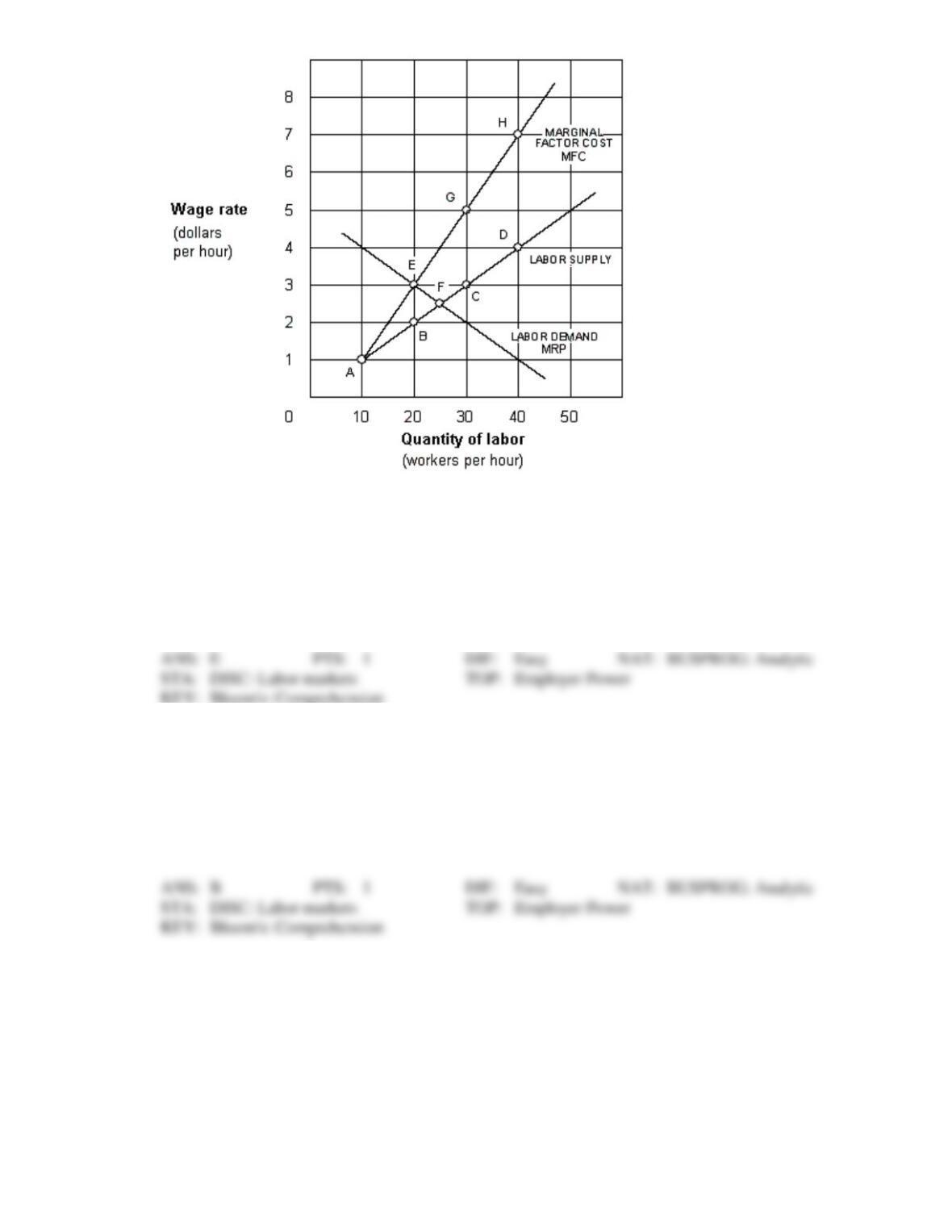
120. If the labor market shown in Exhibit 11-8 is competitive, the wage rate and number of workers
employed will be determined at point:
a.
A.
b.
B.
c.
C.
d.
D.
e.
F.
121. If the labor market shown in Exhibit 11-8 is a monopsony, the wage rate and number of workers
employed will be determined at point:
a.
A.
b.
B.
c.
C.
d.
D.
e.
F.
Exhibit 11-9 A labor market
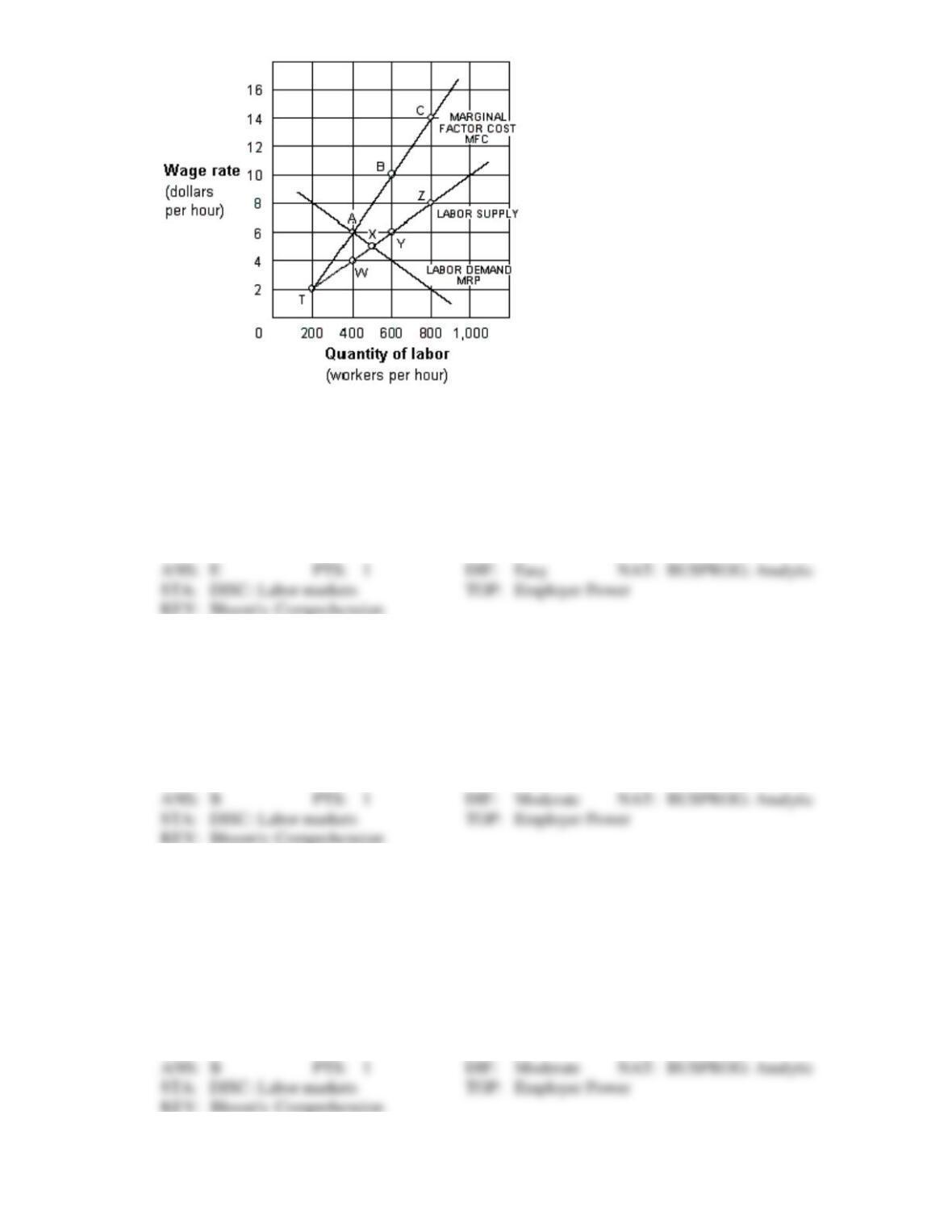
122. If the labor market shown in Exhibit 11-9 is competitive, the wage rate and number of workers
employed will be determined at point:
a.
A.
b.
Y.
c.
C.
d.
Z.
e.
X.
123. If the labor market shown in Exhibit 11-9 is a monopsony, the wage rate and number of workers
employed will be determined at point:
a.
A.
b.
W.
c.
C.
d.
Y.
e.
Z.
124. Which of the following statements is true?
a.
Marginal revenue product is the extra revenue generated to the firm from the production of
one more unit of output.
b.
Marginal factor cost is the extra cost to a firm of employing one more unit of a factor of
production.
c.
The demand curve for a perfectly competitive employer is horizontal at the market wage
rate.
d.
The supply curve of labor is upward sloping because of the law of diminishing marginal
productivity.
125. For a monopsonist, the supply of labor facing the firm is:
a.
an insignificant portion of the market supply.
b.
perfectly horizontal.
c.
downward sloping.
d.
the summation of each firm‘s demand for labor.
e.
identical to the supply curve facing the market.
126. For a monopsonist:
a.
wage > TWC.
b.
wage > MFC.
c.
wage = MFC.
d.
wage = MRP.
e.
wage < MFC
127. Wage and MFC differ for a monopsonist because:
a.
the monopsonist is forced to pay a wage greater than the worker’s MFC.
b.
the monopsonist must accept the market wage rate.
c.
workers are not as efficient when employed by a monopsonist.
d.
any wage increase applies to all workers, not just to the next hired.
e.
wage rate decreases force workers to work longer hours.
128. The profit-maximizing employment level for a monopsonist occurs where:
a.
wage = MFC.
b.
wage = MRP.
c.
price = wage.
d.
wage = TWC.
e.
MRP = MFC
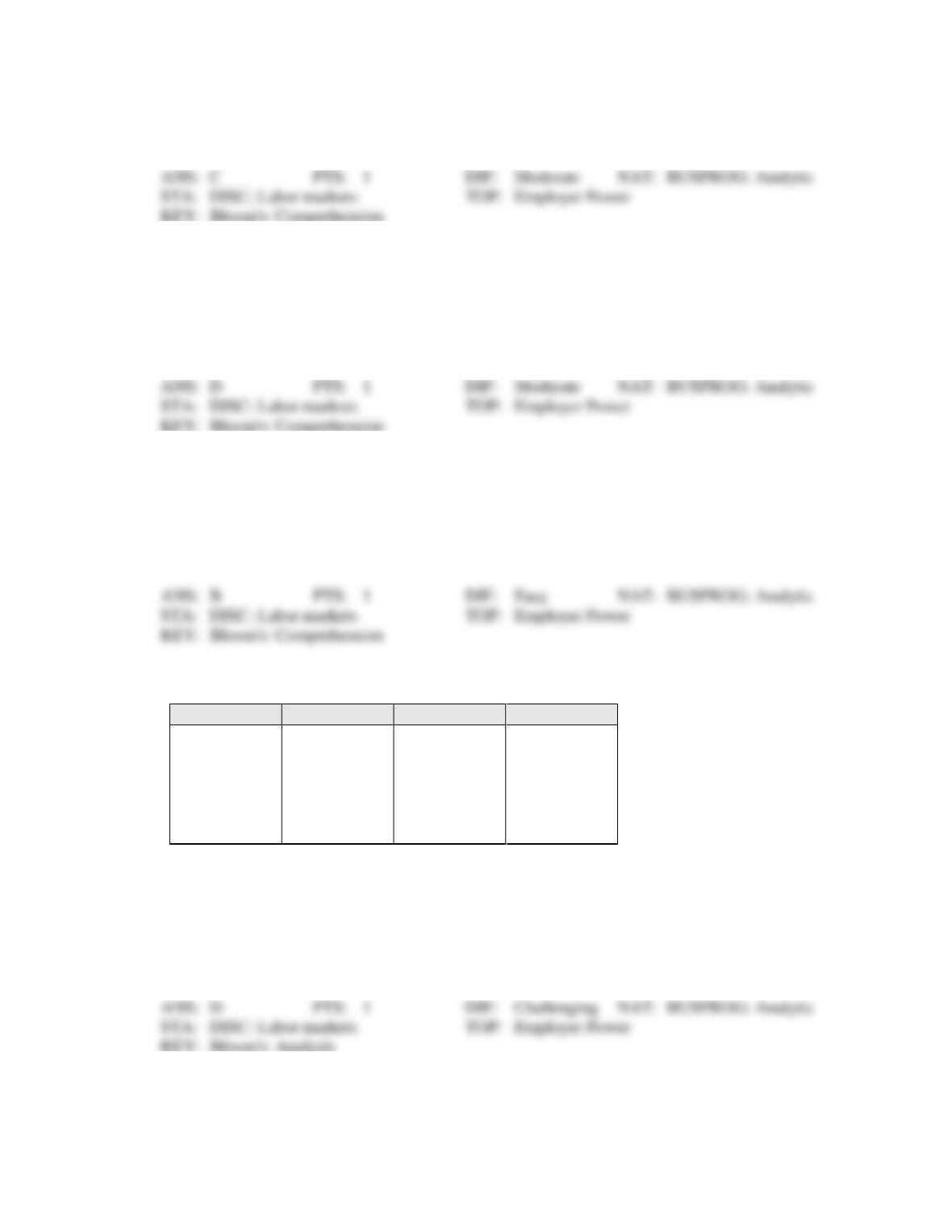
Exhibit 11-10 Labor and wage rate data
Labor
Wage
6
$12
7
13
8
14
9
15
10
16
129. In Exhibit 11-10, the marginal factor cost of the 8th employee is:
a.
$14.
b.
$13.
c.
$21.
d.
$23.
e.
$112
130. In Exhibit 11-10, the marginal factor cost of the 9th employee is:
a.
$15.
b.
$13.
c.
$21.
d.
$23.
e.
$135.
131. In Exhibit 11-10, the total wage cost of hiring 7 employees is:
a.
$15.
b.
$91.
c.
$13.
d.
$19.
e.
$112.
Exhibit 11-11 Labor wage and cost data
Labor
Wage
TWC
MFC
10
$
$ 50.00
$
11
5.80
12
17.80
13
102.70
14
126.00
15
46.50
132. In Exhibit 11-11, the wage required to hire 12 employees is equal to:
a.
$5.80.
b.
$6.00.
c.
$6.50.
d.
$6.80.
e.
$7.00.
133. In Exhibit 11-11, the total wage cost of hiring 12 employees is equal to:
a.
$17.80.
b.
$63.80.
c.
$102.70.
d.
$81.60.
e.
$6.80.
134. In Exhibit 11-11, the marginal factor cost of the 13th employee is equal to:
a.
$102.70.
b.
$17.80.
c.
$7.90.
d.
$21.10.
e.
$17.80.
135. In Exhibit 11-11, the total wage cost of hiring 15 employees is equal to:
a.
$11.50.
b.
$46.50.
c.
$172.50.
d.
$126.00.
e.
$23.30.
136. In Exhibit 11-11, the marginal factor cost of the 14th employee is equal to:
a.
$9.00.
b.
$126.00.
c.
$46.50.
d.
$23.30.
e.
$28.80.
137. In Exhibit 11-11, the wage required to hire 14 employees is equal to:
a.
$5.50.
b.
$8.10.
c.
$8.80.
d.
$9.00.
e.
$9.50.
Exhibit 11-12 A monopsonist
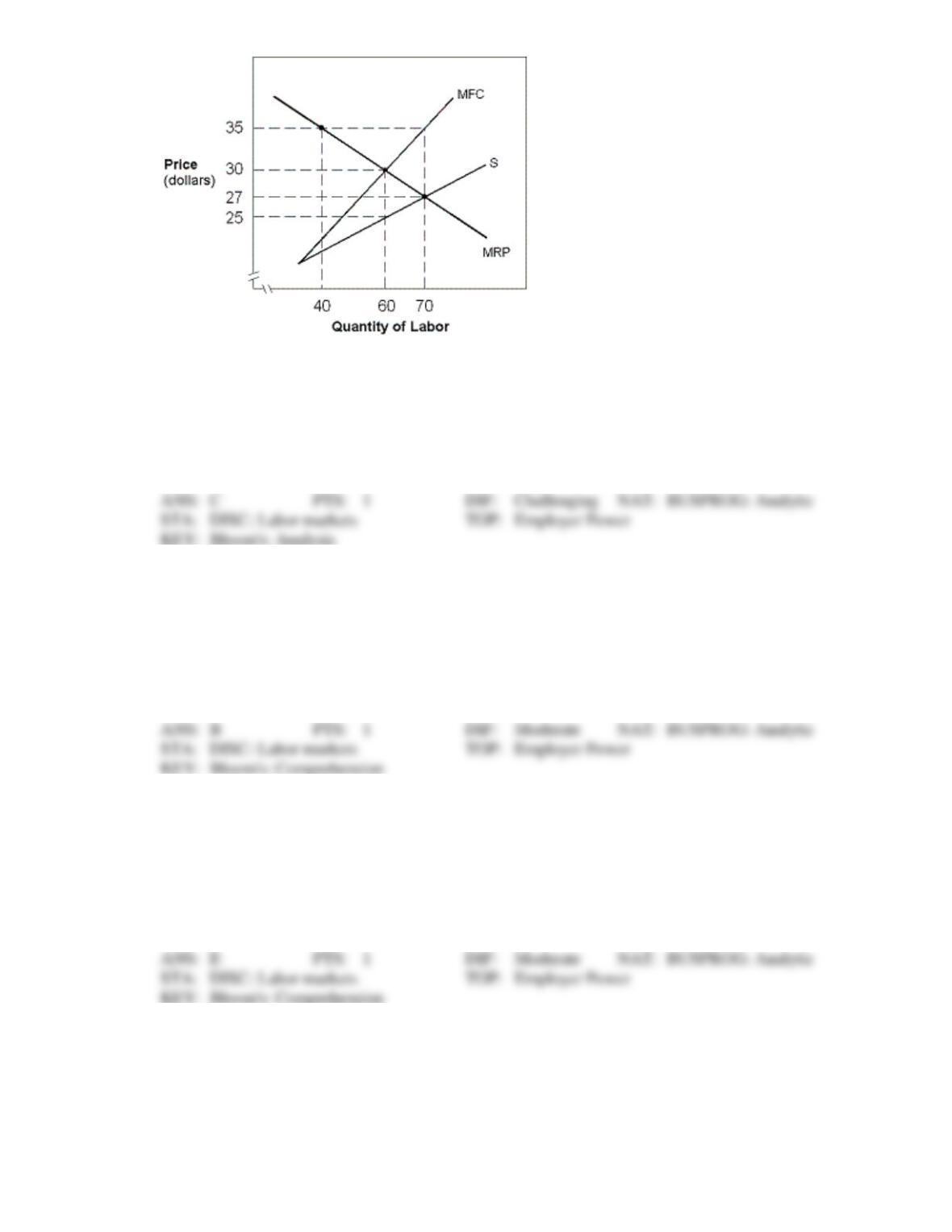
138. In Exhibit 11-12, we know this exhibit shows a monopsonistic labor market because:
a.
the MRP curve slopes down.
b.
the market supply of labor curve is horizontal.
c.
the MFC curve lies above the supply of labor curve.
d.
the MRP curve lies below the supply of labor curve.
e.
wages are below the supply of labor curve.
139. In Exhibit 11-12, a profit-maximizing firm faced with this labor market will hire ____ workers and pay
a wage of ____.
a.
60; $35
b.
60; $25
c.
60; $27
d.
70; $30
e.
70; $25
140. In Exhibit 11-12, at the profit-maximizing level of employment, the firm’s MFC is equal to ____ and
the firm’s MRP is equal to ____.
a.
$35; $30
b.
$25; $27
c.
$30; $35
d.
$27; $30
e.
$30; $30
141. In Exhibit 11-12, suppose this labor market is unionized by a powerful union which forces a wage of
$35 upon the industry. The firm would respond by hiring ____ workers and paying a wage of ____.
a.
40; $35
b.
60; $30
c.
70; $27
d.
60; $35
e.
40; $30
142. A monopoly is a sole ____, and a monopsonist is a sole ____.
a.
buyer in a product market; seller in a product market
b.
seller in a product market; seller in a labor market
c.
buyer in a product market; seller in a labor market
d.
seller in a product market; buyer in a labor market
e.
seller in a labor market; buyer in a product market
143. If an employer currently finds that the MRP of its labor resources equals $67, and the MFC equals
$56, what would you advise the firm to do?
a.
Stay at its current output level.
b.
Hire additional workers.
c.
Raise product prices.
d.
Reduce employment.
e.
Purchase new technology.
144. Suppose a previously competitive labor market turns into a monopsony. The labor supply curve faced
by the new monopsonist is:
a.
above the labor supply curve under perfect competition.
b.
the market supply curve of labor.
c.
below the labor supply curve under perfect competition.
d.
changed because workers are now more willing to supply labor.
e.
perfectly horizontal.
145. Which of the following is not true about a monopsonist?
a.
It can set the wage rate and hire any desired number of workers at that wage.
b.
It is the only buyer of labor in a market.
c.
It usually extracts rents from its monopsony power.
d.
It determines the optimal employment-wage rate combination by equating the marginal
revenue product of labor to the marginal cost of labor.
e.
It usually has to bargain with unionized workers.
146. The marginal factor cost for a monopsonist is:
a.
equal to the market wage rate.
b.
above the market wage rate.
c.
below the market wage rate.
d.
affected by the fact that workers are less willing to work than under conditions of perfect
competition.
e.
lower than the marginal revenue product of labor in equilibrium.
Exhibit 11-13 A monopsonist’s supply and marginal revenue product data
Workers
Wage Rate
MRP
1
$ 8
$50
2
9
25
3
10
20
4
11
17
5
12
16
6
13
13
147. In Exhibit 11-13, what is the marginal factor cost when the monopsonist hires 4 workers?
a.
$11.
b.
$16.
c.
$14.
d.
$17.
e.
$12.
148. In Exhibit 11-13, how many workers will the monopsonist hire?
a.
4.
b.
5.
c.
3.
d.
6.
e.
None.
149. Use Exhibit 11-13. What wage rate will the monopsonist pay the workers?
a.
$11.
b.
$13.
c.
$12.
d.
$16.
e.
0.