KEY: Bloom’s: Comprehension
177. The law of supply states that:
a.
there is a negative relationship between the price of a good and the quantity of it
purchased by suppliers.
b.
there is a positive relationship between the price of a good and the quantity that buyers
choose to purchase.
c.
there is a positive relationship between the price of a good and the quantity of it offered
for sale by suppliers.
d.
at a lower price, a greater quantity will be supplied.
178. Supply curves slope upward because:
a.
the quality is assumed to vary with price.
b.
technology improves over time, increasing the ability of firms to produce more at each
possible price.
c.
increases in the price of a good lead to rightward shifts of the supply curve.
d.
rising prides provide producers with the incentives needed to increase the quantity
supplied.
179. A supply schedule shows the relationship between:
a.
demand and supply.
b.
supply and income.
c.
price and income.
d.
quantity supplied and price.
e.
income and quantity supplied.
180. The supply schedule shows the specific quantity of a good that suppliers are willing and able to:
a.
demand at various prices.
b.
produce at various costs.
c.
hold back from the market when competition is reduced.
d.
provide at different prices.
e.
demand at various costs.
181. With an upward-sloping supply curve, which of the following is true?
a.
An increase in price results in a decrease in quantity supplied.
b.
An increase in price results in an increase in supply.
c.
A decrease in price results in a decrease in quantity supplied.
d.
A decrease in price results in an increase in supply.
182. Tasha decides that when homes in her neighborhood are selling for $150,000 she will not sell her
home. When average prices rise to $175,000, she decides that she will put her home on the market.
This is an example of:
a.
market demand.
b.
market-day supply.
c.
an excess supply of homes.
d.
a positively-sloped supply curve.
e.
a negatively-sloped supply curve.
183. Which of the following corresponds to the definition of the supply curve?
a.
It depicts a positive relationship between income and quantity supplied.
b.
It depicts a positive relationship between technology and prices.
c.
It depicts a positive relationship between prices and quantity supplied.
d.
It depicts a negative relationship between prices and quantity supplied.
e.
It depicts a proportional relationship between prices and quantity supplied.
184. The supply curve reflects the:
a.
inverse relationship between price and quantity offered.
b.
positive relationship between demand and supply.
c.
negative relationship between price and quantity bought.
d.
positive relationship between price and quantity bought.
e.
positive relationship between price and quantity offered.
185. A supply curve:
a.
has a negative slope.
b.
is based on the assumption of a stable demand curve.
c.
illustrates the negative relationship between price and quantity supplied.
d.
illustrates the positive relationship between price and quantity supplied.
e.
shifts about in random fashion.
186. When economists say the quantity supplied of a product has increased, they mean the:
a.
supply curve has shifted to the left.
b.
supply curve has shifted to the right.
c.
price of the product has risen, and consequently, suppliers are producing more of it.
d.
price of the product has fallen, and consequently, suppliers are producing less of it.
187. When economists say the quantity supplied of a product has decreased, they mean the:
a.
supply curve has shifted to the left.
b.
supply curve has shifted to the right.
c.
price of the product has risen, and consequently, suppliers are producing more of it.
d.
price of the product has fallen, and consequently, suppliers are producing less of it.
188. Which of the following will cause a movement upward along a supply curve?
a.
Increases in raw-material costs.
b.
Increases in labor costs.
c.
Increases in the cost of machinery.
d.
Increases in the market price of a good, other things being equal.
189. Which of the following will not cause a movement along the supply curve?
a.
Changes in the sellers’ expectations.
c.
Advances in technology.
b.
Increases in taxes per unit of output.
d.
All of these.
190. Which of the following will cause a movement along the supply curve?
a.
An increase or decrease in the raw materials costs.
b.
An increase in labor costs.
c.
Changes in the cost of the machinery used to make a good.
d.
Changes in the market price of a good, other things held constant.
191. Which of the following is most likely to increase the supply of corn?
a.
The farm worker’s union successfully negotiates a pay increase for corn harvest workers.
b.
The Surgeon General announces that eating corn bread contributes to baldness in men.
c.
Congress and the President eliminate subsidies formerly paid to corn farmers.
d.
Farmers that grow soybeans can also grow corn, and the price of soybeans drops by 75
percent.
192. A technological improvement in producing good A would be a shift in the:
a.
supply curve for A to the right.
c.
demand curve for A to the right.
b.
supply curve for A to the left.
d.
demand curve for A to the left.
193. When economists say the supply of a product has decreased, they mean that:
a.
the supply curve has shifted to the left.
b.
the product price has decreased, and as a consequence, suppliers are producing less of the
product.
c.
producers are now willing to sell more of this product at each possible price.
d.
the supply curve has shifted to the right.
194. How will an increase in lumber prices influence the home construction market?
a.
The demand for newly constructed homes will increase.
b.
The demand for newly constructed homes will decrease.
c.
The supply of newly constructed homes will increase.
d.
The supply of newly constructed homes will decrease.
195. If the United Auto Workers union can obtain a substantial wage increase for auto workers, there will
be a(n):
a.
decrease in the supply of automobiles, which is a shift to the right of the supply curve.
b.
decrease in the supply of automobiles, which is a shift to the left of the supply curve.
c.
increase in the supply of automobiles, which is a shift to the right of the supply curve.
d.
increase in the supply of automobiles, which is a shift to the left of the supply curve.
196. Which of the following would increase the supply of laptop computers?
a.
Higher wage rates for the workers that produce laptop computers.
b.
A technological improvement that lowers the cost of producing laptop computers.
c.
An increase in the price of computer chips used to produce laptop computers.
d.
All of these.
197. Which of the following will reduce the supply of motorcycles?
a.
An increase in the population age 16 to 35, the primary consumers of motorcycles.
b.
An increase in taxes imposed on motorcycle producers.
c.
A technological improvement reducing the production costs of motorcycles.
d.
A government study that reveals motorcycle riders, on average, live 10 years longer than
those who don’t ride motorcycles.
198. A decrease in supply means that:
a.
demand will increase by the same amount.
b.
the quantity demanded will increase.
c.
there is a movement down and to the left along the supply curve.
d.
the quantity supplied at every price will decrease.
e.
the supply curve will shift out and to the right.
199. Which of the following events would increase the supply of tomatoes?
a.
The introduction of mechanized tomato pickers, which raises the cost of production.
b.
An increase in wages for the tomato pickers.
c.
A decrease in the cost of fertilizers for the tomato plants.
d.
Unseasonably hot, dry weather in the tomato-growing regions of the nation.
e.
A decrease in the price of pasta products.
200. An increase in the number of producers will:
a.
increase the market supply, because the price will rise.
b.
increase the market supply only when market demand increases too.
c.
increase the market supply, because market supply is the sum of all individual supply
curves.
d.
increase the market supply only if each supplier has an identical supply curve.
e.
decrease the market supply, because firms compete with each other and each firm will
supply more.
201. An increase in the supply of the product implies:
a.
producers will now charge a higher price for a given quantity of output.
b.
the supply curve will shift to the left.
c.
some producers are dropping out of this market.
d.
producers will now charge a lower price for a given quantity of output.
e.
the price of this product has increased.
202. A leftward shift of a supply curve is called a(n):
a.
decrease in demand.
b.
increase in supply.
c.
decrease in supply.
d.
increase in quantity supplied.
e.
decrease in quantity supplied.
203. A change in supply cannot be caused by a change in:
a.
resource prices.
b.
technology.
c.
prices of other goods.
d.
the price of the good itself.
e.
the number of suppliers.
204. The development of new technology typically:
a.
shifts the supply curve to the right.
b.
reduces profits.
c.
results in a downward movement along a supply curve.
d.
increases costs of production.
e.
shifts the demand curve to the right.
205. Farmers can produce wheat and/or rice. What will happen in the wheat market if there is an increase in
the price of rice?
a.
Wheat supply will increase.
c.
Wheat demand will increase.
b.
Wheat supply will decrease.
d.
Wheat demand will decrease.
206. Farmers can choose to produce eggs or milk. If there is an increase in the price of milk then what will
be the effect in the egg market?
a.
The quantity of eggs demanded will increase.
b.
Egg demand will decrease.
c.
Egg supply will increase.
d.
Egg supply will decrease.
207. If more people enter medical school, we can expect:
a.
the demand for doctors to increase.
b.
the supply of doctors to increase.
c.
the demand for doctors to decrease.
d.
the supply of doctors to decrease.
e.
no effect on the supply or demand of doctors⎯just a movement along the curves.
208. Seller A, has an upward-sloping supply curve, and is willing to supply 400 units of a commodity at a
price of $5 per unit. Seller A is now willing to supply 500 units at a price of $5 per unit. Evidently,
seller A has experienced a(n):
a.
increase in supply.
b.
decrease in supply.
c.
increase in quantity supplied.
d.
decrease in the quantity supplied.
e.
decrease in demand.
209. If Congress decides to reduce the tax per pack paid by sellers of cigarettes, other things being equal,
the price of cigarettes will fall. This fall in prices can be attributed a(n):
a.
upward movement along the supply curve for cigarettes.
b.
rightward shift of the supply curve for cigarettes.
c.
downward movement along the demand curve for cigarettes.
d.
leftward shift of the supply curve for cigarettes.
210. An improvement in a firm’s technology that reduces its production costs will result in a(n):
a.
rightward shift of the supply curve.
b.
increase in supply.
c.
increase in quantity supplied at any given price.
d.
all of these are true.
211. A decrease in the number of dry cleaners in an area is represented by a(n):
a.
downward movement along the dry cleaning supply curve.
b.
upward movement along the dry cleaning supply curve.
c.
leftward shift in the dry cleaning supply curve.
d.
rightward shift in the dry cleaning supply curve.
e.
vertical dry cleaning supply curve.
212. Which of the following could cause the supply of carrots to decrease?
a.
Consumers’ incomes decrease.
b.
There is a technological advance in carrot production.
c.
Fertilizer costs increase.
d.
The number of farmers growing carrots increases.
e.
The price of carrots decreases.
213. The most plausible reason why changes in the price of cotton can cause shifts in the supply curve for
tobacco is:
a.
cigarette smokers often wear cotton shirts.
b.
when incomes rise, people consume more cotton and tobacco.
c.
firms can switch from growing tobacco to cotton and vice versa.
d.
tobacco is an input in the production of cotton.
e.
cotton and tobacco are unrelated markets in all ways.
214. There is a technological advance in the production of digital watches. This will cause:
a.
demand to increase.
b.
supply to increase.
c.
demand to decrease.
d.
supply to decrease.
e.
the price to increase.
215. Which of the following explain(s) better the fact that computers are cheaper now than 10 years ago?
a.
c and d.
b.
c and e.
c.
The technology used in the production of computers has improved during this period.
d.
Resources used in the production of computers have become cheaper during this period.
e.
The demand for computers has increased substantially during this period.
216. A technological improvement in the production of good X causes the:
a.
demand curve for X to shift to the right.
b.
demand curve for X to shift to the left.
c.
supply curve for X to shift to the right.
d.
supply curve for X to shift to the left.
217. A reduction in production costs will result in a(n):
a.
rightward shift of the supply curve.
b.
increase in supply.
c.
greater willingness and ability of producers to supply a larger quantity at any given price.
d.
greater willingness and ability of producers to supply the same quantity at a lower price.
e.
all of these.
218. A shift occurs in the supply curve for salt when:
a.
the price of salt increases.
b.
improvements are made in the production process.
c.
salt is found to be associated with high blood pressure.
d.
consumers expect the price of salt to increase in the future.
219. Which of the following would not cause a shift in the supply curve for a good?
a.
An increase in demand for that good.
b.
An increase in the cost of labor used to produce that good.
c.
A change in the cost of raw materials used to produce that good.
d.
A decrease in the cost of machinery used to produce that good.
220. To finance medical care, the federal government raises the tax per pack paid by sellers of cigarettes.
Other things being equal, the price of cigarettes rises because of a(n):
a.
upward movement along the supply curve for cigarettes.
b.
rightward shift of the supply curve for cigarettes.
c.
upward movement along the demand curve for cigarettes.
d.
leftward shift of the supply curve for cigarettes.
221. Assuming that soybeans and tobacco can both be grown on the same land, a decrease in the price of
tobacco, other things being equal, causes a(n):
a.
rightward shift of the supply curve for tobacco.
b.
upward movement along the supply curve for soybeans.
c.
rightward shift in the supply curve for soybeans.
d.
leftward shift in the supply curve for soybeans.
222. “Because of unseasonable cold weather, much of the peach crop has been destroyed.” This statement
indicates that the:
a.
price of peaches will fall.
b.
quantity of peaches that will be available at any given price has decreased.
c.
demand for peaches will shift to the left.
d.
quantity of peaches that will be available at any given price have increased.
223. Which of the following has a direct relationship rather than an inverse relationship with the supply
curve?
a.
The number of sellers.
b.
Resource prices.
c.
Consumer income.
d.
Prices of other goods that firms could produce.
224. Which of the following would decrease the supply of airline travel?
a.
Reduced number of airline travelers.
b.
New airline companies beginning operations.
c.
Higher fuel costs.
d.
Lower prices for airline tickets.
225. Assume that oranges and peaches can both be grown on the same type of land, a decrease in the price
of peaches, other things being equal, will cause a(n):
a.
upward movement along the supply curve for oranges.
b.
downward movement along the supply curve for oranges.
c.
rightward shift of the supply curve for oranges.
d.
leftward shift of the supply curve for oranges.
226. An advance in technology results in:
a.
suppliers offering a larger quantity than before at each given price.
b.
suppliers offering the same quantity as before at a lower price.
c.
a rightward shift of the supply curve.
d.
an increase in supply.
e.
all of these.
227. Assume Congress passes a new tax of $2.00 per pack on cigarettes. The effect on the supply curve is
a(n):
a.
decrease in supply.
c.
decrease in quantity supplied.
b.
increase in supply.
d.
increase in quantity supplied.
228. Assuming that wheat and corn can both be grown on the same type of land, a decrease in the price of
corn, other things being equal, will cause a(n):
a.
downward movement along the supply curve for wheat.
b.
upward movement along the supply curve for wheat.
c.
rightward shift in the supply curve for wheat.
d.
leftward shift in the supply curve for wheat.
229. An improvement in a firm’s technology that improves productivity results in a(n):
a.
leftward shift of the supply curve.
b.
upward movement along the supply curve.
c.
willingness to supply a larger quantity than before at any given price.
d.
downward movement along the supply curve.
230. Which of the following will increase the supply of a good?
a.
An increase in the price of another good that producers could produce.
b.
A lower price paid for resources used in the production of the good.
c.
A decrease in the number of sellers.
d.
An increase in taxes paid to the government by producers.
Exhibit 3-4 Supply curves
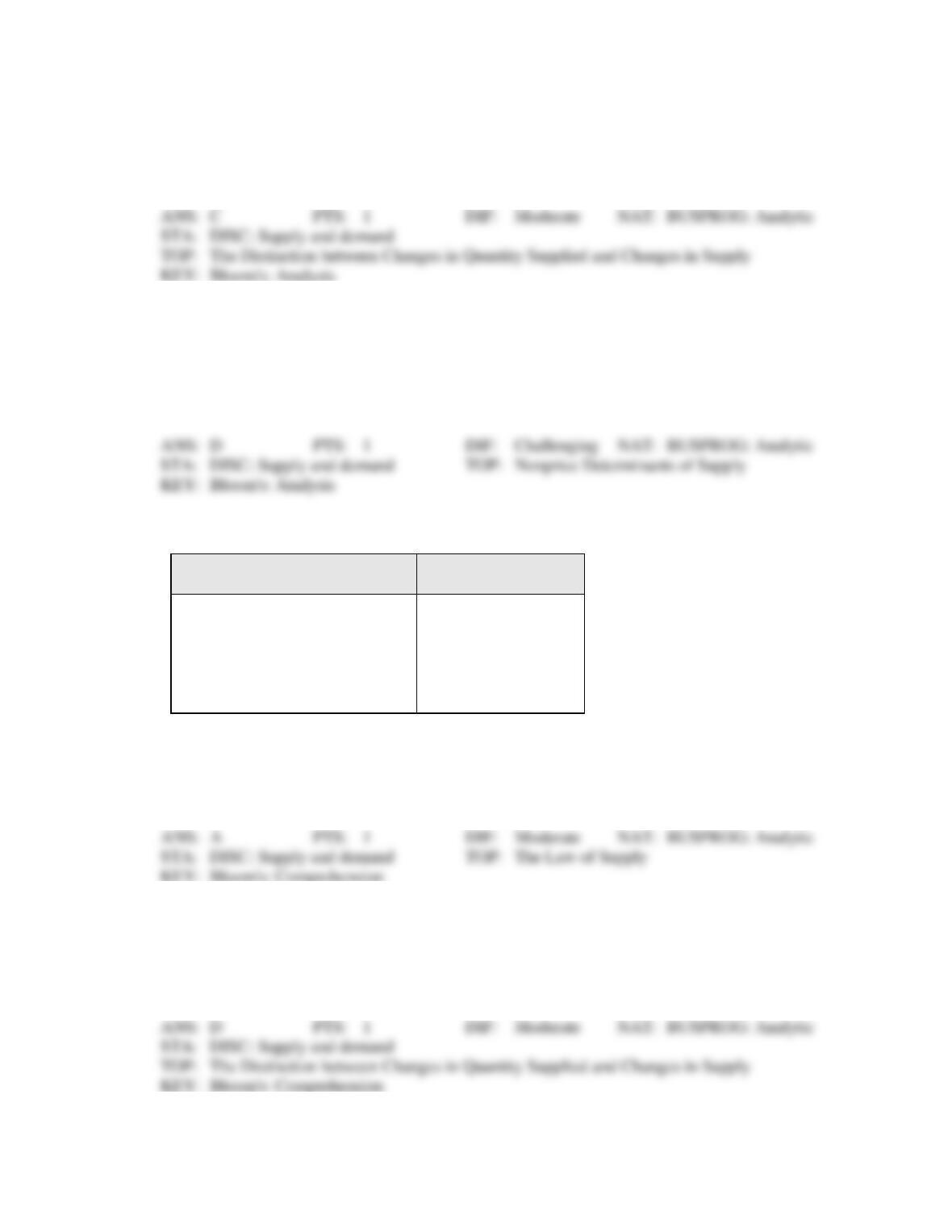
231. In Exhibit 3-4, a shift in the supply curve from S1 to S2 represents a(n):
a.
decrease in supply.
b.
decrease in the quantity supplied.
c.
increase in supply.
d.
increase in the quantity supplied.
e.
increase in demand.
232. In Exhibit 3-4, which of the following could have caused the shift in the supply curve from S1 to S2?
a.
Increase in demand.
b.
Decrease in demand.
c.
Decrease in the number of suppliers in the market.
d.
Decrease in wage rates.
e.
Increase in materials cost.
Exhibit 3-5 Supply for Tucker’s Cola Data
Quantity supplied per week
(millions of gallons)
Price per
gallon
6
$3.00
5
2.50
4
2.00
3
1.50
2
1.00
1
.50
233. As shown in Exhibit 3-5, the price and quantity supplied by sellers of Tucker’s Cola have a(n) ____
relationship.
a.
direct.
c.
negative.
b.
inverse.
d.
zero.
234. In reference to Exhibit 3-5, assume the price of Tucker’s Cola is $1.00 per gallon. If the price were to
rise to $3.00 per gallon, and all other factors, such as taxes, etc. remained constant, the result would be
a(n):
a.
decrease in supply.
c.
decrease in quantity supplied.
b.
increase in supply.
d.
increase in quantity supplied.
235. When there is a surplus of a product in a market the:
a.
price will rise.
b.
price must be above the equilibrium price.
c.
producers will expand output and sales will rise.
d.
price must be below the equilibrium price.
236. The price of a good will fall when:
a.
there is a shortage of the good.
c.
demand for the good increases.
b.
there is a surplus of the good.
d.
the supply of the good decreases.
237. Assume Qs represents the quantity supplied at a given price and Qd represents the quantity demanded
at the same given price. Which of the following market conditions produce a downward movement of
the price?
a.
Qs = 1,000, Qd = 750.
c.
Qs = 750, Qd = 1,000.
b.
Qs = 750, Qd = 750.
d.
Qs = 1,000, Qd = 1,000.
238. If there is a surplus in the oil market, then the price of oil will:
a.
rise.
c.
remain unchanged.
b.
fall.
d.
react unpredictably.
239. The price of a good will fall if:
a.
there is an excess demand of the good.
b.
demand and supply of the good are the same.
c.
there is an excess supply of the good.
d.
the price is below the equilibrium price.
e.
the price is near the equilibrium price.
240. A surplus of wheat:
a.
is impossible if people are hungry.
b.
is impossible if the price of wheat is below equilibrium.
c.
will result when the quantity demanded exceeds the quantity supplied at the current price.
d.
is unlikely to cause any change in the price of wheat.
e.
indicates that the problem of scarcity of wheat has been solved.
241. A surplus means a(n):
a.
excess demand for this product.
b.
situation where the current market price is too low.
c.
situation where the quantity demanded exceeds the quantity supplied.
d.
situation where the quantity supplied is less than the quantity demanded.
e.
excess supply of the product at the current price.
242. If a surplus of a product currently exists in the market,
a.
the market price is too low.
b.
the quantity demanded exceeds the quantity supplied at the current price.
c.
the quantity supplied exceeds the quantity demanded at the current price.
d.
there is a shortage of the product.
e.
there will be a tendency for the price to rise.
243. Assume that the equilibrium price for a good is $5. If the market price is $10, a:
a.
shortage causes the price to decline toward $5.
b.
surplus causes the price to rise above $10.
c.
shortage causes the price to rise above $10.
d.
surplus causes the price to decline toward $5.
244. If the current market price is above the equilibrium price, then:
a.
the quantity demanded exceeds the quantity supplied.
b.
there will be a shortage.
c.
the quantity supplied will exceed the quantity demanded.
d.
the price will have to increase to establish equilibrium.
e.
demand will shift to the left.
245. If the quantity demanded of milk is 55,000 and the quantity supplied of milk is 80,000, then:
a.
there is an excess supply of 25,000 units of milk.
b.
the price of milk will tend to rise to clear the market.
c.
consumers get the milk they want so market equilibrium exists.
d.
there is an excess demand of 25,000 units of milk.
e.
this is the intersection of market supply and demand curves.
246. When the price of a good is above its equilibrium price, a:
a.
surplus puts upward pressure on the price.
b.
surplus puts downward pressure on the price.
c.
shortage puts upward pressure on the price.
d.
shortage puts downward pressure on the price.
247. When there is a shortage of a product in a market the:
a.
price will fall.
b.
price must be below the equilibrium price.
c.
price must be above the equilibrium price.
d.
producers will reduce output and sales will fall.
248. The price of a good will rise when:
a.
there is a shortage of the good.
c.
demand for the good decreases.
b.
there is a surplus of the good.
d.
the supply of the good increases.
249. Tickets to the Indiana-Purdue basketball game are usually sold out in advance of game day. This
suggests:
a.
the price of the tickets must be very high or else people would not consider them valuable.
b.
the price is set below the equilibrium level.
c.
the Indiana basketball stadium is relatively small.
d.
everyone who attends the game will enjoy it.
250. A shortage of product means a(n):
a.
excess supply of the product.
b.
excess demand of the product.
c.
situation where the quantity demanded is less than the quantity supplied.
d.
situation where the quantity supplied exceeds the quantity demanded.
e.
situation where the current market price is too high.