Appendix to Chapter 6—Indifference Curve Analysis
MULTIPLE CHOICE
1. Assume an indifference curve yields a consumer 1,000 utils of total utility. If the consumer’s budget
increases by 50 percent, then the indifference curve:
a.
shifts rightward.
c.
becomes more linear.
b.
shifts leftward.
d.
is unchanged.
2. An indifference curve is:
a.
downward sloping and concave to the origin.
b.
downward sloping and convex to the origin.
c.
upward sloping and concave to the origin.
d.
upward sloping and convex to the origin.
3. An indifference map states:
a.
indifference curves farther from the origin yield higher levels of total utility.
b.
that the consumer’s income varies with the level of the indifference curve.
c.
indifference curves closer to the origin yield higher levels of total utility.
d.
that the points on either parts of indifference curves are preferred to the midpoint.
4. Combinations of two goods along the indifference curve yield:
a.
equal prices for the two goods.
c.
the same total utility.
b.
equal marginal utilities.
d.
zero total utility.
5. The slope of an indifference curve is ____ and a movement along the curve causes the loss in marginal
utility (MU) of one good to ____ the marginal utility (MU) gained from another good.
a.
zero; maximize
c.
concave; reduce
b.
positive; exceed
d.
negative; equal
6. When quantities of two goods belong to the same indifference curve, which of the following is true?
a.
The combinations of the two goods along the indifference curve yield the same total
utility.
b.
Prices of the two goods are equal.
c.
Marginal utilities of both goods are equal.
d.
The total utility of all combinations above the curve equal zero.
7. Along an indifference curve for goods X and Y, the vertical and horizontal axes measure the:
a.
prices of X and Y.
c.
quantities of X and Y.
b.
total utilities of X and Y.
d.
marginal utilities of X and Y.
8. An indifference curve consists of quantity combinations of two goods that yield:
a.
equal marginal utilities.
c.
the same price ratios.
b.
negative marginal utilities.
d.
the same total satisfaction.
9. Which of the following is a characteristic of an indifference curve?
a.
Positive slope.
c.
Negative slope.
b.
Concave shape.
d.
Zero slope.
10. An indifference curve has a negative slope because movement along the curve requires the consumer
to give up the:
a.
marginal utility of one good.
c.
marginal substitution value (MSV).
b.
total utility of one good.
d.
marginal transitivity of one good.
11. The negative slope of an indifference curve means that the consumer must give up quantity of one
good as the quantity of another good increases in order for total utility to ____.
a.
remain constant.
c.
decrease
b.
increase
d.
normalize.
12. Movement along an indifference curve causes the loss in marginal utility (MU) of one good to ____
the marginal utility (MU) gained from another good.
a.
exceed
c.
equal
b.
reduce
d.
maximize
13. The ____ is the absolute value of the slope of an indifference curve.
a.
marginal rate of substitution
c.
relative rate of utility
b.
average rate of transitivity
d.
marginal rate of transposition
14. The slope of an indifference curve is equal to the ratio of the ____ of the good on the horizontal axis to
the ____ of the good on the vertical axis.
a.
marginal product (MP); total value (TV)
b.
marginal utility (MU); marginal utility (MU)
c.
price (P); price (P)
d.
total utility (TU); price (P)
15. The absolute value of the slope of an indifference curve is called the:
a.
marginal rate of transformation.
c.
indifference rate of preference.
b.
transitivity slope.
d.
marginal rate of substitution.
16. The slope of the indifference curve for goods X and Y is called the marginal:
a.
product rate.
c.
rate of substitution.
b.
rate of transformation.
d.
rate of utility.
17. The slope of an indifference curve is equal to the ratio of the ____ of the good on the horizontal axis to
the ____ of the good on the vertical axis.
a.
marginal utility (MU); marginal utility (MU)
b.
total utility (TU); total utility (TU)
c.
marginal product (MP); marginal product (MP)
d.
price (P); total utility (TU)
18. The marginal rate of substitution measures the slope of the:
a.
total utility curve.
c.
budget line.
b.
demand curve.
d.
indifference curve.
19. The marginal rate of substitution ____ as one moves downward along the indifference curve.
a.
increase
c.
decreases
b.
remains constant
d.
increases and then decreases
20. Consumers always ____ indifference curves that are farther from the origin.
a.
reject
c.
prefer
b.
cross
d.
maximize
21. Consumers always prefer indifference curves that are ____ the origin.
a.
closer to
c.
farther from
b.
tangent to
d.
concave relative to
22. Which of the following is true concerning the indifference map?
a.
Each consumer has a map of indifference curves.
b.
Consumers always prefer curves farther from the origin.
c.
Each indifference curve in the map represents a different level of total utility.
d.
All of the above are true.
e.
None of the above is true.
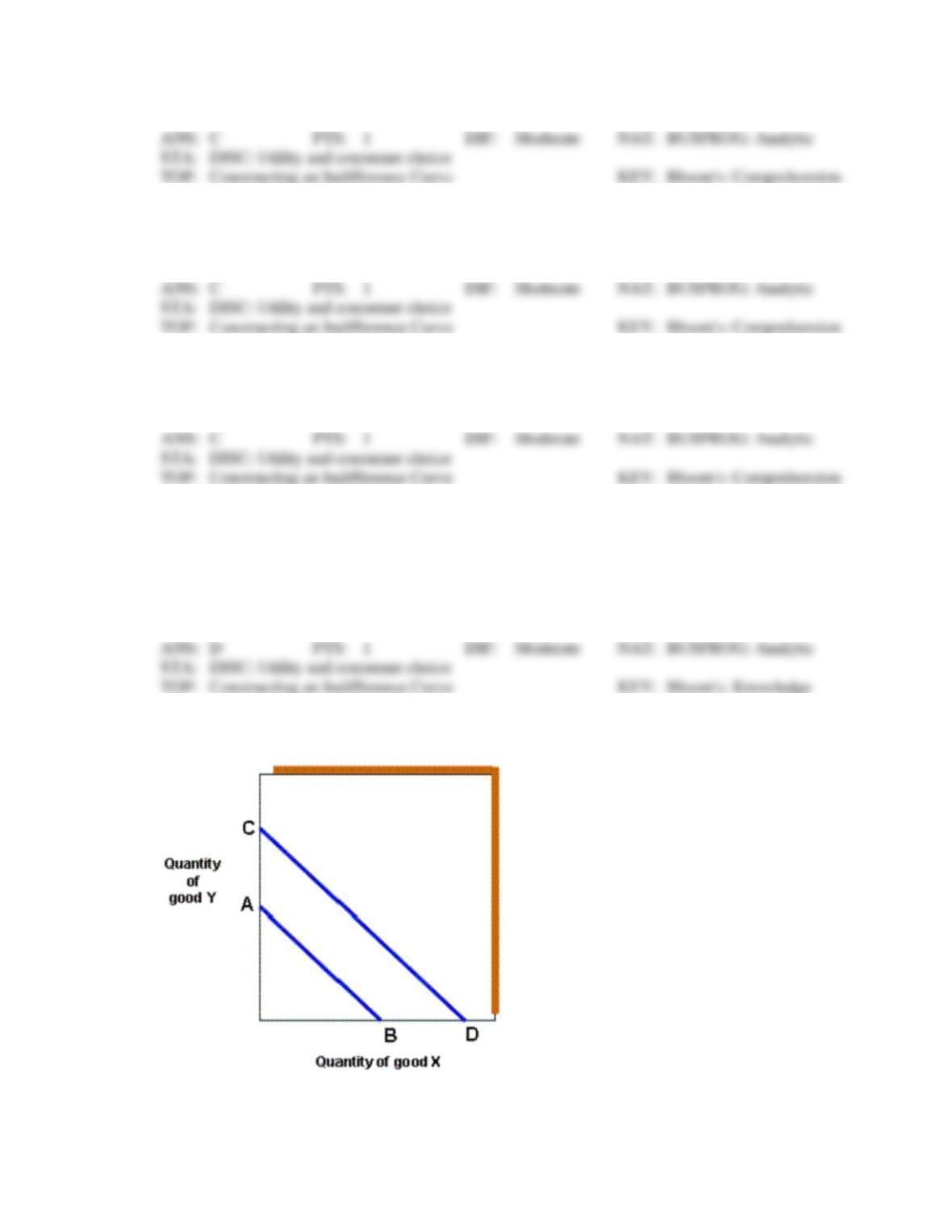
23. Exhibit 6A-1 Budget line
As shown in Exhibit 6A-1, a rightward shift in the budget line from AB to CD would result from:
a.
a price reduction in good X.
b.
a price reduction in good Y.
c.
a change in consumer preference.
d.
an increase in consumer income.
24. As shown in Exhibit 6A-1, a leftward shift in the budget line from CD to AB would result from:
a.
a price reduction in good X.
b.
a price reduction in good Y.
c.
a decrease in consumer income.
d.
an increase in consumer income.
25. Moving along a budget line, the prices of both goods:
a.
vary and the consumer’s budget is held constant.
b.
are held constant and the consumer’s budget varies.
c.
and the consumer’s budget are held constant.
d.
and the consumer’s budget vary.
26. Assume the price of good Y with its quantity measured on the vertical axis is $20 and the price of
good X with its quantity measured on the horizontal axis is $5. If the consumer’s budget is $100, then
the absolute value of the slope of the budget line is:
a.
100.
c.
1/4.
b.
20.
d.
4.
27. Assume the price of good Y with its quantity measured on the vertical axis is $100 and the price of
good X with its quantity measured on the horizontal axis is $10. If the consumer’s budget is $500, then
the absolute value of the slope of the budget line is:
a.
500.
c.
10.
b.
1/10.
d.
100.
28. Given the prices of two goods, all quantity combinations inside the budget line are:
a.
indifferent.
c.
unattainable.
b.
efficient.
d.
attainable.
29. Assume the price of good X is Px, price of good Y is Py, and B is the budget. The formula for the
budget line for these two goods is:
a.
PyQy / PxOx.
c.
PxX + PyY = B.
b.
PxB + PyB = B.
d.
(1 − Py / B) Px.
30. The ratio of the price of good X on the horizontal axis to the price of good Y on the vertical axis is the
____ of the budget line.
a.
marginal rate
c.
marginal utility
b.
slope
d.
equalization rate
31. The vertical and horizontal axes intercepts of the budget line represent the:
a.
quantity of goods that will be purchase if only that good is purchased.
b.
preference of one good compared to another good.
c.
quantity of each good that is outside the consumer’s income.
d.
only two choices that will spend the entire budget.
32. The budget line is a(n):
a.
convex curve.
b.
vertical line.
c.
concave curve.
d.
downward-sloping straight line.
e.
upward-sloping straight line.
33. A line that represents combinations of two goods that a consumer can purchase with a fixed income
and given price for each good is called the:
a.
indifference curve.
c.
budget line.
b.
demand curve.
d.
money line.
34. Given the prices of two goods, all quantity combinations outside the budget line are:
a.
undesirable.
c.
inferior.
b.
inefficient.
d.
unattainable.
35. The equation for a budget line for goods X and Y, with Px being the price of X, Py being the price of Y,
and B being the budget, can be written as:
a.
PxX + PyY = B.
c.
PxX = B + PyY.
b.
PxX + PyY = 1 / B.
d.
PxX / PyY = 1 − B.
36. Assume Px is the price of good X on the horizontal axis and Py is the price of good Y on the vertical
axis. The slope of the budget line equals:
a.
Py / PxY.
c.
(1 − Py / Px).
b.
PyQy / Px Qx.
d.
Px / Py.
37. The slope of the budget line is equal to the ratio of:
a.
marginal utilities.
b.
money income to the price of the good on the horizontal axis.
c.
money income to the price of the good on the vertical axis.
d.
price of the good on the horizontal axis to the price of the good on the vertical axis.
38. Consumer equilibrium occurs where the budget line is ____ to the ____ possible indifference curve.
a.
tangent; highest
c.
marginal; maximum
b.
equal; lowest
d.
differential; highest
39. Consumer equilibrium occurs at:
a.
any point of intersection between the budget line and an indifference curve.
b.
a point of tangency between the budget line and an indifference curve.
c.
the point where the slope of the indifference curve equals the ratio of the quantities.
d.
a point where the budget line cuts the curve from below.
40. Consumer equilibrium occurs where the budget line is tangent to the:
a.
lowest possible indifference curve.
c.
utility maximizing indifference curve.
b.
highest possible indifference curve.
d.
utility equalization indifference curve.
41. Only at the point of consumer equilibrium does the marginal rate of substitution (MRS) equal the:
a.
slope of the budget line.
c.
price ratio.
b.
slope of the indifference curve.
d.
all of these.
42. At the unique point of consumer equilibrium, the:
a.
distance between indifference curves is maximum.
b.
distance between the budget line and the indifference curve is maximum.
c.
marginal utility ratio of the two goods is equal.
d.
marginal rate of substitution (MRS) equals the slope of the budget line.
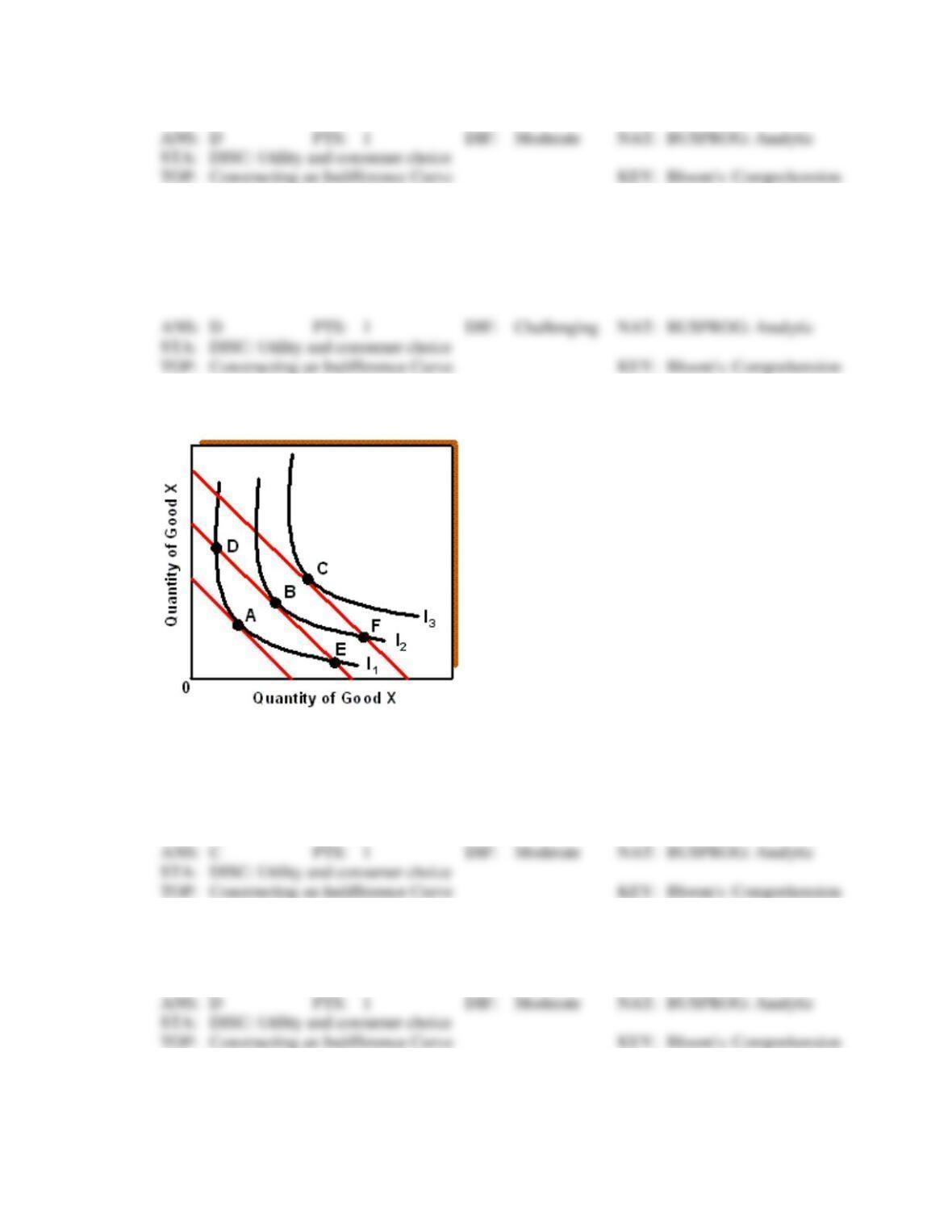
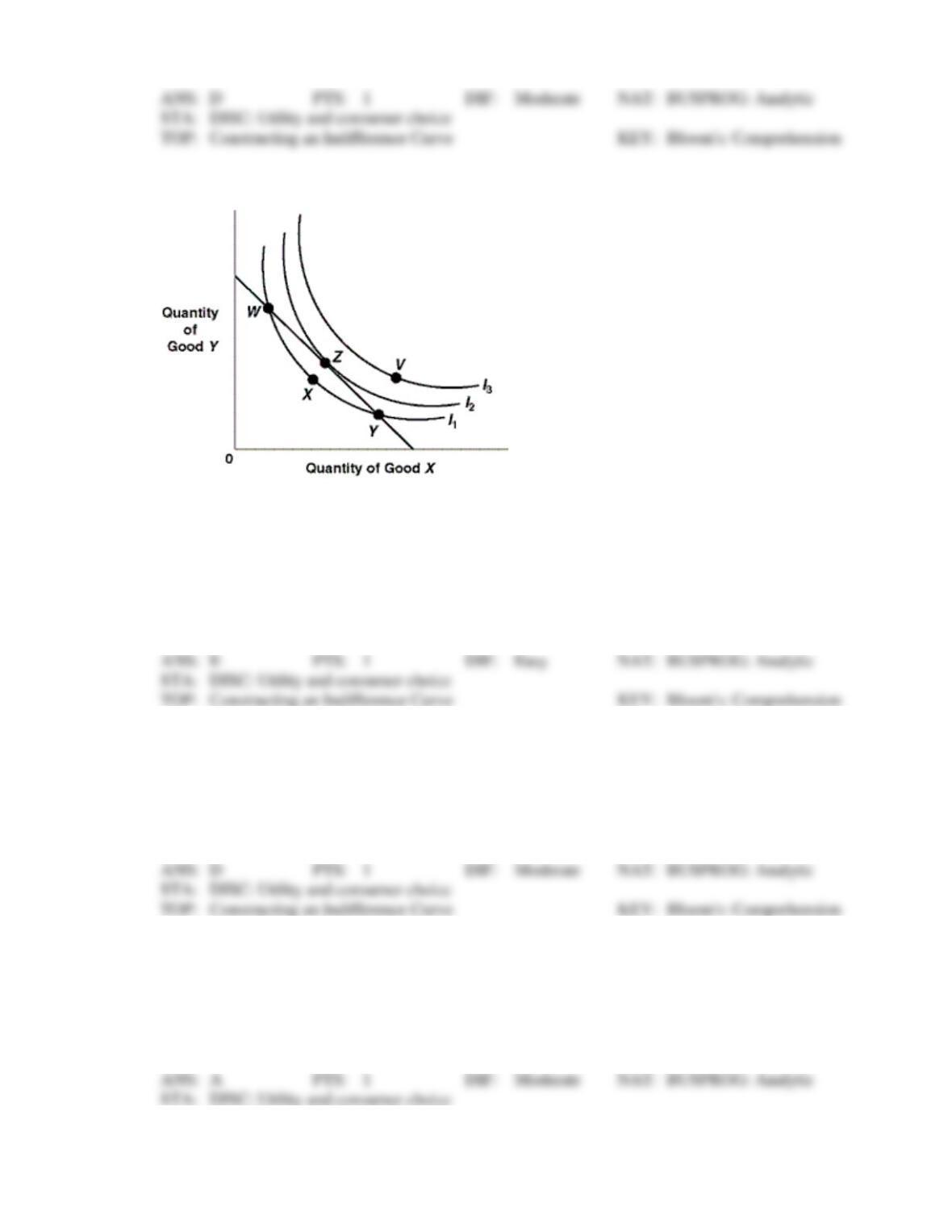
Exhibit 6A-1 Consumer Equilibrium
43. Given the budget lines and indifference curves shown in Exhibit 6A-1, points D, A, and E yield:
a.
more total utility than point B.
b.
more total utility than points B and F.
c.
less total utility than points B and C.
d.
equal total utility to points B, F, and C.
44. Given the budget lines and indifference curves shown in Exhibit 6A-1, point B yields:
a.
more total utility than point F.
c.
less total utility than point F.
b.
more total utility than points A and C.
d.
equal total utility to point F.
45. Given the budget lines and indifference curves shown in Exhibit 6A-1, point D yields:
a.
more total utility than point A.
c.
less total utility than point F.
b.
more total utility than point E.
d.
less total utility than points B, F, and C
Exhibit 6A-2 Consumer equilibrium
46. Given the budget line and indifference curves shown in Exhibit 6A-2, consumer equilibrium occurs at
point:
a.
V.
b.
W.
c.
X.
d.
Y.
e.
Z.
47. Given the budget line and indifference curves shown in Exhibit 6A-2, assume the consumer is initially
at point W. To maximize total utility, the consumer should:
a.
purchase more of good Y and less of good X.
b.
remain at point W.
c.
move to point X and then point Y.
d.
purchase more of good X and less of good Y.
48. Given the budget line and indifference curves shown in Exhibit 6A-2, assume the consumer is initially
at point Y. To maximize total utility, the consumer should:
a.
purchase more of good Y and less of good X.
b.
remain at point Y.
c.
move to point X and then point Y.
d.
purchase more of good X and less of good Y.
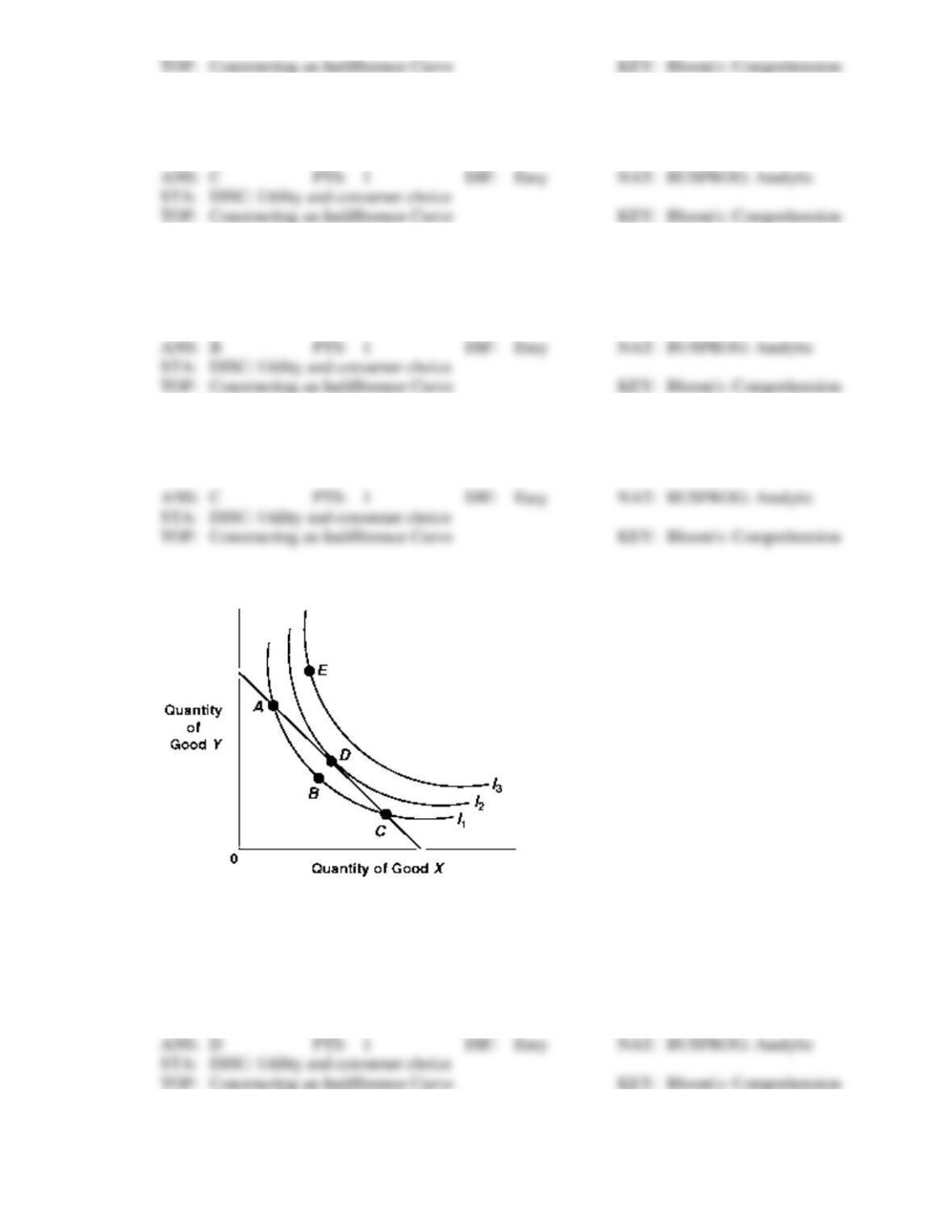
49. Given the budget line and indifference curves shown in Exhibit 6A-2, point V is:
a.
inferior to point X.
c.
unobtainable.
b.
lowest attainable level of total utility.
d.
consumer equilibrium.
50. Given the budge line and indifference curves shown in Exhibit 6A-2, consumer equilibrium occurs at a
tangency to which of the following indifference curves?
a.
I1.
c.
I3.
b.
I2.
d.
I1 or I2.
51. Given the budget line and indifference curves shown in Exhibit 6A-2, at point Z:
a.
Px exceeds Py.
c.
MRS = Px / Py.
b.
MUx = MUy.
d.
MRS = Py / Px.
Exhibit 6A-3 Consumer equilibrium
52. Given the budget line and indifference curves shown in Exhibit 6A-3, consumer equilibrium occurs at
point:
a.
A.
b.
B.
c.
C.
d.
D.
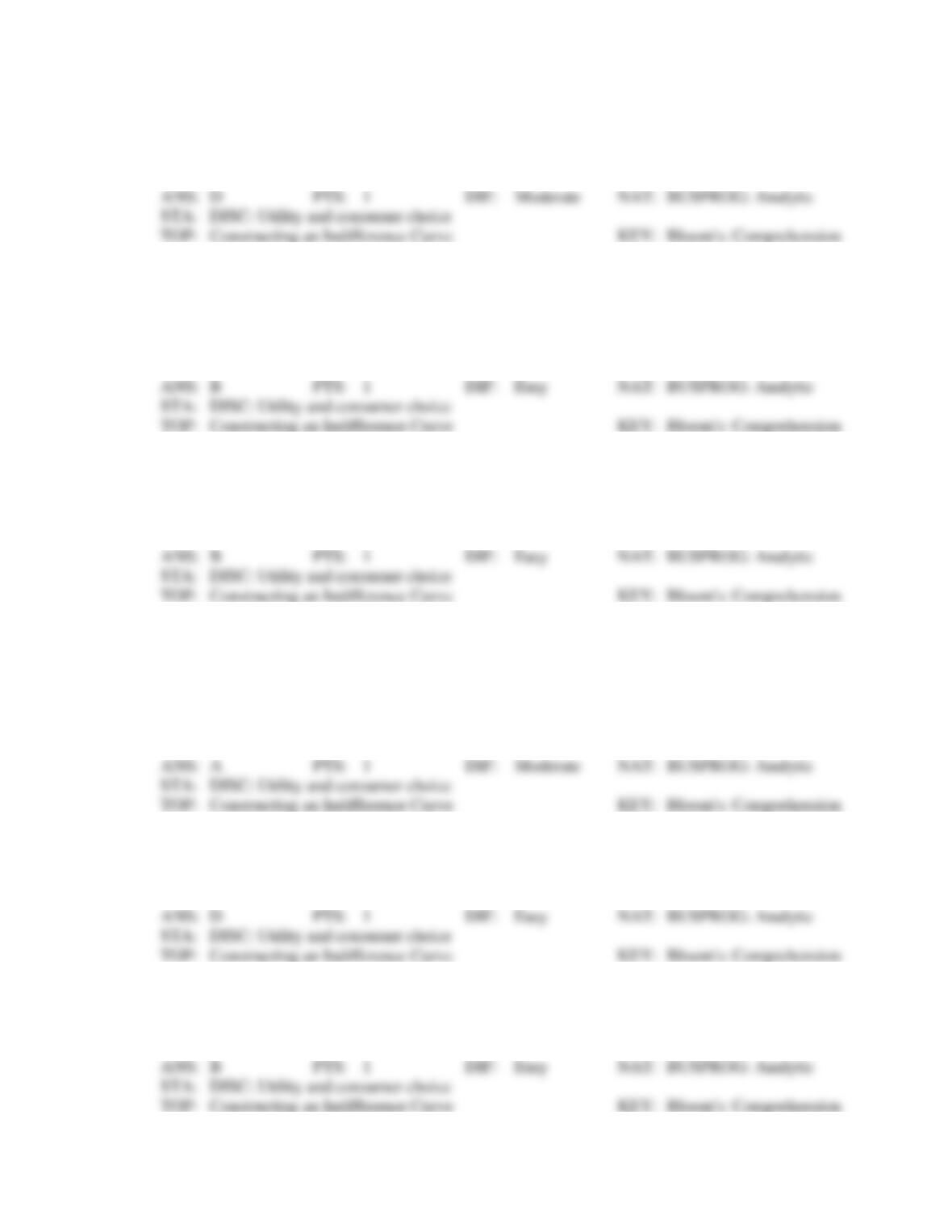
53. Given the budget line and indifference curves shown in Exhibit 6A-3, assume the consumer is initially
at point C. To maximize total utility, the consumer should:
a.
purchase more of good X and less of good Y.
b.
remain at point C.
c.
move to point B and then point A.
d.
purchase more of good Y and less of good X.
54. Given the budget line and indifference curves shown in Exhibit 6A-3, point E is:
a.
consumer equilibrium.
b.
unattainable.
c.
on the highest attainable indifference curve.
d.
a point that yields less total utility than other point in the exhibit.
55. Given the budge line and indifference curves shown in Exhibit 6A-3, consumer equilibrium occurs at a
tangency to which of the following indifference curves?
a.
I1.
c.
I3.
b.
I2.
d.
I1 or I2.
56. Given the budget line and indifference curves shown in Exhibit 6A-3, assume the consumer is initially
at point A. To maximize total utility, the consumer should:
a.
purchase more of good X and less of good Y.
b.
remain at point C.
c.
move to point B and then point C.
d.
purchase more of good Y and less of good X.
57. Given the budget line and indifference curves shown in Exhibit 6A-3, point E is:
a.
inferior to point X.
c.
consumer equilibrium.
b.
lowest attainable level of total utility.
d.
unobtainable.
58. Given the budget line and indifference curves shown in Exhibit 6A-3, at point D:
a.
Px exceeds Py.
c.
MUx = MUy.
b.
MRS = Px / Py.
d.
MRS = Py / Px.
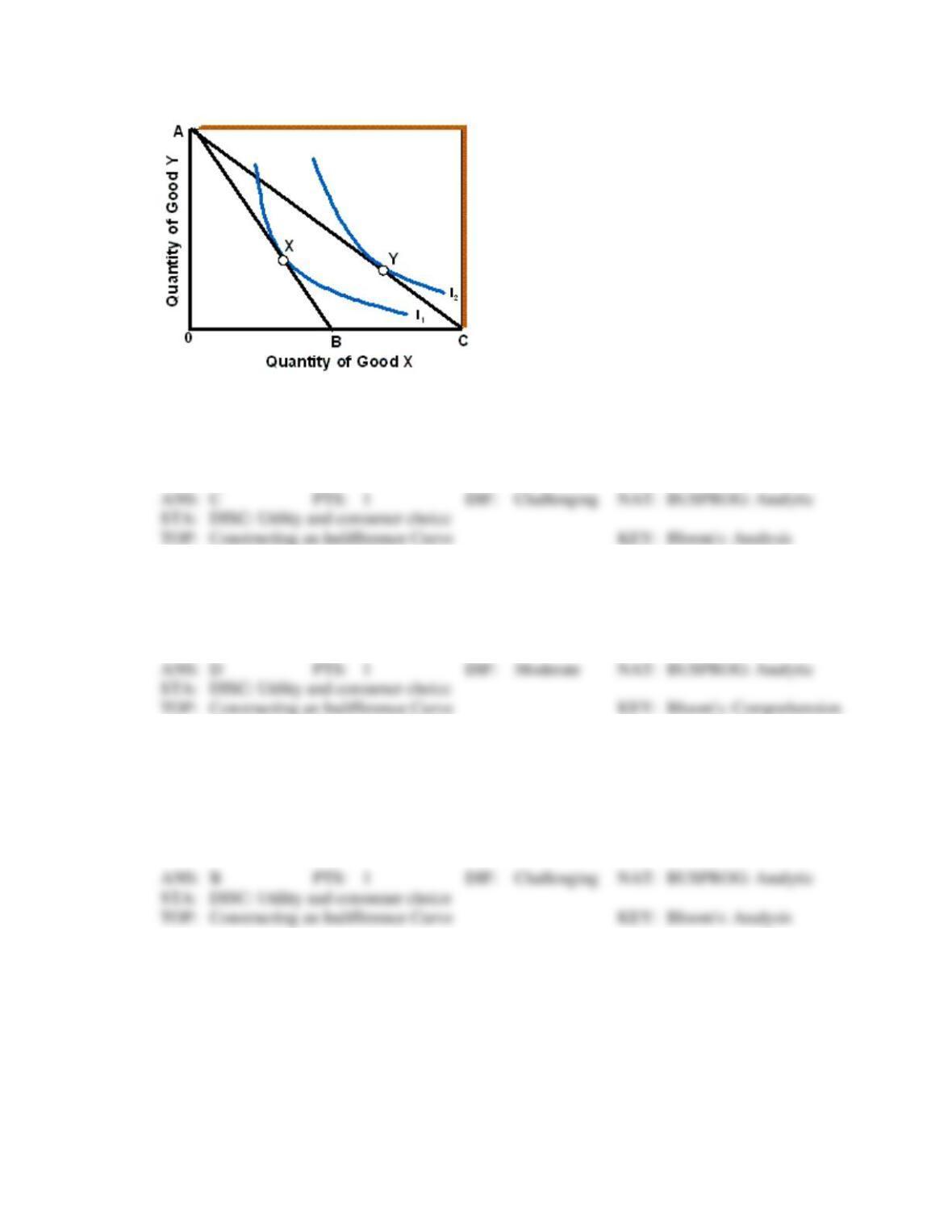
Exhibit 6A-4 Consumer Equilibrium
59. Given the budget lines and indifference curves shown in Exhibit 6A-4, if the budget line shifts from
AB to AC, then the:
a.
price of good Y has increased.
c.
price of good X has increased.
b.
price of good X has decreased.
d.
consumer’s budget has decreased.
60. Given the budget lines and indifference curves shown in Exhibit 6A-4, if the budget line shifts from
AC to AB, then the consumer will purchase:
a.
more of both goods Y and X.
c.
less of both goods X and Y.
b.
a higher level of total utility.
d.
more of good Y and less of good X.
61. Given the budget lines and indifference curves shown in Exhibit 6A-4, if the budget line shifts from
AB to AB, then the equilibrium points X and Y:
a.
result from a decrease in the price of good X.
b.
are two points along a downward sloping demand curve for good X.
c.
result from a decrease in the consumer’s budget.
d.
result from a decrease in the price of good Y.
Exhibit 6A-5 Consumer equilibrium
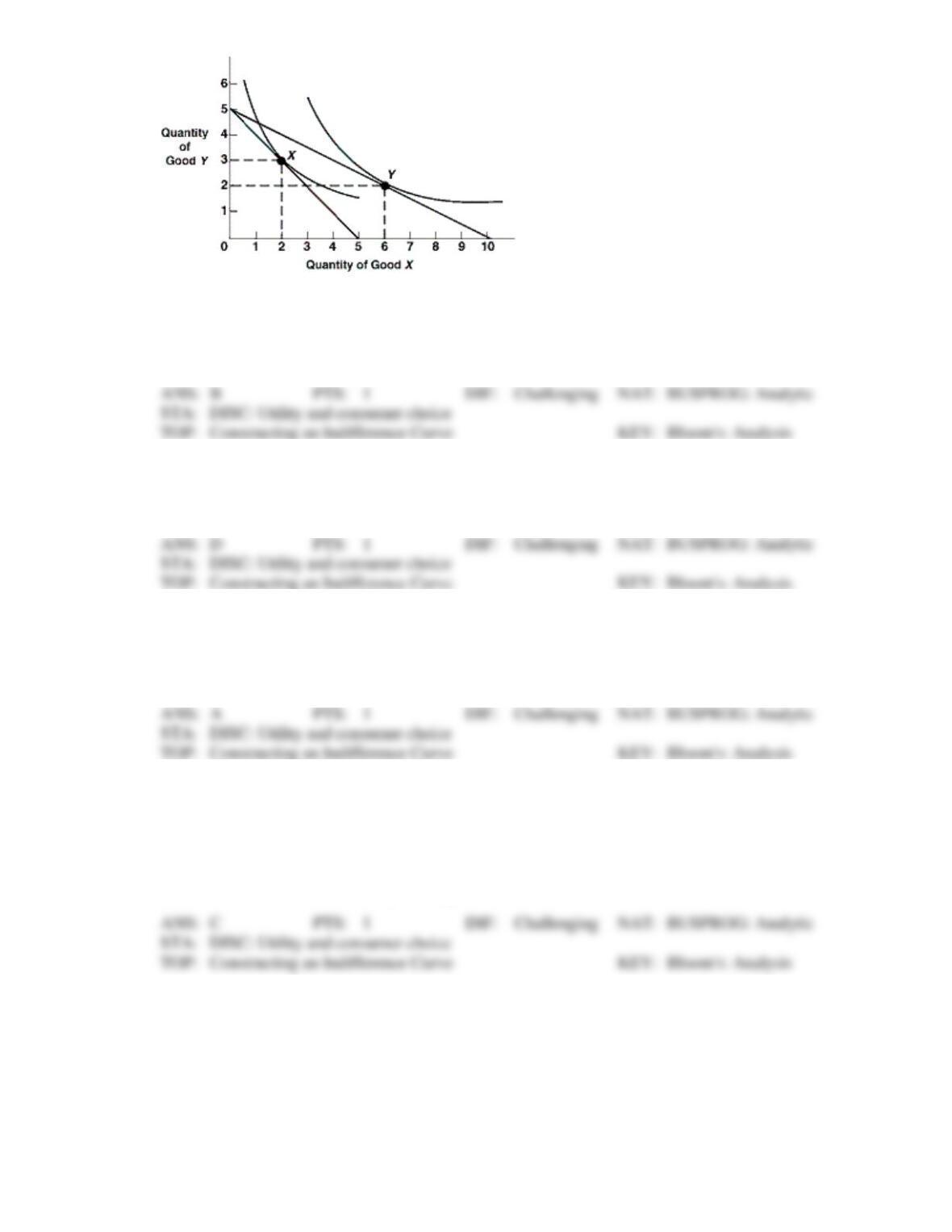
62. As shown in Exhibit 6A-5, the marginal rate of substitution (MRS) at point X is ____ the marginal rate
of substitution at point Y.
a.
less than
c.
equal to
b.
greater than
d.
twice
63. As shown in Exhibit 6A-5, the marginal rate of substitution (MRS) at point X is equal to:
a.
0.75.
c.
0.5.
b.
2.0.
d.
1.0.
64. As shown in Exhibit 6A-5, movement from consumer equilibrium at point Y to point X is caused by
a(n):
a.
increase in the price of good X.
c.
increase in the price of good Y.
b.
decrease in the price of good X.
d.
decrease in the price of good Y.
65. Given the budget lines and indifference curves shown in Exhibit 6A-5, if the budget line shifts, then
the equilibrium points X and Y:
a.
result from a decrease in the price of good X.
b.
result from a decrease in the consumer’s budget.
c.
are two points along a downward sloping demand curve for good X.
d.
result from a decrease in the price of good Y.
Exhibit 6A-6 Consumer equilibrium
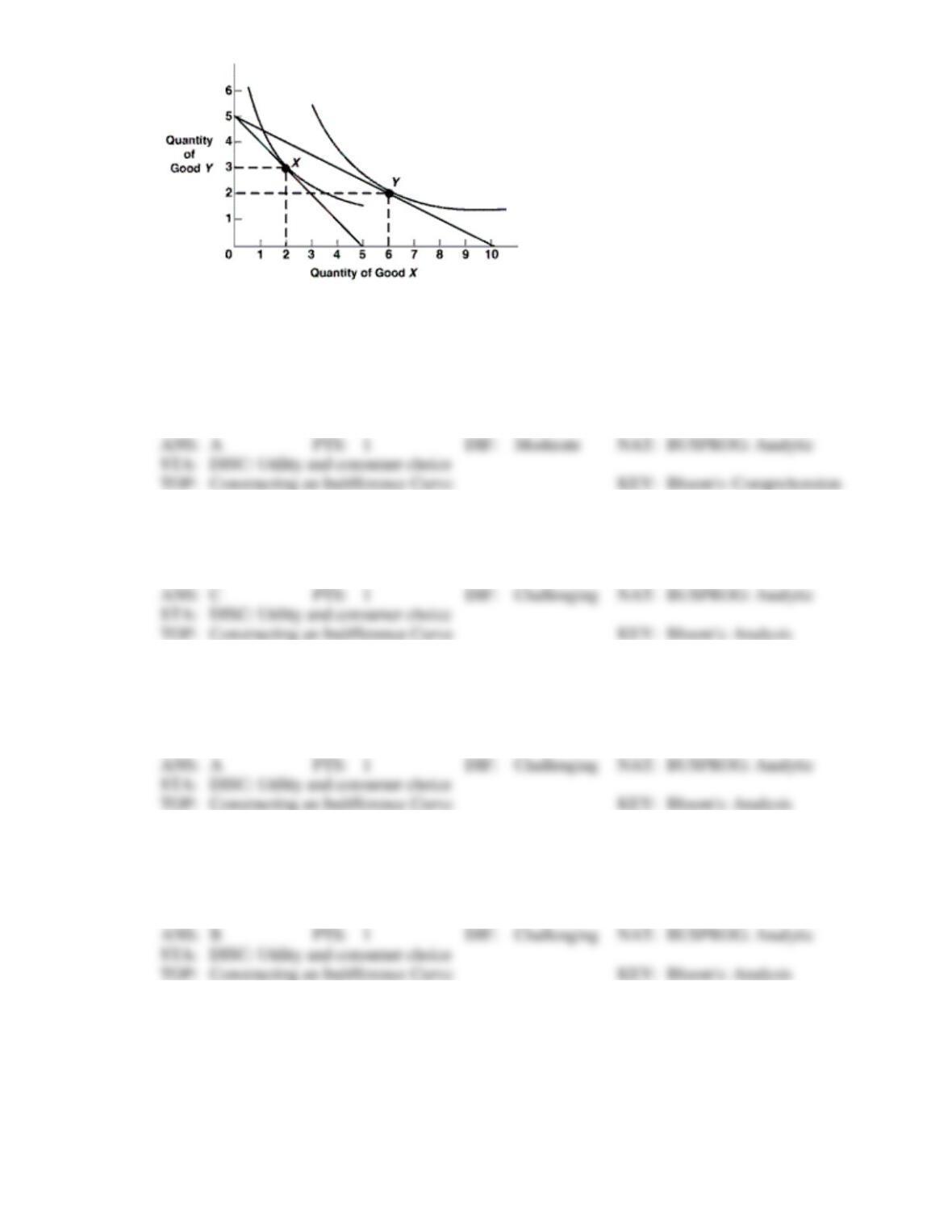
66. As shown in Exhibit 6A-6, the total utility a consumer receives at point B is ____ the total utility at
point A.
a.
greater than
b.
equal to
c.
less than
d.
equal to the marginal rate of substitution (MRS) plus
67. As shown in Exhibit 6A-6, the marginal rate of substitution (MRS) at point B is equal to:
a.
0.33.
c.
0.5.
b.
2.0.
d.
3.0.
68. As shown in Exhibit 6A-6, the marginal rate of substitution (MRS) at point B is ____ the marginal rate
of substitution at point A.
a.
less than
c.
equal to
b.
greater than
d.
twice
69. As shown in Exhibit 6A-6, movement from consumer equilibrium at point A to point B is caused by
a(n):
a.
increase in the price of good X.
c.
increase in the price of good Y.
b.
decrease in the price of good X.
d.
decrease in the price of good Y.
70. Given the budget lines and indifference curves shown in Exhibit 6A-6, if the budget line shifts, then
the equilibrium points X and Y:
a.
are equal in total utility.
b.
result from a decrease in the consumer’s budget.
c.
result from a decrease in the price of good Y.
d.
are two points along a downward sloping demand curve for good X.
TRUE/FALSE
1. Indifference curve analysis is based on a mythical unit called a util.
2. Indifference curve analysis is based on numerical measurement of utility.
3. Indifference curves that are closest to the origin are preferable to ones that are farther from the origin.
4. Each point along an indifference curve represents the same level of total utility for a consumer.
5. Indifference curves that are farther from the origin are preferable to ones that are closer to the origin.
6. Indifference curve slopes upward from left to right because consumers always prefer more of a good to
less.
7. As one moves down and along a budget line, its slope decreases.
8. A budget line represents all the combinations of two good a consumer can buy with a given amount of
money and fixed prices for the goods.
9. A budget line represents all combinations of bundles of two goods that give a consumer equal total
utility.