Chapter 17—The Phillips Curve and Expectations Theory
MULTIPLE CHOICE
1. The Phillips curve illustrates the relationship between:
a.
change in the money supply and change in unemployment.
b.
tax rates and tax revenues.
c.
the equilibrium level of income and the employment rate.
d.
inflation and unemployment.
2. According to the Phillips curve, a more expansionary macro-policy that causes inflation to be greater
will:
a.
place downward pressure on prices.
c.
reduce output.
b.
reduce unemployment.
d.
reduce the natural rate of unemployment.
3. The modern view of the Phillips curve suggests that:
a.
when inflation is reduced, unemployment will fall below the natural rate.
b.
the Phillips curve is an unstable relationship.
c.
systematic demand stimulus policies will be unable to affect prices in the long run.
d.
there will be a trade-off between inflation and unemployment in the long run.
4. The Phillips curve relates the inflation rate to the:
a.
unemployment rate.
c.
disposable personal income.
b.
GDP.
d.
interest rate.
5. The tradeoff between the inflation rate and unemployment rate is represented by the:
a.
consumption function.
c.
Phillips curve.
b.
misery index.
d.
Keynes curve.
6. The Phillips curve shows a negative relationship between the:
a.
consumption rate and the unemployment rate.
b.
savings rate and the inflation rate.
c.
interest rate and the savings rate.
d.
inflation rate and the unemployment
7. Each point on the Phillips curve represents a combination of the:
a.
consumption rate and the unemployment rate.
b.
savings rate and the inflation rate.
c.
interest rate and the savings rate.
d.
inflation rate and the unemployment rate.
8. Movements along the Phillips curve result in the:
a.
savings rate varying inversely with the unemployment rate.
b.
inflation rate varying directly with the unemployment rate.
c.
inflation rate varying inversely with the unemployment rate.
d.
interest rate varying inversely with the unemployment rate.
9. On a Phillips curve diagram, an increase in the rate of inflation, other things being equal, is
represented by a(n):
a.
upward movement along the Phillips curve.
b.
downward movement along the Phillips curve.
c.
upward shift of the Phillips curve.
d.
downward shift of the Phillips curve.
10. On a Phillips curve diagram, a decrease in the rate of inflation, other things being equal, is represented
by a(n):
a.
upward movement along the Phillips curve.
b.
downward movement along the Phillips curve.
c.
upward shift of the Phillips curve.
d.
downward shift of the Phillips curve.
11. In the United States, the Phillips curve in the 1960s:
a.
shifted upward dramatically.
b.
shifted upward moderately.
c.
remained stable.
d.
shifted downward moderately.
e.
shifted downward dramatically.
12. Economists began to lose confidence in the Phillips curve during the:
a.
1930s.
b.
1960s.
c.
1970s.
d.
1980s.
e.
1990s.
13. Experience with the Phillips curve since the 1970s has shown that the:
a.
curve can be used as a reliable model to guide public policy.
b.
relationship between the inflation rate and the unemployment rate moves in a clockwise
direction.
c.
curve is not stable.
d.
inflation rate and the unemployment rate are equal.
14. Suppose that the economy experiences an increase in the inflation rate at the same time that the
unemployment rate decreases. This situation indicates a:
a.
shift in the Phillips curve.
b.
movement along a vertical Phillips curve.
c.
movement along a horizontal Phillips curve.
d.
movement along a positively-sloped Phillips curve.
e.
movement along a negatively-sloped Phillips curve.
15. Which of the following curves show an inverse relationship between a nation’s inflation and
unemployment rates?
a.
The aggregate demand curve.
c.
The short-run Phillips curve.
b.
The aggregate supply curve.
d.
The long-run Phillips curve.
16. A Phillips curve shows the relationship between the inflation rate and the:
a.
wage rate.
c.
real GDP growth rate.
b.
unemployment rate.
d.
population growth rate.
17. The Phillips curve:
a.
is downward sloping.
b.
is upward sloping.
c.
shows there is a tradeoff between unemployment and the inflation rate.
d.
shows there is a tradeoff between population and the inflation rate.
18. Each point on the Phillips curve represents a combination of the:
a.
prime rate and the savings rate.
c.
inflation rate and the unemployment rate.
b.
savings rate and the unemployment rate.
d.
consumption rate and the inflation rate.
19. On a Phillips curve diagram, a decrease in the rate of inflation, other things being equal, is represented
by a(n):
a.
upward shift of the Phillips curve.
b.
downward movement along Phillips curve.
c.
upward movement along the Phillips curve.
d.
downward shift of the Phillips curve.
20. Since the 1970s, the Phillips curve has:
a.
remained stable.
b.
moved in a clockwise direction.
c.
been unstable.
d.
been used as a reliable model to guide public policy.
21. The long-run Phillips curve:
a.
is downward sloping.
b.
is upward sloping.
c.
shows there is no tradeoff between unemployment and inflation.
d.
is horizontal at the natural rate of inflation.
22. Which of the following statements is true?
a.
The Phillips curve has always been stable.
b.
If the Phillips curve shifts outward to the right this illustrates a greater tradeoff between
unemployment and inflation.
c.
Keynesian economics assumes a vertical Phillips curve.
d.
According to the natural rate hypothesis the Phillips curve is downward sloping.
e.
All of these.
23. A graph showing the inverse relationship between the economy’s rate of unemployment and rate of
inflation is called the:
a.
Laffer curve.
b.
aggregate expenditure model.
c.
Keynesian cross.
d.
Phillips curve.
e.
consumption curve.
24. The Phillips curve traces a set of combinations of rates of:
a.
interest and unemployment.
b.
real GDP and inflation.
c.
real GDP and interest.
d.
inflation and interest.
e.
unemployment and inflation.
25. The Phillips curve:
a.
was relatively well-defined during the 1960s.
b.
demonstrates how to achieve stable economic growth.
c.
shows the trade-off between deficits and inflation.
d.
helps to stimulate entrepreneurial profits.
e.
becomes vertical at full employment.
26. Which economist(s) first identified an inverse relationship between inflation and unemployment?
a.
Robert Lucas and Thomas Sargent.
b.
W. Phillips.
c.
Robert Barro.
d.
Paul Samuelson.
e.
Arthur Laffer.
27. The Phillips Curve shows the trade-off between:
a.
unemployment and output.
b.
inflation and output.
c.
unemployment and inflation.
d.
imports and exports.
e.
unemployment and imports.
28. The inverse trade-off between inflation and unemployment is known as the:
a.
Laffer curve.
b.
aggregate supply curve.
c.
Phillips curve.
d.
aggregate demand curve.
e.
Keynesian curve.
29. The relationship between inflation and unemployment shown along a Phillips curve is a(n):
a.
direct relationship.
b.
quadratic relationship.
c.
exponential relationship.
d.
inverse relationship.
e.
parabolic relationship.
30. The long-run Phillips curve:
a.
is horizontal.
b.
is the same as the short-run Phillips curve.
c.
displays a positive relationship rather than an inverse relationship.
d.
is exponential.
e.
is vertical.
31. If the long-run Phillips curve is vertical, then any government policy designed to lower:
a.
unemployment will not change the unemployment rate and only increase the inflation rate.
b.
unemployment will work leaving the inflation rate unchanged.
c.
inflation will cause employment to rise.
d.
unemployment will work causing the inflation rate to fall.
e.
unemployment will work causing inflation to rise.
Exhibit 17-1 Inflation and unemployment rates
32. The name of the graph in Exhibit 17-1 is the:
a.
Laffer curve.
b.
aggregate supply curve.
c.
aggregate demand curve.
d.
Keynesian curve.
e.
Phillips curve.
33. The graph in Exhibit 17-1 indicates a(n):
a.
direct relationship.
b.
quadratic relationship.
c.
exponential relationship.
d.
inverse relationship.
e.
hyperbolic relationship.
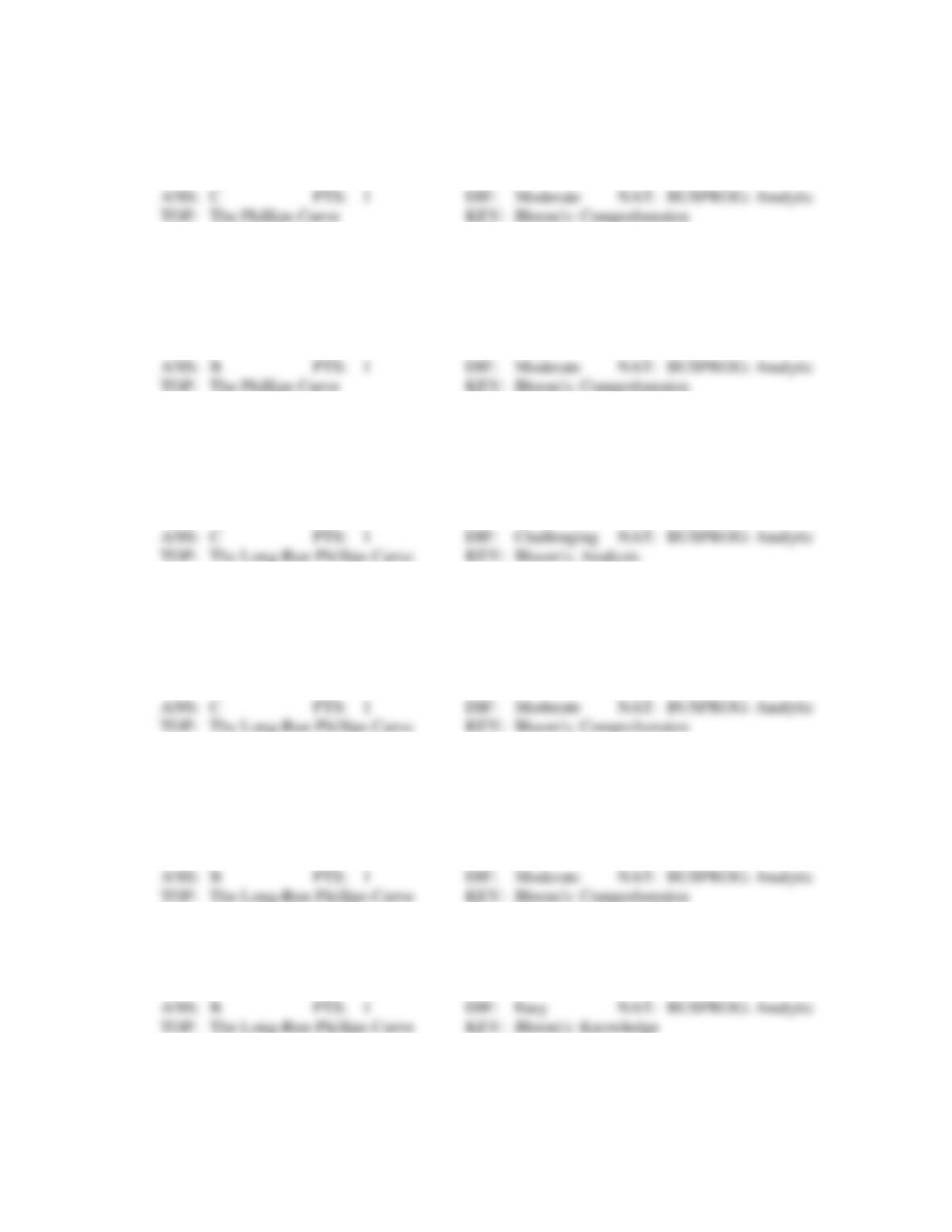
34. In Exhibit 17-1, when the unemployment rate goes from 3 percent to 9 percent,
a.
the level of inflation is unaffected.
b.
the inflation rate goes from 8 percent to 14 percent.
c.
the inflation rate goes from 8 percent to 3 percent.
d.
the inflation rate goes to 0 percent.
e.
deflation occurs.
35. In Exhibit 17-1, when the unemployment rate goes from 9 percent to 1 percent, the:
a.
level of inflation is unaffected.
b.
inflation rate goes from 3 percent to 14 percent.
c.
inflation rate goes from 3 percent to 8 percent.
d.
inflation rate goes from 8 percent to 14 percent.
36. Incorporation of expectations into economic decision making indicates that in the long run:
a.
inflation relates directly to unemployment.
b.
inflation is inversely related to unemployment.
c.
the Phillips curve is vertical at the natural rate of unemployment.
d.
high unemployment is a primary cause of inflation.
37. The natural rate hypothesis argues that the economy will:
a.
self-correct to the natural rate of inflation.
b.
require expansionary fiscal policy to reach the natural rate of unemployment.
c.
self-correct to the natural rate of unemployment.
d.
require expansionary monetary policy to reach the natural rate of unemployment.
38. Under the natural rate hypothesis, expansionary monetary and fiscal policies can at best produce a:
a.
permanent change in the unemployment rate.
b.
short-run change in the unemployment rate.
c.
permanent change in the inflation rate.
d.
short-run change in the long-run Phillips curve.
39. The long-run Phillips curve is a(n) ____ line at the natural rate of unemployment.
a.
horizontal
c.
upward-sloping
b.
vertical
d.
downward-sloping
40. Many economists argue that, in the long run, the economy self-corrects and achieves full employment.
This argument is known as the:
a.
natural rate hypothesis.
c.
political business cycle theory.
b.
incomes policy approach.
d.
Keynesian cross model.
41. The natural rate hypothesis implies that the long-run Phillips curve will be:
a.
downward-sloping.
c.
vertical.
b.
upward-sloping.
d.
horizontal.
42. Under the natural rate hypothesis, expansionary monetary and fiscal policies can at best produce a:
a.
permanent change in the long-run Phillips curve.
b.
short-run change in the unemployment rate.
c.
long-run change in the unemployment rate.
d.
permanent change in the unemployment rate.
43. Under the adaptive expectations hypothesis, which of the following is the effect of a shift to a more
expansionary monetary policy?
a.
In the short run, the real rate of output will be unaffected, but in the long run, it will
increase.
b.
In the short run, the unemployment rate will decrease, but in the long run, it will self
correct to the natural rate of unemployment.
c.
There will be a permanent increase in the real rate of output, but the inflation rate will also
be a little higher.
d.
In the short run, the impact on the real rate of output is uncertain, but in the long run,
output will increase.
44. The adaptive expectations hypothesis implies that people:
a.
adjust their expectations quickly to policy changes.
b.
expect the next period to be pretty much like the recent past.
c.
will always be correct in their forecast for the next period.
d.
change their expectations about the future if policy changes.
45. The view that decision-maker expectations are based on actual outcomes observed during the recent
past is called the:
a.
rational expectations hypothesis.
c.
permanent income theory.
b.
adaptive expectations hypothesis.
d.
recognition lag.
46. The proponents of adaptive expectations believe that:
a.
there will be a substantial time lag before people anticipate the effects of a shift to a more
expansionary macro-policy.
b.
macro-policies that stimulate demand and place upward pressure on the general level of
prices will temporarily increase output and employment.
c.
discretionary changes in macro-policy can be made in a manner that will reduce the
economic ups and downs of a market economy.
d.
all of these are true.
47. Under adaptive expectations, the short-term effect of an unanticipated shift to a more expansionary
macroeconomic policy will be a:
a.
temporary reduction in the unemployment rate.
b.
permanent reduction in the unemployment rate.
c.
temporary reduction in the inflation rate.
d.
permanent reduction in the inflation rate.
48. The hypothesis that people believe the best indicator of the future is the recent past is known as:
a.
rational expectations.
c.
lagged expectations.
b.
adaptive expectations.
d.
trend expectations.
49. Under adaptive expectations theory, people expect the rate of inflation this year to be:
a.
zero, regardless of the rate last year.
b.
the same as last year.
c.
the rate based on predictable and fiscal policies.
d.
All of these.
50. Under adaptive expectations theory, people persistently:
a.
underestimate inflation when it is slowing down.
b.
overestimate inflation when it is accelerating.
c.
underestimate inflation when it is accelerating.
d.
adapt to the prevailing inflation rate.
51. According to adaptive expectations theory, expansionary monetary and fiscal policies to reduce the
unemployment rate are:
a.
useless in the long run.
c.
ineffective on the price level.
b.
useless in the short run.
d.
None of these.
52. According to adaptive expectations theory, which of the following would be the result of expansionary
monetary and fiscal policies?
a.
The economy self-corrects to the natural rate of unemployment.
b.
There is no long-run trade off between inflation and unemployment.
c.
The inflation rate rises.
d.
All of these.
53. According to adaptive expectations theory, which of the following would be the result of expansionary
monetary and fiscal policies?
a.
There is a short-run reduction in unemployment.
b.
There is a long-run trade off between inflation and unemployment.
c.
The inflation rate falls in the long run.
d.
The economy always operates at the natural rate of unemployment
54. Under adaptive expectations theory, an increase in the short-run aggregate demand curve ____ the
inflation rate and ____ the unemployment rate.
a.
increases; increases
c.
increases; does not change
b.
increases; decreases
d.
decreases; increases
55. Under adaptive expectations theory, a decrease in the short-run aggregate demand curve ____ the
inflation rate and ____ the unemployment rate.
a.
increases; increases
c.
decreases; increases
b.
increases; decreases
d.
decreases; decreases
56. When people use recent information to gradually adjust their forecasts of inflation, they are said to
have:
a.
static expectations.
c.
rational expectations.
b.
adaptive expectations.
d.
spiraling expectations.
57. Which of the following best describes the idea of a political business cycle?
a.
Politicians have a bias to cut taxes and increase government spending.
b.
Special interests result in alternating federal deficits.
c.
Politicians will use fiscal and monetary policy to cause output, real incomes, and
employment to be rising prior to elections.
d.
Good intentions of politicians influence the business cycle.
58. The political business cycle refers to the possibility that:
a.
incumbent politicians will be reelected regardless of the state of the economy.
b.
politicians will manipulate the economy to enhance their chances of being reelected.
c.
there are more recessions prior to elections.
d.
recessions coincide with election years.
59. Under the rational expectations hypothesis, which of the following is the most likely short-run effect
of a move to expansionary monetary policy?
a.
A higher general level of prices but no change in real output
b.
A higher general level of prices and an expansion in real output
c.
No change in the general level of prices and a reduction in real output
d.
No change in either the general level of prices or real output
60. The view that individuals weigh all available evidence when they formulate their expectations about
economic events (including information concerning the probable effects of current and future
economic policy) is called:
a.
the adaptive expectations hypothesis.
c.
the rational expectations hypothesis.
b.
the permanent income hypothesis.
d.
the Phillips curve.
61. The rational expectations hypothesis indicates that people:
a.
pay little attention to policy when forming their expectations about the future.
b.
expect the next period to be pretty much like the recent past, regardless of policy changes.
c.
will always be able to forecast the future accurately.
d.
change their expectations about the future if policy changes.
62. The proponents of rational expectations believe that:
a.
there will be a substantial time lag before people anticipate the eventual effects of a shift
to a more expansionary macro-policy.
b.
macro-policies that stimulate demand and place upward pressure on the general level if
prices will temporarily increase output and employment.
c.
the inflationary side effects of expansionary policies will be anticipated quickly, and
therefore, even their short-run effects on real output and employment will be minimal.
d.
discretionary changes in macro-policy can be made in a manner that will reduce the
economic ups and downs of a market economy.
63. Starting from an initial long-run equilibrium, under the rational expectations hypothesis, an anticipated
shift to a more expansionary policy will increase:
a.
prices but not real output in the short run.
b.
real output but not prices in the short run.
c.
real output in the long run but not in the short run.
d.
real output in both the long run and the short run.
64. The rational expectations hypothesis implies that discretionary macro-policy will: