Archives
BUA 121 Quiz 1
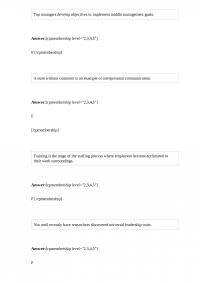
Top managers develop objectives to implement middle management goals. A stare without comment is an example of interpersonal communication. Answer: F Training is the stage of the staffing process where employees become acclimated to their work surroundings. Answer: F Not […]
BUA 300
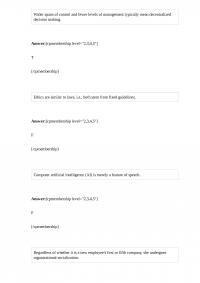
Wider spans of control and fewer levels of management typically mean decentralized decision making. Ethics are similar to laws, i.e., both stem from fixed guidelines. Answer: F Computer artificial intelligence (AI) is merely a feature of speech. Answer: F Regardless […]
BUA 310 Midterm 2
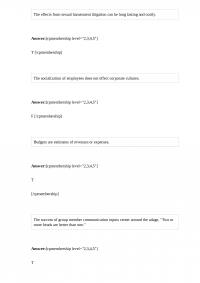
The effects from sexual harassment litigation can be long lasting and costly. The socialization of employees does not effect corporate cultures. Answer: F Budgets are estimates of revenues or expenses. Answer: T The success of group member communication inputs center […]
BUA 378 Test
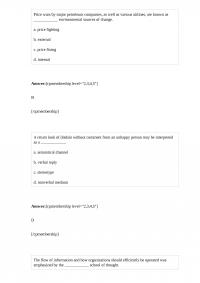
Price wars by major petroleum companies, as well as various airlines, are known as ____________ environmental sources of change. a. price fighting b. external c. price fixing d. internal A return look of disdain without comment from an unhappy person […]
BUA 396
Organizations are composed of internal and external environments. Proactive motives include the desire to escape from trade barriers and other government restrictions. Answer: F When a mission is formalized in writing and communicated to all organizational members, it becomes the […]
BUA 401 Test 2
Along with intangible assets, intellectual capital constitutes the current worth of a company and its future prospects. Title VII of the 1964 Civil Rights Act requires parties who file discrimination complaints to do so within 90 days of the alleged […]
BUA 596 Quiz 2
Standards are either qualitative or quantitative measuring devices. The difference between a MIS and DSS is that a decision maker can interact directly with a DSS. Answer: T Controlling attempts to prevent, identify, and correct deviations from guidelines and to […]
BUA 656 Quiz 2
A closed-book organization fosters continual learning. Sequentially, symptoms lead to problems and problems lead to sources. Answer: F The continuous focus of all teams must be toward the team’s objective(s). Answer: T Most changes introduced by top-level management effect only […]
BUA 701 Midterm 2
Which one of the following is not a characteristic of work teams? a. They are composed of multiskilled workers. b. They perform tasks previously done by members in a functional department. c. They are typically large. d. They assume responsibility […]
BUA 745
The characteristics of effective teams include the following except: a. they are committed to and involved in clear, shared goals. b. they trust each other. c. they are flexible. d. they focus on symptoms, not causes, when problems occur. The […]
BUA 845 Test 1
When sports coaches listen to players’ suggestions and feedback during game intermissions, they are using ____________ leadership. a. free-rein b. general c. absolute d. participative If you are both good with the task and good with people, you might have […]
BUS 440 Midterm 2
An organization’s competitors are those firms that offer dissimilar products and services in the organization’s marketplace. Vertical communication is most appropriate for organizational work teams. Answer: F Monitoring events and trends outside a manager’s specific area of influence is called […]
BUS 449 Midterm
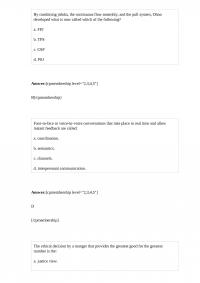
By combining jidoka, the continuous flow assembly, and the pull system, Ohno developed what is now called which of the following? a. FPJ b. TPS c. CSP d. PSJ Face-to-face or voice-to-voice conversations that take place in real time and […]
BUS 475
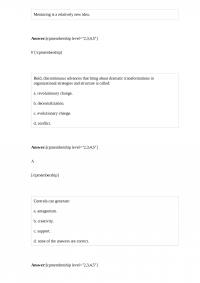
Mentoring is a relatively new idea. Bold, discontinuous advances that bring about dramatic transformations in organizational strategies and structure is called: a. revolutionary change. b. decentralization. c. evolutionary change. d. conflict. Answer: A Controls can generate: a. antagonism. b. creativity. […]
BUS 671 Midterm 1
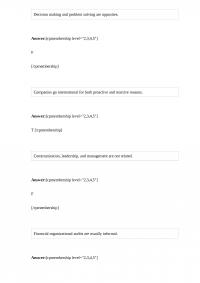
Decision making and problem solving are opposites. Companies go international for both proactive and reactive reasons. Answer: T [/cpmembership] Communication, leadership, and management are not related. Answer: F Financial organizational audits are usually informal. Answer: Answer: F The determination of […]
BUS 825 Quiz
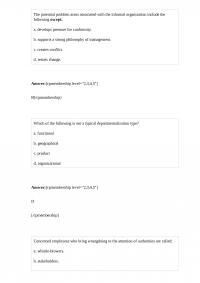
The potential problem areas associated with the informal organization include the following except: a. develops pressure for conformity. b. supports a strong philosophy of management. c. creates conflict. d. resists change. Which of the following is not a typical departmentalization […]
BUS 834
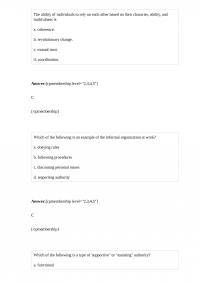
The ability of individuals to rely on each other based on their character, ability, and truthfulness is a. coherence. b. revolutionary change. c. mutual trust. d. coordination. Which of the following is an example of the informal organization at work? […]
EMBA 208 Homework
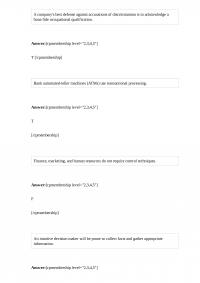
A company’s best defense against accusations of discrimination is to acknowledge a bona fide occupational qualification. Bank automated-teller machines (ATMs) use transactional processing. Answer: T Finance, marketing, and human resources do not require control techniques. Answer: F An intuitive decision […]
EMBA 279
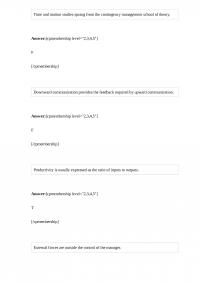
Time and motion studies sprang from the contingency management school of theory. Downward communication provides the feedback required by upward communication. Answer: F Productivity is usually expressed as the ratio of inputs to outputs. Answer: T External forces are outside […]
EMBA 328
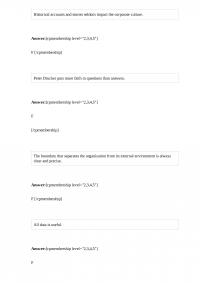
Historical accounts and stories seldom impact the corporate culture. Peter Drucker puts more faith in questions than answers. Answer: F The boundary that separates the organization from its external environment is always clear and precise. Answer: F All data is […]
EMBA 638 Midterm
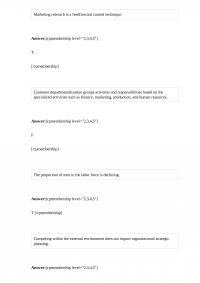
Marketing research is a feedforward control technique. Customer departmentalization groups activities and responsibilities based on the specialized activities such as finance, marketing, production, and human resources. Answer: F The proportion of men in the labor force is declining. Answer: T […]
EMBA 643 Midterm 1
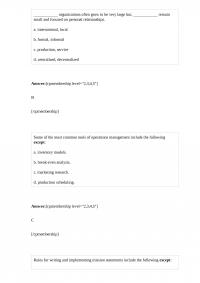
____________ organizations often grow to be very large but, ____________ remain small and focused on personal relationships. a. international, local b. formal, informal c. production, service d. centralized, decentralized Some of the most common tools of operations management include the […]
EMBA 712 Final
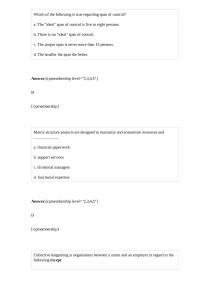
Which of the following is true regarding span of control? a. The “ideal” span of control is five to eight persons. b. There is no “ideal” span of control. c. The proper span is never more than 15 persons. d. […]
EMBA 788 Test
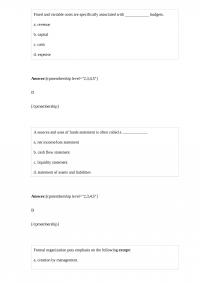
Fixed and variable costs are specifically associated with ____________ budgets. a. revenue b. capital c. cash d. expense A sources and uses of funds statement is often called a ____________. a. net income/loss statement b. cash flow statement c. liquidity […]
EMBA 897 Test
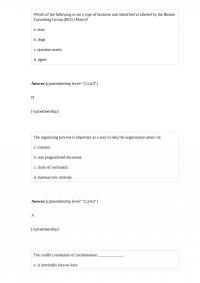
Which of the following is not a type of business unit identified or labeled by the Boston Consulting Group (BCG) Matrix? a. stars b. dogs c. question marks d. tigers The organizing process is important as a way to help […]
Management 148 Quiz 2
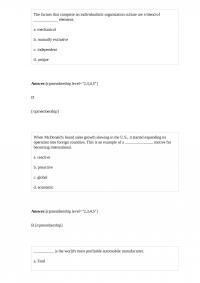
The factors that comprise an individualistic organization culture are a blend of ____________ elements. a. mechanical b. mutually exclusive c. independent d. unique When McDonald’s found sales growth slowing in the U.S., it started expanding its operation into foreign countries. […]
Management 183 Final
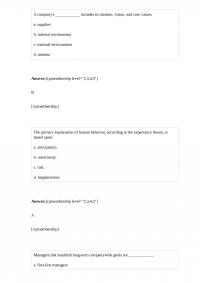
A company’s ____________ includes its mission, vision, and core values. a. supplies b. internal environment c. external environment d. mission The primary explanation of human behavior, according to the expectancy theory, is based upon: a. anticipation. b. uncertainty. c. risk. […]
Management 230
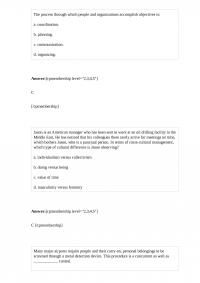
The process through which people and organizations accomplish objectives is: a. coordination. b. planning. c. communication. d. organizing. Jason is an American manager who has been sent to work at an oil drilling facility in the Middle East. He has […]
Management 301 Test 2
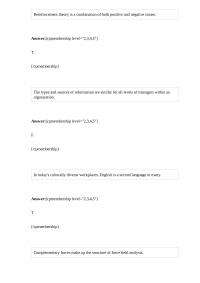
Reinforcement theory is a combination of both positive and negative issues. The types and sources of information are similar for all levels of managers within an organization. Answer: F In today’s culturally diverse workplaces, English is a second language to […]
Management 344
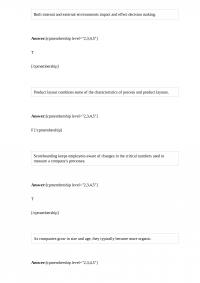
Both internal and external environments impact and effect decision making. Product layout combines some of the characteristics of process and product layouts. Answer: F Scoreboarding keeps employees aware of changes in the critical numbers used to measure a company’s processes. […]
Management 376 Quiz 2
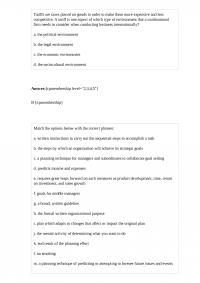
Tariffs are taxes placed on goods in order to make them more expensive and less competitive. A tariff is one aspect of which type of environment that a multinational firm needs to consider when conducting business internationally? a. the political […]
Management 468 Homework
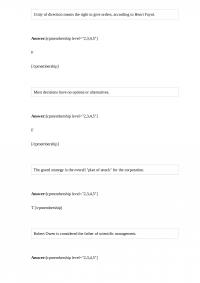
Unity of direction means the right to give orders, according to Henri Fayol. Most decisions have no options or alternatives. Answer: F The grand strategy is the overall “plan of attack” for the corporation. Answer: T [/cpmembership] Robert Owen is […]
Management 520 Test 1
Brainstorming allows for and encourages group members to address ____________. a. alternatives b. decisions c. evaluations d. criticisms Leadership skills are mainly comprised of: a. norms and abilities. b. positives and negatives. c. personalities and expressions. d. competencies and capabilities. […]
Management 534 Final
Leadership skills, traits, and behaviors are the same. Examples of staff departments might include human resources, legal, computer services, and public relations. Answer: T The manager’s ability to work effectively as a group member and to build cooperative effort within […]
Management 535
Once in place, job descriptions and specifications are indefinite. The definition of a customer has been expanded to include anyone inside organizations. Answer: T Performance has one distinct definition. Answer: F The use of programmed machines to handle production constitutes […]
Management 580
When an organization downsizes, this is referred to as shrinking: a. the size of the company. b. the amount of expenditures a company has. c. the number of employees. d. the number of employees and the size of the company. […]
Management 603 Midterm
Which of the following is not one of the types of approaches to personal decision making? a. rational b. logical c. predisposed d. disposed All of the following are elements of the staffing process except: a. human resource planning. b. […]
Management 643 Test 1
Behavioral-oriented theories about why people choose a particular behavior to satisfy their needs include the following except: a. expectancy theory. b. reinforcement theory. c. equity theory. d. process theory. A decision-making technique that requires questions to be asked and answered […]
Management 680
A disciplined approach to solving quality problems before the design phase of a product is called: a. benchmark. b. a production standard. c. systems approach. d. quality function deployment. Herzberg’s maintenance factors are the ____________ context of the job and […]
Management 788 Midterm 1
When conditions change, ____________ managers change from one leadership style to another more appropriate style. a. indecisive b. effective c. incompetent d. flighty Which of the following is NOT true about the Hawthorne studies? a. workers pressure coworkers to keep […]
Management 839
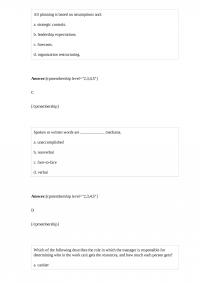
All planning is based on assumptions and: a. strategic controls. b. leadership expectations. c. forecasts. d. organization restructuring. Spoken or written words are ____________ mediums. a. unaccomplished b. nonverbal c. face-to-face d. verbal Answer: D Which of the following describes […]
Management 882
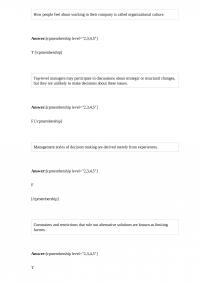
How people feel about working in their company is called organizational culture. Top-level managers may participate in discussions about strategic or structural changes, but they are unlikely to make decisions about these issues. Answer: F Management styles of decision making […]
MGMT 144
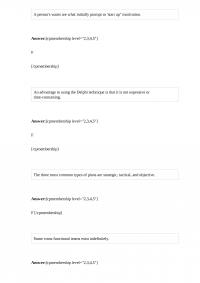
A person’s wants are what initially prompt or ‘start up” motivation. An advantage to using the Delphi technique is that it is not expensive or time-consuming. Answer: F The three most common types of plans are strategic, tactical, and objective. […]
MGMT 188 Quiz 2
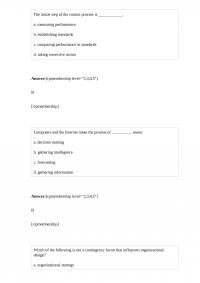
The initial step of the control process is ____________. a. measuring performance b. establishing standards c. comparing performance to standards d. taking corrective action Computers and the Internet make the process of __________ easier. a. decision making b. gathering intelligence […]
MGMT 277
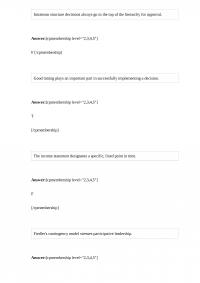
Intrateam structure decisions always go to the top of the hierarchy for approval. Good timing plays an important part in successfully implementing a decision. Answer: T The income statement designates a specific, fixed point in time. Answer: F Fiedler’s contingency […]
MGMT 383 Test
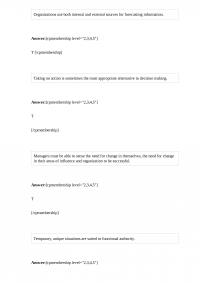
Organizations use both internal and external sources for forecasting information. Taking no action is sometimes the most appropriate alternative to decision making. Answer: T Managers must be able to sense the need for change in themselves, the need for change […]
MGMT 525 Test 1
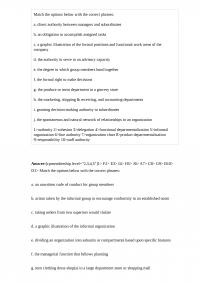
Match the options below with the correct phrases: a. direct authority between managers and subordinates b. an obligation to accomplish assigned tasks c. a graphic illustration of the formal positions and functional work areas of the company d. the authority […]
MGMT 561 Quiz
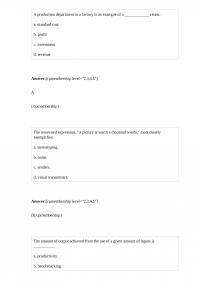
A production department in a factory is an example of a ____________ center. a. standard cost b. profit c. investment d. revenue The renowned expression, “A picture is worth a thousand words,” most closely exemplifies: a. stereotyping. b. noise. c. […]
MGMT 581 Homework
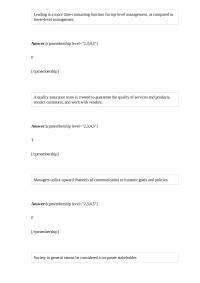
Leading is a more time-consuming function for top-level management, as compared to lower-level management. A quality assurance team is created to guarantee the quality of services and products, contact customers, and work with vendors. Answer: T Managers utilize upward channels […]
MGMT 603 Quiz 2
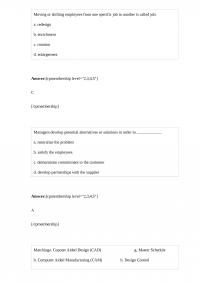
Moving or shifting employees from one specific job to another is called job: a. redesign b. enrichment c. rotation d. enlargement Managers develop potential alternatives or solutions in order to ____________. a. neutralize the problem b. satisfy the employees c. […]
MGMT 641 Test 1
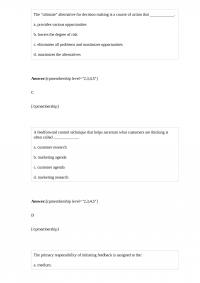
The “ultimate” alternative for decision making is a course of action that ____________. a. provides various opportunities b. lowers the degree of risk c. eliminates all problems and maximizes opportunities d. maximizes the alternatives A feedforward control technique that helps […]
MGMT 845 Quiz 3
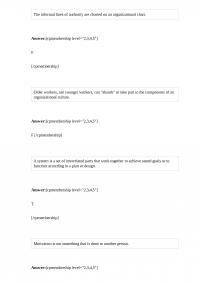
The informal lines of authority are charted on an organizational chart. Older workers, not younger workers, can “absorb” or take part in the components of an organizational culture. Answer: F A system is a set of interrelated parts that work […]
MGMT 849
Receiving an annual flu shot is an example of a feedforward control. Influencing others with one’s abilities, knowledge, and experience is using one’s expert power. Answer: T Answer: T
MGMT 854 Quiz
Chris Argyris, management author, states that mature individuals are ____________. a. passive b. dependent c. unaware d. independent The ____________ concept of organizational systems affects and is affected by various and constantly changing forces. a. closed b. open c. practical […]
MGT 227
A manager formally assigned as department head possesses organization ____________ power. a. referent b. legitimate c. charismatic d. expert Decision points and competitive moves are elements of ____________. a. a decision tree b. a simulation c. the Delphi technique d. […]
MGT 292
Leadership can influence an individual as well as a group. A person’s ethics are not influenced by his or her morality. Answer: F The more efficient the tools and methods, the more quality and productivity will benefit. Answer: T A […]
MGT 309 Quiz 3
Employee empowerment is a motivational technique unique to the Japanese workforce. An organizational unit that contributes costs, revenues, profits, or investments is called a financial responsibility center. Answer: T Assets = Debt(s) + Capital Expenditures Answer: F Relationships with suppliers […]
MGT 436
Organizational change means altering the work environment. Management science techniques cannot substitute for sound, balanced judgment and management experience. Answer: T The classical scientific school grew from the classical administrative school. Answer: F Team communication revolves around getting customers and […]
MGT 459 Quiz
Within any market, the product to meet or beat in terms of design, manufacture, performance, and service is called a(n) __________. a. accolade b. benchmark c. classic d. dark house The specialized or technical language that develops in trades, professions, […]
MGT 565
A Theory Y manager assumes that work is a natural event and the subordinates will seek and accept responsibility for that work willingly. Competition among organizational members can produce negative as well as positive results. Answer: T Once decisions are […]
MGT 711
Dysfunctional conflict limits the organization’s ability to achieve its objectives. Controls must be controlled! Answer: T Typical results of reengineering have been not to change organizations’ missions, visions, values, activities, and structures. Answer: F The receiver determines the medium for […]
MGT 736
Which of the following is not one of the activities involved in the career planning process? a. performing a self-assessment b. identifying opportunities c. limiting your focus to short-term goals d. matching skills to career-related activities Computer operating systems are […]
MGT 777
The type of work activity that draws heavily on the leadership abilities of top managers is the implementation of: a. operating plans. b. production schedules. c. strategic planning. d. PERT diagrams. Managers are using ____________ reinforcement when they choose to […]
MGT 809 Test 2
Leadership styles are made up of both perceived approaches and: a. behaviors. b. rights. c. privileges. d. rewards. The initial work for developing a human resource plan is to conduct a ____________. a. job description b. job enrichment c. job […]
MGT 830 Test
Programs and budgets are which type of operational plan? a. single-use b. standing c. continuous, ongoing d. occupational During this century, several studies regarding leadership traits have proven that: a. leadership traits are universal. b. leadership and management are the […]
MHR 188 Quiz
The process of collecting information about the external environment to identify and analyze trends is called: a. environmental scanning. b. production scanning. c. the systems approach. d. processing. An organizational system is comprised of all the following except: a. science. […]
MHR 625 Homework
Corporate assets such as land, buildings, and heavy equipment are itemized with ____________ budgets. a. cash b. profit c. revenue d. capital expenditures The products that have completed the entire production process but have not yet been sold are identified […]
MHR 800
Team members generally engage in three types of communication. When a company produces a small volume of customized products, it employs large batch technology or mass production technology. Answer: F Fixed assets are assets that are normally converted into cash […]
MHR 872
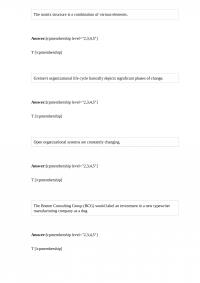
The matrix structure is a combination of various elements. Greiner’s organizational life cycle basically depicts significant phases of change. Answer: T [/cpmembership] Open organizational systems are constantly changing. Answer: T [/cpmembership] The Boston Consulting Group (BCG) would label an investment […]
OBHR 206 Test
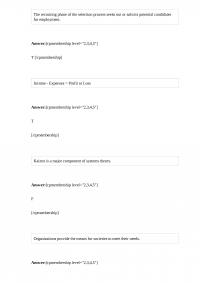
The recruiting phase of the selection process seeks out or solicits potential candidates for employment. Income – Expenses = Profit or Loss Answer: T Kaizen is a major component of systems theory. Answer: F Organizations provide the means for societies […]
OBHR 530 Quiz 3
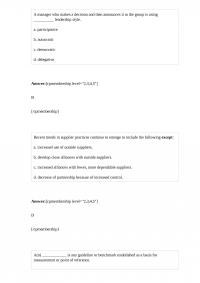
A manager who makes a decision and then announces it to the group is using __________ leadership style. a. participative b. autocratic c. democratic d. delegative Recent trends in supplier practices continue to emerge to include the following except: a. […]
OBHR 587 Midterm 1
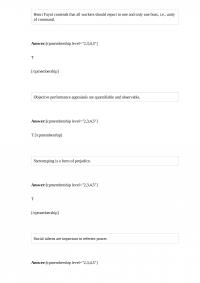
Henri Fayol contends that all workers should report to one and only one boss, i.e., unity of command. Objective performance appraisals are quantifiable and observable. Answer: T [/cpmembership] Stereotyping is a form of prejudice. Answer: T Social talents are important […]
PRST 120 Quiz 3
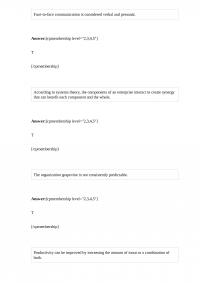
Face-to-face communication is considered verbal and personal. According to systems theory, the components of an enterprise interact to create synergy that can benefit each component and the whole. Answer: T The organization grapevine is not consistently predictable. Answer: T Productivity […]
PRST 129 Test 1
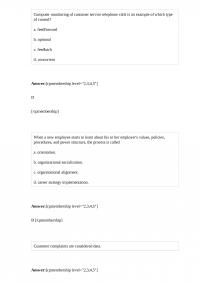
Computer monitoring of customer service telephone calls is an example of which type of control? a. feedforward b. optional c. feedback d. concurrent When a new employee starts to learn about his or her employer’s values, policies, procedures, and power […]
PRST 146 Midterm
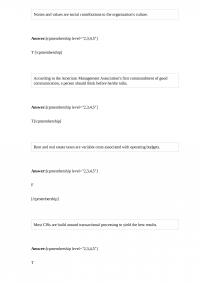
Norms and values are social contributions to the organization’s culture. According to the American Management Association’s first commandment of good communication, a person should think before he/she talks. Answer: T Rent and real estate taxes are variable costs associated with […]
PRST 185 Quiz 1
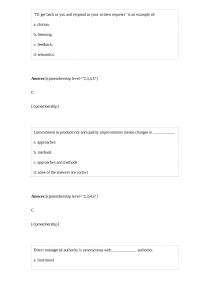
“I’ll get back to you and respond to your written requests” is an example of: a. diction. b. listening. c. feedback. d. semantics. Commitment to productivity and quality improvements means changes in __________. a. approaches b. methods c. approaches and […]
PRST 237
Development techniques include: a. job rotation b. professional seminars c. paying for formal education d. all of the above In facilities layout, when all of the equipment or machines that perform a similar task or function are located together, it […]
PRST 258 Test 1
Reengineering applies only to organizations, and not individuals. Teams should solve problems by addressing causes, not symptoms. Answer: T Producability is the excellence of a product or service. Answer: F A demotion is a reduction of pay, status, and responsibilities […]
PRST 428 Final
Which of the following is the top computer use for employed persons 25 and over? a. spreadsheets. b. Internet. c. word processing. d. scheduling. It is said that form follows function. However, regarding the contingency factors approach to organizational design, […]
PRST 447
Autocratic, participative, and free-rein are ____________ of leadership. a. traits b. roles c. styles d. skills Which of the following individuals is known as the Father of Scientific Management? a. Frederick Taylor b. Mary Parker Follett c. Edwards Deming d. […]
PRST 461
The autocratic style of leadership primarily focuses upon the ____________. a. situation b. leader c. group d. decision-making process The percentage of an organization’s work force not at work on any given day is ____________. a. turnover b. absenteeism c. […]
PRST 552 Quiz 2
The “through-puts” of communication are actually the information transmitted between sender and receiver. Once the managers of a large diversified organization decide on a portfolio strategy, they develop a grand strategy. Answer: F Expanding from specifics to generalities is known […]
PRST 564
A continuous, accusatory reference by employees toward management such as “they did it” would typify which source of resistance to change? a. selective perception b. loss of power and control c. loss of security d. fear of economic loss Quality […]
PRST 628 Midterm 1
The organization’s ________ resources used to carry out the activities are the most visible and complex of all the shaping factors of a culture. a. technical b. intangible c. tangible d. administrative The basic problem facing any business in its […]
PRST 669 Midterm 1
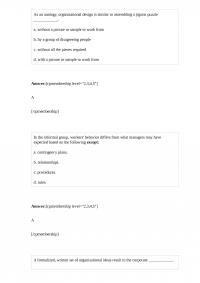
As an analogy, organizational design is similar to assembling a jigsaw puzzle ____________. a. without a picture or sample to work from b. by a group of disagreeing people c. without all the pieces required d. with a picture or […]
PRST 670 Midterm 1
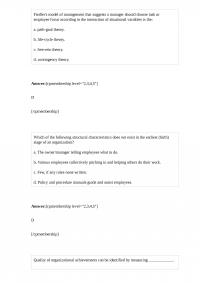
Fiedler’s model of management that suggests a manager should choose task or employee focus according to the interaction of situational variables is the: a. path-goal theory. b. life-cycle theory. c. free-rein theory. d. contingency theory. Which of the following structural […]
PRST 785 Midterm 1
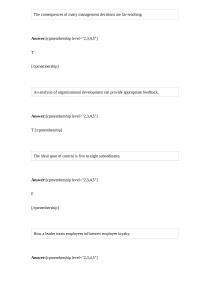
The consequences of many management decisions are far-reaching. An analysis of organizational development can provide appropriate feedback. Answer: T [/cpmembership] The ideal span of control is five to eight subordinates. Answer: F How a leader treats employees influences employee loyalty. […]
PRST 822 Midterm
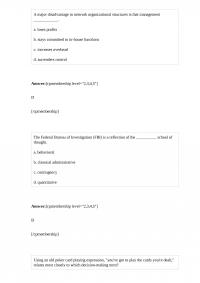
A major disadvantage to network organizational structures is that management ____________. a. loses profits b. stays committed to in-house functions c. increases overhead d. surrenders control The Federal Bureau of Investigation (FBI) is a reflection of the __________ school of […]