Archives
978-1259285295 Chapter 1 Lecture Note
Chapter 01 An Introduction to Money and the Financial System Chapter 1 An Introduction to Money and the Financial System Chapter Overview Chapter 1 introduces students to the five parts of the financial system and to the five core principles […]
978-1259285295 Chapter 1 Solution Manual
Chapter 01 – An Introduction to Money and the Financial System Chapter 1 An Introduction to Money and the Financial System Problems 1. List the financial transactions you have engaged in over the past week. How might each one have […]
978-1259285295 Chapter 10 Lecture Note
Chapter 10 – Foreign Exchange Chapter 10 Foreign Exchange Chapter Overview This chapter provides an introduction to foreign exchange rates and exchange markets, helping students to understand how they are determined and what accounts for their fluctuation over days, months, […]
978-1259285295 Chapter 10 Solution Manual Part 1
Chapter 10 – Foreign Exchange Chapter 10 Foreign Exchange Conceptual and Analytical Problems 1. If the U.S. dollar-British pound exchange rate is $1.50 per pound, and the U.S. dollar-euro rate is $0.90 per euro: (LO1) a. What is the pound […]
978-1259285295 Chapter 10 Solution Manual Part 2
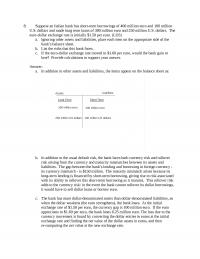
8. Suppose an Italian bank has short-term borrowings of 400 million euro and 100 million U.S. dollars and made long term loans of 300 million euro and 250 million U.S. dollars. The euro-dollar exchange rate is initially $1.50 per euro. […]
978-1259285295 Chapter 11 Lecture Note
Chapter 11 – The Economics of Financial Intermediation Chapter 11 The Economics of Financial Intermediation Chapter Overview In theory, the market system may seem neat and simple, but in reality economic growth is a messy, chaotic thing. Problems with the […]
978-1259285295 Chapter 11 Solution Manual Part 1
Chapter 11 – The Economics of Financial Intermediation Chapter 11 The Economics of Financial Intermediation Conceptual and Analytical Problems 1. Describe the problem of asymmetric information that an employer faces in hiring a new employee. What solutions can you think […]
978-1259285295 Chapter 11 Solution Manual Part 2
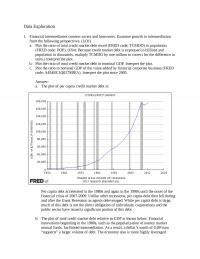
Data Exploration 1. Financial intermediaries connect savers and borrowers. Examine growth in intermediation from the following perspectives. (LO1) a. Plot the ratio of total credit market debt owed (FRED code: TCMDO) to population (FRED code: POP). (Hint: Because credit market […]
978-1259285295 Chapter 12 Lecture Note
Chapter 12 – Depository Institutions: Banks and Bank Management Chapter 12 Depository Institutions: Banks and Bank Management Chapter Overview This chapter examines the business of banking, looking at where depository institutions get their funds and what they do with them. […]
978-1259285295 Chapter 12 Solution Manual Part 1
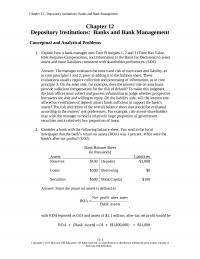
Chapter 12 – Depository Institutions: Banks and Bank Management Chapter 12 Depository Institutions: Banks and Bank Management Conceptual and Analytical Problems 1. Explain how a bank manager uses Core Principles 1, 2 and 3 (Time Has Value, Risk Requires Compensation, […]
978-1259285295 Chapter 12 Solution Manual Part 2
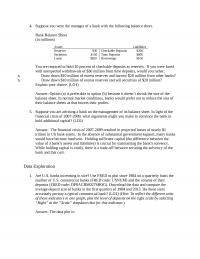
4. Suppose you were the manager of a bank with the following balance sheet. Bank Balance Sheet (in millions) You are required to hold 10 percent of checkable deposits as reserves. If you were faced with unexpected withdrawals of $30 […]
978-1259285295 Chapter 13 Lecture Note Part 1
Chapter 13 – Financial Industry Structure Chapter 13 Financial Industry Structure Chapter Overview The first half of this chapter considers current trends in the banking industry, including the tendency toward consolidation with nondepository institutions. In the second half of the […]
978-1259285295 Chapter 13 Lecture Note Part 2
II. Nondepository Institutions A. Insurance Companies 1. Insurance companies began hundreds of years ago with long sea voyages. 2. The most famous insurance company, Lloyd’s of London, was established in 1688. 3. Two Types of Insurance Company: insurance companies offer […]
978-1259285295 Chapter 13 Solution Manual
Chapter 13 – Financial Industry Structure Chapter 13 Financial Industry Structure Conceptual and Analytical Problems 1 For many years you have been using your local, small-town bank. One day you hear that the bank is about to be purchased by […]
978-1259285295 Chapter 14 Lecture Note
Chapter 14 – Regulating the Financial System Chapter 14 Regulating the Financial System Chapter Overview In this chapter the sources and consequences of financial fragility are examined, with the emphasis on banking crises. Next, the chapter looks at the institutional […]
978-1259285295 Chapter 14 Solution Manual
Chapter 14 – Regulating the Financial System Chapter 14 Regulating the Financial System Conceptual and Analytical Problems 1. Explain how a bank run can turn into a bank panic. (LO1) Answer: Bank runs occur when people fear that their bank […]
978-1259285295 Chapter 15 Lecture Note
Chapter 15 – Central Banks in the World Today Chapter 15 Central Banks in the World Today Chapter Overview Despite the constant presence of central banks in the news and their unprecedented power, most people only have a vague idea […]
978-1259285295 Chapter 15 Solution Manual
Chapter 15 – Central Banks in the World Today Chapter 15 Central Banks in the World Today Conceptual Problems 1. In 1900, there were 18 central banks in the world; today, there are more than 175. Why does nearly every […]
978-1259285295 Chapter 16 Lecture Note
Chapter 16 – The Structure of Central Banks: The Federal Reserve and the European Central Bank Chapter 16 The Structure of Central Banks: The Federal Reserve and the European Central Bank Chapter Overview In this chapter we examine two important […]
978-1259285295 Chapter 16 Solution Manual
Chapter 16 – The Structure of Central Banks: The Federal Reserve and the European Central Bank Chapter 16 The Structure of Central Banks: The Federal Reserve and the European Central Bank Conceptual and Analytical Problems 1. What are the Federal […]
978-1259285295 Chapter 17 Lecture Note
Chapter 17 – The Central Bank Balance Sheet and the Money Supply Process Chapter 17 The Central Bank Balance Sheet and the Money Supply Process Chapter Overview In this chapter we develop an understanding of how the central bank interacts […]
978-1259285295 Chapter 17 Solution Manual
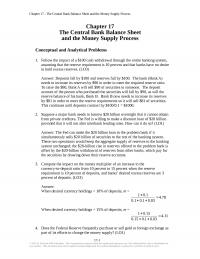
Chapter 17 – The Central Bank Balance Sheet and the Money Supply Process Chapter 17 The Central Bank Balance Sheet and the Money Supply Process Conceptual and Analytical Problems 1. Follow the impact of a $100 cash withdrawal through the […]
978-1259285295 Chapter 18 Lecture Note Part 1
Chapter 18 – Monetary Policy: Stabilizing the Domestic Economy Chapter 18 Monetary Policy: Stabilizing the Domestic Economy Chapter Overview The purpose of this chapter is to study three different links: the link from the central bank’s balance sheet to its […]
978-1259285295 Chapter 18 Lecture Note Part 2
IV. A Guide to Central Bank Interest Rates: The Taylor Rule A. A simple formula approximates what the FOMC does, tracking the behavior of the target federal funds rate and relating it to the real interest rate, inflation, and output. […]
978-1259285295 Chapter 18 Solution Manual Part 1
Chapter 18 Monetary Policy: Stabilizing the Domestic Economy Conceptual and Analytical Problems 1. Suppose, one morning, the Open Market Trading Desk drastically underestimates the demand for reserves when deciding the quantity of reserves to supply to the market. Based on […]
978-1259285295 Chapter 18 Solution Manual Part 2
18. How might the Federal Reserve exit from the unconventional policies it employed during the financial crisis of 2007-2009 without causing inflationary problems? (LO4) Answer: The Fed could tighten monetary policy without selling assets by raising the deposit 19. The […]
978-1259285295 Chapter 19 Lecture Note Part 1
Chapter 19 – Exchange-Rate Policy and the Central Bank Chapter 19 Exchange-Rate Policy and the Central Bank Chapter Overview In this chapter we turn to a discussion of exchange rate regimes and consider the link between a country’s exchange rate […]
978-1259285295 Chapter 19 Lecture Note Part 2
I. Fixed Exchange-Rate Regimes A. Exchange-Rate Pegs and the Bretton Woods System 1. The Bretton Woods System, which lasted from 1945 to 1971, was a system of fixed exchange rates that offered more flexibility over the short term than had […]
978-1259285295 Chapter 19 Solution Manual Part 1
Chapter 19 – Exchange-Rate Policy and the Central Bank Chapter 19 Exchange-Rate Policy and the Central Bank Conceptual and Analytical Problems 1. Explain the mechanics of a speculative attack on the currency of a country with a fixed exchange-rate regime. […]
978-1259285295 Chapter 19 Solution Manual Part 2
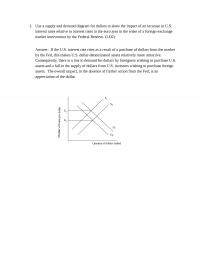
1. Use a supply and demand diagram for dollars to show the impact of an increase in U.S. interest rates relative to interest rates in the euro area in the wake of a foreign-exchange market intervention by the Federal Reserve. […]
978-1259285295 Chapter 2 Lecture Note
Chapter 02 – Money and the Payments System Chapter 2 Money and the Payments System Chapter Overview As indicated by the title, this chapter covers money and the payments system, which includes checks and electronic payments. The implications of new […]
978-1259285295 Chapter 2 Solution Manual
Chapter 02 – Money and the Payments System Chapter 2 Money and the Payments System Conceptual and Analytical Problems 1. Describe at least three ways you could pay for your morning cup of coffee. What are the advantages and disadvantages […]
978-1259285295 Chapter 20 Lecture Note
Chapter – 20 – Money Growth, Money Demand, and Modern Monetary Policy Chapter 20 Money Growth, Money Demand, and Modern Monetary Policy Chapter Overview In contrast with the United States, money plays a central role in the formulation of European […]
978-1259285295 Chapter 20 Solution Manual
Chapter – 20 – Money Growth, Money Demand, and Modern Monetary Policy Chapter 20 Money Growth, Money Demand, and Modern Monetary Policy Conceptual and Analytical Problems 1. Why is inflation higher than money growth in high-inflation countries and lower than […]
978-1259285295 Chapter 21 Lecture Note Part 1
Chapter 21 – Output, Inflation, and Monetary Policy Chapter 21 Output, Inflation, and Monetary Policy Chapter Overview Everyone is preoccupied with monetary policy, from traders to consumers to politicians. The objective of this chapter is to understand fluctuations in inflation […]
978-1259285295 Chapter 21 Lecture Note Part 2
III. Aggregate Supply A. Short-Run Aggregate Supply 1. The short-run aggregate supply curve is the upward-sloping relationship between current inflation and the quantity of output. 2. In the short run the prices of factors used as inputs are sticky; that […]
978-1259285295 Chapter 21 Solution Manual
Chapter 21 – Output, Inflation and Monetary Policy Chapter 21 Output, Inflation and Monetary Policy Conceptual and Analytical Problems 1. Explain the determinants of potential growth. (LO1) Answer: Growth of potential output depends on the growth rate of the capital […]
978-1259285295 Chapter 22 Lecture Note Part 1
Chapter 22 – Understanding Business Cycle Fluctuations Chapter 22 Understanding Business Cycle Fluctuations Chapter Overview The objective of this chapter is to use the framework developed in the last chapter to understand fluctuations in output and inflation. We will examine […]
978-1259285295 Chapter 22 Lecture Note Part 2
I. Using the Aggregate Demand-Aggregate Supply Framework A. How Do Policymakers Achieve Their Stabilization Objectives? 1. Policymakers can neutralize movements in aggregate demand but they cannot offset supply shocks. 2. Positive supply shocks that raise output and lower inflation provide […]
978-1259285295 Chapter 22 Solution Manual Part 1
Chapter 22 – Understanding Business Cycle Fluctuations Chapter 22 Understanding Business Cycle Fluctuations Conceptual and Analytical Problems 1. Define the term stabilization policy and describe how it can be used to reduce the volatility of economic growth and inflation. Do […]
978-1259285295 Chapter 22 Solution Manual Part 2
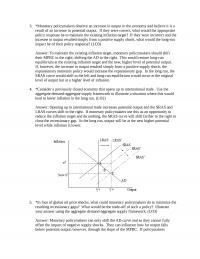
3. *Monetary policymakers observe an increase in output in the economy and believe it is a result of an increase in potential output. If they were correct, what would the appropriate policy response be to maintain the existing inflation target? […]
978-1259285295 Chapter 23 Lecture Note
Chapter 23 – Modern Monetary Policy and the Challenges Facing Central Bankers Chapter 23 Modern Monetary Policy and the Challenges Facing Central Bankers Chapter Overview The purpose of this chapter is two-fold. First, we will examine all the ways that […]
978-1259285295 Chapter 23 Solution Manual
Chapter 23 – Modern Monetary Policy and the Challenges Facing Central Bankers Chapter 23 Modern Monetary Policy and the Challenges Facing Central Bankers Conceptual and Analytical Problems 1. Explain in detail how monetary policy influences banks’ lending behavior. Show how […]
978-1259285295 Chapter 3 Lecture Note Part 1
Chapter 03 – Financial Instruments, Financial Markets, and Financial Institutions Chapter 3 Financial Instruments, Financial Markets, and Financial Institutions Chapter Overview In this chapter the financial system is surveyed in three steps: 1) financial instruments or securities are studied; 2) […]
978-1259285295 Chapter 3 Lecture Note Part 2
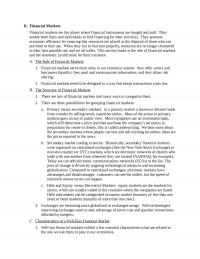
II. Financial Markets Financial markets are the places where financial instruments are bought and sold. They enable both firms and individuals to find financing for their activities. They promote economic efficiency by ensuring that resources are placed at the disposal […]
978-1259285295 Chapter 3 Solution Manual
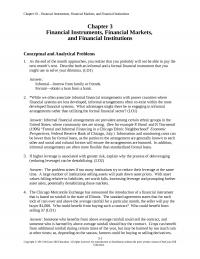
Chapter 03 – Financial Instruments, Financial Markets, and Financial Institutions Chapter 3 Financial Instruments, Financial Markets, and Financial Institutions Conceptual and Analytical Problems 1. As the end of the month approaches, you realize that you probably will not be able […]
978-1259285295 Chapter 4 Lecture Note
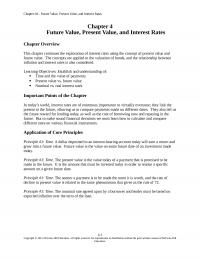
Chapter 04 – Future Value, Present Value, and Interest Rates Chapter 4 Future Value, Present Value, and Interest Rates Chapter Overview This chapter continues the exploration of interest rates using the concept of present value and future value. The concepts […]
978-1259285295 Chapter 4 Solution Manual Part 1
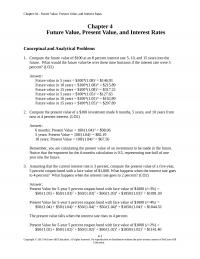
Chapter 04 – Future Value, Present Value, and Interest Rates Chapter 4 Future Value, Present Value, and Interest Rates Conceptual and Analytical Problems 1. Compute the future value of $100 at an 8 percent interest rate 5, 10, and 15 […]
978-1259285295 Chapter 4 Solution Manual Part 2
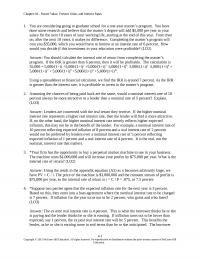
Chapter 04 – Future Value, Present Value, and Interest Rates 1. You are considering going to graduate school for a one-year master’s program. You have done some research and believe that the master’s degree will add $5,000 per year to […]
978-1259285295 Chapter 5 Lecture Note
Chapter 05 – Understanding Risk Chapter 5 Understanding Risk Chapter Overview This chapter covers how to measure risk and assess whether it will increase or decrease. It also develops an understanding of why changes in risk lead to changes in […]
978-1259285295 Chapter 5 Solution Manual Part 1
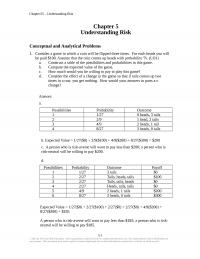
Chapter 05 – Understanding Risk Chapter 5 Understanding Risk Conceptual and Analytical Problems 1. Consider a game in which a coin will be flipped three times. For each heads you will be paid $100. Assume that the coin comes up […]
978-1259285295 Chapter 5 Solution Manual Part 2
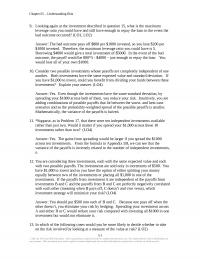
Chapter 05 – Understanding Risk 9. Looking again at the investment described in question 15, what is the maximum leverage ratio you could have and still have enough to repay the loan in the event the bad outcome occurred? (LO1, […]
978-1259285295 Chapter 6 Lecture Note
Chapter 06 – Bonds, Bond Prices, and the Determination of Interest Rates Chapter 6 Bonds, Bond Prices, and the Determination of Interest Rates Chapter Overview If we want to understand the financial system, particularly the bond market, we must understand […]
978-1259285295 Chapter 6 Solution Manual Part 1
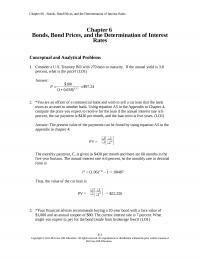
Chapter 06 – Bonds, Bond Prices, and the Determination of Interest Rates Chapter 6 Bonds, Bond Prices, and the Determination of Interest Rates Conceptual and Analytical Problems 1. Consider a U.S. Treasury Bill with 270 days to maturity. If the […]
978-1259285295 Chapter 6 Solution Manual Part 2
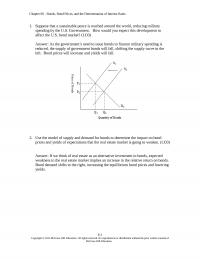
Chapter 06 – Bonds, Bond Prices, and the Determination of Interest Rates 1. Suppose that a sustainable peace is reached around the world, reducing military spending by the U.S. Government. How would you expect this development to affect the U.S. […]
978-1259285295 Chapter 7 Lecture Note
Chapter 07 – The Risk and Term Structure of Interest Rates Chapter 7 The Risk and Term Structure of Interest Rates Chapter Overview In this chapter students are introduced to the three factors that affect bond yields: default risk, taxes, […]
978-1259285295 Chapter 7 Solution Manual
Chapter 07 – The Risk and Term Structure of Interest Rates Chapter 7 The Risk and Term Structure of Interest Rates Conceptual and Analytical Problems 1. Consider a firm that issued a large quantity of commercial paper in the period […]
978-1259285295 Chapter 8 Lecture Note
Chapter 08 – Stocks, Stock Markets, and Market Efficiency Chapter 8 Stocks, Stock Markets, and Market Efficiency Chapter Overview The goal of this chapter is to try to make sense of the stock market, to show what fluctuations in stock […]
978-1259285295 Chapter 8 Solution Manual
Chapter 08 – Stocks, Stock Markets, and Market Efficiency Chapter 8 Stocks, Stock Markets, and Market Efficiency Conceptual and Analytical Problems 1. Explain why being a residual claimant makes stock ownership risky. (LO1) Answer: Stockholders do not receive dividends unless […]
978-1259285295 Chapter 9 Lecture Note Part 1
Chapter 09 – Derivatives: Futures, Options, and Swaps Chapter 9 Derivatives: Futures, Options, and Swaps Chapter Overview This chapter provides an introduction to derivatives, and examines both their uses and abuses. Learning Objectives: Establish an understanding of: 1. How derivatives […]
978-1259285295 Chapter 9 Lecture Note Part 2
II. Options A. Puts, Calls, and All That: Definitions 1. Like futures, options are agreements between two parties, a seller (option writer) and a buyer (option holder). 2. Option writers incur obligations, while option holders obtain rights. 3. There are […]
978-1259285295 Chapter 9 Solution Manual Part 1
Chapter 09 – Derivatives: Futures, Options, and Swaps Chapter 9 Derivatives: Futures, Options, and Swaps Conceptual and Analytical Problems 1. An agreement to lease a car can be thought of as a set of derivative contracts. Describe them. (LO2) Answer: […]
978-1259285295 Chapter 9 Solution Manual Part 2
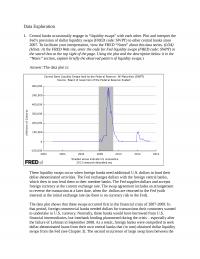
Data Exploration 1. Central banks occasionally engage in “liquidity swaps” with each other. Plot and interpret the Fed’s provision of dollar liquidity swaps (FRED code: SWPT) to other central banks since 2007. To facilitate your interpretation, view the FRED “Notes” […]
BUS 12038
The law of one price: A. is based on arbitrage. B. applies only to real goods and not financial assets. C. can explain short-run exchange rates but not long-run exchange rates. D. is a mathematical concept that is not useful […]
BUS 12069
Checks and currency function similarly, however: A. currency is a more effective means of payment. B. carrying currency entails greater risk, because it cannot be replaced if lost or stolen. C. currency is a better store of value than checking […]
BUS 18547
One reason the target federal funds rate may not equal the actual federal funds rate is because: A. there is no way that the Fed could keep the actual rate at the target rate. B. the target rate changes with […]
BUS 18970
Which of the following statements is most correct? A. When a risk is difficult to predict, financial instruments are created to transfer these risks. B. Financial instruments are created to transfer risks that are relatively easy to predict. C. Financial […]
BUS 23700
If policymakers are aggressive in keeping current inflation near the target inflation rate then the monetary policy reaction curve will: A. be steep. B. be flat. C. have an undefined slope. D. be vertical. Answer: Suppose that Fly-By-Night Airlines Inc., […]
BUS 31335
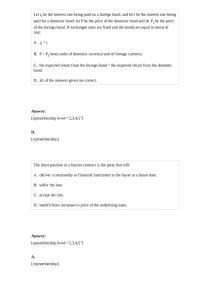
Let if be the interest rate being paid on a foreign bond, and let i be the interest rate being paid for a domestic bond; let P be the price of the domestic bond and let Pf be the price […]
BUS 32684
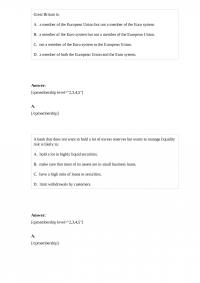
Great Britain is: A. a member of the European Union but not a member of the Euro system. B. a member of the Euro system but not a member of the European Union. C. not a member of the Euro […]
BUS 39772
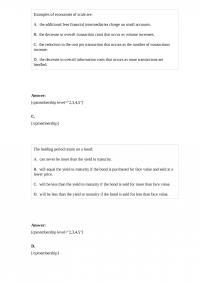
Examples of economies of scale are: A. the additional fees financial intermediaries charge on small accounts. B. the decrease in overall transaction costs that occur as volume increases. C. the reduction in the cost per transaction that occurs as the […]
BUS 45093
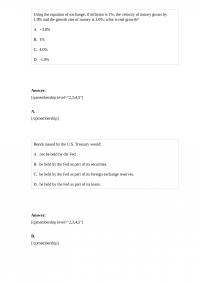
Using the equation of exchange, if inflation is 1%, the velocity of money grows by 1.0% and the growth rate of money is 3.0%; what is real growth? A. +3.0% B. 1% C. 4.0% D. -1.0% Answer: Bonds issued by […]
BUS 70022
Finance companies perform all of the following functions, except: A. issue commercial paper and securities. B. take deposits. C. make loans. D. lease equipment to firms. Answer: Often Eurodollar deposits earn higher returns than U.S. bank deposits for all of […]
BUS 71243
The better the information provided to financial markets the: A. less the amount of funds transferred between savers and borrowers. B. greater the amount of funds transferred between savers and borrowers though risk increases. C. higher the return required by […]
BUS 95074
The risk spread: A. is also known as the default-risk premium. B. should have a direct relationship with the bond’s price. C. should have an inverse relationship with the bond’s yield. D. is always constant. Answer: Comparing the banking systems […]
ECB 34727
If M = the quantity of money, m the money multiplier, MB the Monetary Base, C = Currency, D = Deposits, R = Reserves, RR = required reserves, and ER = Excess reserves, then RR would equal: A. MB. B. […]
ECB 40282
One reason it took so long to have a central bank in the United States is that: A. it wasn’t needed. B. states feared centralization of power. C. state currencies worked fine. D. all of the answer options are correct. […]
ECB 44561
If a bank’s return on equity remains constant, but the ratio of bank assets to bank capital increases: A. the bank’s return on assets must have increased. B. the bank’s return on assets must have decreased. C. the bank’s assets […]
ECB 63440
The value of $100 left in a certificate of deposit for four years that earns 4.5% annually will be: A. $120.00 B. $119.25 C. $117.00 D. $145.00 Answer: The stability of the financial system is enhanced by the ability of […]
ECB 89408
Secondary credit provided by the Fed is designed for: A. banks who qualify for a lower interest than what is available under primary credit. B. banks that are in trouble and cannot obtain a loan from anyone else. C. banks […]
ECB 94428
If the required reserve rate is ten percent and banks do not hold any excess reserves and there are no changes in currency holdings, a $1 million open market purchase by the Fed will result in what change in loans? […]
ECB 98375
A lender usually knows less about the creditworthiness of a borrower than the borrower does. This is an example of: A. opportunistic behavior. B. economies of scale. C. diminishing marginal returns. D. information asymmetry. Answer: An investment has grown from […]
ECB 99078
If a bank’s return on equity remains constant, but the ratio of bank assets to bank capital decreases: A. the bank’s return on assets must have increased. B. the bank’s return on assets must have decreased. C. the bank’s assets […]
ECON 10776
The reserve requirement is applied to two-week balances on: A. transactions deposits. B. savings deposits. C. both transactions deposits and savings deposits. D. savings deposits and one-week balances on transactions deposits. Answer: Automated teller machines provided by financial intermediaries are […]
ECON 22407
The size of the bond dealer’s spread is mainly a function of the: A. purchase price of the bond. B. current yield. C. liquidity of the bond market. D. face value of the bond. Answer: Considering the euro/U.S. dollar exchange […]
ECON 33809
Reasons for the rapid structural change in financial markets in recent years include all of the following except: A. globalization. B. technological advances in computing. C. technological advances in communication. D. high real interest rates. Answer: Net interest income for […]
ECON 40670
Taxes play an important role in bond returns because: A. all interest from owning bonds is taxed. B. all governments (federal, state, municipal) tax bonds similarly. C. some bond interest is exempt from some government taxation, so after tax returns […]
ECON 53708
Governments employ three strategies to contain the risks created by government safety nets. These include each of the following, except: A. government supervision. B. an excise tax on bank profits. C. government regulation. D. formal bank examination. Answer: The components […]
ECON 79332
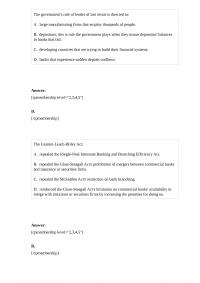
The government’s role of lender of last resort is directed to: A. large manufacturing firms that employ thousands of people. B. depositors; this is role the government plays when they insure depositors’ balances in banks that fail. C. developing countries […]
ECON 81771
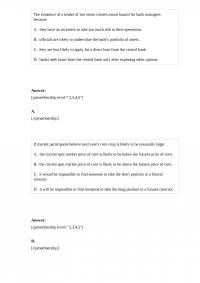
The existence of a lender of last resort creates moral hazard for bank managers because: A. they have an incentive to take too much risk in their operations. B. officials are likely to undervalue the bank’s portfolio of assets. C. […]
ECON 97361
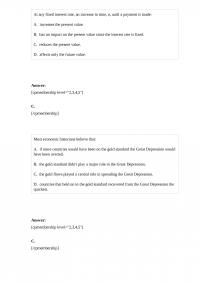
At any fixed interest rate, an increase in time, n, until a payment is made: A. increases the present value. B. has no impact on the present value since the interest rate is fixed. C. reduces the present value. D. […]
ECON A 41216
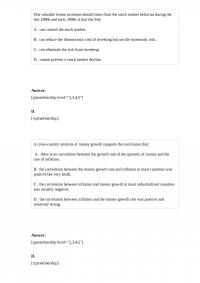
One valuable lesson investors should learn from the stock market behavior during the late 1990s and early 2000s is that the Fed: A. can control the stock market. B. can reduce the idiosyncratic risk of investing but not the systematic […]
ECON A 49147
If a government were to find that it cannot raise taxes any further, and that it cannot borrow any further from financial markets, the government: A. cannot increase its spending any further. B. can increase spending by having the central […]
ECON A 54722
If a bank has 1,000 depositors, each of whom deposits $1,000 in the bank, and the bank makes loans of $10,000 each, then each depositor has contributed: A. $100 to each loan. B. $1 to each loan. C. $10 to […]
ECON A 67639
The option writer is: A. the seller of an option. B. the buyer of an option. C. the underlying asset of the option. D. the individual who obtains the rights. Answer: If the nominal interest rate increases: A. the cost […]
ECON A 69787
If the target federal funds rate reaches zero: A. the FOMC would run out of policy options. B. monetary policy would no longer be of use. C. the FOMC would turn to unconventional measures, such as forward guidance. D. the […]
ECON A 79848
If a bank has $100 million in assets and a net worth of $10 million, its debt-to-equity ratio is: A. 10 to 1. B. 5 to 1. C. 9 to 1. D. 0.1 to 1. Answer: Under the Expectations Hypothesis, […]
ECON A 89799
If the required reserve rate is ten percent and banks do not hold any excess reserves and there are no changes in currency holdings, a $1 million open market purchase by the Fed will result in deposit creation of: A. […]
ECON A 95854
If U.S. assets are seen as having greater risk relative to foreign assets in the market for foreign exchange, this should cause the: A. demand for dollars to increase. B. supply of dollars to decrease. C. supply of dollars to […]
ECON E 17623
Commercial banks differ from credit unions in the following way: A. credit unions focus on consumer loans while commercial banks primarily make loans to businesses. B. credit unions make loans and accept deposits while commercial banks just make loans. C. […]
ECON E 40306
During a recession you would expect the difference between the commercial paper rate and the yield on U.S. T-bills of the same maturity to: A. be the same since their maturities are the same. B. increase reflecting the possibility of […]
ECON E 60724
If someone wants to start a bank today they would have to: A. obtain a charter from the federal government. B. simply have $5 million is startup capital, a charter is no longer needed. C. obtain a charter either from […]
ECON E 61618
The financial system is inherently more unstable than most other industries due to the fact that: A. while in most other industries customers disappear at a faster rate, in banking they disappear slowly so the damage is done before the […]
ECON E 62611
Compounding refers to the A. calculation of after tax interest returns. B. internal rate of return a firm earns on an investment. C. real interest return after taxes. D. process of earning interest on both the principal and the interest […]
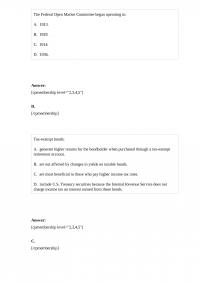
ECON E 88737
The Federal Open Market Committee began operating in: A. 1913. B. 1929. C. 1914. D. 1936. Answer: Tax-exempt bonds: A. generate higher returns for the bondholder when purchased through a tax-exempt retirement account. B. are not affected by changes in […]
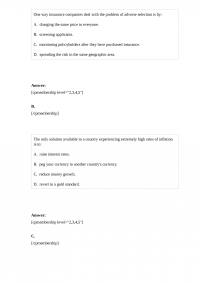
ECON E 90413
One way insurance companies deal with the problem of adverse selection is by: A. charging the same price to everyone. B. screening applicants. C. monitoring policyholders after they have purchased insurance. D. spreading the risk in the same geographic area. […]
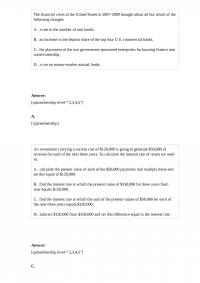
ECON E 95768
The financial crisis in the United States in 2007-2009 brought about all but which of the following changes: A. a rise in the number of unit banks. B. an increase in the deposit share of the top four U.S. commercial […]
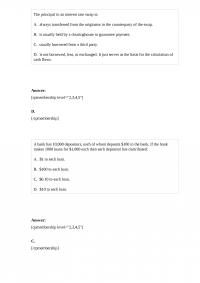
ECON E 98441
The principal in an interest rate swap is: A. always transferred from the originator to the counterparty of the swap. B. is usually held by a clearinghouse to guarantee payment. C. usually borrowed from a third party. D. is not […]
Economics 11932
Which of the following statements is most correct? A. Money is wealth but not all wealth is money. B. Money is a means of payment but is not part of wealth. C. In order to be considered part of a […]
Economics 12897
U.S. government bonds that provide for bondholders to receive a fixed rate of interest plus the change in the consumer price index were designed to remove: A. default risk. B. liquidity risk. C. inflation risk. D. interest-rate risk. Answer: Suppose […]
Economics 19043
When the Federal Reserve purchases a U.S. Treasury bond for $1 million by writing a check, when the check returns, the Fed’s balance sheet will show: A. an increase in assets and a decrease in liabilities of $1 million. B. […]
Economics 24112
One major difference between a debit card and a credit card is: A. only the debit card helps you to build a credit history. B. the debit card has lower minimum monthly payments. C. you do not need to actually […]
Economics 25712
Compare two economies: a barter economy versus an economy that uses money. In order to exchange goods and services: A. a double coincidence of wants is necessary in the barter economy. B. a double coincidence of wants is more likely […]
Economics 36315
If the lender of last resort function of the government is to be effective in working to minimize a crisis, it must be: A. reserved only for those banks that are most deserving. B. used on a limited basis. C. […]
Economics 44104
On November 20, 1985, the Bank of New York needed to use the lender of last resort function due to: A. a run on the bank started by a rumor that the president of the bank embezzled tens of millions […]
Economics 61203
The dividend-discount model of stock valuation: A. is an application of the net present value formula. B. takes the net present value of expected dividends and add it to the future sale price of the stock. C. takes the net […]
Economics 72171
The quantity theory of money along with the assumption of a constant velocity can explain which of the following? A. At a given level of money growth, the higher the level of real growth the higher the level of inflation […]
Economics 79898
During most of the 1970s, officials at the Fed: A. overestimated inflation and underestimated the growth rate of potential GDP. B. overestimated the growth rate of potential GDP and underestimated inflation. C. underestimated both the growth rate of output and […]
Economics 83365
The most commonly quoted monetary aggregate is: A. money-market mutual fund shares. B. M1 since it is the most liquid. C. public currency. D. M2 since its movement is most closely related to interest rates and economic growth. Answer: In […]
Economics 94608
We should expect a country that experiences volatile inflation to also have: A. volatile nominal interest rates. B. volatile real interest rates but stable nominal rates. C. stable nominal interest rates. D. volatile real interest rates. Answer: The Fed purchases […]
MicroEconomic 11025
Assume that the required reserve rate is ten percent, banks want to hold excess reserves in an amount that equals three percent of deposits, and the public withdraws ten percent of every deposit in cash. An open market purchase of […]
MicroEconomic 25343
If the internal rate of return from an investment is more than the opportunity cost of funds the firm should: A. make the investment. B. not make the investment. C. only make the investment using retained earnings. D. only make […]
MicroEconomic 73859
Asymmetric information poses two important obstacles to the smooth flow of funds from savers to investors. They are: A. adverse selection, which arises before the transaction occurs, and moral hazard, which occurs after the transaction. B. moral hazard, which arises […]