
Chapter 03 – Financial Instruments, Financial Markets, and Financial Institutions
Chapter 3
Financial Instruments, Financial Markets,
and Financial Institutions
Conceptual and Analytical Problems
1. As the end of the month approaches, you realize that you probably will not be able to pay the
next month’s rent. Describe both an informal and a formal financial instrument that you
might use to solve your dilemma. (LO1)
Answer:
2. *While we often associate informal financial arrangements with poorer countries where
financial systems are less developed, informal arrangements often co-exist within the most
developed financial systems. What advantages might there be to engaging in informal
arrangements rather than utilizing the formal financial sector? (LO1)
Answer: Informal financial arrangements are prevalent among certain ethnic groups in the
United States, where community ties are strong. (See for example P. Bond and R Townsend
3. If higher leverage is associated with greater risk, explain why the process of deleveraging
(reducing leverage) can be destabilizing. (LO2)
Answer: The problem arises if too many institutions try to reduce their leverage at the same
4. The Chicago Mercantile Exchange has announced the introduction of a financial instrument
that is based on rainfall in the state of Illinois. The standard agreement states that for each
inch of rain over and above the average rainfall for a particular month, the seller will pay the
buyer $1,000. Who could benefit from buying such a contract? Who could benefit from
selling it? (LO1)
Answer: Someone who benefits from above average rainfall could sell the contract, and
3-1
Copyright © 2015 McGraw-Hill Education. All rights reserved. No reproduction or distribution without the prior written consent of McGraw-Hill
Education.

Chapter 03 – Financial Instruments, Financial Markets, and Financial Institutions
5. You wish to buy an annuity that makes monthly payments for as long as you live. Describe
what happens to the purchase price of the annuity as (a) your age at the time of purchase goes
up, (b) the size of the monthly payment rises, and (c) your health improves. (LO1)
Answer:
a. The number of expected monthly payments declines so the price of the annuity falls.
b. The price of the annuity rises as each payment is larger.
6. Which of the following would be more valuable to you: a portfolio of stocks that rises in
value when your income rises or a portfolio of stocks that rises in value when your income
falls? Why? (LO1)
7. The Wall Street Journal has a daily listing of what are called “Money Rates” or interest rates
on short-term securities. Locate it either in a recent issue of the newspaper by looking at the
index on page 1 of the Money and Investing section, or in the Market Data Center of
www.wsj.com. The most important money rates are the prime rate, the federal funds rate,
and the Treasury bill rate. Describe each of these and report the current rate quoted in the
paper. (LO1)
Answer: The prime rate is the base rate for corporate loans offered by at least 70% of the
largest banks in the U.S. The federal funds rate is the rate at which banks lend reserves to
8. Designated market makers, who historically have provided liquidity (i.e,, have stood by
ready to buy and sell) in markets for specific stocks, have declined in importance. Explain
this decline in terms of technology and global economic integration. (LO2)
Answer: Advances in technology have made it possible for investors from around the world
to trade via electronic exchanges and communications networks. Large numbers of electronic
3-2
Copyright © 2015 McGraw-Hill Education. All rights reserved. No reproduction or distribution without the prior written consent of McGraw-Hill
Education.

Chapter 03 – Financial Instruments, Financial Markets, and Financial Institutions
9. The design and function of financial instruments, markets, and institutions are tied to the
importance of information. Describe the role played by information in each of these three
pieces of the financial system. (LO2)
Answer: The design and function of financial instruments, markets, and institutions are tied
to the importance of information. Financial instruments summarize essential information
10. Suppose you need to take out a personal loan with a bank. Explain how you could be
affected by problems in the interbank lending market such as those seen during the
2007-2009 financial crisis. (LO2)
Answer: The strains in the interbank market pushed up interbank lending rates, which
11. *Advances in technology have facilitated the widespread use of credit scoring by financial
institutions in making their lending decisions. Credit scoring can be defined broadly as the
use of historical data and statistical techniques to rank the attractiveness of potential
borrowers and guide lending decisions. In what ways might this practice enhance the
efficiency of the financial system? (LO3)
Answer: The use of credit scoring techniques standardizes the assessment of loan applicants
and reduces information costs. This allows financial institutions to lend to a broader range of
12. Commercial banks, insurance companies, investment banks, and pension funds are all
examples of financial intermediaries. For each of these, give an example of a source of their
funds and an example of their use of funds. (LO3)
Answer:
a. Commercial banks receive deposits in checking and savings accounts and borrow
b. Insurance companies receive premium payments, which they invest in securities or
c. Investment banks charge fees for advising clients on mergers and acquisitions and for
3-3
Copyright © 2015 McGraw-Hill Education. All rights reserved. No reproduction or distribution without the prior written consent of McGraw-Hill
Education.
Chapter 03 – Financial Instruments, Financial Markets, and Financial Institutions
d. Pension funds receive regular contributions from companies providing for retirement
13. Life insurance companies tend to invest in long-term assets such as loans to manufacturing
firms to build factories or to real estate developers to build shopping malls and skyscrapers.
Automobile insurers tend to invest in short-term assets such as Treasury bills. What accounts
for these differences? (LO3)
Answer: Automobile insurers generally need to have funds readily available when a
policyholder makes a claim, and Treasury bills are highly liquid. Life insurance companies
14. For each pair of instruments below, use the criteria for valuing a financial instrument to
choose the one with the highest value. (LO1)
a. A U.S. Treasury bill that pays $1,000 in six months or a U.S. Treasury bill that pays
$1,000 in three months.
b. A U.S. government Treasury bill that pays $1,000 in three months or commercial
paper issued by a private corporation that pays $1,000 in three months.
c. An insurance policy that pays out in the event of serious illness or one that pays out
when you are healthy, assuming you are equally likely to be ill or healthy.
Explain each of your choices briefly.
Answer:
a. The T-bill that pays out in three months, as the sooner the payment the more valuable.
b. The T-bill is more valuable as the likelihood of the U.S government honoring its debts
15. Joe and Mike purchase identical houses for $200,000. Joe makes a down payment of
$40,000 while Mike only puts down $10,000; for each individual, the down payment is the
total of his net worth. Assuming everything else equal, who is more highly leveraged? If
house prices in the neighborhood immediately fall by 10 percent (before any mortgage
payments are made), what would happen to Joe’s and Mike’s net worth? (LO2)
Answer: Mike is more highly leveraged as he has financed a larger part of his asset with
borrowing (95% compared with Joe’s 80%). Assuming they have no other assets or
16. *Everything else being equal, which would be more valuable to you – a derivative instrument
whose value is derived from an underlying instrument with a very volatile price history or
3-4
Copyright © 2015 McGraw-Hill Education. All rights reserved. No reproduction or distribution without the prior written consent of McGraw-Hill
Education.

Chapter 03 – Financial Instruments, Financial Markets, and Financial Institutions
one derived from an underlying instrument with a very stable price history? Explain your
choice. (LO2)
Answer: The primary use of derivatives is to transfer risk from one party to another. The
more volatile the price of the instrument upon which the derivative is based, the higher the
17. You decide to start a business selling covers for smart phones in a mall kiosk. To buy
inventory, you need to borrow some funds. Why are you more likely to take out a bank loan
than to issue bonds? (LO3)
Answer: Issuing bonds is a form of direct finance and would require finding a buyer who
would be willing to bear the information and monitoring costs associated with the loan. For
18. Splitland is a developing economy with two distinct regions. The northern region has great
investment opportunities, but the people who live there need to consume all of their income
to survive. Those living in the south are better off than their northern counterparts and save a
significant portion of their income. The southern region, however, has few profitable
investment opportunities and so most of the savings remain in shoeboxes and under
mattresses. Explain how the development of the financial sector could benefit both regions
and promote economic growth in Splitland. (LO2)
Answer: In the absence of financial markets, resources are not being allocated to the best
investment opportunities available – in this case, to the northern region. The introduction of
19. What would you expect to happen to investment and growth in the economy if the U.S.
government decided to abolish the Securities and Exchange Commission? (LO2)
Answer: The role of the Securities and Exchange Commission (SEC) is to protect investors
by working to insure that all investors have access to certain knowledge about companies.
3-5
Copyright © 2015 McGraw-Hill Education. All rights reserved. No reproduction or distribution without the prior written consent of McGraw-Hill
Education.
Chapter 03 – Financial Instruments, Financial Markets, and Financial Institutions
20. Use Core Principle 3 from Chapter 1 to suggest some ways in which the problems associated
with the shadow banking sector during the 2007-2009 financial crisis might be mitigated in
the future. (LO3)
Answer: Core Principle 3 states that information is the basis for decisions. Many of the
problems in the shadow banking sector during the financial crisis arose because investors and
21. What risks might financial institutions face by funding long-run loans such as mortgages to
borrowers (often at fixed interest rates) with short-term deposits from savers? (LO3)
Answer: If savers decide to withdraw in large numbers from the financial institution, the
institution may not have sufficient funds readily available for them if the funds had been lent
22. *As the manager of a financial institution, what steps could you take to reduce the risks
referred to in Problem 21? (LO3)
Answer: Some strategies include pooling mortgages into mortgage-backed securities and
selling them or using derivative instruments to transfer the risk associated with interest rate
Data Exploration
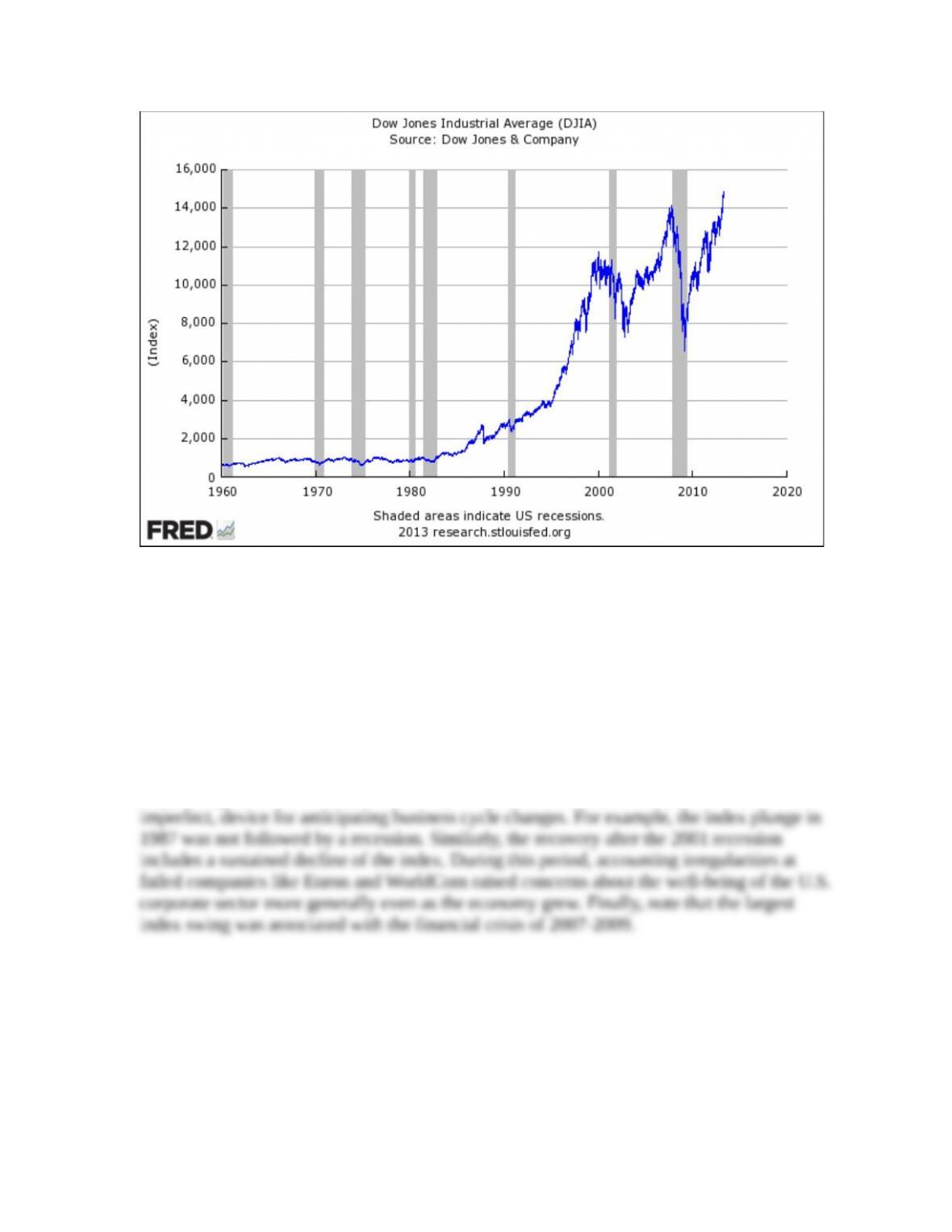
1. Probably the most famous stock index in the financial markets is the Dow Jones Industrial
Average. Plot this index (FRED code: DJIA) over the period from 1960 to the present. (LO2)
(Hint: At the FRED Web site, go to “Data Tools,” then “Create Your Own Graphs,” and
input “DJIA” in the search box. You will see a plot beginning in the 1890s. To set a time
period different from the default period, set the desired dates in the “Observation Date
Range” dropdown box that appears under the “Line 1” summary of the data and select
“Redraw Graph.”)
Answer: The requested data plot is:
3-6
Copyright © 2015 McGraw-Hill Education. All rights reserved. No reproduction or distribution without the prior written consent of McGraw-Hill
Education.
Chapter 03 – Financial Instruments, Financial Markets, and Financial Institutions
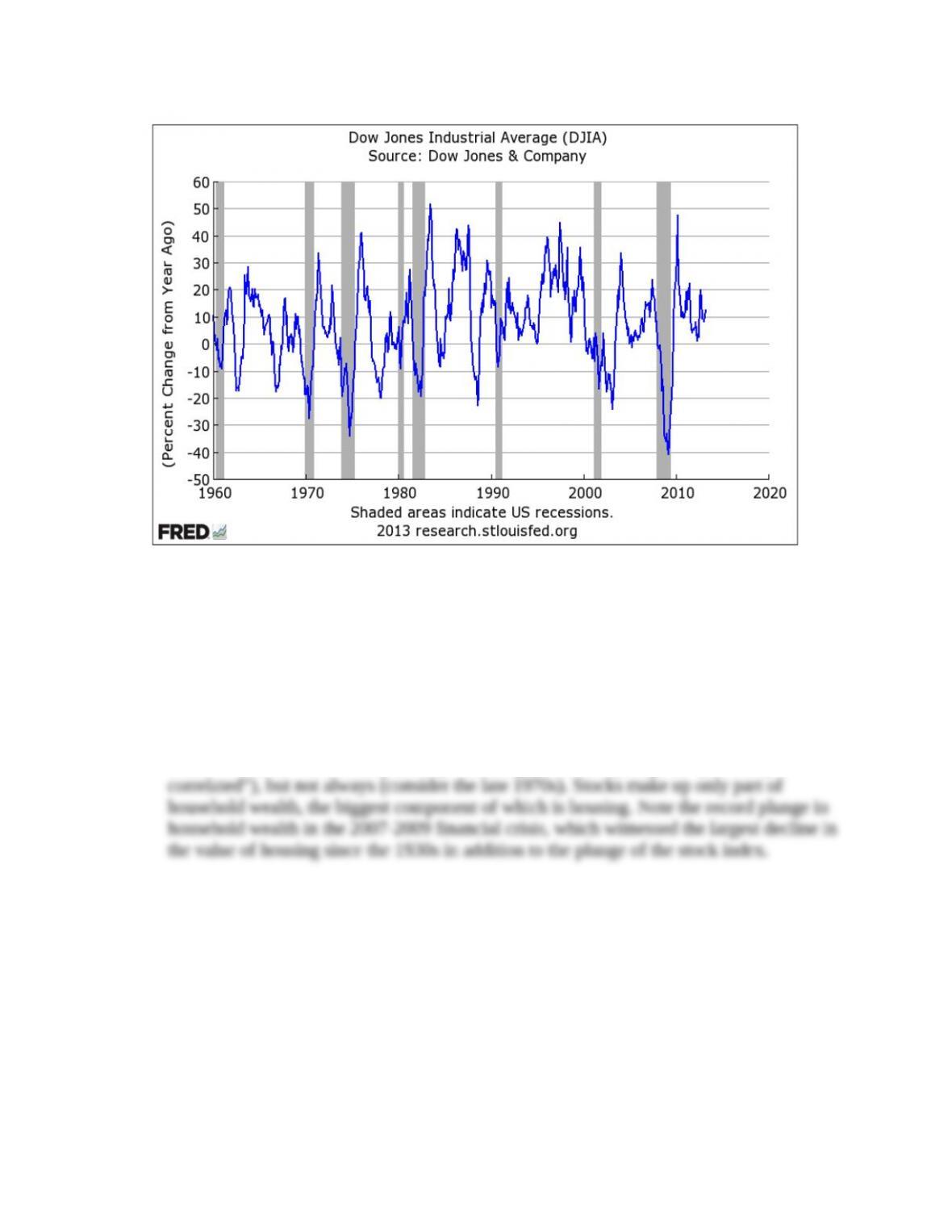
2. Plot the percent change from a year ago of the Dow Jones Industrial Average (FRED code:
DJIA). Discuss the behavior of changes in the average before, during, and after recession
periods, which are indicated by the vertical, shaded bars on the graph. (LO2) (Hint: Change
the “Units” dropdown box from “Index” to “Percent Change from Year Ago;” change the
“Frequency” dropdown box to “Monthly” from “Daily;” and select “Redraw Graph.”
Changing to “Percent Change from Year Ago” highlights the swings in the index, while
using the monthly frequency averages out daily fluctuations that obscure the big patterns.)
Answer: It is common for the index to fall prior to or coincident with the onset of recession
and then to rise in advance of or coincident with the onset of economic expansion. However,
large swings in the index occur more frequently than recessions, so they are a useful, but
The requested data plot is:
3-7
Copyright © 2015 McGraw-Hill Education. All rights reserved. No reproduction or distribution without the prior written consent of McGraw-Hill
Education.
Chapter 03 – Financial Instruments, Financial Markets, and Financial Institutions
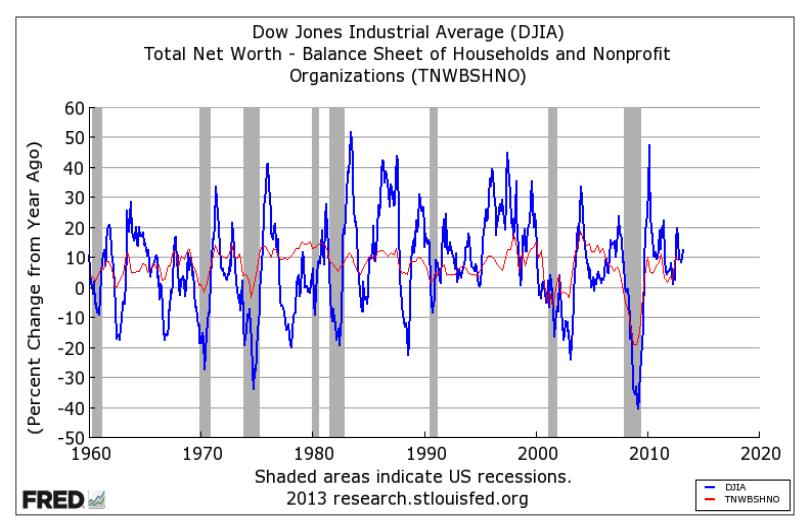
3. Do changes in stock values affect the wealth of households? Beginning in 1960, plot on a
quarterly basis the percent change from a year ago of the Dow Jones Industrial Average
(FRED code: DJIA) and the percent change from a year ago of household net worth
(FRED code: TNWBSHNO). Compare the two lines. (LO2) (Hints: Select “Add Data
Series;” enter the FRED code “TNWBSHNO;” set the start date in the Observation Date
Range to January 1960; and select “Redraw Graph.”)
Answer: The percentage swings in household net worth are smaller in amplitude than
those in the stock index. They usually move together (we say they are “positively
The requested data plot is:
3-8
Copyright © 2015 McGraw-Hill Education. All rights reserved. No reproduction or distribution without the prior written consent of McGraw-Hill
Education.
Chapter 03 – Financial Instruments, Financial Markets, and Financial Institutions
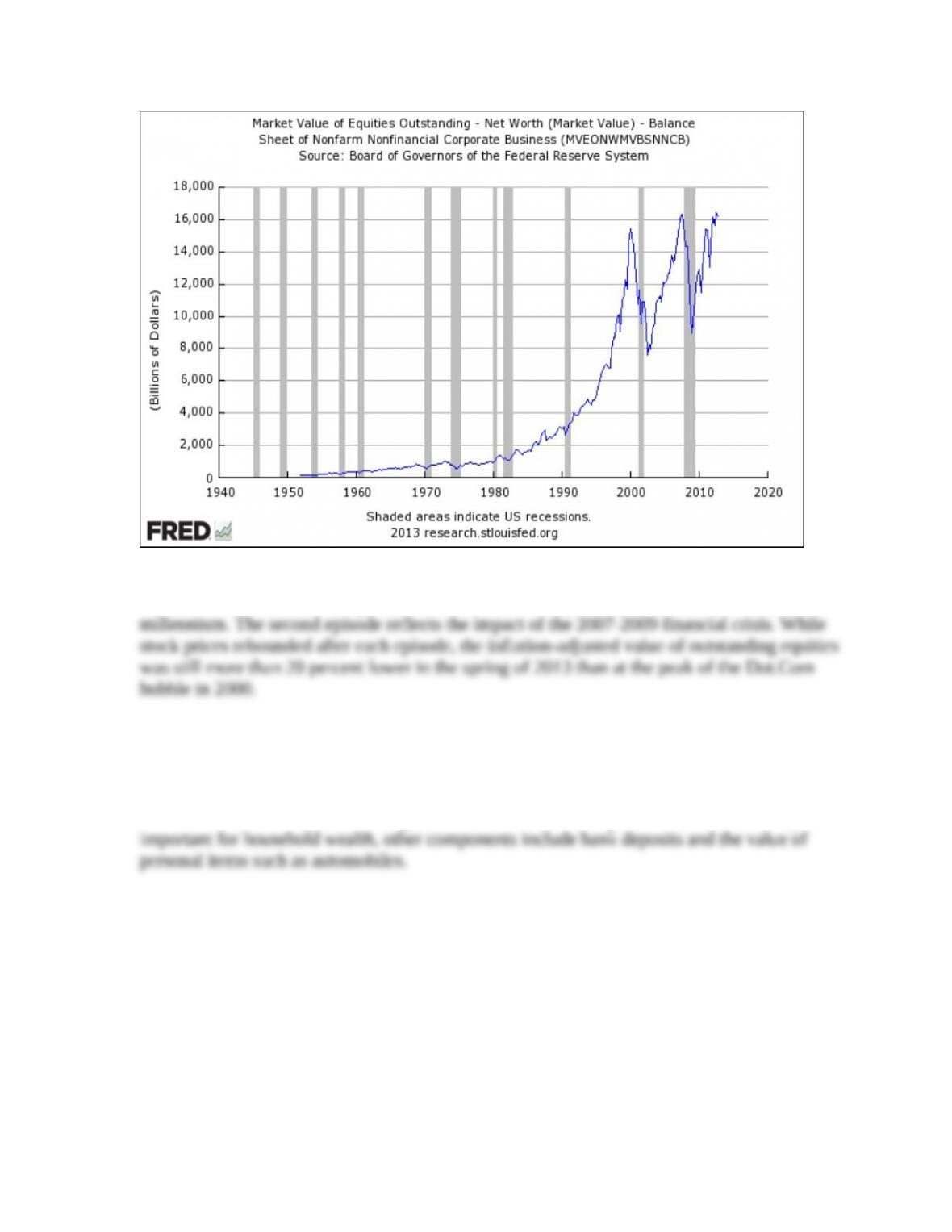
4. The Dow Jones Industrial Average is an index of the prices of only 30 stocks. Consider a
much broader measure of the stock market — the market value of equities (FRED code:
MVEONWMVBSNNCB) – which sums the price of each stock times the number of
outstanding shares. After plotting it, comment on its pattern since the mid-1990s. (LO2)
(Hint: Follow the steps in Data Exploration question 1 using the new FRED code.
Answer: The indicated data plot is:
3-9
Copyright © 2015 McGraw-Hill Education. All rights reserved. No reproduction or distribution without the prior written consent of McGraw-Hill
Education.
Chapter 03 – Financial Instruments, Financial Markets, and Financial Institutions
The most volatile periods have occurred since the late 1990s. The first episode reflects the
“Dot.Com” bubble that emerged in the 1990s and burst spectacularly at the start of the new
5. In Data Exploration Problem 3, you looked at changes in household net worth. In Data
Exploration Problem 4 you examined stock market wealth. Aside from stock market wealth,
what other assets contribute to household net worth? (LO1)
Answer: While the value of housing and financial assets like equities and bonds are very
* indicates more difficult problems
3-10
Copyright © 2015 McGraw-Hill Education. All rights reserved. No reproduction or distribution without the prior written consent of McGraw-Hill
Education.