
The size of the bond dealer’s spread is mainly a function of the:
A. purchase price of the bond.
B. current yield.
C. liquidity of the bond market.
D. face value of the bond.
Answer:
Considering the euro/U.S. dollar exchange rate, as a U.S. dollar decreases in value
versus the euro (holding other factors constant):
A. this is represented by a downward movement along the supply of dollars curve.
B. this would be represented by an upward sloping demand for dollars curve.
C. this would be represented by a leftward shift of the supply of dollars curve.
D. this is represented by an upward movement along the demand for dollars curve.
Answer:

Well-run financial markets:
A. keep transactions costs high to benefit brokers
B. prevent the widespread pooling of information
C. ensure that resources are allocated efficiently
D. are usually the result of little or no government regulation
Answer:
Mutual funds are characterized by the fact that they all:
A. have the same management fee set by regulation.
B. require the same minimum investment of $10,000.
C. provide some degree of diversification.
D. provide the same degree of liquidity.
Answer:
When the Fed makes a discount loan, the impact on the Banking System’s balance sheet

is:
A. an increase in liabilities with no change in assets.
B. an increase in assets and a decrease in liabilities.
C. a decrease in assets and an increase in liabilities.
D. the same as that of an open market purchase.
Answer:
One of the results of the Riegle-Neal Interstate Banking and Branching Efficiency Act
of 1994 was:
A. a reversal of the branching restrictions of the McFadden Act.
B. an increase in the number of banks in the U.S.
C. a decrease in the average size of banks.
D. a decrease in commercial banks but an increase in the number of savings and loans
and savings banks.
Answer:

Stock market bubbles impact consumers by:
A. encouraging greater consumption and greater saving.
B. encouraging greater consumption and less saving.
C. encouraging more work and delaying retirement.
D. resulting in less investment in home ownership and more into stocks.
Answer:
Farou invests $2,000 at 8% interest. About how long will it take for Farou to double his
investment (e.g., to have $4,000)?
A. 4 years
B. 5 years
C. 8 years
D. 9 years
Answer:

According to the theory of efficient markets, mutual fund managers may be expected to
earn above-average returns if they:
A. take on less risk.
B. have access to illegal, private information.
C. participate in efficient markets.
D. have learned from investing in the same stocks repeatedly.
Answer:
If the quantity of bonds demanded exceeds the quantity of bonds supplied, bond prices:
A. would rise and yields would fall.
B. would fall and yields would increase.
C. will rise and yields will remain constant.
D. will rise and yields would increase.
Answer:

Doubling the future value will cause the:
A. present value to double.
B. present value to decrease.
C. present value to increase by less than 100%.
D. interest rate, i, to decrease.
Answer:
A monetary policy reaction curve requires the central bank to have a(n):
A. money growth target.
B. inflation target.
C. unemployment target.
D. economic growth target.
Answer:
The self-correcting mechanism to return the economy to potential output from output

gaps is the change in:
A. potential output.
B. aggregate demand.
C. short-run aggregate supply.
D. the real interest rate by the central bank.
Answer:
An investor deposits $400 into a bank account that earns an annual interest rate of 8%.
Based on this information, how much interest will he earn during the second year
alone?
A. $25.60
B. $32
C. $34.56
D. $64
Answer:

One of the unique problems that banks face is:
A. they hold liquid assets to meet illiquid liabilities.
B. they hold illiquid assets to meet liquid liabilities.
C. they hold liquid assets to meet liquid liabilities.
D. both their assets and their liabilities are illiquid.
Answer:
One reason the government requires public corporations to disclose so much
information is to:
A. minimize the monopoly profits some corporations earn.
B. give small corporations a better chance of competing against large corporations.
C. address the potential harm from asymmetric information.
D. discourage risk-taking by investors.
Answer:

Equity markets are markets:
A. of U.S. Treasury bonds.
B. for AAA rated bonds.
C. for stocks.
D. for either stocks or bonds.
Answer:
With respect to consumer behavior, the interest-rate channel of monetary policy
transmission appears to be:
A. weak because people’s decisions to purchase cars or houses depend more on
short-term rates rather than long-term rates.
B. weak because people’s decisions to purchase cars or houses depend more on
long-term rates rather than short-term rates.
C. strong because people’s decisions to purchase cars or houses depend on the
short-term rates that policymakers can change.
D. strong because it affects both spending and saving decisions.
Answer:

Stock market bubbles typically lead to all of the following except:
A. an efficient allocation of resources.
B. stock market crashes.
C. patterns of volatile returns from the stock market.
D. gaps between actual stock prices and those warranted by the fundamentals.
Answer:
Which of the following is not typically used for qualifying mortgages as prime or
subprime?
A. The borrower’s income
B. The borrower’s credit score
C. The borrower’s ethnicity
D. The loan to value ratio
Answer:

Considering the balance sheet for all commercial banks in the U.S., the net worth of
banks is:
A. about 12% of total liabilities.
B. about 5 times total assets.
C. about the same as total assets.
D. about 4 times total liabilities.
Answer:
If the economy’s current level of output rises above its potential level of output, the
short-run aggregate supply curve will:
A. shift right.
B. shift left.
C. become horizontal.
D. become vertical.
Answer:

If a bank has deposits of $250 million, reserves that total $30 million and has a required
reserve rate of 10 percent:
A. the bank is short of required reserves.
B. the bank has excess reserves of $27.5 million.
C. the bank has excess reserves of $5 million.
D. the bank has excess reserves of $3 million.
Answer:
The law of one price fails as a result of:
A. low tariffs.
B. insignificant transportation costs.
C. similar technical specifications.
D. goods that cannot be traded.
Answer:

Banking regulations prevent banks from:
A. holding more than 10 percent of their assets in common stock of companies.
B. owning corporate jets.
C. owning common stocks of corporations.
D. building big office buildings.
Answer:
The function of providing liquidity by financial intermediaries:
A. includes depositors withdrawing funds but not borrowers.
B. only considers people who borrow on a short-term basis, but not depositors.
C. affects people who need to borrow and depositors who withdraw their funds.
D. only affects customers with savings accounts.
Answer:
Vault cash is not included in the central bank’s liability category of currency because:

A. only non-bank currency is in the liability category of currency.
B. vault cash really is only electronic funds.
C. vault cash is in the asset category of reserves.
D. it is the liability of the U.S. Treasury.
Answer:
One lesson that Akerlof’s Lemons model provides is:
A. that for high quality providers to survive they must provide a way that customers
can distinguish high quality from low quality.
B. low quality will not survive in a market.
C. people always prefer high quality to low quality goods.
D. moral hazard is unavoidable.
Answer:
The Federal Reserve’s Open Market Committee currently meets:

A. monthly.
B. bi-weekly.
C. eight times a year.
D. once every quarter, unless a crisis warrants more frequent meetings.
Answer:
Stabilization policy refers to the use of:
A. only fiscal policy.
B. only monetary policy.
C. either fiscal or monetary policy.
D. policy to shift the long-run aggregate supply curve.
Answer:
Central bank accountability means:

A. politicians will establish goals and central bankers will report on their progress.
B. central bankers are not accountable to any elected officials.
C. central bankers are only accountable to the banks in their respective countries.
D. central bankers must hold press conferences to explain their monetary policy views.
Answer:
The bank failures that occurred during the early years of the Great Depression:
A. hurt large depositors the most since it was the large money center banks that failed.
B. hurt small depositors the most since it was mainly small banks that failed.
C. hurt the government insurance funds since FDIC covered most of the losses of
depositors.
D. totaled about 30% of total bank customer deposits.
Answer:
Between 1998 and the end of 2000, the U.S. ran a large trade deficit; this should have
caused the dollar to depreciate against foreign currencies but instead the dollar

appreciated. The main reason for this is:
A. foreign exchange markets are slow to react.
B. the supply of dollars actually fell.
C. the dramatic increase in U.S. stock prices attracted a lot of foreign capital increasing
the demand for dollars by more than the increase in the supply of dollars.
D. the demand for dollars shifted left by more than the supply of dollars shifted right.
Answer:
Evidence points out that since the mid-1950’s just about every recession was preceded
by:
A. low interest rates.
B. rising interest rates.
C. falling interest rates.
D. negative real interest rates.
Answer:
Answer:
Describe the automatic stabilizers that are lost to a country that fixes its exchange rate
to another currency.
Answer:
The investment you made in a mutual fund one year ago lost 50% of its value over the
past year. What percentage increase is needed in the fund to restore your portfolio to the
level it was one year ago?
Answer:
Compare the monetary policy of the 50 states that make up the United States to the
exchange rate regime of dollarization.
Answer:
What is the relationship between financial market development and economic growth?
Answer:
From the perspective of the theory of efficient markets, explain why it may be difficult
for professional portfolio managers who have an exceptional year to continuously
outperform the market average.
Answer:
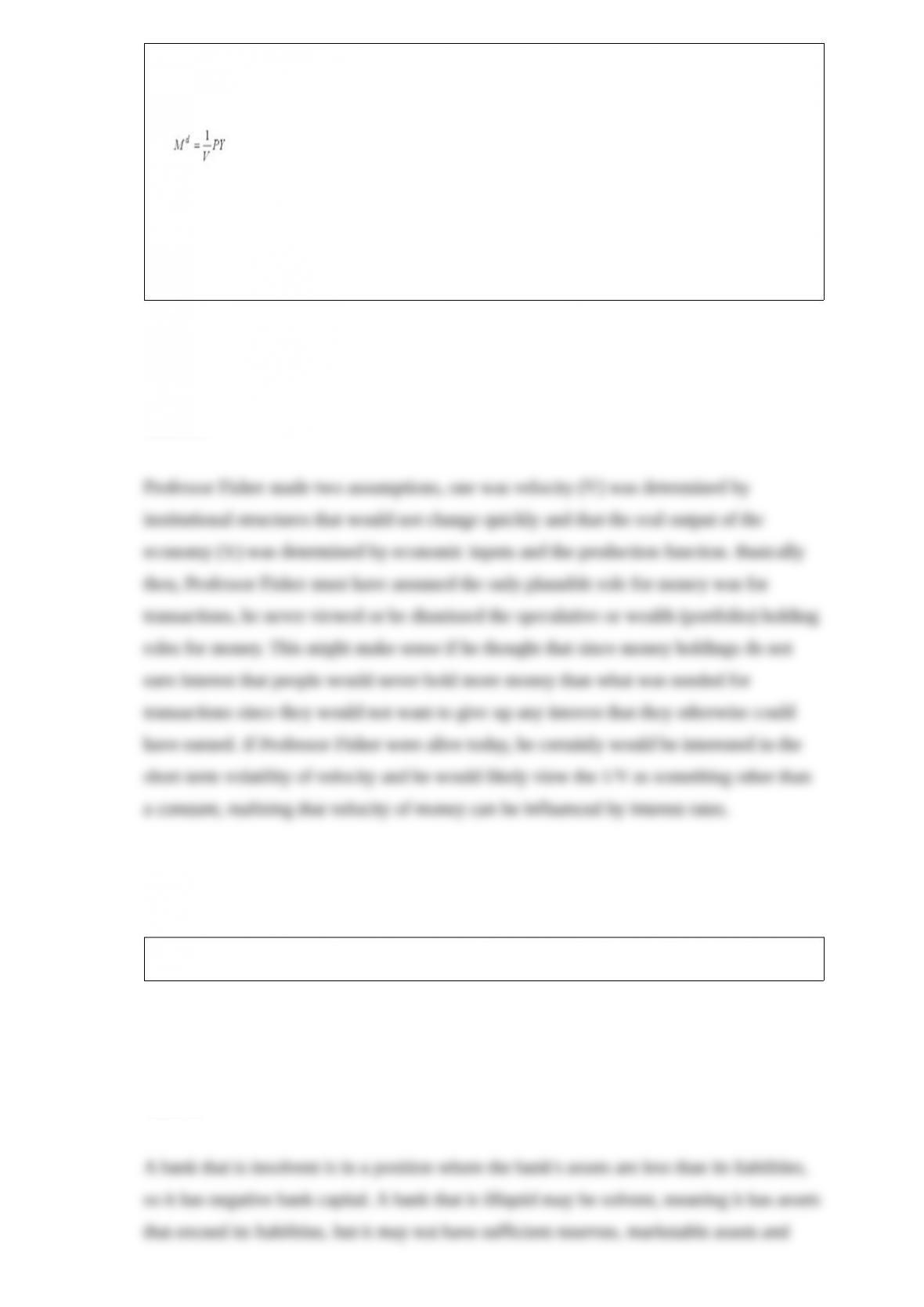
The equation for money demand expressed in the chapter that is derived from the
equation of exchange is:
We see that the equation does not explicitly address the interest rate. In fact, Professor
Fisher assumed that velocity is constant which means 1/V is also a constant. Why do
you think Professor Fisher left the interest rate out of the equation? Do you think he
would if he were alive today? Explain.
Answer:
What is the difference between a bank that is insolvent and one that is illiquid?
Answer:
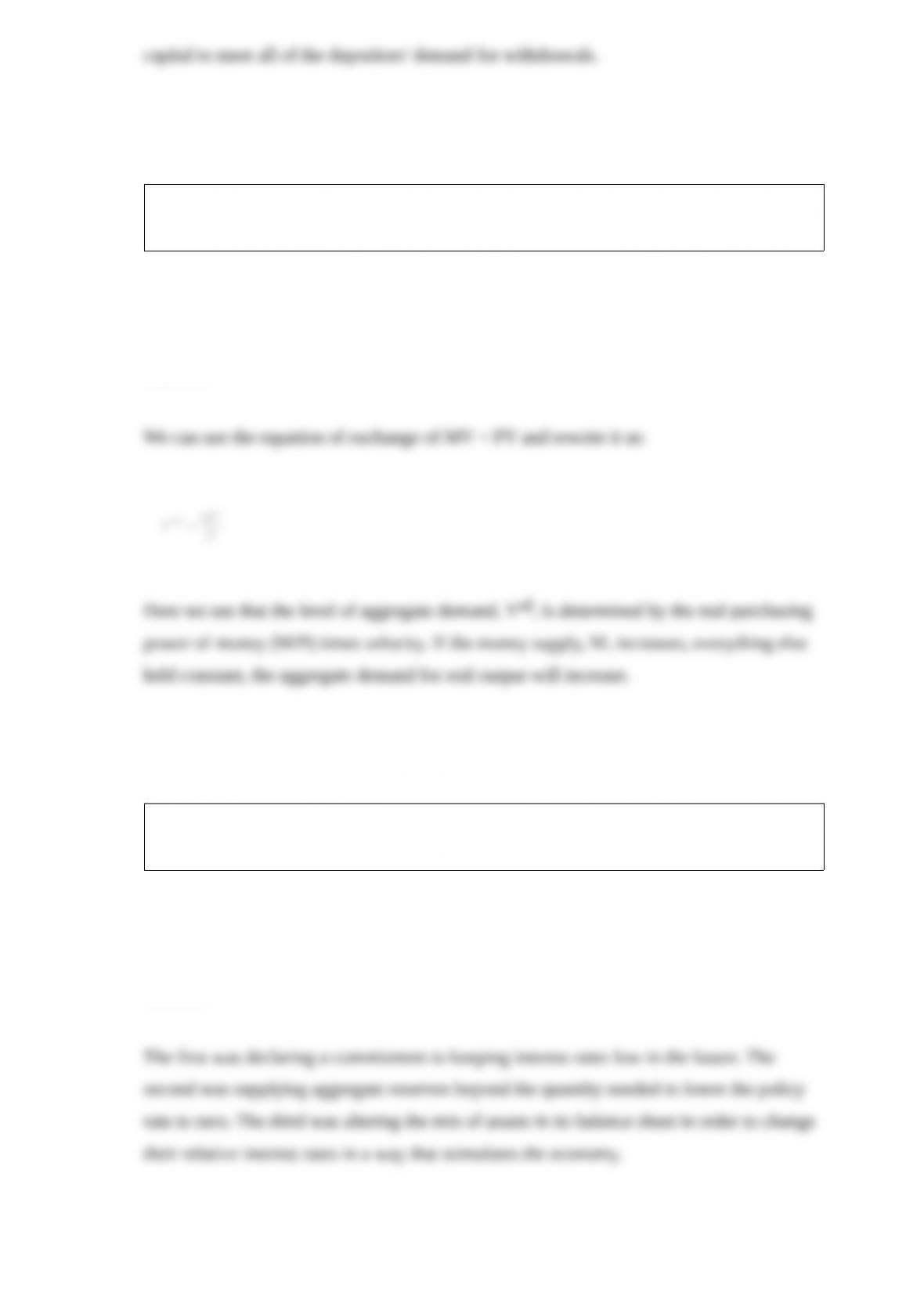
Use the equation of exchange to show how the level of money in the economy impacts
the level of aggregate demand.
Answer:
What were the 3 unconventional policy approaches used by the Fed during the financial
crisis of 2007-2009?
Answer:
Is it a necessary condition that velocity is constant and that real output growth is
assumed to be zero to have Milton Friedman’s assertion that inflation is a monetary
phenomenon be true?
Answer:
Explain the difference between a secured and an unsecured loan, and the interest rate
you would expect to see charged on each (all other factors equal).
Answer:
What is included in M2 that is not included in M1?
Answer:
Why is it necessary to understand fluctuations in investment if we want to understand
the fluctuations in the business cycle?
Answer:
Neutralizing demand shocks is easier in theory than in practice. Why?
Answer:
Standard & Poor’s sells information to investors; this is their primary business. Is this an
example of a financial intermediary? Explain.
Answer:
What is the monthly interest rate if you are asked to convert a 12 percent annual rate to
a monthly rate (calculate to 4 decimal places)?
Answer:
If there are 1,000 people, each of whom owns a $100,000 house, and they each stand a
1/1,000 chance each year of suffering a fire that will totally destroy their house, what is
the minimum that they would have to pay annually for fire insurance?
Answer:
Who makes up the voting members of the Federal Reserve’s Open Market Committee?
Answer: