Chapter 15 – Central Banks in the World Today
Chapter 15
Central Banks in the World Today
Conceptual Problems
1. In 1900, there were 18 central banks in the world; today, there are more than 175. Why does
nearly every country in the world now have a central bank? (LO1)
Answer: A central bank plays a vital role in any nation’s economy. By controlling the rate at
2. The power of a central bank is based on its monopoly over the issuance of currency.
Economics teaches us that monopolies are bad and competition is good. Would competition
among several central banks be better? Provide arguments both for and against. (LO1)
Answer: Competition could force central banks to become more efficient and would increase
3. Explain the costs of each of the following conditions, and explain who bears them. (LO1)
a. Interest-rate instability
b. Exchange-rate instability
c. Inflation
d. Unstable growth
Answer:
a. Interest-rate instability makes output unstable. It also increases risk and therefore the risk
b. Exchange-rate instability makes the revenue from exports and the costs of imports
c. Inflation creates uncertainty, which reduces investment and hurts growth. When inflation
d. When growth is unstable, people are less sure about their future incomes and are less
15-1
Copyright © 2015 McGraw-Hill Education. All rights reserved. No reproduction or distribution without the prior written consent of McGraw-Hill
Education.
Chapter 15 – Central Banks in the World Today
4. Provide arguments for and against the proposition that a central bank should be allowed to
set its own objectives. (LO1)
Answer: One could argue that a central bank should be able to set its own objectives so as to
5. When countries in a common currency area show persistently rising ratios of public debt to
GDP, how does it affect the credibility of an inflation-targeting central bank? (LO3)
Answer: The central bank will face pressure to purchase additional bonds to avoid rising
6. A country in the European Monetary Union that runs very large public deficits or shows a
persistently high and rising debt-to-GDP ratio violates a fiscal compact among the member
countries of the union. Explain how this fiscal violation poses a challenge for the ECB in the
form of moral hazard. (LO3)
Answer: If the ECB buys the bonds of the violator, it risks signaling to other countries that
7. How do long terms of office for central bankers help overcome the problem of time
inconsistency in monetary policy? (LO3)
Answer: Long appointments allow central bankers to resist reneging on desirable long-run
8. What problems does a central bank face in a country with inefficient methods of tax
collection? (LO3)
Answer: If the government cannot efficiently collect tax revenues, it may pressure the central
9. The Maastricht Treaty, which established the European Central Bank, states that the
governments of the countries in the European Monetary Union must not seek to influence the
members of the central bank’s decision-making bodies. Why is freedom from political
influence crucial to the ECB’s ability to maintain price stability? (LO2)
15-2
Copyright © 2015 McGraw-Hill Education. All rights reserved. No reproduction or distribution without the prior written consent of McGraw-Hill
Education.
Chapter 15 – Central Banks in the World Today
Answer: Because politicians are elected for short terms, they have an incentive to create
10. Transparency is a key element of the monetary policy framework. (LO2)
a. Explain how transparency helps eliminate the problems that are created by central bank
independence.
b. In what way did the financial crisis of 2007-2009 emphasize the importance of central
bank transparency?
c. Since 1993, the Bank of England has published a quarterly Inflation Report. Find a copy
of the report on the bank’s Web site, www.bankofengland.co.uk. Describe its contents,
and explain why the bank might publish such a document.
Answer:
a. Central bank independence takes significant power away from elected politicians and
b. In volatile, uncertain times, central bank transparency helps reduce uncertainties that
arise from the central bank’s own policies and actions. During the 2007-2009 financial
c. The U.K. Inflation Report describes current economic conditions and makes projections
for the future. It also explains the reasoning behind the Bank of England’s interest rate
11. *While central bank transparency is widely accepted as a desirable, too much openness may
have disadvantages. Discuss what some of these drawbacks might be. (LO2)
Answer: Disclosing too much information may, in fact, obscure the key message the central
bank is trying to get across. Disclosing details of the debate that took place to make a policy
12. Which do you think would be more harmful to the economy – an inflation rate that averages
5 percent a year that has a high standard deviation or an inflation rate of 7 percent that has a
standard deviation close to zero? (LO1)
15-3
Copyright © 2015 McGraw-Hill Education. All rights reserved. No reproduction or distribution without the prior written consent of McGraw-Hill
Education.
Chapter 15 – Central Banks in the World Today
Answer: Inflation of 5 percent with a high standard deviation is likely to be more harmful to
13. Suppose the central bank in your country has price stability as its primary goal. Faced with a
choice of having monetary policy decisions made by a well-qualified individual with an
extremely strong dislike of inflation or a committee of equally well-qualified people with a
wide-range of views, which choice would you recommend? (LO2)
Answer: In general, decision-making by committee is considered a better choice as it allows
for the pooling of knowledge and experience and reduces the risk that policy will be dictated
14. Suppose the president of a newly independent country asks you for advice in designing the
country’s new central bank. For each of the following design features, choose which one you
would recommend and briefly explain your choice: (LO2)
a. Central bank policy decisions that are irreversible or central bank policy decisions that
can be overturned by the democratically elected government.
b. The central bank has to submit a proposal for funding to the government each year or the
central bank finances itself from the earnings on its assets and turns the balance over to
the government.
c. The central bank policymakers are appointed for periods of four years to coincide with
the electoral cycle for the government or the central bank policymakers are appointed for
14-year terms.
Answer:
a. You should choose irreversible central bank decisions as the priorities of the central bank
b. You should choose for the central bank to be free to control its own budget. Otherwise,
c. You should choose to elect central bank policymakers for long terms in office to enable
15. “A central bank should remain vague about the relative importance it places on its various
objectives. That way, it has the freedom to choose which objective to follow at any point in
time.” Assess this statement in light of what you know about good central bank design.
(LO2)
Answer: This statement is inaccurate. In order for the central bank to be credible, it needs to
15-4
Copyright © 2015 McGraw-Hill Education. All rights reserved. No reproduction or distribution without the prior written consent of McGraw-Hill
Education.
Chapter 15 – Central Banks in the World Today
16. *The long list of central bank goals includes the stability of interest rates and exchange rates.
You look on the central bank Web site and note that they have increased interest rates at
every one of their meetings over the last year. You read the financial press and see references
to how the exchange rate has moved in response to these interest-rate changes. How could
you reconcile this behavior with the central bank pursuing its objectives? (LO1)
Answer: This behavior is perfectly consistent with a monetary policy framework that
17. Provide arguments for why you think the financial crisis of 2007-2009 did or did not
compromise the independence of the Federal Reserve. (LO2)
Answer: To argue that the Fed’s independence was compromised, you could point out that,
during the crisis, the Fed cooperated closely with the Treasury to restore financial stability
To argue that the Fed’s independence has not been compromised (in the absence of any
legislative changes so far), you could point out that its actions in cooperating with Treasury
18. Suppose in an election year, the economy started to slow down. At the same time, clear signs
of inflationary pressures were apparent. How might the central bank with a primary goal of
price stability react? How might members of the incumbent political party who are up for
reelection react? (LO1)
Answer: In this case, the appropriate monetary policy is to tighten monetary policy,
increasing interest rates to curb the emerging inflationary pressures in pursuit of the long-run
15-5
Copyright © 2015 McGraw-Hill Education. All rights reserved. No reproduction or distribution without the prior written consent of McGraw-Hill
Education.
Chapter 15 – Central Banks in the World Today
19. Assuming that they could, which of the following governments do you think would be more
likely to pursue policies that would seriously hinder the central bank’s pursuit of low and
stable inflation? Explain your choice. (LO3)
a. A government that is considered highly creditworthy both at home and abroad in a
politically stable country with a well-developed tax system, or
b. A government of a politically unstable country which is heavily indebted and considered
an undesirable borrower in international markets.
Answer: The government described in b) would more likely be tempted to force the central
bank to buy its bonds to finance increased spending. In a politically unstable country,
20. *Suppose the government is heavily in debt. Why might it be tempting for the fiscal
policymakers to sell additional bonds to the central bank in a move that it knows would be
inflationary? (LO3)
Answer: In this case, the inflation would benefit the fiscal policymakers, as it would erode
Data Exploration
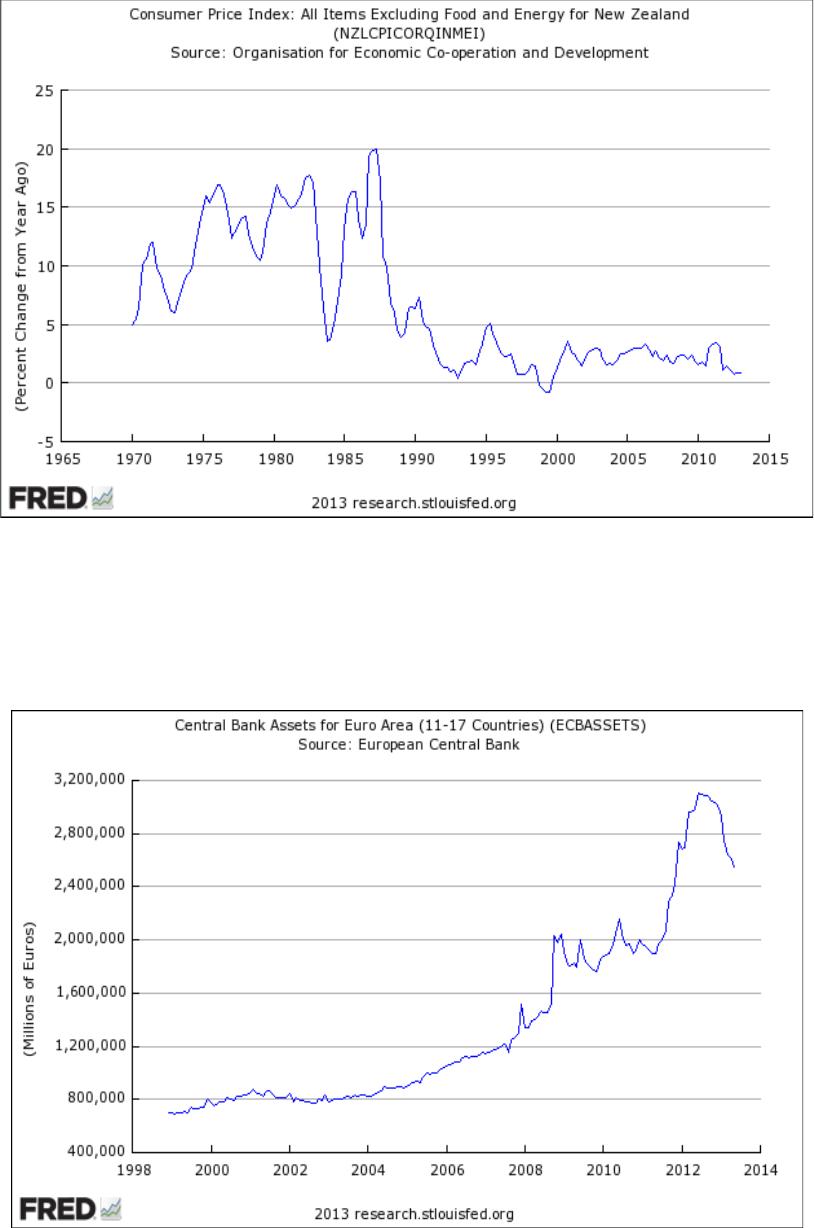
1. According to Figure 15.1, New Zealand in the 1970s and 1980s combined high inflation with
relatively little central bank independence. In 1989, New Zealand became the first country to
adopt an inflation target. How did this policy regime shift affect inflation? Plot the inflation
rate based on the percent change from a year ago of New Zealand’s “core” consumer price
index (FRED code: CPGRLE01NZQ659N) beginning in 1970. Was inflation after 1990
lower and more stable than before? Download the data and compute the average and the
standard deviation of inflation for: (a) the period through 1989; and (b) the period from 1990
to the present. (LO1)
Answer: The data plot below confirms that inflation was higher and more variable prior to
15-6
Copyright © 2015 McGraw-Hill Education. All rights reserved. No reproduction or distribution without the prior written consent of McGraw-Hill
Education.
Chapter 15 – Central Banks in the World Today
2. Financial stability is a goal of most central banks. Based on a graph showing the evolution of
the European Central Bank’s assets (FRED code: ECBASSETS), how important was this
goal for the ECB (a) before 2007, (b) during the crisis period of 2007-2009, and (c) when the
euro-area crisis intensified in 2011-2012? (LO1)
15-7
Copyright © 2015 McGraw-Hill Education. All rights reserved. No reproduction or distribution without the prior written consent of McGraw-Hill
Education.
Chapter 15 – Central Banks in the World Today
Answer: (a) Prior to 2007, ECB assets rose steadily, reflecting tranquil economic conditions.
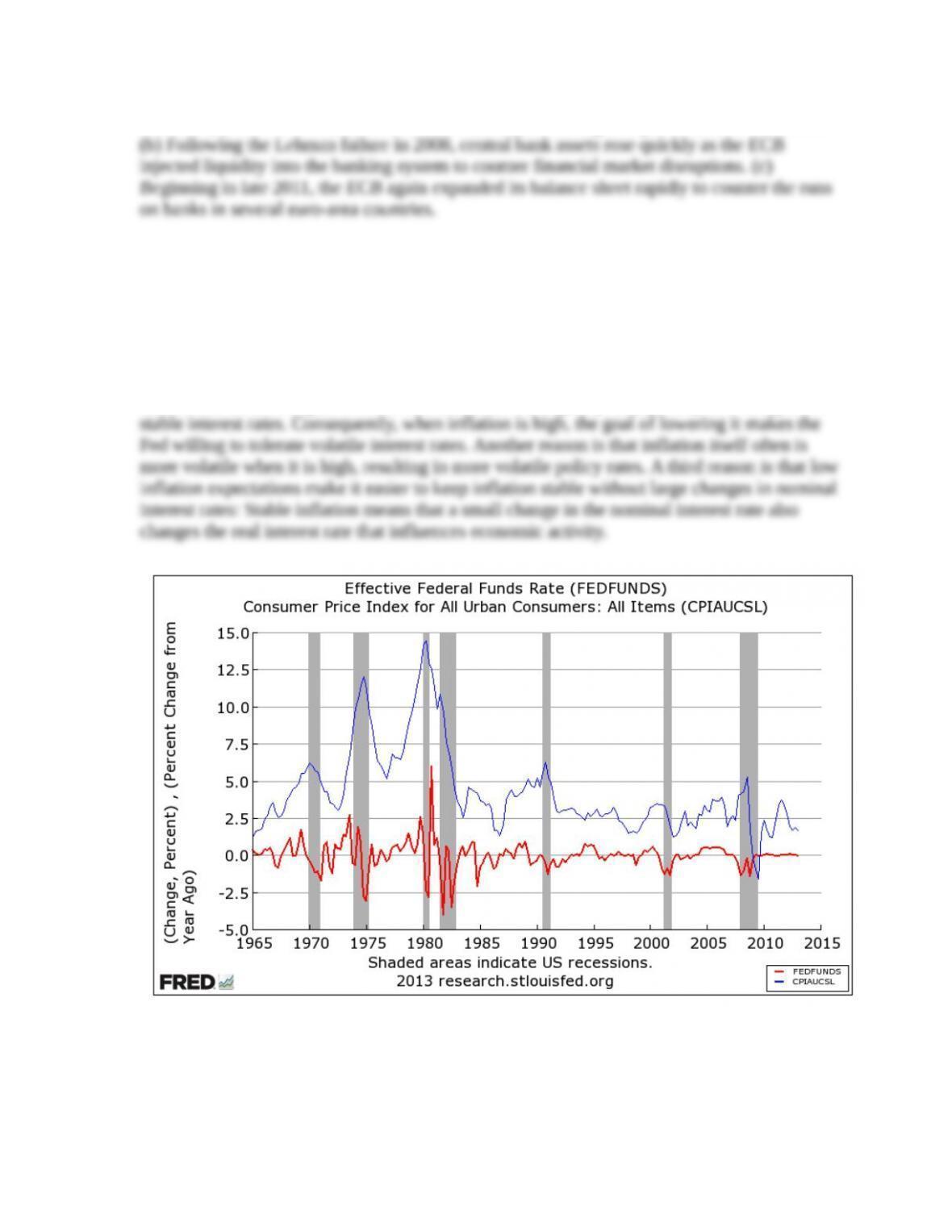
3. Interest rate stability is a common goal of central banks. When has the Federal Reserve been
relatively successful at keeping interest rates stable? Compare quarterly changes since 1965
of the federal funds rate (FRED code: FEDFUNDS) with the level of inflation based on the
percentage change from year-ago levels of the consumer price index (FRED code:
CPIAUCSL). Are stable interest rates associated with high or low inflation? Why? (LO1)
Answer: Higher inflation prior to 1985 was associated with volatile interest rates. Why? The
first reason is that the goal of low, stable inflation is a higher policy priority than the goal of
15-8
Copyright © 2015 McGraw-Hill Education. All rights reserved. No reproduction or distribution without the prior written consent of McGraw-Hill
Education.
Chapter 15 – Central Banks in the World Today
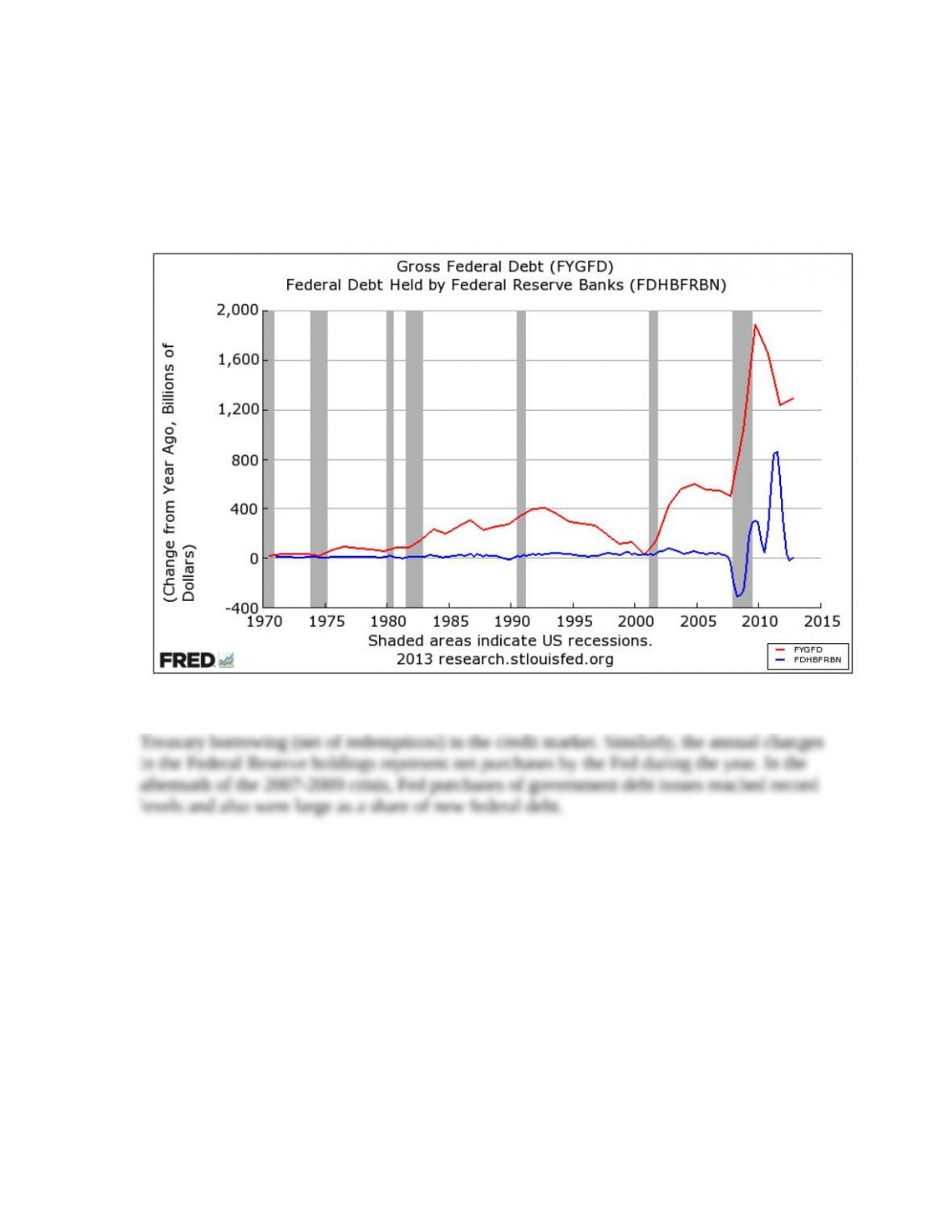
4. To what extent has the Federal Reserve “monetized” government debt? Plot since 1970 the
change from a year ago (measured in billions of dollars) in gross federal debt (FRED code:
FYGFD) and the change from a year ago (measured in billions of dollars) in the federal debt
held by the Federal Reserve System (FRED code: FDHBFRBN). (LO3) (Hint: In the
“Units” box, specify “Change from Year Ago, Billions of Dollars” for both indicators)
Answer: By examining the annual change in the gross federal debt, we are evaluating new
* indicates more difficult problems
15-9
Copyright © 2015 McGraw-Hill Education. All rights reserved. No reproduction or distribution without the prior written consent of McGraw-Hill
Education.