
The most commonly quoted monetary aggregate is:
A. money-market mutual fund shares.
B. M1 since it is the most liquid.
C. public currency.
D. M2 since its movement is most closely related to interest rates and economic
growth.
Answer:
In today’s world, the goal of financial stability means:
A. no institution should fail.
B. competition should be eliminated.
C. preventing large-scale financial catastrophes.
D. creating one mega regulatory agency.
Answer:

Consider a $2 billion open market purchase of U.S. Treasury securities by the Federal
Reserve. The Fed’s balance sheet will show:
A. only an increase in the asset of securities of $2 billion.
B. only show an increase in the liability of reserves of $2 billion.
C. no change in the size of the balance sheet, just the composition of assets will change
from cash to securities.
D. an increase in the asset category of securities and the liability category of reserves
by $2 billion.
Answer:
As an economy produces more different types of goods:
A. it is more difficult to quote prices if the economy does not use money.
B. the number of relative prices decreases.
C. money becomes less useful as a unit of account.
D. money becomes less useful as a standard of value.
Answer:

A bank that cannot meet its loan commitments is experiencing the results of:
A. interest rate risk.
B. credit risk.
C. trading risk.
D. liquidity risk.
Answer:
The most prominent of asset-backed securities is:
A. shares of stock in corporations since stockholders own the assets.
B. securities backed by home mortgages.
C. U.S. Treasury bonds since they are backed by all public assets.
D. movie box-office receipts.
Answer:
Carlos pays his cable bill using his bank’s internet banking web site to withdraw funds

from his checking account. This transaction is a(n):
A. automated clearinghouse transaction (ACH).
B. digitized-check transaction.
C. e-money transaction.
D. fedwire transaction.
Answer:
A change in the interest rate:
A. has a smaller impact on the present value of a payment to be made far into the
future than on one to be made sooner.
B. will not make a difference in the present values of two equal payments to be made at
different times.
C. has a larger impact on the present value of a payment to be made far into the future
than on one to be made sooner.
D. has a larger impact on the present value of a bigger payment to be made far into the
future than on one of lesser value.
Answer:

Which of the following statements is most correct?
A. All banks are financial intermediaries, but not all financial intermediaries are banks.
B. Financial intermediaries must be public corporations.
C. All financial intermediaries are insurance companies.
D. Financial intermediaries are government agencies.
Answer:
Which of the following expresses 4.85%?
A. 0.0485
B. 4.850
C. 0.00485
D. 0.485
Answer:
Considering the euro-U.S. dollar market, as a euro purchases a larger number of U.S.

dollars, we should see:
A. the quantity of dollars demanded decrease.
B. the quantity of dollars supplied increase.
C. an increase in the purchase of U.S. assets by Europeans.
D. a decrease in American exports to Europe.
Answer:
Which of the following is not a pillar of the latest Basel Accord?
A. A revised set of minimum capital requirements
B. It includes liquidity requirements in addition to capital requirements
C. It supplements capital requirements based on risk-weighted assets with restrictions
on leverage
D. Uniform international laws for bank regulation
Answer:

The Expectations Hypothesis suggests the:
A. yield curve should usually be downward sloping.
B. yield curve should usually be upward sloping.
C. slope of the yield curve reflects the risk premium associated with longer-term bonds.
D. slope of the yield curve depends on the expectations for future short-term rates.
Answer:
The driving force in the balance-sheet channel of monetary policy mechanism is which
of the following?
A. Information
B. Timing
C. Asset diversity
D. Bank net worth
Answer:

Professional gamblers know that the odds are always in favor of the house (casinos).
The fact that they gamble says they are:
A. irrational.
B. risk-neutral.
C. risk-averse.
D. risk seekers.
Answer:
Suppose that the return on assets other than bonds falls. In the bond market this will
result in a(n):
A. movement down the bond demand curve.
B. shift to the left of the bond demand curve.
C. increase in the price of bonds.
D. shift to the left of the bond supply curve.
Answer:

If a bank has $150 million in assets and a net worth of $20 million, its asset-to-equity
ratio is:
A. 6.5 to 1.
B. 7.5 to 1.
C. 0.13 to 1.
D. 0.15 to 1.
Answer:
Some people who believe monetary policymakers should not address equity and
property price bubbles argue their position based on:
A. their belief that government should stay out of private matters.
B. the policymakers lack experience with financial markets.
C. price bubbles are virtually impossible to identify when they are developing.
D. all of the answers given are correct.
Answer:

A home mortgage is a good example of:
A. an unsecured loan.
B. a secured loan.
C. a high risk loan.
D. the problem of adverse selection.
Answer:
The number of banks in the U.S. today is approximately:
A. 6,100.
B. 500.
C. 100.
D. 15,300.
Answer:
Which of the following financial instruments is used mainly to transfer risk?

A. Asset-backed securities
B. Bonds
C. Options
D. Stocks
Answer:
Mary deposits funds into a CD at her bank. The CD has an annual interest of 4.0%. If
Mary leaves the funds in the CD for two years she will have $540.80. What amount is
Mary depositing?
A. $520.00
B. $514.50
C. $500.00
D. $512.40
Answer:

M1 is:
A. a more useful measure of the relationship between the money supply and inflation
because it includes the most liquid assets.
B. the money supply the Federal Reserve pays the most attention to in conducting
monetary policy.
C. less useful than M2 for understanding inflation.
D. the fastest growing of all of the money aggregates.
Answer:
The intrinsic value of a call option:
A. is the difference between the option price and the interest rate.
B. must be less than or equal to zero.
C. is the greater of zero or the difference between the price of the underlying asset and
the strike price.
D. will be negative if the time value of the option is negative.
Answer:
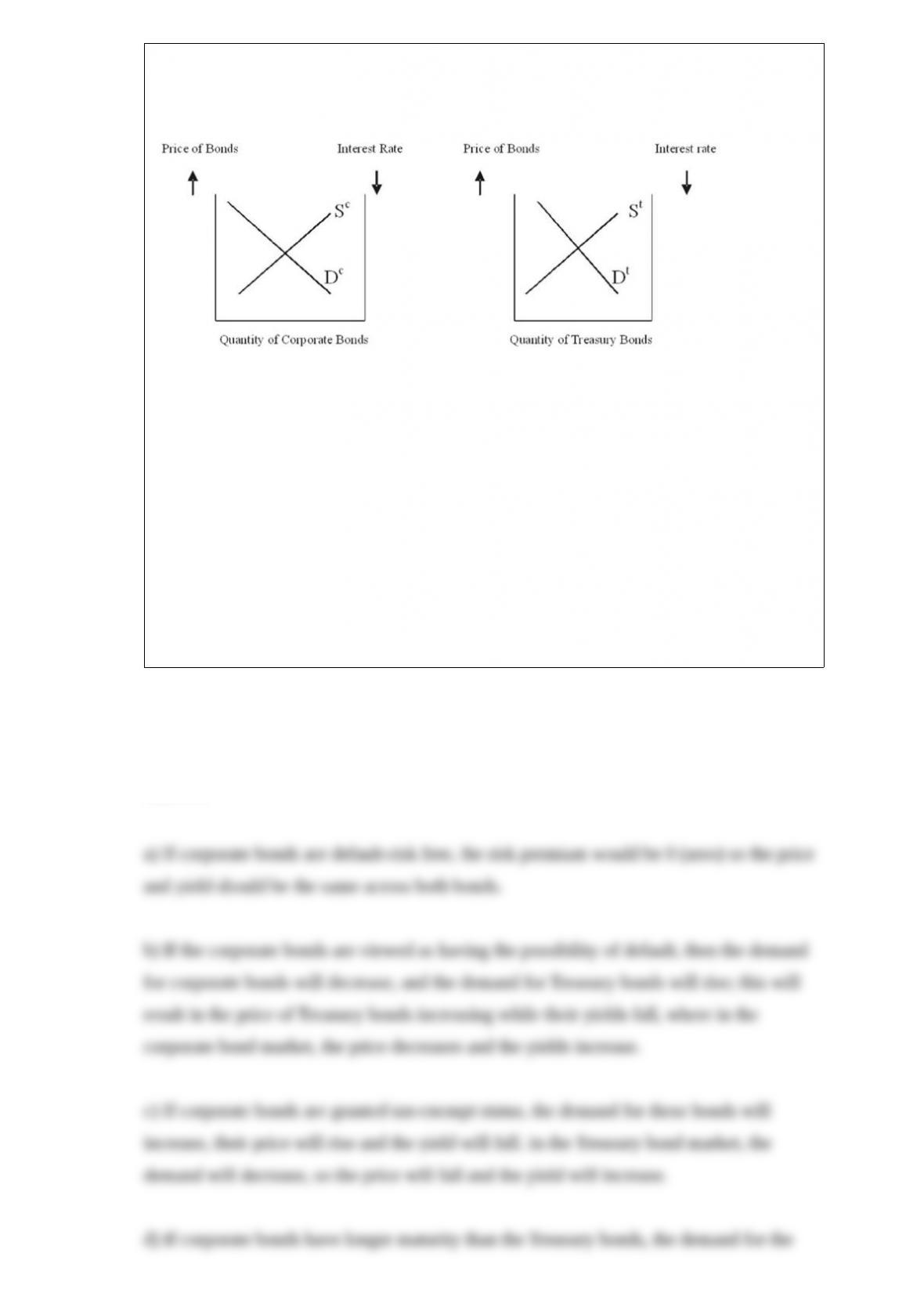
Please use the graphs to show what happens to the risk (yield) differential in each
situation and why?
Assume the corporate and Treasury bonds have the same maturity.
a) If the corporate bonds are default-risk free, what could you tell about the price and
yields of each?
b) If the corporate bonds are now viewed as having the possibility of default, what
happens in each market?
c) If the corporate bonds are granted tax-exempt status, what happens in each market?
d) If the corporate bonds have a longer maturity than the Treasury bonds what would
happen?
Answer:

One reason for having a monetary policy framework is:
A. it makes clear what specific goals the central bankers are pursuing.
B. it provides leeway for central bankers to change their goals without communicating
the change and disrupting financial markets.
C. it provides central bankers the secrecy needed to perform their jobs effectively.
D. it can make goal setting vague enough so that the central bankers can always claim
success.
Answer:
Which of the following is an example of the economies of scale argument for increased
profits for large financial holding companies?
A. Financial holding companies offer a wide array of services under one name.
B. Financial holding companies need only one CEO, one Board of Directors, and one
accounting system regardless of size.
C. Financial holding companies are well diversified so risk is reduced.
D. The profitability of financial holding companies does not rely on one particular line
of business.

Answer:
Companies whose stocks increase the most during a stock market bubble will:
A. have a difficult time raising investment capital.
B. tend to under-invest.
C. usually rebound faster once the bubble bursts.
D. find it difficult to put their capital to profitable use after the bubble bursts.
Answer:
The portfolio demand for money reflects:
A. the money we hold for our everyday transactions.
B. the portion of wealth people desire to hold in the form of money.
C. the money we hold to purchase stocks and bonds and other financial securities.
D. the money we hold for our everyday transactions and the money we hold to
purchase stocks and bonds and other financial securities.

Answer:
Financial intermediaries:
A. increase the cost of financial transactions but offset these higher costs by providing
safekeeping of customer funds.
B. provide handling of payments but usually less efficiently than other firms.
C. reduce the cost of financial transactions.
D. provide safety of resources, but only for the large borrowing customers who can
afford it.
Answer:
Agencies exist which rate bonds based on characteristics of the borrower Such bond
rating agencies are an example of a financial market response designed to:
A. increase information asymmetry.
B. decrease the real return to bondholders.
C. provide a lower cost solution to the high cost of information.
D. transfer risk from the buyer to the rating agency.

Answer:
Mary Jones is the president of a local bank. She knows that half of the loan applicants
in town she would classify as high risk and the other half as low risk. She observes that
the other banks in town charge two different interest rates, a lower rate for low risk
borrowers and the higher rate for high risk borrowers. She decides that to have an
advantage over the other banks she will offer an average rate to everyone. The likely
result will be:
A. Mary’s bank will be highly successful as this will provide the bank with a large
competitive advantage.
B. Mary’s bank is likely to see a dramatic increase in both types of borrowers.
C. Mary’s bank will experience adverse selection and have a disproportionate number
of low risk borrowers.
D. Mary’s bank will experience adverse selection and have a disproportionate number
of high risk borrowers.
Answer:
If the economy’s output response to changes in current inflation is small, the slope of
the dynamic aggregate demand curve will be:
A. flat.
B. steep.

C. positive.
D. zero.
Answer:
Please state whether you agree or disagree with the following statement, and why: “An
increase in the price level of a country, relative to another country’s price level, will
cause its currency to appreciate.”
Answer:
What are the securities that U.S. banks own and why are they often referred to as
secondary reserves?
Answer:

Which bond will have a higher yield to maturity, a $1,000 face value bond, with a 5.0%
coupon rate that sells for $900; or a $1000 face value bond, with a $50 annual coupon
that sells for $1,050? Explain your choice.
Answer:
With a put option, what specifically does the option holder receive for the price paid for
the option?
Answer:

Why would central bankers have to pay attention to forecasts regarding consumer
sentiment and expectations of business owners and managers?
Answer:
Chapter 10 presents the Big Mac Index. While it is a clever illustration, the Big Mac
Index is not really a good example to use to explain the theory of purchasing power
parity. Why not?
Answer:
Why isn’t the actual level of an index, for example the Dow Jones Industrial Average,
very useful on its own?
Answer:
Explain why changes in the central bank’s inflation target will shift the dynamic
aggregate demand curve.
Answer:
Answer:

Describe the immediate short-run effect to the economy from an increase in government
purchases, as well as the self-correcting mechanism that will restore long-run
equilibrium.
Answer:
Calculate the holding period return for a $1,000 face value bond with a $60 annual
coupon purchased for $970.00 and sold three years later for $1,060.00.
Answer:

Explain why many mayors of cities facing the need to borrow for infrastructure
improvements, may not look favorably on a large federal income tax rate reduction.
Answer:
State and briefly define the tools of monetary policy available to the Federal Reserve.
Answer:
In terms of desirable features of a monetary policy instrument, explain why the size of
the staff at the Fed is not a good policy instrument. Be sure to address which feature(s)
it fits and which one(s) it doesn’t.
Answer:

How has Islamic banking redefined lending to deal with Islam’s prohibition of usury?
Answer:
What are the cost and benefits to a country instituting capital controls?
Answer: