Chapter 12 – Depository Institutions: Banks and Bank Management
Chapter 12
Depository Institutions: Banks and Bank Management
Conceptual and Analytical Problems
1. Explain how a bank manager uses Core Principles 1, 2 and 3 (Time Has Value,
Risk Requires Compensation, and Information Is the Basis for Decisions) to select
assets and issue liabilities consistent with shareholder preferences. (LO1)
Answer: The manager evaluates the return and risk of each asset and liability, as
in core principles 1 and 2, prior to adding it to the balance sheet. These
evaluations usually require collection and processing of information, as in core
2. Consider a bank with the following balance sheet. You read in the local
newspaper that the bank’s return on assets (ROA) was 1 percent. What were the
bank’s after-tax profits? (LO2)
Bank Balance Sheet
(in thousands)
Assets Liabilities
Reserves $100 Deposits $1,000
Loans $500 Borrowing $0
Securities $500 Bank Capital $100
Answer: Since the return on assets is defined as
assetsBank
taxesafterprofitNet
ROA
,

Chapter 12 – Depository Institutions: Banks and Bank Management
3. Based on the information provided below about banks A and B, compute for each
bank its return on assets (ROA), return on equity (ROE) and leverage ratio. (LO2)
a. Bank A has net profit after taxes of $1.8 million and the balance sheet below:
Bank A
(in millions)
Assets Liabilities
Reserves $5 Deposits $100
Loans $70 Borrowing $10
Securities $45 Bank Capital $10
b. Bank B has net profit after taxes of $0.9 million and the balance sheet below:
Bank B
(in millions)
Assets Liabilities
Reserves $7.5 Deposits $75.0
Loans $55.0 Borrowing $3.0
Securities $23.5 Bank Capital $8.0
Answer: For both banks, we will compute ROA as
assetsBank
taxesafterprofitNet
ROA
and ROE as
capitalBank
taxesafterprofitNet
ROE
As a check, we note that
ROE
CapitalBank
taxesafterprofitNet
CapitalBank
AssetsBank
assetsBank
taxesafterprofitNet
ROA
where
CapitalBank
AssetsBank
is the leverage ratio, the value of assets divided by the
owner’s equity.
12-2
Copyright © 2015 McGraw-Hill Education. All rights reserved. No reproduction or distribution without the prior written consent of
McGraw-Hill Education.
Chapter 12 – Depository Institutions: Banks and Bank Management
4. Banks hold more liquid assets than do most businesses. Explain why. (LO1)
Answer: Banks are required to meet depositors’ demands for cash. In order to be
5. Explain why banks’ holdings of cash have increased significantly as a portion of
their balance sheets in recent times. (LO1)
Answer: Banks hold cash for liquidity purposes – to meet immediate withdrawal
requests from customers. Holding cash is costly for banks, however, due to the
6. Why are checking accounts not an important source of funds for commercial
banks in the United States? (LO2)
Answer: Checkable deposits make up only 10 percent of banks’ total liabilities.
As a result of financial innovations, consumers can keep their funds in accounts
7. The volume of commercial and industrial loans made by banks has declined over
the past few decades, while the volume of real estate loans has risen. Explain
why this trend occurred and how it contributed to banks’ difficulties during the
financial crisis of 2007-2009. (LO2)
12-3
Copyright © 2015 McGraw-Hill Education. All rights reserved. No reproduction or distribution without the prior written consent of
McGraw-Hill Education.
Chapter 12 – Depository Institutions: Banks and Bank Management
Answer: The rise of the commercial paper market enabled businesses to raise
funds directly, diminishing their need to borrow from banks. The creation of
8. *Why do you think that U.S. banks are prohibited from holding equity as part of
their own portfolios? (LO3)
Answer: If a bank owns equity in a company to which it extends a loan, the fact
that it is a part owner of the company can give rise to a conflict of interest. If the
9. Explain how a bank uses liability management to respond to a deposit outflow.
Why do banks prefer liability management to asset management? (LO1)
Answer: Banks can respond to a deposit outflow by borrowing from another bank
or from the Federal Reserve or by issuing large-denomination time deposits.
10. A bank with a two-year horizon has issued a one-year certificate of deposit for
$50 million at an interest rate of 2 percent. With the proceeds, the bank has
purchased a two-year Treasury note that pays 4 percent interest. What risk does
the bank face in entering into these transactions? What would happen if all
interest rates were to rise by 1 percent? (LO3)
Answer: The bank faces the risk that the short-term interest rate will rise before
the second year, increasing the amount of interest the bank has to pay on the CD,
but leaving the interest income that the bank receives from the Treasury note
12-4
Copyright © 2015 McGraw-Hill Education. All rights reserved. No reproduction or distribution without the prior written consent of
McGraw-Hill Education.
Chapter 12 – Depository Institutions: Banks and Bank Management
11. *In response to changes in banking legislation, the past two decades have seen a
significant increase in interstate branching by banks in the United States. How do
you think a development of this type would affect the level of risk in banking
business? (LO3)
Answer: The increase in interstate branching increases the ability of banks to
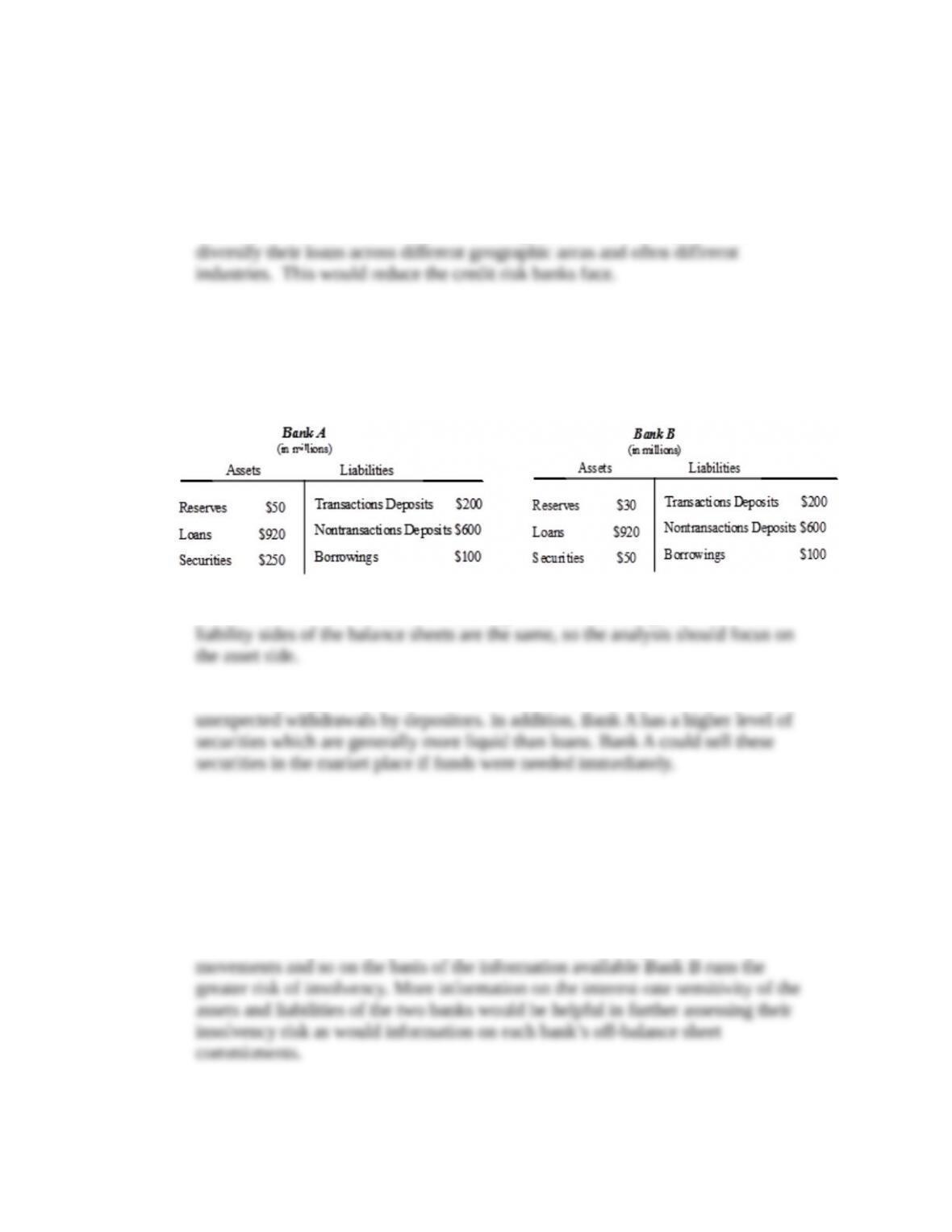
12. Consider the balance sheets of Bank A and Bank B. If reserve requirements were
10 percent of transaction deposits and both banks had equal access to the
interbank market and funds from the Federal Reserve, which bank do you think
faces the greatest liquidity risk? Explain your answer. (LO3)
Answer: On the basis of the information given, Bank B is at greater risk. The
Bank A has a higher level of excess reserves and is therefore better able to meet
13. Looking again at Bank A and Bank B in Problem 12, based on the information
available, which bank do you think is at the greatest risk of insolvency? What
other information might you use to assess the risk of insolvency of these banks?
(LO3)
Answer: Bank A has net worth (bank capital) of $320 million while Bank B has
net worth of $100 million. Bank A has more of a cushion against interest rate
12-5
Copyright © 2015 McGraw-Hill Education. All rights reserved. No reproduction or distribution without the prior written consent of
McGraw-Hill Education.
Chapter 12 – Depository Institutions: Banks and Bank Management
14. Bank Y and Bank Z both have assets of $1 billion. The return on assets for both
banks is the same. Bank Y has liabilities of $800 million while Bank Z’s
liabilities are $900 million. In which bank would you prefer to hold an equity
stake? Explain your choice. (LO2)
Answer: Your choice will depend on your preference for return versus risk.
15. *You are a bank manager and have been approached by a swap dealer about
participating in fixed for floating interest-rate swaps. If your bank has the typical
maturity structure, which side of the swap might you be interested in paying and
which side would you want to receive? (LO3)
Answer: A typical bank has liabilities that are shorter-term than its assets – or has
floating rate liabilities and fixed rate assets. Because the bank receives fixed
16. If lines of credit and other off-balance sheet activities do not, by definition, appear
on the bank’s balance sheet, how can they influence the level of liquidity risk to
which the bank is exposed? (LO3)
Answer: With lines of credit, customers pay a fee to the bank for the right to
borrow at their behest. It is the customer, not the bank that determines when the
17. Suppose a bank faces a gap of -20 between its interest-sensitive assets and its
interest-sensitive liabilities. What would happen to bank profits if interest rates
were to fall by 1 percentage point? You should report your answer in terms of the
change in profit per $100 in assets. (LO2)
12-6
Copyright © 2015 McGraw-Hill Education. All rights reserved. No reproduction or distribution without the prior written consent of
McGraw-Hill Education.

Chapter 12 – Depository Institutions: Banks and Bank Management
Answer: A gap of -20 means that the bank has more interest-sensitive liabilities
18. *Duration analysis is an alternative to gap analysis for measuring interest-rate
risk. (See footnote 9 on page 314.) The duration of an asset or liability measures
how sensitive its market value is to a change in the interest rate: the more
sensitive, the longer the duration. In Chapter 6, you saw that the longer the term
of a bond, the larger the price change for a given change in the interest rate.
Using this information and the knowledge that interest rates increases tend to hurt
banks, would you say that the average duration of a bank’s assets is longer or
shorter than that of its liabilities? (LO1)
Answer: When interest rates increase, the market value of assets such as bonds
fall. If interest rate increases hurt banks, then the average value of assets must fall
12-7
Copyright © 2015 McGraw-Hill Education. All rights reserved. No reproduction or distribution without the prior written consent of
McGraw-Hill Education.