
At any fixed interest rate, an increase in time, n, until a payment is made:
A. increases the present value.
B. has no impact on the present value since the interest rate is fixed.
C. reduces the present value.
D. affects only the future value.
Answer:
Most economic historians believe that:
A. if more countries would have been on the gold standard the Great Depression would
have been averted.
B. the gold standard didn’t play a major role in the Great Depression.
C. the gold flows played a central role in spreading the Great Depression.
D. countries that held on to the gold standard recovered from the Great Depression the
quickest.
Answer:

Financial instruments used primarily as stores of value include each of the following,
except:
A. bonds.
B. futures contracts.
C. stocks.
D. home mortgages.
Answer:
Unconventional monetary policy tools include all but:
A. quantitative easing.
B. forward guidance.
C. targeted asset purchases.
D. reserve requirement.
Answer:

Policymakers could neutralize all of the following except:
A. an increase in federal government spending on defense.
B. an increase in the price of oil.
C. a trade deficit.
D. a decrease in business confidence.
Answer:
Gross Domestic Product in the U.S. is roughly:
A. equal to M1.
B. twice as large as M2.
C. equal to M2.
D. more than five times M1.
Answer:
If the annual interest rate is 5%(.05), the price of a three-month Treasury bill would be:

A. $98.79
B. $95.00
C. $98.75
D. $97.59
Answer:
With the economy at its potential level of output, the federal government undertakes a
large military buildup; all other things equal, the impact on the long-run real interest
rate will be to:
A. increase.
B. decrease.
C. remain constant since output is at its potential level.
D. change at the same rate as inflation.
Answer:
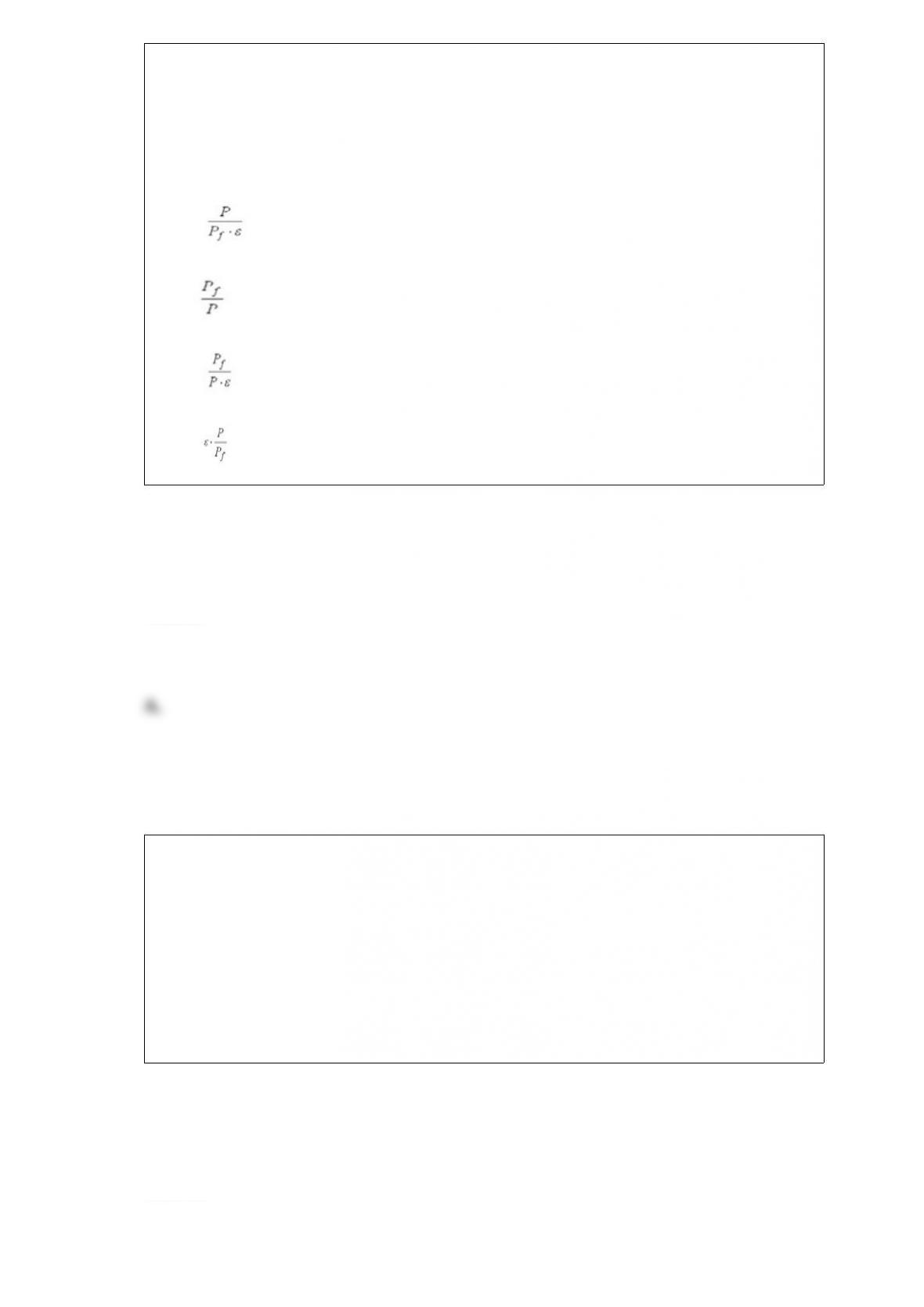
If we let P = the domestic price of a basket of goods and Pf the foreign price of the same
basket of goods, and = the nominal exchange rate of U.S. $/foreign currency the real
exchange rate is best expressed as:
A.
B.
C.
D.
Answer:
The largest regulatory change in U.S. financial markets since 1930 is known as:
A. Basel III.
B. the Fred-Bob Act.
C. the Gramm-Leach-Bliley Act.
D. the Dodd-Frank Act.
Answer:

During the 2007-2009 financial crisis which of the following became the largest
component of assets on the Fed’s balance sheet:
A. foreign exchange reserves.
B. loans.
C. U.S. Treasury securities.
D. mortgage backed securities.
Answer:
If inflation is very high, say 50 or 100 percent a year, monetary policymakers wishing
to lower it will shift their focus to controlling:
A. the long-term interest rate.
B. the short-term interest rate.
C. the exchange rate.
D. money growth.
Answer:

An insurance company is an example of a financial institution that:
A. transfers risk.
B. acts as a broker.
C. serves as a depository institution.
D. sells derivative securities.
Answer:
The Federal Reserve’s policy regarding announcing its policy decisions has:
A. always been to announce it immediately; that was part of the original Federal
Reserve Act of 1913.
B. only recently gone to immediate announcement; until 1994 these policy decisions
were secret.
C. been to release the decisions immediately since its early failure at preventing the
Great Depression.
D. changed so that now the Fed does not release its decisions publicly.
Answer:

When faced with negative supply shocks, policymakers:
A. will stabilize both inflation and output.
B. will always focus on stabilizing output.
C. cannot stabilize output so they tend to focus on inflation.
D. face a trade-off because they cannot simultaneously stabilize both output and
inflation.
Answer:
As general business conditions deteriorate, all other factors constant:
A. the bond supply curve will shift left.
B. there will be a movement down the existing bond supply curve.
C. the bond demand curve shifts left.
D. the price of bonds will decrease.
Answer:

Most economists do not advocate a return to the gold standard because:
A. it forces the central bank to fix the price of something we don’t really care about
while other prices can fluctuate a lot.
B. past willingness to exit the Gold Standard casts doubt on the credibility of
committing to it again.
C. inflation will depend on the rate that gold is mined.
D. all of the answers given are correct.
Answer:
Purchasing power parity implies:
A. a basket of goods should sell for the same price in all countries, even if trade
barriers exist.
B. a basket of goods will sell for the same price in all countries as long as there are no
trade barriers is a free flow of capital across borders.
C. a basket of goods cannot sell for the same price in different countries due to the
different wage rates.
D. as long as all goods and services are traded freely across international boundaries,
one unit of domestic currency should buy the same basket of goods anywhere in the
world.
Answer:

Governments supervise banks mainly to do each of the following, except:
A. reduce the potential cost to taxpayers of bank failures.
B. be sure the banks are following the regulations set out by banking laws.
C. reduce the moral hazard risk.
D. eliminate all risk faced by investors.
Answer:
What is the highest bond rating assigned by Standard and Poor’s?
A. AA
B. EEE
C. AAA
D. A
Answer:

China has used its current account surplus to:
A. buy stocks on the New York Stock Exchange.
B. buy German government and agency securities.
C. buy U.S. government and agency securities.
D. make loans to foreigners.
Answer:
Financial instruments and money share which of the following characteristics?
A. Both can function as a means of payment and a store of value.
B. Both can function as a store of value and allow for trading of risk.
C. Both can function by acting as a means of payment and allow for trading of risk.
D. Both can function as a store of value even though they do not allow for trading of
risk.
Answer:

Which of the following would give the most importance to the goal of exchange rate
stability?
A. Large, closed economies
B. The U.S. and Japan and other developed countries
C. Emerging market countries where exports and imports are central to the structure of
the economy
D. Europe
Answer:
Central banks often find:
A. they can efficiently pursue all of their goals simultaneously.
B. there are tradeoffs that make pursuing all of their goals simultaneously impossible.
C. the goal(s) they pursue will be determined by their profitability.
D. they must keep their goals secret or else they cannot be attained.
Answer:

Disinflation occurs when:
A. the inflation rate is negative.
B. the inflation rate is 2 percent or less.
C. the inflation rate goes above ten percent.
D. the rate of inflation declines.
Answer:
The lines drawn to establish Federal Reserve Districts were based on:
A. solely population distribution in 1914.
B. solely economic forces that existed in 1914.
C. economic and political forces that existed in 1914.
D. economic and political forces as well as population distribution in 1914.
Answer:

Assuming the free flow of capital across borders, which of the following statements is
most correct?
A. A central bank can have both a fixed exchange rate and an independent inflation
policy.
B. A central bank cannot have both a fixed exchange rate and an independent inflation
policy.
C. The central banks of most industrialized countries focus on fixed exchange rates.
D. While most central banks of industrialized countries favor fixing exchange rates,
their primary concern is on domestic inflation.
Answer:
For the Fed to use money growth as a direct monetary policy target, which of the
following needs to exist?
A. A highly variable deposit expansion multiplier
B. A stable link between the monetary base and the quantity of money
C. A predictable link between the quantity of money and the deposit expansion
multiplier
D. A stable link between the monetary base and the quantity of money and a
predictable relationship between the quantity of money and the rate of inflation
Answer:

A company that continues to have strong profit performance during an economic
downturn when many other companies are suffering losses or failing should see:
A. an increase in the yield of their bonds and the price of the bond increases.
B. their bond rating maintained or actually increase.
C. the demand for their bonds decrease and their yields decrease.
D. the demand and price for their bonds decrease.
Answer:
The benefits to a country from dollarization include each of the following, except:
A. a lower risk premium since inflationary finance is no longer a possibility.
B. greater and faster integration into world markets, increasing trade and investment.
C. no risk of an exchange rate crisis.
D. increased revenue from seignorage.
Answer:

Today, most central banks announce their policy actions:
A. one year after the policy is put in place.
B. almost immediately.
C. within a 3 to 5 year “window”.
D. usually six months after the policy is put in place.
Answer:
Firms have a harder time getting loans during periods of deflation because:
A. deflation aggravates information problems in ways dissimilar to inflation.
B. for a firm seeking a loan, deflation increases the real amount of their liabilities
without increasing the real value of their assets.
C. deflation decreases the net worth of firms.
D. all of the answers given are correct.
Answer:

Policymakers are often reluctant to turn to unconventional monetary policy measures
because:
A. they are uncertain of the quantitative impact of using them.
B. such policies are potentially too powerful.
C. such policies require Congressional approval and Congress is often slow to act.
D. such policies require coordination with the central bankers of foreign countries.
Answer:
The stocks that make up the Dow Jones Industrial Average:
A. are dominated by the automobile industry.
B. are the same ones that were originally used to construct the index.
C. are not a broad measure of the market since they do not include any technology
companies.
D. have changed as the structure of the economy has changed.
Answer:
Explain how a well-functioning stock market contributes to the efficiency of the
economy.
Answer:
Suppose that you have a winning lottery ticket for $100,000. The State of California
doesn’t pay this amount up front – this is the amount you will receive over time. The
State offers you two options. The first pays you $80,000 up front and that will be the
entire amount. The second pays you winnings over a three year period. The last option
pays you a large payment today with small payments in the future. The payment options
are detailed in the table below:
Compute the present value of each payment option, assuming the interest rate is 12%.
Now, compute the present values based on an interest rate of 5%. Compare your
answers, explaining why they are different when the interest rate changes. When the
interest rate is 5%, the present values are as follows:
Answer:
What do you think is meant by the statement that ‘successful monetary policy requires
competent people and the right institutional environment”?
Answer:
Why could it be effectively argued that the temporary increase in inflation from the
spending for the Vietnam War was made permanent by the Fed?
Answer:
Explain the relationship between coupon rate (or coupon yield) and current yield.
Answer:
Explain why the decision to join the Euro system presents serious domestic monetary
policy issues.
Answer:
Calculate the expected value of an investment that has the following payoff frequency:
a quarter of the time it will pay $2,000, half of the time it will pay $1,000 and the
remaining time it will pay $0.
Answer:
In Chapter 11 we discussed the principal-agent problem as a form of moral hazard.
Discuss the unique problems a bank manager faces in terms of trying to please the
owners of the bank and at the same time trying to appease regulators.
Answer:
What is the difference between economies of scale and economies of scope? Provide an
example of each that pertains to financial institutions.
Answer:
Is the Taylor rule the specific formula followed by the FOMC? Explain.
Answer:
Within the insurance industry a common saying is that insurance works because of the
“law of large numbers”. What do you think is meant by this?
Answer:
Is keeping money growth low when the central bank can accurately forecast real growth
a guarantee that short-run inflation will not occur? Explain
Answer:
How did asset backed commercial paper (ABCP) rollover risk contribute to the
financial crisis of 2007-2009?
Answer:
Professor Milton Friedman stated that “inflation is a monetary phenomenon.” What did
he mean by this statement and what is the basis for this assertion?
Answer:
Considering the foreign exchange market, identify at least four causes for a decrease in
the demand for dollars.
Answer:
Identify the ways in which a bondholder’s rights differ from those of a stockholder. In
what ways do they differ when a firm is bankrupt?
Answer:
Why does the Federal Funds rate face a zero bound?
Answer: