Chapter 14 – Regulating the Financial System
Chapter 14
Regulating the Financial System
Conceptual and Analytical Problems
1. Explain how a bank run can turn into a bank panic. (LO1)
Answer: Bank runs occur when people fear that their bank has become insolvent. Depositors
rush to their bank to withdraw their funds. Depositors at other banks become concerned
2. Current technology allows large bank depositors to withdraw their funds electronically at a
moment’s notice. They can do so all at the same time, without anyone’s knowledge, in what
is called a silent run. When might a silent run happen, and why? (LO1)
Answer: Depositors may have their accounts set up so that funds are automatically
withdrawn under certain conditions. If the value of the depositors’ other assets decreases
3. Explain why financial institutions such as pension funds and insurance companies are not as
vulnerable to runs as money market mutual funds and securities dealers. (LO1)
Answer: Like deposit-taking institutions, money market mutual funds and securities dealers
have liquid liabilities backing illiquid assets and can suffer from a loss of liquidity similar to
4. Explain the link between falling house prices and bank failures during the financial crisis of
2007-2009. (LO1)
Answer: Falling house prices led to a higher rate of mortgage defaults (as some customers
could not re-finance to a lower interest rate as they had planned, for example). These
5. Discuss the regulations that are designed to reduce the moral hazard created by deposit
insurance. (LO3)
14-1
Copyright © 2015 McGraw-Hill Education. All rights reserved. No reproduction or distribution without the prior written consent of McGraw-Hill
Education.
Chapter 14 – Regulating the Financial System
Answer: Regulators can restrict competition so that banks are not under as much pressure to
engage in risky investments. They can also prohibit banks from making certain types of
6. During the financial crisis of 2007-2009, the Federal Reserve used its emergency authority to
lend to nonbank intermediaries. Explain how this extension of the lender of last resort
function added to moral hazard. (LO2)
Answer: Nonbanks (including shadow banks) are subject to less oversight than the
7. *Why is the banking system much more heavily regulated than other areas of the economy?
(LO3)
Answer: The banking system, by its nature, is fragile, and banks play a crucial role in the
economy. Therefore, the government provides a safety net to banking customers to ensure
8. *Explain why, in seeking to avoid financial crises, the government’s role as regulator of the
financial system does not imply it should protect individual institutions from failure. (LO2)
Answer: Failure of less competitive, less efficient institutions or firms is part of the
9. Explain how macro-prudential regulations work to limit systemic risk in the financial system.
(LO3)
Answer: Macro-prudential regulations aim to safeguard the financial system by promoting
better risk management by firms and reducing the financial system’s vulnerability to the
14-2
Copyright © 2015 McGraw-Hill Education. All rights reserved. No reproduction or distribution without the prior written consent of McGraw-Hill
Education.
Chapter 14 – Regulating the Financial System
10. Why were runs during the financial crisis of 2007-2009 not limited to institutions with large
exposures to sub-prime mortgage lending? (LO1)
Answer: Banks and shadow banks are highly interconnected with one another and so
11. *Do you think that the central bank, as lender of last resort, should also supervise the
financial industry? Why or why not? (LO3)
Answer: An advantage of having the lender of last resort supervise is that they would have
access to supervisory information essential for assessing the solvency of institutions,
allowing the lender of last resort function to be carried out more effectively in times of crisis.
12. Suppose you have two deposits totaling $280,000 with a bank that has just been declared
insolvent. Would you prefer that the FDIC resolve the insolvency under the “payoff method”
or the “purchase and assumption” method? Explain your choice. (LO2)
Answer: You would prefer the purchase and assumption method, because under the payoff
method, you would lose any funds above the insurance limit. Currently, the limit is
13. *How might the existence of the government safety net lead to increased concentration in the
banking industry? (LO2)
Answer: In an effort to avoid financial crisis, large institutions realize that the government
would not allow them to fail. This too-big-to-fail policy adds to moral hazard problems and
14-3
Copyright © 2015 McGraw-Hill Education. All rights reserved. No reproduction or distribution without the prior written consent of McGraw-Hill
Education.
Chapter 14 – Regulating the Financial System
14. One goal of the Dodd-Frank Wall Street reform is to end the “too big to fail” problem. How
does it propose to do so? Why might it fail? (LO3)
Answer: The government’s implicit willingness to bail out the creditors of a large
intermediary causes the “too big to fail” (TBTF) problem, contributing to moral hazard. For
However, given the size and interconnectedness of designated SIFIs, investors may doubt the
15. A government can overcome the challenge of time consistency only if it is both able and
willing to make credible commitments. With this in mind, how might the U.S. laws and
procedures for bankruptcy affect the “too big to fail” problem? (LO2)
Existing bankruptcy procedures are not designed for the speedy resolution of large, complex
financial intermediaries like SIFIs. If these procedures impede creditors from using their
assets to make payments, the failure of one SIFI can trigger a cascade of failures of its
16. If banks’ fragility arises from the fact that they provide liquidity to depositors, as a bank
manager, how might you reduce the fragility of your institution? (LO1)
Answer: You could reduce the risk of large-scale unexpected withdrawals by increasing the
portion of your liabilities accounted for by deposits that have restrictions on withdrawals,
17. *Why do you think bank managers are not always willing to pursue strategies to reduce the
fragility of their institutions? (LO1)
14-4
Copyright © 2015 McGraw-Hill Education. All rights reserved. No reproduction or distribution without the prior written consent of McGraw-Hill
Education.
Chapter 14 – Regulating the Financial System
Answer: In Problem 16, we identified ways to reduce a bank’s vulnerability to sudden
withdrawals. These methods, however, are likely to adversely affect the bank’s profits.
18. Regulators have traditionally required banks to maintain capital-asset ratios of a certain level
to ensure adequate net worth based on the size and composition of the bank’s asset on its
balance sheet. Why might such capital adequacy requirements not be effective? (LO3)
Answer: The importance of off-balance sheet activities of banks has been increasing and the
nature of these activities, such as engagement in derivative markets, facilitate a high level of
19. You are the lender of last resort and an institution approaches you for a loan. You assess that
the institution has $800 million in assets, mostly in long-term loans, and $600 million in
liabilities. The institution is experiencing unusually high withdrawal rates on its demand
deposits and is requesting a loan to tide it over. Would you grant the loan? (LO2)
Answer: Based on the information given, you should grant the loan. The institution has
20. You are a bank examiner and have concerns that the bank you are examining may have a
solvency problem. On examining the bank’s assets, you notice that the loan sizes of a
significant portion of a bank’s loans are increasing in relatively small increments each month.
What do you think might be going on and what should you do about it? (LO3)
Answer: This may be a case where the bank has a large portion of non-performing loans.
Data Exploration
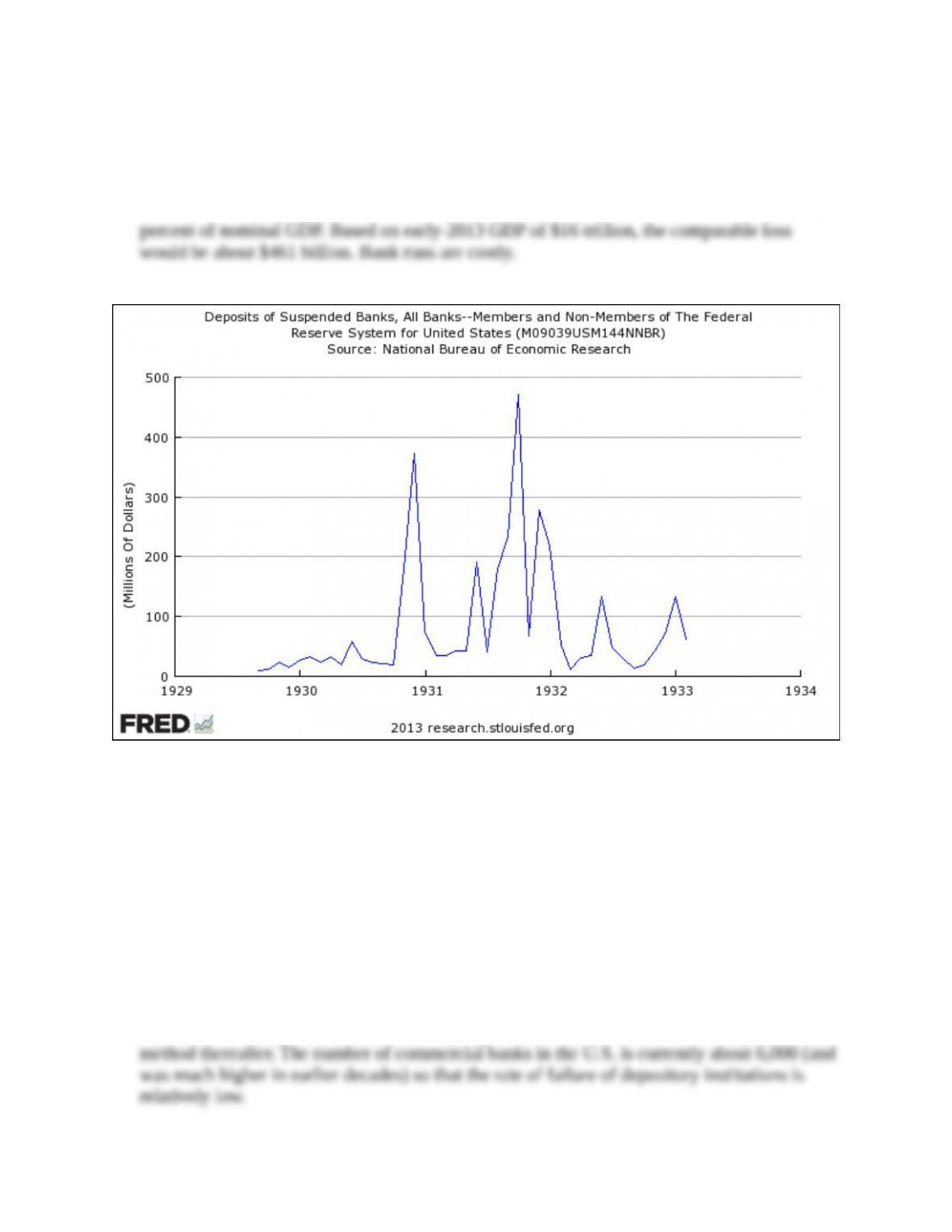
1. When banks failed in the 1929-1933 period, the lack of deposit insurance meant that
depositors experienced sizable losses. How big were these losses? For September 1929
through February 1933, plot the deposits in suspended banks (FRED code:
M09039USM144NNBR). Download the data and sum the deposits lost to bank failures in
14-5
Copyright © 2015 McGraw-Hill Education. All rights reserved. No reproduction or distribution without the prior written consent of McGraw-Hill
Education.
Chapter 14 – Regulating the Financial System
1932. Using this total, compute its ratio to 1932 gross national product of $58.7 billion.
Using that ratio, how large would the losses be compared to first-quarter 2013 nominal GDP
of $16 trillion. (LO1)
Answer: The data plot is below. In 1932, the cumulative loss was $1,690 million, about 2.88
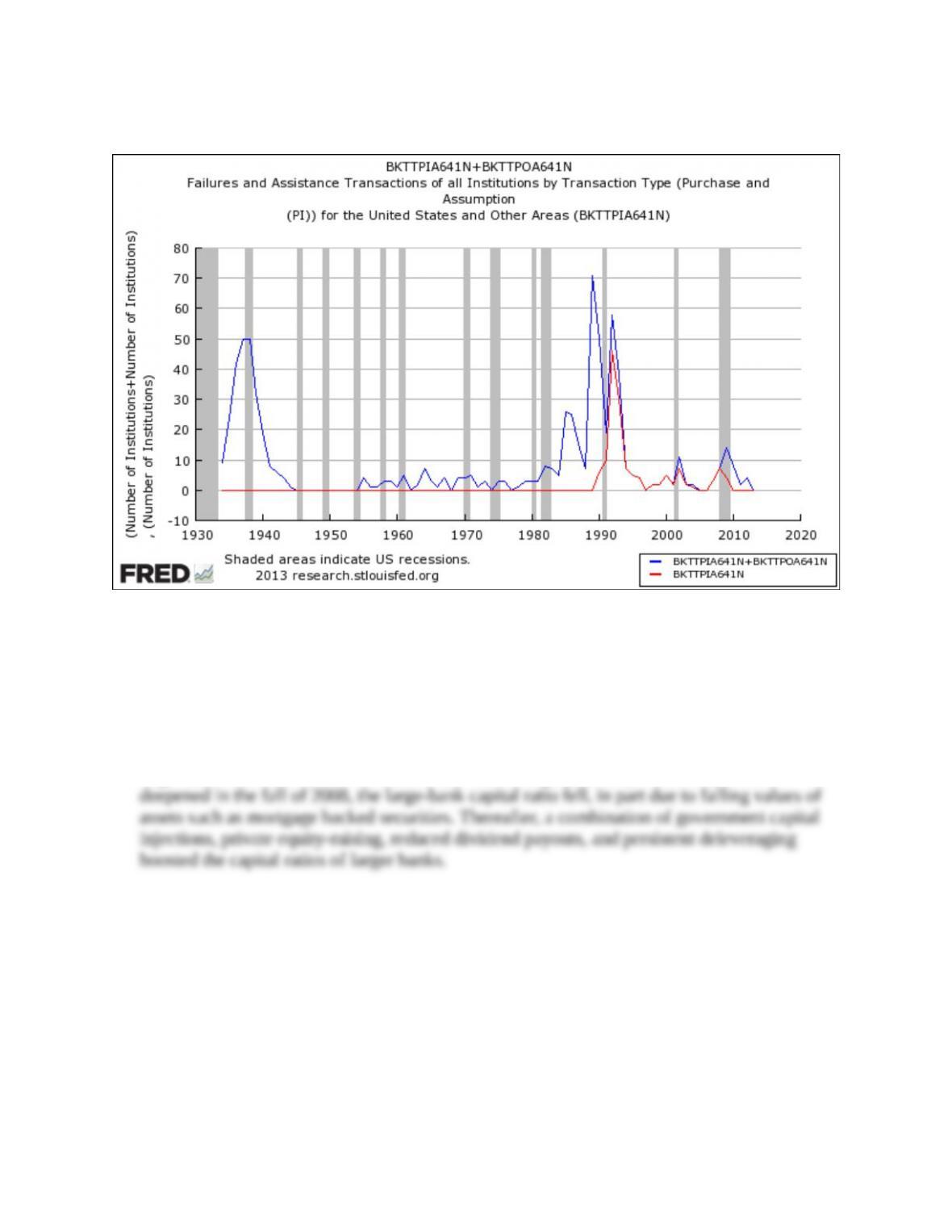
2. How frequently are the payoff and the purchase-and-assumption methods used by the FDIC?
Using FRED, plot the total number of institutions receiving such assistance (FRED codes:
BKTTPIA641N for purchase and assumption; and BKTTPOA641N for the payoff method).
On the same graph, plot as a second line the purchase and assumption data separately (so that
you graph will show one line with the total and a second line with the purchase and
assumption data only). Describe the evolution over the long run. From what you know about
the total number of depository institutions, does the total number of resolutions seem high or
low? (LO2)
Answer: Until the late 1980s, the payoff method was used to restore the balances to
depositors at failing banks. The FDIC only began to use the purchase-and-assumption
14-6
Copyright © 2015 McGraw-Hill Education. All rights reserved. No reproduction or distribution without the prior written consent of McGraw-Hill
Education.
Chapter 14 – Regulating the Financial System
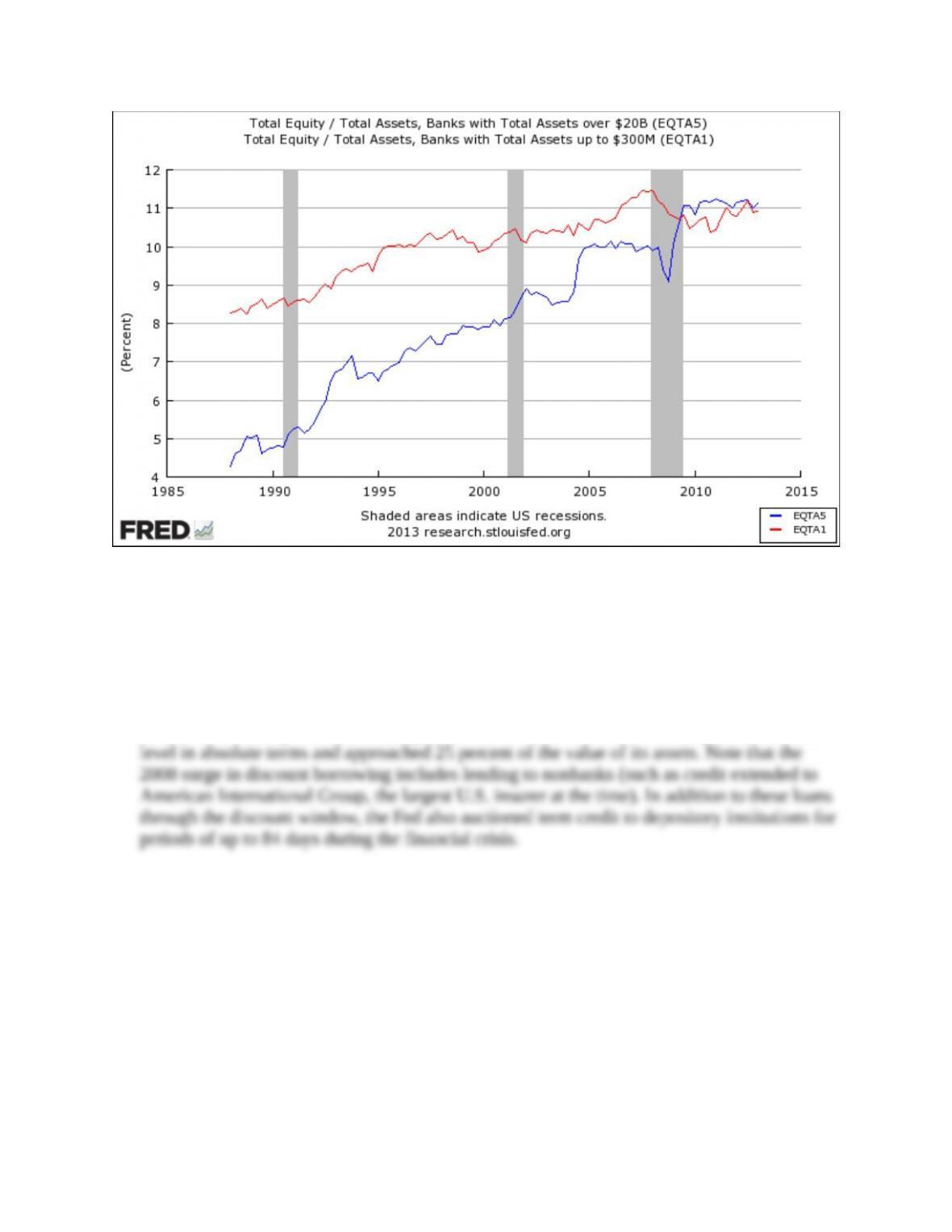
3. Examine the capital ratios of large banks (FRED code: EQTA5) and small banks (FRED
code: EQTA1). What can you say about the risk-taking propensity of these banks over the
long run? How did the financial crisis of 2007-2009 influence the risk-taking of large banks?
(LO3)
Answer: Historically, small banks have sought higher capital ratios than large banks, while
large banks have been more inclined to take on leverage (and risk). As the final crisis
14-7
Copyright © 2015 McGraw-Hill Education. All rights reserved. No reproduction or distribution without the prior written consent of McGraw-Hill
Education.
Chapter 14 – Regulating the Financial System
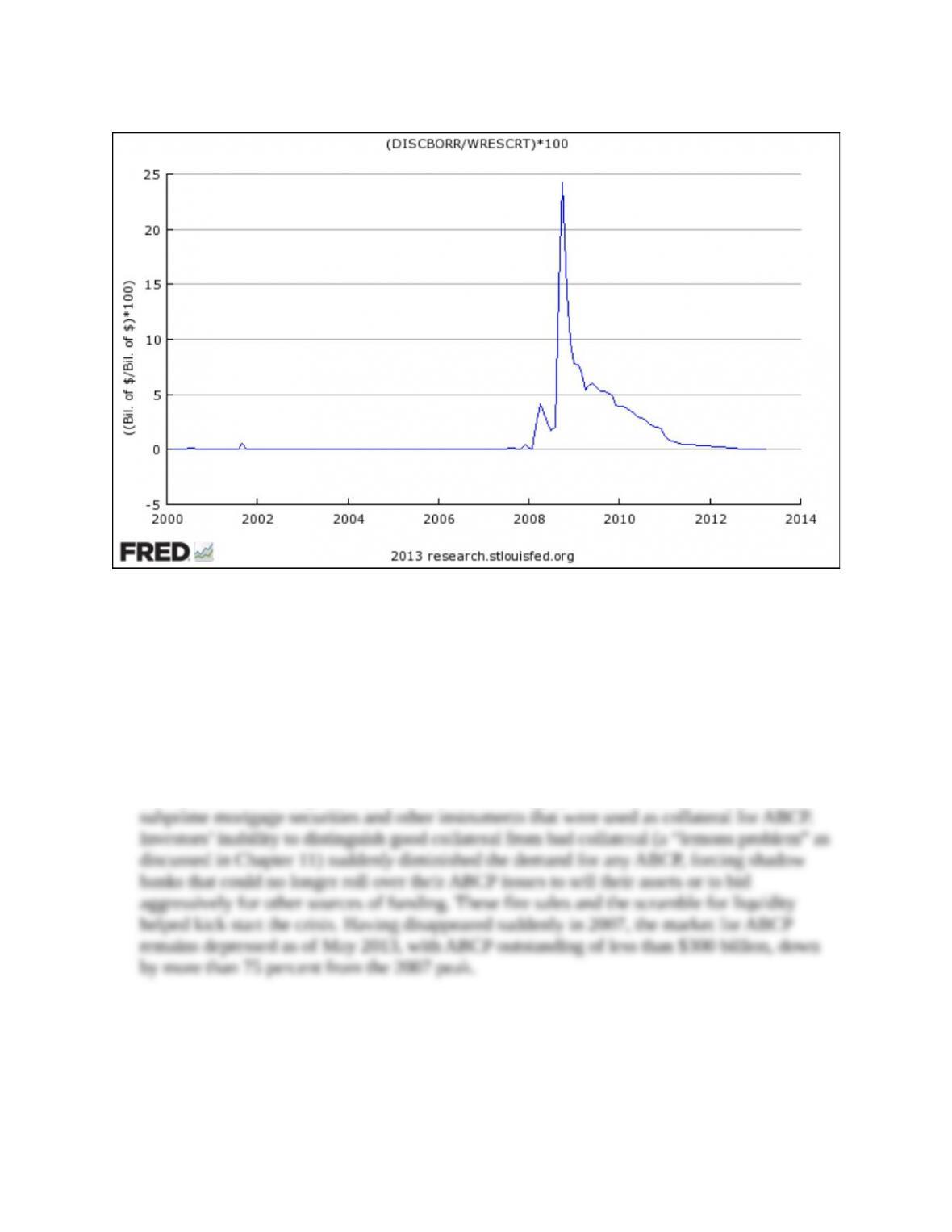
4. How important was the lender-of-last-resort function of the Federal Reserve in the financial
crisis of 2007-2009? Beginning in 2000, plot the ratio of (in percent) of borrowing from the
Fed (FRED code: DISCBORR) to its asset holdings (FRED code: WRESCRT). What
happened to the borrowing ratio during the 2007-2009 financial crisis? (LO2)
Answer: The data plot is below. Usually, discount window borrowing is a negligible portion
of the Fed’s holding of assets. During the crisis, discount window borrowing reached a record
14-8
Copyright © 2015 McGraw-Hill Education. All rights reserved. No reproduction or distribution without the prior written consent of McGraw-Hill
Education.
Chapter 14 – Regulating the Financial System
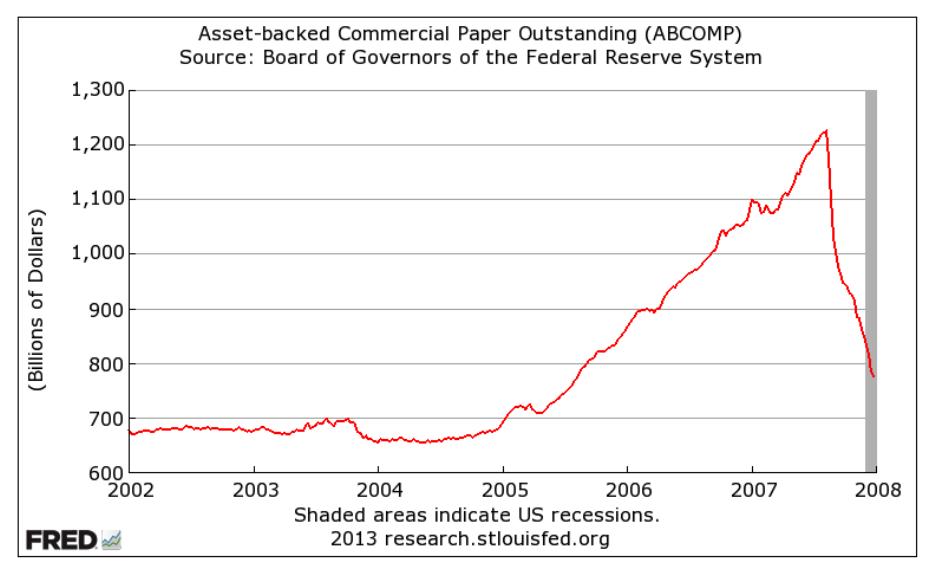
5. Shadow banks typically fund their assets by issuing liabilities of shorter maturity that are
close substitutes for bank deposits. The maturity mismatch between their assets and liabilities
creates rollover risk that can trigger fire sales and systemic disruption. Plot the outstanding
level of one such liability – asset-backed commercial paper (FRED code: ABCOMP) – from
the start of 2002 to the end of 2007. Based on the plot, discuss how the use of asset-backed
commercial paper influenced the financial crisis of 2007-2009? (LO1)
Answer: The plot appears below. From 2005 to the summer of 2007, shadow banks
increasingly relied on the issuance of asset-backed commercial paper (ABCP) to fund their
asset purchases. In August 2007, investors became highly uncertain about the value of
14-9
Copyright © 2015 McGraw-Hill Education. All rights reserved. No reproduction or distribution without the prior written consent of McGraw-Hill
Education.
Chapter 14 – Regulating the Financial System
* indicates more difficult problems
14-10
Copyright © 2015 McGraw-Hill Education. All rights reserved. No reproduction or distribution without the prior written consent of McGraw-Hill
Education.