
If policymakers are aggressive in keeping current inflation near the target inflation rate
then the monetary policy reaction curve will:
A. be steep.
B. be flat.
C. have an undefined slope.
D. be vertical.
Answer:
Suppose that Fly-By-Night Airlines Inc., has a return of 5% twenty percent of the time
and 0% the rest of the time. The expected return from Fly-By-Night is:
A. 10%.
B. 0.1%.
C. 0.2%.
D. 1.0%.
Answer:

Convert each of the following basis points amounts to percents:
a) 5
b) 10
c) 7
d) 1075
e) 1
Answer:
Higher than expected inflation will increase the:
A. real interest rate borrowers pay on fixed rate mortgages.
B. nominal amounts people need to save for retirement.
C. real interest rate savers earn on fixed rate CDs.
D. real interest rates both paid on mortgages and earned on CDs.

Answer:
The federal funds rate is stated as:
A. a real interest rate.
B. a nominal interest rate.
C. a rate that is automatically indexed to inflation.
D. the current rate less the expected rate of inflation.
Answer:
Which of the following could cause a stock market bubble?
A. Changes in the real interest rate
B. Better enforcement of insider trading laws
C. Investor euphoria
D. Changes in dividends
Answer:

The higher the future value of the payment the:
A. lower the present value.
B. higher the present value.
C. future value doesn’t impact the present value, only the interest rate really matters.
D. lower the present value because the interest rate must fall.
Answer:
Repurchase agreements are usually used by banks that:
A. have a need for long-term financing.
B. need cash for a very short period of time.
C. have negative net worth.
D. cannot obtain financing from any other source.
Answer:

If a zero-coupon bond sells for par, the nominal interest rate on that bond is:
A. 100 percent.
B. negative.
C. zero.
D. infinity.
Answer:
The value of money as a means of payment:
A. is independent of changes in the amount of money in the economy.
B. is fixed once relative prices are set.
C. depends on the amount of money in the economy, among other things.
D. depends on whether the majority of M1 is in currency or demand deposits.
Answer:

A pension fund manager who plans on purchasing bonds in the future:
A. wants to insure against the price of bonds falling.
B. can offset the risk of bond prices rising by selling a futures contract.
C. will take the long position in a futures contract.
D. will take the short position in a futures contract.
Answer:
The government regulates bank mergers, sometimes denying the proposed merger.
Often the reason given for the denial is to protect small investors. What are small
investors being protected from?
A. with a larger bank the bank is likely to take greater risk and may fail.
B. in order to pay for the merger, the bank may seek higher returns putting the
depositors’ funds at greater risk.
C. mergers can increase the monopoly power of banks and the bank may seek to
exploit this power by raising prices and earning unwarranted profits.
D. bank runs hurt larger banks more than smaller banks.
Answer:

Consider a one-year corporate bond that has a 20% probability of default. The payoff
on the bond is $2,000 if the corporation does not default. The interest rate is 10%. If
buyers of this bond are risk-neutral, this bond will sell for:
A. $400
B. $909.09
C. $1,454.54
D. $1,600
Answer:
A $1000 face value bond, with one year to maturity that sells for $950 and has a $40
annual coupon has a:
A. current yield and yield to maturity of 4.00%.
B. yield to maturity that equals the current yield.
C. coupon rate of 4.00% and a current yield that is below this.
D. current yield of 4.21%.
Answer:

An arbitrageur is someone who:
A. always takes the long position in a futures contract.
B. always takes the short position in a futures contract.
C. seeks the high returns that come from the high risk inherent in futures markets.
D. simultaneously buys and sells financial instruments to benefit from temporary price
differences.
Answer:
The intrinsic value of an option:
A. is the amount the investor believes the option will be worth on the expiration date.
B. is the amount the option is worth if it is exercised immediately.
C. is equal to price of the underlying asset.
D. cannot be determined without knowing the future price of the underlying asset.
Answer:

Consider a bond that costs $1000 today and promises a one-time future payment of
$1080 in four years. What is the approximate interest rate on this bond?
A. 2%
B. 4%
C. 8%
D. 10.8%
Answer:
The Consumer Price Index (CPI) is:
A. an example of an index that uses variable expenditure weights.
B. a fixed-expenditure-weight index used to measure changes in the GDP Deflator.
C. a fixed-expenditure-weight index used to measure changes in purchasing power for
households.
D. the least commonly used measure of inflation.
Answer:

The specific goals of central banks include all of the following except:
A. high stock prices.
B. low and stable inflation.
C. high and stable real growth.
D. a stable exchange rate.
Answer:
Suppose that consumer and business confidence fall. What is the ultimate outcome for
the economy if monetary policymakers respond to keep inflation on an unchanged
target?
A. If monetary policymakers respond, output would remain close to potential output.
B. If monetary policymakers respond, output would fall below potential output.
C. If monetary policymakers respond, output would rise above potential output.
D. If monetary policymakers respond, output would remain close to potential output
but inflation would still rise despite their actions.
Answer:

The Expectations Hypothesis cannot explain why:
A. yields on securities of different maturities move together.
B. short-term yields are more volatile than long term yields.
C. yield curves usually slope upward.
D. long-term bonds usually are less liquid than short-term bonds with the same default
risk.
Answer:
Within the European Central Bank, banks with excess reserves:
A. can deposit them with the ECB and earn an interest rate below the target refinancing
rate.
B. earn no interest on excess reserves, similar to the system in the U.S.
C. must deposit the excess with the ECB’s Deposit Facility.
D. none of the above answers is correct; there are no required reserves for the ECB and
so therefore no excess reserves.
Answer:

The law of one price is not expected to hold for:
A. differentiated goods.
B. financial assets.
C. commodity goods.
D. oil.
Answer:
All of the following are consequences of an economy operating above its potential level
except:
A. high rates of inflation.
B. high interest rates.
C. low unemployment.
D. stable prices.
Answer:

As general business conditions improve, we would witness the following in the bond
market:
A. the bond demand curve shifting left.
B. the bond supply curve shifting left.
C. bond prices decreasing.
D. bond prices increasing.
Answer:
You have a portfolio valued at $10,000. Over the next twelve months it loses 50% of its
value. What return does the portfolio need to earn over the following twelve months to
be restored to its original value?
A. 100%
B. 50%
C. 200%
D. 25%
Answer:

A moral hazard situation arises in the lender of last resort function because:
A. a central bank finds it difficult to distinguish illiquid from insolvent banks.
B. a central bank usually will only make a loan to a bank after it becomes insolvent.
C. a central bank usually undervalues the assets of a bank in a crisis.
D. the central bank is the first place a bank facing a crisis will turn.
Answer:
The European equivalent of the U.S.’s market federal funds rate is called the:
A. overnight cash rate.
B. target refinancing rate.
C. European discount rate.
D. overnight repurchase rate.
Answer:
When interest rates fall a bank’s capital will usually:

A. not change.
B. decrease.
C. turn negative.
D. increase.
Answer:
In a derivative transaction:
A. the dollar amount of the transaction increases as the contract date approaches.
B. the risk is less than if actually purchasing the underlying asset.
C. what one person gains is what the other person loses.
D. there is always a futures contract.
Answer:
Which of the following statements best completes the sentence, “All other factors
constant, as the nominal interest rate increases, the opportunity cost of money…”?

A. decreases, the velocity of money decreases, and the quantity of money people want
to hold decreases.
B. increases, the velocity of money decreases, and the quantity of money people want
to hold decreases.
C. decreases, the velocity of money increases, and the quantity of money people want
to hold decreases.
D. increases, the velocity of money increases, and the quantity of money people want
to hold decreases.
Answer:
Once a bond rating is assigned, it:
A. never changes over the life of the bond.
B. can change as the financial position of the issuer changes.
C. can only change if the rating change is approved by the securities and exchange
commission.
D. can change on the next bond from the issuer but is fixed for the current bond.
Answer:

Considering the value of a financial instrument, the more likely it is the payment will be
made:
A. the more valuable the financial instrument.
B. the less valuable is the instrument because risk is lower.
C. the less valuable is the financial instrument because it is highly liquid.
D. the greater the uncertainty; therefore the less valuable is the financial instrument.
Answer:
In comparing money to a U.S. Treasury bond held by an individual, we can say:
A. both are legal tender.
B. both are units of account.
C. only the bond is legal tender since it is an obligation of the U.S. government.
D. both are stores of value.
Answer:
Why can’t two Governors of the Fed come from the same district and does this
limitation make sense today?
Answer:
The CAMELS criteria to evaluate the health of banks by supervisors is not made public.
Make a case for one making this information public and a case for keeping it private.
Answer:
Explain why anti-branching laws often created credit crunches that slowed economic
growth.
Answer:
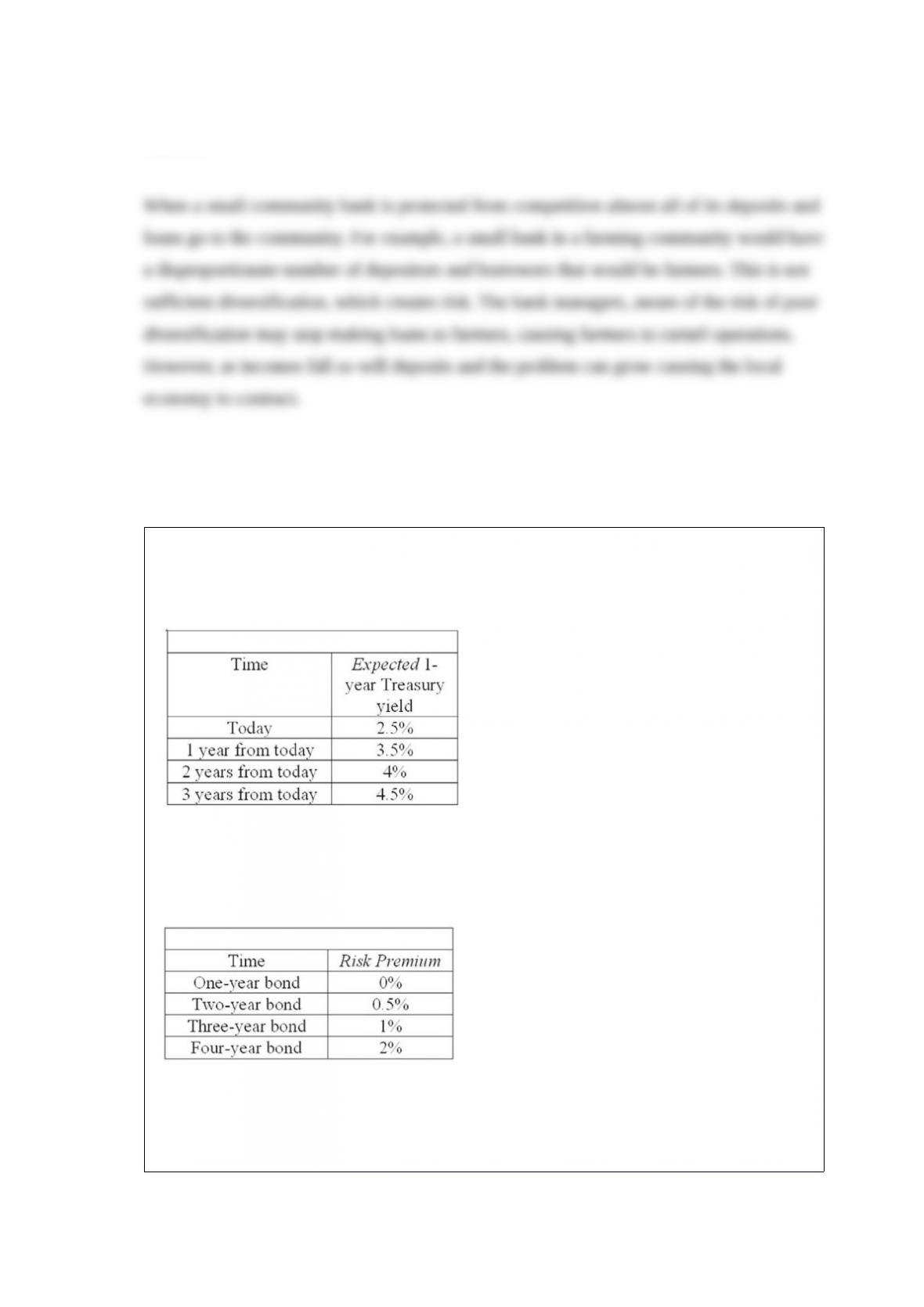
Using the information provided and the Expectations Hypothesis, compute the yields
for a two-year, three-year, and four-year bonds.
Now, suppose there is a risk premium attached to each bond. These risk premiums are
given in the table below:
Using the information above and the Liquidity Premium Theory, compute the yields for
a two-year, three-year, and four-year bonds. How does this yield curve compare to the
one you computed using the Expectations Hypothesis?
Answer:
Calculate which has a higher present value: an annual payment of $100 received over 3
years or an annual payment of $50 received over 7 years. In both cases the interest rate
is 7% (or 0.07).
Answer:
What are the pros and cons of a policy of “leaning against bubbles?”
Answer:
Historically, some governments have relied on the revenue generated from printing
currency to finance government spending. Give two examples of government’s relying
on paper currency to finance wartime expenditures. What do you expect happened to
inflation rates during these historical episodes?
Answer:
Briefly explain the difference between idiosyncratic risk and systematic risk. Provide an
example of each.
Answer:
What does it mean to say that an asset is “liquid”?
Answer:
During the financial crisis of 2007-2009, the deposit expansion multiplier plummeted to
a fraction of its normal value. Why?
Answer:
Suppose there is an economy that has 100 people each of whom makes a different good,
and that they use a barter system for exchange. How many relative prices will there be?
Answer:
There are several important differences between the Fed and the European Central Bank
(ECB). What are they?
Answer:
Why do government debt managers often use interest-rate swaps?
Answer:
Evaluate the pros and cons of the repeal of the Glass-Steagall Act of
Answer:
How can irresponsible fiscal policy contribute to a speculative attack on a country’s
currency that is fixed in value to another currency?
Answer:
Explain why the ratio of assets to capital increased dramatically for commercial banks
from the 1920s to the present.
Answer:
What are the specific objectives of most central bankers?
Answer: