
If the required reserve rate is ten percent and banks do not hold any excess reserves and
there are no changes in currency holdings, a $1 million open market purchase by the
Fed will result in what change in loans?
A. No change
B. A decrease of $1 million
C. An increase of $10 million
D. An increase of $1 million
Answer:
One cost that potentially could result from central banks targeting money growth is:
A. high inflation.
B. a slowdown in financial innovation.
C. volatile interest rates.
D. decreased independence.
Answer:

The balance-sheet channel of monetary policy works because it can:
A. increase a borrower’s asset value but not the burden of his/her liabilities.
B. change the value of a borrower’s assets and liabilities, but it can’t change a
borrower’s net worth.
C. increase a borrower’s assets and reduce the cost of his/her liabilities.
D. none of the answers given is correct.
Answer:
One result of the Riegle-Neal Interstate Banking and Branching Efficiency Act was
that:
A. banking system efficiency decreased.
B. banks became less geographically diversified.
C. banking system efficiency increased.
D. banks became less geographically diversified and banking system efficiency
decreased.
Answer:

The use of coinsurance clauses and deductibles is an attempt by insurance companies to
deal with the problem of:
A. non-payment of premiums.
B. adverse selection.
C. insufficient government regulation.
D. moral hazard.
Answer:
Deflation can cause widespread bank crises for all of the following reasons except:
A. a decline in the value of borrowers’ net worth but not their liabilities.
B. borrowers’ default rates increase.
C. bank balance sheets deteriorate as the level of economic activity decreases.
D. information asymmetry problems decrease during deflationary periods.
Answer:

Milton Friedman’s assertion that “inflation is a monetary phenomenon” is based on:
A. the quantity theory of money.
B. the assumption of constant nominal GDP growth.
C. the assumption that the price level grows at the same rate as real GDP.
D. the assumption that the central bank increases the money supply by a constant rate
every year.
Answer:
If the Fed were to increase the required reserve rate from ten percent to twenty percent,
the simple deposit expansion multiplier would:
A. double.
B. increase by 10 percent.
C. decrease by a factor of ten.
D. be half as large as it was before the increase.
Answer:

Which of the following would reflect the transactions demand for money?
A. Keeping funds in your checking account to pay your rent
B. Keeping funds in your savings account because the interest rate looks relatively
attractive
C. Selling common stocks you own and increasing the money in your savings account
because you think stock prices will fall soon
D. Buying a U.S. Treasury security using funds from your checking account
Answer:
If a one-year bond currently yields 4% and is expected to yield 6% next year, the
Liquidity Premium Theory suggests the yield today on a two-year bond will be:
A. More than 4% but less than 5%.
B. 5%.
C. 4%.
D. More than 5%.
Answer:

An increase in the federal funds rate should:
A. cause mortgage rates to increase by less than the increase in the federal funds rate.
B. have an inverse impact on mortgage rates.
C. not impact mortgage rates since the federal funds rate is a very short-term rate.
D. cause the mortgage rates to increase by more than the increase in the federal funds
rate.
Answer:
The European Central Bank has ensured independence by:
A. explicitly forbidding the Governing Council from taking instructions from any
government.
B. making sure the ECB’s financial interests supports member countries’ political
organizations.
C. by appointing the Executive board members for life.
D. not taking votes on policy matters.
Answer:

One lesson policymakers have learned, and which was evident from Japan’s experience
in 2002, is:
A. an intervention in the foreign exchange market will not work unless accompanied
by a change in the policy interest rate.
B. an intervention in the foreign exchange market is almost always effective if done on
a regular basis.
C. in order for foreign exchange interventions to work, they must be frequent and
expected.
D. for an intervention in the foreign exchange market to work, the interest rate must be
held constant by the central bank.
Answer:
Equity and property price bubbles are commonly associated with periods when:
A. financial assets are undervalued.
B. financial asset prices reflect the book value of companies.
C. financial asset prices are well above what seems to be a reasonable present value
estimate of earnings.
D. the earnings that companies report are overstated.
Answer:

If required reserves are expressed by RR; the required reserve rate by rD and deposits
by D, the simple deposit expansion multiplier is expressed as:
A. RDD.
B. (1/rD) D.
C. RD.
D. 1/rD.
Answer:
If a borrower’s net worth increases:
A. the likelihood of moral hazard also increases.
B. the borrowers are likely to want to take less risk.
C. the moral hazard risk for the potential lenders decreases.
D. the supply of loans decreases.
Answer:

A call option described as at the money would find:
A. the market price of the stock is above the strike price.
B. the market price of the stock is below the strike price.
C. the option has been exercised.
D. the market price of the stock equals the strike price.
Answer:
If output and inflation are unrelated in the long run, the long-run aggregate supply curve
must be:
A. horizontal.
B. vertical.
C. upward sloping.
D. non-existent.
Answer:

If the Fed were to decrease the required reserve rate from ten percent to five percent,
the simple deposit expansion multiplier would:
A. double.
B. decrease by 5 percent.
C. increase by a factor of five.
D. be half as large as it was before the reduction.
Answer:
If the U.S. were to revert to a gold standard, trade deficits would:
A. result in gold reserves in the U.S. increasing.
B. result in higher domestic interest rates.
C. quickly disappear.
D. result in high inflation.
Answer:

The Federal Reserve System is composed of:
A. five branches with clear responsibilities.
B. six branches with overlapping responsibilities.
C. three branches with overlapping responsibilities.
D. twelve branches with clear responsibilities.
Answer:
A consol is:
A. another name for a zero-coupon bond.
B. a bond with a maturity date exceeding 10 years.
C. a bond that makes periodic interest payments forever.
D. a form of a bond that is issued quite often by the U.S. Treasury.
Answer:
The Fed’s revenue comes:

A. from Congressional appropriation.
B. from the Department of Commerce.
C. from internally generated funds from interest on securities it holds and fees charged
to banks for payments system services.
D. solely from taxes placed on member banks.
Answer:
The International Monetary Fund’s primary role under the Bretton Woods System was
to be:
A. the issuer of gold.
B. the clearinghouse for international transactions.
C. a short-term lender for countries with an excess of imports over exports.
D. the arbiter of trade disputes.
Answer:

The impact from rapid dividend growth on a stock’s current price will be:
A. negative, since the company is paying out profits to stockholders.
B. positive, since rapid dividend growth causes stockholders to expect higher future
dividends.
C. zero; only current dividends are used to determine the current price of a stock.
D. positive, but only if the corporation does not have any debt.
Answer:
All but which of the following is a reason policymakers are concerned about the
strength of the rebound from the 2007-2009 financial crisis:
A. Banks would make credit expensive and difficult to obtain
B. Investors would be cautious about buying securitized assets
C. Households would prefer to save more and borrow less
D. The pace of technological change would slow
Answer:

A borrower who makes a $1000 loan for one year and earns interest in the amount of
$75, earns what nominal interest rate and what real interest rate if inflation is two
percent?
A. A nominal rate of 5.5% and a real rate of 2.0%.
B. A nominal rate of 7.5% and a real rate of 5.0%.
C. A nominal rate of 7.5% and a real rate of 9.5%.
D. A nominal rate of 7.5% and a real rate of 5.5%.
Answer:
Many states prohibited bank branching because of all of the following except:
A. they feared the concentration and monopoly power of large banks.
B. they generated significant revenue from issuing bank charters.
C. they wanted to protect the profits of banks since they generated tax revenue from
these profits.
D. the McFadden Act of 1927.
Answer:

An individual who neither uses nor produces a commodity but buys a futures contract
for the asset is:
A. speculating that the price of the commodity is going to fall.
B. speculating that the price of the commodity is going to increase.
C. is using arbitrage to earn profits without taking a risk.
D. is hedging and transferring risk.
Answer:
If the economy is in long-run equilibrium:
A. inflation should be accelerating.
B. current output should be greater than potential output.
C. current inflation should equal expected inflation.
D. current inflation should be less than expected inflation.
Answer:

Which of the following is not a role of a financial institution acting as a financial
intermediary?
A. Pooling the resources of small savers
B. Formulating oversight regulations
C. Providing ways to diversify risk
D. Supplying liquidity
Answer:
Considering the value of a financial instrument, the circumstances under which the
payment is to be made influence the value because:
A. we like uncertain payoffs because this adds to the return.
B. payments that are made when we need them the most are more valuable.
C. the sooner the payment is to be made the better.
D. we know when certain events are going to occur and that is when we want the
payment.
Answer:

The 2008 and 2009 tax cuts and the increase in government spending that occurred at
the same time did not have the same inflationary impact as the similar policy in the
1960s because:
A. the fiscal stimulus came at a time when the economy was weakening due to other
factors.
B. monetary policymakers, having perceived the inflation risk, responded
appropriately.
C. aggregate demand was far below potential output.
D. all of the answers provided are correct.
Answer:
When a currency is described as undervalued, this typically implies:
A. it is undervalued relative to what the describer believes purchasing power parity to
be.
B. it is undervalued relative to the exchange rate set by the nation’s central bank.
C. the exchange rate is greater than one.
D. the exchange rate is lower than one year previous.
Answer:

The Dow Jones Industrial Average:
A. gives equal weight to a change in the price of the stock of any company in the
index.
B. reflects that a 10% increase in a share of stock selling for $30 will have the same
effect on the index as a 10% increase in the price of a stock selling for $60.
C. is a value-weighted index.
D. gives greater weight to shares with higher prices.
Answer:
Why are so few state chartered banks members of the Federal Reserve System?
Answer:
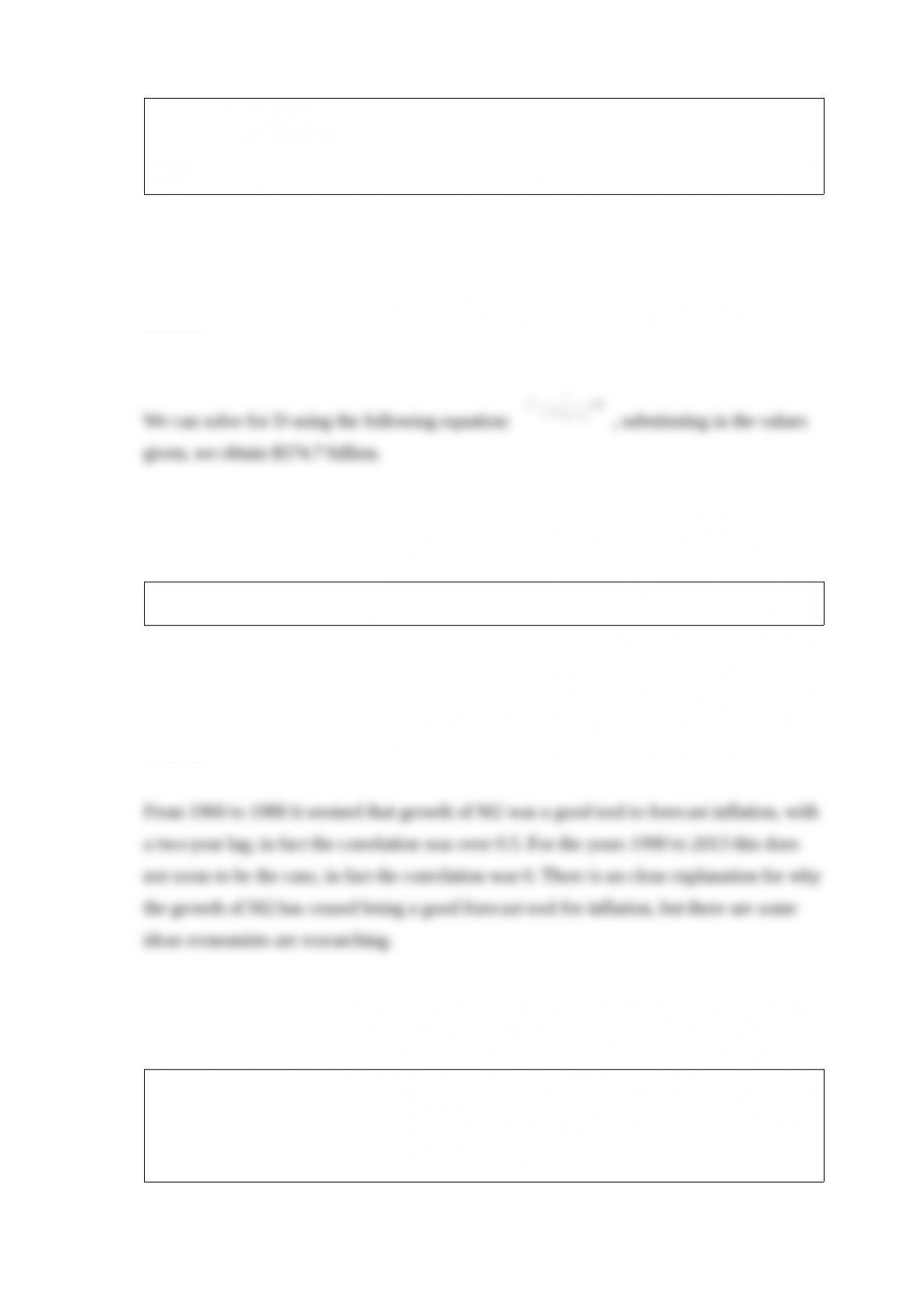
What would be the amount of deposits D, given that the monetary base MB = $750
billion, the required reserve rate (rD) = 0.1, the excess reserve rate (ER/D) = 0.005, and
non-bank currency to deposits (C/D) equaled 1.2?
Answer:
Has M2 always been a useful tool for forecasting inflation? Explain.
Answer:
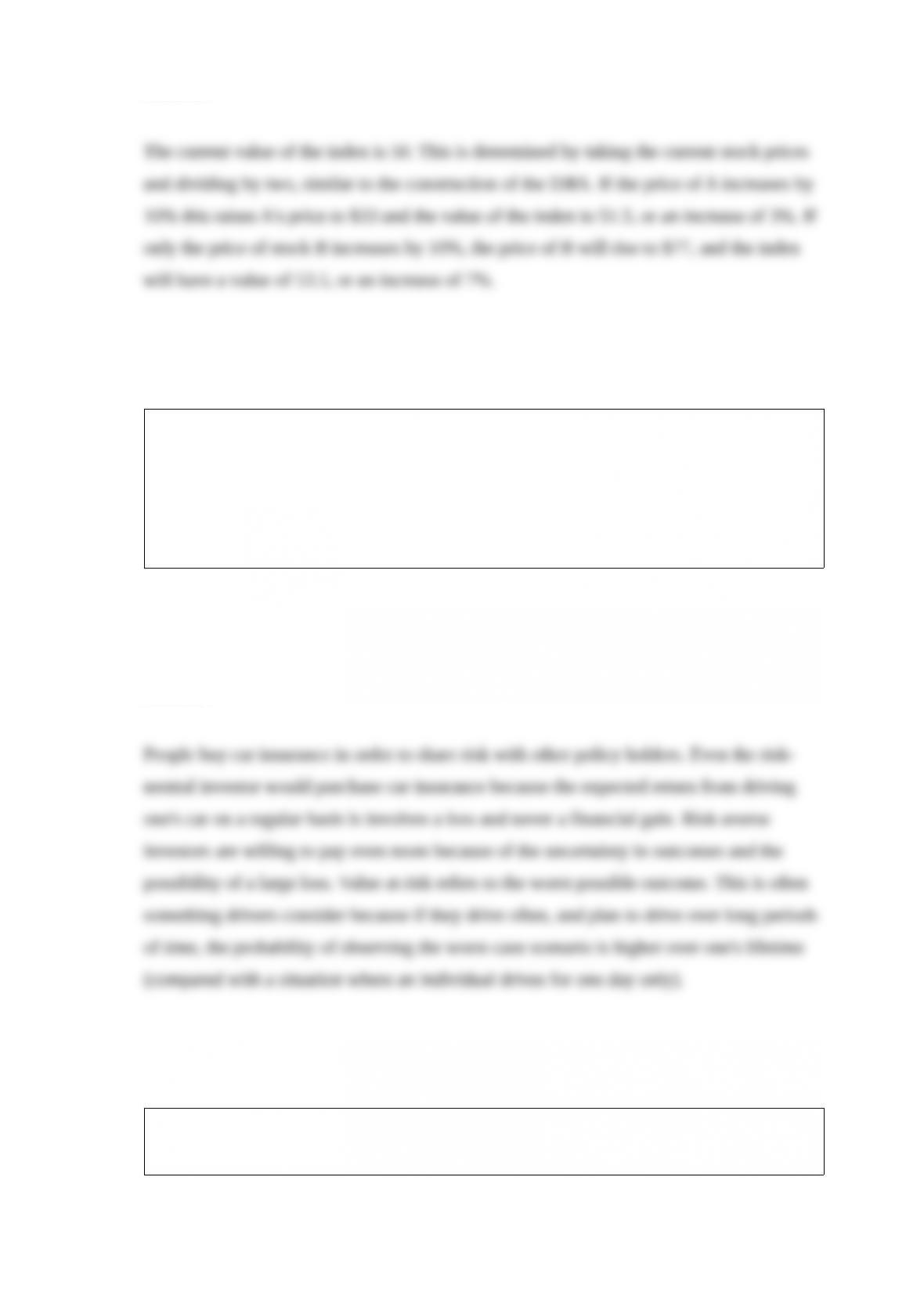
You have a price-weighted index made up of two stocks, A and B. The price of A equals
$30 and the price of B equals $70. What is the current value of this index? Also, what
will be the percentage change in the index resulting from a 10% increase only in the
price of A? A 10% increase only in the price of B?
Answer:
Apply the definition of risk provided in the textbook to an individual’s decision to
purchase a car insurance policy. Suppose that the individual has two possibilities: no
accident ($0 gain/loss) and accident (-$30,000 loss). If the probability of an accident is
lower than the probability of an accident occurring (say the probability of an accident is
10%), then why do people buy car insurance? How is this related to the concept of
value at risk and the time horizon of investment decisions?
Answer:
Why do bank runs usually have people rushing to their bank instead of waiting for the
lines to taper off so they do not have to wait so long?
Answer:
Please explain how financial intermediaries contribute to increasing the output of an
economy.
Answer:
What matters more: having a credit card with a low rate or paying off your balance as
quickly as possible? Explain.
Answer:
If the yield curve is flat, using liquidity premium theory, what do you know about the
expected future short-term interest rate?
Answer:
If the current number of participating countries in the Euro system is eighteen as of
2014 and the number of large countries is four (Germany, France, Italy, and Spain), are
policies likely to favor small or large countries? Explain.
Answer:
What are the three main ways to categorize derivatives?
Answer:
Why do economists claim the Consumer Price Index (CPI) tends to overstate the actual
rate of inflation?
Answer:
Fiscal policy can act just like monetary policy to offset shifts in the dynamic aggregate
demand curve and stabilize inflation and output. Explain how the two policies could
have the same effect.
Answer:
If a lender faces a potential loan applicant pool made up of equal amounts of low risks
and high risks, will charging an average interest rate provide the average (expected)
return? Explain.
Answer:
You have a retirement account in a bank that has failed. The balance in your account is
$330,000. Does it make a difference to you if FDIC uses the payoff method or the
purchase-and-assumption method for resolving this insolvency? Explain.
Answer:
Explain why the Fed making more discount loans to banks, or an open market purchase,
or an increase in foreign exchange reserves all have the same effect on its balance sheet.
What is that effect on the monetary base?
Answer:
If the option holder is the individual with the options, why is anyone an option writer?
Answer: