
The option writer is:
A. the seller of an option.
B. the buyer of an option.
C. the underlying asset of the option.
D. the individual who obtains the rights.
Answer:
If the nominal interest rate increases:
A. the cost of holding money decreases.
B. the cost of holding money increases.
C. the velocity of money should decrease.
D. the cost of holding money increases and the velocity of money should decrease.
Answer:
For every $100 in assets, a bank has $30 in interest-rate sensitive assets, and the other

$70 in non-interest-rate sensitive assets. The same bank has $60 for every $100 in
liabilities in interest-rate sensitive liabilities, the other $40 are in liabilities that are not
interest-rate sensitive. If the interest rate on assets decreases from 6 to 5 percent, and
the interest rate on liabilities decreases from 4 to 3 percent, the impact on the bank’s
profits per $100 of assets will be:
A. a reduction of $0.30.
B. an increase of $0.30.
C. a reduction of $3.00.
D. zero since the interest rates on assets and liabilities fell by the same amount.
Answer:
The most broadly based stock index in use is the:
A. Nasdaq Composite Index.
B. Wilshire 5000.
C. Dow Jones Industrial Average.
D. Standard and Poor’s 500 Index.
Answer:

The primary objective of most central banks in industrialized economies is:
A. high securities prices.
B. low unemployment.
C. price stability.
D. a strong domestic currency.
Answer:
Management fees for mutual funds are:
A. different across funds and can significantly impact the return to an investor.
B. fixed by regulation.
C. fixed by regulation but can vary by the size of the fund.
D. usually a percentage of the return achieved by fund managers.
Answer:
One argument why farmers in poor countries remain poor is:

A. they know very little about farming techniques needed for the crop they are
growing.
B. they are poor assessors of the risks they face.
C. risk taking is a deterrent to growth.
D. poor farmers in many countries lack access to commodity futures markets.
Answer:
If a consol is offering an annual coupon of $50 and the annual interest rate is 6%, the
price of the consol is:
A. $47.17
B. $813.00
C. $833.33
D. $8333.33
Answer:
Rank the following assets from most liquid to least liquid.
a) Common stock
b) Houses
c) Currency
d) Art
e) Savings accounts
f) Checking account deposits.
Answer:
Since the Federal Reserve was created, it has:
A. averted all financial panics that could have plagued the U.S. economy.
B. averted a few financial panics but not most.
C. improved its skill at securing financial stability.

D. proved to be much better at preventing international panics than domestic ones.
Answer:
Futures markets and derivatives contribute to economic growth by:
A. decreasing speculation.
B. increasing the risk-taking capacity of the economy.
C. deterring the transfer of risk.
D. forcing people to accept the risk their decisions create.
Answer:
Investment A pays $1,200 half of the time and $800 half of the time. Investment B pays
$1,400 half of the time and $600 half of the time. Which of the following statements is
correct?
A. Investment A and B have the same expected value, but A has greater risk.
B. Investment B has a higher expected value than A, but also greater risk.

C. Investment A has a greater expected value than B, but B has less risk.
D. None of the statements are correct.
Answer:
The “coupon rate” is:
A. the annual amount of interest payments made on a bond as a percentage of the
amount borrowed.
B. the change in the value of a bond expressed as a percentage of the amount
borrowed.
C. another name for the yield on a bond, assuming the bond is sold before it matures.
D. the total amount of interest payments made on a bond as a percentage of the amount
borrowed.
Answer:
The return on bonds rises relative to other assets, in the bond market this will result in:
A. the price of bonds falling and the yields increasing.

B. a rightward shift in the bond supply curve.
C. a shift to the left of the bond demand curve.
D. an increase in bond prices.
Answer:
The central bank has the ability to create money; this means it:
A. can control the availability of money but not the availability of credit in the
economy.
B. can make loans only when other institutions can.
C. can impact the rate of inflation.
D. has an objective to maximize its profit.
Answer:
If a company reports that it is going to have a difficult time meeting its debt obligations,
you would expect the Ptoday:
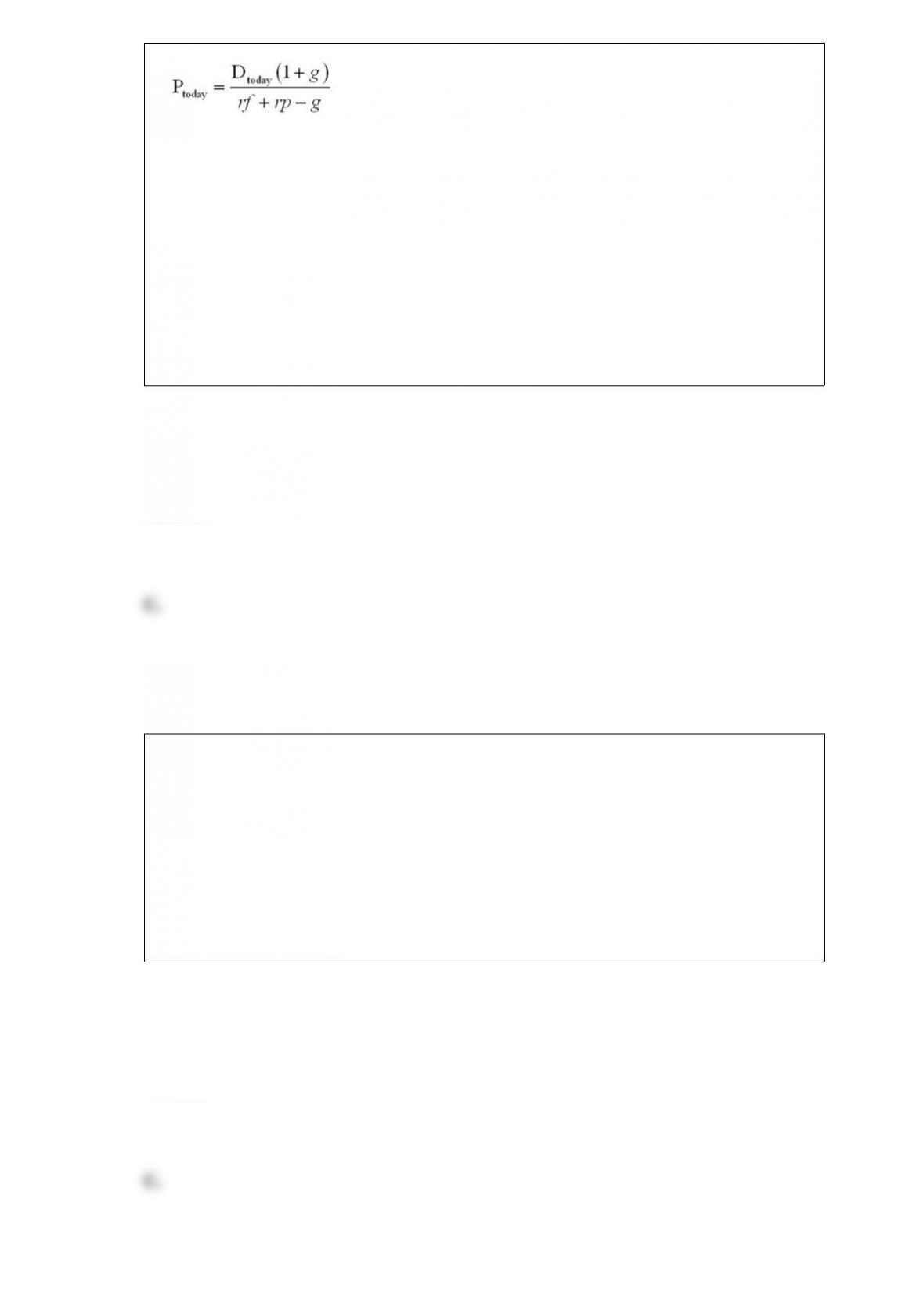
A. to fall since the risk-free return will rise.
B. to rise since the Dtoday will likely fall.
C. to fall since the risk premium will likely rise.
D. to remain about the same until the Dtoday actually changes.
Answer:
Financial intermediation is:
A. far less important than direct finance through stock and bond markets.
B. only a little more important than direct finance in the United States.
C. much more important than direct finance through stock and bond markets.
D. the same thing as finance through stock and bond markets.
Answer:

Which of the following statements best completes the following statement: “Over the
past 40 years, the percentage(s) of assets for all financial intermediaries”?
A. controlled by banks has decreased as has the percentage for mutual funds while
insurance companies have increased their percentage.
B. controlled by insurance companies and mutual funds has decreased and the
percentage controlled by banks has increased.
C. controlled by banks and insurance companies has decreased while the percentage
controlled by mutual funds and pensions has increased.
D. controlled by banks, insurance companies, mutual funds and pensions have all
increased.
Answer:
An individual who is risk-averse:
A. never takes risks.
B. accepts risk but only when the expected return is very small.
C. requires larger compensation when the risk increases.
D. will accept a lower return as risk rises.
Answer:

If the annual interest rate is 5%(.05), the price of a six-month Treasury bill would be:
A. $97.50
B. $97.59
C. $95.25
D. $95.00
Answer:
Which of the following assets is the most liquid?
A. Art
B. Demand deposits
C. Houses
D. Stocks
Answer:

An open market sale of U.S. Treasury securities by the Fed will cause the Banking
System’s balance sheet to show:
A. only an increase in liabilities.
B. only a decrease in assets.
C. no net change in assets or liabilities, only a change in the composition of assets with
securities decreasing and reserves increasing.
D. no net change in assets or liabilities, only a change in the composition of assets with
securities increasing and reserves decreasing.
Answer:
Fannie Mae, Freddie Mac, and similar government-sponsored enterprises obtain their
funds from:
A. the U.S. Treasury.
B. the Federal Reserve.
C. issuing commercial paper and bonds.
D. both the U.S. Treasury and the Federal Reserve.
Answer:

Adverse selection:
A. increases the efficiency of most markets.
B. usually causes prices to adjust faster than they otherwise would.
C. makes it easier for all customers to find what they want.
D. results in fewer market transactions.
Answer:
Financial regulators set capital requirements for banks. One characteristic about these
requirements is:
A. every bank will have to hold the same level.
B. the riskier the asset holdings of a bank, the more capital it will be required to have.
C. the more branches a bank has, the more capital it must have.
D. the amount of capital required is inversely related to the amount of assets the bank
owns.
Answer:

The procedure that estimates the interest-rate sensitivity of a bank’s assets and liabilities
is called:
A. managing credit risk.
B. estimating operating risk differential.
C. trading risk minimization.
D. gap analysis.
Answer:
Which of the following statement is true?
A. Printing currency can be a profitable venture for a government.
B. Printing currency, while necessary, is a losing venture for a government.
C. Too much money printed usually leads to lower prices.
D. In the modern economy the amount of money created has no effect on prices.
Answer:

Which of the following is not a financial intermediary?
A. A bank
B. An insurance company
C. The New York Stock Exchange
D. A mutual fund
Answer:
Which best describes money as a means of payment?
A. Money provides an immediate double coincidence of wants.
B. Money makes sure a double coincidence of wants never occurs.
C. Money requires at least two transactions to obtain the double coincidence of wants.
D. To obtain a double coincidence of wants without money is impossible.
Answer:
One hundred basis points could be expressed as:

A. 0.01%
B. 1.00%
C. 100.0%
D. 0.10%
Answer:
Consider the following four investors. Rank each according to who has the most to gain
from investing in 30-year tax-exempt municipal bonds. Each investor has $1000 in a
savings account that he/she plans to use to buy bonds. Explain briefly why you ranked
the investors this way.
(a) A 20-year old college student who earns low income through working over summers
and breaks. The student plans to graduate next year.
(b) The CEO of a large company who is currently in the highest tax bracket.
(c) A middle-income household saving up to move into a larger home.
(d) A 60-year old nurse who plans to retire at age 62. He uses a tax-exempt pension
fund for all of his savings.
Answer:

The reinsurance market is characterized as having:
A. a few buyers and many sellers.
B. many buyers and sellers.
C. few buyers and sellers.
D. many buyers and a few sellers.
Answer:
Which of the following statements is most correct?
A. A fixed exchange rate policy is a lack of a monetary policy.
B. A fixed exchange rate policy is appropriate for a country that lacks a central bank.
C. A fixed exchange rate policy is only appropriate for countries with little
international reserves.
D. A fixed exchange rate policy is a monetary policy.
Answer: