Chapter 18
Monetary Policy:
Stabilizing the Domestic Economy
Conceptual and Analytical Problems
1. Suppose, one morning, the Open Market Trading Desk drastically underestimates the demand
for reserves when deciding the quantity of reserves to supply to the market. Based on
analysis of the market for bank reserves, explain why the market federal funds rate will not
exceed the discount rate regardless of the size of the gap between estimated and actual
reserve demand. (LO2)
Answer: If the actual demand for reserves were larger than the estimated demand, the actual
reserve demand curve would be farther to the right than the estimated demand curve. If the
gap is large enough, the demand and supply curves for reserves would intersect on the
2. Consider a situation where reserve requirements are binding and the Federal Reserve decides
to reduce the requirements. How would the Open Market Trading Desk act to maintain the
interest rate target, assuming the demand for excess reserves remains unchanged? (LO2)
Answer: If required reserves fell with no change in desired excess reserves, then overall
3. Suppose the Federal Reserve did not pay interest on excess reserves. How would the reserve
demand curve differ from that in Figure 18.2? (LO1)
Answer: Instead of becoming flat at the deposit rate, the reserve demand curve would
continue to slope downward until it hits the horizontal axis at zero, at which point it would
18-1
© 2015 by McGraw-Hill Education. This is proprietary material solely for authorized instructor use. Not authorized for sale or distribution in any manner.
This document may not be copied, scanned, duplicated, forwarded, distributed, or posted on a website, in whole or part.
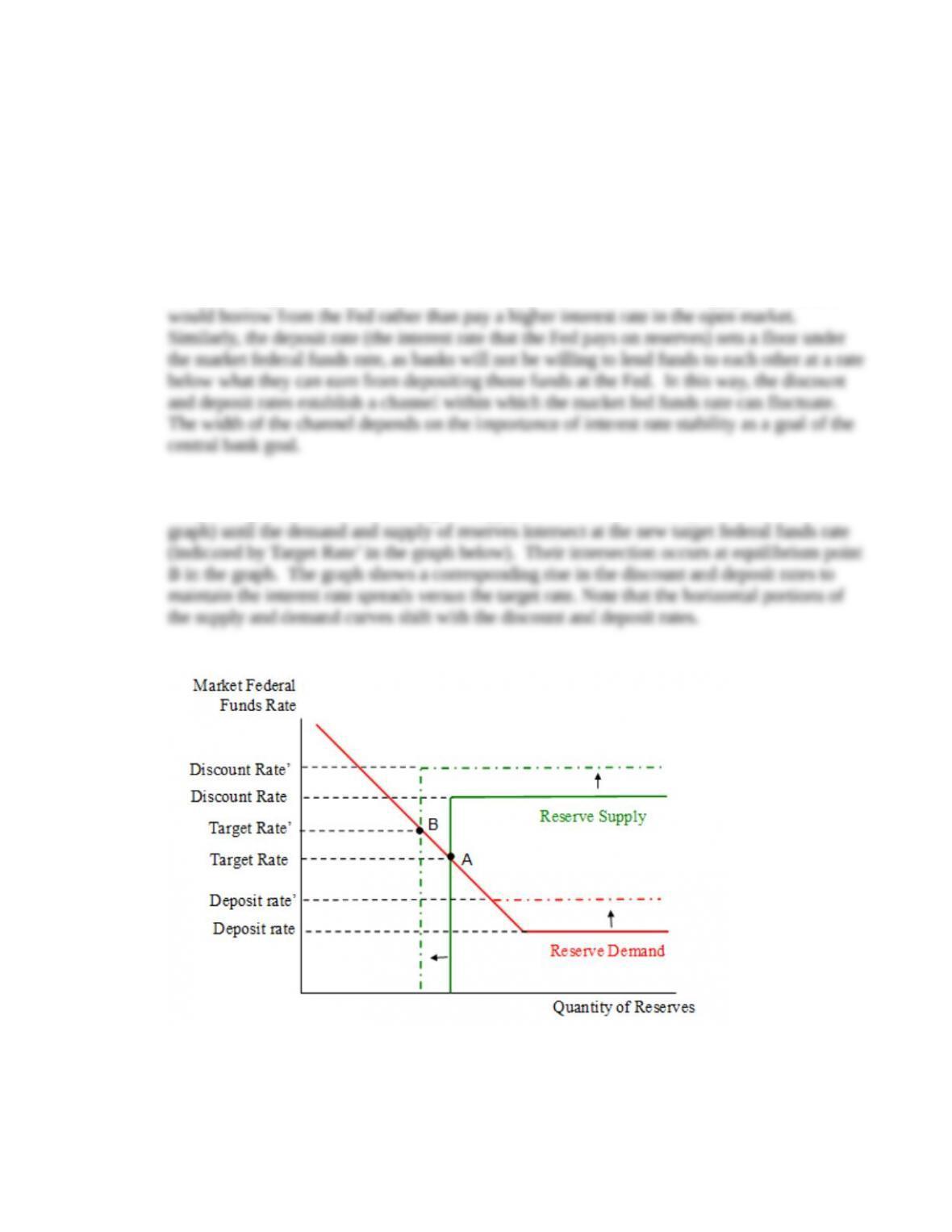
4. * In a graph of the market for bank reserves, show how the Federal Reserve limits deviations
of the market federal funds rate from its interest rate target under the channel system. Next,
show how the Open Market Trading Desk would implement a decision by the FOMC to raise
the target federal funds rate. Assume that the Fed alters the discount and deposit rates to
maintain fixed spreads between them and the target federal funds rate. (LO1)
Answer: In the graph, the initial target interest rate, discount rate, and deposit rate are
indicated, with the initial equilibrium at point A. Were the reserve demand curve to shift
sufficiently rightward to intersect the horizontal portion of the reserve supply curve, banks
To implement a higher target for the federal funds rate, the Open Market Trading Desk would
carry out open market sales, shifting the supply of reserves to the left (see the arrows in the
18-2
© 2015 by McGraw-Hill Education. This is proprietary material solely for authorized instructor use. Not authorized for sale or distribution in any manner.
This document may not be copied, scanned, duplicated, forwarded, distributed, or posted on a website, in whole or part.
5. From 1979 to 1982, the FOMC used money growth as an intermediate target. To do so, the
committee instructed the Open Market Trading Desk to target the level of reserves in the
banking system. What was the justification for doing so? Explain why the result was
unstable interest rates. Would you advocate a return to reserve targeting? Why or why not?
(LO2)
Answer: In 1979, the Fed had to reduce inflation. It would not have been politically
acceptable for the Fed to explicitly raise interest rates to the level required to bring down
6. Federal Reserve buying of mortgage-backed securities is an example of a targeted asset
purchase. Explain how the Fed’s actions are intended to work. (LO2)
Answer: The Fed wishes to stimulate the housing market. Housing prices and activity
collapsed in the 2007-2009 episode, serving as a key driver of the crisis. By purchasing
7. The strategy of inflation targeting, which seeks to keep inflation close to a numerical goal
over a reasonable horizon, has been referred to as a policy of “constrained discretion.” What
does this mean? (LO2)
Answer: Under inflation targeting, central banks conduct policy to attain the inflation goal.
However, the targets may specify an acceptable range around the central target. In addition,
8. The charge given by Congress to the Federal Reserve is to “promote effectively the goals of
maximum employment, stable prices, and moderate long-term interest rates.” Discuss
whether the Taylor rule conforms to this mandate. (LO3)
Answer: The mandate given to the Federal Reserve by Congress is embedded in the Taylor
rule. First, if the inflation target π*, is low, the inflation gap term satisfies the “stable price”
18-3
© 2015 by McGraw-Hill Education. This is proprietary material solely for authorized instructor use. Not authorized for sale or distribution in any manner.
This document may not be copied, scanned, duplicated, forwarded, distributed, or posted on a website, in whole or part.
9. Discuss the coefficients on the inflation gap and output gap terms in the Taylor rule given in
equation (1). If you could change the relative importance of the coefficients, what would you
choose? (LO3)
Answer: The coefficients on the inflation gap and output gap terms express the “weights” the
policy maker assigns to each of the objectives. A relatively higher weight on the inflation gap
10. Use the following Taylor rule to calculate what would happen to the real interest rate if actual
and expected inflation increased by 3 percentage points. (LO3)
Target federal funds rate = 2 + current inflation + ½(inflation gap) +½(output gap)
Answer: Target federal funds rate = 2 + current inflation + ½(inflation gap) +½(output gap)
To calculate the impact on the real interest rate, we can use the Fisher equation
11. *The Taylor rule in Problem 19 is thought to be a reasonably good description of policy
behavior in the United States in the absence of unusual financial market conditions or
deflationary worries. Taking into account what you know about the policy goals of the ECB
and that the average economic growth rate tends to be lower in Europe than in the United
States, how would you amend the Taylor rule to better approximate policymaking behavior
by the ECB? (LO3)
Answer: You should amend both the constant term and the weights on the inflation and
output gaps to better fit the ECB.
The constant term in the Taylor rule is a measure of the risk-free interest rate over the long
run. That rate is typically at or below the economy’s growth rate. Given that economic
The ECB has a hierarchical mandate where price stability is accorded greater importance that
18-4
© 2015 by McGraw-Hill Education. This is proprietary material solely for authorized instructor use. Not authorized for sale or distribution in any manner.
This document may not be copied, scanned, duplicated, forwarded, distributed, or posted on a website, in whole or part.
12. Go to the Web site of the Federal Reserve Board at www.federalreserve.gov and find the
section describing monetary policy tools. Which unconventional tools employed during the
financial crisis of 2007-2009 has the Fed stopped using? What do you think determined the
order in which various facilities were shut down? Which, if any, of the tools still remain in
operation? (LO4)
Answer: On www.federalreserve.gov/monetarypolicy/expiredtools.htm the Fed reports that
the following policy tools have expired as of 2013: (1) the Money Market Investor Funding
The order in which the facilities shut down reflects the sequence in which the problems they
13. *Use your knowledge of the problems associated with asymmetric information to explain
why, prior to the change in the Federal Reserve’s discount lending facility in 2002, banks
were extremely unlikely to borrow from the facility despite funds being available at a rate
below the target federal funds rate? (LO1)
Answer: Participants in the federal funds market do not have full information about each
other, so signals about the well-being of borrowers played a very important role. If a bank
14. The ECB pays a market-based interest rate on required reserves and a lower rate on excess
reserves. Explain why the system is structured this way. (LO1)
Answer: Paying a market-based interest rate on required reserves reduces the costs to banks
of holding reserves. Paying interest on excess reserves helps sets a floor under the overnight
18-5
© 2015 by McGraw-Hill Education. This is proprietary material solely for authorized instructor use. Not authorized for sale or distribution in any manner.
This document may not be copied, scanned, duplicated, forwarded, distributed, or posted on a website, in whole or part.
15. Based on the liquidity premium theory of the term structure of interest rates, explain how
forward guidance about monetary policy can lower long-term interest rates today. Be sure to
account for both future short-term rates and for the risk premium. How does the effectiveness
of forward guidance depend on its time consistency? (LO4)
Answer: The liquidity premium theory expresses the long-term interest rate as the sum of
average expected future short-term rates and a liquidity risk premium:
int=i1t+i1, t+1
e+…+i1, t+n−1
e
n+rpn
When credible, forward guidance influences expectations about future short-term rates. For
example, if policymakers credibly express intent to keep interest rates low for several years,
16. With the policy interest rate at zero, how might a central bank counter unwanted deflation?
(LO4)
Answer: Several unconventional policy options exist, including forward guidance,
quantitative easing and targeted asset purchases. These can be used individually or in
17. *Outline and compare the ways in which the Federal Reserve and the ECB added to or
adjusted their monetary policy tools in response to the financial crisis of 2007-2009 and
subsequent financial crisis in the euro area. (LO2)
Answer: The Federal Reserve set up a host of lending facilities such as the Term Auction
Facility, the Primary Dealer Credit Facility and the Commercial Paper Funding Facility (see
18-6
© 2015 by McGraw-Hill Education. This is proprietary material solely for authorized instructor use. Not authorized for sale or distribution in any manner.
This document may not be copied, scanned, duplicated, forwarded, distributed, or posted on a website, in whole or part.
In both crises, the ECB used dollar liquidity swaps from the Fed to provide dollar funding to
euro-area banks. In the latter part of 2008, the ECB switched from using variable rate tenders
to fixed rate tenders for its main refinancing operations. Over time, it widened markedly the
range of acceptable collateral and lengthened the term of key refinancing arrangements to as
long as three years. By early 2013, most of its liquidity supply was longer term. The ECB
Unlike the Fed, the ECB generally has not provided forward guidance regarding the future
level of the policy rate.
18-7
© 2015 by McGraw-Hill Education. This is proprietary material solely for authorized instructor use. Not authorized for sale or distribution in any manner.
This document may not be copied, scanned, duplicated, forwarded, distributed, or posted on a website, in whole or part.