Chapter 06 – Bonds, Bond Prices, and the Determination of Interest Rates
Chapter 6
Bonds, Bond Prices, and the Determination of Interest
Rates
Conceptual and Analytical Problems
1. Consider a U.S. Treasury Bill with 270 days to maturity. If the annual yield is 3.8
percent, what is the price? (LO1)
Answer:
24.97$
)038.01(
100$
12/9
P
2. *You are an officer of a commercial bank and wish to sell a car loan that the bank
owns as an asset to another bank. Using equation A5 in the Appendix to Chapter 4,
compute the price you expect to receive for the loan if the annual interest rate is 6
percent, the car payment is $430 per month, and the loan term is five years. (LO1)
Answer: The present value of the payments can be found by using equation A5 in the
appendix to chapter 4:
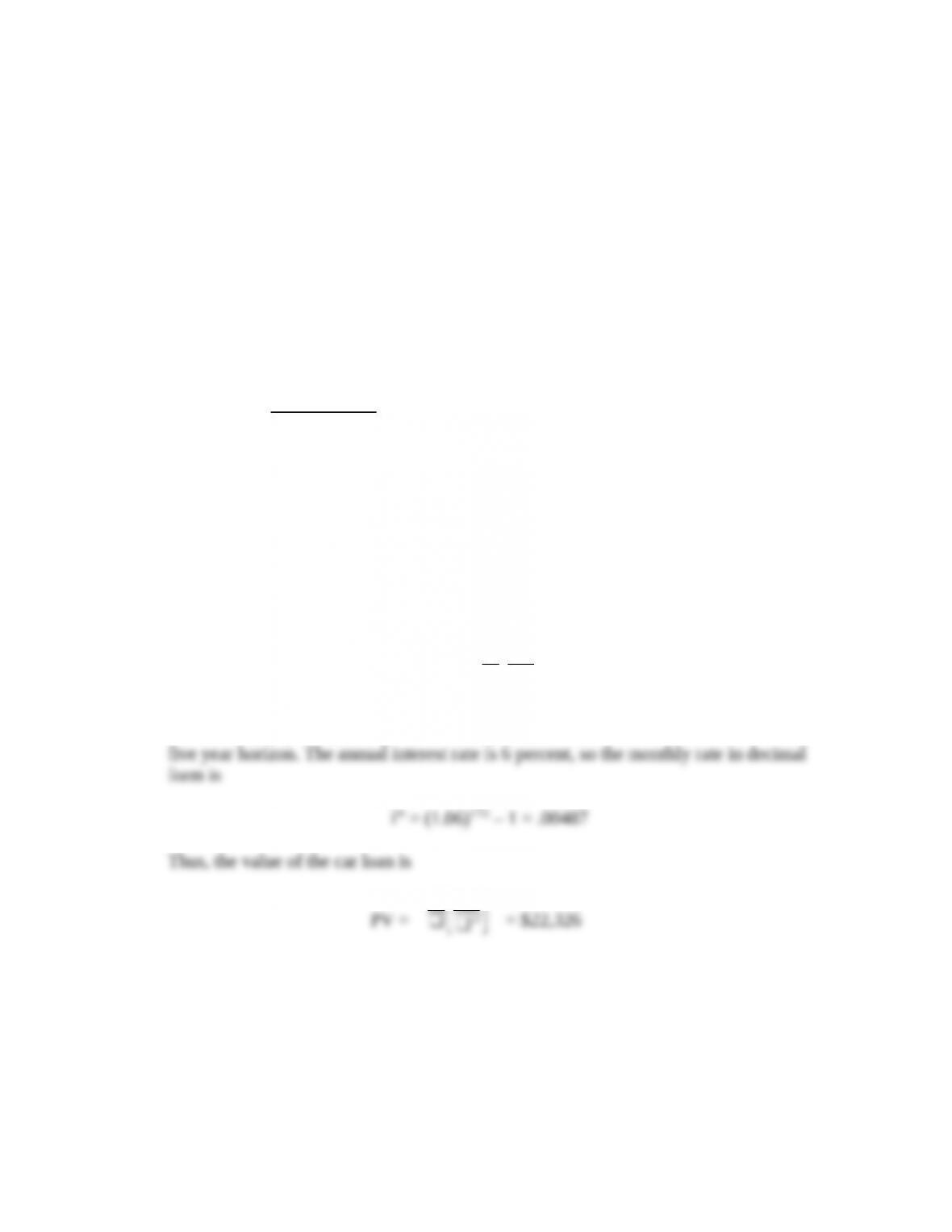
PV =
❑
❑
[
❑
❑❑
]
The monthly payment, C, is given as $430 per month and there are 60 months in the
five year horizon. The annual interest rate is 6 percent, so the monthly rate in decimal
form is
im = (1.06)1/12 – 1 = .00487
Thus, the value of the car loan is
❑
❑
❑❑
3. *Your financial adviser recommends buying a 10-year bond with a face value of
$1,000 and an annual coupon of $80. The current interest rate is 7 percent. What
might you expect to pay for the bond (aside from brokerage fees)? (LO1)
6-1
Copyright © 2015 McGraw-Hill Education. All rights reserved. No reproduction or distribution without the prior written consent of
McGraw-Hill Education.
Chapter 06 – Bonds, Bond Prices, and the Determination of Interest Rates
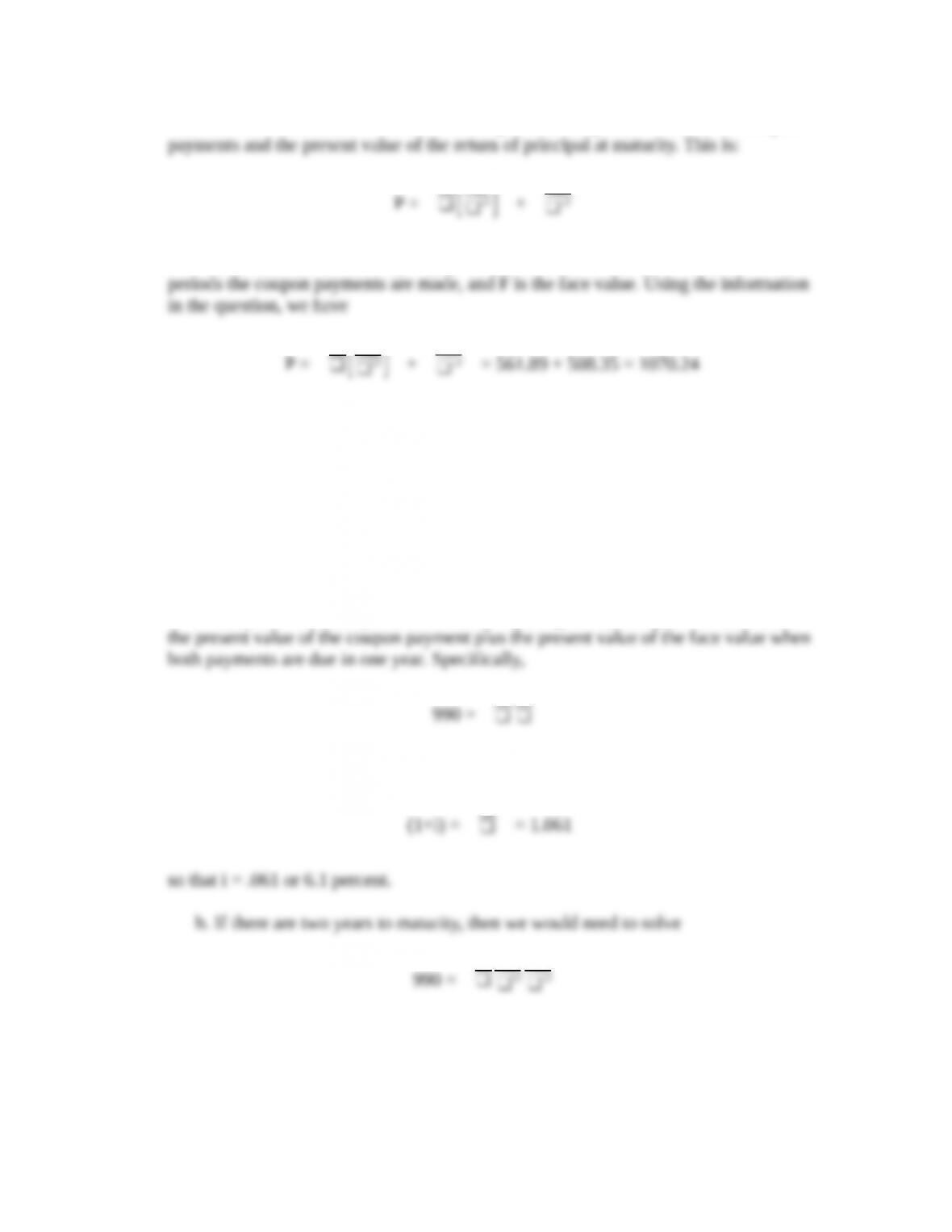
Answer: The value of the bond has two components: the present value of the coupon
❑❑
❑❑
In this expression, C is the coupon payment, i is the interest rate, n is the number of
❑❑
❑❑
4. *Consider a coupon bond with a $1,000 face value and a coupon payment equal to 5
percent of the face value per year. (LO1)
a. If there is one year to maturity, find the yield to maturity if the price of the
bond is $990.
b. Explain why finding the yield to maturity is difficult if there are two years to
maturity and you do not have a financial calculator.
Answer:
a. The yield to maturity can be found by equating the current price of the bond to
❑
Then
❑
❑❑
❑❑
The presence of the quadratic term makes this equation much more time-consuming
to solve without a financial calculator.
6-2
Copyright © 2015 McGraw-Hill Education. All rights reserved. No reproduction or distribution without the prior written consent of
McGraw-Hill Education.
Chapter 06 – Bonds, Bond Prices, and the Determination of Interest Rates
5. Which of these $100 face value one-year bonds will have the highest yield to maturity
and why? (LO2)
a. A 6 percent coupon bond selling for $85.
b. A 7 percent coupon bond selling for $100.
c. An 8 percent coupon bond selling for $115.
Answer:
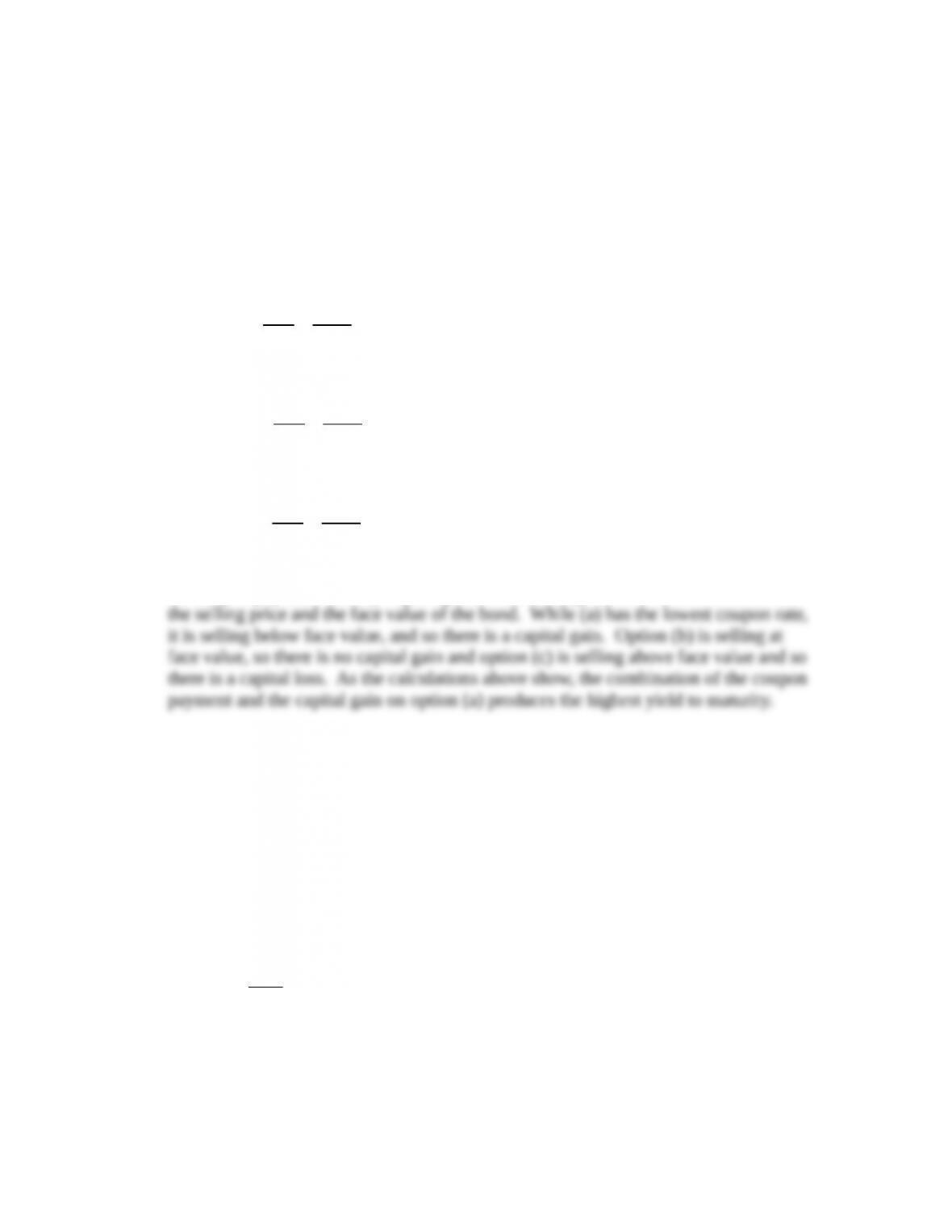
a.
%71.24
1
100$
1
6$
85$
i
ii
b.
%7
1
100$
1
7$
100$
i
ii
c.
%1.6
1
100$
1
8$
115$
i
ii
Option (a) has the highest yield to maturity. The yield to maturity depends both on
the coupon payment and any capital gain or loss arising from the difference between
6. You are considering purchasing a consol that promises annual payments of $4. (LO2)
a. If the current interest rate is 5 percent, what is the price of the consol?
b. You are concerned that the interest rate may rise to 6 percent. Compute the
percentage change in the price of the consol and the percentage change in the
interest rate. Compare them.
c. Your investment horizon is one year. You purchase the consol when the
interest rate is 5 percent and sell it a year later, following a rise in the interest
rate to 6 percent. What is your holding period return?
Answer:
a.
80$
05.0
4$ P
6-3
Copyright © 2015 McGraw-Hill Education. All rights reserved. No reproduction or distribution without the prior written consent of
McGraw-Hill Education.
Chapter 06 – Bonds, Bond Prices, and the Determination of Interest Rates
b.
67.66$
06.0
4$ newP
P falls by 16.7%; i rises by 20%
c.
%7.11
80$
80$67.66$
80$
4$
7. *Suppose you purchase a 3-year, 5-percent coupon bond at par and hold it for two
years. During that time, the interest rate falls to 4 percent. Calculate your annual
holding period return. (LO2)
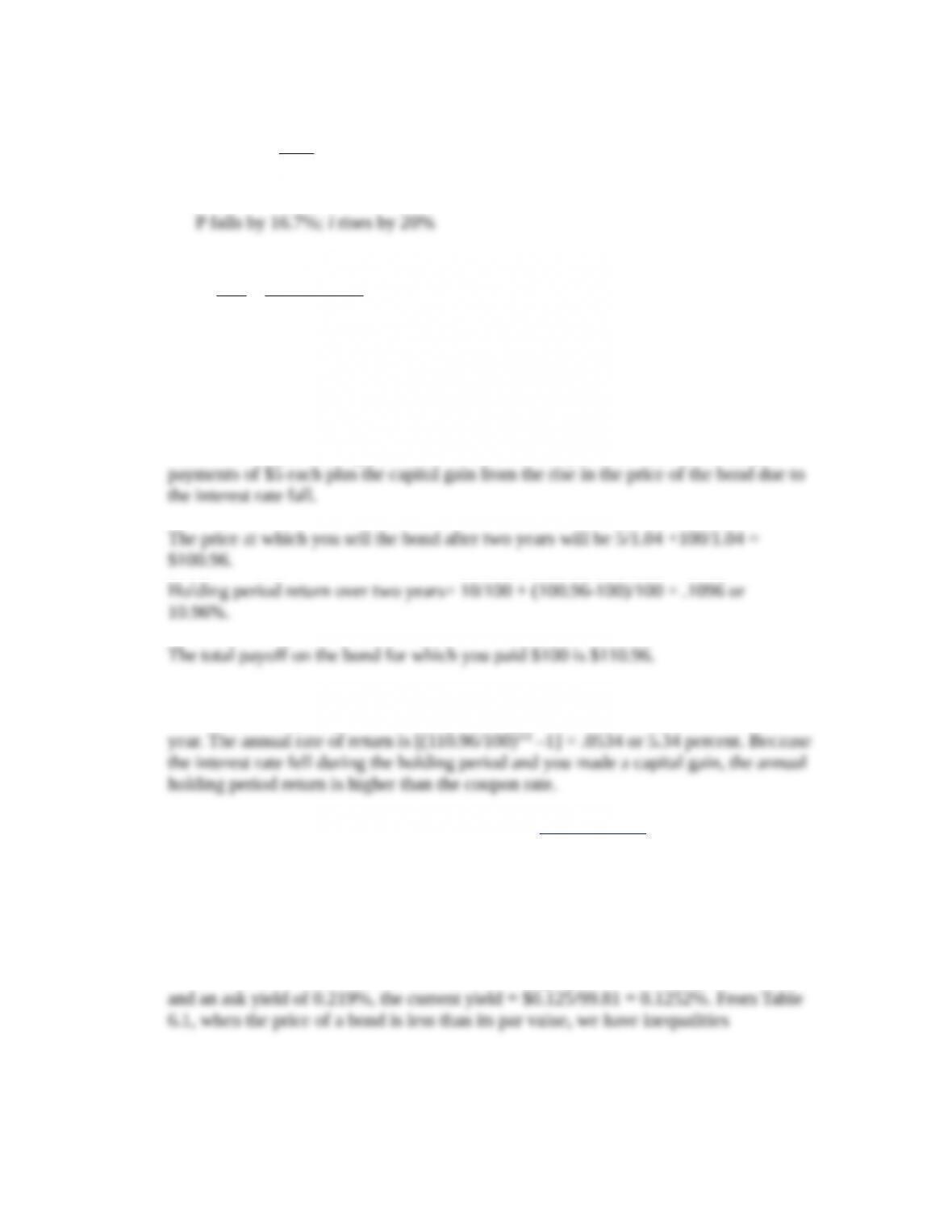
Answer: The total holding period return over the two years consists of two coupon
To calculate the annual rate of return, we refer to the footnote on p. 140. It is
assumed, for simplicity, that the first-year coupon is not reinvested for the second
8. In a recent issue of the Wall Street Journal (or on www.wsj.com or an equivalent
financial Web site), locate the prices and yields on U.S. Treasury issues. For one bond
selling above par and one selling below par (assuming they both exist), compute the
current yield and compare it to the coupon rate and the ask yield printed in the paper.
(LO2)
Answer: (From the Wall Street Journal Market Data Center for May 3, 2013)
a. For a $100 face value, 0.125% note maturing April 2015, with a price of 99.81
coupon rate < current yield < ask yield
6-4
Copyright © 2015 McGraw-Hill Education. All rights reserved. No reproduction or distribution without the prior written consent of
McGraw-Hill Education.
Chapter 06 – Bonds, Bond Prices, and the Determination of Interest Rates
b. For a $100 face value, 3.125% bond maturing Feb 2043, with a price of
9. In a recent issue of the Wall Street Journal (or on www.wsj.com), locate the yields on
government bonds for various countries. Find a country whose 10-year government
bond yield was above that on the U.S. 10-year Treasury bond and one whose 10-year
yield was below the Treasury yield. What might account for these differences in
yields? (LO4)
Answer: (From the Wall Street Journal Market Data Center for May 3, 2013)
The yield on the 10-year U.S. Treasury bond was 1.742% while the 10-year
10. A 10-year zero-coupon bond has a yield of 6 percent. Through a series of unfortunate
circumstances, expected inflation rises from 2 percent to 3 percent. (LO4)
a. Assuming the nominal yield rises in an amount equal to the rise in expected
inflation, compute the change in the price of the bond.
b. Suppose that expected inflation is still 2 percent, but the probability that it will
move to 3 percent has risen. Describe the consequences for the price of the
bond.
Answer:
a. Price (with 2% expected inflation) = 100/(1.06)10 = $55.84
11. As you read the business news, you come across an advertisement for a bond
mutual fund – a fund that pools the investments from a large number of people and
then purchases bonds, giving the individuals “shares” in the fund. The company
claims their fund has had a return of 13½ percent over the last year. But you
remember that interest rates have been pretty low – 5 percent at most. A quick
check of the numbers in the business section you’re holding tells you that your
6-5
Copyright © 2015 McGraw-Hill Education. All rights reserved. No reproduction or distribution without the prior written consent of
McGraw-Hill Education.
Chapter 06 – Bonds, Bond Prices, and the Determination of Interest Rates
recollection is correct. Explain the logic behind the mutual fund’s claim in the
advertisement. (LO2)
Answer: There are two possible explanations for the high return. The first is that
Remember that when interest rates fall, the prices of bonds rise, giving the owner a
12. You are sitting at the dinner table and your father is extolling the benefits of
investing in bonds. He insists that as a conservative investor he will only make
investments that are safe, and what could be safer than a bond, especially a U.S.
Treasury bond? What accounts for his view of bonds? Explain why you think it is
right or wrong. (LO4)
Answer: Like most people, your father believes that the government guarantee
means that he will get his investment back. He’s right that the U.S. Treasury is
13. *Consider a one-year, 10-percent coupon bond with a face value of $1,000 issued
by a private corporation. The one-year risk-free rate is 10 percent. The
corporation has hit on hard times, and the consensus is that there is a 20 percent
probability that it will default on its bonds. If an investor were willing to pay at
most $775 for the bond, is that investor risk-neutral or risk averse? (LO4)
Answer: If the bond were risk free, it would pay off $1,100 in one year’s time – $100
coupon payment and $1,000 face value of the bond.
6-6
Copyright © 2015 McGraw-Hill Education. All rights reserved. No reproduction or distribution without the prior written consent of
McGraw-Hill Education.
Chapter 06 – Bonds, Bond Prices, and the Determination of Interest Rates
14. If, after one year, the yield to maturity on a multi-year coupon bond that was
issued at par is higher than the coupon rate, what happened to the price of the bond
during that first year? (LO2)
Answer: The price of the bond fell below par. When a bond is at par, the yield to
maturity equals the coupon rate. If the yield to maturity rises, the price of the
15. Use your knowledge of bond pricing to explain under what circumstances you
would be willing to pay the same price for a consol that pays $5 a year forever and
a 5-percent, 10-year coupon bond with a face value of $100 that only makes
annual coupon payments for 10 years. (LO1)
Answer: The price you are willing to pay for a bond reflects the present value of
the payment flows from the bond. In this case, if i = 5%, the present value of the
payment flows for both these bonds would be $100. Intuitively, while the consol
16. *You are about to purchase your first home and receive an advertisement regarding
adjustable-rate mortgages (ARMs). The interest rate on the ARM is lower than
that on a fixed rate mortgage. The advertisement mentions that there would be a
payment cap on your monthly payments and you would have the option to convert
to a fixed-rate mortgage. You are tempted. Interest rates are currently low by
historical standards and you are anxious to buy a house and stay in it for the long
term. Why might an ARM not be the right mortgage for you? (LO4)
Answer: There are several factors to consider. First, with a fixed rate mortgage, your
payments are fixed over the life of the loan. The interest rate on this mortgage is
higher because the lender is assuming the interest rate risk. The ARM has a lower
interest rate in part because you will assume risk associated with interest rate
6-7
Copyright © 2015 McGraw-Hill Education. All rights reserved. No reproduction or distribution without the prior written consent of
McGraw-Hill Education.
Chapter 06 – Bonds, Bond Prices, and the Determination of Interest Rates
17. Use the model of supply and demand for bonds to illustrate and explain the impact
of each of the following on the equilibrium quantity of bonds outstanding and on
equilibrium bond prices and yields: (LO3)
a. A new Web site is launched facilitating the trading of corporate bonds with
much more ease than before.
b. Inflationary expectations in the economy fall evoking a much stronger
response from issuers of bonds than investors in bonds.
c. The government removes tax incentives for investment and spends additional
funds on a new education program. Overall, the changes have no effect on the
government’s financing requirements.
d. All leading indicators point to stronger economic growth in the near future.
The response of bond issuers dominates that of bond purchasers.
6-8
Copyright © 2015 McGraw-Hill Education. All rights reserved. No reproduction or distribution without the prior written consent of
McGraw-Hill Education.
Chapter 06 – Bonds, Bond Prices, and the Determination of Interest Rates
Answer:
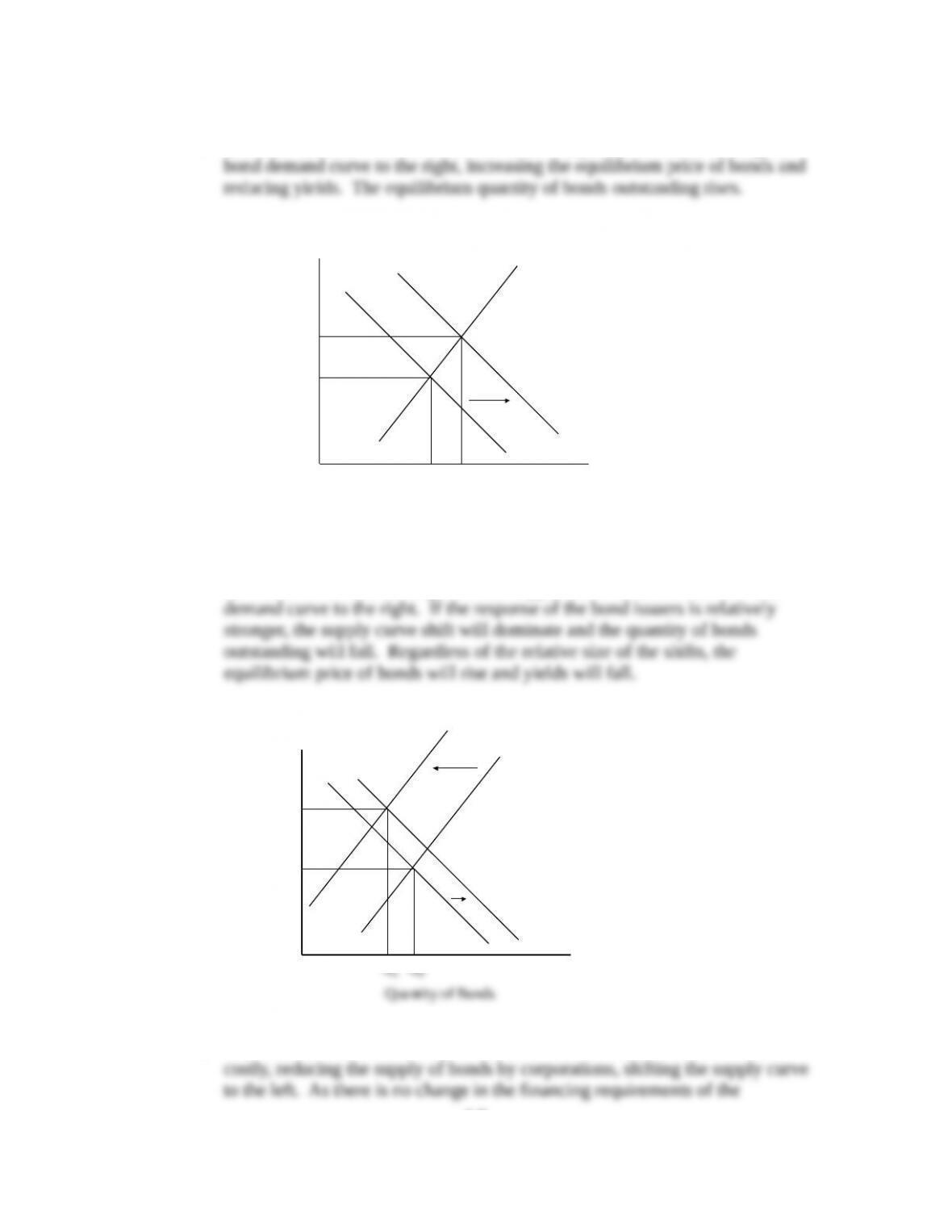
a. The new web site would increase the relative liquidity of bonds, shifting the
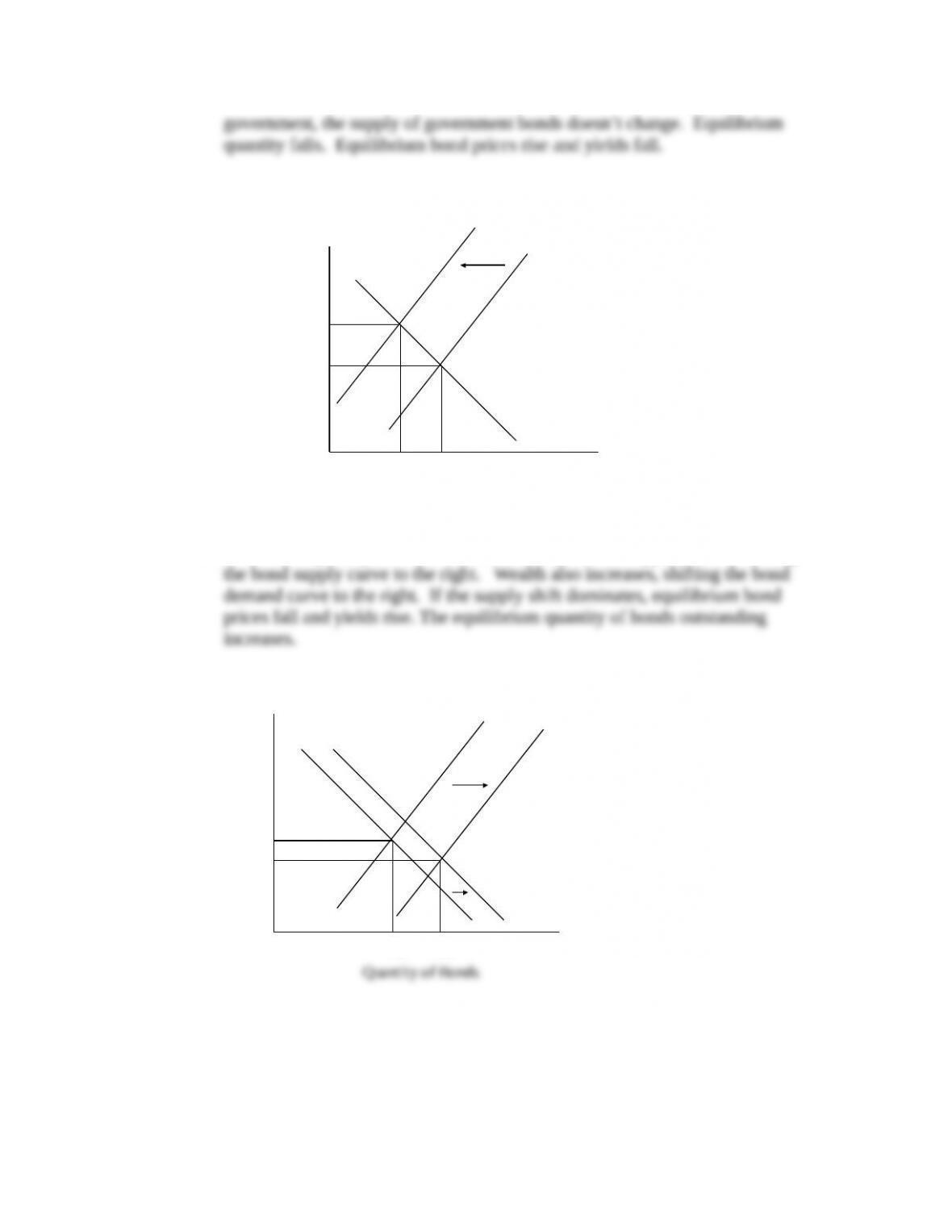
b. For a given nominal interest rate, a fall in inflationary expectations increases
the real interest rate, shifting the bond supply curve to the left and the bond
Price of Bonds
Quantity of Bonds
D0
D1
S
P0
P1
Q1
Q0
Price of Bonds
D0D1
S0
P0
P1
S1
Q0
Q1
Chapter 06 – Bonds, Bond Prices, and the Determination of Interest Rates
d. A business cycle upturn increases business investment opportunities, shifting
Price of Bonds
Quantity of Bonds
D0
S0
P0
P1
S1
Q0
Q1
Price of Bonds
D0D1
S0
P0
P1
S1
Q0Q1