Chapter 10 – Foreign Exchange
Chapter 10
Foreign Exchange
Conceptual and Analytical Problems
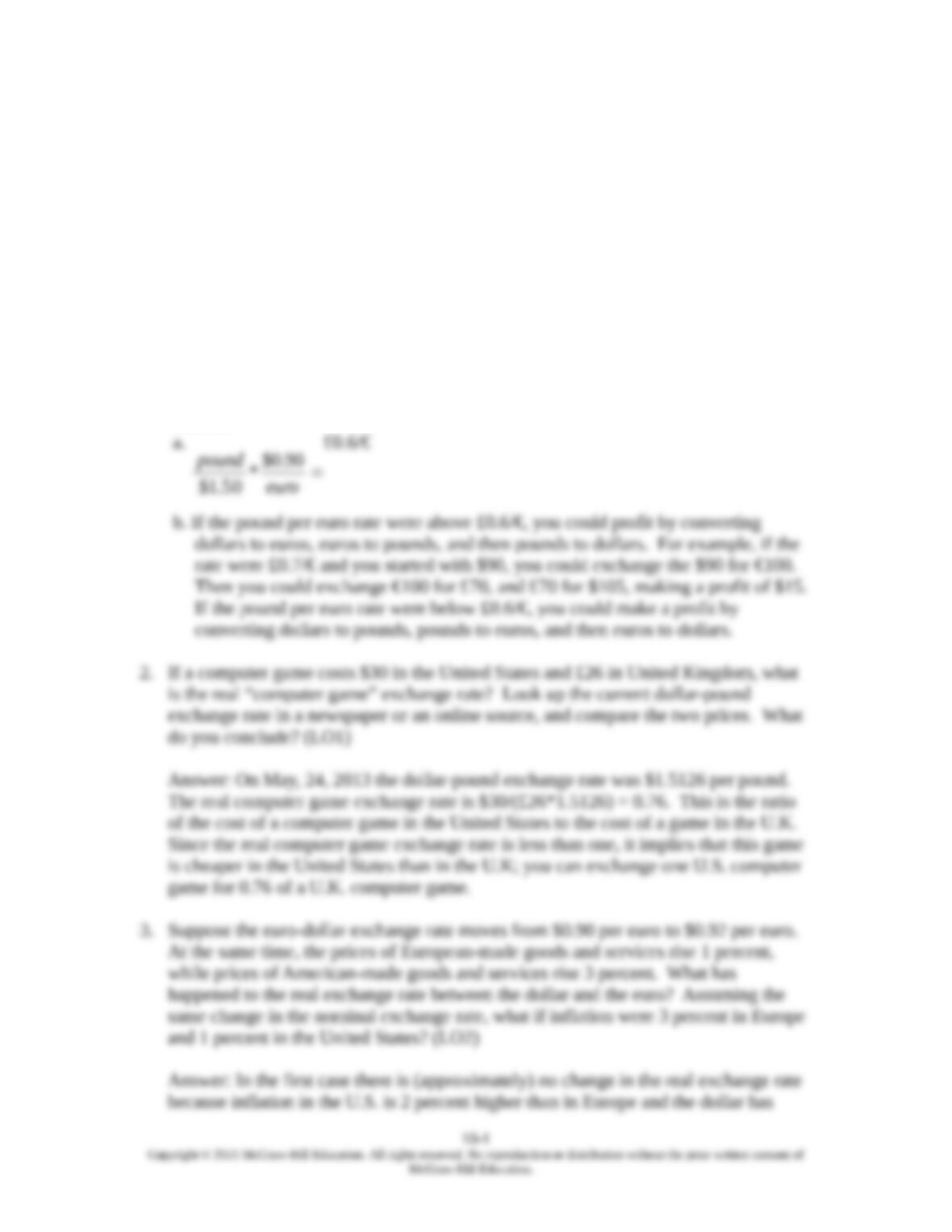
1. If the U.S. dollar-British pound exchange rate is $1.50 per pound, and the U.S.
dollar-euro rate is $0.90 per euro: (LO1)
a. What is the pound per euro rate?
b. How could you profit if the pound per euro rate were above the rate you
calculated in part a? What if it were lower?
Answer:
2. If a computer game costs $30 in the United States and £26 in United Kingdom, what
is the real “computer game” exchange rate? Look up the current dollar-pound
exchange rate in a newspaper or an online source, and compare the two prices. What
do you conclude? (LO1)
Answer: On May, 24, 2013 the dollar-pound exchange rate was $1.5126 per pound.
The real computer game exchange rate is $30/(£26*1.5126) = 0.76. This is the ratio
3. Suppose the euro-dollar exchange rate moves from $0.90 per euro to $0.92 per euro.
At the same time, the prices of European-made goods and services rise 1 percent,
while prices of American-made goods and services rise 3 percent. What has
happened to the real exchange rate between the dollar and the euro? Assuming the
same change in the nominal exchange rate, what if inflation were 3 percent in Europe
and 1 percent in the United States? (LO2)
Answer: In the first case there is (approximately) no change in the real exchange rate
because inflation in the U.S. is 2 percent higher than in Europe and the dollar has
10-1
Copyright © 2015 McGraw-Hill Education. All rights reserved. No reproduction or distribution without the prior written consent of
McGraw-Hill Education.
Chapter 10 – Foreign Exchange
Chapter 10 – Foreign Exchange
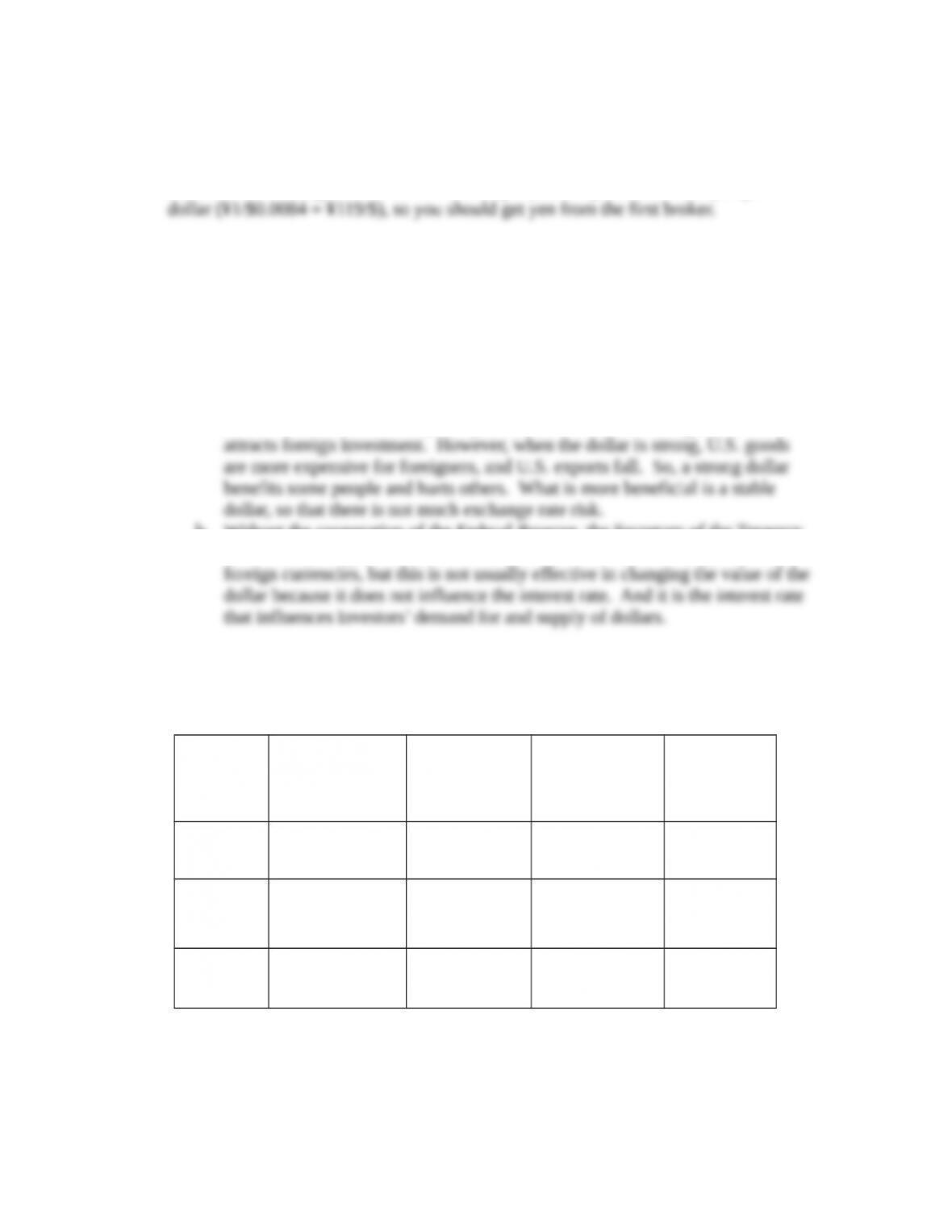
market convention, quoted a price of 0.0084 dollars per yen. To which broker should
you give your business? Why? (LO1)
Answer: An exchange rate of 0.0084 dollars per yen is equivalent to 119 yen per
8. During the 1990s, the U.S. Secretary of the Treasury often stated, “a strong dollar is
in the interest of the United States.” (LO4)
a. Is this statement true? Explain your answer.
b. What can the Secretary of the Treasury actually do about the value of the
dollar relative to other currencies?
Answer:
a. When the dollar is strong, foreign goods are relatively cheap for consumers in
the United States. This helps keep inflation in check. A strong dollar also
b. Without the cooperation of the Federal Reserve, the Secretary of the Treasury
can’t do anything about the value of the dollar. He or she can buy and sell
9. The following table gives selective data on nominal exchange rates, price levels,
and real exchange rates for Country A and several other countries. Country A uses the
dollar (A$) as its currency. Fill in the blanks in the table. (LO1)
Nominal
Exchange Rate
(A$ per unit of
other currency)
Price Level in
Country A
Price Level in
Other Country
Real
Exchange
Rate
Country
B
$1.25 per unit
of currency B 114.5 88.3
Country
C114.5 95.6 1.23
Country
D
$0.55 per unit
of currency D 114.5 0.80
10-3
Copyright © 2015 McGraw-Hill Education. All rights reserved. No reproduction or distribution without the prior written consent of
McGraw-Hill Education.
Chapter 10 – Foreign Exchange
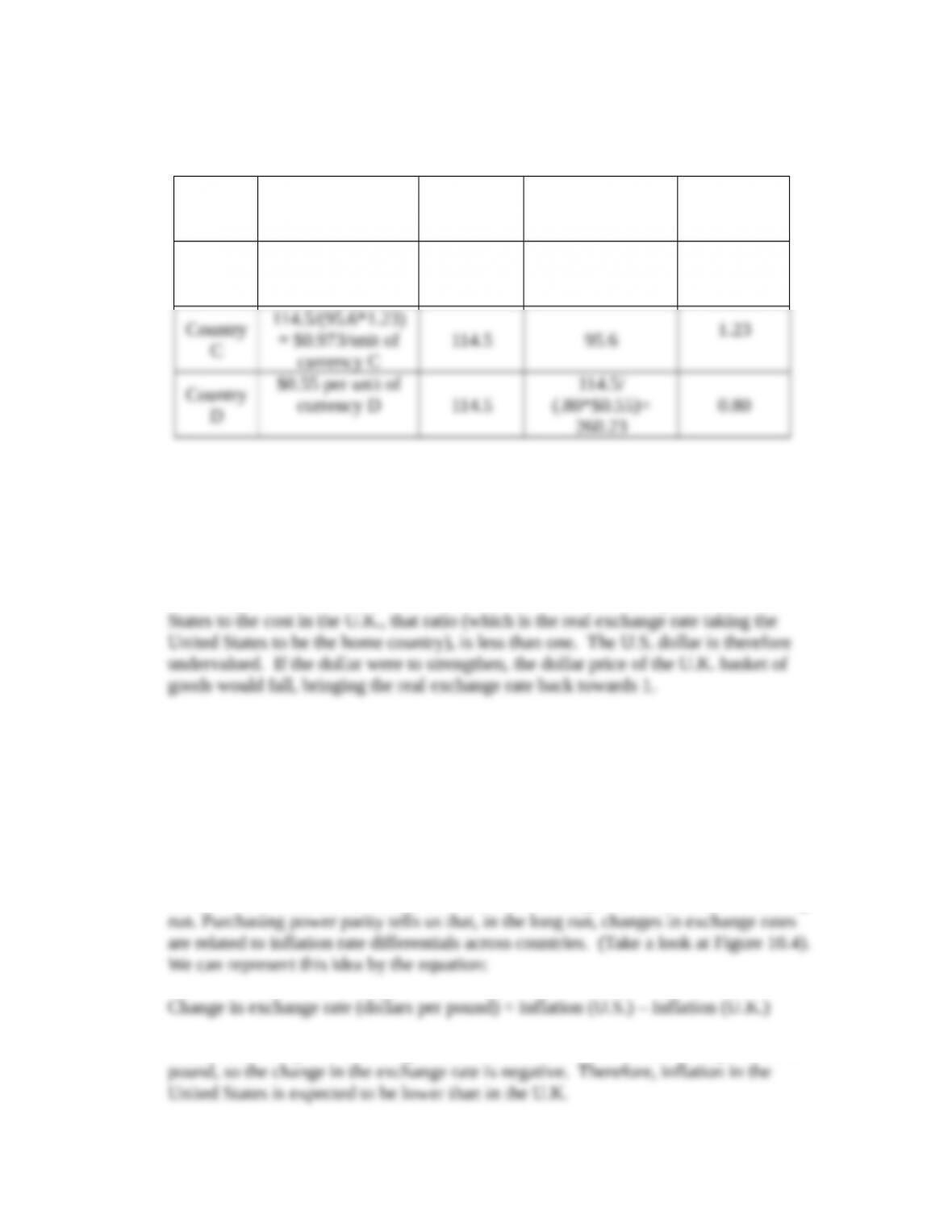
Answer:
Nominal Exchange
Rate (A$ per unit
of other currency)
Price Level
in Country
A
Price Level in
Other Country
Real
Exchange
Rate
Country
B
$1.25 per unit of
currency B 114.5 88.3
114.5/
(88.3*1.25)
= 1.04
D
260.23
10. If the price (measured in a common currency) of a particular basket of goods is 10
percent higher in the U.K. than it is in the United States, which country’s currency is
undervalued, according to the theory of purchasing power parity? (LO2)
Answer: According to the theory of purchasing power parity, the real exchange rate
should equal 1. If we look at the ratio of the cost of the basket of goods in the United
11. *You hear an interview with a well-known economist who states that she expects
the U.S. dollar to strengthen against the British pound over the next five to ten years.
This economist is known for her support of the theory of purchasing power parity.
Using an equation to summarize the relationship predicted by purchasing power
parity between exchange-rate movements and the inflation rates in the two countries,
explain whether you expect inflation in the United States to be higher or lower on
average compared with that in the U.K. over the period in question. (LO2)
Answer: The economist’s comments were about exchange rate movements in the long
If the dollar is expected to strengthen, this means it takes fewer dollars to purchase a
10-4
Copyright © 2015 McGraw-Hill Education. All rights reserved. No reproduction or distribution without the prior written consent of
McGraw-Hill Education.
Chapter 10 – Foreign Exchange
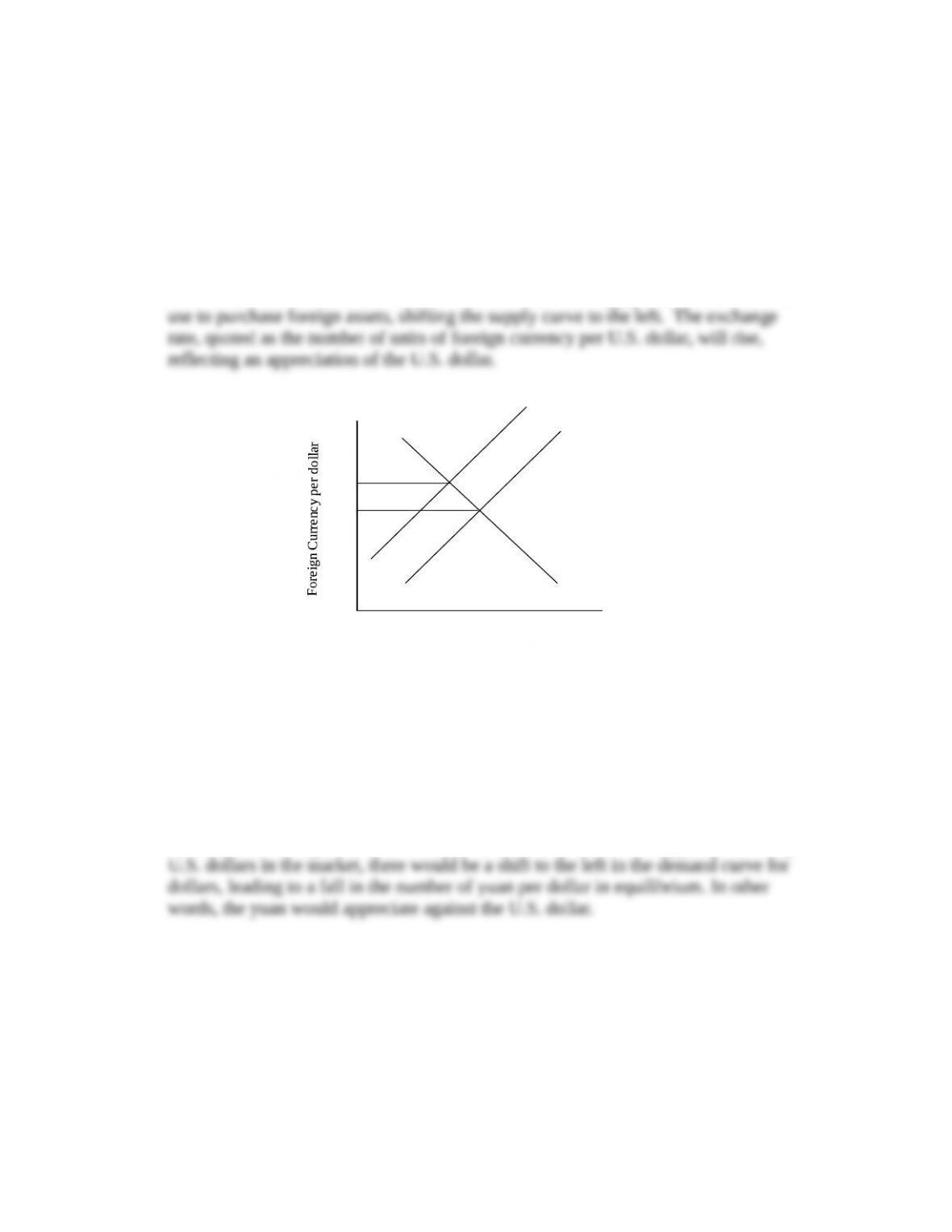
12. Using the model of demand and supply for U.S. dollars, what would you expect to
happen to the U.S. dollar exchange rate if, in light of a worsening geopolitical
situation, Americans viewed foreign bonds as more risky than before? (You should
quote the exchange rate as number of units of foreign currency per U.S. dollar.)
(LO3)
Answer: If Americans view foreign bonds as more risky than before, they will reduce
their demand for these bonds. There will be a fall in the supply of dollars Americans
Quantity of dollars traded
E0
S0
D0
S1
E1
13. Suppose that the Chinese central bank has been intervening in the foreign
exchange market, buying U.S. dollars in an effort to keep its own currency, the yuan,
weak. Use the model of demand and supply for dollars to show what the immediate
effect would be on the yuan/dollar exchange rate of a decision by China to allow its
currency to float freely. (LO3)
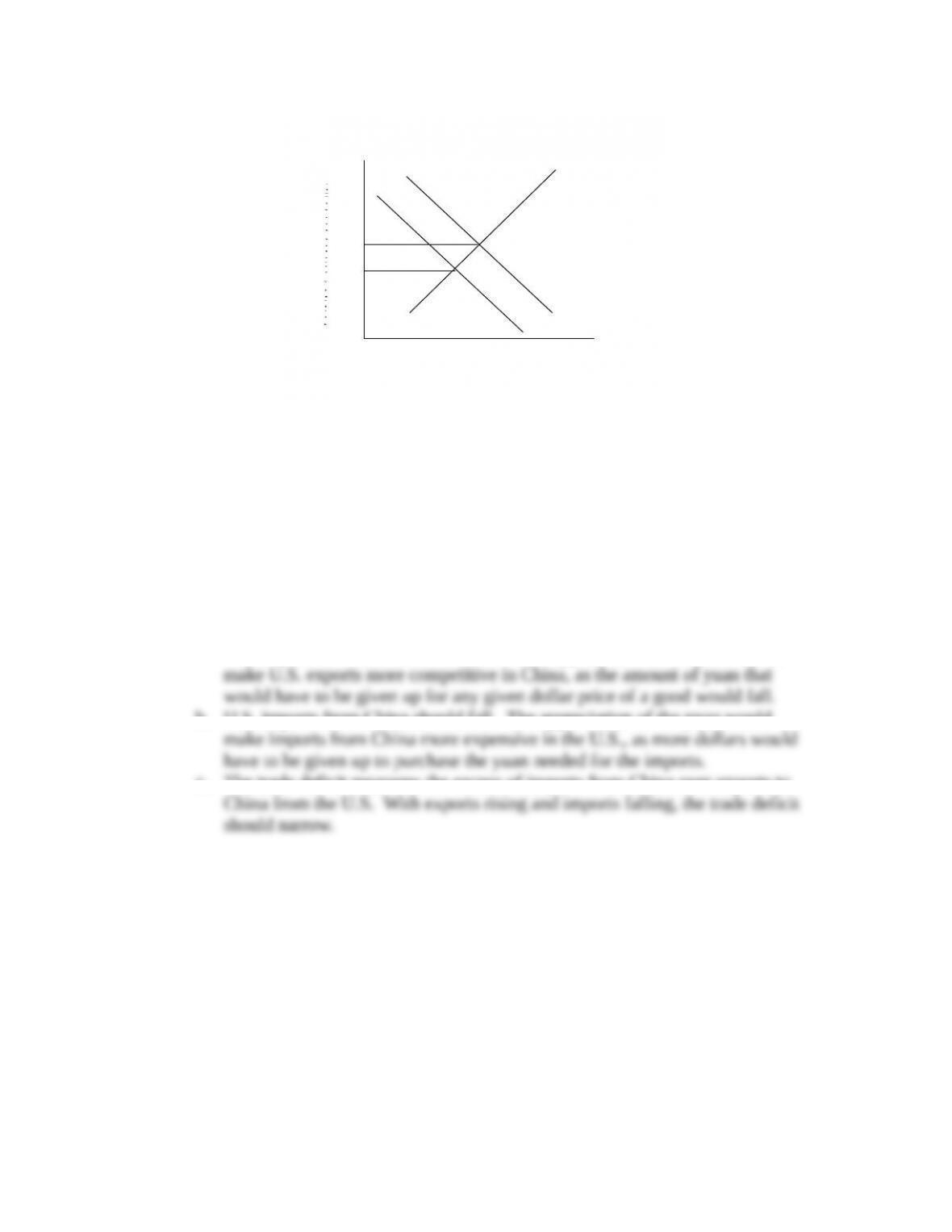
Answer: Suppose initially that the Chinese central bank had maintained the exchange
rate at E0 in the diagram below. If the Chinese central bank then stopped purchasing
10-5
Copyright © 2015 McGraw-Hill Education. All rights reserved. No reproduction or distribution without the prior written consent of
McGraw-Hill Education.
Chapter 10 – Foreign Exchange
Q u a n t i t y o f d o l l a r s t r a d e d
E
0
S
0
D
0
E
1
D
1
14. Consider again the situation described in Problem 13 where China decided to
allow the yuan to float. What would you expect to happen to
a. U.S. exports to China
b. U.S. imports from China
c. the U.S. trade deficit with China
Explain your answers. (LO4)
Answer: If the yuan is undervalued and is allowed to float freely, market forces will
cause the yuan to appreciate. Thus,
a. U.S. exports to China should increase. The appreciation of the yuan would
b. U.S. imports from China should fall. The appreciation of the yuan would
c. The trade deficit measures the excess of imports from China over exports to
15. Use the model of demand for and supply of foreign currency to analyze the
following scenarios: (LO3)
a. Impressed with the magnificent scenery from Vancouver during the coverage
of the Winter Olympics, French and German tourists flock to the west coast of
Canada. Explain the impact on the euro-Canadian dollar exchange rate in the
short run.
b. Driven by waves of national pride, consumers across the world (including in
the United States), decide to buy home-produced products where possible.
Explain how the demand and supply for dollars would be affected? What can
you say about the impact on the equilibrium dollar exchange rate?
10-6
Copyright © 2015 McGraw-Hill Education. All rights reserved. No reproduction or distribution without the prior written consent of
McGraw-Hill Education.
Chapter 10 – Foreign Exchange
Answer:
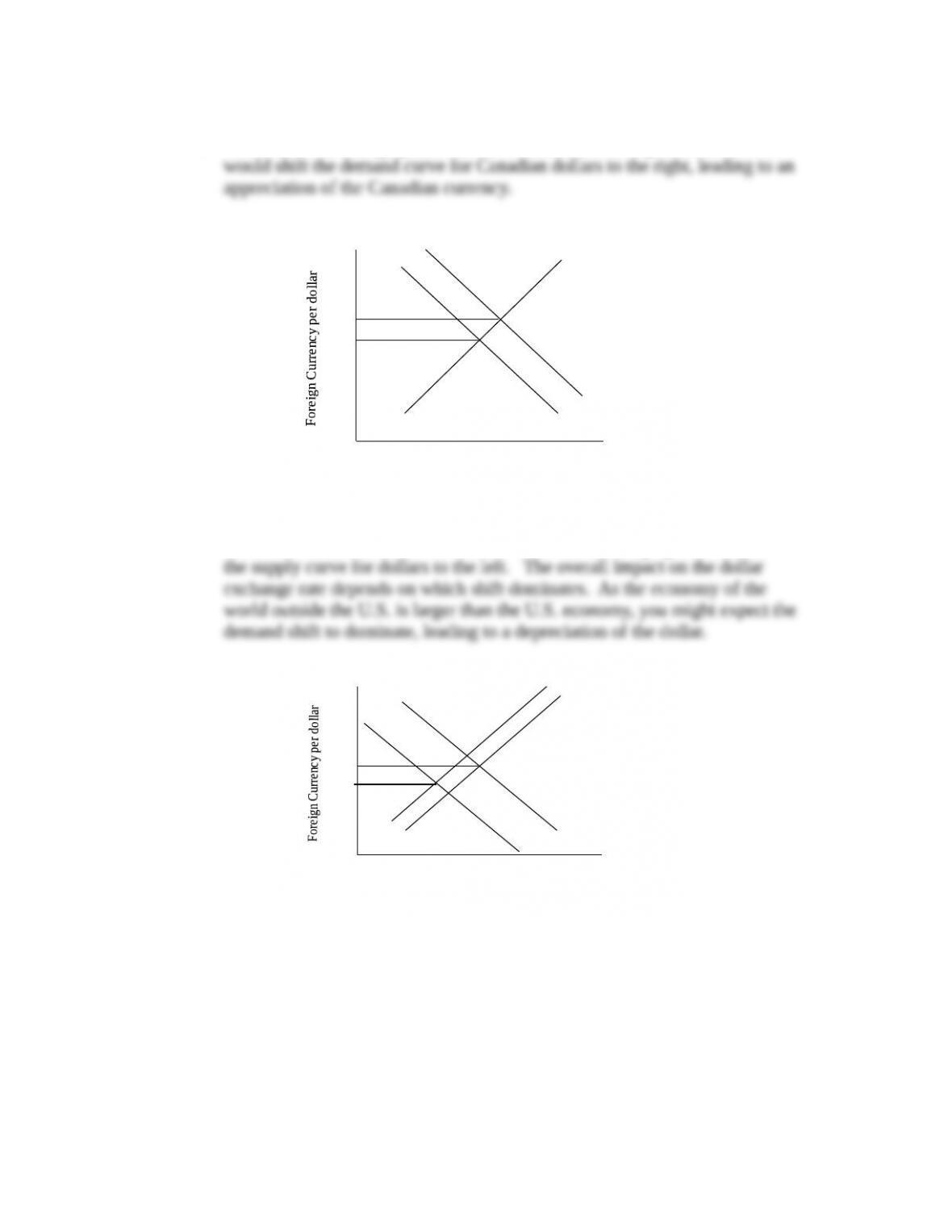
a. The increase in foreign preferences for Canadian tourist goods and services
Quantity of dollars traded
E0
S0
D0
E1
D1
b. A fall in foreign demand for U.S. goods would shift the demand curve for
dollars to the left while the fall in U.S. demand for foreign goods would shift
Quantity of dollars traded
E
0
S
0
D
0
E
1
D
1
S
1
10-7
Copyright © 2015 McGraw-Hill Education. All rights reserved. No reproduction or distribution without the prior written consent of
McGraw-Hill Education.