Chapter 02 – Money and the Payments System
Chapter 2
Money and the Payments System
Conceptual and Analytical Problems
1. Describe at least three ways you could pay for your morning cup of coffee. What are
the advantages and disadvantages of each? (LO2)
Answer: You could use money, a check, or a debit card.
Money: This is the most likely to be accepted, but it means you have to replenish
your supply periodically.
2. You are the owner of a small sandwich shop. A buyer may offer one of several
payment methods: cash, a check drawn on a bank, a credit card, or a debit card.
Which of these is the least costly for you? Explain why the others are more
expensive. (LO2)
Answer: Cash is the cheapest option for the merchant; no information is required
about the buyer and no additional costs are imposed (though the merchant may need
Even with appropriate identification, the merchant does not know if funds are actually
available in the check writer’s account. If not, the merchant will likely undergo a
3. Explain how money encourages specialization, and how specialization improves
everyone’s standard of living. (LO3)
Answer: Without money, people have to barter to exchange goods and services. This
requires a “double coincidence of wants,” which makes it difficult to specialize. In
2-1
Copyright © 2015 McGraw-Hill Education. All rights reserved. No reproduction or distribution without the prior written consent of
McGraw-Hill Education.
Chapter 02 – Money and the Payments System
4. *Could the dollar still function as the unit of account in a totally cashless society?
(LO2)
Answer: Yes. Using dollars and cents to quote prices and record debts does not
5. Give four examples of ACH transactions you might make. (LO2)
Answer:
a. You receive your paycheck as an electronic transfer from your employer’s
b. You schedule your monthly electric bill payment to be made automatically.
d. You make your monthly car payment by arranging for the amount to be deducted
6. As of July 2013, 17 of the 28 countries of the European Union have adopted the euro.
The remaining 11 countries, including Great Britain, Denmark, and Sweden have
retained their own currencies. What are the advantages of a common currency for
someone who is traveling through Europe? (LO1)
Answer: Each country has the same unit of account, making it easier for a traveler to
7. Why might each of the following commodities not serve well as money? (LO2)
a. Tomatoes
b. Bricks
c. Cattle
Answer:
a. Tomatoes are perishable and thus would not serve as a store of value.
2-2
Copyright © 2015 McGraw-Hill Education. All rights reserved. No reproduction or distribution without the prior written consent of
McGraw-Hill Education.
Chapter 02 – Money and the Payments System
8. Despite the efforts of the United States Treasury and the Secret Service, someone
discovers a cheap way to counterfeit $100 bills. What will be the impact of this
discovery on the economy? (LO3)
Answer: People will be unwilling to accept $100 bills as payment and will require
payment via check, credit card, debit card, or electronic transfer instead, all of which
9. You receive a check drawn on another bank and deposit it into your checking account.
Even though this is a “demand deposit” the funds are not immediately available for
your use. Why? Would your answer change if the check is drawn on the account of
another customer of your own bank? (LO2)
Answer: Funds drawn on another bank are not immediately available (i.e., “on
demand”) until the funds are transferred through the check-clearing process. So, when
10. Over a nine-year period in the 16th century, King Henry VIII reduced the silver
content of the British pound to one-sixth its initial value. Why do you think he did
so? What do you think happened to the use of pounds as a means of payment? If you
held both the old and new pounds, which would you use first, and why? (LO1)
Answer: King Henry needed to silver to pay for wars. The use of pounds as a means
11. Under what circumstances might you expect barter to reemerge in an economy that
has fiat money as a means of payment? Can you think of an example of a country
where this has happened recently? (LO3)
Answer: You might expect an economy to revert to barter when the public loses
confidence in the fiat money issued by the government, perhaps because of over-use
12. You visit a tropical island that has only four goods in its economy – oranges,
pineapples, coconuts and bananas. There is no money in this economy. (LO1)
2-3
Copyright © 2015 McGraw-Hill Education. All rights reserved. No reproduction or distribution without the prior written consent of
McGraw-Hill Education.
Chapter 02 – Money and the Payments System
a. Draw a grid showing all the prices for this economy. (You should check your
answer using the n(n – 1)/2 formula where n is the number of goods.)
b. An islander suggests designating oranges as the means of payment and unit of
account for the economy. How many prices would there be if her suggestion
were followed?
c. Do you think the change suggested in part b is worth implementing? Why or
why not?
Answer:
a. There would be six prices in total.
Oranges Pineapples Coconuts Banana
s
Oranges
s
ts
b. There would be three prices – pineapples/oranges, coconuts/oranges and
banana/oranges.
c. In the case of this four-good economy, there is only a small gain by using
oranges as a unit of account. The gains would be significantly bigger in an
13. Consider again the tropical island described in Problem 12. Under what
circumstances would you recommend the issue of a paper currency by the
government of the island? What advantages might this strategy have over the use of
oranges as money? (LO1)
Answer: The Islanders must have enough confidence in their government to accept
notes backed only by a government decree that have no intrinsic value themselves.
The have to believe that these notes will be widely accepted by other islanders as
2-4
Copyright © 2015 McGraw-Hill Education. All rights reserved. No reproduction or distribution without the prior written consent of
McGraw-Hill Education.
Chapter 02 – Money and the Payments System
14. What factors should you take into account when considering using the following
assets as stores of value? (LO1)
a. Gold
b. Real estate
c. Stocks
d. Government bonds
Answer:
a. The potential for the price of gold to rise, the ability to buy and sell gold easily
b. The rate at which real estate is appreciating and is likely to appreciate in the
c. The potential appreciation in nominal value of the stock; the historical volatility
d. The rate of return on the bonds – including any potential capital gain as well as
15. *Under what circumstances might money in the form of currency be the best option
as a store of value? (LO3)
Answer: If there were deflation in the economy, then paper currency would increase
in value. When deflation occurs, overall prices in the economy are falling and so the
16. Suppose a significant fall the price of certain stocks caused the market makers in
those stocks to experience difficulties with their funding liquidity. Under what
circumstances might that development lead to liquidity problems in markets for other
assets? (LO1)
Answer: Faced with difficulties in borrowing money, the market makers in the stocks
may decide to hold more cash to ensure their ability to meet clients’ demands. This,
2-5
Copyright © 2015 McGraw-Hill Education. All rights reserved. No reproduction or distribution without the prior written consent of
McGraw-Hill Education.
Chapter 02 – Money and the Payments System
17. *Consider an economy that only produces and consumes two goods – food and
apparel. Suppose the inflation rate based on the consumer price index is higher
during the year than that based on the GDP deflator. Assuming underlying tastes and
preferences in the economy stay the same, what can you say about food and apparel
price movements during the year? (LO3)
Answer: Since the two price indices yield different inflation rates with preferences
remaining constant, the relative price of the two goods must have changed. In other
18. Assuming no interest is paid on checking accounts, what would you expect to see
happen to the relative growth rates of M1 and M2 if interest rates rose significantly?
(LO3)
Answer: When interest rates rise, you would expect that people would shift funds
from checking accounts into savings accounts, as the opportunity cost of holding
19. If money growth is related to inflation, what would you expect to happen to the
inflation rates of countries that join a monetary union and adopt a common currency
such as the euro? (LO3)
Answer: Once countries join a monetary union, they effectively share a common
Data Exploration
1. Find the most recent level of M2 (FRED code: M2SL) and of the U.S. population
(FRED code: POP). Compute the quantity of money divided by the population. Do
you think your answer is large? Why? (Hint: At the FRED Web site,
http://research.stlouisfed.org/fred2/, type “M2SL” in the search box at the top right
and find the most recent observation above the graph. Repeat for “POP.”)
Answer: In March 2013, the value of M2 was $10,447 billion. The total population
was 315.8 million, resulting in M2 per capita of $33,081. This seems like a lot, but
2-6
Copyright © 2015 McGraw-Hill Education. All rights reserved. No reproduction or distribution without the prior written consent of
McGraw-Hill Education.
Chapter 02 – Money and the Payments System
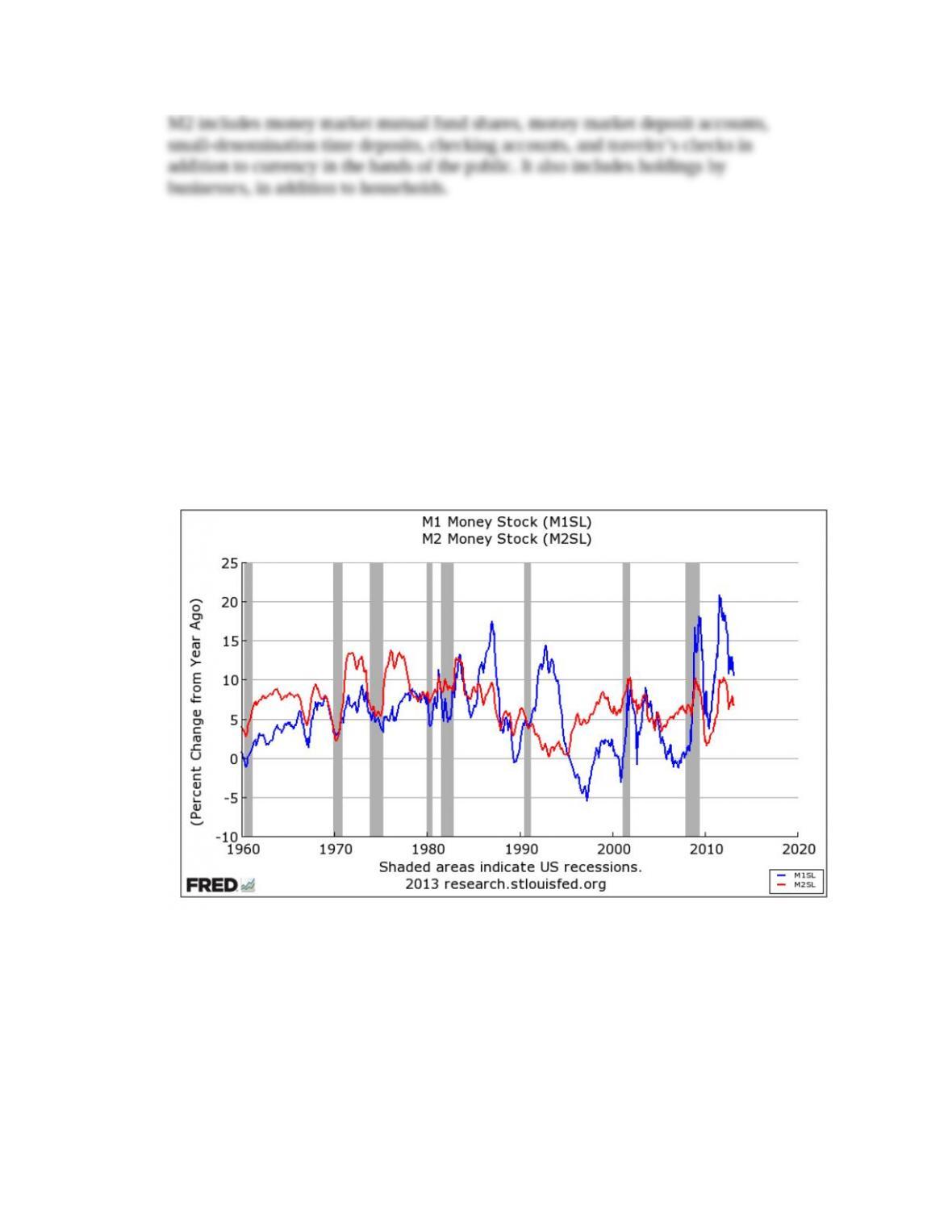
2. Reproduce Figure 2.3 from 1960 to the present, showing the percent change from a
year ago of M1 (FRED code: M1SL) and M2 (FRED code: M2SL). Comment on the
pattern over the last five years. Would it matter which of the two monetary
aggregates you looked at? (LO3) (Hints: At the FRED Web site, select “Data Tools”
and then “Create Your Own Graphs.” In the search box under “Add Data Series,”
type in the code for M1 (M1SL). At the “Units” dropdown box, select “Percentage
Change from Year Ago” and then the “Redraw Graph” button. To add M2, select
“Add Data Series,” and type in “M2SL” in the search box. Change the start date by
selecting the first date in the “Observation Date Range” and choosing the year 1960,
click “Copy to All Lines”, and then the “Redraw Graph” button.)
Answer: Following the directions given, the data plot of Figure 2.3 is:
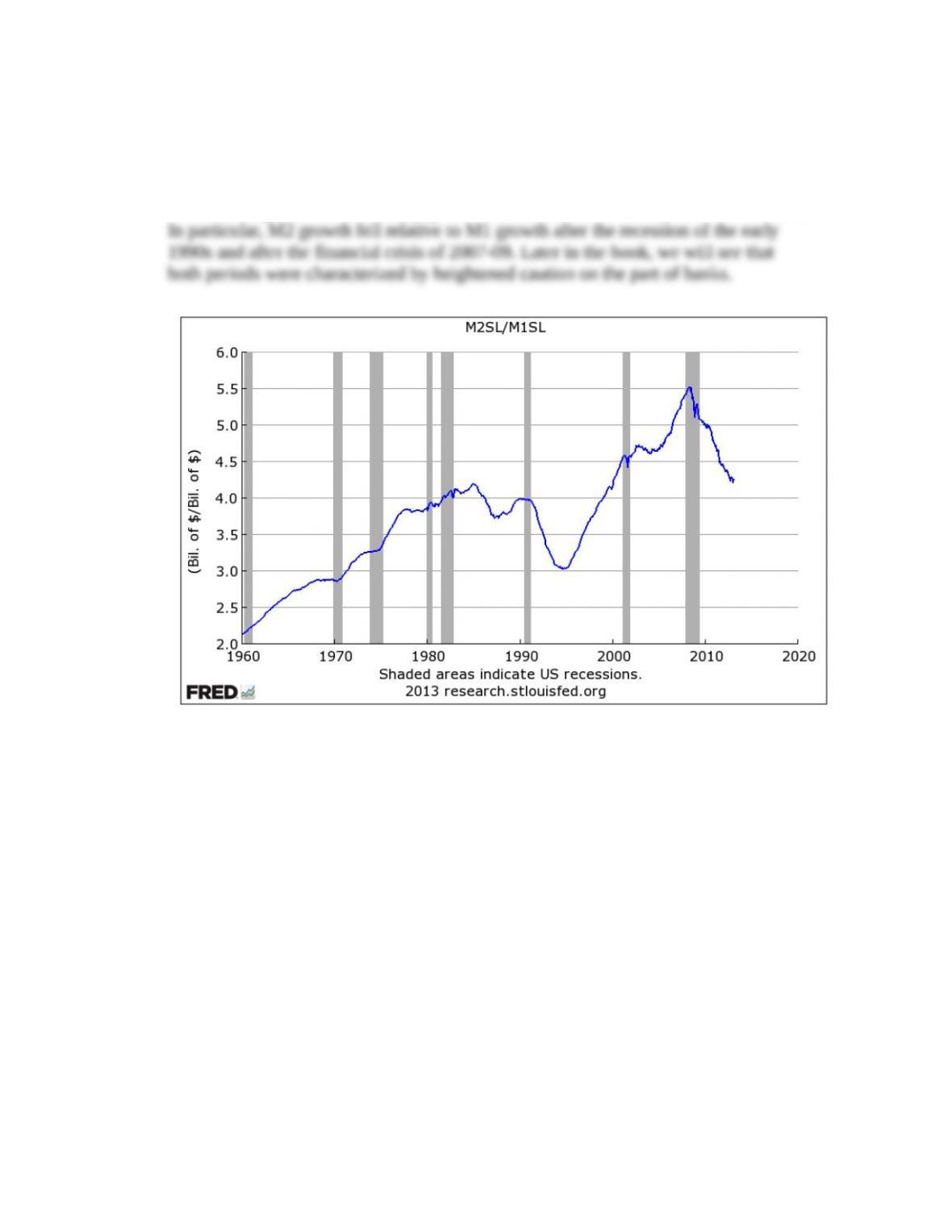
3. Which usually grows faster: M1 or M2? Produce a graph showing M2 divided by M1.
When this ratio rises, M2 outpaces M1, and vice versa. What is the long-run pattern?
Is the pattern stable? (LO3) (Hints: Follow the initial procedure in Data Exploration
question 2, selecting “Data Tools,” then “Create Your Own Graphs,” and then “Add
Data Series.” First graph M2 by typing in “M2SL” in the search box. To add M1 and
calculate the ratio, select “Add Data Series,” click on the “Line 1” button – so that
2-7
Copyright © 2015 McGraw-Hill Education. All rights reserved. No reproduction or distribution without the prior written consent of
McGraw-Hill Education.
Chapter 02 – Money and the Payments System
only one line will be graphed – and type “M1SL” in the search box. Scroll down to
the Formula box and type in “a/b” and select “Redraw Graph.”)
Answer: Following the directions given, the plot of the ratio M2/M1 appears below.
Over the long run, M2 has usually grown faster than M1, but this pattern is not stable.
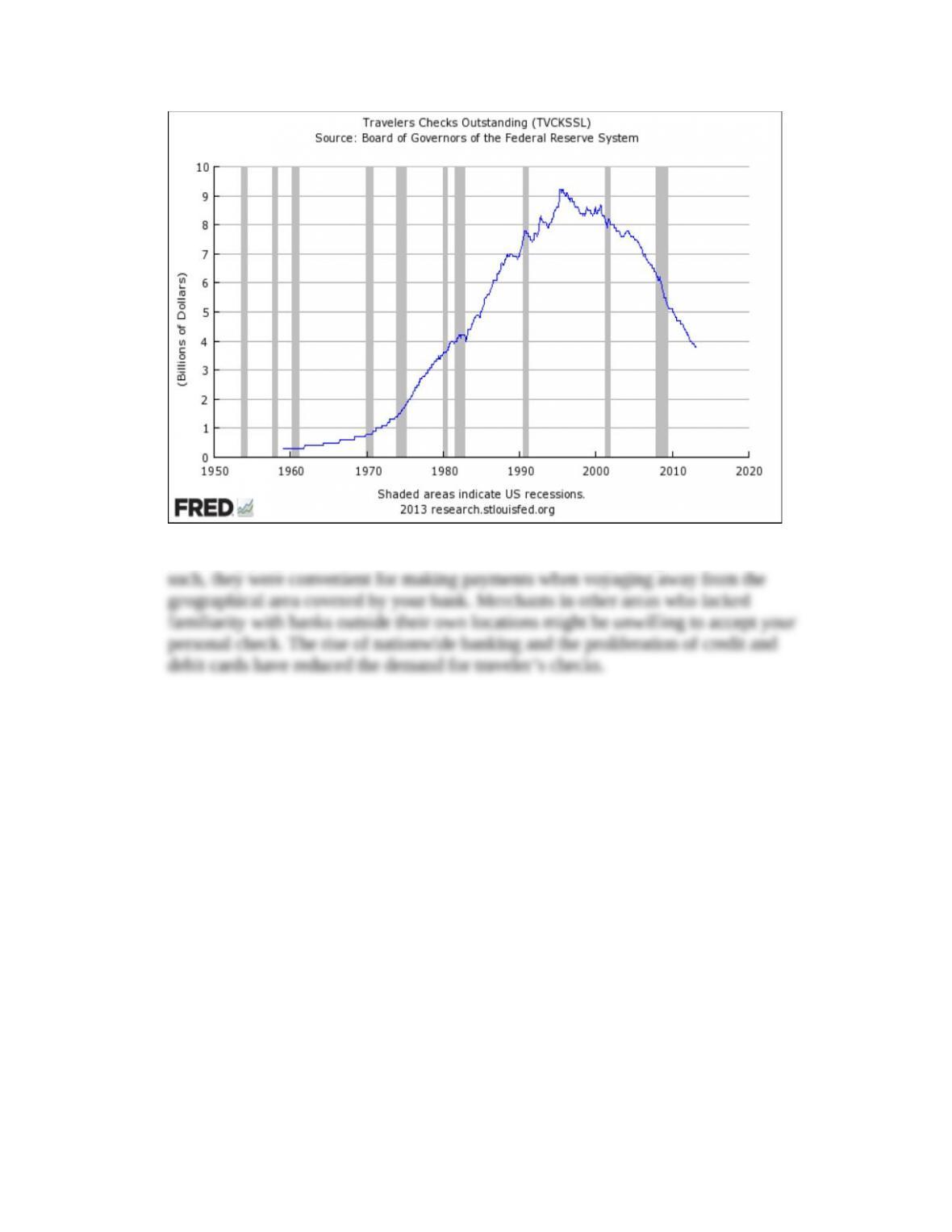
4. Traveler’s checks are a component of M1 and M2. Using FRED, produce a graph of
this component of the monetary aggregates (FRED code: TVCKSSL). Explain the
pattern you see. (LO1) (Hints: Follow the procedure in Data Exploration question 2
for graphing M1.)
Answer: The indicated data plot is:
2-8
Copyright © 2015 McGraw-Hill Education. All rights reserved. No reproduction or distribution without the prior written consent of
McGraw-Hill Education.
Chapter 02 – Money and the Payments System
The use of traveler’s checks has declined since the mid-1990s. Traveler’s checks were
essentially prepaid checks drawn on the account of a widely-recognized issuer. As
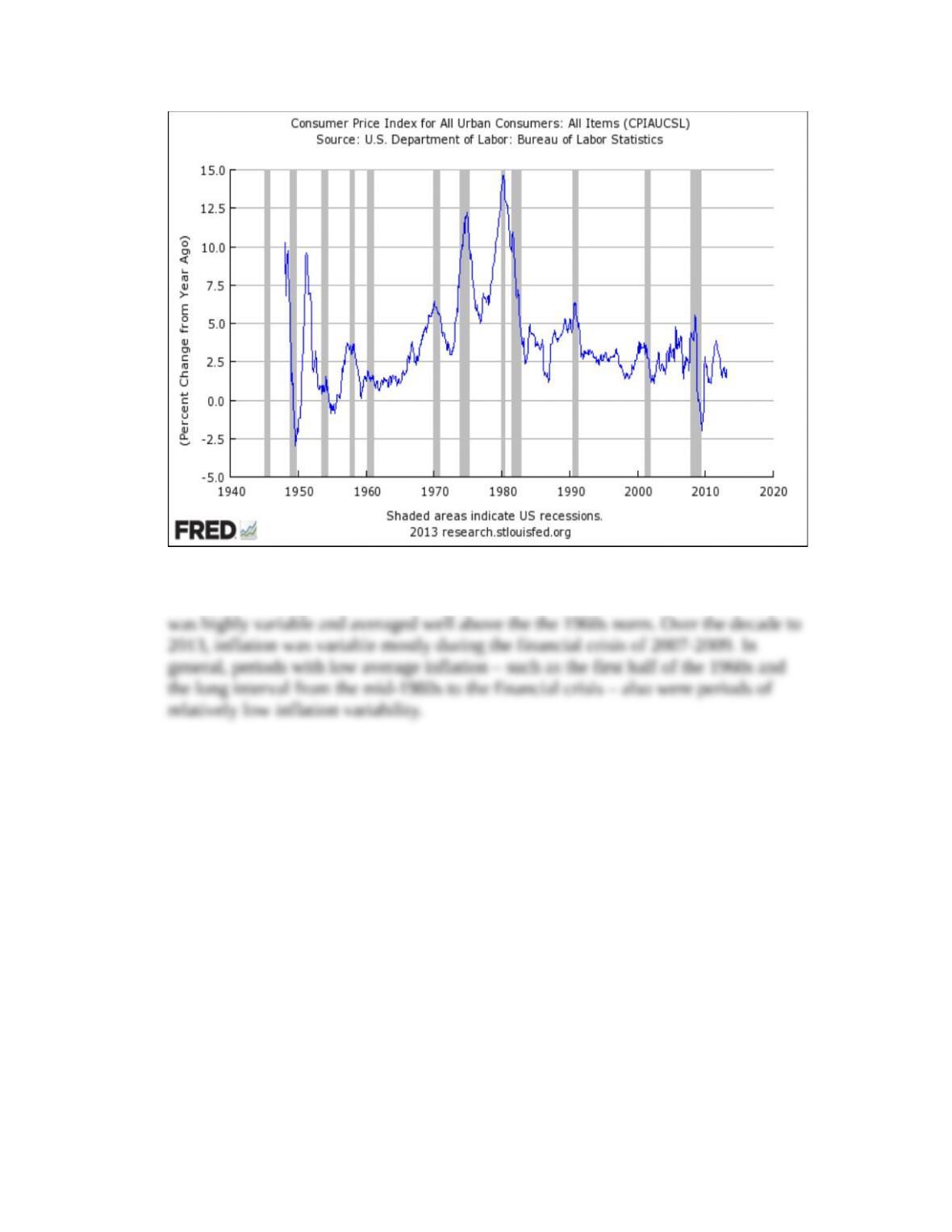
5. Plot the annual inflation rate based on the percent change from a year ago of the
consumer price index (FRED code: CPIAUCSL). Comment on the average and
variability of inflation in the 1960s, the 1970s, and the most recent decade. (LO3)
(Hints: Follow the procedure in Data Exploration question 2 for graphing M1 by
typing “CPIAUCSL” in the search box beneath “Add Data Series.” Next, at the
“Units” dropdown box select “Percentage Change from Year Ago” and then
“Redraw Graph.” Save this graph and name it “CPI Inflation” so that you can
update it easily in the future.)
Answer: The indicated data plot is:
2-9
Copyright © 2015 McGraw-Hill Education. All rights reserved. No reproduction or distribution without the prior written consent of
McGraw-Hill Education.
Chapter 02 – Money and the Payments System
The variability of inflation in the 1960s was reasonably low in the first part of the
decade, then rising with the trend of inflation toward the end. In the 1970s, inflation
* indicates more difficult problems
2-10
Copyright © 2015 McGraw-Hill Education. All rights reserved. No reproduction or distribution without the prior written consent of
McGraw-Hill Education.