Chapter 05 – Understanding Risk
Chapter 5
Understanding Risk
Conceptual and Analytical Problems
1. Consider a game in which a coin will be flipped three times. For each heads you will
be paid $100. Assume that the coin comes up heads with probability . (LO1)⅔
a. Construct a table of the possibilities and probabilities in this game.
b. Compute the expected value of the game.
c. How much would you be willing to pay to play this game?
d. Consider the effect of a change in the game so that if tails comes up two
times in a row, you get nothing. How would your answers to parts a-c
change?
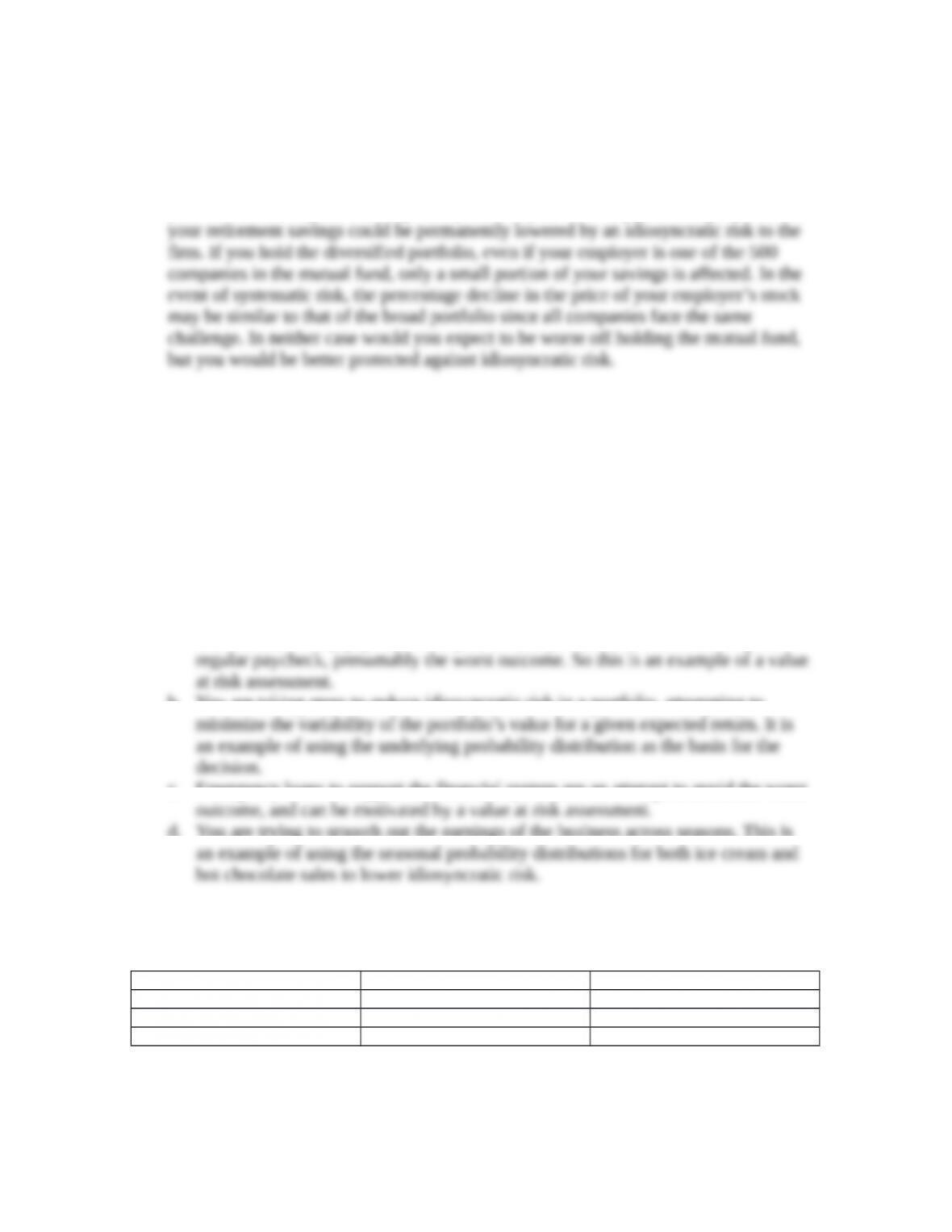
Answer:
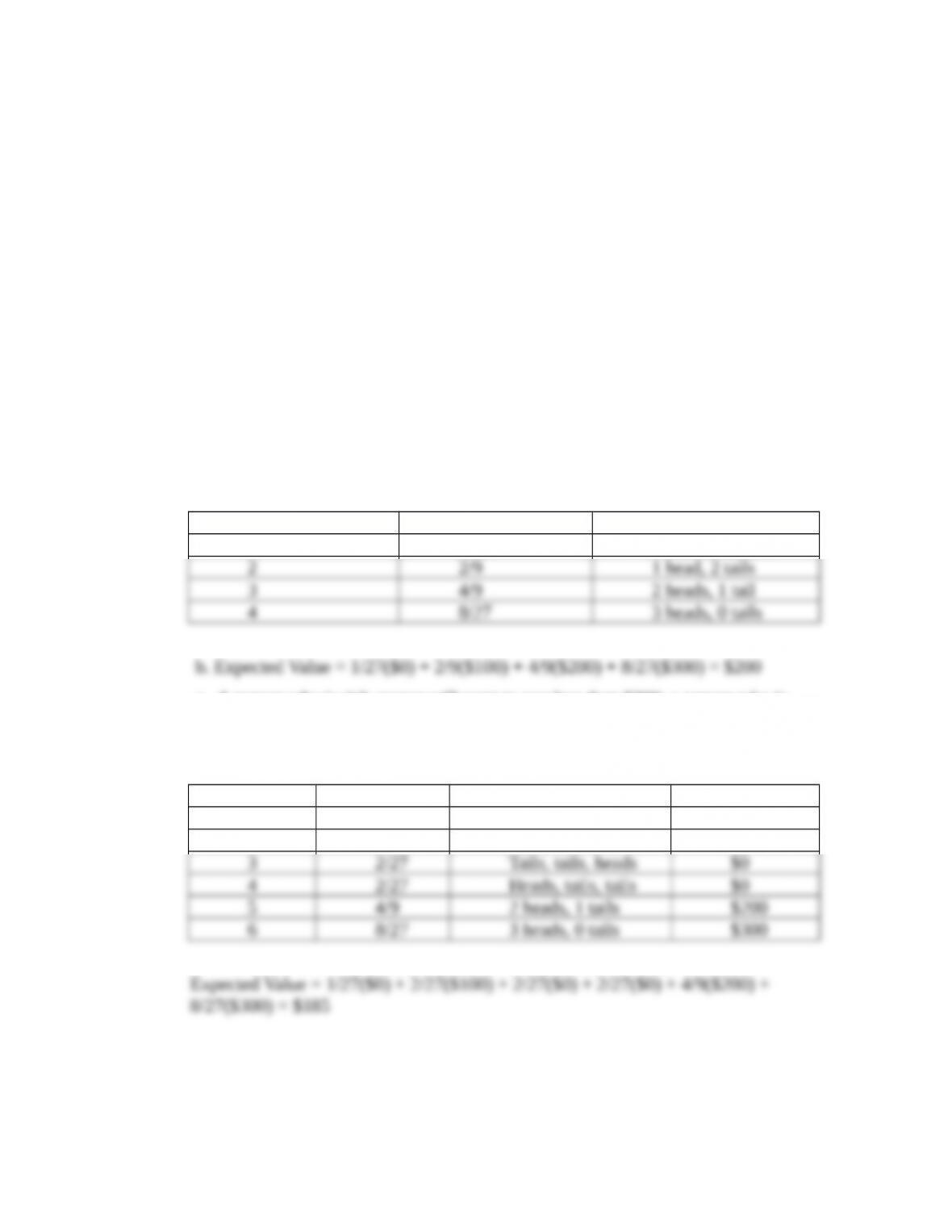
a.
Possibilities Probability Outcome
1 1/27 0 heads, 3 tails
c. A person who is risk-averse will want to pay less than $200; a person who is
risk-neutral will be willing to pay $200.
d.
Possibilities Probability Outcome Payoff
1 1/27 3 tails $0
2 2/27 Tails, heads, tails $100
A person who is risk-averse will want to pay less than $185; a person who is risk-
neutral will be willing to pay $185.
5-1
© 2015 by McGraw-Hill Education. This is proprietary material solely for authorized instructor use. Not authorized for sale or distribution in
any manner. This document may not be copied, scanned, duplicated, forwarded, distributed, or posted on a website, in whole or part.
Chapter 05 – Understanding Risk
2. *Why is it important to be able to quantify risk? (LO2)
Answer: Core Principle 2 tells us that risk requires compensation. In order to
3. You are the founder of IGRO, an Internet firm that delivers groceries. (LO3, LO4)
a. Give an example of an idiosyncratic risk and a systematic risk your company
faces.
b. As founder of the company, you own a significant portion of the firm, and
your personal wealth is highly concentrated in IGRO shares. What are the
risks that you face, and how should you try to reduce them?
Answer:
a. An idiosyncratic risk is that someone could create another Internet firm to deliver
groceries, which would reduce IGRO’s share of the market. A systematic risk could
b. You could suffer large losses if IGRO does poorly; your stock holdings could
4. Assume that the economy can experience high growth, normal growth, or recession.
Under these conditions, you expect the following stock market returns for the coming
year: (LO1, LO2)
State of the Economy Probability Return
High Growth 0.2 +30%
Normal Growth 0.7 +12%
Recession 0.1 -15%
a. Compute the expected value of a $1,000 investment over the coming year. If
you invest $1,000 today, how much money do you expect to have next year?
What is the percentage expected rate of return?
b. Compute the standard deviation of the percentage return over the coming
year.
c. If the risk-free return is 7 percent, what is the risk premium for a stock
market investment?
Answer:
5-2
© 2015 by McGraw-Hill Education. This is proprietary material solely for authorized instructor use. Not authorized for sale or distribution in
any manner. This document may not be copied, scanned, duplicated, forwarded, distributed, or posted on a website, in whole or part.
Chapter 05 – Understanding Risk
Chapter 05 – Understanding Risk
Answer: The first concern of a bank’s management is to stay open. This means
9. Explain how liquidity problems can be an important source of systemic risk in the
financial system. (LO3)
Answer: Lack of liquidity can make it difficult or impossible for certain firms to
meet their obligations to other firms in the system. For example, if one firm cannot
10. *Give an example of systematic risk for the U.S. economy and how you might reduce
your exposure to such a risk. (LO3)
Answer: A recession is one kind of systematic risk facing the U.S. economy. You
could diversify your investments internationally. You could hedge against a
11. For each of the following events, explain whether it represents systematic risk or
idiosyncratic risk and explain why. (LO3)
a. Your favorite restaurant is closed by the county health department.
b. The government of Spain defaults on its bonds, causing the breakup of the euro
area.
c. Freezing weather in Florida destroys the orange crop.
d. Solar flares destroy earth-orbiting communications satellites, knocking out
cellphone service worldwide.
Answer:
a. This is idiosyncratic risk since it is unique to this particular establishment.
c. This is idiosyncratic risk as only one of several orange-growing areas in the
d. This is systematic risk as communications around the globe are disrupted, perhaps
12. You are planning for retirement and must decide whether to purchase only your
employer’s stock for your 401(k) or, instead, to buy a mutual fund that holds shares in
5-4
© 2015 by McGraw-Hill Education. This is proprietary material solely for authorized instructor use. Not authorized for sale or distribution in
any manner. This document may not be copied, scanned, duplicated, forwarded, distributed, or posted on a website, in whole or part.
Chapter 05 – Understanding Risk
the 500 largest companies in the world. From the perspective of both idiosyncratic
and systematic risk, explain how you would make your decision. (LO3)
Answer: From both perspectives, you should purchase the more highly diversified
portfolio containing the 500 large companies. If you own only your company’s stock,
13. For each of the following actions, identify whether the method of risk assessment
motivating your action is due to the value at risk or the standard deviation of an
underlying probability distribution. (LO2)
a. You buy life insurance.
b. You hire an investment advisor who specializes in international diversification in
stock portfolios.
c. In your role as a central banker you provide emergency loans to illiquid
intermediaries.
d. You open a kiosk at the mall selling ice cream and hot chocolate.
Answer:
a. Life insurance only pays off when you die and your heirs are left without your
b. You are taking steps to reduce idiosyncratic risk in a portfolio, attempting to
c. Emergency loans to support the financial system are an attempt to avoid the worst
d. You are trying to smooth out the earnings of the business across seasons. This is
14. Which of the following investments in the following table would be most attractive to
a risk-averse investor? How would your answer differ if the investor were described as
risk-neutral? (LO1)
Investment Expected Value Standard Deviation
A 75 10
B 100 10
C 100 20
5-5
© 2015 by McGraw-Hill Education. This is proprietary material solely for authorized instructor use. Not authorized for sale or distribution in
any manner. This document may not be copied, scanned, duplicated, forwarded, distributed, or posted on a website, in whole or part.
Chapter 05 – Understanding Risk
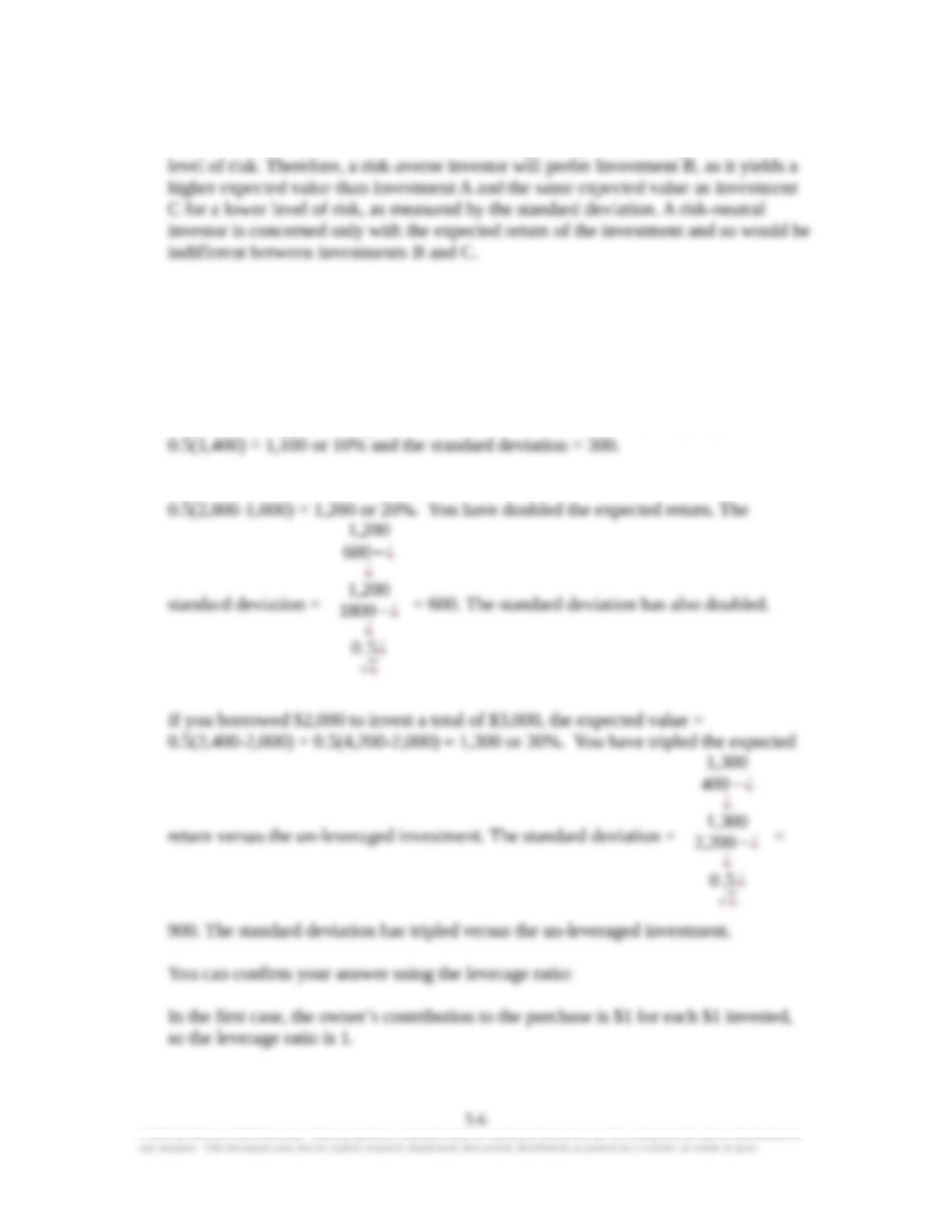
Answer: A risk-averse investor requires a higher return for taking on more risk. This
investor will also prefer an investment with a higher expected value given a certain
15. Consider an investment that pays off $800 or $1,400 per $1,000 invested with equal
probability. Suppose you have $1,000 but are willing to borrow to increase your
expected return. What would happen to the expected value and standard deviation of
the investment if you borrowed an additional $1,000 and invested a total of $2,000?
What if you borrowed $2,000 to invest a total of $3,000? (LO1, LO2)
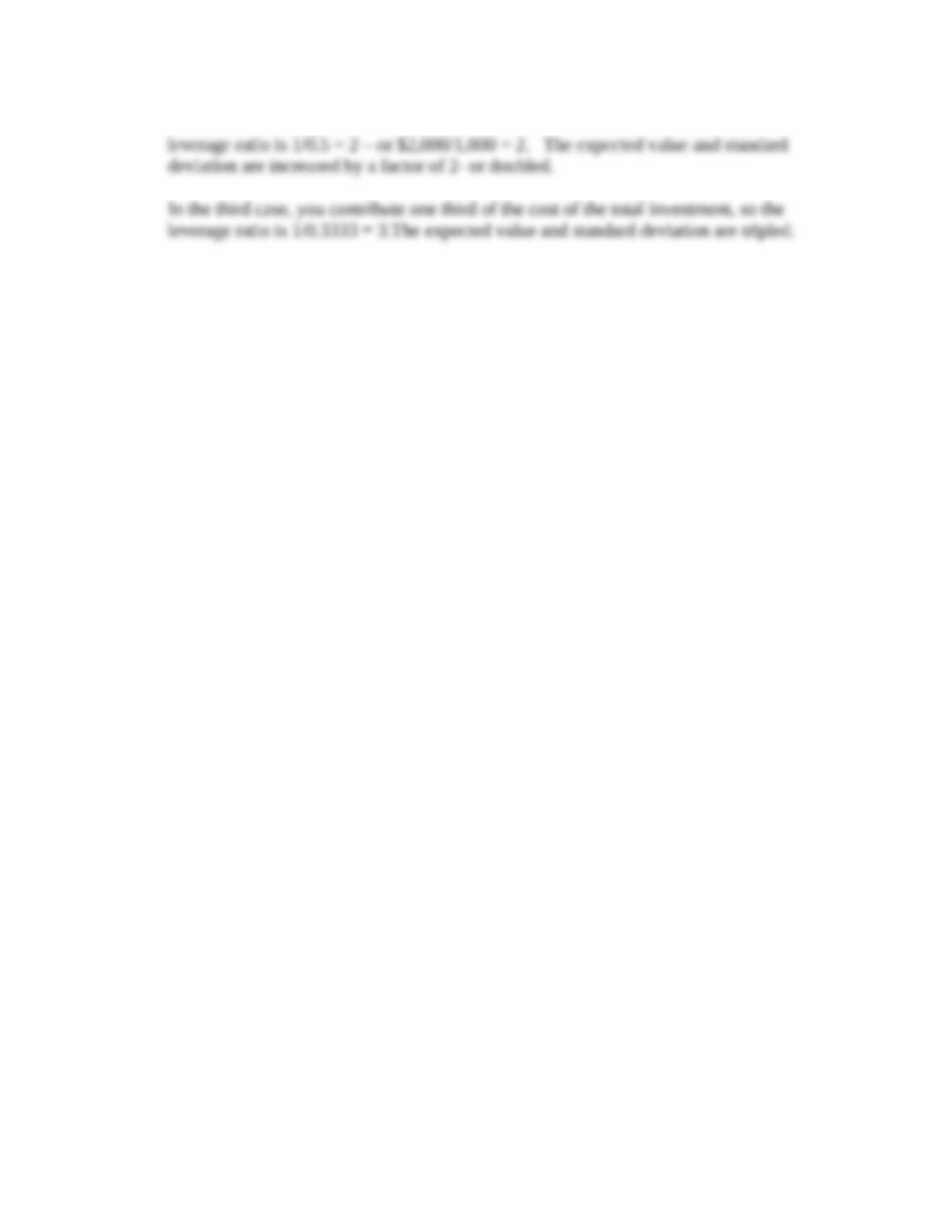
Answer: If you just invest your own $1,000, the expected value = 0.5(800) +
If you borrow an additional $1,000, the expected value = 0.5(1,600-1,000) +
5-6
© 2015 by McGraw-Hill Education. This is proprietary material solely for authorized instructor use. Not authorized for sale or distribution in
Chapter 05 – Understanding Risk
In the second case, you contribute half of the cost of the total investment, so the
5-7
© 2015 by McGraw-Hill Education. This is proprietary material solely for authorized instructor use. Not authorized for sale or distribution in
any manner. This document may not be copied, scanned, duplicated, forwarded, distributed, or posted on a website, in whole or part.